
Our readers keep the lights on and my garage snacks stocked. As an Amazon Associate, I earn from qualifying purchases.
Specs are compiled from manufacturer listings and verified buyer reviews and can change over time — please confirm the key details on the product page before buying.
Camping in a frozen landscape is a different kind of adventure. You want the warmth of a campfire without the smoke, the smell, or the need to chop wood. A diesel heater lets you sleep in a t-shirt while snow piles up outside your rig. It pulls fuel from your tank, burns it in a sealed chamber, and blows dry, clean heat into your space — no propane bottles, no carbon monoxide from an open flame inside, and no soggy air from a gas heater.
I’m Min Islam — the founder and writer behind Trending Car. This guide is built by comparing the manufacturers’ published specifications and the patterns across verified customer reviews, so you get each pick’s real strengths and trade-offs instead of marketing spin.
Whether you live out of a van for weeks at a time or just want one reliable cold-escape for weekend trips, this look at the best diesel heater for overlanding cuts through the noise to give you the real story on nine models built to handle the backcountry.
Our Picks at a Glance

How To Choose The Best Diesel Heater for Overlanding
Most overlanders heat a space that is roughly 20 to 25 square meters — a medium roof-top tent, a van cabin, or a small truck camper. A comfortable night hinges on fuel burn per hour, altitude compensation, and pump noise.
Heat Output: 2kW vs 5kW vs 8kW
An 8kW diesel heater sounds like overkill for a van, and it can be. The real job of the higher wattage is to recover warmth quickly after you open a door. A 2kW unit like the premium German model is efficient and sips fuel — roughly a quart every 6 hours — but it will struggle to keep a drafty uninsulated rig warm in single-digit weather. An 8kW model can overshoot and cause the heater to cycle on and off, which wastes fuel. the balance for most vans and small campers is 5kW. For a larger space, a truck or a workshop, 8kW is the right call.
Fuel Consumption: The Real Cost Per Hour
Fuel consumption is measured in liters per hour (L/h). A heater that burns 0.16 L/h on low will let a 5-liter tank run for over 30 hours. One that burns 0.62 L/h on high empties that same tank in 8 hours. For overlanding, where you might be away from a diesel station for days, a heater with a wide adjustment range — 0.18 to 0.53 L/h — gives you the choice to stretch fuel on low or blast heat on high when you need it. The most efficient models can run an entire night on less than a gallon of diesel.
Altitude Compensation
At 10,000 feet, the air is thin. A standard diesel heater without altitude compensation will run rich — too much fuel, not enough oxygen — and produce soot that clogs the glow plug and exhaust. Look for a heater that automatically adjusts the fuel-air mixture up to 5,500 meters (about 18,000 feet). Altitude compensation is the difference between reliable heat in the Rockies and a soot-filled rig.
Noise Level and Pump Design
The loudest part of a diesel heater is the fuel pump — a small solenoid that clicks with every pulse. The cheapest heaters sound like a loud mechanical watch under your bed. Premium units use a silent pump or a muffled pump that reduces that tick to near-zero. For undisturbed sleep, choose a heater with a silent or mute fuel pump. The noise of the fan itself (measured in dB) is usually less bothersome, but anything above 35 decibels in a small space can disturb light sleepers.
Quick Comparison
| Model | Best For | Heat Output | Fuel Consumption | Item Weight | Amazon |
|---|---|---|---|---|---|
| BougeRV 5KW★ Best Overall | Tech-savvy vanlifers | 5 KW | 0.18-0.53 L/h | 21.4 lb | Amazon |
| VEVOR 8KW (App, Orange)Budget Champion | Budget-conscious overlanders | 8 KW | 0.16-0.62 L/h | 22.4 lb | Amazon |
| Sunster 8KW (Pink)Silent Operator | Ultra-quiet sleepers | 8 KW | 0.16-0.45 L/h | 21.7 lb | Amazon |
| VOYOCHT 8KW | Aluminum durability seekers | 8 KW | 0.18-0.53 L/h | 18 lb | Amazon |
| VEVOR 8KW (CO Alarm) | Safety-focused builders | 8 KW | 0.18-0.35 L/h | 21.6 lb | Amazon |
| Sunster TB10PRO | Wi-Fi remote preheating | 8 KW | — | 22 lb | Amazon |
| HCALORY 8KW | Dual-power (AC/DC) users | 8 KW | 0.02-0.12 gal/h | 20 lb | Amazon |
| LSZQJ 7kW Air + Water | RV hot water & engine preheat | 7 KW | — | 22.8 lb | Amazon |
| Eberspacher Airtronic S2 D2 L | Premium long-term reliability | 2.2 KW | ~1 qt/6 hr | 17.16 lb | Amazon |
In‑Depth Reviews
1. BougeRV 5KW Diesel Heater
Our pick — over 4★ from 100+ verified ratings; the strongest balance of quality and price.
A smart, quiet overnighter that sips fuel and lets an app handle the controls.
This BougeRV runs on 12V DC or 110V AC, so you can plug it into a campsite outlet or your vehicle’s cigarette lighter without extra adapters. The 5-kilowatt burner warms a 307 cubic-foot tent in about 8 minutes, according to the maker — fast enough that you stop shivering before you finish setting up your cot. And the real-world fuel consumption is impressive: buyers report using about 0.5 gallons every 8 hours, which works out to roughly 11 to 27 hours of runtime from the built-in 5-liter tank depending on your setting.
The smart control is the standout here. An app works via Bluetooth, so you can preheat the rig from inside a warm gas station or set a timer for a specific wake-up temperature. The noise reduction is genuine — the fuel pump is muffled, and owners describe the operation as quiet enough to sleep through. It weighs 21.4 pounds, making it mid-pack for portability, and the all-in-one form factor means you don’t need to install a separate tank or fuel line under the vehicle.
BougeRV 5KW Reliable
- APP-based control with timer and temperature presets
- Low fuel consumption — 0.5 gal per 8 hours in real use
- Dual voltage support (12V DC and 110V AC)
- Quiet enough for sleeping with muffled pump operation
Noisy Operation
- Exhaust pipe is small and can clog with soot if not maintained
- One owner reported fumes leaking back into the camper after heavy use
- Not designed for continuous unattended overnight operation
Budget Pick: you want a feature-rich, app-controlled heater with low fuel burn and a proven track record from a brand with good tech support.
Loud Unit: you plan to sleep with the heater running without a CO monitor — this unit demands vigilance on exhaust maintenance.
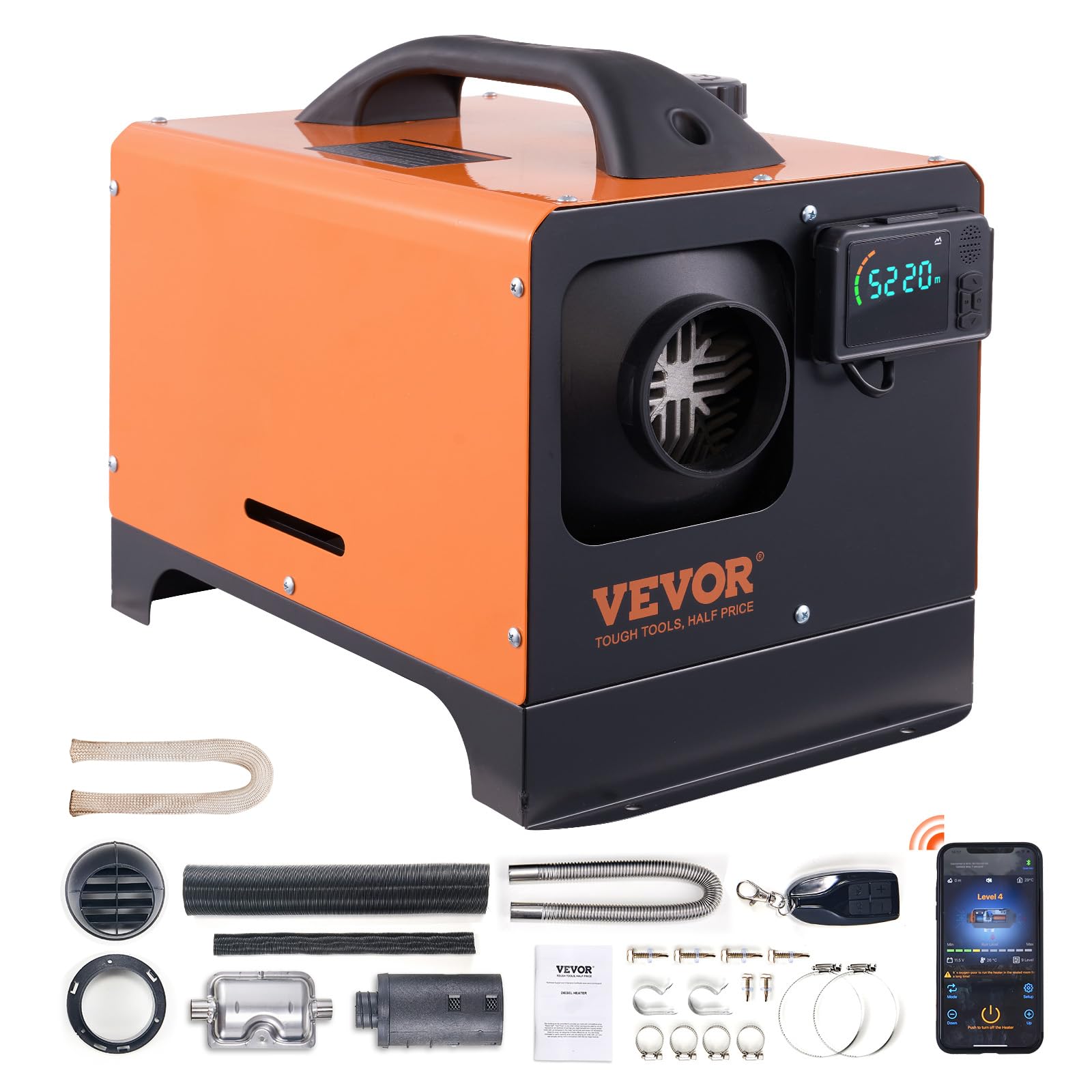
2. VEVOR 8KW Diesel Heater (App, Orange)
An inexpensive 8KW workhorse that keeps a fifth wheel warm in subzero Maine nights.
VEVOR’s 8-kilowatt all-in-one heater claims to heat a space of 215 to 269 square feet — roughly a small camper or a well-insulated garage. The heater comes with automatic altitude compensation that works up to 18,045 feet, so high passes in Colorado or the Sierras are no issue.
The big draw here is price-to-performance. The heater costs roughly half what the mid-range models do, yet delivers genuine 8-kilowatt output with a 5-liter tank that provides up to 8 hours of heat. Fuel consumption runs from 0.16 L/h on low to 0.62 L/h on high — a 12% wider range than the BougeRV, meaning you have more fine control at the low end if you want to stretch diesel. The trade-off is weight: at 22.4 pounds, this is the heaviest unit on the list, and the all-in-one box is 15.7 x 9.8 x 12.2 inches, so it takes up some storage space when not installed.
VEVOR App Control: the wiring is bare — you have to connect the positive and negative wires yourself. Owners note it won’t run while your battery is being charged at 13.5-14.5V, so you may need to disconnect the charger to use the heater.
Smart Choice: you need raw heat power on a tight budget and are comfortable with basic wiring tasks.
App Issues: you want a plug-and-play unit with a cigarette lighter adapter or a warranty-backed support team.
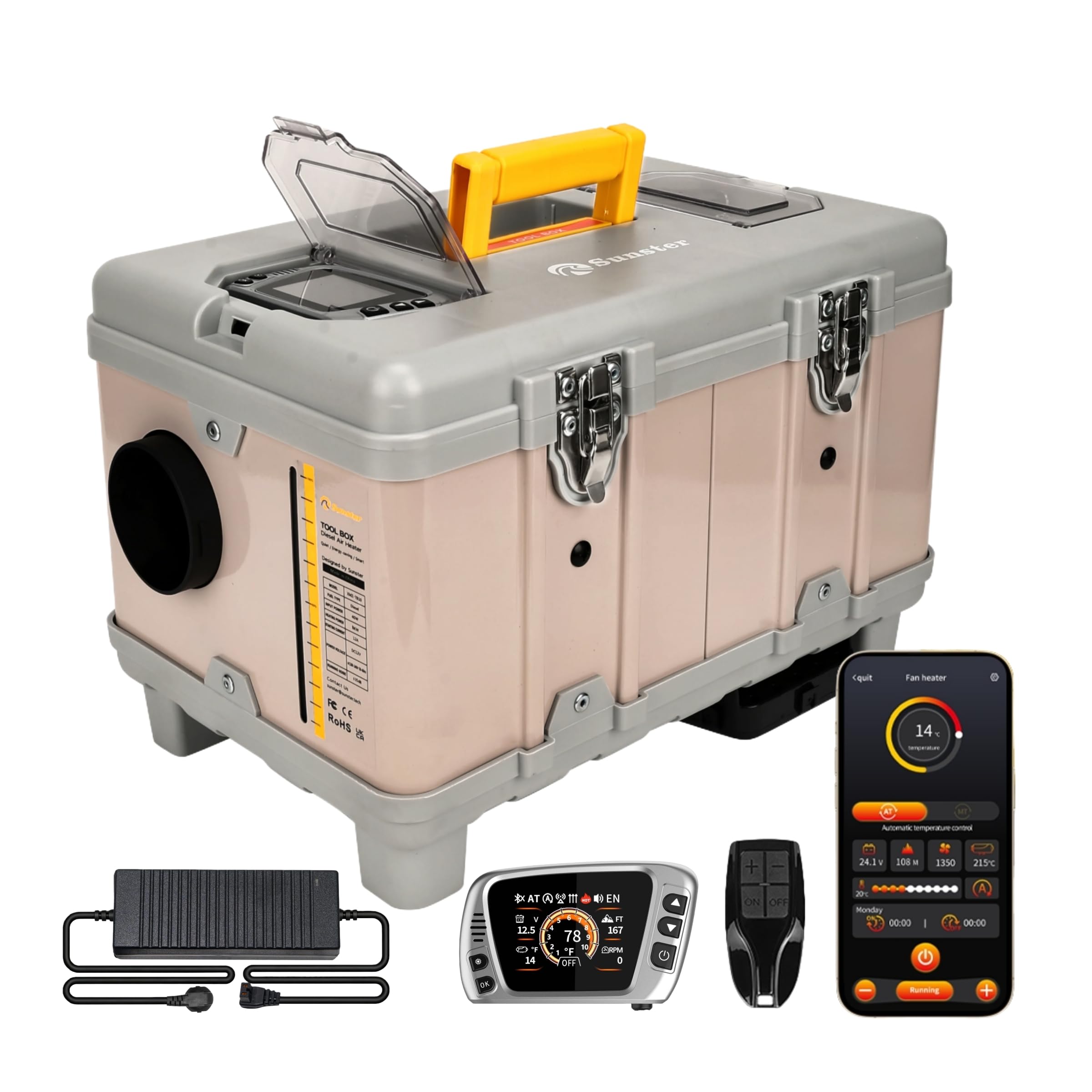
3. Sunster 8KW Compact Diesel Heater
A pink toolbox that delivers 8kW of heat with a genuinely silent fuel pump.
The Sunster TB10 is built around a reinforced aluminum heat exchanger that the maker says boosts combustion efficiency by 38% compared to standard steel exchangers. The result is lower fuel consumption — just 0.16 to 0.45 liters per hour — and a 6-liter tank that can run for up to 20 hours on a low setting. That is a massive runtime advantage over the VEVOR’s 8-hour ceiling and leaves the BougeRV’s 11-27 hour claim in the same ballpark.
What owners rave about most is the noise level — or the lack of it. The pump is a silent design with no ticking sound, and the fan operates at about 35 decibels, which is quieter than normal conversation. For anyone who has spent a night next to a chattering Chinese fuel pump, this is a genuine upgrade. The unit also handles altitude automatically up to 5,500 meters. The “Pink” color is a bit of a head-turner, but the anti-theft angle is real: one owner said they bought it specifically to make it less likely to be stolen from a campsite.
Sunster Compact Design: a small number of owners reported the unit failing after just three uses. The failure rate appears low, but you are buying a budget-friendly heater, not a German-engineered one. Factor that into your risk tolerance for remote trips.
Space Saver: silence is your top priority — this is the quietest heater in the under- range.
Mount Weakness: you are building a permanent install and need a proven, long-term reliable unit with 500+ reviews.
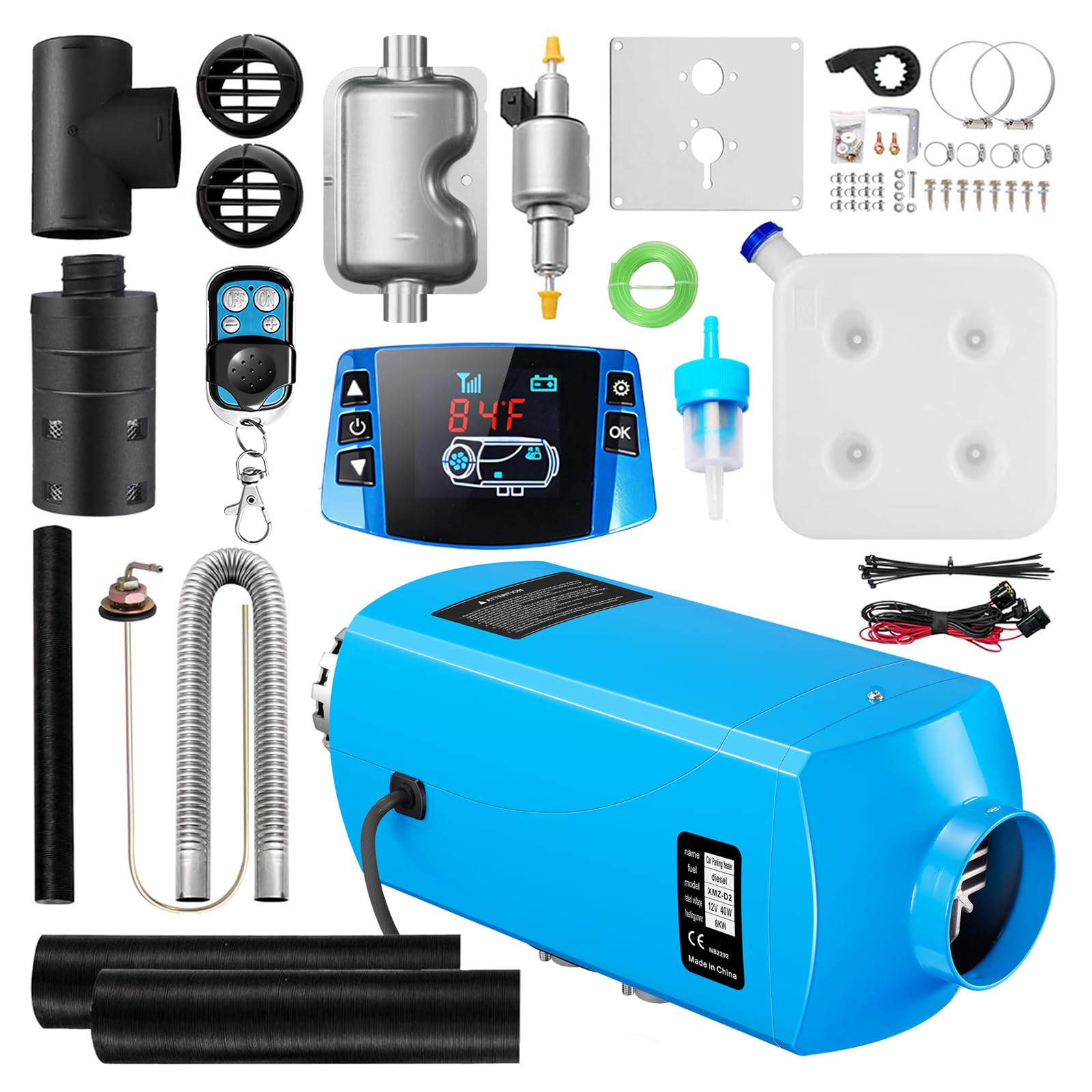
4. VOYOCHT 8KW Diesel Heater (Aluminum Housing)
The aluminum-bodied heater that ditches the burning plastic smell for good.
Most diesel heaters under use a plastic housing. The VOYOCHT is one of the few that wraps its 8-kilowatt burner in a full aluminum casing. That is not just about aesthetics — owners who switched from plastic-housed heaters report a total elimination of that burnt plastic odor that can develop when the unit runs for hours. The metal shell also dissipates heat better and feels more durable in a truck bed or trailer corner.
The heater delivers 4,700 to 17,000 BTU and consumes 0.18 to 0.53 L/h. what separates it is the massive 15-liter fuel tank — three times the capacity of the 5-liter tanks on most competitors. With a claimed 30 hours of continuous operation, you can run this heater for multiple nights without refueling. It weighs only 18 pounds despite the larger tank, making it one of the lighter 8kW units. That is 4.4 pounds lighter than the VEVOR and 3.4 pounds lighter than the BougeRV.
VOYOCHT Aluminum Durable
- Aluminum housing eliminates plastic-burning smell during extended use
- 15-liter tank offers ~30 hours of runtime
- Lightweight at 18 pounds — the lightest full-size 8kW here
- Works down to -40°C, so it handles arctic overlanding
Heavy Weight
- Some units failed after a few days; support sent replacement parts
- The housing material is nice, but reliability is hit-or-miss for a few
- Not recommended for non-mechanical users if something goes wrong
Rugged Build: you hate the smell of burning plastic and need a tank that lasts the whole weekend without a refill.
Heavier Unit: you want a “low-maintenance” heater with a strong warranty and a low defect rate.
5. VEVOR 8KW Diesel Heater (CO Alarm, White)

The model that adds a carbon monoxide alarm so you can sleep without worry.
This VEVOR variant is the same 8-kilowatt core as the orange model, but it adds a built-in CO alarm that monitors the air and shuts the heater off automatically if levels become unsafe. For anyone mounting a diesel heater inside a van or tent, that extra layer of safety is worth the small price jump. The heater also gets a leak-proof fuel tank cap and a fuel level indicator, making it easier to glance at before bed rather than guessing.
Fuel consumption is rated at 0.18 to 0.35 L/h — slightly more efficient at the top end than the orange version’s 0.62 L/h. That likely reflects a different controller calibration. The cast aluminum body and ceramic igniter contribute to the advertised 90%+ combustion efficiency. Owners mention that two of these units on the lowest setting can keep a 16×70-foot mobile home warm in cold weather. The dual-voltage compatibility (12V and 24V DC) also means it can run on a wider range of vehicle electrical systems.
VEVOR CO Alarm: the unit has no feet or base grips, so it slides on smooth surfaces. The fuel window gauge is nearly impossible to read. And the power cord is proprietary — no standard 12V cigarette plug, so expect to wire it directly.
Safety First: safety monitoring is non-negotiable for you, especially if you plan to sleep with the heater running.
False Alarms: you need a simple plug-and-play heater with a cigarette lighter adapter and a readable fuel gauge.
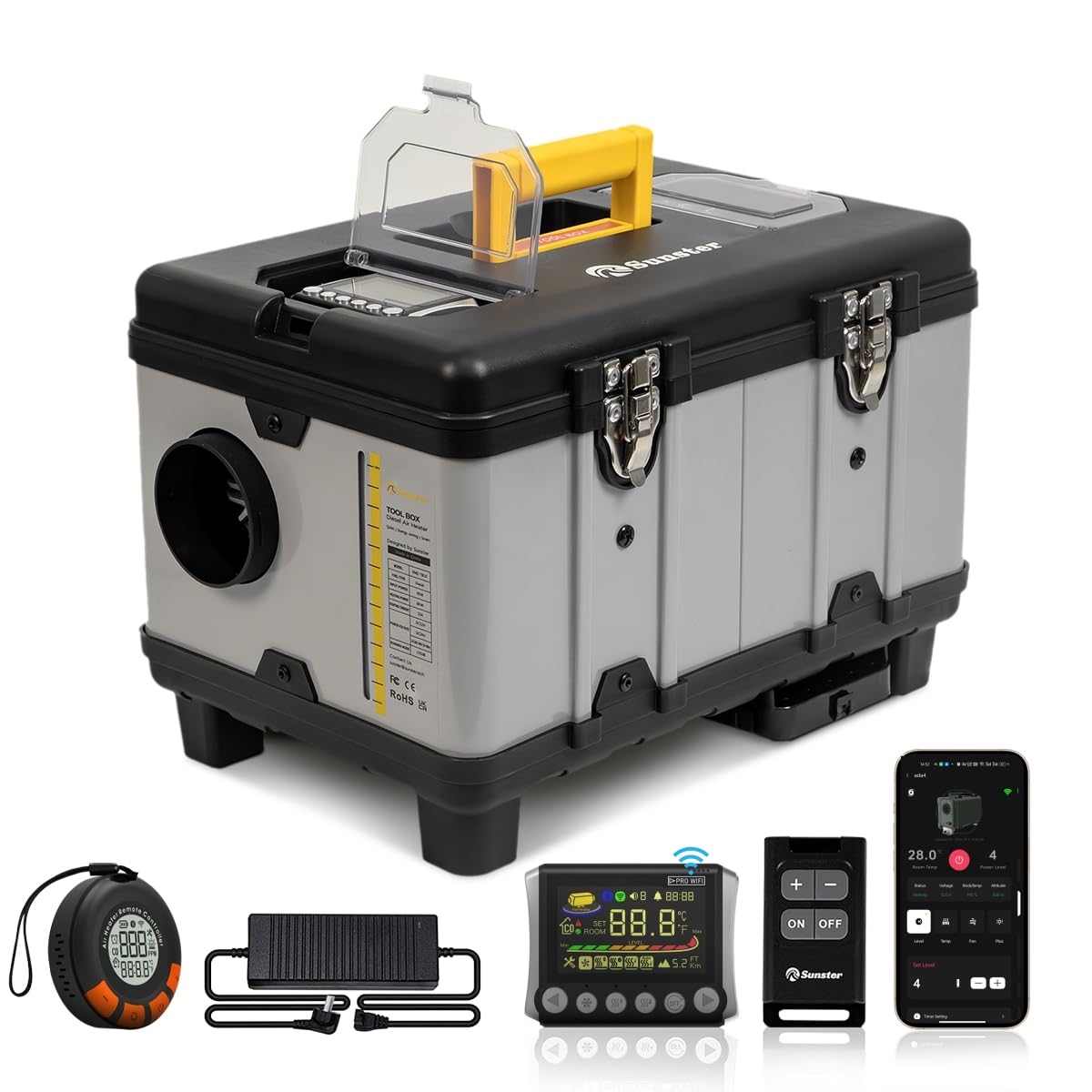
6. Sunster TB10PRO 8KW Diesel Heater
The toolbox heater you can turn on from a different state, thanks to Wi-Fi control.
The TB10PRO is the premium version of the Sunster line, replacing Bluetooth with Wi-Fi so you can control the heater from anywhere your phone has a signal. You can preheat your rig an hour before you arrive at camp, or check the temperature while you are out on a hike. The controller is a separate “A2422 Wireless Temperature Sensing Switch” that also includes a CO alarm with automatic shutdown — a safety feature that matches the VEVOR CO model.
The all-in-one toolbox design uses a metal buckle opening, a fully sealed upper cover to block rain and snow, and a 6-liter tank. The altitude compensation reaches 5,500 meters. Customers note the unit runs flawlessly for 8-hour stretches, and the Wi-Fi connectivity works on 5 of 6 common protocols — though some buyers found it only supported 2G, not 5G, which can be a problem if your campsite has only modern Wi-Fi.
Sunster TB10PRO Efficient: the Wi-Fi controller is an add-on that needs a specific 2409PRO WIFI controller to work — check that before purchasing if the remote feature is the main draw.
Efficient Heat: you want the convenience of remote preheating and central monitoring for a camper or animal shelter.
Hard Setup: your campsites never have reliable Wi-Fi or cellular signal — you are paying for a feature you cannot use.
7. HCALORY 8KW Diesel Heater

The rare heater that runs on household 110V AC as easily as it runs on 12V DC.
Most diesel heaters are pure 12V devices. The HCALORY is one of the few that includes a built-in AC power adapter, so you can plug it into a wall outlet at a cabin or a friend’s garage without wiring a separate DC supply. That dual-voltage support — 12V/24V DC and 110-240V AC — makes it uniquely flexible for people who bounce between driving and stationary life. The unit has a 5-liter tank and fuel consumption rates as low as 0.02 gallons per hour (about 0.07 L/h on the lowest setting).
The 8-kilowatt core heats a 14×22-foot garage with 12-foot ceilings, according to one long-term owner. In a real-world snow test, the heater kept a 16-foot enclosed trailer warm on the highest setting all night, using roughly half of a 6-liter tank. The Bluetooth app includes an altitude mode for up to 13,000 feet. The plastic housing and overall build quality feel solid, but the price sits in the mid-to-upper range.
HCALORY Affordable: the heater has a no-return policy, and a small number of units arrive with defects — error codes related to overheating and ignition failure. The support team does resolve issues, but you may need to wait for replacement parts.
Cheap Option: you need a single heater that works in both a vehicle and a house without an external power inverter.
Short Life: you want a strict 12V-only unit to keep weight down and don’t have access to shore power.
8. LSZQJ 7kW Diesel Air & Water Heater
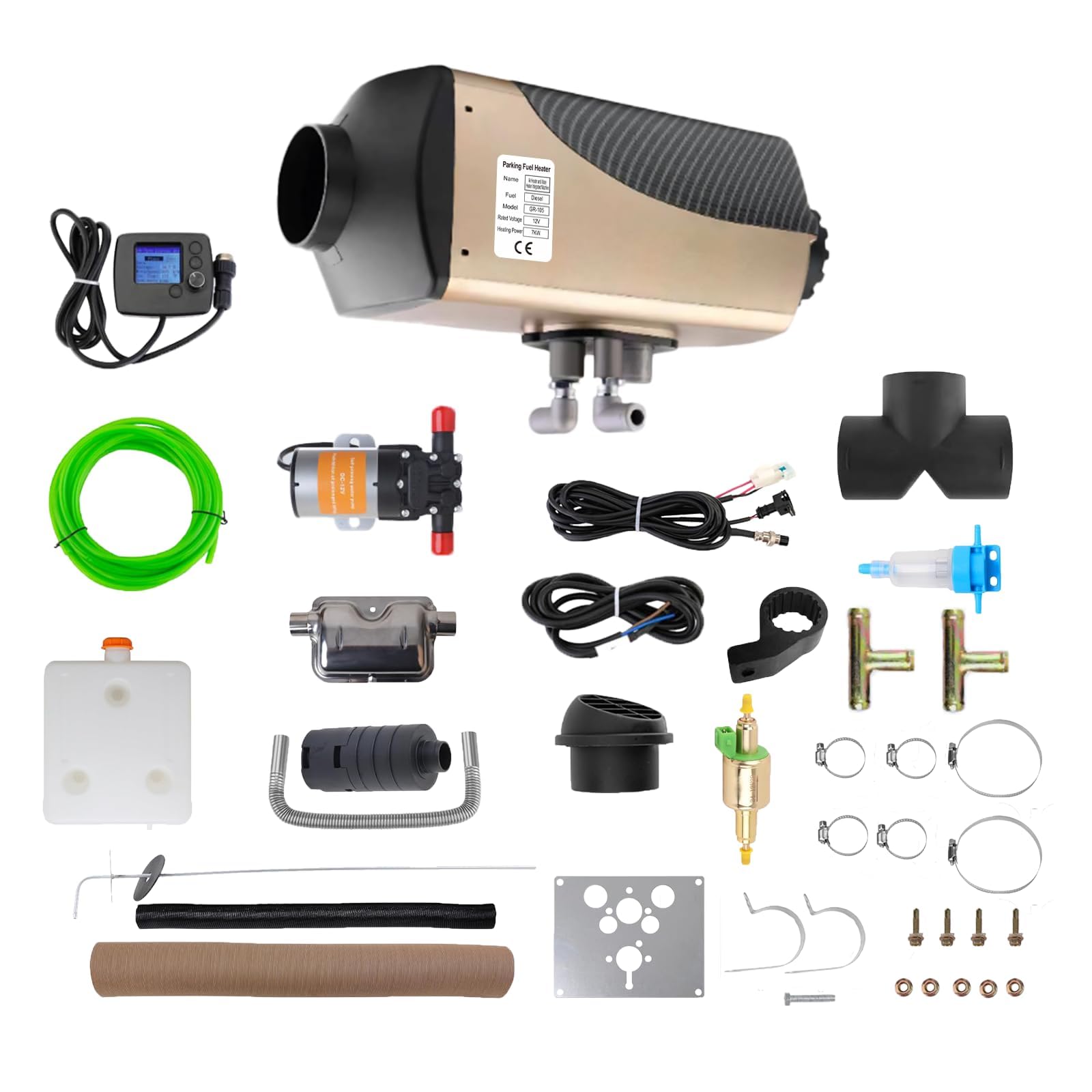
The dual-purpose unit that heats your cabin air and your hot water tank at the same time.
This LSZQJ is a different animal from the air-only heaters on this list. It pumps heat into both the cabin air and the engine coolant system, doubling as a diesel water heater and an engine preheater. That means you can warm your RV living space, have hot water for a morning shower, and preheat your truck’s engine block before starting it in subzero weather — all from one 7-kilowatt burner. The high-altitude mode saves 43% on fuel, according to the maker, and the auto-cleaning function deals with carbon buildup.
The 7-speed adjustment lets you dial in the heat level precisely, and the LCD screen shows real-time data and error codes. The kit includes an aviation plug for a secure electrical connection, a flame-retardant shell for safety in enclosed spaces, and all the ducting and exhaust components. Owners praise its stable temperature control and near-silent operation. It works at -40°C, so it is appropriate for arctic overlanding or extreme winter camping.
LSZQJ Dual Function: there is no thermostat — the unit is either off or on at a set speed. The instruction manual is unclear, and the smart modes require some learning. It also weighs 22.8 pounds, making it the heaviest unit here.
Dual Purpose: you live in an RV full-time and want one system for cabin heat, hot water, and a prewarmed engine in winter.
Hard Install: you only need cabin air heat and do not want the extra plumbing complexity of a water heating system.
9. Eberspacher Espar Airtronic S2 D2 L 12V

The German-built 2.2kW that sips a quart of diesel in 6 hours and runs at 10,000 feet without issue.
Eberspacher’s Airtronic S2 D2 L is the gold standard in diesel heaters for a reason: it uses a stepless motor and a silent fuel pump that produce almost no noise, and it comes with automatic altitude adjustment up to 3,000 meters (about 10,000 feet) without needing an additional kit. The EasyStart PRO timer lets you program 7 days of heating schedules and runs fault diagnostics that tell you exactly what is wrong if something breaks.
Real-world usage backs the specs. In a Metris van at 20°F ambient, the heater held a 55°F setpoint using roughly one quart of diesel in 6 hours. Another owner in an Astro van reports three years of trouble-free operation in -25°F weather at 10,000 feet with no altitude issues. The heater draws about 6 amp-hours over an 8-hour night, so it is friendly to a 100Ah battery. At 17.16 pounds, it is also the lightest unit here — light enough to mount in a small compartment with minimal structural support.
Eberspacher Premium
- German engineering with proven 3+ year reliability in extreme cold
- Ultra-low fuel consumption — ~1 quart per 6 hours at 20°F
- Silent operation and stepless motor modulation
- EasyStart PRO controller with 7-day timer and full diagnostics
High Cost
- Expensive — roughly 5x the cost of a comparable-output Chinese heater
- Requires wiring harness assembly; some buyers found installation too technical
- Not powerful enough for a large uninsulated space or a big truck camper
Top Brand: you plan to keep your van or rig for years and want a heater that starts every time without repair drama — think of it as an investment in confidence and resale value.
Expensive: you have a tight budget or your rig has drafty walls — you need the brute power of an 8kW budget unit to stay warm.
Understanding the Specs
Kilowatts (kW) and BTU
Kilowatts measure the heater’s raw heat output. 1 kW equals about 3,412 BTUs. A 2kW heater is good for a well-insulated van or small tent. A 5kW unit covers a medium RV or a large roof-top tent. An 8kW heater is for larger spaces like a truck camper, a garage, or a poorly insulated vehicle. More kilowatts mean faster warm-up but also higher fuel consumption and more cycling on and off in a small space.
Altitude Compensation
At high altitudes, the air is thinner and contains less oxygen for combustion. A heater without altitude compensation runs rich — too much fuel — and produces soot that clogs the glow plug and exhaust pipe. Models that automatically adjust the fuel-air mixture up to 5,500 meters (about 18,000 feet) avoid this problem and burn cleanly at altitude. If you camp above 8,000 feet, this is not optional; it is essential.
Fuel Consumption (L/h)
This is the amount of diesel the heater burns per hour at a given setting. A low-end figure like 0.16 L/h means the heater is very efficient on the lowest setting — you get 31+ hours from a 5-liter tank. A high-end figure like 0.62 L/h means full blast drains that same tank in about 8 hours. A wide fuel-consumption range lets you stretch diesel on mild nights and burn more when it’s truly cold.
Silent vs Standard Fuel Pump
The fuel pump is a solenoid that clicks each time it pushes a pulse of fuel into the combustion chamber. Standard pumps click audibly — loud enough to bother light sleepers in a small van. Silent or muffled pumps use a rubber dampener or a different internal mechanism to reduce that ticking to near-zero. If you are sensitive to noise, pay the small premium for a heater that specifically advertises a silent fuel pump or a mute pump.
FAQ
Can I run a diesel heater while sleeping inside the vehicle?
Will a diesel heater work at high altitude above 10,000 feet?
How much battery does a diesel heater drain overnight?
Can I use home heating oil (kerosene) instead of diesel?
How loud is a diesel heater compared to a propane heater?
How long does a 5-liter diesel tank last in real-world use?
Is a 2kW diesel heater enough for a van?
Can I install a diesel heater myself?
Final Thoughts: The Verdict
If you want one dependable pick, the diesel heater for overlanding winner is the BougeRV 5KW because it combines a powerful 5-kilowatt heat output with app-based smart control, low fuel consumption, and dual-voltage support — all in a quiet, well-built all-in-one package that owners consistently praise for heating performance and reliability. If you want raw 8-kilowatt heat on a tight budget, grab the VEVOR 8KW (Orange) — it has kept real owners warm in -1°F Maine weather and costs roughly half the price of the mid-range models. And for the overlander who wants a heater that will last a decade and sip fuel like a camp stove, the Eberspacher Airtronic S2 D2 L is the one to reach for — it is expensive up front, but time on the trail proves that reliability is the ultimate value when you are miles from the nearest repair shop.
How We Picked
We do not accept paid placement. Every pick is matched to a real buyer and a real use-case; we do not hands-on test units.
Sources & Methodology
Specifications: manufacturer listings and product documentation. Review insights: verified customer reviews, as of July 2026. Pricing: not shown on this page (it changes often); check the current price via the retailer link.
As an Amazon Associate, Trending Car earns from qualifying purchases. This does not affect which products we feature.