
Our readers keep the lights on and my garage snacks stocked. As an Amazon Associate, I earn from qualifying purchases.
Specs are compiled from manufacturer listings and verified buyer reviews and can change over time — please confirm the key details on the product page before buying.
Your engine block faces oil spills, temperature swings, and constant vibration — the right enamel keeps it from flaking, blistering, or fading. The difference between a paint job that lasts a season and one that still looks fresh years later depends on heat tolerance, chemistry, and the prep you put in. Here are the top options so you know exactly which can or brush-dip gives your block the finish it deserves.
I’m Min Islam — the founder and writer behind Trending Car. This guide is built by comparing the manufacturers’ published specifications and the patterns across verified customer reviews, so you get each pick’s real strengths and trade-offs instead of marketing spin.
Whether you are restoring a classic or just touching up your daily driver, choosing the right best engine enamel paint means matching the heat rating to your build and the finish to your eye.
Our Picks at a Glance

How To Choose The Best Engine Enamel Paint
Engine enamel is tougher than standard spray paint. It is built to bond with metal surfaces, resist petroleum fluids, and hold its color under high heat. Three things matter most: temperature ceiling, finish type, and application method. Get these right and your engine bay stays sharp for thousands of miles.
Temperature Resistance — the real number
Paint that cannot take the heat will bubble and peel after a short drive. Most standard engine enamels handle up to 500°F intermittently, which covers valve covers and intake manifolds. For headers and exhaust manifolds, you need a paint rated to 1200°F or higher. Check your engine’s hottest surface area before you buy — the spec on the can is the ceiling.
Finish Type — gloss, satin, or matte
Gloss finishes shine and are easier to wipe clean, but they show every fingerprint and dust speck. Satin lands in the middle — popular on motorcycle cases and street rods. Matte hides grime best and works well on BBQ grills and exhaust parts where glare is unwanted. The choice is mostly cosmetic, but gloss is generally thicker and tougher.
Spray Can vs Brush-On Liquid
Spray cans are the go-to for most DIYers because they lay down an even coat without brush strokes. Aerosol with a catalytic hardener cures harder than standard aerosol. Brush-on enamels like the KBS Motor Coater let you paint without a compressor, and buyers report brush marks flow out flat during drying. The trade-off is thicker coverage per coat, but slower drying between layers.
Quick Comparison
| Model | Best For | Heat Rating | Finish | Form | Amazon |
|---|---|---|---|---|---|
| Dupli-Color DE1636★ Best Overall | All‑round engine restorations | 500°F | High‑Gloss | 12 oz Aerosol | Amazon |
| PlastiKote 211Color‑Match Champ | Exact factory color matching | 500°F | High‑Gloss | 12 oz Aerosol | Amazon |
| NADAMOO High Heat | Exhaust parts & BBQ gear | 1200°F | Matte | 12.5 oz Aerosol | Amazon |
| PJ1 16-SAT | Motorcycle engine cases | 500°F | Satin | 12 oz Aerosol | Amazon |
| KBS Coatings 60307 | Brush‑on, no spray gun needed | 450°F | Gloss | 1 pt Liquid | Amazon |
| ERA Paints Purple 2K | Show‑car gloss & chemical resistance | N/A | Gloss | 12 oz Aerosol + catalyst | Amazon |
In‑Depth Reviews
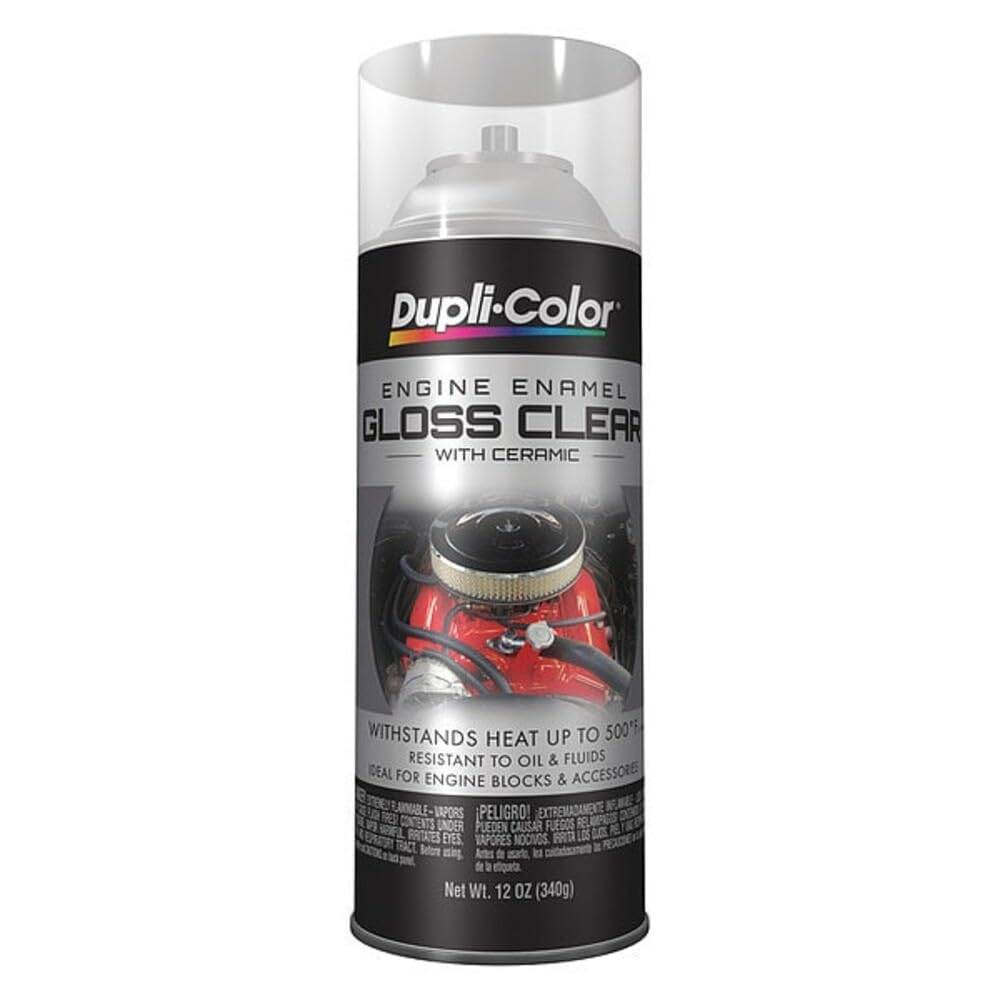
1. Dupli-Color DE1636 Engine Enamel Spray Paint with Ceramic – Clear
Our pick — over 4.5★ from 7,500+ verified ratings; the strongest balance of quality and price.
The crowd favorite that refuses to blister, flake, or peel on your engine block.
Dupli-Color packs ceramic resin into this 12-ounce aerosol, a material that helps the paint shed heat and hold its gloss. The rating is 500°F intermittent, which covers valve covers, engine blocks, and brake calipers for most builds. That EZ Touch Conical Nozzle makes aiming straightforward, and the paint is dry to the touch in 30 minutes — you can handle the part in an hour. Owners mention using it on a Honda lawnmower deck and reporting the color was “spot on” with great coverage. The clear option here gives you a protective topcoat layer that works over other colors, locking in the finish underneath.
What really sets this one apart is scale — it is the most-reviewed engine enamel on the market by a wide margin, with over 7,800 ratings. The thing owners praise most is the quality, with 289 buyers singling it out. The color accuracy gets nearly as many shouts at 272. A small note: durability is marked mixed in some owner experiences, so if you are painting a part that sees constant fluid contact, make sure the surface is immaculate before spraying.
The gloss comes out strong, and owners say it can make an old part look fresh — one buyer called it “perfect Pontiac blue” and said it looked factory-new. Unlike the PlastiKote which needs a primer on bare metal, Dupli-Color sticks well to clean, prepped surfaces right out of the can.
Why owners keep coming back
- Ceramic resin helps heat dissipation and gloss retention
- Dries to the touch in 30 minutes — fast turnaround on a project
- Huge color range; matching a factory shade is realistic
The honest fit warning
- 500°F intermittent means it is not for header or exhaust pipe surfaces
- Some cans need aggressive shaking; settling is a minor hassle
Grab it when: you need a dependable, widely tested engine enamel with good heat resistance for blocks, covers, and accessories.
Think twice if: your engine has bare metal parts that see direct flame or sustained heat above 500°F — step up to a 1200°F formula.
2. PlastiKote 211 Hot Rod White Engine Enamel, 12 oz.
One coat, and your engine block looks like it just left the factory assembly line.
If you need an exact factory color match for a restoration, PlastiKote delivers accuracy. The color choices match original engine manufacturer standards — Hot Rod White is a period-correct shade for classic builds. The paint is rated to 500°F, and the manufacturer says repeated heat exposure fuses the enamel to the surface, increasing bonding strength. Customers note using it on a 1971 Ford 390 FE restoration where it passed scrutiny, and another buyer noted it was “superior to Dupli-Color Ford Blue” for matching the original corporate blue tone. The spray lays fine and even, but you must shake the can very thoroughly to open up the real color — one owner found the paint starts dark blue and only shifts to the correct light blue after long shaking. skip it if you want a quick spray-and-go job; this one demands patience with prep and shaking.
Oil and gasoline resistance is built in — the enamel will not crack, lift, or peel when exposed to engine fluids. This makes it a solid choice for a daily driver where leaks and spills are inevitable. Many owners note that you need a heat-resistant primer on bare metal to get the full effect, so factor in a primer step for fresh engine blocks. Durability gets high marks across the board, and the cap is easy to open, which matters when your hands are dirty.
What makes it worth the money
- Exact factory-standard color matching — good for restoration and concours judging
- Resistant to oil and gasoline; won’t lift or peel
- Sprays finely and evenly for a professional look
Prep note from owners
- Heat-resistant primer required on bare metal surfaces
- Extra-long shaking needed for true color — budget a minute of vigorous shaking
Reach for this if: your build needs an authentic factory color that experts can spot — especially for classic Ford, GM, or Mopar restorations.
Look elsewhere if: you want a faster, primerless application — the extra prep here is non-negotiable for best results.
3. NADAMOO High Heat Spray Paint for Metal, Matte Finish

This paint laughs at 1200°F while every other can in the garage would bubble away.
For exhaust headers or any part that sees temperatures above 500°F, NADAMOO handles the heat. It uses a blend of heat-resistant aluminum pigments in a silicone polymer resin, a formula that goes well beyond standard engine enamel. The working temperature ceiling is 1200°F — more than double the 500°F of most rattle cans like the Dupli-Color DE1636. That makes it the pick for exhaust manifolds, headers, stove pipes, and BBQ grills. Reviewers point out excellent adhesion on prepped metal: one buyer sprayed it on a rifle barrel to match a damaged matte finish and said the sheen and color were “perfect.” Another refreshed a fire pit and called the effect “beautiful.” The matte finish hides fingerprints and soot better than gloss. One can covers roughly 10-12 square feet for two light coats. A clear caution from the manufacturer: do not use directly on areas that hit 3000°F, such as grill grates or the inside of a BBQ.
Rust protection is built in — the paint creates a shield against corrosion, which is a big plus for any metal part exposed to moisture or road salt. The spray goes on smooth and even, and buyers describe it as a “clean reliable spray” with no runs when applied correctly. The 13 positive mentions of performance make it the most-praised aspect among owners, followed closely by appearance. For anyone with a classic car that has visible headers, this is the paint that keeps the look consistent without the gloss.
Best use case: exhaust headers, exhaust manifolds, fire pits, and any ferrous metal surface that sees serious heat. The matte finish is a bonus for hiding grime.
The catch: the manufacturer explicitly warns against using this on surfaces that reach 3000°F, like grill grates or interior fireplace floors — stay within the 1200°F ceiling and it performs.
Reach for this when: your project involves exhaust components, stove pipes, or any part that regularly hits 500°F+ and needs a tough, flat finish.
pass on it if: you want a glossy show finish — this is strictly matte, and it is not designed for engine blocks that need a high-shine look.
4. PJ1 16-SAT Satin Black Engine Spray Paint, 12 oz

The rattle can that makes a Harley Evolution engine look like it was powder-coated at the factory.
Motorcycle owners get a factory-matching satin finish with PJ1, developed specifically for 2-stroke and 4-stroke engine cases, cylinders, and heads. The satin black finish hits a balance — not too shiny, not too flat. Shoppers say it matches the factory texture on black Harley Evolution engines perfectly. The color is called Satin Black, and the finish delivers a “very uniform satin sheen” according to the buy-side consensus. Application advice from owners: apply 3-5 light coats in warm, dry sunlight. They emphasize that thin coats give a smooth satin look and that the paint blends smoothly with powder-coated parts once it dries. One owner working on a 2000 Harley motor called the result “flawless.” Another used it on vintage two-stroke motorcycle exhaust and was thrilled with the fresh, non-dead-stock paint quality after delivery. This is the one for bike restorers; it’s not for you if you need a gloss finish or are painting a car block.
The 500°F heat ceiling covers the typical temperature of motorcycle engine cases and cylinders — it is not meant for exhaust pipes but works beautifully on the engine block itself. Drying time has a mixed verdict among a small group of owners, but the overwhelming consensus is that the color, quality, and finish all land on the positive side. For VW air-cooled engine enthusiasts, buyers report it is “perfect for VW cylinders, pulleys, and engine cooling tin.”
Standout trait: the satin texture matches OEM aircraft-grade engine finishes better than any generic spray — owners repeatedly call out the exact match for Harley and Suzuki parts.
One thing to know: durability gets a mixed note from a handful of owners. Stick to engine cases and avoid hot exhaust surfaces.
Best for: motorcycle enthusiasts, especially those restoring or blacking out Harley, Suzuki, or vintage two-stroke engines.
Not your pick if: you need a gloss finish for a car engine block — this satin look is purpose-built for bikes and small engines.
5. KBS Coatings 60307 White Motor Coater Engine Paint – 1 Pint

No spray gun, no compressor — just a brush and a perfect factory gloss.
If you hate masking and overspray, KBS Coatings lets you brush on a pro-looking finish. This is a liquid acrylic enamel, not an aerosol, and it is designed to be brushed on. The key innovation? Brush marks flow out during curing, leaving a smooth, glossy surface that looks like it was sprayed by a pro. Owners confirm this: one buyer painted a small block Chevy with a brush and said it “came out great” and that “once it sets up there are no brush marks.” The coverage is generous — the manufacturer states 100 square feet per quart, meaning a 1-pint tin covers a full engine block with some left over. The heat ceiling is 450°F, slightly lower than standard engine enamel, but that still covers valve covers, intake manifolds, and most engine block surfaces. look elsewhere if you need to paint exhaust parts that exceed 450°F.
Owners note that it works beautifully on marine boat engines and on Cummins white applications. One buyer painted a full diesel marine engine and confirmed it is a “good color match for Cummins white.” The paint is waterproof and designed for outdoor use, so moisture under the hood is not a problem. The only caveat is that it requires frequent stirring — the pigment settles quickly — and any coat applied too thickly can run or drip. Overall, 51 owners mention quality as the top positive, and 28 highlight how easy the application is.
Why it wins over spray cans
- Brush marks flow out flat — you get a glossy sprayed look without the equipment
- High coverage per pint — paints an engine block with material left over
- Excellent color match for Cummins, Ford, and Chevy engine colors
The few trade-offs
- Frequent stirring is needed to keep the pigment uniform
- Thick application can cause runs and drips — go light and build up coats
Grab this when: you do not own a spray gun but still want a glossy, professional-looking engine finish. Ideal for home restorations where simplicity matters.
Pass if: you need a finish above 450°F, or you want the quick-dry convenience of a rattle can for a tight schedule.
6. ERA Paints Purple Engine Paint With Omni-Curing Catalyst Technology, 12 oz

Two-component chemistry in a can gives this paint the hardness of a professional bake-on coating.
ERA Paints brings a 2K aerosol — the kind of paint that comes with a built-in catalyst hardener that activates when you press the button. This is not a standard single-stage enamel. The catalyst creates a chip-resistant, chemical-resistant surface that stands up to brake fluid, acetone, and lacquer thinner, which are the three things that wreck most rattle-can paint jobs. The full cure time is 8 hours, and the paint is dry to the touch in under 30 minutes. Owners who used it on engine blocks and valve covers report that it hardens fast and works well. The color here is Purple, and the paint is high-gloss — an attention-getting shade for show builds or custom projects.
The honesty note: color gets a mixed reception among owners. Some call it bright and beautiful, while others say it is not as advertised. Since 13 buyers mention the color with a mixed verdict, it is best to check recent photos and reviews if your theme depends on an exact shade. Drying time and value also earn mixed marks — one owner reported the paint cracking and flaking on brake calipers after three months, though the manufacturer does not recommend it for that use. For engine blocks and valve covers specifically, the consensus is that the quality and performance are solid, with 11 and 9 positive mentions respectively. The can is made in the USA and does not require a primer, just thorough cleaning and masking.
what separates it
- 2K catalyst hardener creates an extremely chip-resistant, chemical-proof surface
- No primer needed — clean, mask, and spray for a high-gloss finish
- Resists brake fluid, acetone, and lacquer thinner without lifting
What to watch for
- Color consistency is mixed — a few owners find it different from the listing swatch
- Not tested well on brake calipers; the manufacturer recommends engine blocks and valve covers only
Ideal for: a custom show-car engine where chemical resistance and a rock-hard gloss matter more than color-perfectionism.
steer clear if: you need a reliable purple that exactly matches an OEM shade — or if your budget prefers a standard single-stage enamel without the catalyst fuss.
Understanding the Specs
Heat Rating — 500°F vs 1200°F
The number on the can tells you the maximum temperature the paint can handle before it starts to degrade. Standard engine enamel sits around 500°F, which covers the block, valve covers, and intake. Exhaust manifolds and headers run much hotter, often above 800°F, so you need a silicone-based paint like the NADAMOO that is rated to 1200°F. Ignoring this ceiling is the fastest way to watch your fresh paint peel off on the first long drive.
Ceramic Resin and Catalyst Hardeners
Ceramic resins such as the ones in Dupli-Color help the paint shed heat and reflect it away from the block. Catalyst hardeners, found in 2K aerosol paints like the ERA, create a cross-linked molecular bond that makes the finish tougher and more chemical-resistant than a standard acrylic enamel. The trade-off is that catalyst paints have a limited working life once activated and typically cost more per can.
Finish Types — Gloss, Satin, Matte
Gloss is the easiest to clean and most common for engine blocks, but it highlights dirt and scratches. Satin falls in the middle — popular on motorcycle engine cases, where you want a factory-like appearance without the high shine. Matte hides smudges and soot best, which is why it shows up on exhaust parts and BBQ equipment. Choose based on how much you want to see the engine bay versus how much grime you are willing to clean.
Aerosol vs Liquid Brush-On
Spray cans give you even coverage and fast drying, making them the choice for most DIYers. Brush-on enamels like the KBS Motor Coater let you paint large blocks without a compressor, and the brush marks disappear during curing. The liquid form covers more area per volume, but takes longer between coats. If you have access to a spray gun, a professional urethane enamel is the hardest option, but the aerosol 2K paints are closing the gap fast.
FAQ
Can I use standard spray paint on my engine block?
What is the difference between 500°F and 1200°F engine paint?
Do I need a primer before applying engine enamel?
How long does engine enamel take to dry and cure?
Can I brush engine enamel instead of spraying it?
Will engine enamel resist oil and gasoline?
How many square feet does one can of engine enamel cover?
Can I use engine enamel on brake calipers?
What does a catalyst hardener do in 2K aerosol paint?
Is engine enamel paint waterproof?
Final Thoughts: The Verdict
For most people, the best engine enamel paint winner is the Dupli-Color DE1636 because it combines ceramic heat dissipation, a high-gloss finish, and the largest owner community confirming its reliability — all at an entry-level price that makes it the safest first buy. If you need to match a factory engine color exactly for a restoration, grab the PlastiKote 211 and be prepared to prime and shake thoroughly. And for exhaust headers or any part that sees temperatures above 500°F, the NADAMOO High Heat at 1200°F is the one to reach for.
How We Picked
We do not accept paid placement. Every pick is matched to a real buyer and a real use-case; we do not hands-on test units.
Sources & Methodology
Specifications: manufacturer listings and product documentation. Review insights: verified customer reviews, as of July 2026. Pricing: not shown on this page (it changes often); check the current price via the retailer link.
As an Amazon Associate, Trending Car earns from qualifying purchases. This does not affect which products we feature.