
Our readers keep the lights on and my garage snacks stocked. As an Amazon Associate, I earn from qualifying purchases.
Specs are compiled from manufacturer listings and verified buyer reviews and can change over time — please confirm the key details on the product page before buying.
Picking a 1/10 scale crawler isn’t about speed — it’s about how the tires bite, how the suspension twists, and whether the drivetrain survives a tumble down a rocky ravine. The wrong choice leaves you with a plastic toy that can barely climb a curb, while the right one delivers hours of technical crawling you can upgrade for years.
I’m Min Islam — the founder and writer behind Trending Car. This guide is built by comparing the manufacturers’ published specifications and the patterns across verified customer reviews, so you get each pick’s real strengths and trade-offs instead of marketing spin.
These ten ready-to-run rigs cover the full spectrum, from a crowd-favorite entry model to a premium brushless model, to help you decide which 1 10 body crawler matches your trail and your budget.
Our Picks at a Glance


How To Choose The Best 1/10 Crawler
Before you scroll through the reviews, these three criteria will help you filter the options that actually suit your terrain and ambition level.
Chassis and Frame Material
The frame is the backbone of your crawler. A steel C-channel or ladder frame, like the 3mm steel ladder frame on some mid-range models, delivers the rigidity needed for serious rock crawling. Plastic frames save weight but flex under heavy torque, which can throw off your climb angle on uneven boulders. Look for aluminum or steel rails if you plan to run larger tires or a heavier battery.
Motor and Speed Control
A brushed 550 motor provides the low-end torque that crawlers depend on for slow, precise tire placement on steep slabs. Brushless motors, like the 3541 outrunner found in high-end models, deliver more linear control and higher top speed, but they often require a better ESC to avoid cogging at low RPM. If you want to climb technical lines without wheel spin, a brushed system is your friend.
Waterproof Electronics
If you intend to cross streams, mud puddles, or snow, a waterproof ESC and servo are non-negotiable. A 40A waterproof brushed ESC with a sealed receiver lets you drive through wet conditions without worrying about short circuits. Entry-level models sometimes skip this, so check the spec before taking a rig near water.
Quick Comparison
| Model | Best For | Motor | Chassis | Included Battery | Amazon |
|---|---|---|---|---|---|
| Redcat Racing Everest 10★ Best Overall | Entry-level value | 54T Brushed | Aluminum Chassis | 7.2V NiMH | Amazon |
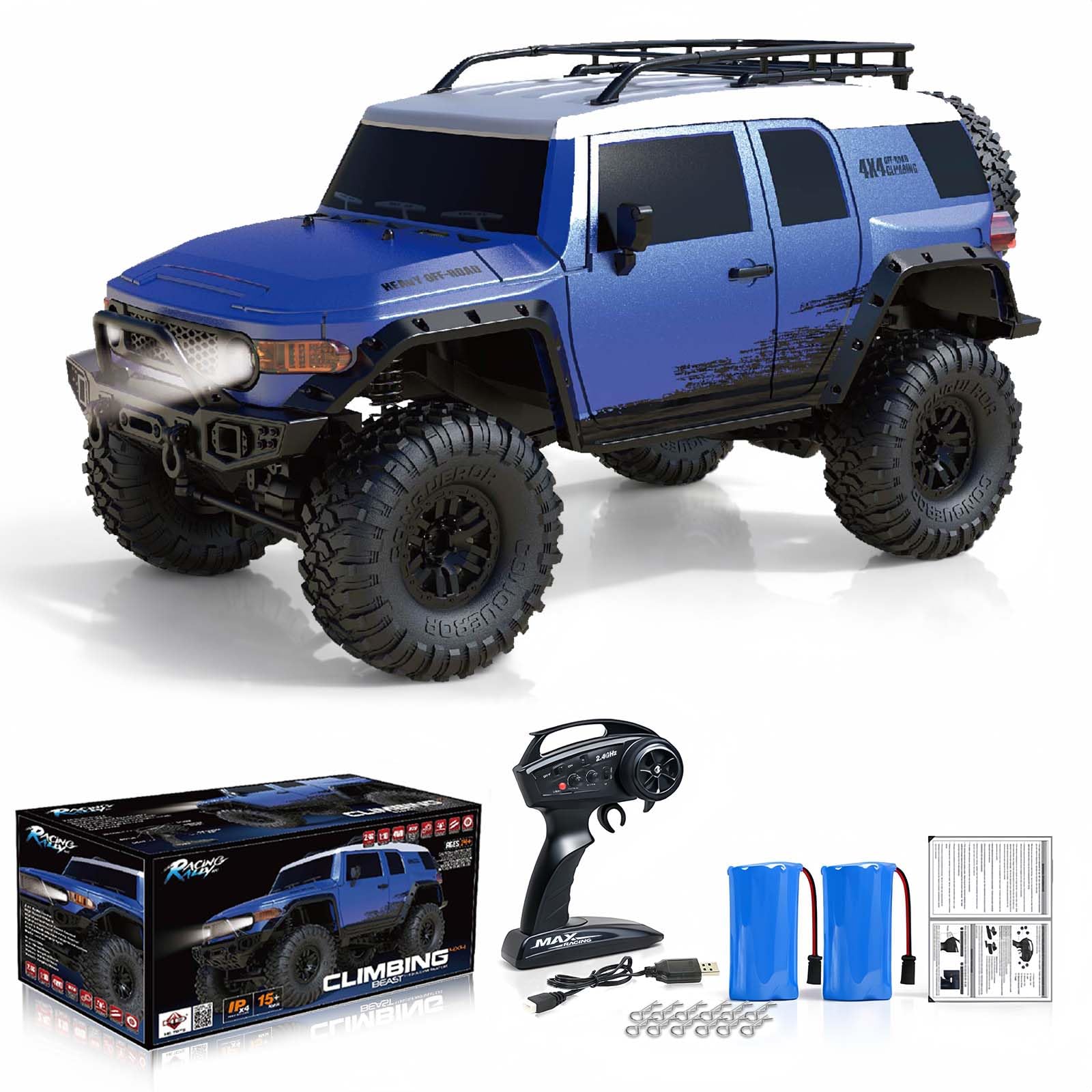
| Desdoni RC CrawlerFastest Budget | Budget LED runner | 540 Brushed | ABS Hardshell | 2×7.4V 1500mAh | Amazon |
| Cheerwing Rock CrawlerBest Value | Budget trail truck | 550 Brushed | Steel Rail Frame | 2500mAh | Amazon |
| Redcat Racing Everest GEN7 Sport | Scale realism | 550 Brushed | 3mm Steel Ladder Frame | 2000mAh NiMH | Amazon |
| RGT RC-4 V3-FD | Scale Bronco look | Brushed | Integrated Chassis Rail | NiMH | Amazon |
| RocHobby Atlas | Customizer’s base | 35T 550 Brushed | Metal Frame | Not Included | Amazon |
| RocHobby Atlas S | All-terrain beginner | 35T 550 Brushed | Metal Frame | Not Included | Amazon |
| Axial SCX10 III Base Camp | Beginner durability | 35T 540 Brushed | Steel C-Channel | Not Included | Amazon |
| Axial SCX10 III Coyote | Premium trail rider | 35T 540 Brushed | Steel C-Channel | Not Included | Amazon |
| FMS LC80 Brushless Pro V2 | Scale fanatic | 3541 Brushless | Plastic with Metal Links | Not Included | Amazon |
| Traxxas TRX-4 Bronco | Licensed scale performance | Titan 21T Brushed | Steel Ladder Frame | Not Included | Amazon |
In‑Depth Reviews
1. Redcat Racing Everest 10
Our pick — 4.5★ from 800+ verified ratings; the strongest balance of quality and price.
The Everest 10 puts you on the rocks for less without cutting corners that matter.
With a 54T brushed motor and locked differentials, this crawler delivers the kind of slow, steady torque that lets you pick your line across loose boulders without spinning out. The shaft-driven 4WD system and aluminum chassis give it a solid foundation, while the 40A waterproof ESC means you can cross a stream without worrying about fried electronics. What wins people over is the value — the quality and climbing ability both earn strong praise from owners, and many note it performs well.
The trade-off here is speed. from the start, the 54T motor is tuned for crawling, not trailing. One owner swapped in a 27T motor and saw the speed jump from 2.6 to 5.3 mph, which gives you an idea of the stock pace. The turning radius is also a common point of mixed feedback — tight switchbacks in the rocks require some back-and-forth. That said, the aftermarket support is huge, so you can upgrade the motor, shocks, and even add rear steering as your skills grow.
This is the pick that lets you hit the trail immediately. The 2.4GHz radio, 7.2V NiMH battery, and charger are all in the box — just add four AA batteries for the transmitter. The red and black body looks aggressive on the shelf, and the beadlock tires grip surprisingly well on dry rock right out of the gate.
Why it wins
- Aluminum chassis and shaft-driven 4WD for durability
- Waterproof ESC and sealed servo for wet terrain
- Aftermarket parts ecosystem for endless upgrades
The honest downsides
- Stock 54T motor is slow for trail running
- Turning radius is wide for tight rock gardens
- Early units had reports of body cracking on hard rolls
Perfect first crawler for: Anyone who wants to learn technical rock crawling without a big investment, and who enjoys tinkering with upgrades over time.
skip it if: You need a fast trail truck from the start — the stock gearing is deliberately slow for climbing, not covering ground.
2. Desdoni RC Crawler
A fast, LED-lit crawler that impresses on the first run but shows its budget roots quickly.
This Desdoni rig stands out for its speed — the 540 motor pushes it to 15 km/h, which is noticeably faster than most dedicated crawlers at this price. The ABS hardshell body looks like a mini FJ Cruiser, and the front LED headlights add a cool factor for dusk trails. You get two 1500mAh batteries in the box, giving you about 30 minutes of total run time before a recharge cycle, which is decent for a budget package.
The catch is build quality. The highest complaint is about the plastic components — several buyers report fragile parts, including a steering bar that broke quickly and loose screws right from the start. The scale representation also draws mixed feedback, with some noting it feels smaller than a true 1/10. If you are looking for a gift or a casual backyard runner, the looks and price are compelling, but if you plan to crawl serious rocks, you will want to budget for metal upgrades.
Great for beginners on a budget: The 2.4GHz controller with one-button speed change makes it easy for kids to learn, and the two included batteries mean less waiting for recharges.
Not for aggressive crawlers: The ABS shell and plastic suspension links won’t survive repeated hard rolls on concrete or sharp rocks.
3. Cheerwing 1/10 Rock Crawler
The 550 motor and steel frame give it a torque advantage most budget rivals lack.
The Cheerwing uses a 550 brushed motor paired with a waterproof ESC, which provides strong torque for climbing steep grades. The all-steel suspension links and rail chassis frame add rigidity, and the 2500mAh battery provides longer run times than the pack-in NiMH found on many competitors. It is also the largest physical truck in the budget tier, measuring 19.88 x 10.15 x 10.23 inches, which makes it feel more substantial on the trail.
Durability is where this truck divides opinion. The value for money scores high, and many owners call it a great starting rig, but the negative durability count is significant — several owners mention stripped wheel hexes (the small metal part that connects the wheel to the axle) after just a few runs and suggest upgrading the transmission to metal gears early. The driveshafts are also a known weak point. If you treat it as a baseline to upgrade over time, the steel frame and 550 motor (a standard-size brushed motor) are a solid foundation; if you expect it to survive full-throttle abuse from the start, it may disappoint.
Who it fits: Hobbyists who want a steel-framed platform with a 550 motor and are comfortable replacing the plastic drivetrain parts as they break.
Who should look elsewhere: Anyone who wants a maintenance-free rig — the Cheerwing rewards tinkerers, not plug-and-play drivers.
4. Redcat Racing Everest GEN7 Sport

The GEN7 Sport brings scale authenticity and a steel frame that rivals cost twice as much.
This crawler’s defining feature is its 3mm powder-coated steel ladder frame, which provides a stiff platform for serious rock crawling. The 550 brushed motor, waterproof ESC, and licensed Interco Super Swamper tires mounted on beadlock wheels with 2mm steel rings give it convincing off-road credibility from the start. The 4-door SUV body with LED-ready bumpers looks fantastic on the trail, and the adjustable wheelbase and multiple shock positions let you fine-tune the setup for different terrain.
Owners consistently highlight the value — the GEN7 Sport is often compared to modified rigs costing more. However, the build quality is a mixed bag. Several reports mention broken steering knuckles and axle shafts under hard use, along with a poor turning radius that requires extra maneuvering in tight spots. The stock shocks also benefit from an oil change and softer springs. If you are willing to address these few weak points, the platform supports endless upgrades, from high-torque servos to Pro CV shafts.
The battery life is a strong point, with the included 2000mAh NiMH lasting through long trail sessions, though the stock charger is slow. Plan to invest in a better charger early.
Best for scale fans who want to upgrade: The steel frame and licensed tires (realistic rubber treads modeled after full-size off-road tires) are a rare combination at this price, and the aftermarket support is sturdy for those who enjoy wrenching (customizing and replacing parts).
The honest limit: The stock steering components are the first thing to break under aggressive crawling — budget for an upgraded servo and CV shafts if you run 3S batteries.
5. RGT RC-4 V3-FD

The Bronco body and integrated electronics make this a scale showpiece that crawls well.
RGT’s RC-4 V3-FD nails the scale look with a detailed Bronco body that includes a clear window, hidden front body posts, a roof rack, and a rear ladder. The integrated electronics, co-developed by Fly Sky and Hobby Wing, combine the ESC, LED light control, and receiver into one unit, which cleans up the wiring and simplifies installation. The differential gears are all metal, and the Ackerman angle design helps the truck achieve up to a 45-degree climbing angle. The front-mounted battery tray also helps prevent rollovers on steep ascents.
The drivability and lighting features both earn strong positive feedback, with owners calling it a great project car from the start. The stock servo, however, is a known weak point — it lacks torque and often fails quickly, so replacing it with a metal-gear unit is a smart first upgrade. The truck also runs light, and many owners add heavier wheels and tires for better grip. For the price, you get an excellent scale platform that rewards upgrades without requiring them immediately.
One owner noted that the packaging was sturdy and the truck arrived ready to run, which is a nice touch for a first-time crawler buyer. Just plan to add a LiPo battery and a better servo to open up its full potential.
Who should buy it: Scale enthusiasts who want a Bronco body with integrated electronics and metal diffs, and who enjoy upgrading the servos and wheels.
Who should pass: Anyone who wants a top-tier crawler from the start without tinkering — the stock servo and light weight hold it back on hard lines.
6. RocHobby Atlas
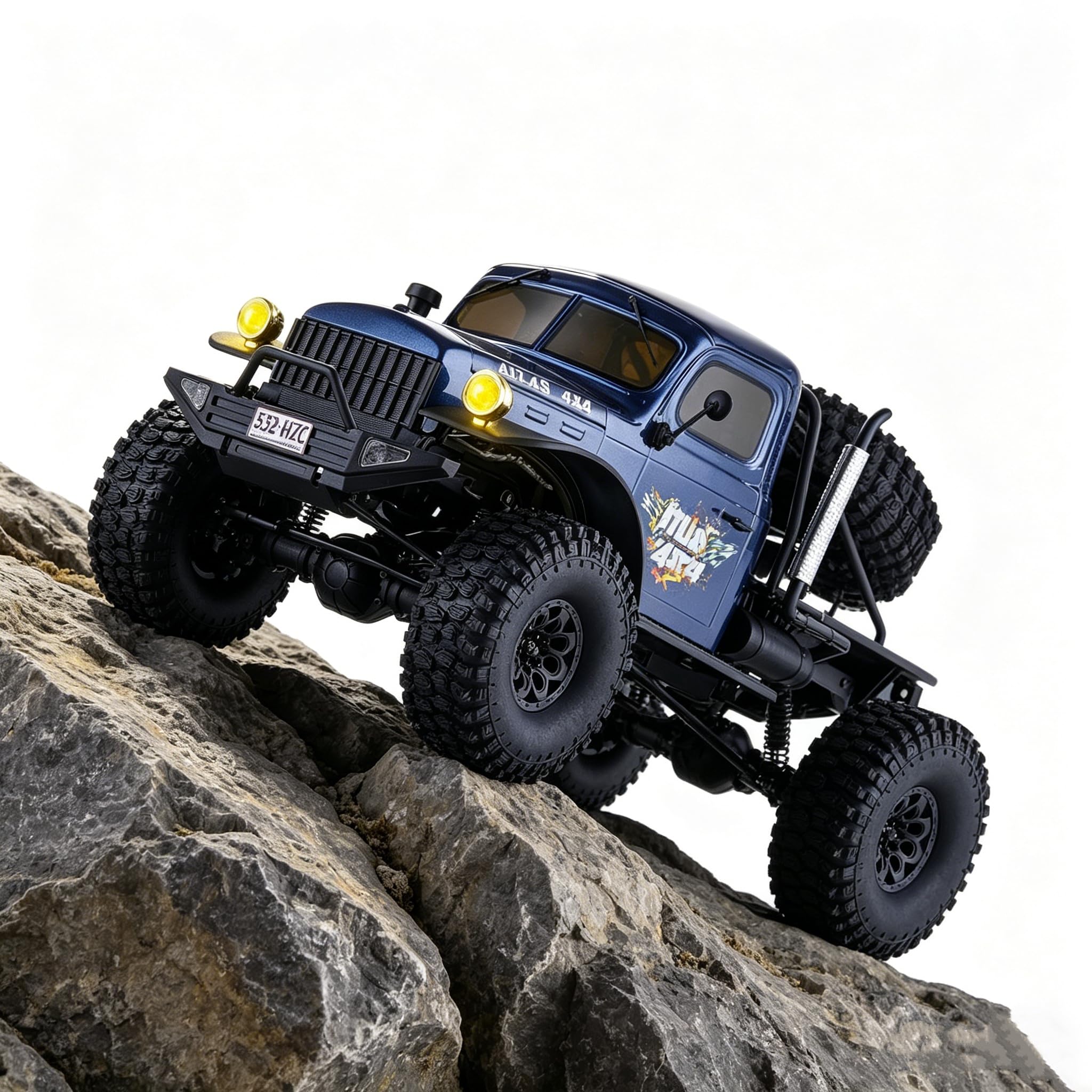
A blank slate for serious modders, with a nylon roll cage and metal frame that beg for upgrades.
The Atlas is built around a rigid metal frame with a four-link suspension system and a nylon roll cage that protects the PC plastic body during rollovers. The 35T 550 motor provides good torque for technical crawling, and the 120mm all-terrain tires with a deep tread design offer solid grip on loose surfaces. The build quality earns strong praise, with owners noting that the chassis is well-designed and easy to work on. The included sticker sheet lets you personalize the body, and the detailed replica captures the look of a real off-road truck down to the roll cage and bumpers.
Customizability scores mixed feedback, though, because the electronics are not 3S-friendly from the start — the ESC and motor overheat within minutes on a 3S LiPo. Owners who have upgraded to a Hobbywing 1080 ESC and a brushless system report drastically better slow-speed control and reliability. The gearbox is also difficult to access, making pinion changes a chore. This rig is best approached as a project: the rolling chassis is excellent, but the electronics need an immediate upgrade for serious crawling.
Best for experienced hobbyists: The metal frame and roll cage (the protective structure around the body) are a fantastic base for a fully customized crawler, and the scale detail (realistic body panels and accessories) is tough to top at this price.
The hard truth: The stock ESC cannot handle 3S batteries without overheating, and the gearbox is not user-friendly for quick gear swaps.
7. RocHobby Atlas S
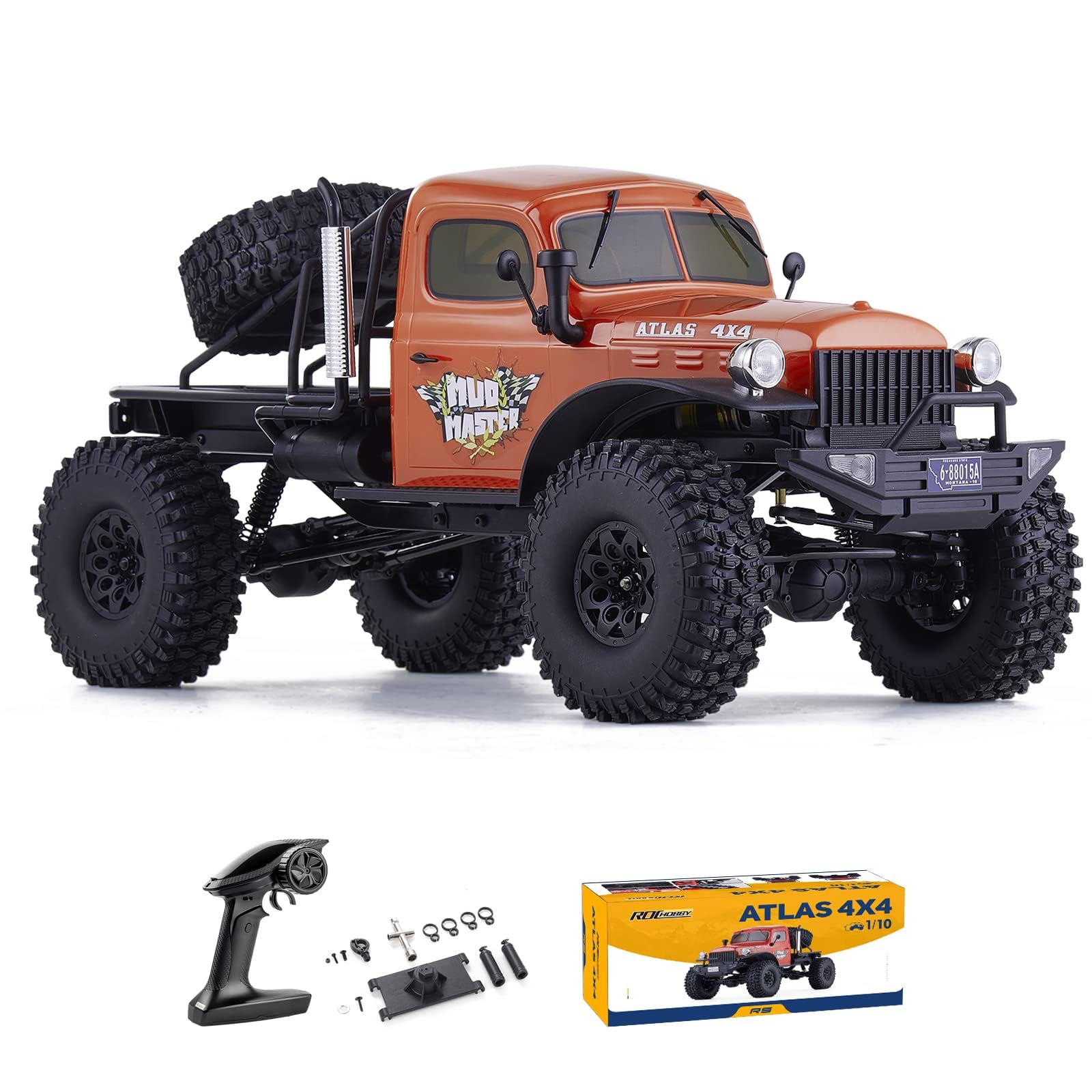
The Atlas S delivers strong hill-climbing power and a 4-channel radio at a mid-range price.
This version of the Atlas shares the same 35T 550 motor and 120mm tires but adds a 4-channel 2.4GHz radio system that supports complex acceleration, braking, and light switching functions. The 80-meter range gives you plenty of space to explore, and the top speed of 15 km/h makes it quick enough for trailing between crawl sections. The metal frame and four-link suspension provide proven reliability on swamps, hills, and desert terrain.
The capability and quality both earn positive feedback, with owners calling it a great first crawler or project build. The stock tires and foams are stiff, however, and the ESC lacks smooth slow-speed control — many owners upgrade to a Hobbywing 1080 ESC or a Fusion motor for better crawling manners. The servo is also loud and slow. At this price point, you are paying for a solid rolling chassis that responds well to upgrades, not a finished competition rig.
Who it suits: Beginners who want a capable 4-channel radio system and a metal-framed platform that grows with their skills through upgrades.
Who should look at higher-end models: Anyone who wants a smooth crawler from the start without immediately replacing the ESC and servo.
8. Axial SCX10 III Base Camp

The SCX10 III platform sets the standard for beginner durability and upgrade potential.
Axial’s SCX10 III Base Camp starts with a strong steel C-channel chassis and high-clearance AR45 portal axles, which lift the axle centerline for extra ground clearance over rocks. The LCXU transmission is built tough, and the factory-assembled truck arrives ready to run with a Spektrum SLT3 3-channel radio, a Spektrum 40A waterproof ESC, a Slickrock 35T 540 brushed motor, and a Spektrum S664 15kg waterproof servo. The fun factor and capability both score exceptionally high with owners, who consistently mention that it crawls well from the start and survives tumbles down hills without breaking.
The truck is designed for beginners — the 14+ age rating and easy-to-navigate chassis layout make it a straightforward first rig. One owner specifically notes that mud, snow, and stream water have not stopped it, as long as you pick your line smart. The only maintenance tip from experienced owners is to grease the gears before the first run, as the factory lubrication is minimal. Like all Axial SCX10 III trucks, the battery and charger are not included, so factor in a LiPo pack and a balance charger.
The strengths
- Portal axles for exceptional ground clearance
- Steel C-channel chassis with proven durability
- Spektrum electronics with waterproof ESC and servo
The trade-offs
- Battery and charger not included
- Factory gears need regreasing before use
- Stock 540 motor is adequate but not powerful for heavy wheels
Perfect for new RC enthusiasts: The portal axles, durable transmission, and clear upgrade path make this the easiest recommendation for a first serious crawler.
Not if you need a complete kit: Factor in the cost of a LiPo battery and charger — the truck will not run without them.
9. Axial SCX10 III Coyote
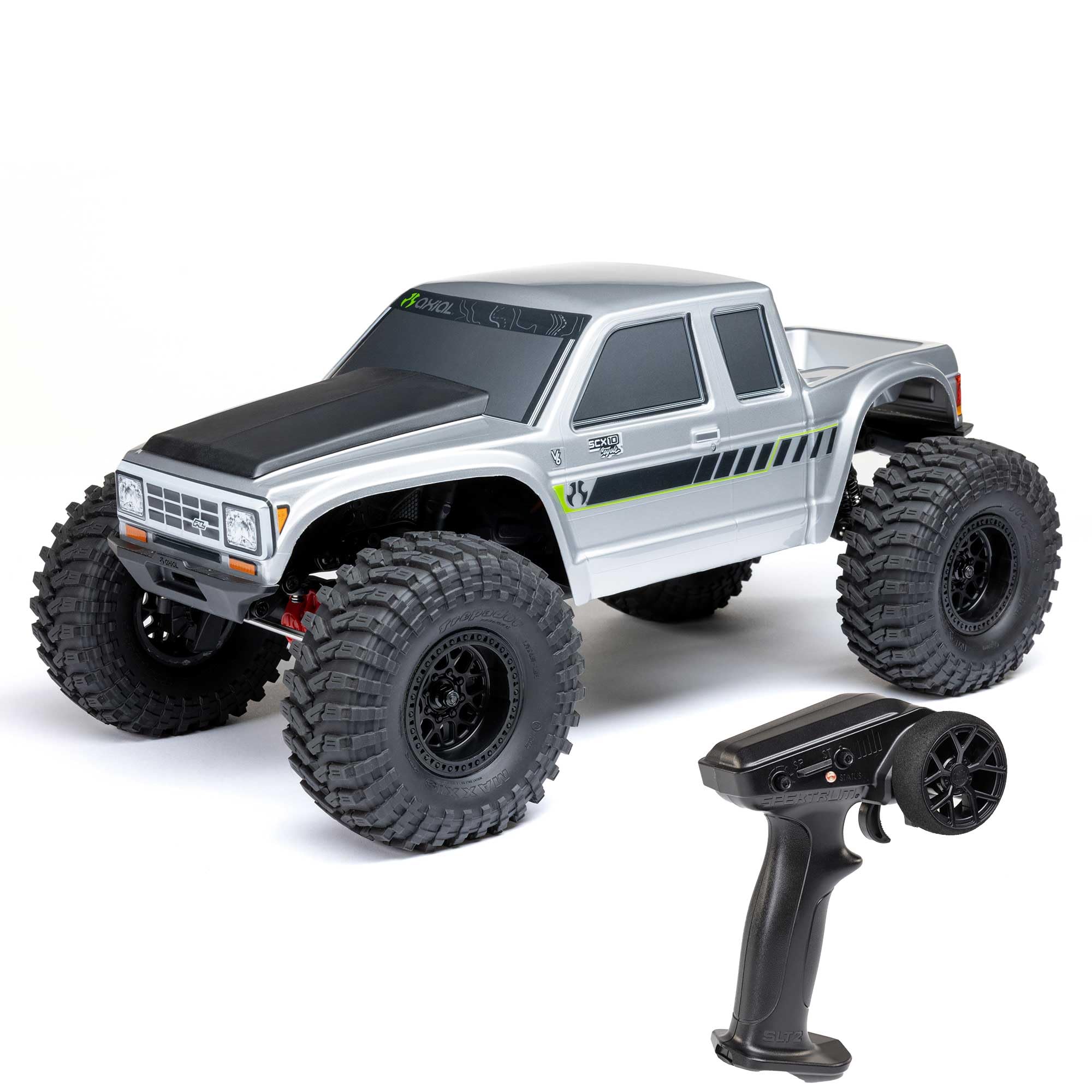
The Coyote combines a factory-painted Pro-Line body with Axial’s proven SCX10 III chassis for a premium trail experience.
Building on the same steel C-channel chassis and AR45P portal axles as the Base Camp, the Coyote adds a factory-painted Pro-Line body with a silver finish and detailed scale accessories. The quality and crawler capability both earn top marks from owners, who describe it as a solid beginner model that outperforms many upgraded rigs. The traction on rocks and trails is excellent, with the stock Pro-Line tires providing confident grip on dry surfaces. The low-speed control from the brushed 35T motor is smooth enough for technical lines, and the 10.8-pound weight gives it good planted feel on steep climbs.
The assembly experience is mixed — while most find it easy to set up, a few note that the glued-on wheels require Un-cure or similar solvent to remove if you plan to replace the tires. The aftermarket is huge, and common mods include adding brass portal covers (weighted covers for the axle ends) and diff covers (covers for the differential gear housing) to lower the center of gravity. Some owners also recommend upgrading the shocks for more articulation (wheel travel) on extreme terrain. Overall, this is the pick for someone who wants a ready-to-run trail truck with a beautiful body and the confidence of Axial’s reputation.
Best for the scale purist: The Pro-Line body and portal axles give you a truck that looks as good as it performs, right from the start.
The honest catch: The glued-on wheels are a hassle to swap if you want different tires, and the stock shocks are adequate but not exceptional for extreme crawling.
10. FMS LC80 Brushless Pro V2
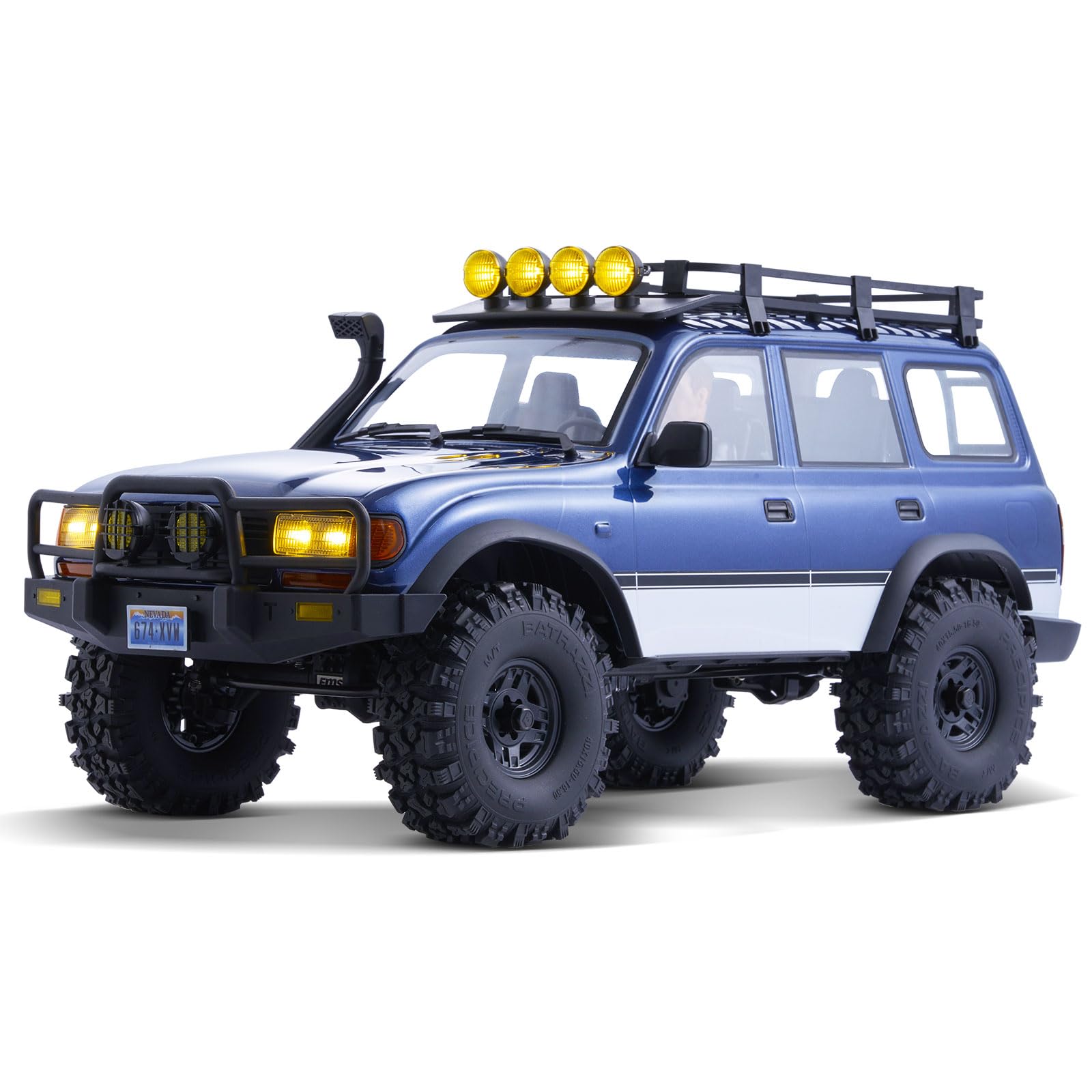
Toyota licensing, a brushless motor, and two-speed transmission make this the most detailed performer on the list.
The FMS LC80 is a Toyota-licensed 1/10 scale Land Cruiser 80 with a two-color sprayed PC body that creates a subtle metallic sparkle in sunlight. The real draw is the brushless power system — a 3541 outrunner motor paired with a 50A ESC delivers snail-like low-speed control for technical crawling, plus enough top end to reach roughly 14 mph on a 3S battery. The two-speed transmission lets you switch between a crawling gear for rocks and a higher gear for trailing. The full lighting system, including headlights, turn signals, and brake lights, is pre-installed and controlled by the remote, with a magnetic interface that makes body removal simple.
The quality and appearance both earn strong praise, and the suspension flex is excellent. The run time is also solid, with roughly one hour of light crawling on a 2S 5500mAh pack. The downsides are the price point and some consistency issues. While the FMS LC80 is a fantastic scale model, a few customers note receiving units with faulty motors or ESC right from the start, which is frustrating at this price. The stock tires are also just okay for serious rock crawling — many owners upgrade to softer compound tires for better grip.
What stands out
- Brushless motor with buttery low-speed control
- Two-speed transmission for crawling and trailing
- Toyota licensed body with full lighting and interior detail
The drawbacks
- Occasional motor or ESC issues from the start
- Stock tires need upgrading for technical crawling
- Battery and charger not included
Who it’s for: Scale enthusiasts who want a brushless, two-speed rig with Toyota licensing and realistic lighting, and who are comfortable addressing potential early QC issues.
Who should skip: Pure rock crawlers who need maximum durability — the plastic body and occasional electronics failures make this better for trail running and light crawling.
Understanding the Specs
Brushed vs Brushless Motors
A brushed motor uses carbon brushes to transfer electricity to the rotor. For 1/10 crawlers, the brushed 540 or 550 motors are the standard because they deliver smooth, predictable torque at low RPM — perfect for inching over rocks. A brushless motor, like the 3541 outrunner in some high-end models, uses electronic commutation for higher efficiency, faster top speeds, and silky low-speed control, but it requires a compatible ESC and often costs more. If you are learning, a brushed system is simpler and cheaper to replace.
Portal Axles vs Straight Axles
Portal axles have a gear reduction at each wheel hub, which lifts the axle centerline above the wheel center. This gives you more ground clearance under the differential, which means you can clear taller rocks without scraping the bottom. Straight axles are simpler and lighter but sit lower, so they are more prone to getting hung up. For serious rock crawling, portal axles are a clear advantage — you will find them on the Axial SCX10 III and Traxxas TRX-4 models.
FAQ
What does 1/10 scale mean for a RC crawler?
Can I run a brushed crawler in water and mud?
Will a 1/10 body fit on any 1/10 chassis?
Do I need a special battery for a 1/10 crawler?
How fast is a typical 1/10 brushed crawler?
Can I upgrade the motor on my 1/10 crawler?
What is the difference between RTR and kit 1/10 crawlers?
Why do some crawlers use a steel ladder frame instead of plastic?
What is the advantage of a two-speed transmission on a crawler?
Final Thoughts: The Verdict
For most buyers, the best 1 10 body crawler is the Redcat Racing Everest 10 because it combines a durable aluminum chassis, waterproof electronics, and an affordable price with a huge aftermarket support ecosystem. If you want a beginner-friendly platform with portal axles and a steel frame, grab the Axial SCX10 III Base Camp.
How We Picked
We do not accept paid placement. Every pick is matched to a real buyer and a real use-case; we do not hands-on test units.
Sources & Methodology
Specifications: manufacturer listings and product documentation. Review insights: verified customer reviews, as of July 2026. Pricing: not shown on this page (it changes often); check the current price via the retailer link.
As an Amazon Associate, Trending Car earns from qualifying purchases. This does not affect which products we feature.