
Our readers keep the lights on and my garage snacks stocked. As an Amazon Associate, I earn from qualifying purchases.
Specs are compiled from manufacturer listings and verified buyer reviews and can change over time — please confirm the key details on the product page before buying.
You have a 1½-inch nut that needs turning — a truck fan clutch, a hydraulic line, a piece of heavy equipment — and the tiny wrenches in your drawer are useless. One wrong move with an ill-fitting tool strips the fastener, and then the real headache starts. Choosing the right 1½-inch wrench balances leverage, jaw precision, and if you need ratcheting speed or brute force.
I’m Min Islam — the founder and writer behind Trending Car. This guide is built by comparing the manufacturers’ published specifications and the patterns across verified customer reviews, so you get each pick’s real strengths and trade-offs instead of marketing spin.
Here are the nine best 1½-inch wrenches for automotive, industrial, and farm work, ranked by the real-world feedback from thousands of owners who have already put them to the test on stubborn fasteners.
Our Picks at a Glance

How To Choose The Best 1½-Inch Wrench
A 1½-inch wrench is a specialty tool — you are not buying this for a household curtain rod. A poor choice can round a fastener or cause a busted knuckle. Focus on wrench type, material and build, and fit precision.
Wrench Type: Combination, Adjustable, Ratcheting, or Service
A combination wrench offers both an open end and a box end in one bar, ideal for raw torque. An adjustable wrench adapts to multiple sizes but introduces jaw play. A ratcheting box end speeds work by staying on the fastener, but its mechanism may not fit tight spaces. A service or angle-head wrench fits where standard wrenches cannot swing due to obstructions.
Material and Heat Treatment
Quality wrenches are forged from chrome vanadium or chromium-molybdenum steel. Look for drop-forged construction (shaped under a hammer press for strength) and heat-treated steel (50–53 HRC on the high-end Tekton models — that is a hardness rating on the Rockwell scale, so the jaw stays sharp). That is what keeps the jaw from spreading open under a breaker bar. Cheaper wrenches may be cast or poorly hardened and will flex or snap on the first tough bolt.
Fit and Jaw Precision
A 1½-inch wrench that measures sloppy will round the corners off your fastener. The mixed-size feedback on several popular models proves this is a real issue — some buyers report the open end needs a file to fit. Sticking with a known brand (Sunex, GearWrench, Tekton) or reading the verified reviews about fit is the best safeguard. Also, consider the jaw depth: a service wrench with a very thin open end is purpose-built for clearance, while a standard combo wrench gives you deeper jaw engagement.
Quick Comparison
| Model | Best For | Wrench Length | Weight | Jaw/Material | Amazon |
|---|---|---|---|---|---|
| Sunex 948A★ Best Overall | Best Overall brute force | 21.38 inches | 1.4 pounds | 1.5-inch combo / Chrome Vanadium | Amazon |
| GearWrench 9042Speed King | Ratcheting speed | 19.69 inches | — | 1.5-inch ratcheting / Alloy Steel | Amazon |
| TightSpot T-RW112INTight-Spot Ace | Tight-swing ratcheting | — | 3.2 pounds | 1.5-inch ratcheting / Chrome Vanadium | Amazon |
| Tekton WSA04122 | Adjustable jaw versatility | 6 inches | 9.92 ounces | 1.5-inch adj / Chromium-Vanadium | Amazon |
| Performance Tool W344B | Budget-friendly combo | — | — | 1.5-inch combo / Chrome Alloy | Amazon |
| HHIP 7023-1024 | Simple reliable steel | 0.3 meters (~12 inches) | 2.5 pounds | 1.5-inch combo / Forged Steel | Amazon |
| Wright Tool 1448 | Ultra-thin service access | 6.5 inches | — | 1.5-inch open-end / Alloy Blend | Amazon |
| Tekton WAE83238 | Dual-angle confined space | — | 1.7 pounds | 1.5-inch open-end / 4140 Steel | Amazon |
| Williams 1248 | USA-made precision | 20.03 inches | — | 1.5-inch combo / Alloy Steel | Amazon |
In‑Depth Reviews
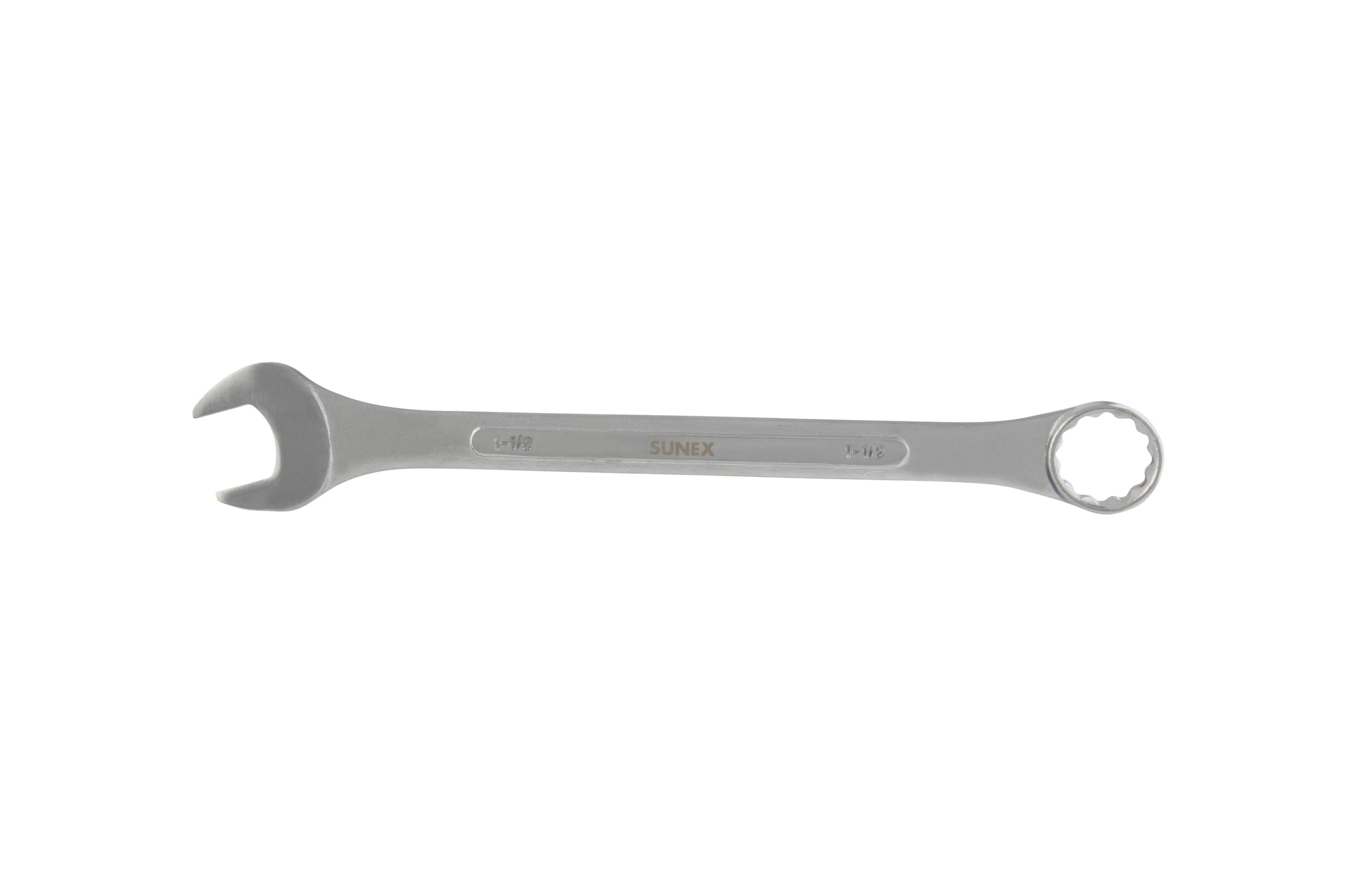
1. Sunex Tools 948A 1-1/2″ Jumbo Combination Wrench CRV
Our pick — over 4.5★ from 700+ verified ratings; the strongest balance of quality and price.
The jumbo-length lever that handles a truck fan clutch without breaking a sweat.
You get the most leverage in this lineup because the Sunex wrench measures 21.38 inches long — that is the handle length that breaks loose rusted-on nuts a shorter tool cannot budge. It is forged from chrome vanadium steel (a strong, corrosion-resistant alloy) with a polished finish, and the raised panel profile (a reinforced center section) increases strength without piling on unnecessary weight — it weighs 1.4 pounds, which is remarkably manageable for a wrench this size.
The feedback from owners is striking: the build quality is the single most-discussed reason people buy it, with an overwhelming number calling it “heavy” and “well-made.” One reviewer noted it worked perfectly for removing the large nut on a 2018 Ram fan clutch. A very small number of owners say the open end is a hair tight and needs some material shaved off — this is a known fit variance on large combo wrenches — but the box end is universally praised as precise.
What you get
- Longest handle in this lineup — 21.38 inches of pure leverage.
- Customers rave about the quality and functionality above all else.
- Includes an angled box end (15-degree offset) for better fastener access.
- Lifetime warranty from Sunex Tools backs it.
One honest note
- A few buyers found the open end slightly undersized and needed to file it for a perfect slip-fit.
Reach for this if: you are wrenching on trucks, tractors, or heavy equipment and want the longest bar for the price.
Look elsewhere if: you need a ratcheting action to save time — this is a standard combination wrench only.
2. GearWrench 12 Pt. Ratcheting Combination Wrench, 1-1/2″ – 9042
A ratcheting box end that doubles your speed on long threads.
You move faster on long threads because the GearWrench 9042 has a 12-point ratcheting mechanism in the box end — that means you keep the wrench on the fastener and rock it back and forth without lifting and resetting every turn. That is a big time saver compared to the Sunex 948A, which requires you to lift off each time. Owners who work on electrical substations and Bobcat track tensioners call it a lifesaver for exactly this reason.
The thin head and beam are purposely slimmed to fit into confined work areas where a standard combination wrench is too bulky. The off-corner loading design (the box end grips the flat side of the fastener, not the corner) is what prevents rounding even under high torque. At 19.69 inches, it is still a long tool but shorter than the Sunex, and the ratcheting action more than makes up for the slight loss in leverage on most jobs.
Why it stands out
- Ratcheting action cuts fastener removal time dramatically.
- Off-corner loading design protects fasteners from rounding.
- Owners note it handles heavy industrial use without failure.
- Limited Lifetime Warranty from GearWrench.
Size reality check
- At nearly 20 inches, this is a big wrench — not ideal for very tight engine compartments.
Best for: professional mechanics and industrial techs who need to spin fasteners fast.
skip it if: space is extremely tight — the ratcheting head adds thickness.
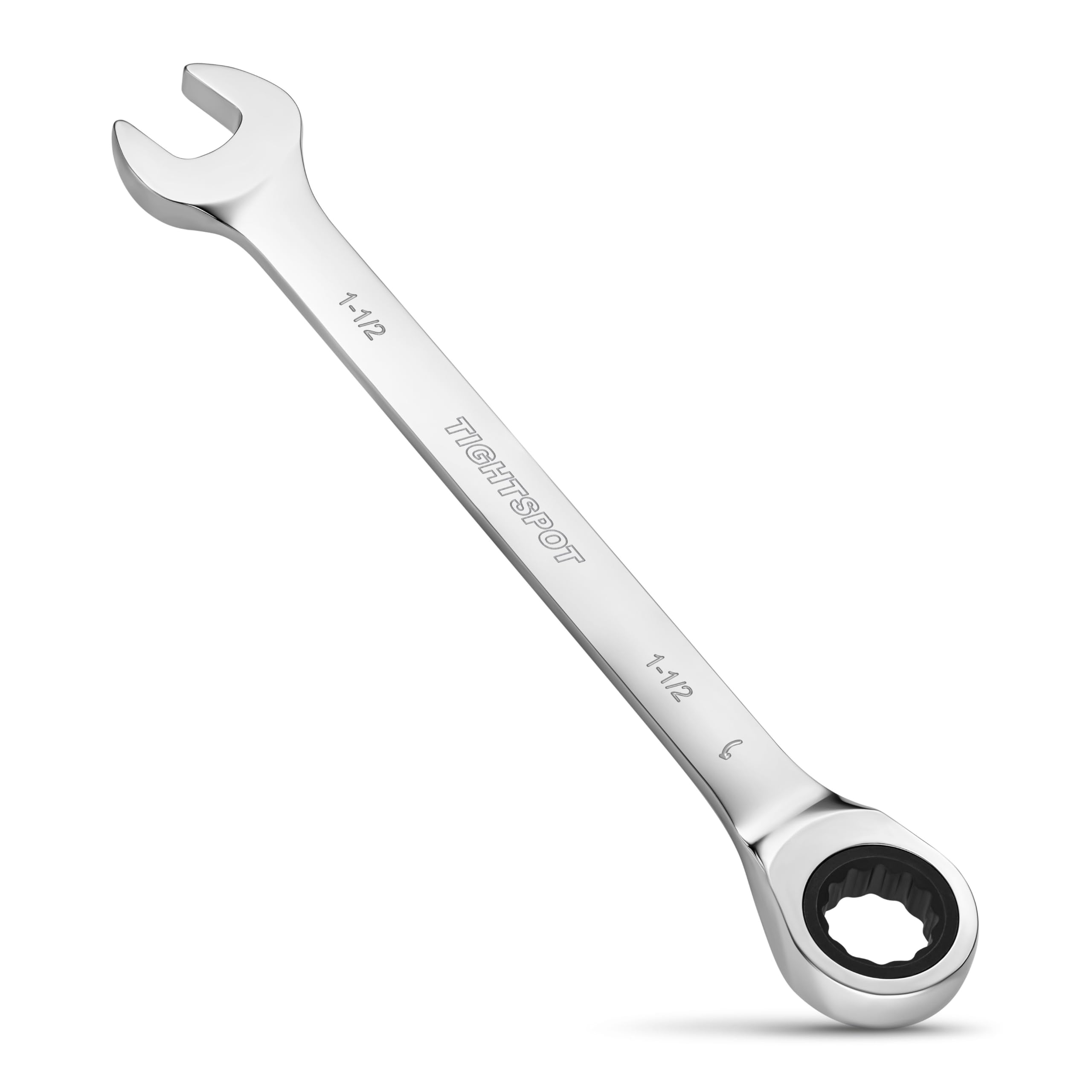
3. TightSpot 1-1/2 Inch Combo Ratchet Wrench (T-RW112IN)
A 4-degree ratcheting swing for spaces where a standard wrench has no room to move.
You can turn a fastener with barely any hand movement because the TightSpot’s 90-tooth ratcheting box end engages every 4 degrees — that is a tiny arc, so it works in spaces where the GearWrench 9042’s 19.69-inch handle would have no room to swing. The construction uses a “7-stage” drop-forging and heat-treating process the maker describes, plus aerospace-grade vanadium and chromium for corrosion resistance. Owners consistently praise the quality and note it feels comfortable in the hand. The reinforced open end is designed to reduce bolt rounding, and the company backs it with a “Guaranteed forever” policy. One catch: at 3.2 pounds, it is noticeably heavier than the Sunex 948A (1.4 pounds) or GearWrench, so it is not the lightest tool for a mobile kit.
Defining trait: If your job involves fasteners in cramped engine bays or behind machinery panels, the 4-degree swing is a genuine productivity boost.
Trade-off: The extra heft is noticeable — this is a dense tool built to last, not for weight savings.
Who it fits: equipment service techs and DIYers working on appliances or tight engine compartments.
Who it skips: anyone who wants the lightest tool in the bag.
4. Tekton 6 Inch Adjustable Wrench (1-1/2 in. Jaw Capacity) | WSA04122
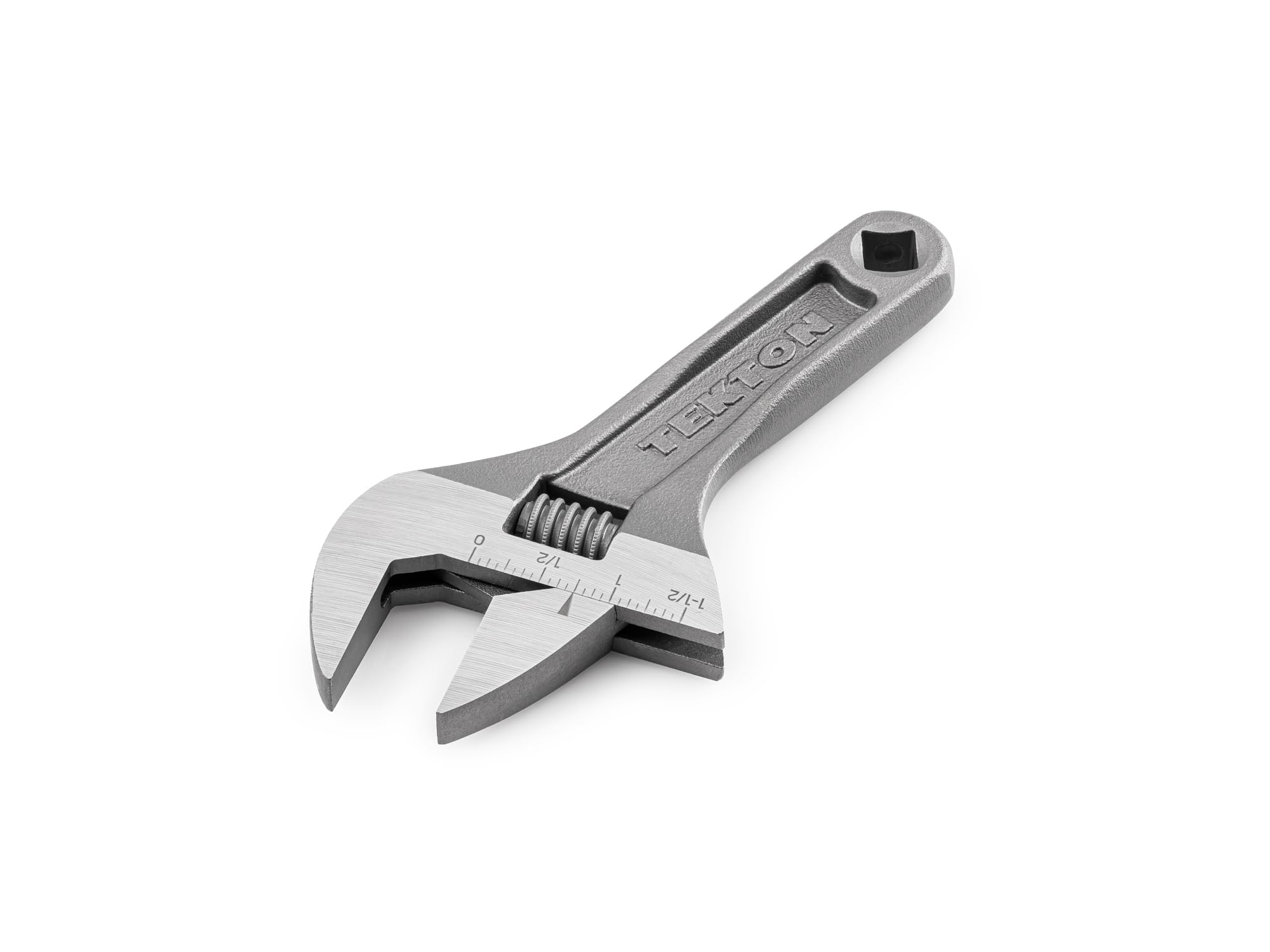
The adjustable wrench that refuses to slip open — with a hidden ratchet trick.
This Tekton is fundamentally different from every other pick on this list. It is an adjustable wrench, not a fixed combo wrench, which means it tackles any fastener from zero up to 1½ inches. The low-pitch worm gear (a threaded screw that moves the jaw) and tight tooth fit are the secret — most adjustable wrenches gradually back off under load, but this one holds its setting so well that the phrase “The hype is real” appears repeatedly in buyer feedback.
The integrated 3/8-inch square drive (a square hole at the end of the handle) is what separates it. You can plug a ratchet or breaker bar into the handle to multiply torque without any cheater pipe — a trick the fixed-combo Sunex 948A cannot do. Owners call it “heavy-duty” and note the jaw moves smoothly with precise fittings. At 6 inches long, it is the short-handle option here — not the tool for massive leverage on a stuck bolt, but a brilliant companion to a 3/8 breaker bar. The zinc phosphate coating (a matte finish) resists corrosion, and the head is ground smooth with a lightly oiled surface.
Signature innovation: the 3/8-inch drive slot turns a compact adjustable into a torque monster when paired with a breaker bar.
Honest limit: the 6-inch handle alone offers less raw turning force than the long combo wrenches — you will want a breaker bar for stubborn fasteners.
Best for: a mobile kit or service truck where you need one tool that covers many sizes.
Think twice if: you only work on one specific fastener size and prefer a fixed-length combo wrench for maximum leverage.
5. Performance Tool W344B 1-1/2-Inch Combo Wrench

A solid, affordable combo wrench that gets the job done without the premium price.
Drop-forged (hammer-pressed under high force) from chrome alloy steel with a raised panel design that increases strength, the W344B is the straightforward choice for anyone who just needs a 1½-inch wrench in the toolbox. The box end features rounded corners (a design that helps the wrench withstand high torque without slipping off the fastener), and the size is stamped clearly into the metal for quick identification.
Owners highlight the functionality and quality — it is heavy, well-made for the money, and delivers exactly what you expect. A few do note that the fit can be a bit sloppy on the open end, which is the recurring theme among budget large wrenches. On the plus side, the unpolished finish hides shop grime well, and the lifetime warranty provides a safety net. It competes directly with the Sunex 948A but at a much lower entry point, making it the choice for the careful budget buyer who does not need 21.38 inches of leverage.
Value proposition: The lowest-priced dedicated 1½-inch combo wrench here that still has forged-steel durability.
Margin note: Fit tolerance varies — a few owners mention the open end is loose, so test-fit before applying full torque.
For the buyer: occasional users and DIYers who want a capable wrench without spending premium money. It is the budget-conscious pick.
6. HHIP 7023-1024 Forged Steel Combination Wrench, 1-1/2″

A forged-steel brute that one owner tried to bend — and barely managed a degree.
The HHIP is pure simplicity: a forged steel combination wrench with a polished head, an open end, and a 15-degree offset box opening (the closed loop is angled so you can flip it for better clearance). At 2.5 pounds, it is the heaviest standard combo wrench in this comparison — a full 1.1 pounds heavier than the Sunex 948A — which tells you exactly how much steel you are getting. One owner reported wedging it in a vise and pushing with full body weight, only to bend it 1 or 2 degrees — that is the kind of strength this tool delivers.
Customers call it solid, accurate, and a good finish for the price. The quality rating is the top-discussed aspect, with value for money coming in second. The mixed-feedback area is the fit — a few owners expected a 3/8-inch drive or found the sizing slightly off for specific applications. For general-purpose turning of 1½-inch fasteners, especially on harp levers (a type of mechanical adjusting lever) and similar adjustments, owners say it is a dependable tool.
Defining strength: The 2.5-pound forged body resists flexing under extreme torque — one of the toughest picks here.
Caveat: Fit feedback is mixed, so test on your specific fastener before leaning on it with a cheater bar.
Best for: heavy adjustments where you need raw steel and do not mind the weight.
Skip if: precision fit on the first try is critical for your work.
7. Wright Tool 1448 30° Angle Service Wrench, 1-1/2″ SAE

The service wrench engineered to slip into gaps a standard wrench cannot touch.
When a lathe faceplate nut is recessed behind a stand slot, or a helicopter kit bolt is buried in an aluminum frame, the Wright Tool 1448 is the specialist you call. It is an open-end service wrench with a very thin jaw profile (the open end is purpose-built to be extra narrow for restricted clearances). The 30-degree angle head lets you approach the fastener from a better angle, reducing the swing arc — a feature the standard combo Sunex 948A does not offer.
Made in Barberton, Ohio, from a forged and machined alloy blend, this wrench meets ASME B107 hand tool standards (a set of safety and performance specs). The satin finish (a matte, non-reflective surface) gives it a non-slip grip in damp or oily conditions — one owner specifically praised that feature. The feedback is uniformly excellent on quality, though the size does get mixed reviews, mostly because some buyers expected a combo wrench rather than a pure open-end tool. At just 6.5 inches long, it does not offer the leverage of the 21-inch Sunex, but if you are in a tight space, leverage is not your problem — access is.
Specialty value: No other wrench here has a jaw this thin — it solves clearance issues that stop other tools cold.
Not for: general nut-busting where you need the torque of a long handle.
Reach for it if: you work on machinery with recessed or obstructed fastener access.
Think twice if: you want a dual-purpose open-and-box end for everyday use.
8. Tekton 1-1/2 Inch Angle Head Open End Wrench | WAE83238
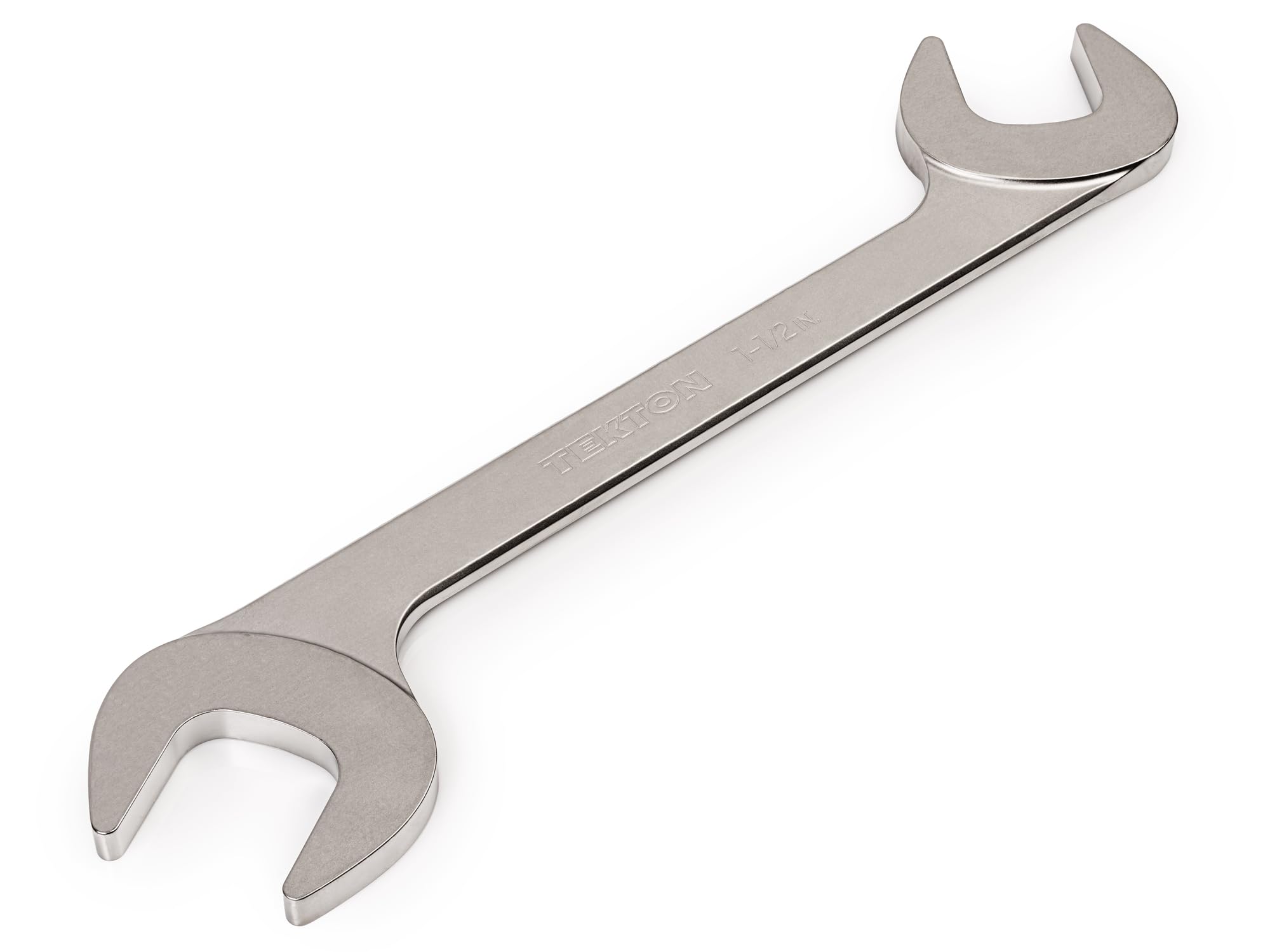
Two angled heads on one bar — 30 and 60 degrees — to beat blind spots in tight machinery.
You get two approach angles on one tool because this Tekton has both a 30-degree and a 60-degree angled open end — so you cover a wider range of tight spots without switching wrenches, unlike the single-angle Wright Tool 1448. It is made from 4140 chromium-molybdenum steel (a very tough alloy used in high-stress tools), hardened to 50–53 HRC on the Rockwell scale. The beam is shifted upward as far as possible to reduce interference, and the edges are chamfered (beveled) for a comfortable hand grip.
Professional mechanics call it a direct alternative to Snap-On at a fraction of the price, noting the same angle design for hydraulic line work. The fit is praised as excellent for lock nuts in space-constrained installations, and the satin finish is a brushed, corrosion-resistant surface. A small number of owners note that the finish has changed slightly (eco-friendly plating adjustment), but the tool quality itself is universally rated as excellent. Made in the USA.
Key advantage: dual-angle heads (30°/60°) give you the coverage of two dedicated angle wrenches in one tool.
It is not: a combination wrench — this is open-end only, no box end for final torque.
Who it serves: hydraulic mechanics and industrial techs working on confined plumbing. For the buyer who needs angle coverage, this is the precision pick.
9. Williams 1248 1-1/2-Inch Super Combo Wrench

Snap-On’s industrial brand delivers aerospace-spec precision for the critical fasteners.
The Williams 1248 is the product of Snap-On’s industrial division (JH Williams), and it brings a pedigree that meets aerospace specification AS 954 for 12-point fasteners (a strict standard for fit and strength in aviation-grade parts). The SUPERTORQUE box opening design (the box end applies force to the flat sides of the fastener, not the corners) prevents rounding even under extreme torque. At 20.03 inches, it is within striking distance of the Sunex 948A’s 21.38-inch length, but the heat-treated alloy steel and precision forging take the quality up a notch.
Multiple owners describe it as a “beautiful” tool, made in the USA with excellent craftsmanship. They consistently say it is worth the money and beats the quality of offshore-made competitors. The 7.5-degree offset broach on the box end (a slight angle cut into the closed loop) gives you 15 degrees of access when you flip the wrench — a small but meaningful advantage in confined spaces. It is expensive relative to the rest of this list, but if you trust the Snap-On lineage and want a tool that will outlast several truck payments, this is the one.
Pro-level detail: Meets aerospace spec AS 954 — the most rigorous fastener standard of any wrench here.
Reality check: The premium over the Sunex 948A is significant, and for most jobs the Sunex will do the same work for less.
Choose this if: you work to aerospace or industrial specs and want a heirloom-quality tool.
pass on it if: your budget stops at mid-range — the Sunex 948A gives you 95% of the utility for far less.
Understanding the Specs
Jaw Capacity and Wrench Length
Jaw capacity (1½ inches) is the maximum fastener size the wrench fits, but the length of the handle determines how much torque you can apply. A 21-inch wrench like the Sunex 948A gives you a long lever arm, which is essential for breaking free rusted nuts. A 6-inch wrench like the Tekton adjustable is more portable but relies on a breaker bar attachment for serious turning force. The longer the handle, the less muscle you need — but the harder it is to fit into a tight space.
Steel Type and Heat Treatment
Chrome vanadium steel (Cr-V) is the standard for most quality wrenches — it resists bending and corrosion. Chromium-molybdenum steel (Cr-Mo, or 4140) is tougher and often used in high-end tools because it withstands more cycles of stress without fatigue. The heat treatment rating (like 50–53 HRC on the Tekton angle wrench) tells you the hardness: higher numbers mean the steel is harder and more resistant to wear, but it can also be more brittle if over-hardened. Drop forging is the construction method — it aligns the grain of the steel for maximum strength.
FAQ
Will a 1½-inch wrench fit a 1½-inch bolt head?
What is the difference between a combination wrench and a ratcheting wrench?
Can I use an adjustable wrench instead of a 1½-inch combo wrench?
Why are some 1½-inch wrenches so long?
What does “offset box end” mean?
Is a polished finish better than a satin finish on a wrench?
Will a 1½-inch service wrench work for automotive work?
How do I maintain a large 1½-inch wrench?
Final Thoughts: The Verdict
For most people, the best 1½-inch wrench winner is