
Our readers keep the lights on and my garage snacks stocked. As an Amazon Associate, I earn from qualifying purchases.
Specs are compiled from manufacturer listings and verified buyer reviews and can change over time — please confirm the key details on the product page before buying.
If you drive a European car or a high-performance machine, the oil grade your owner’s manual demands isn’t a suggestion—it’s a lifeline. The “0W-40” on the bottle tells you two things: it flows like a lighter oil when your engine is stone-cold (helping every part live longer on startup) and it stays thick as honey when your engine is red-hot (keeping metal from grinding on metal). The wrong 0W-40 can cause sludge, ticking, or costly repairs that a few extra dollars could have prevented. This guide reviews nine top 0W-40 motor oils, matching each to specific engines and driving styles.
I’m Min Islam — the founder and writer behind Trending Car. This guide is built by comparing the manufacturers’ published specifications and the patterns across verified customer reviews, so you get each pick’s real strengths and trade-offs instead of marketing spin.
Whether you own a BMW, a Mercedes-Benz, a VW, or a high-mileage Jeep that calls for this critical viscosity, finding the best 0w-40 motor oil means balancing cold-start protection, high-temperature shear strength, and the specific approvals your engine needs to run its best for years to come.
Our Picks at a Glance

How To Choose The Best 0W-40 Motor Oil
Choosing the right 0W-40 oil requires more than picking the cheapest bottle. The 0W-40 category is popular because it offers a wide temperature range, but the additives, base stocks, and manufacturer approvals vary a lot between brands. Here is what you need to look at.
Start with Your Manufacturer’s Approvals
This is the single most important rule. Your car’s maker has tested certain oil formulas and given them a specific approval code — think Mercedes-Benz 229.5, BMW LL-01, VW 502.00, or Porsche A40. If a bottle lacks your engine’s required approval, do not buy it. These approvals guarantee the oil has the right additive package, high-temperature shear strength, and emissions-system compatibility to protect your particular engine. Ignoring approvals can cause sludge, premature wear, or a voided warranty.
Base Oil Type: Group III vs. PAO/Ester
Most budget-friendly synthetic oils use a Group III base oil, which is highly refined crude oil that performs much better than conventional oil. Premium options use a PAO (polyalphaolefin) or ester base — chemically engineered molecules that provide superior thermal stability, better cold-flow properties, and longer life under extreme stress. If you are running a tuned engine, driving a turbocharged car hard, or want to extend your oil change interval toward 15,000 miles or more, a PAO or ester blend is worth the extra money. Shell’s base-gas-to-liquid process (used in Pennzoil Platinum) is a notable alternative that delivers PAO-like performance.
Cold-Start Behavior and Viscosity Index
The “0W” part of 0W-40 means the oil behaves like a very thin oil at low temperatures — down to -40 degrees Fahrenheit if the spec sheet is accurate. This is critical for engines with tight tolerances and turbochargers, where oil needs to reach every bearing in seconds. A quality 0W-40 flows instantly on cold mornings; a cheaper one may cause brief valvetrain clatter. The viscosity index, though rarely printed on the bottle, tells you how well the oil resists thinning as it gets hot. A higher index means more stable protection across the full temperature range.
High-Temperature High-Shear (HTHS) for Turbo Engines
Turbocharged engines generate extreme heat and physical stress on the oil film. HTHS viscosity measures how well the oil film holds up between the piston ring and cylinder wall under those high-temperature, high-load conditions. A 0W-40 oil with a higher HTHS value is better at preventing metal-to-metal contact in a forced-induction engine. Most premium 0W-40 oils in this guide are formulated with this in mind, but if your car is chipped or tuned, prioritize oils specifically marked for “European” or “heavy duty” use.
Quick Comparison
| Model | Best For | Key Approval | Base Oil | Volume | Amazon |
|---|---|---|---|---|---|
| Mobil 1 European Car Formula★ Best Overall | Best Overall Value | MB 229.5, Porsche A40 | Group III+ | 5 Quart | Amazon |
| Valvoline European VehicleTop Performer | Best Emissions-System Safety | MB 229.5, BMW LL-01 | Group III+ | 5 Quart | Amazon |
| TRIAX Euro LXPremium Pick | Best Extended Drain | BMW LL-04, MB 229.51 | PAO/Ester | 5 Quart | Amazon |
| Pennzoil Platinum Euro | Best for Long-Term Engine Life | VW 502.00, Porsche A40 | Gas-to-Liquid | 1 Quart (6-Pack) | Amazon |
| Castrol Edge Euro | Best Premium Brand Reputation | MB 229.5, VW 502.00 | Group III | 1 Quart (6-Pack) | Amazon |
| Royal Purple High Performance | Best Smoother Operation | API-Licensed | PAO | 1 Quart (6-Pack) | Amazon |
| Royal Purple 06484 | Best Cooling Properties | API SM | PAO | 1 Quart (6-Pack) | Amazon |
| Red Line 0W40 | Best for Track/High-Perf | BMW LL-01, MB 229.5 | PAO/Ester | 1 Gallon | Amazon |
| LIQUI MOLY Synthoil Energy | Best German Engineering | VW 502.00, Porsche A40 | Group IV (PAO) | 5 Liter | Amazon |
In‑Depth Reviews
1. Mobil 1 European Car Formula Full Synthetic Motor Oil 0W-40
Our pick — over 4.5★ from 5,000+ verified ratings; the strongest balance of quality and price.
This proven bottle keeps European engines running smoothly and reliably.
Mechanics recommend this oil without hesitation. Mobil 1’s European Car Formula holds a broad array of serious approvals—MB-Approval 229.5, Porsche A40, VW 502.00, and BMW Longlife 01—so it fits everything from a VW GTI to a Mercedes S-Class. It handles internal heat up to 500 degrees Fahrenheit and stays liquid down to -40 degrees Fahrenheit, which means your engine is protected the instant you turn the key on a polar morning.
Buyers report changing their oil using this product every 5,000 miles with a quality filter and experiencing no issues whatsoever. The no-drip pour bottle and built-in fluid level gauge are thoughtful touches that keep the garage floor clean. For the vast majority of European and performance car owners looking for the most trusted name at a sensible price, this is the bottle to reach for.
What Wins People Over
- Massive owner base with near-universal praise — 4.8 stars across thousands of ratings
- Approved for the widest range of Euro brands: BMW, Mercedes, VW, Porsche, Nissan, and more
- Handled bottle with a no-drip pour spout and a built-in gauge
The Honest Trade-Off
- Not a PAO/ester blend — it is Group III+, so extreme-tuned engines may want more
- Does not meet the newer MB 229.51 low-SAPS spec for late-model diesel emissions systems
The simple verdict: Buy it if you want the safest, most-proven 0W-40 for daily-driven Euro cars.
Think twice if: You own a late-model diesel or a heavily tuned engine — step up to a PAO/ester blend.
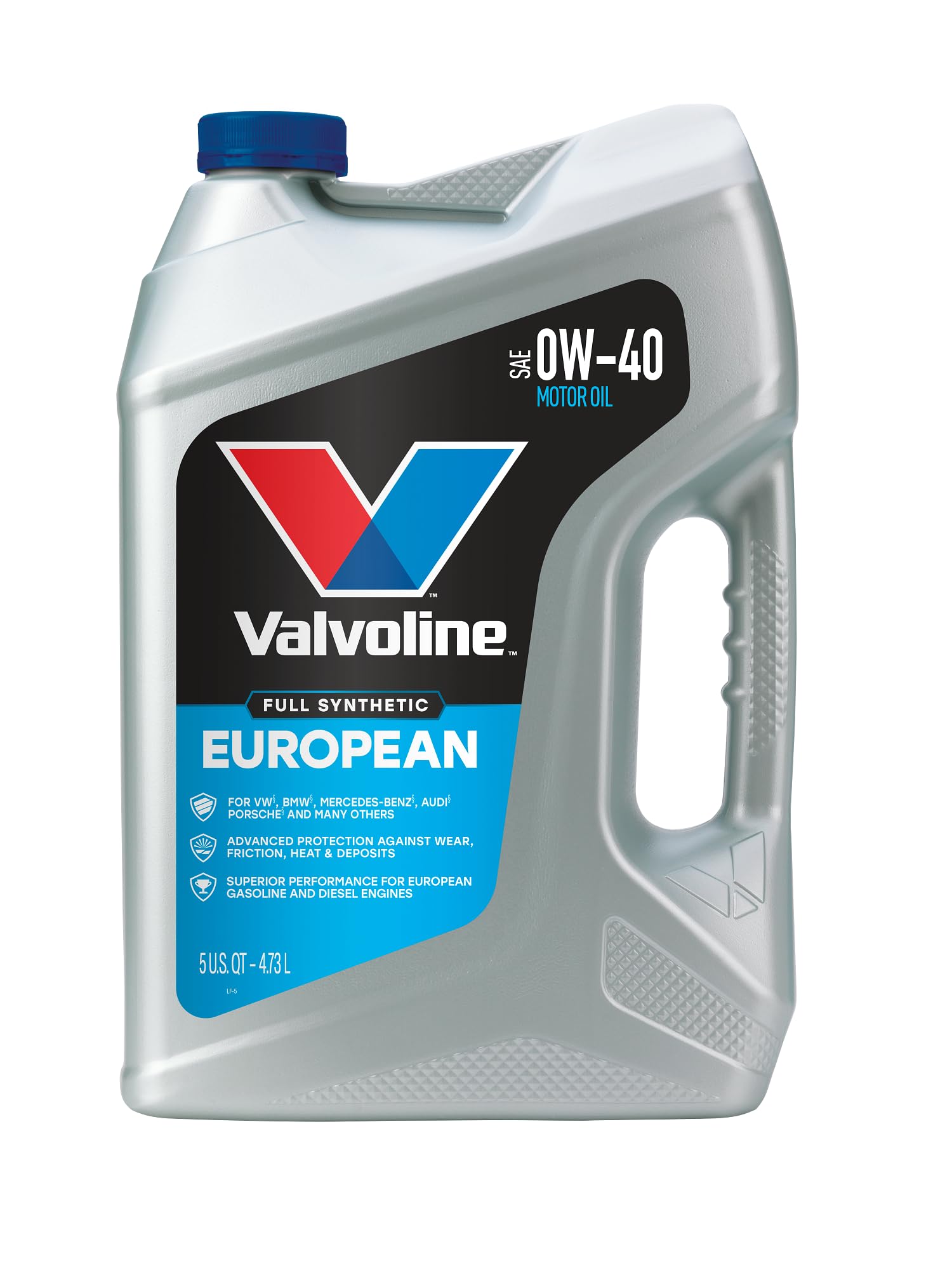
2. Valvoline European Vehicle Full Synthetic SAE 0W-40 Motor Oil 5 QT
The low-ash oil that protects both your pistons and your expensive emissions gear.
Valvoline answers a specific new-school problem. Many modern European cars — especially diesels and direct-injection gas engines — use complex particulate filters and catalytic converters that can get clogged by high-ash oil. This 0W-40 is a low-SAPS formula (Sulfated Ash, Phosphorus, and Sulfur) that keeps your emissions system happy without sacrificing wear protection. It carries approvals for Mercedes-Benz 229.5, BMW LL-01, VW 502.00, and even Chrysler MS-10725.
Owners mention using it in a Jeep Rubicon 3.6L V-6 in hot South Texas, confirming it meets Stellantis specs and does not void warranties. Many note consistent smooth operation and a noticeable difference in driving feel. The extra anti-wear additives offer more protection than the industry standard, and the 428-degree Fahrenheit flash point means it handles heat without vaporizing. This is the smart pick for anyone driving a newer Euro model with a sensitive emissions system.
Why It Stands Out
- Low-SAPS formula protects catalytic converters and DPFs
- Flash point of 428 °F resists vaporization at high temperatures
- Covers American models too — Chrysler MS-10725 and Stellantis specs
What to Consider
- Not a PAO/ester blend; uses a conventional Group III+ base
- Slightly smaller pool of reviews compared to Mobil 1
Best for: Owners of modern diesel, BlueTEC, or direct-injection European cars.
skip it if: You drive an older engine that does not need low-SAPS protection.
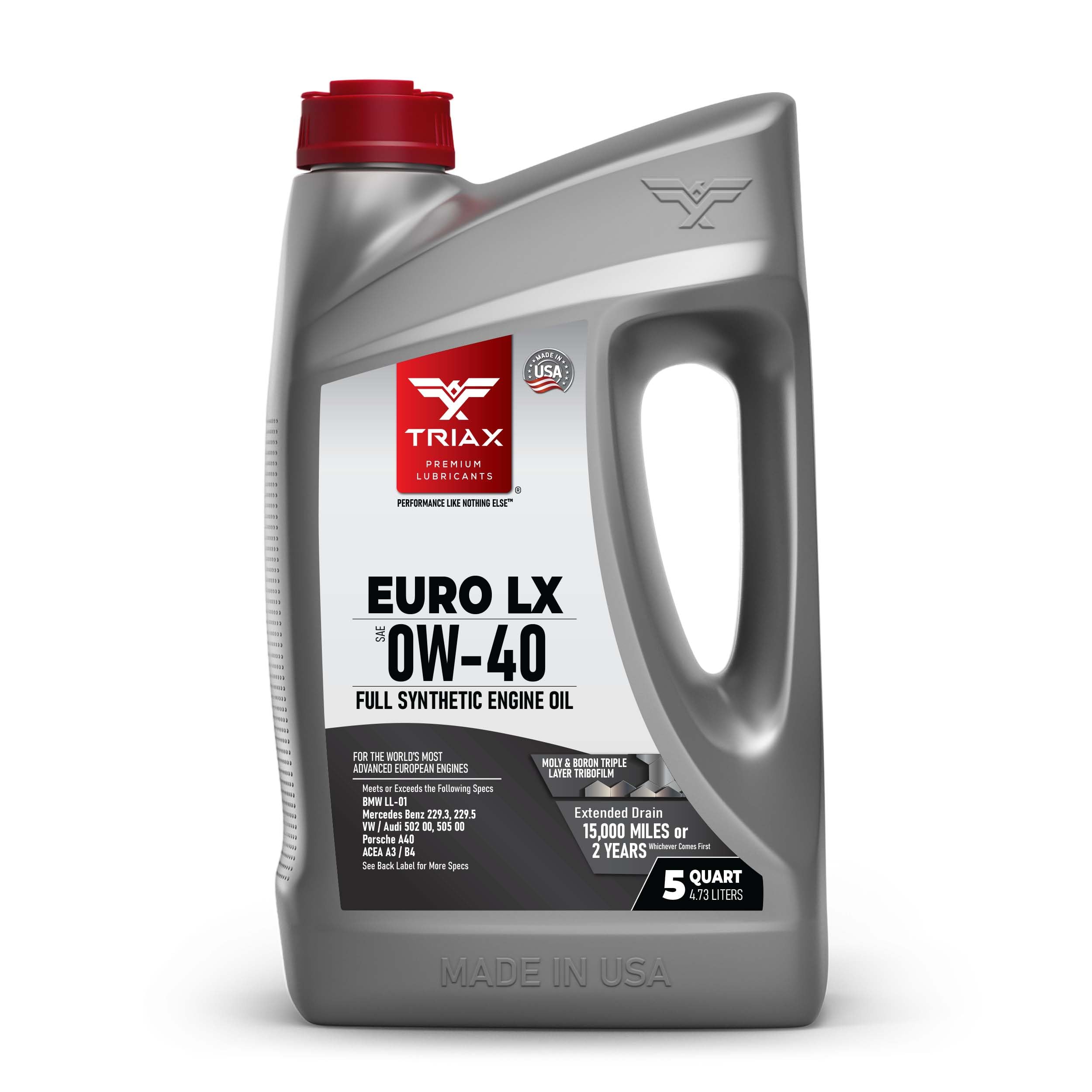
3. TRIAX Euro LX 0W-40 Full Synthetic European Car Engine Oil
The hard-core PAO/ester blend for turbo cars that get driven like they’re stolen.
TRIAX is the specialist’s choice. While Mobil 1 and Valvoline use Group III bases, TRIAX builds its Euro LX on a PAO and ester foundation, which means it resists shear, heat, and oxidation for far longer. The maker claims an extended drain interval of 20,000 miles or more — a figure that will save DIYers significant time and money.
In a real-world test, a BMW M5 Competition owner reported the engine ran “softer and less noisy” and achieved fuel efficiency on the highway close to 25 mpg on premium 93 octane gas. The oil is compatible with ACEA C3, A3/B4, BMW LL-04, and MB 229.51, making it a safe bet for newer turbocharged motors that demand low-SAPS oils. If you want maximum interceptor-level protection for a tuned or boosted engine, this is the one.
The Niche It Fills
- True PAO/ester base for extreme thermal stability and shear resistance
- Extended drain capability — up to 20,000 miles
The Catch
- Fewer owners have reviewed it — smaller sample-size, though all positive
- Price is higher per quart than the mass-market picks
Reach for this if: You have a tuned turbo (Audi 2.0T, BMW N54/B58, Mercedes M271) and want the best film strength.
Look elsewhere if: You are on a strict budget or change oil every 5,000 miles anyway.
4. Pennzoil Platinum Euro Full Synthetic 0W-40 Motor Oil (1 Quart, 6-Pack)
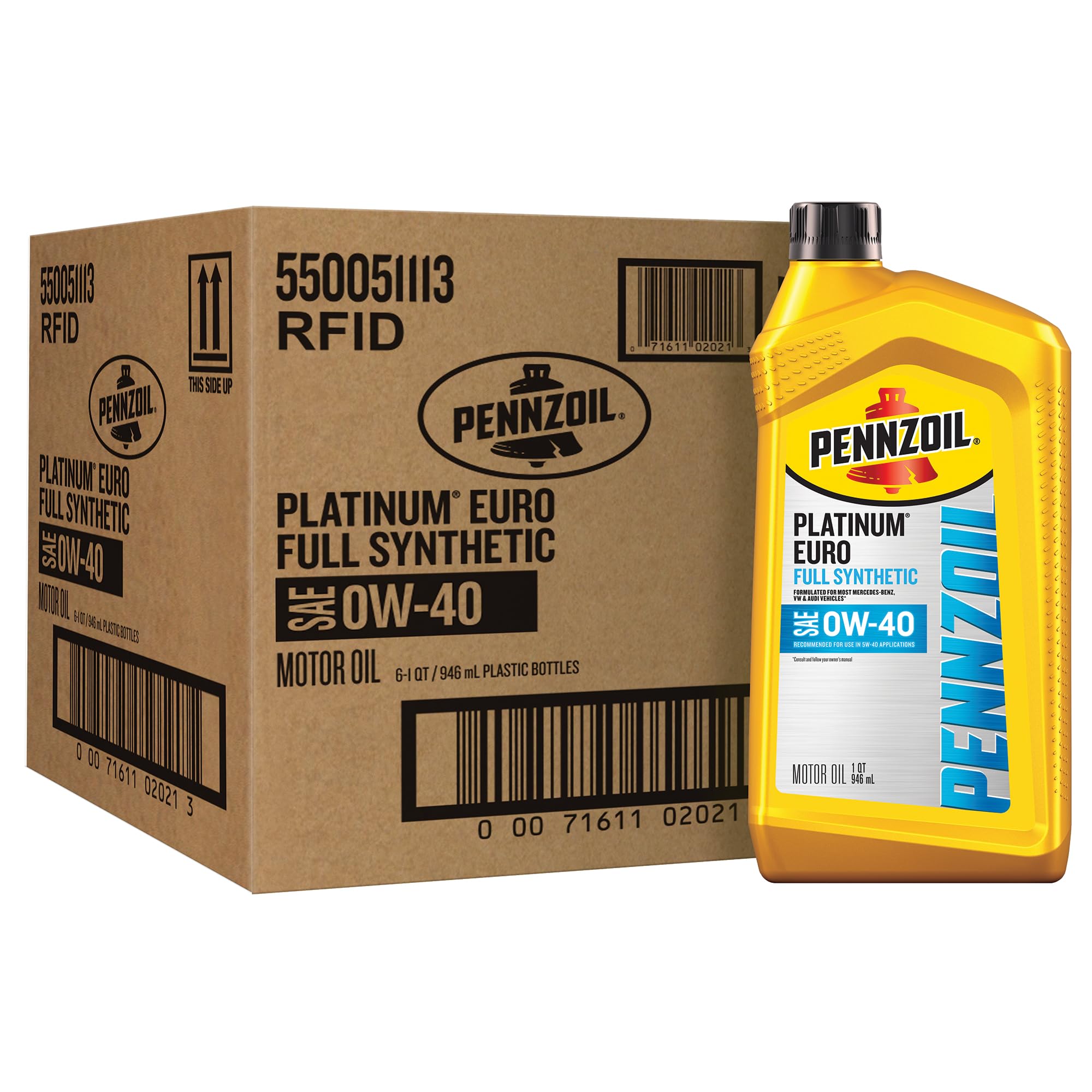
The gas-to-liquid synthetic that offers a 500,000-mile engine-life guarantee.
Pennzoil makes its Platinum oil from natural gas using a Shell process that yields an ultra-pure base stock. This means the oil has none of the contaminants found in crude-derived Group III oils, leading to better thermal stability and less sludge formation. It is formulated for Mercedes-Benz, Renault, VW, and Porsche vehicles, matching the most crucial Euro approvals.
The standout promise here is the guarantee: Pennzoil says this oil protects engines for up to 15 years or 500,000 miles — whichever comes first. Owners back this up, with one Tiguan 2.0 TSI driver noting the engine runs “super smooth” with no valve or cam chain noise at 140,000 miles. The 6-quart pack is ideal for the 5-6 quart sumps common in Euro engines, and the gas-to-liquid base means you get PAO-like purity at a Group III price.
The Smart Buy
- Ultra-pure natural gas base stock for exceptional engine cleanliness
- 15-year / 500,000-mile engine protection guarantee
- Excellent cold-flow and extreme heat resistance
A Small Note
- Not a PAO/ester — but the gas-to-liquid base is chemically similar in purity
Reach for this if: You want a modern, clean-burning synthetic with a mileage guarantee that backs its claims.
Look elsewhere if: Your engine specifically requires an ester-based oil for track or competition use.
5. Castrol Edge Euro 0W-40 A3/B4 Advanced Full Synthetic Motor Oil (1 Quart, 6-Pack)
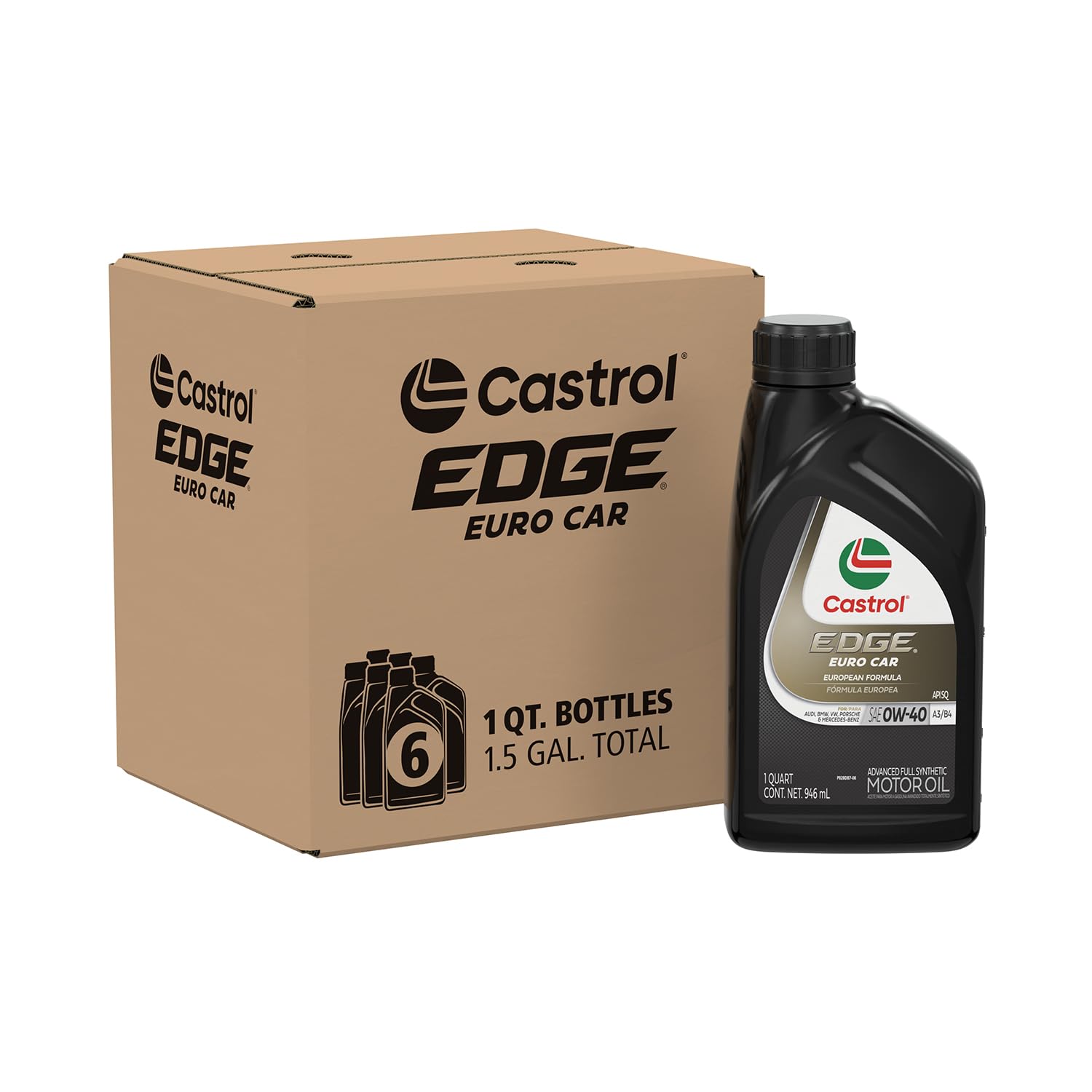
The German-made jug that die-hard Euro owners swear by for deposit-free engines.
Castrol’s Edge Euro 0W-40 is a perennial favorite among European car enthusiasts for good reason. It meets the critical big-three approvals — Mercedes-Benz 229.5, VW 502.00, and Porsche A40 — so it fits everything from an SL500 to a Jetta. The “42 percent better rating” referenced in the marketing means it outperformed industry standards in a specific deposit-fighting test, which translates to cleaner pistons and valve heads over time.
Owners with high-mileage Euro cars consistently report that the oil holds up well over extended drain intervals. One long-time Amsoil user switched to this German-made Castrol formula per verified buyer reviews themselves and gave it top marks. The price fluctuates significantly on Amazon, which can be frustrating, but for those who prioritize brand heritage and proven performance, Castrol Edge remains the gold standard for daily-driven BMWs, Porsches, and VWs.
What Keeps It Popular
- German-made blend trusted by decades of Euro car owners
- Full set of OEM approvals for BMW, Mercedes, VW, and Porsche
What to Watch
- Price is volatile on Amazon and often on the high side
- Not a PAO/ester base — uses conventional Group III
The simple verdict: Buy it if you want a time-tested, German-formulated oil with a rock-solid reputation.
Think twice if: You are on a tight budget — the price swings can make it the most expensive option in this guide.
6. Royal Purple 06484-6PK API-Licensed Heavy Duty SAE 0W-40 High Performance Synthetic Motor Oil

The purple stuff that cools and quiets engines, backed by decades of hard-core fans.
Royal Purple has among the most loyal followings in the motor oil world, and the 0W-40 version is no exception. It is API-licensed and marketed for heavy-duty use, with claims of better wear protection and improved fuel efficiency. The PAO base stock is visible in the claimed performance benefits: customers note “smoother, cooler operation” and the ability to extend oil change intervals compared to conventional synthetics.
The biggest conversation among owners centers on value. While some consider it “well worth the price,” others find it “a waste of money” compared to cheaper options. The quality of the oil (a top positive aspect among dozens of owners) is never in doubt, but the price premium may not be justified for every driver. If you want a high-performance lubricant for an engine that gets regular track time or heavy towing, this is a strong candidate.
The Strengths
- PAO-based synthetic for superior high-temperature stability
- Owners consistently praise smoother and cooler running engines
- Better ethanol-compatibility claimed for modern flex-fuel vehicles
The Honest Trade-Off
- Value-for-money reviews are mixed — some see it as costly for what it is
- Lacks some specific European OEM approvals (e.g., MB 229.5) that other oils carry
Best for: Performance enthusiasts who want a PAO oil and believe Royal Purple’s cooler-running claims.
pass on it if: You need a specific OEM approval like MB 229.5 or VW 502.00 printed on the bottle.
7. Royal Purple 06484 Motor Oil — 0W40 SM — 6 Pack

The go-to purple juice for big American V8s that need a 0W-40 diet.
This is the same Royal Purple 0W-40 formulation offered in a different 6-pack arrangement. The appeal here is for owners of high-performance American V8s — the 6.4 Hemi crowd, for instance — who want a premium oil to keep their engines cool and smooth. Reviewers point out gaining 30 extra miles per tank on a 2009 Nissan Versa after switching, and describe the oil as “the best oil you can buy for high performance.”
Long-term users — spanning 10 to 20 years — report smoother and cooler operation, along with the ability to extend oil change intervals. However, some owners who have used it in modern turbocharged Euro cars note no noticeable performance or temperature improvement over OEM or Mobil 1. If you are running an American muscle car or a heavy-duty truck that specifies 0W-40, this is a proven pick.
The High Points
- Excellent for American V8s like the 6.4 Hemi and Chrysler heavy-duty engines
- Reportedly delivers cooler and smoother operation
- Decades of loyal owner following
A Consideration
- Some owners of modern turbo Euro cars felt no improvement over cheaper oils
The simple verdict: A high-quality PAO oil for American performance engines and those who trust the brand.
Think twice if: You are a purely European-turbo owner — Mobil 1 or Valvoline may offer better value for your specific needs.
8. Red Line 11105 SAE 0W40 Fully Synthetic Motor Oil (1 Gallon)

The ester-rich track oil that eliminates cold-start valvetrain chatter for good.
Red Line is the quiet powerhouse of the synthetic oil world. Their 0W40 uses a full ester/PAO base stock with natural multi-grade properties, meaning it does not rely on viscosity index improvers — additives that can shear down over time. For the driver of a tuned 6.4 Hemi or a modified turbo diesel, Red Line’s high zinc and phosphorus content offers superior anti-wear protection for flat-tappet camshafts and high-load bearings.
Owners of high-strung engines report that the ester basestock adheres to components overnight, meaning there is no valvetrain noise on cold starts — even in winter. One Porsche Boxster S owner said it runs “smoother than Mobil 1, Fuchs, Motul 8100.” It consistently beats out Amsoil and other premium oils in real-world comparisons, making it the undisputed king for track-day specials and heavily modified performance cars.
The Track-Day Edge
- Full ester/PAO base with no VI improvers — resists shear for the life of the oil
- High zinc/phosphorus for flat-tappet cam and high-load bearing protection
- Eliminates cold-start valvetrain noise; shoppers say immediate smoothness
The Trade-Off
- The most expensive oil on this list by a wide margin
- Sold by the gallon — not all engines take a full gallon
Reach for this if: You track your car, run a high-lift cam, or drive a modified turbo diesel and want the best possible protection.
Look elsewhere if: You do not have a high-performance or modified engine — the extra cost offers no real benefit.
9. LIQUI MOLY Synthoil Energy A40 SAE 0W-40 | 5 Liter

The German group IV oil that whispers through your engine at idle and pulls hard at redline.
Liqui Moly is the reputation pick among German car aficionados. This Synthoil Energy is a true Group IV (PAO) base oil, which makes it a legitimate full synthetic in the purest sense. It carries Porsche A40, VW 502.00, and the critical BMW and Mercedes approvals, so it fits everything from an Audi A6 to a VW Golf R. The 5-liter jug is perfectly sized for most European engines that take around 4.5 to 5.5 liters.
Owners with modified VW Golf Rs report wear indicators “well below average” — iron levels as low as 1-2 ppm at 5,000-mile changes — and a quieter, smoother engine sound compared to Mobil 1. Some note that the oil is thicker when cold, which can cause momentary timing chain noise on a cold Audi 2.0T, but warmer operation is exceptionally refined. For the purist who wants a German-established full synthetic, this is the definitive choice.
The German Legacy
- True Group IV (PAO) base oil — the “real” synthetic
- Impressive engine-wear indicators: 1-2 ppm iron at 5K miles in a Golf R
- 5-liter jug matches the sump size of most Euro cars perfectly
What to Know
- Cold-start timing chain noise possible in some VAG engines below 40°F
- Premium price — expect to pay more than the Mobil 1
Reach for this if: You want the confidence of a German-made Group IV oil for your Audi, BMW, VW, or Porsche.
Look elsewhere if: You live in a very cold climate — the thicker cold behavior may cause brief startup noises.
Understanding the Specs
OEM Approvals (MB 229.5, VW 502.00, BMW LL-01)
These are not marketing buzzwords — they are engineering guarantees. When an oil bottle carries the “MB 229.5” stamp, it means Mercedes-Benz has tested that specific formulation in its engines and confirmed it meets their standards for wear protection, sludge resistance, and oil life. Using an oil without your car’s required approval can lead to premature engine wear, especially in modern engines with variable valve timing and turbochargers. Always check your owner’s manual or oil cap first, and find the oil that carries exactly that approval number on the label.
Base Oil Groups (Group III vs. PAO vs. Ester)
All modern synthetic oils are not equal. Group III is highly refined crude oil — it performs miles better than conventional oil but still has some natural impurities. PAO (Group IV) is chemically engineered from smaller molecules to create a perfectly consistent lubricant with no impurities. Ester (Group V) is another engineered molecule that has a polarized nature, meaning it clings to metal longer at shutdown, reducing startup wear. A “PAO/Ester” blend offers the best of both worlds: extreme thermal stability from the PAO and the cling-film protection of esters. These blends are overkill for a daily commuter but essential for tuned or heavily stressed engines.
FAQ
Can I use 0W-40 instead of 5W-30 or 0W-20 in my engine?
What is the difference between 0W-40 and 5W-40 for my European car?
How often should I change 0W-40 synthetic oil?
Is Royal Purple worth the extra money over Mobil 1 for my daily driver?
What does “low-SAPS” mean, and do I need it?
Can I mix different brands of 0W-40 motor oil?
What is the difference between API SN and API SP ratings in 0W-40 oil?
Does 0W-40 protect my turbo engine better than 5W-40?
Is Liqui Moly oil better than Castrol for my BMW?
Final Thoughts: The Verdict
For most buyers, the best 0w-40 motor oil is the Mobil 1 European Car Formula because it combines near-universal OEM approvals, a massive 4.8-star owner base, and a price that undercuts most premium competitors. If you need low-SAPS protection for a modern diesel or direct-injection Euro car, the Valvoline European Vehicle is the safer pick that won’t compromise your emissions system. And for the tuner or track-day enthusiast with a heavily modified engine, the Red Line 0W40 delivers uncompromising ester/PAO protection that leaves nothing to chance — if you can handle the premium price. Whichever you choose, matching the oil’s OEM approval to your owner’s manual guarantee is the only guarantee worth chasing.
How We Picked
We do not accept paid placement. Every pick is matched to a real buyer and a real use-case; we do not hands-on test units.
Sources & Methodology
Specifications: manufacturer listings and product documentation. Review insights: verified customer reviews, as of July 2026. Pricing: not shown on this page (it changes often); check the current price via the retailer link.
As an Amazon Associate, Trending Car earns from qualifying purchases. This does not affect which products we feature.