
Our readers keep the lights on and my garage snacks stocked. As an Amazon Associate, I earn from qualifying purchases.
Specs are compiled from manufacturer listings and verified buyer reviews and can change over time — please confirm the key details on the product page before buying.
Nothing ruins a perfect day on the water faster than an engine that sputters, stalls, or won’t start because the fuel has gone bad. Ethanol-blended gasoline is the culprit—it attracts moisture, turns into varnish, and clogs your carburetor or injectors in just a few months. The right marine fuel stabilizer stops that process cold, keeping your gas fresh and your engine reliable every time you turn the key.
I’m Min Islam — the founder and writer behind Trending Car. This guide is built by comparing the manufacturers’ published specifications and the patterns across verified customer reviews, so you get each pick’s real strengths and trade-offs instead of marketing spin.
Whether you run a high-horsepower outboard or a small trolling motor, you need a stabilizer formulated for marine use that fights ethanol damage, corrosion, and water. Here is your complete guide to the best marine fuel stabilizer options for every size of boat and every season of storage.
Our Picks at a Glance

How To Choose The Best Marine Fuel Stabilizer
Not all fuel additives are the same. A stabilizer built for a car may not protect your boat’s fuel system from the moisture and vibration that marine engines face. Here is what to check before you buy.
Marine-Specific Formula vs. Universal Additives
A marine formula is engineered to handle ethanol-blended gasoline in high-humidity environments. It fights phase separation (when ethanol and water separate from the gasoline) and includes corrosion inhibitors that protect metal components from salt and moisture. Universal car additives often lack these protections and can leave your fuel system vulnerable.
Water Removal and Phase Separation Protection
Water in your fuel tank is the fastest way to ruin an engine. Look for a stabilizer that absorbs or disperses water so it can burn off safely during combustion. Products labeled with water removal or phase separation inhibitor give you an extra layer of defense, especially if you store your boat for long periods.
Storage Duration and Treatment Ratio
Some stabilizers keep fuel fresh for just a few months, while others protect for up to two years. Check the treatment ratio (ounces per gallon) so you know how much to add at each fill-up. High-concentration formulas treat more fuel per bottle, making them more cost-effective for larger tanks or frequent use.
Quick Comparison
| Model | Best For | Bottle Size | Water Protection | Storage Life | Amazon |
|---|---|---|---|---|---|
| Mercury Quickare 8M0047930★ Best Overall | Fuel fresh between fill-ups | 12 oz | Yes | 3 months | Amazon |
| Yamaha Yamalube 32 ozBest Value | Yamaha outboard owners | 32 oz | Yes | 1 year | Amazon |
| Star Brite PRO Star 8 ozPremium Pick | Winterizing in one step | 8 oz | Yes | 1 year | Amazon |
| STA-BIL MARINE FORMULA 8 oz | Long-term ethanol protection | 8 oz | Yes | 2 years | Amazon |
| STA-BIL Marine Tune-Up 8 oz | Cleaning gunked carbs | 8 oz | Yes | 1 year | Amazon |
| K100 Marine Grade 32 oz | Water removal specialist | 32 oz | Yes | 1 year | Amazon |
| Johnson Evinrude OMC 2+4 32 oz | Classic OMC engines | 32 oz | Yes | 2 years | Amazon |
| Ethanol Shield MARINE 2×24 oz | Water removal + cleaning | 48 oz (2-pack) | Yes | 1 year | Amazon |
| CRC Marine Gasoline Stabilizer 1 gal | Fleet / large tank storage | 1 gallon | Yes | 1 year | Amazon |
In‑Depth Reviews
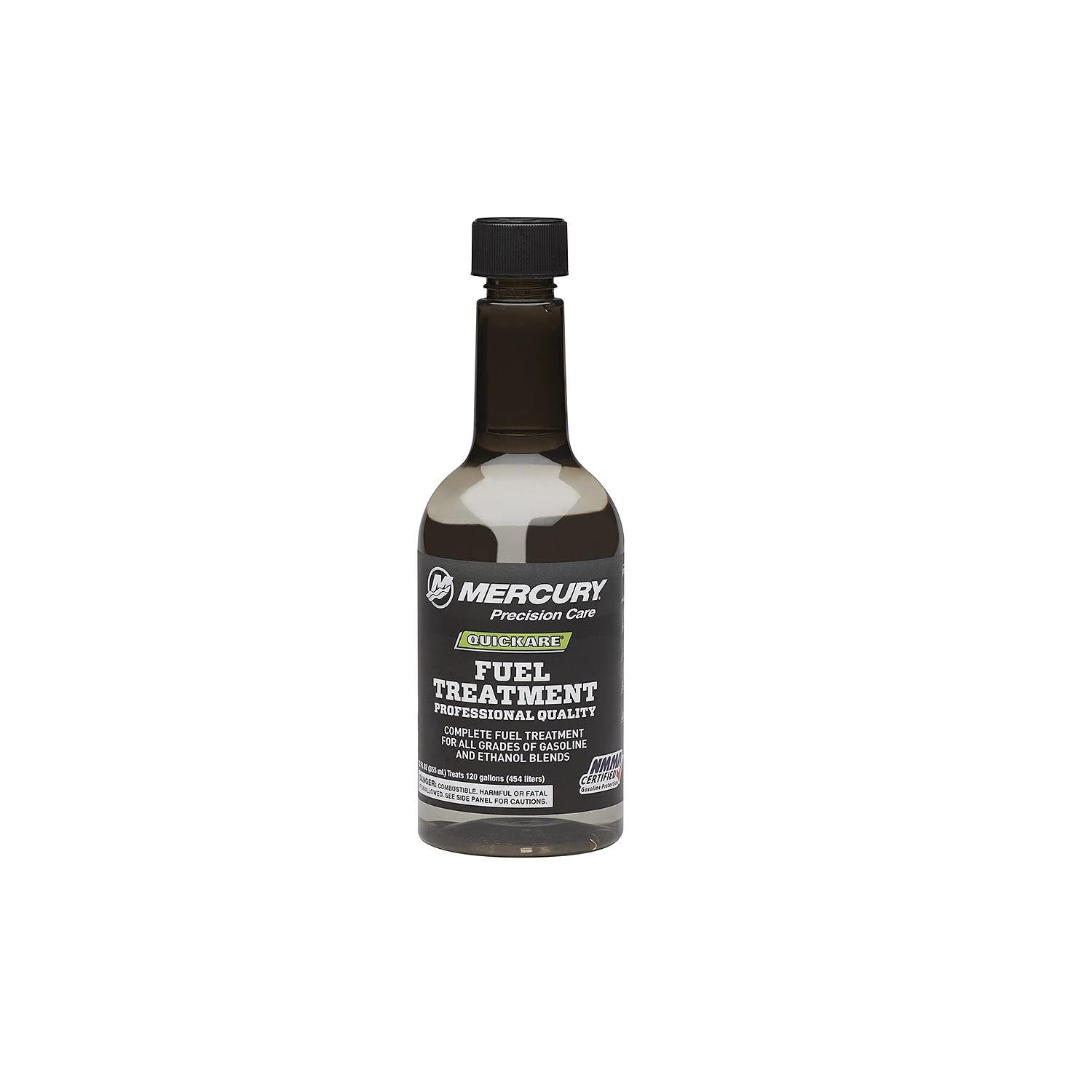
1. Mercury Quickare Fuel Treatment Additive 12 oz
Our pick — over 4.5★ from 500+ verified ratings; the strongest balance of quality and price.
The crowd-pleasing stabilizer that keeps a 250 HP Yamaha SHO humming fill-up after fill-up.
You get a smooth start every time because Mercury poured decades of marine engineering into the Quickare formula. The bottle holds 12 fluid ounces, and you only need 1 ounce to treat 10 gallons of gasoline. That means a single bottle handles 120 gallons of fuel, making it among the most cost-effective per-gallon options in this lineup. Owners running everything from a Mercury 225 Optimax to a 250 HP Yamaha SHO report the engine stays smooth between fill-ups, with no stalling or hesitation.
The consensus is clear: this is the do-it-all additive for anyone who owns a boat. Buyers call it a “must for any boater” and praise its ability to control corrosion, gumming, and varnish from ethanol-blended gasoline — it keeps fuel fresh for up to 3 months. While the Mercury sticker is a natural fit for Mercury engines, the formula works across all marine gasoline engines.
Performance-first design: The most-discussed feature is performance — 13 owners call it out by name. A close second is fuel performance, with 10 more buyers saying it eliminates ethanol issues entirely. Across 522 ratings, the average holds at a near-perfect 4.8 stars. For reference, this bottle is 8 x 7 x 8 inches and weighs 9.6 ounces, notably heavier than the 7.5-ounce STA-BIL Tune-Up, but the extra heft comes from a larger, more concentrated volume.
Who it fits: Any boater who wants a reliable ethanol fighter for daily use and weekend runs, backed by a name that has engineered marine engines for decades.
One honest nudge: The 3-month storage life means it is not the best choice for overwintering your boat — for that, look at the Star Brite or CRC picks below.
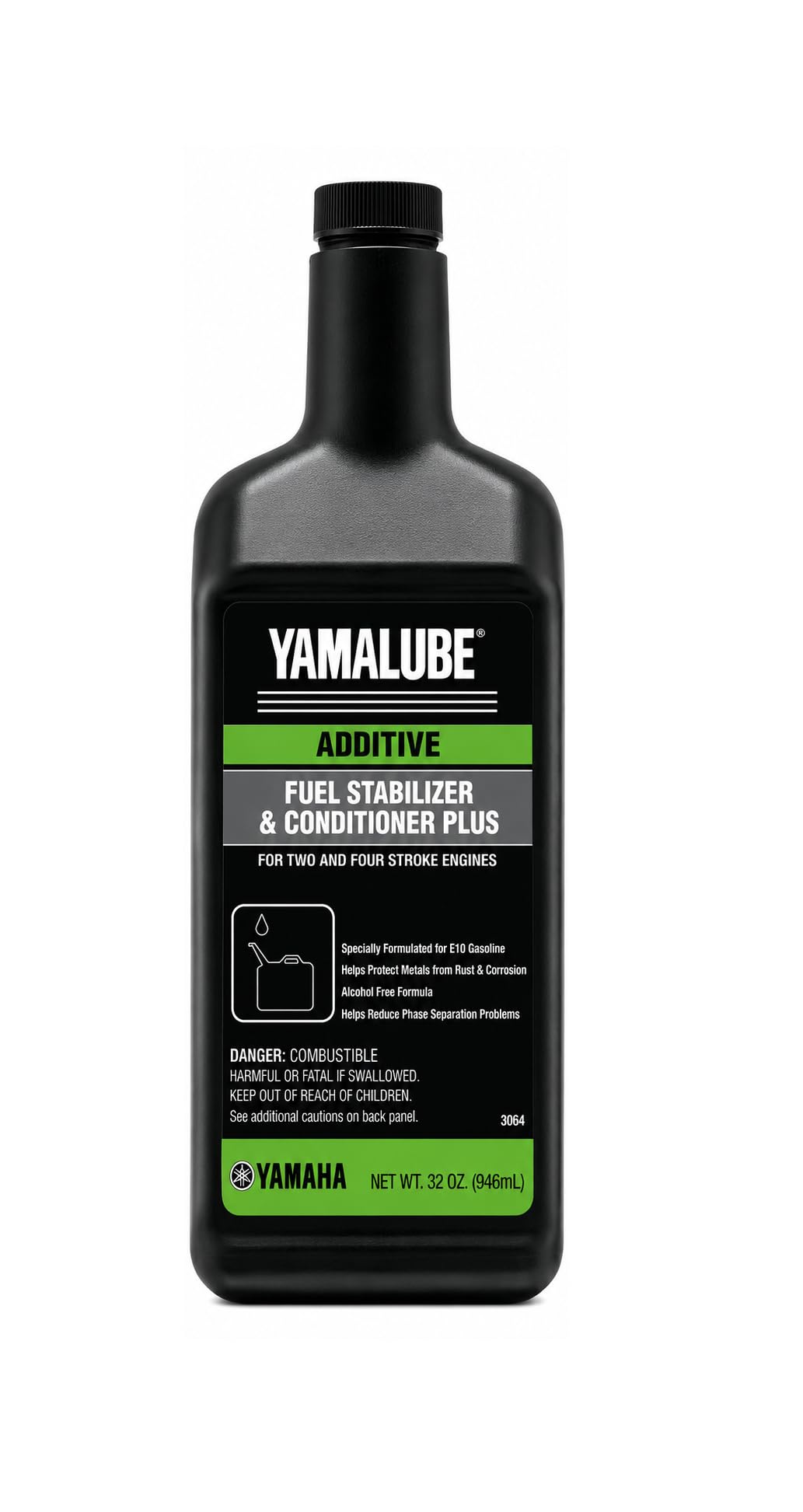
2. Yamaha Yamalube Fuel Stabilizer & Conditioner 32 oz
A 32-ounce jug of genuine Yamaha protection that has taken one owner past 1,000 hours without a fuel issue.
When the manufacturer of your outboard builds a stabilizer, you expect a perfect match — and Yamaha delivers. The Yamalube Fuel Stabilizer & Conditioner comes in a 32-ounce bottle that measures 3.5 x 3 x 9 inches, at 32 ounces versus the STA-BIL MARINE 8-ounce bottle. That larger container means fewer trips to the marina store and more cost per ounce. Owners say the formula has kept their engines fuel-related-issue-free for ten straight years.
The reviews back it up: functionality and quality are the two most-praised aspects. One owner with a Yamaha 250 reports over 1,000 hours on the engine and says the engine “is running strong.” It works on Mercury engines too, according to buyers — flexibility that makes it a smart choice for households with multiple outboard brands.
Brand-match advantage: If you own a Yamaha outboard, this is the stabilizer designed specifically for its fuel system. The 4.8-star average across 245 ratings confirms owners trust it for long-term storage and daily running. At 1.87 pounds, it is heavier than the 9.6-ounce Mercury bottle, but that is the trade-off for double the capacity.
Reach for it if: You want genuine OEM-grade protection for a Yamaha outboard, or you run mixed-brand engines and prefer a large bottle that covers frequent fill-ups.
Look elsewhere if: Your boat sits idle for years at a time — the Johnson Evinrude and Ethanol Shield formulas offer longer preservation for seasonal equipment.
3. Star Brite PRO Star Gasoline Stabilizer & Fogger 8 oz
The one-step winterizer that fogs your engine and stabilizes your fuel simultaneously.
Star Brite designed PRO Star to eliminate a tedious step in winter storage: after you add it to the gas and run the engine, it provides passive light fogging inside the cylinders. That means you can skip the spark-plug removal and manual fogging spray that most boat owners dread. It protects both 2-stroke and 4-stroke gasoline engines, and reviewers have used it on snowmobiles, generators, and lawn equipment with equal success.
Fuel stabilization is the most-praised aspect (8 mentions), and owners who have used it for more than 10 years report no fuel issues whatsoever. The product keeps gas fresh for up to 1 year and prevents corrosion in the fuel tank and delivery system. A satisfied buyer who also uses it on golf carts and pressure washers sums it up: “never had an issue after 10 years of using it.” The 8-ounce bottle is rated for inboard and outboard engines, and the manufacturer offers a satisfaction guarantee with a 30-day return window.
Winterization time-saver: The combination of stabilizer and fogger in a single pour is the standout feature — buyers report it saves significant effort compared to traditional fogging methods. At 4.6 stars from 146 ratings, it trails the Mercury and Ethanol Shield by a narrow margin, but the convenience factor is class-leading for seasonal storage.
Best for: The owner who stores their boat every winter and wants to knock out stabilization and fogging in one step, then walk away until spring without pulling spark plugs.
The catch: The 8-ounce bottle treats fewer gallons than the gallon jug options — if you have a large tank, you will need multiple bottles or a transition to the CRC gallon.
4. STA-BIL MARINE FORMULA ETHANOL TREATMENT 8 oz

The blue formula that owners say keeps gasoline usable for two years — even after a season in the tank.
Gold Eagle’s STA-BIL Marine Formula is the ethanol-treatment specialist. Buyers routinely pair it with SeaFoam and report that gas stays usable for up to two years, . The 8-ounce bottle measures 7.1 x 3.6 x 1.4 inches and weighs 9.6 ounces — a noticeably smaller footprint than the Yamaha 32-ounce, which fits more easily into a cramped glovebox or tool locker.
Quality is the most-praised aspect (9 mentions), and fuel retention (8 mentions) comes a close second. One long-term user says the formula is stronger than the standard red STA-BIL, requiring a smaller volume per gallon, which makes each bottle more cost-effective. The Project Farm test rated it top in its category. Reviewers who have used it for 15+ years confirm it prevents carburetor rebuilds by keeping ethanol mixed with the gasoline.
Long-term champion: If you need to store a boat, a generator, or lawn equipment for a full off-season, this is the stabilizer with the best real-world evidence for extended protection. It holds 4.8 stars from 253 ratings, nearly matching the Mercury. Note: the bottle is 1.4 inches thin, so it slides into tight compartments easily.
Reach for this if: You plan to leave your boat or equipment sitting for a year or more — the two-year fuel life is verified by owners.
Not if: You need a fuel-system cleaner rather than a pure stabilizer; the Marine Tune-Up below is better for existing gum and varnish.
5. STA-BIL Marine Tune-Up Fuel Treatment 8 oz

The tune-up in a bottle that revived a Volvo Penta engine from 3,000 to 5,000 RPM in 20 minutes.
While most stabilizers purely preserve fuel, the STA-BIL Marine Tune-Up actively cleans carburetors, injectors, and intake valves. One owner with a Volvo Penta 4.3 GX-i saw RPM rise from 3,000 to 5,000 after just 20 minutes of running — using two-year-old stabilized gas. The formula treats up to 20 gallons and eliminates water from the fuel system. It also restores performance on rough-running engines, which is why functionality is the most-cited praise (23 mentions).
Quality runs second (13 mentions), and buyers appreciate that the same product works for a bass boat, a Harley, and lawn equipment. The 8-ounce bottle weighs 7.5 ounces, lighter than the 9.6-ounce STA-BIL Marine Formula, and the 6 x 3 x 3-inch dimensions make it compact. The only aspect that draws mixed feedback is engine performance — a few owners mention that their engine still ran rough after treatment, so it is not a miracle cure for mechanical issues like worn spark plugs.
Restorative ability: This is the pick for bringing a neglected engine back to life. The Tune-Up combines cleaning and stabilizing in one formula, and customers note it fixes sputtering in under 10 minutes. At 4.7 stars from 503 ratings, it is the second-most-reviewed product in the lineup, just behind the K100.
Best for: Anyone who bought a used boat, has an engine that runs rough, or wants to clean out years of varnish while also protecting the fuel.
skip it if: Your engine is already running perfectly and you only need a long-term stabilizer — the Marine Formula above or the CRC gallon are better for pure storage.
6. K100 Marine Grade Gasoline Fuel Treatment 32 oz
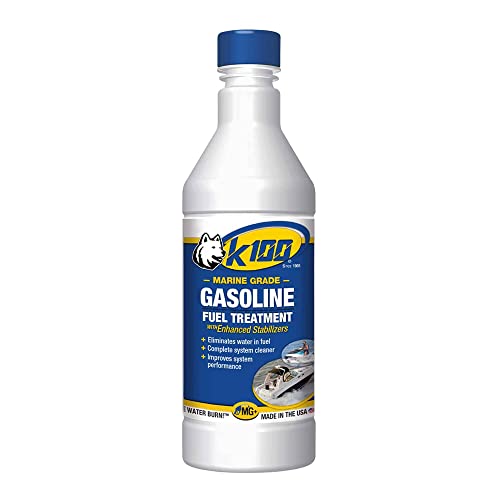
The fuel treatment that claims to change water’s molecular structure so it burns instead of clogging.
K100’s Marine Grade formula is engineered specifically to eliminate water from fuel — a claim it backs up with a highly convinced owner base. The liquid volume is 32 fluid ounces, and it treats gasoline and diesel for cars, trucks, boats, motorcycles, and lawn equipment. Buyers in Northern Quebec and Atlantic Canada report that engines unused for 2-3 years start on the first pull after treatment. One owner rescued a boat with a quarter-tank of water-contaminated fuel by running three bottles through the system.
Quality (78 mentions) and effectiveness (58 mentions) dominate the praise. However, water removal and engine start-up receive mixed feedback — some owners see less dramatic results than others. The bottle includes a 2-point octane boost and cleans the entire fuel system, dissolving gum and varnish. The 32-ounce size is a solid middle ground between the small 8-ounce bottles and the gallon jugs.
Water removal leader: If you suspect water in your tank (a common issue after storms or long storage), this is the stabilizer with the strongest owner evidence for handling it. At 4.7 stars from 691 ratings, it is the most-reviewed product here, giving it a broad confidence base. The bottle measures 32 fluid ounces and includes a caution: it can damage furniture and painted surfaces if spilled, so handle with care.
Reach for it if: You have a known water problem in your fuel tank, run a boat that sits for long periods in a humid climate, or want a versatile treatment that works on multiple vehicle types.
Look elsewhere if: You want a pure stabilizer with no cleaning additives; the standard STA-BIL Marine Formula or Johnson Evinrude 2+4 are simpler for straight preservation.
7. Johnson Evinrude OMC 2+4 Fuel Conditioner & Stabilizer 32 oz
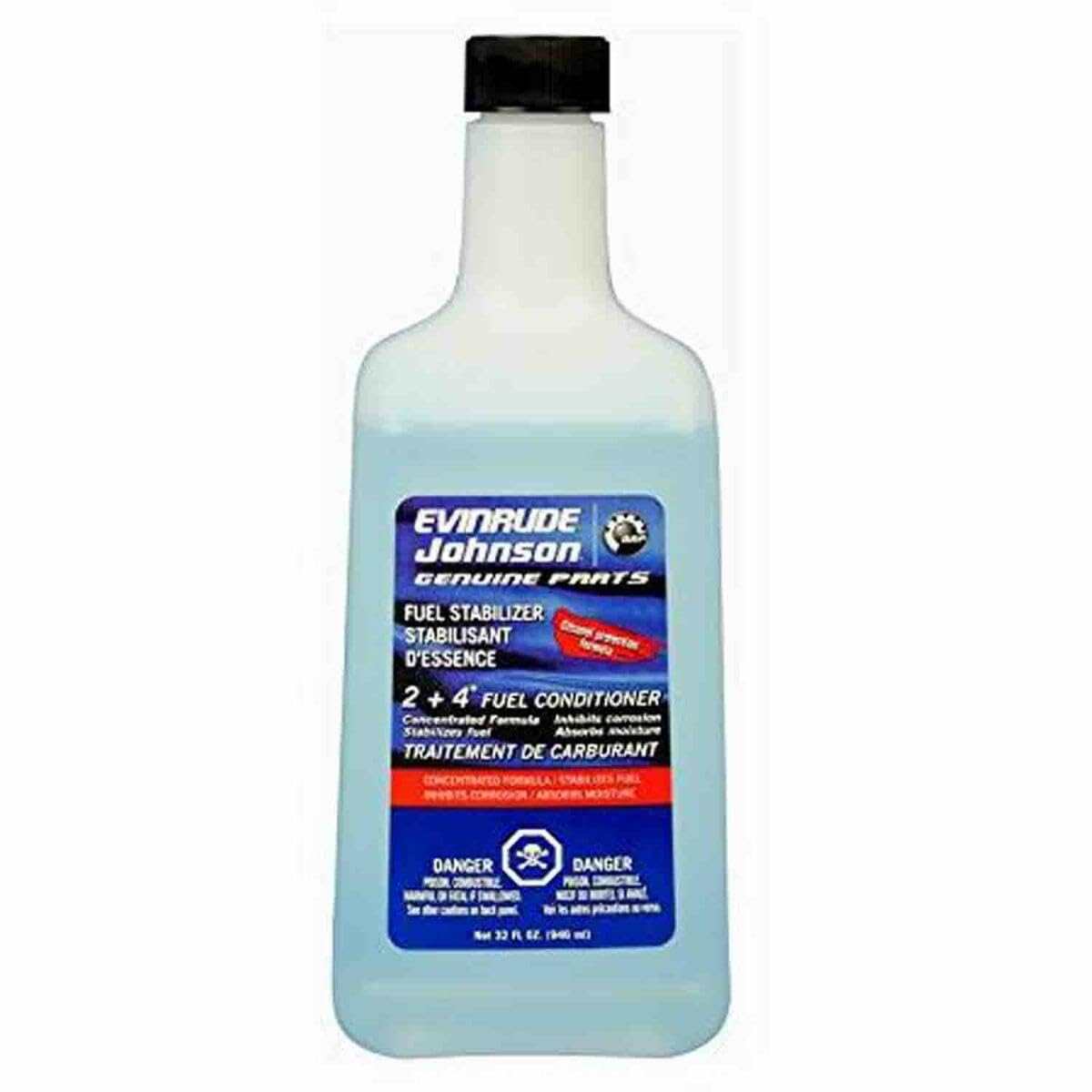
The OEM formula that has kept Evinrude and Johnson engines alive for years — and works on any 2- or 4-stroke.
For owners of classic Johnson or Evinrude outboards, the OMC 2+4 Fuel Conditioner is the factory-specified stabilizer. The 32-ounce bottle contains a concentrated formula that stabilizes fuel, inhibits corrosion, and absorbs moisture. Reviewers point out it keeps gas ready for up to two years — matching the STA-BIL Marine Formula for storage longevity — and that the boat fires right up after sitting that long.
Performance (10 mentions) and quality (7 mentions) are the top aspects, and owners appreciate the simple treatment method: pour it in when you fill up at the gas station. The 16-ounce weight (half the K100 at 16 oz vs 32 oz) makes it lighter than some 32-ounce competitors while still holding the same volume. One key detail: this is formulated for 2-stroke and 4-stroke gasoline engines, so it covers older two-stroke Evinrudes that many modern stabilizers overlook.
OEM reliability: If you own a classic OMC engine (Johnson, Evinrude, or any pre-2002 outboard with that heritage), this is the stabilizer designed specifically for its fuel system. At 4.8 stars from 199 ratings, the owner satisfaction is as high as the Mercury and STA-BIL Marine. Note: the bottle is 10 x 3 x 2 inches — taller and thinner than the Yamaha 32 oz.
Best for: Owners of older Johnson or Evinrude engines who want the exact OEM formula the manufacturer recommends for long-term storage and ethanol protection.
Think twice if: You run a modern 4-stroke that is not an OMC brand — the Yamaha or Mercury options may be a closer match to your engine’s fuel system specs.
8. Ethanol Shield MARINE Fuel Stabilizer & Preservative 2-Pack

The 2-pack that treats 480 gallons — enough to keep a boat fleet running for a full season.
Ethanol Shield brings a proprietary formula featuring PEA-based detergent (a top-tier cleaning agent) combined with a phase separation inhibitor and a 3X all-metal anticorrosive package — the highest ASTM and NACE corrosion ratings. Each 24-ounce bottle treats 240 gallons, so the 2-pack covers 480 gallons total. Owners call it “one of the only ones that really removes water from fuel” and report that boats stored for nearly a year start on the first crank, which rarely happens with untreated fuel.
The formula works on all 2- and 4-cycle engines and all gasolines, with or without ethanol. It also provides upper-cylinder lubrication and slows fuel aging significantly. One small engine repair shop owner confirmed the product’s effectiveness in snow blowers, lawn mowers, and marine engines during winter storage. At 4 pounds for the 2-pack, it is heavier than any single bottle here, but the value per treated gallon is well above average.
Industrial-strength protection: The 3X anticorrosive and 2X antioxidant packages are unique among these picks — no other stabilizer boasts that level of metal protection. The 4.7-star average from 84 ratings is strong, though the review base is smaller than the K100 (691) or STA-BIL Tune-Up (503).
Reach for it if: You own multiple boats, a large yacht, or seasonal equipment that demands serious corrosion protection — the 2-pack format is especially handy for households with several machines.
One honest nudge: At this price point, it competes with the CRC gallon. If you prefer a single large container, the CRC gallon offers a similar volume in one bottle.
9. CRC Marine Gasoline Fuel Stabilizer 1 Gallon
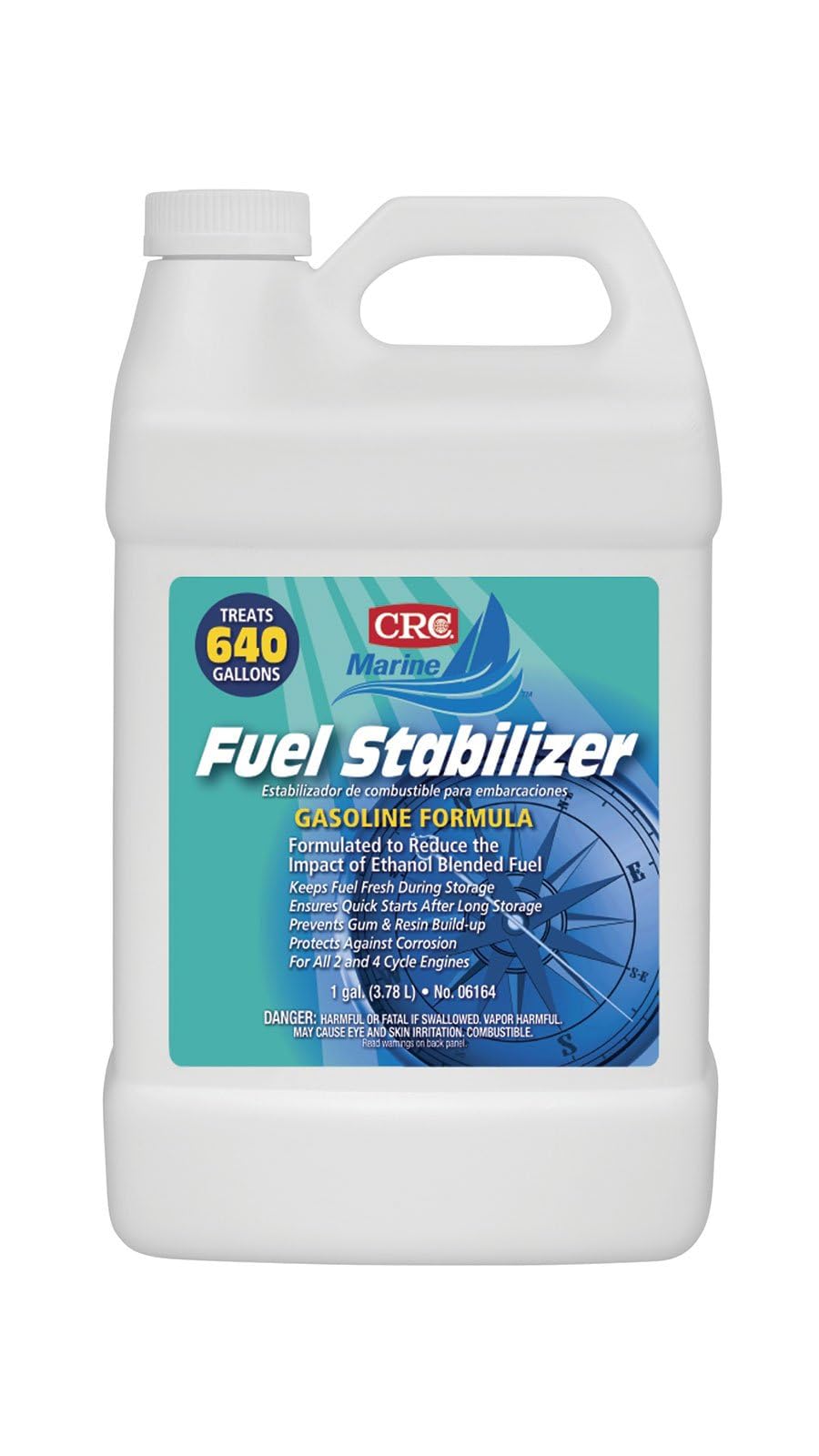
The gallon jug that a retired mechanic says has protected his boat and lawn equipment — and never needed a carb rebuild.
CRC is a market leader in chemical solutions for marine, industrial, and heavy-duty engines, and their Marine Fuel Stabilizer comes in a 1-gallon container — the largest volume in this list. The formula is concentrated: 1 ounce treats 5 gallons of gasoline. Run the engine for 15 minutes after adding it, and the stabilizer protects against resin and gum build-up for up to a year. It works on all 2- and 4-cycle gasoline engines, including marine engines, agricultural equipment, chainsaws, generators, jet skis, and more.
Quality (7 mentions) and functionality (6 mentions) are the most-praised aspects, and a retired mechanic who has used CRC for years says he “never had to rebuild a carburetor.” The gallon jug measures 13.25 x 11.44 x 10.88 inches — bulky, but perfect for a garage shelf or workshop. Owners appreciate the concentrated formula, which can be decanted into a smaller bottle for portable use. One buyer used it during the COVID storage period and confirmed the boat ran fine after months of sitting.
Bulk storage king: For anyone with a large fuel tank (over 50 gallons) or multiple engines, the gallon size eliminates the need for frequent reordering. At 4.8 stars from 70 ratings, it matches the peak quality scores of the Mercury and STA-BIL Marine. The 15-minute run-time instruction is simple and effective during winterization.
Best for: Commercial boat operators, fleet owners, or anyone with a large storage tank who wants a concentrated, high-volume stabilizer that will last a full season.
Think twice if: You have a small boat with a 10-gallon tank and limited storage space — the 8-ounce STA-BIL Marine or Mercury Quickare will be more convenient and less wasteful.
Understanding the Specs
Treatment Ratio
The treatment ratio tells you how many ounces of stabilizer you need per gallon of fuel. A formula that requires 1 ounce per 10 gallons (like the Mercury Quickare) is more concentrated than one needing 1 ounce per 5 gallons (like CRC’s stabilizer). A higher ratio means a single bottle lasts longer and covers more fuel — important for large tanks or frequent fill-ups.
Water Removal vs. Dispersion
Some stabilizers absorb water into the fuel so it burns off during combustion (dispersion). Others claim to break water into burnable particles. The K100 is known for water removal, while the Ethanol Shield and Johnson Evinrude focus on moisture absorption. If your boat sits in high-humidity areas, a dedicated water-removing formula adds an extra layer of safety.
FAQ
Can I use an automotive fuel stabilizer in my boat?
How often should I add stabilizer to my boat’s fuel?
Will a fuel stabilizer fix an engine that is already running rough?
How long does treated fuel stay fresh?
Can I mix two different stabilizer brands in the same tank?
What is phase separation and why does it matter?
Does a fuel stabilizer work with diesel engines too?
How much stabilizer should I use for winter storage?
Is it safe to use a stabilizer in a fuel-injected engine?
Can a fuel stabilizer damage my boat’s fuel system?
Final Thoughts: The Verdict
Across the board, the best marine fuel stabilizer winner is the Mercury Quickare because it delivers the highest rating with the strongest owner consensus, treats fuel economically at 1 oz per 10 gallons, and is backed by genuine marine engineering. If you want a large bottle with OEM-grade protection for a Yamaha outboard, grab the Yamaha Yamalube. And for two-year storage or heavy water contamination, the STA-BIL Marine Formula or K100 are the ones to reach for.
How We Picked
We do not accept paid placement. Every pick is matched to a real buyer and a real use-case; we do not hands-on test units.
Sources & Methodology
Specifications: manufacturer listings and product documentation. Review insights: verified customer reviews, as of July 2026. Pricing: not shown on this page (it changes often); check the current price via the retailer link.
As an Amazon Associate, Trending Car earns from qualifying purchases. This does not affect which products we feature.