
Our readers keep the lights on and my garage snacks stocked. As an Amazon Associate, I earn from qualifying purchases.
Specs are compiled from manufacturer listings and verified buyer reviews and can change over time — please confirm the key details on the product page before buying.
Standing in your garage staring at a cracked, stained concrete floor is a daily reminder that it doesn’t have to look like this. The right interlocking tiles can transform a dull workspace into a clean, professional-looking area that handles vehicle weight, spills, and heavy tools without breaking down.
I’m Min Islam — the founder and writer behind Trending Car. This guide is built by comparing the manufacturers’ published specifications and the patterns across verified customer reviews, so you get each pick’s real strengths and trade-offs instead of marketing spin.
You want a garage floor that can take a beating from a truck, cushion a home gym, or just hide an ugly slab while staying affordable. The four floor tiles for garage below each deliver on a specific promise — and this guide names the one worth buying first.
Our Picks at a Glance

How To Choose The Best Floor Tiles for Garage
Garage floor tiles need to survive a lot more abuse than living-room flooring. Between vehicle weight, dropped tools, chemical spills, and temperature swings, a few key specs separate a long-lasting floor from a disappointing one.
Thickness and load capacity
Thicker tiles distribute weight better and resist cracking under a car or truck. A tile that is 0.5 inches thick will handle most passenger cars. A tile that is 0.79 inches thick is built for heavier vehicles and high-impact zones like a garage gym where you drop barbells.
Material: polypropylene vs. rubber and foam
Hard polypropylene tiles (common for garages) resist oil, grease, and chemicals, and handle rolling loads well. Rubber-topped foam tiles (often labeled as gym mats) offer cushioning and sound dampening but are not always intended for parking a car on top of them. Match the material to your primary use — vehicle parking or workout area.
Interlocking system quality
The connection loops on the edges determine how tightly the tiles stay together. More loops (six per side versus four) make for a firmer, gap-free floor that resists spreading apart when you roll a jack across it. Check whether the tile uses a standard connector shape if you plan to mix brands.
Surface texture and drainage
A coin or diamond pattern provides slip resistance when the floor gets wet. Some tiles have an open-grid design that lets water and debris fall through to the concrete below, keeping the walking surface dry. If you live in a snowy region, drainage is a major convenience for melting snow off your car.
Quick Comparison
| Model | Best For | Thickness | Individual Tile Size | Material | Amazon |
|---|---|---|---|---|---|
| Big Floors RaceDeck★ Best Overall | Best Overall Garage Floor | 0.5 inches | 12 x 12 inches | High-impact polypropylene | Amazon |
| VEVOR Garage Floor Tiles | Best Heavy Duty Value | 0.53 inches | 12 x 12 inches | Hard plastic (polypropylene) | Amazon |
| VEVOR Rubber Top Gym Mats | Best for Garage Gym | 0.79 inches | 24 x 24 inches | Rubber top with high-density EVA foam | Amazon |
| Big Floors GarageDeck | Best Coin Pattern Durability | 0.5 inches | 12 x 12 inches | High-impact copolymer | Amazon |
In‑Depth Reviews
1. Big Floors RaceDeck Garage Floor Tiles
Our pick — 4.5★ from 500+ verified ratings; the strongest balance of quality and price.
The crowd favorite that gives your garage a showroom look and a dry floor all at once.
If you park a pickup truck in your garage, the RaceDeck tile from Big Floors gives you a professional-looking floor that handles real abuse. The 0.5-inch thick polypropylene tiles handle rolling loads up to 80 — that is well into pickup-truck territory. What wins people over is the self-draining open-grid design. Snow melt, car-wash water, and mud fall right through, so you are not standing in puddles or pushing a wet squeegee around. Installation is a simple snap-together process with no adhesive or tools required.
The 12 x 12 inch tiles come in a 48-pack covering 48 square feet, and buyers report the whole thing can go down in a few hours. One owner noted the tiles are “sturdy, easy to assemble tiles with endless design combos,” calling the result a real garage makeover. The non-slip surface combined with anti-fatigue understructure means you can stand on it for a full afternoon of tinkering without your feet aching. Unlike the VEVOR tiles below, the connection system on this RaceDeck is well-proven — buyers describe the fit as tight and permanent once snapped.
The honest trade-off? Because the surface is an open grid, small screws, bolts, and debris can disappear under the tiles. And the plastic is firm enough that walking barefoot is not comfortable, and rolling a floor jack around takes a bit more effort than on smooth concrete. But for a garage that stays dry, looks clean, and protects the concrete from oil and stains, this is the tile that the review pages sum it up: beautiful and durable with very few actual complaints.
Snap-and-forget install: The interlocking tiles require zero tools or glue — just set them down and press until they lock. Buyers consistently praise the straightforward process that a single person can handle.
Dry-floor bonus: The patented free-flow rib design lets air circulate under the tile, so moisture evaporates quickly. If you live in a damp climate or pull in a wet car, this is the design that prevents mildew and slippery puddles.
Reach for this if: You want a durable, great-looking garage floor that drains itself, installs without a contractor, and supports a full-size vehicle.
Think twice if: You plan to spend a lot of time kneeling or lying on the floor — the open grid is not padded, and the plastic surface can feel cold in winter.
2. VEVOR Garage Floor Tiles

Serious load capacity on a budget, if you can live with a few temperature quirks.
VEVOR packs a lot of capability into a budget-friendly price here. These tiles measure 0.53 inches thick — slightly beefier than the RaceDeck tile above — and the manufacturer rates them for an impressive 5500 lbs of load. That is enough for a full-size pickup truck or even a large SUV, making them a legitimate heavy-duty option. The 3D diamond-textured surface provides strong non-slip grip, and the upgraded interlocking system uses six connection loops per side for a tighter fit during installation.
The 25-pack covers a smaller area than the other options here, and owners mention the installation is straightforward with a satisfying click-lock. The rhombic grid bottom layer makes cleaning simple — a mop or vacuum handles dust and grime quickly. This is a solid choice for a workshop or single-bay garage where you need maximum weight capacity without jumping to a premium price tier.
The catch — and it is an honest one that buyers flag repeatedly — is temperature sensitivity. Customers note that the tiles expand noticeably in direct sunlight, causing the edges to lift, and can become brittle in cold weather, leading to cracks when tools are dropped. The durability aspect gets mixed feedback from the community, and a few long-term reviewers point out cracking after several months of use. The VEVOR is a decent tile for light-to-moderate use, but it does not have the cold-weather resilience of the premium picks above it.
Buyer-approved strengths
- The click-lock install is genuinely easy — a single person can lay a floor in an afternoon with no tools at all.
- The 5500-lb load rating is the highest in this roundup, making it a true heavy-duty budget pick.
- The double-sided texture gives you two surface options in one tile (diamond or grid).
What owners warn about
- Expansion in sunlight can cause tiles to lift at the edges; leaving a small gap helps but is not guaranteed to fix it.
- Brittleness in freezing temperatures is the most common durability complaint — a cold garage is hard on these.
- The 25-pack is a smaller coverage area than most garages need, so factor in buying multiple boxes.
Perfect match if: Your garage floor sees a heavy vehicle but stays in a moderate climate — the 5500-lb rating is legit and the price is low.
Not ideal if: Your garage is unheated in a freezing winter region, or you park in direct sunlight for long periods.
3. VEVOR 0.79Inch Rubber Top Gym Mats
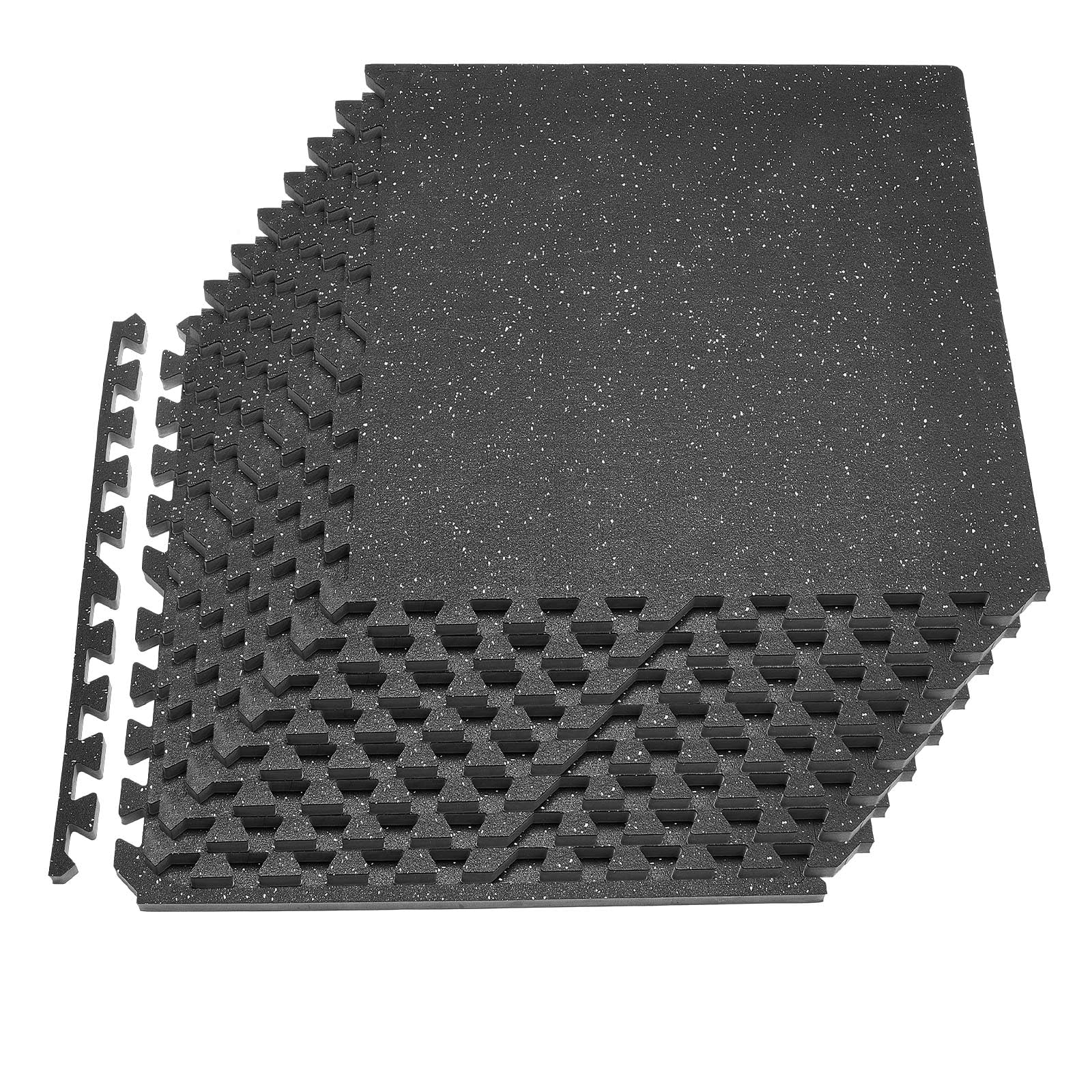
Thick rubber-and-foam comfort that absorbs dropped weights and quiets a noisy garage gym.
This is not a tile for parking a car on. At 0.79 inches thick with a rubber surface bonded to high-density EVA foam, this VEVOR gym mat is built for one thing: protecting the floor under a home gym. The 24 x 24 inch tiles are larger than the garage-focused options, so they cover ground faster — the 12-pack covers 48 square feet. The rubber top resists wear from power racks, spin bikes, and dumbbell drops, while the EVA foam layer absorbs the impact so your concrete stays crack-free.
Buyers consistently call the quality impressive for the price, with one describing the feel as “like nice expensive gym flooring.” The interlocking design is tool-free — a single person can lay and cut the tiles to fit irregular corners. The strong grip on the surface is excellent for yoga, deadlifts, and anything where slipping would be a problem, and the cushioning makes standing on concrete for a long workout much more forgiving. At 0.79 inches, it is noticeably thicker than the 0.5-inch RaceDeck tile above — a meaningful difference if you care about shock absorption.
The main drawback is that this is a gym mat, not a vehicle tile. The EVA foam core will not support the concentrated weight of a car jack without permanent compression. And shoppers say an initial strong rubber odor that takes up to two weeks to dissipate. If your garage is split between parking and workouts, you will need two separate flooring zones or one of the polypropylene options above that can do both. But for a dedicated gym area, this is the right tool for the job.
Noise and impact standout: The rubber top cuts vibration from a treadmill or spin bike dramatically, which is why home-gym owners cite this as the top benefit. One buyer called it “durable, cushioned, and easy to install” and said it completely upgraded their home gym.
Fair warning: Do not expect these to withstand a car. The rubber-and-foam construction excels at absorbing shock, not carrying rolling loads. For parking, stick with the pure polypropylene tiles.
Reach for this if: You are setting up a home gym in the garage and want a cushioned, professional floor that protects your concrete from dropped weights.
Look elsewhere if: You need a single floor that handles both a car and a workout space — for that, get one of the hard plastic tiles and add a separate rubber mat under your squat rack.
4. Big Floors GarageDeck Coin Pattern Tiles
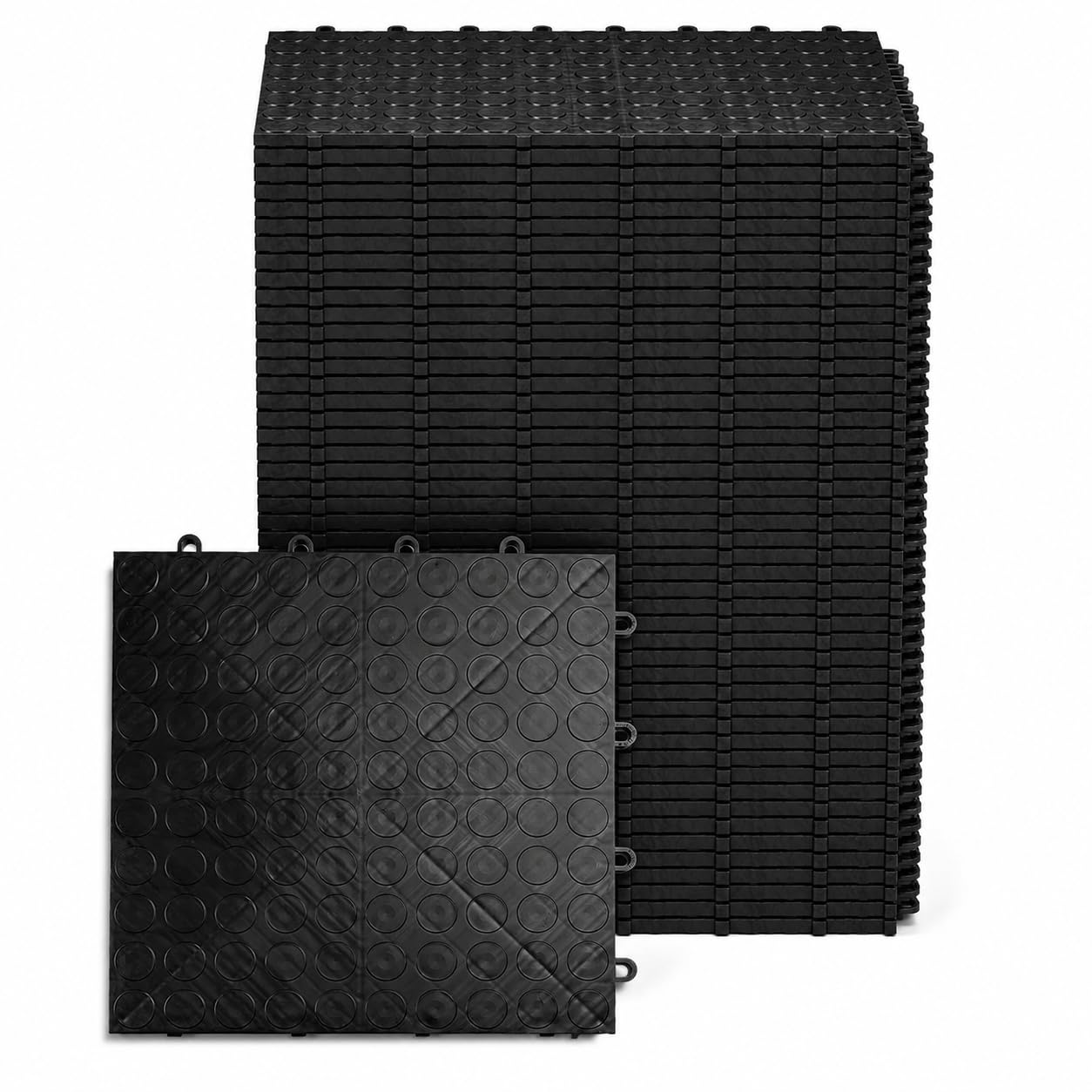
A showroom-ready floor that shrugs off oil, grease, and antifreeze without blinking.
The GarageDeck coin-pattern tile from Big Floors is the tougher sibling of the RaceDeck above, tune for the messy reality of working on vehicles. Made from non-toxic high-impact copolymer, this tile resists oil, grease, petroleum, antifreeze, and most household chemicals — so a spill during an oil change wipes up without staining. The coin top design (raised round bumps) provides excellent slip resistance even when wet, and the surface is easy to clean with a mop or shop vacuum. At 0.5 inches thick, it can support rolling loads of over 40, making it suitable for a parked car or a tool chest.
Installation is the same tool-free snap-together system as the RaceDeck, and buyers call the ease of installation the top feature by far. The 48-pack covers 48 square feet. One owner who installed it solo in 2.5 days noted it is a cost-effective alternative to epoxy — running about versus + for professional epoxy — and called it a “great product” that looks like a showroom floor. The tiles can be snapped apart and reconfigured if you make a mistake during layout, which takes the pressure off a first-time installer.
The limitation is that the hard plastic surface makes a hollow plastic sound when walked on — something buyers describe as a “plastic noise” that feels less solid than epoxy. The material aspect gets negative feedback from some buyers who expected a more rubbery, quiet feel. This is a purely aesthetic and acoustic issue, not a performance one. Compared to the VEVOR tiles above, the GarageDeck is more expensive but far more temperature-stable, with no reports of brittleness in cold or expansion in heat.
Why owners love it
- Installation is by far the most praised feature — 113 owners single it out for being straightforward and fast with no adhesive required.
- The chemical resistance is real: oil, antifreeze, and grease wipe off without staining the surface.
- Buyers report it looks like a showroom floor and makes an old, cracked garage look brand new.
A few honest notes
- The plastic surface produces a hollow sound when walked on — it does not feel or sound like a poured floor.
- The coin pattern is dirt-collecting in the recessed bumps; a quick shop-vac pass handles it, but it is not as self-cleaning as a smooth tile.
- Separating the pre-assembled 4-packs requires pliers to avoid damaging the clips — it is doable but needs the right technique.
Best for: The home mechanic who parks a car and works on it regularly — the chemical resistance and easy install make this a practical, long-term garage floor.
skip it if: You cannot stand the hollow plastic sound underfoot, or you need a cushioned floor for standing all day (the coin pattern is firm, not padded).
Understanding the Specs
Thickness and load rating
The thickness of a garage tile is the single most important number for vehicle support. A 0.5-inch polypropylene tile is enough for most passenger cars and SUVs. A 0.79-inch tile is typically a rubber-foam hybrid designed for gym equipment, not car weight. Always match the thickness to your heaviest load.
Interlocking system
The number of locking loops or tabs on each tile edge determines how tightly the floor stays together. More connection points (six per side versus four) make for a stiffer, gap-free surface that resists shifting when you roll a jack across it. A pre-assembled 4-pack tile uses a different separation technique than a single tile.
Surface texture
Coin, diamond, and open-grid patterns each serve a different purpose. Coin and diamond textures give you slip resistance and grip for walking. Open-grid designs let water and debris fall through to the concrete, keeping the top surface dry. If you park a wet car, prioritize a self-draining design over a solid tile.
Chemical resistance
Not all plastic handles chemicals the same way. Polypropylene and copolymer tiles resist oil, grease, antifreeze, and gasoline without staining or degrading. The wrong type of plastic can become brittle or discolored when exposed to these chemicals. If you work on cars, check the material spec before buying.
FAQ
Can I park my car on garage floor tiles?
Will garage floor tiles crack in cold weather?
How do I clean garage floor tiles?
Do interlocking garage tiles need adhesive or tools to install?
How long do garage floor tiles last?
Can I remove and reinstall garage floor tiles after they snap together?
What is the difference between RaceDeck and GarageDeck tiles?
Will a floor jack damage garage floor tiles?
Can I mix different brands of interlocking garage tiles?
Are garage floor tiles slippery when wet?
Final Thoughts: The Verdict
For most garage owners, the floor tiles for garage winner is the Big Floors RaceDeck because it combines a self-draining, non-slip surface with easy installation and genuine heavy-duty capability — a true do-everything floor. If you need a budget-friendly option that handles a heavy truck while staying affordable, grab the VEVOR Garage Floor Tiles. And for anyone turning their garage into a home gym, the VEVOR Rubber Top Gym Mats provide the cushioning and impact protection that hard plastic tiles cannot match.
How We Picked
We do not accept paid placement. Every pick is matched to a real buyer and a real use-case; we do not hands-on test units.
Sources & Methodology
Specifications: manufacturer listings and product documentation. Review insights: verified customer reviews, as of July 2026. Pricing: not shown on this page (it changes often); check the current price via the retailer link.
As an Amazon Associate, Trending Car earns from qualifying purchases. This does not affect which products we feature.