
Our readers keep the lights on and my garage snacks stocked. As an Amazon Associate, I earn from qualifying purchases.
Specs are compiled from manufacturer listings and verified buyer reviews and can change over time — please confirm the key details on the product page before buying.
Camping without power doesn’t mean running your car battery dead or rationing your phone’s last 5%. A portable solar charger turns a sunny patch of ground into your personal charging station, keeping phones, tablets, power stations, and even coolers topped up from dawn to dusk. The trick is picking one that actually delivers the watts it promises and survives being tossed in the back of your truck.
I’m Min Islam — the founder and writer behind Trending Car. This guide is built by comparing the manufacturers’ published specifications and the patterns across verified customer reviews, so you get each pick’s real strengths and trade-offs instead of marketing spin.
if you need a lightweight panel for backpacking or a 200-watt powerhouse for an extended RV trip, this roundup of the best portable solar charger for camping breaks down nine top contenders by real-world output, durability, and compatibility with popular power stations.
Our Picks at a Glance
![[Upgraded] FlexSolar 60W Portable Solar Panel](https://m.media-amazon.com/images/I/71G3sBCJvjL.jpg)
How To Choose The Best Portable Solar Charger for Camping
Picking a camping solar panel depends on three things: how much power you need, what gear you want to plug into it, and how far you plan to carry it. Here is what to look for.
Wattage and Your Power Station
The most important number is wattage — it tells you how fast the panel can feed energy into a power station or device. A 60W panel is fine for topping off phones and small battery packs, while a 200W panel can recharge a large power station from empty in a few sunny hours. But your power station also has a maximum input wattage; a 200W panel won’t charge a station with a 60W input limit any faster than a 60W panel will. Always match the panel’s output to your generator’s max input.
Cell Efficiency and Panel Build
Monocrystalline cells (usually with an efficiency rating of 23% to 25%) convert more sunlight into electricity than older polycrystalline types. That means they still produce useful power on overcast days or in partial shade. The panel’s outer coating matters too: ETFE (a tough, transparent film) resists scratches and weathering far better than cheaper PET, making it worth the extra cost for regular outdoor use.
Portability vs. Output
A 200W panel that folds into a suitcase shape and weighs under 14 lbs is easy to store in an RV or truck bed, but it is still too heavy for a backpacking trip. For hiking, stick with a 28W to 60W panel that fits inside your pack. Check the folded dimensions and look for a built-in handle or magnetic closure — small comforts that make daily setup and storage much less of a chore.
Quick Comparison
| Model | Best For | Max Power | Weight | Waterproof Rating | Amazon |
|---|---|---|---|---|---|
| HQST 200W Ultra-Light★ Best Overall | Best Overall | 200 Watts | 11 Pounds | IP67 | Amazon |
| FlexSolar 60WBest Value | Budget Power Station Charging | 60 Watts | 6.4 lbs | IP65 | Amazon |
| SOKIOVOLA 100WSolid Performer | Mid-Range 100W Output | 100 Watts | 8.8 Pounds | Waterproof Dragon Cloth | Amazon |
| FlexSolar 100W (Ultra-Light) | Ultra-Compact 100W Panel | 100 Watts | 4.1 lbs | IP67 | Amazon |
| ELECOM NESTOUT 28W | Backpacking Efficiency | 28 Watts | 1.2 lbs | Water-Resistant Nylon | Amazon |
| Goal Zero Nomad 10 | Ultralight Solo Trips | 10 Watts | 1.2 lbs | Not Rated | Amazon |
| ZOUPW 100W | Versatile Connectivity | 100 Watts | 9.48 Pounds | IP67 | Amazon |
| Mesuvida 200W | Rugged 200W Value | 200 Watts | — | IP68 | Amazon |
| Renogy 200W E.Flex | Premium 200W Performance | 200 Watts | 13.9 Pounds | IP65 | Amazon |
In‑Depth Reviews
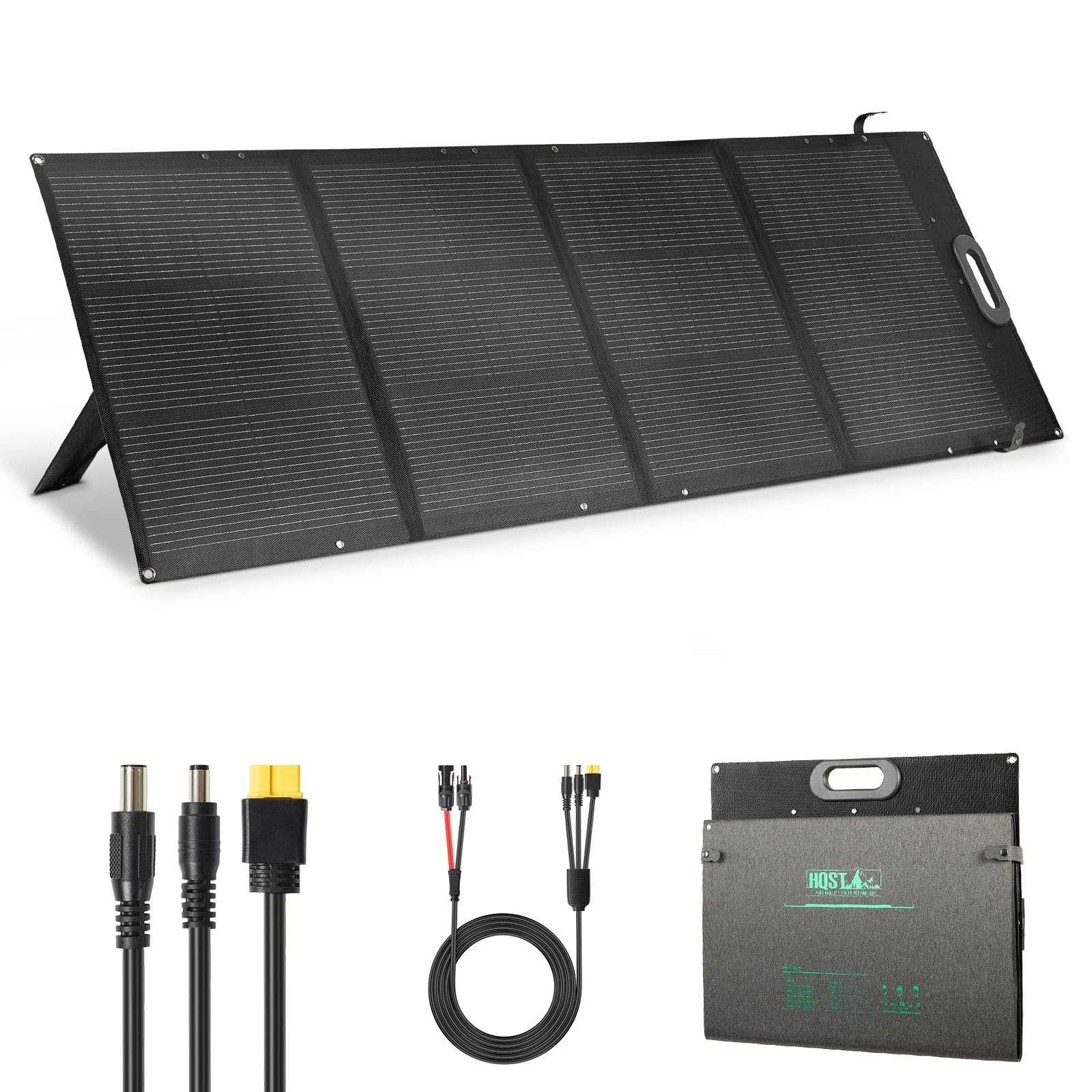
1. HQST 200W Ultra-Light Portable Solar Panel
Our pick — over 4.5★ from 950+ verified ratings; the strongest balance of quality and price.
The heavyweight that somehow weighs almost nothing — 200 watts at just 11 pounds.
This panel uses next-gen 16BB N-Type cells to hit 25% efficiency, which means it pulls more power from the same patch of sunlight than standard 9BB panels. Buyers report that after seven years of use, this panel still outputs up to 180W in parallel, proving its long-term value. At 200 watts versus the FlexSolar 60W’s 60W, yet it folds down to just 1.97 inches thick with built-in buckles for trunk storage.
The IP67 waterproof rating means rain and splashes won’t shut you down — no stitched seams for water to sneak through, and the PVDF coating resists scratches. A 4.9-foot 3-in-1 adapter cable (XT60, DC7909, DC5521) covers most major power stations including Jackery, EcoFlow, and Bluetti. Over 900 ratings with a 4.6-star average confirm its reliability.
The only real trade-off? The rigid frame makes it less backpack-friendly than soft panels, and an occasional unit arrives with a dented frame from shipping. But as owners sum it up: “Great panels for starter solar power system” — and they mean it.
What Wins Owners Over
- Functionality and quality are the most-praised aspects — buyers consistently report it delivers or exceeds its 200W rating.
- Two adjustable kickstands (40-60°) keep it stable on uneven ground, so you are not chasing it across the campsite.
- Ultra-light construction is 37% lighter than most 200W panels, making it easy to carry with one hand.
The Honest Downside
- Packaging can be rough — some panels arrive with dented frames, so inspect on delivery.
- At 11 pounds, it is still too heavy for backpacking; this is a car/RV panel.
Reach for it if: you need serious 200W power for an RV, off-grid cabin, or emergency home backup and want a panel that is genuinely easy to carry and store.
Think twice if: you are backpacking or need a sub-5lb panel — this is built for vehicle-supported camping, not hiking.
2. [Upgraded] FlexSolar 60W Portable Solar Panel
Small enough to forget, powerful enough to keep a 300Wh station alive all weekend.
This 60-watt, 6-fold panel unfolds to 33.8 x 28.1 inches and folds back down to laptop size (13.8 x 9.1 x 2.2 inches), making it among the most carry-friendly options for car campers and overlanders. Owners mention it peaks at 48W on a sunny day and still delivers 10-20W in overcast conditions, which aligns with the manufacturer’s note that full 60W requires direct sunlight. The ETFE-coated A+ monocrystalline cells (24% efficiency) and IP65 waterproofing are rated for 5-10 years of outdoor use.
Built-in smart chip automatically identifies connected devices and adjusts output current for fastest possible charging. It includes USB-A, USB-C, and DC5521/8mm outputs, so you can charge a phone and a power station simultaneously. Owners consistently praise its reliability and build quality for the price.
The catch is that charging performance is a mixed bag: in less-than-ideal sun, it obviously won’t hit 60W, and one owner noted a max of 38W, which is not enough for larger power stations. It is also note the junction box is not waterproof, so keep that connection dry.
Why It Is a Fan Favorite
- Reliability is the top praise — owners trust it to charge their gear trip after trip.
- Multiple connector types and a compact fold mean it goes from trunk to campsite in seconds.
- Works with 300Wh power stations like Anker and keeps them topped up during camping trips.
The Trade-Offs
- Charging performance varies heavily with sun conditions — do not expect 60W on a partly cloudy day.
- At 6.4 lbs it is portable but not ultralight; best for car camping, not backpacking.
Grab this if: you want a budget-friendly mid-range panel for car camping and keeping a small power station (under 500Wh) topped up.
skip it if: you need to charge a large power station quickly or hike miles to your campsite each day.
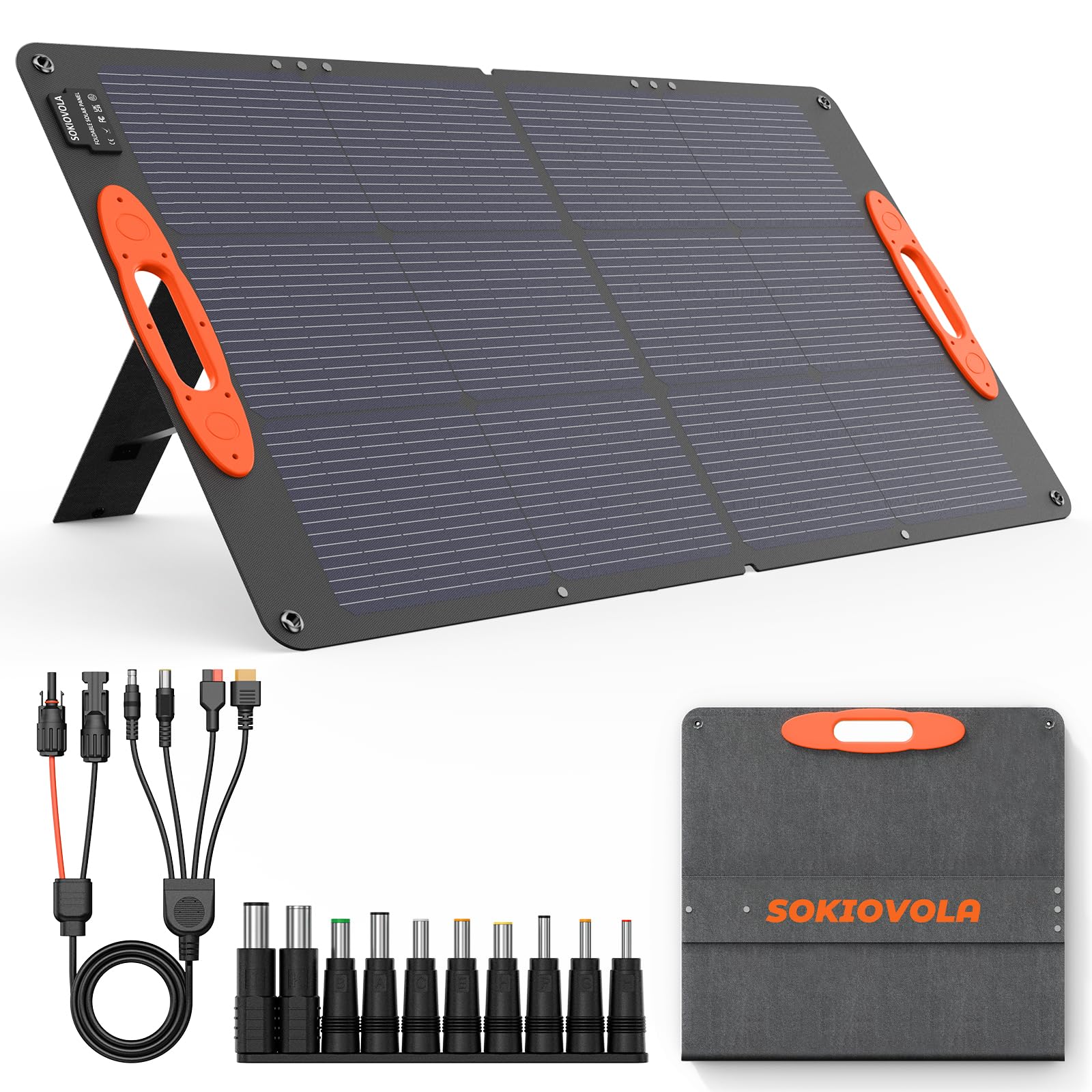
3. SOKIOVOLA N-Type 16BB 100W Portable Solar Panel
A 100W panel that actually hits triple digits — and pairs smoothly with Jackery and EcoFlow.
This panel uses NextGen N-Type 16BB monocrystalline cells with a 25% conversion efficiency, and buyers confirm it holds a consistent 91W input in direct sunlight, peaking over 100W. This real-world performance earns consistent praise from owners. The ETFE coating and waterproof dragon cloth outer material (a tough, water-resistant fabric) mean it holds up to rain and rough handling on campsites.
Weighing 8.81 pounds and folding to 21 x 23 inches, it is significantly lighter than the HQST 200W (8.81 pounds vs 11 pounds) while still delivering half the wattage. That makes it a smarter choice for those who do not need 200W but want a reliable, portable 100W option. It comes with an MC4 to 4-in-1 cable (XT60, DC5521, DC7909, Anderson) for broad generator compatibility.
The honest downsides: some owners find the material feels thin and worry about UV durability over years, and the kickstands are described as awkward with very strong retraction springs. The build quality is marked as mixed in reviews, so handle with care.
What Owners Celebrate
- Performance is the #1 praise — it consistently delivers near or above its 100W rating in good sun.
- Plug-and-play compatibility with Bluetti, Jackery, and EcoFlow; all necessary adapters are included.
- Quality and value for money score highly; owners feel it punches above its price point.
The Catch
- Material feels thin and flimsy to some — long-term UV durability is a lingering question.
- Kickstand design is frustrating; strong springs make them hard to deploy and retract smoothly.
Perfect if: you need a 100W panel that actually delivers its rated power and fits most power stations without fuss.
Not for you if: you expect rugged, premium-feeling materials — this is a value-oriented 100W panel with a slightly delicate build.
4. FlexSolar 100W Portable Solar Panel (Ultra-Light)
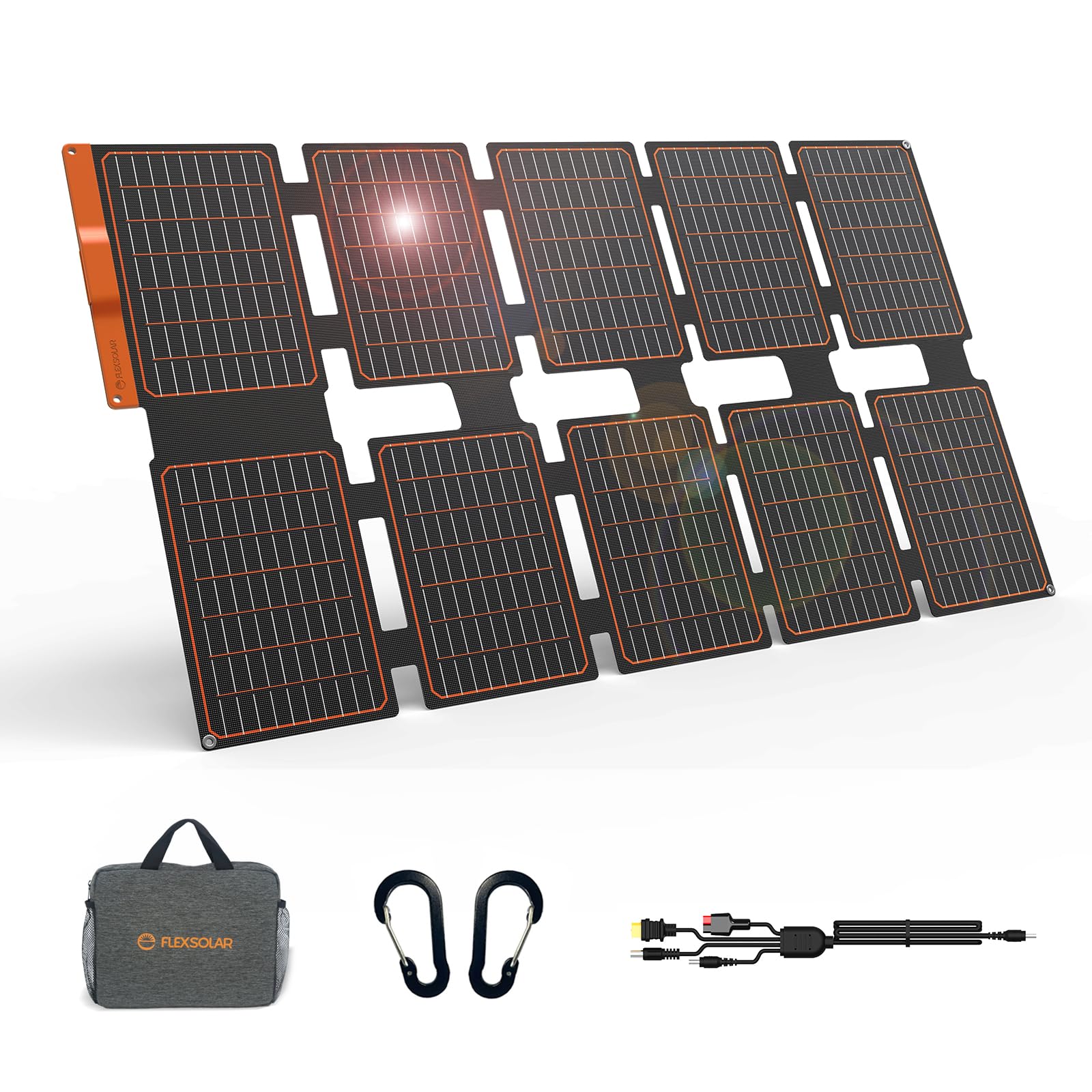
At 4.1 pounds, this may be the lightest 100W panel you can buy — and it folds to notebook size.
This FlexSolar variant is a completely different beast from the 60W model above. Weighing just 4.1 pounds with a folded profile of 12.99 x 10.43 x 2.17 inches, it is a true backpacking contender that still delivers 100W of power. Customers note hitting 70W even in horizontal position (Maine July) and up to 90W from the DC output, with the USB-C port pushing 56W. That makes it among the most compact 100W panels available.
The IP67 waterproof/dustproof rating means you can leave it out in a sudden downpour without worry. It features a built-in PD 3.0 45W USB-C port, an 18W USB-A port, and a dedicated 100W DC output via a 4-in-1 cable (DC5521, DC7909, Anderson, XT60). The monocrystalline cells with E-Film lamination deliver 23%+ efficiency, and the whole package comes with a premium carry bag.
The trade-off: without an MC4 connector, you have fewer options for daisy-chaining panels. Also, the DC/USB circuitry can get hot under high loads (60W+), so keep airflow around it. Some owners note it is hard to angle for optimal sun capture.
The consensus: “A good panel, lightweight and compact” — owners consistently praise its portability and output, with a small but honest caveat about heat management.
Best for: backpackers and hikers who want a 100W panel that fits inside their main pack and charges power stations efficiently.
pass on it if: you want MC4 compatibility for a multi-panel array or plan to run it at full load for hours in hot weather.
5. ELECOM NESTOUT 28W Portable Solar Panel

An iF Design Gold Award winner that turns a day hike into a charging session without weighing you down.
This 28W panel uses high-quality SunPower MAXEON cells for up to 24% efficiency boost over traditional cells, and it folds into its own water-resistant ripstop nylon bag with mesh pouches for cables and small gear. At just 1.2 pounds, it is purpose-built for backpacking and hiking. The bag has an exterior loop system so you can hang it from a tree, tent, or backpack while you walk. Reviewers point out it charges a 15,000mAh power bank in about 2.5 to 3 hours, which is respectable for a 28W panel.
The built-in current checker LED display shows real-time solar generation into the USB ports — a small but genuinely useful feature that tells you at a glance whether you are getting full sun. Dual USB-A ports (4.8 amps total) let you charge two devices simultaneously. It also includes a storage pouch that fits a 5,000mAh battery pack and a lantern securely, making it an all-in-one charging kit.
The single missing piece is a USB-C port — you get two USB-A ports only, so if your phone or power bank uses USB-C, bring your own cable. The 28W output is ideal for phones and small battery banks, but it will not run a laptop or large power station.
The real-world take: “Very handy and simple to use” — buyers love the packable form factor and modular approach. It is the just-right panel for ultralight campers who value design and daily usability.
Reach for this if: you hike frequently, need a panel that straps to your backpack, and want to top off phones and a power bank during the day.
Look elsewhere if: you need USB-C output or want to charge a laptop or large power station — this is strictly for small USB devices.
6. Goal Zero Nomad 10

The ultralight that still charges a phone on a cloudy mountain afternoon at 4,900 feet.
This 10-watt, 1.2-pound panel is designed for ultralight solo trips where every ounce matters. It measures 9.5 x 14.5 inches unfolded and folds to 9.5 x 7.2 x 1.3 inches. The built-in USB port and 180-degree adjustable kickstand make it easy to prop on a rock or hang from a pack. A buyer reported it charges a dead Flip20 power bank fully in roughly 6.5 hours on a mostly cloudy day at 4,900 feet, which is genuinely impressive for a 10W panel. In direct sun, that time drops to about 4-5 hours.
The monocrystalline cells and Goal Zero’s engineering pedigree (over 50 years of solar experience, US-based team) give confidence in its durability. Owners consistently say it is “well-made” and “portable,” and the 1-year manufacturer warranty backs it up. The panel works well with small battery banks (like the 5,000mAh Flip 24) and phones, making it a complete micro system for thru-hikers.
The honest caveats: the USB port is not water-resistant, so you need to protect the connection in rain. Output is realistically limited to about 7.5-8W in direct sun, and it can be a bit pricey for its power output. The kickstand also needs a bit of tweaking to stay open in wind.
The owner consensus: “Sturdy, easy to use solar panel” — buyers love the build quality and portability, even if the power output is modest.
Ideal for: ultralight backpackers and solo campers who need just enough power to keep a phone and a small battery bank alive for days.
Not for: anyone who needs to charge a laptop, power station, or multiple devices — this is strictly a micro-charging companion.
7. ZOUPW 100W Portable Solar Panel

The 5-in-1 cable fits nearly every power station — no more hunting for the right adapter at dusk.
This 100W panel stands out for its true 5-in-1 connectivity cable, which includes DC8020 (for specific Jackery models like the Explorer 1000V2), XT60 (for EcoFlow and Anker), Anderson (older Jackery), DC7909/8mm (Jackery 240/300/500), and DC5521. That means it covers 99% of portable power stations without extra adapters. The A+ grade monocrystalline cells with ETFE coating hit 23.5% efficiency, and the two adjustable kickstands allow a 45-degree angle for up to 25% more sunlight capture than flat placement.
At 9.48 lbs and folding to 24.13 x 21.06 x 1.77 inches, it is moderately portable. Buyers consistently report strong performance, with one owner noting it charged a Jackery Explorer 300 from 84% to 100% in about 20 minutes on a cloudy day — proof of the panel’s real-world output. The built-in intelligent controller includes USB-C PD (15V/3A) and two USB-A (one QC3.0) ports for direct device charging without a generator.
The drawbacks: the kickstands lack adjustability (fixed at one angle), and the USB-C PD is limited to about 45W rather than the full 60W. Some owners find it slightly heavier than expected for long carries, though manageable for car camping.
Why Owners Love It
- Near top performance among 100W foldable panels, beating many flex and quarter-fold competitors in side-by-side tests.
- Magnetic handle and 10-foot adapter cable make setup flexible and storage tidy.
- Works great with Jackery, Goal Zero, Anker, and Bluetti — owners confirm low-maintenance compatibility.
The Honest Gripes
- Kickstand legs are fixed — cannot adjust angle for optimal sun tracking.
- USB-C PD output is limited to ~45W (15V/3A), not the 60W some buyers expect.
Best for: campers who own multiple power station brands or want one panel that works with all of them without adapter hunting.
it’s not for you if: you need fully adjustable kickstands or require the full 60W USB-C PD output for laptop charging.
8. Mesuvida 200W Portable Solar Panel
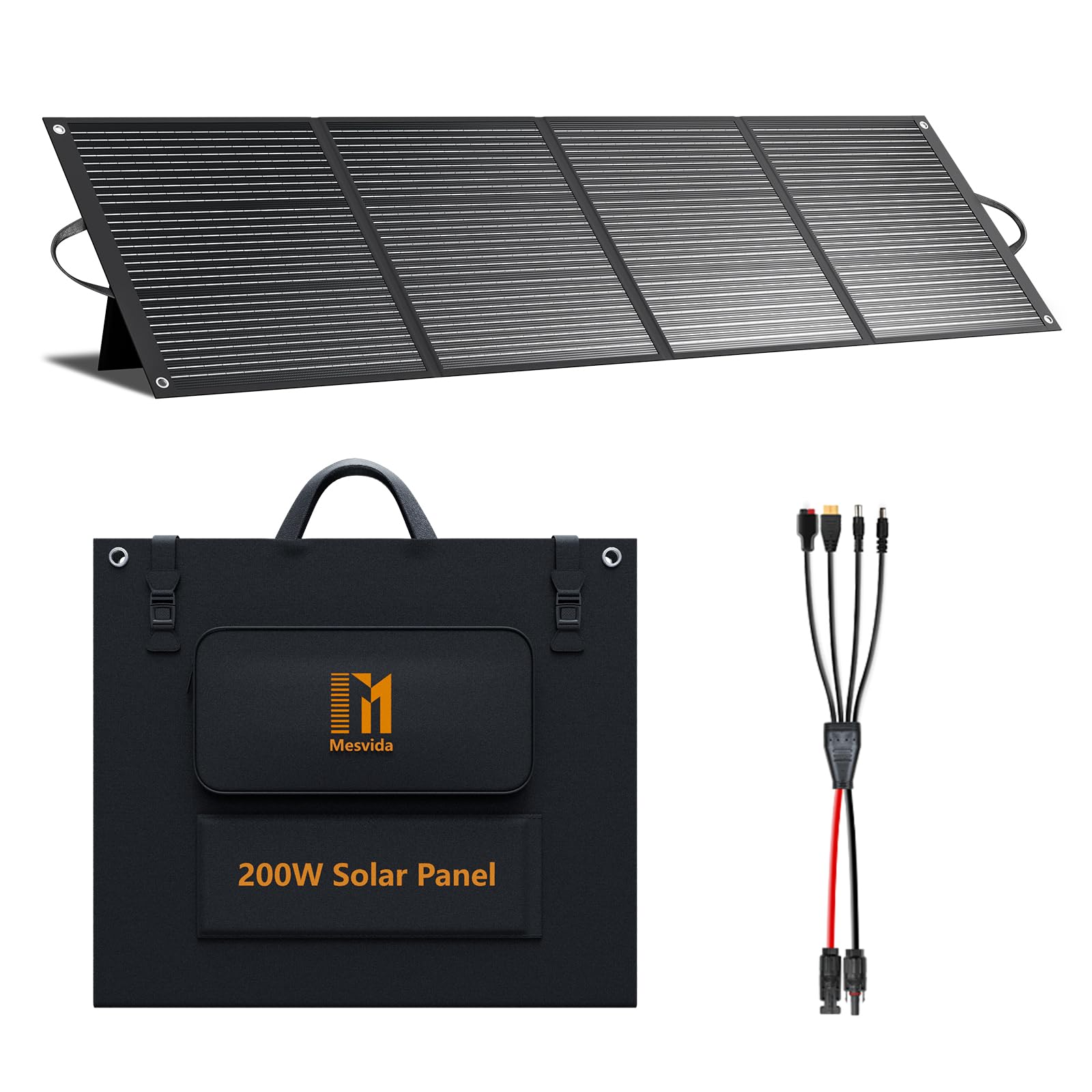
An IP68-rated 200W beast with a quick-lock stand that sets up in seconds — not minutes.
This 200W panel uses A+-grade ETFE-coated monocrystalline cells (23.5% efficiency) with a scratch-resistant, corrosion-proof surface. The standout feature is the IP68 waterproof/dustproof rating — that is the highest common IP standard, meaning it survives full immersion in water, not just splashes. The 600D Oxford fabric outer with double-stitched seams adds UV resistance for all-season use. The unique quick-lock stand uses a self-retracting nylon elastic band that snaps into place instantly, and the leather carry handle makes it feel more like premium luggage than a solar panel.
It outputs 24V/8.33A via MC4 and includes a converter cable for Anderson, XT60, DC7909, and DC8020 connectors, so it covers most modern power stations. Two panels can be connected in series to reach 400W output at 48V (Voc 56V), compatible with 60V power stations. Shoppers say it works well for charging small electronics and power banks, even on partially cloudy days.
The mixed feedback centers on durability — some owners note the fabric could be more sturdy over time. It also lacks built-in USB ports, so you need a generator or charge controller for device charging. The weight is not listed, but the build suggests it is not ultralight.
Owner takeaway: “Works well, lots of adapters” — buyers appreciate the premium ETFE build and complete connectivity kit, even if a few have durability concerns.
Best for: off-grid campers in harsh environments (heavy rain, snow, salt spray) who want a 200W panel that can take a beating.
Not for: those who need built-in USB ports or prefer a lighter panel for frequent hiking — this is a rugged vehicle/RV companion.
9. Renogy 200W E.Flex Portable Solar Panel
A 200W panel that exceeds its rating in full sun — and packs down to backpack size.
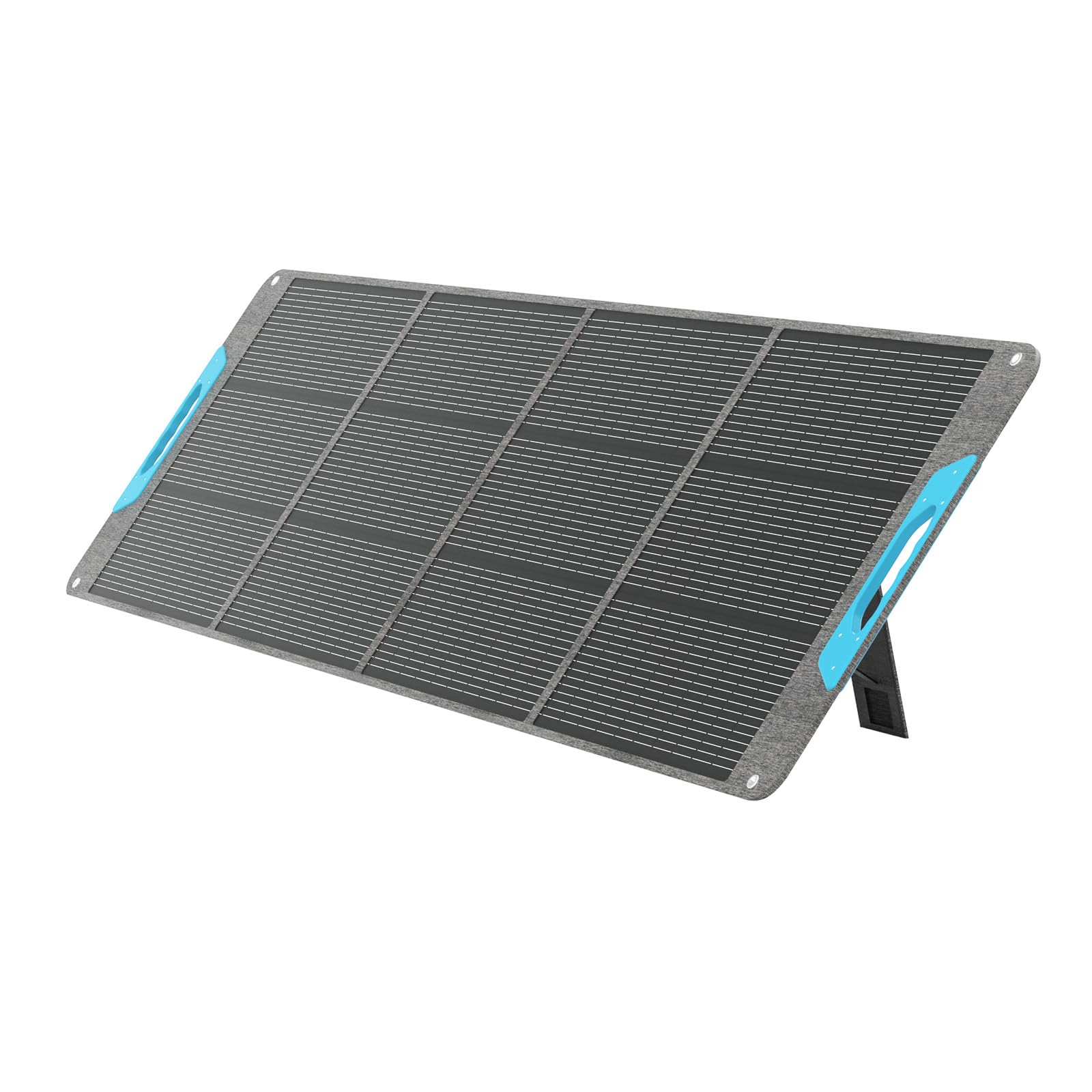
Renogy is a household name in solar, and this 200W E.Flex panel justifies the reputation. It uses 16BB N-Type cell technology to achieve 25% efficiency, which means it outperforms standard 9BB panels at 22.5%. Buyers in Florida and Arizona report it exceeds the 200W rating in full sun, with one owner logging 209W in Arizona summer sunlight. The quad-fold design with magnetic closure packs it down to 23.72 x 22.99 x 1.97 inches, and at 13.89 pounds, Renogy claims it is the lightest in its class.
Versatility is a strong suit: you get one USB-C PD port (45W max), two USB-A ports (18W and 15W), and MC4 output for power station or 12V battery system charging (AGM, LiFePO4, deep cycle). Four kickstands with a “small ear” design and ground studs (sold separately) ensure stability in wind, and the 3-angle adjustment (40°/50°/60°) helps tune sun capture. It is UL 61730 certified and comes with a 2-year warranty, which is the longest of any panel in this roundup.
The mixed feedback is around power output consistency — some buyers report it averages only 133W in milder sun, and the legs can feel janky in strong winds. It also does not include a charging cord in the box, which is an odd omission at this price point.
The Renogy Advantage
- Quality is the most-praised aspect — owners consistently rate it as well-built and reliable.
- 25% efficiency with 16BB N-Type cells means you get more power from limited sunlight.
- 3-angle kickstand adjustment and magnetic closure make daily setup remarkably easy.
The Compromises
- Power output is mixed — some units average 133W in SoCal summer, not the full 200W.
- Legs are not the most stable in high winds, and no charging cord is included in the box.
Perfect if: you want a premium, certified 200W panel with the longest warranty (2 years) and the strongest brand reputation in the category.
Not ideal if: you are on a tight budget or need guaranteed full 200W output in all conditions — treat it as a very capable 180W panel that sometimes peaks higher.
Understanding the Specs
Wattage & Power Output
Wattage (W) is the headline number — it tells you how much power the panel can generate in full direct sunlight. A 60W panel charges phones and small battery banks at a decent pace, while 100W panels can power a laptop or top up a power station. 200W panels handle large generators and even small appliances. But remember: cloudy conditions slash output by 50-70%, so your actual daily watt-hours will be much lower than the panel’s rating. A panel with higher efficiency (23%+) will outperform a lower-efficiency one in weak sun.
Cell Type & Efficiency
Monocrystalline cells are the standard for portable panels — they are more efficient and space-efficient than older polycrystalline types. The efficiency percentage tells you how much of the sunlight hitting the panel is turned into electricity. 23% is good, 25% is excellent. Panels with N-Type or 16BB (16 busbar) cell technology are the latest generation, offering slightly better low-light performance and durability. ETFE (a durable transparent film) coated panels resist scratches and UV damage better than PET-coated ones, making them worth the premium.
Connector Types & Compatibility
There are two main categories: USB-only panels (with built-in USB-A and USB-C ports) for direct device charging, and panels with MC4 or DC barrel connectors for charging power stations. Many modern panels offer both — USB ports for phones and tablets, plus DC outputs for generators. The most common DC connectors are XT60 (EcoFlow), Anderson (older Jackery), DC7909/8mm (Jackery, Bluetti), and DC5521. A 5-in-1 or 4-in-1 cable saves you from carrying a bag full of adapters.
Waterproof Rating (IP Code)
The Ingress Protection (IP) rating tells you how well the panel resists dust and water. IP65 means it is dust-tight and can handle low-pressure water jets — fine for rain. IP67 means it survives immersion in 1 meter of water for 30 minutes — good for heavy downpours and accidental drops in puddles. IP68 is the top tier, allowing full submersion in deeper water. For camping, IP65 is sufficient unless you plan to set up in a riverbed. Also check if the junction box or USB ports are separately rated — they often are not.
FAQ
Can I charge my power station directly from these portable solar panels?
How long does it take to charge a power station with a 200W solar panel?
What is the difference between ETFE and PET solar panel coatings?
Can I connect two portable solar panels together for more power?
How do I clean and maintain a portable solar panel?
Will a portable solar panel work on a cloudy or overcast day?
Can I leave my portable solar panel out in the rain?
What is the best wattage for backpacking vs. car camping?
How do I know if my power station is compatible with a specific solar panel?
Can I use a portable solar panel to charge a 12V battery directly without a controller?
Final Thoughts: The Verdict
For the majority of shoppers, the portable solar charger for camping winner is the HQST 200W Ultra-Light because it delivers class-leading 200W power at just 11 pounds with IP67 durability, proven by thousands of satisfied owners. If you want the most versatile connectivity and strong 100W performance at a moderate price, grab the ZOUPW 100W — its 5-in-1 cable fits nearly every power station on the market. And for ultralight backpacking where every ounce counts, the ELECOM NESTOUT 28W is the one to reach for — an 1.2-pound design award winner that keeps your phone and power bankalive during the day.
How We Picked
We do not accept paid placement. Every pick is matched to a real buyer and a real use-case; we do not hands-on test units.
Sources & Methodology
Specifications: manufacturer listings and product documentation. Review insights: verified customer reviews, as of July 2026. Pricing: not shown on this page (it changes often); check the current price via the retailer link.
As an Amazon Associate, Trending Car earns from qualifying purchases. This does not affect which products we feature.