
Our readers keep the lights on and my garage snacks stocked. As an Amazon Associate, I earn from qualifying purchases.
Specs are compiled from manufacturer listings and verified buyer reviews and can change over time — please confirm the key details on the product page before buying.
Your diesel engine has a personality. It clatters at idle, hesitates on cold mornings, and slowly builds soot deposits that rob performance. The right oil quiets valves, speeds up starts, and makes an engine feel years younger. Every bottle claims to be “heavy duty,” so finding one that truly quiets the engine and lasts between changes is the real challenge.
I’m Min Islam — the founder and writer behind Trending Car. This guide is built by comparing the manufacturers’ published specifications and the patterns across verified customer reviews, so you get each pick’s real strengths and trade-offs instead of marketing spin.
We looked at flash point, viscosity hold, and real-owner results to find the best oil for diesel cars that quiets the tick, handles extreme cold, and keeps your engine running strong between changes.
Our Picks at a Glance


How To Choose The Best Oil for Diesel Cars
Diesel oil does more than lubricate. It holds soot in suspension, neutralizes acids from combustion, and protects your expensive injection system. Picking the wrong viscosity or rating can clog a DPF or leave your engine wearing faster than it should.
Viscosity Grade (5W-40 vs 15W-40)
The first number tells you how the oil flows in cold weather — 5W means it stays thinner at low temperatures, so your starter spins easier on a frosty morning. 15W is thicker when cold, better suited to warmer climates or engines that run hot. The second number (40) is the hot operating thickness; both grades protect well at running temperature, but 5W-40 is the go-to for colder starts.
API CK-4 and DPF Compatibility
Newer diesel cars with a diesel particulate filter need a low-SAPS oil (sulfated ash, phosphorus, sulfur) that won’t clog the filter. API CK-4 fully covers that along with turbocharger protection and shear stability for long drain intervals. Your owner’s manual will list the required API rating — stick to it.
Friction Modifiers (Moly and Boron)
Molybdenum and boron are solid lubricants that bond to metal surfaces inside the engine. They reduce friction where oil film alone would thin out, which cuts valve-train noise (the “diesel tick”) and lowers operating temperatures. High-moly oils like Triax and Schaeffer stand out here.
Flash Point and Thermal Stability
Flash point is the temperature at which oil vapor ignites — higher is better for resisting burn-off under heavy load.
Quick Comparison
| Model | Best For | Viscosity Grade | Flash Point | Volume | Amazon |
|---|---|---|---|---|---|
| Schaeffer SynShield 15W-40★ Best Overall | Best Overall – Ultimate Wear Protection | 15W-40 | — | 1 Gallon | Amazon |
| Mobil 1 Turbo Diesel Truck 5W-40Best Value | Best Value for Mixed Fleets | 5W-40 | 234°C | 1 Gal | Amazon |
| Triax Fleet Supreme ESP 5W-40Top Performer | Top Performer – Extreme Cold Starts | 5W-40 | — | 1 Gallon | Amazon |
| Delo 400 XSP 5W-40 | Great for Mixed Diesel/Gasoline Fleets | 5W-40 | — | 1 Gallon | Amazon |
| Triax Fleet Supreme 15W-40 | Best Extended Drain for Heavy Trucks | 15W-40 | — | 1 Gallon | Amazon |
| Hot Shot’s Secret Green Diamond 15W-40 | Best Fuel Economy Improvement | 15W-40 | — | 1 Gallon | Amazon |
| Schaeffer SynShield OTR Plus 5W-40 | Premium Choice – Extended Drain Up To 20K Miles | 5W-40 | — | 1 Gallon | Amazon |
| Royal Purple 15W-40 (Case of 6) | Premium Pick – Proven Fuel Mileage Gains | 15W-40 | — | 6 Quarts | Amazon |
| Liqui Moly Diesel High Tech 5W-40 | Best for VW TDI & Older Passenger Diesels | 5W-40 | — | 5 Liters | Amazon |
In‑Depth Reviews
1. Schaeffer Manufacturing Co. SynShield 15W-40
Our pick — over 4.5★ from 400+ verified ratings; the strongest balance of quality and price.
This oil silences the rattle and makes an old engine feel new.
Nothing quiets a diesel like Schaeffer’s SynShield. Owners of high-mileage 7.3L Power Strokes and Duramaxes with 145,000 miles report the engine tick virtually disappears at idle and under acceleration — one owner noticed a solid 5 psi bump in oil pressure right after the swap. The secret is micron moly and a “penetrate” additive that coats metal surfaces, so friction drops and sound vanishes.
Fuel economy comes along for the ride. A buyer running a 7.3L Ford found “around 2 more mpg” after just 700 miles, and the oil stays on the stick with very little top-off. The viscosity holds steady for extended service, meaning soot stays suspended rather than settling into sludge. The only catch? This isn’t cheap, and your wallet will feel it, but owners unanimously call it worth the price — especially if you plan to push a truck past 500,000 miles.
Schaeffer’s sturdy protection
- Oil quality is the most-praised feature — over 40 owners single it out.
- Eliminates injector tick and idle rattle across multiple engine families.
- Improved fuel economy reported (2+ mpg in real-world driving).
- Strong stay-in-grade performance for long drain intervals.
Premium price point
- Premium price per gallon.
- 15W-40 is thicker for warm climates; not ideal for sub-zero starts.
Heavy-duty engines: you own a high-mileage diesel and want to cut noise, gain fuel economy, and extend engine life with proven additive technology.
Budget builds: your winters hit single digits regularly — the 5W-40 version (Product 7 below) fits better there.
2. Mobil 1 Turbo Diesel Truck Full Synthetic 5W-40
This oil delivers reliable cold starts while staying affordable.
Mobil 1 Turbo Diesel Truck sets the standard for affordable full-synthetic diesel protection. Its 5W-40 viscosity grade (how thin or thick the oil is at different temperatures) flows thin enough in the cold that a diesel van owner driving 3,000 miles a week reports it “fires right up without hesitation” on freezing mornings — a big improvement over the long cranking most diesel owners dread. The flash point (the temperature at which the oil vapor can ignite) is 234°C, so it resists high-temperature breakdown well for a mid-range oil.
Buyers consistently praise two things: keeps engines clean “with no issues” and the price that makes it one of their go-to diesel oils. Mixed-fleet operators especially like that one oil handles everything from light trucks to heavy vans. It is not the most exotic formulation on the shelf, but it is the most proven — tens of thousands of owners trust it for extended drain intervals without sludge buildup. For sheer dependability at a fair price, this is the bottle to grab.
Mobil’s turbo reliability
- Value for money is the second-most praised feature — 20 owners highlight it.
- Excellent cold-weather starting; drives 3,000 miles a week without issues.
- Reduces high-temperature deposits and low-temperature sludge.
Limited cold flow
- Does not carry the same moly/boron additive levels as boutique oils.
Turbo diesel trucks: daily-driver diesel owners who want reliable full-synthetic protection without going overboard on price.
Cold climates: you regularly tow at max load in high heat — the Triax options below offer more thermal headroom.
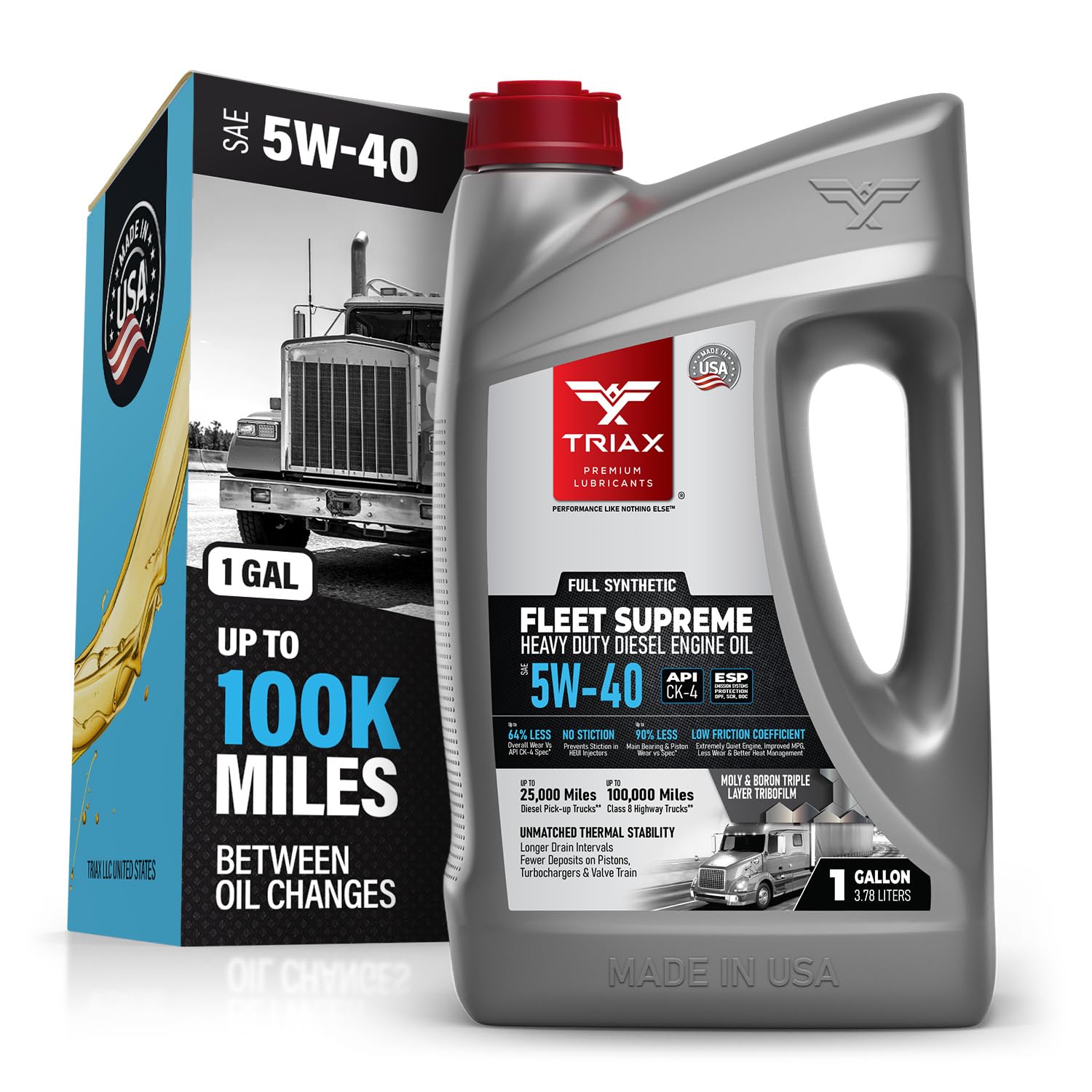
3. Triax Fleet Supreme ESP 5W-40
This synthetic oil starts willingly at 45 below and resists thermal breakdown.
Triax Fleet Supreme ESP pushes thermal capability further than any oil on this list. The manufacturer claims exceptional cold-start properties down to -45°F, and owners back it up: a 2022 RAM EcoDiesel owner reported that Triax eliminated hard cold starts between 30-40°F and delivered a smoother, quieter idle compared to the Mopar 5W-40.
Nano-Boron and Moly friction modifiers are the key. They produce a lower friction coefficient that cuts injector stiction — one Duramax owner confirmed the common “tick” noise disappeared with this oil. Oil temperatures ran slightly higher (206°F to 219°F in that RAM), but the trade-off is cleaner oil after 1,300 miles with a stable level. For the price, you get a heavy-duty chemical package that rivals boutique oils costing far more.
Triax’s low ash formula
- Eliminates hard cold starts and quiets injector tick in Duramax and EcoDiesel engines.
- Moly/boron package for extreme wear protection and extended drain potential.
Niche compatibility
- Oil temp ran slightly higher in some applications (206°F to 219°F).
- Not widely available in big-box stores; primarily an online buy.
DPF-equipped diesels: extreme cold starts and heavy towing where thermal breakdown is a real risk — the flash point lead over Mobil 1 is hard to ignore.
Older engines: your diesel is a light-duty passenger car that never sees a trailer; the 5W-40 savings might be overkill.
4. Delo 400 XSP SAE 5W-40

This synthetic works in both your lawn mower and your turbo car.
Delo 400 XSP is the fleet manager’s Swiss Army knife. Its 5W-40 formulation passes both the diesel CK-4 standard and the SN rating for gasoline engines, meaning one gallon covers your diesel truck, your turbocharged SUV, and even your motorcycle’s wet clutch without slip. A sport-bike owner confirmed zero clutch slip at 15,000 RPM and reported “buttery shifts” with crisp take-up — a rare endorsement for a diesel oil.
Cold starts get noticeably easier thanks to the low-temperature package, and buyers report the oil stays thick at operating temperature unlike some other synthetics that thin out. A 7.3L diesel owner reported reliable winter starts, and the additive package keeps spark plugs cleaner in mixed-fuel situations. The trade-off? A few found it expensive for what you get, but overall the quality-to-price ratio earns consistent praise.
Delo’s long drain life
- Quality is the top aspect — 25 owners recognize it as a solid performer.
- Cross-compatible with gasoline engines, motorcycles, and turbo cars.
- Promotes consistent cold starts in sub-zero temps.
Slightly higher viscosity
- No flash point published in the data for direct thermal comparison.
- Some owners consider it on the pricier side for a 1-gallon jug.
Extended intervals: multi-vehicle households with a diesel truck plus a gasoline car or motorcycle — one oil does it all.
Light duty: heavy commercial towing where you need a published high flash point like the Triax offers.
5. Triax Fleet Supreme 15W-40
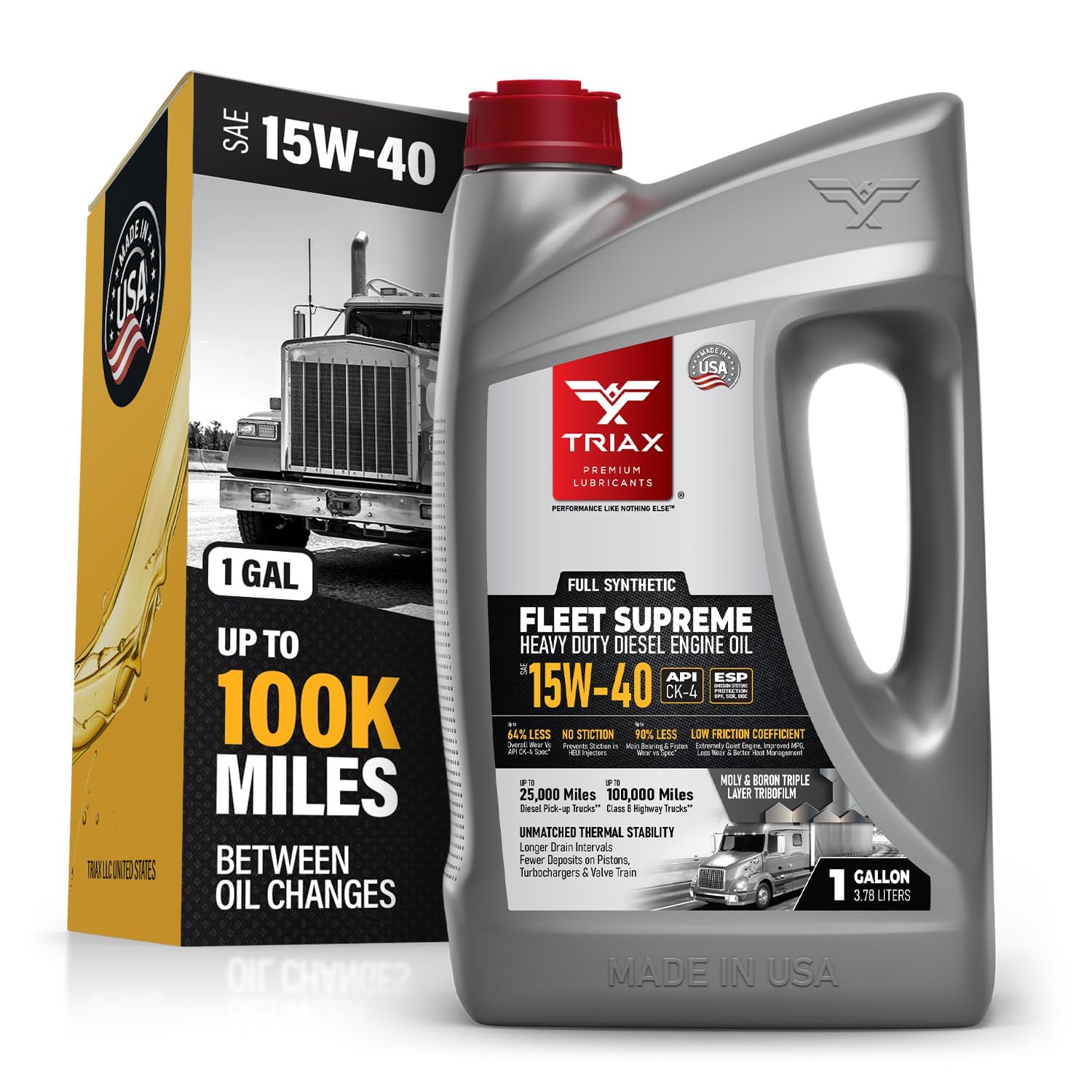
This 15W oil ran 15,250 miles and still had additive life left.
Triax offers two viscosities, and the 15W-40 version trades cold-weather thinness for extreme oil-life endurance. The manufacturer claims drain intervals exceeding 100,000 miles for highway semis and 30,000 miles for super duty pickups, and independent oil analysis backs that up — one owner sent in a sample after 15,250 miles and found less than 15-20% additive depletion, estimating he could stretch to 20,000 or even 25,000 miles. In a semi application, 70,000-mile drains came back with stable TBN (total base number, a measure of the oil’s ability to neutralize acids) and viscosity requiring no boosters.
Cold starts are still manageable — a buyer noted excellent performance at -20°F — and owners consistently mention quieter idle and smoother operation on Powerstroke and Cummins engines. The 8-10°F cooler oil temperature compared to the previous oil is a real benefit for high-load towing. You pay a premium, but the extended drain capability quickly offsets the per-bottle cost.
Triax’s 15W-40 stability
- Quality is the top aspect with 44 owners — performance is second at 22.
- Proven extended drain capability: oil analysis green after 15,250 miles.
- Runs 8-10°F cooler than conventional diesel oil.
Thicker in winter
- 15W-40 is thicker at cold start than the 5W-40 version — not the best for extreme northern winters.
- Per-gallon cost is higher than standard diesel oils.
Warm weather use: heavy-duty pickup owners who rack up 15,000+ miles between changes and want oil analysis to back the interval.
Arctic starts: you live where winter temps frequently drop below -20°F — the 5W-40 Triax or Mobil 1 starts easier there.
6. Hot Shot’s Secret Green Diamond 15W-40

This oil claims a 4 MPG gain on 33-inch tires.
Hot Shot’s Secret uses a Group III base oil blend (a high-quality refined mineral oil) with proprietary FR3 nanotechnology that penetrates fine engine crevices to reduce metal-on-metal contact. The maker says the formula can improve fuel economy by up to 3 percent versus standard oils, and owners see real results — one LLY Duramax running 33-inch tires reported MPG jumping from 18 to 22 at 70 mph after the switch. That is a meaningful gain for anyone who covers serious miles.
The CK-4 additive package (a standard for diesel engine protection) also holds up well over time. A sample tested after 14,000 miles of hard use still had intact viscosity and additive levels, so extended drain is a realistic option. An older Cummins 6.7 owner noted slightly higher oil pressure than Amsoil after 15,000 miles and a quieter idle. The only downside is the pungent exhaust smell from the high zinc content — a sign of sturdy anti-wear chemistry, but noticeable if you idle near an open window.
Hot Shot’s additive package
- Reported fuel economy improvement of 4 MPG on a LLY Duramax at highway speed.
- FR3 nanotechnology reduces friction in microscopic crevices.
- Holds additive package well after 14,000 miles of hard use.
Less common brand
- Strong zinc smell in exhaust may be off-putting in enclosed spaces.
- No flash point published in the data for direct heat comparison.
High mileage engines: high-mileage drivers who want every drop of fuel economy — the MPG improvements are reported, not theoretical.
Newer vehicles: garage queens or short-trip rigs that never reach full operating temperature; the zinc smell lingers more at idle.
7. Schaeffer SynShield OTR Plus 5W-40

The lab-tested synthetic that still tests like new after 20,000 miles.
Schaeffer’s OTR Plus takes everything the 15W-40 version does and swaps to a 5W-40 base for better cold-weather flow. The real headline is the drain interval — one owner sends in oil analysis samples and reports the oil still tests good at 20,000 miles with “highest EP additive molybdenum” he has found across any brand. He changes the filter at 10,000 miles and the oil itself easily doubles standard recommendations. For a 6.7 Cummins driver covering 50,000 miles a year, that means drastically fewer trips under the truck.
Performance feedback is immediate: a 6.0 Power Stroke owner found that switching from non-synthetic 15W-40 to this 5W-40 halved cold cranking time. Another 2020 Power Stroke driver said the truck “feels more responsive” and “like it has more power.” The main hesitation is the per-gallon cost — value for money is rated mixed, with some buyers finding it expensive. But for those who prioritize maximum engine protection and lab-verified longevity, the price gap closes quickly.
Schaeffer’s OTR durability
- Oil quality is the top praise — 33 owners confirm it outperforms other synthetics.
- Oil analysis confirms 20,000-mile drain intervals with filter changes at 10,000 miles.
- Halves cold cranking time on 6.0 Power Stroke engines.
Higher cost per quart
- Value for money is the most mixed aspect — 15 owners are split on whether it justifies the premium.
- Not the oil for a strict maintenance budget; you pay for the long-drain capability.
Long-haul trucks: you run oil analysis and want lab-confirmed 20,000-mile drain intervals with the highest EP molybdenum available.
Short trips: you change oil every 5,000 miles regardless — the extra cost brings no benefit at that interval.
8. Royal Purple 15W-40 (Case of 6)
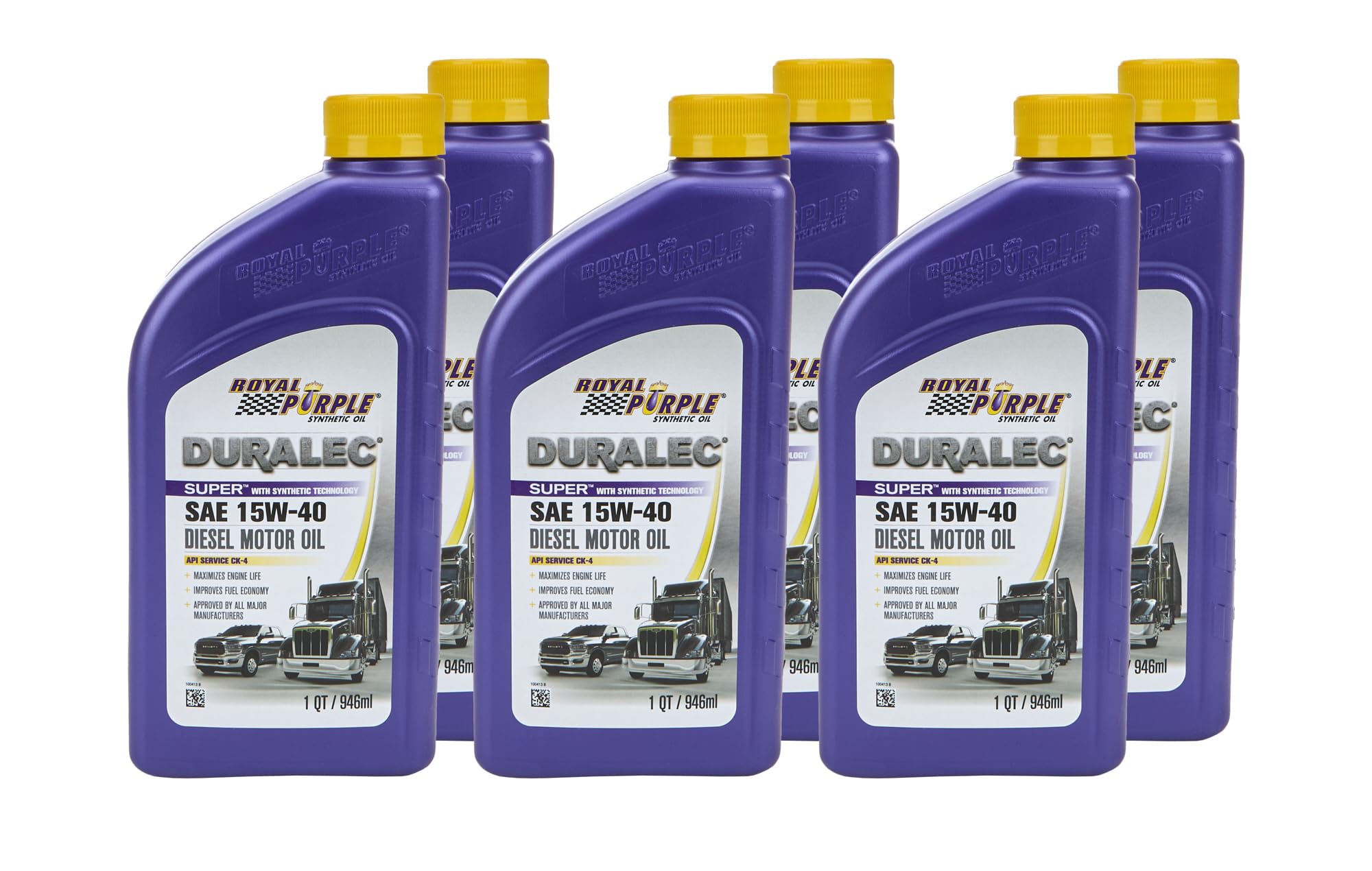
The purple bottle that convinced a Duramax owner for over a decade.
Royal Purple carries a reputation that precedes it. One owner has used it continuously since 2012 after a mechanic recommended the switch, and he reports his fuel mileage increased by 3 MPG — a meaningful bump that keeps him loyal. The oil is API CJ-4 licensed, meaning it protects catalytic emission systems while delivering the signature purple-branded wear protection. It is formulated specifically for diesel-powered vehicles, not as a gasoline blend crossover.
The quality feedback is strong: 80 owners single out quality as the top aspect, with value for money coming second at 42 mentions. Engine noise reduction, smoother operation at lower RPMs, and durability are also frequently cited. The case-of-6 configuration makes sense for owners who want a consistent supply. The honest catch is the per-quart price — it is a premium product with a premium tag, and some buyers push back on cost despite the performance.
Royal Purple’s synthetic blend
- Quality dominates feedback — 80 owners call it the best on the market.
- Reported 3 MPG fuel economy improvement after switching from standard oil.
- Reduces engine noise and provides smooth operation at lower RPMs.
Overkill for stock
- Per-quart cost is among the highest on this list.
- 15W-40 base is not ideal for severe cold-weather starting.
Performance builds: the diesel owner who values brand trust and consistent noise reduction and is willing to pay more for a proven formulation.
Daily drivers: budget-conscious buyers who change oil frequently; the per-mile cost is higher than mid-range options.
9. Liqui Moly Diesel High Tech 5W-40

The low-SAPS formula that took a VW TDI past 350,000 miles on the original cam.
Liqui Moly Diesel High Tech is a low-SAPS fully synthetic 5W-40 engineered specifically for older-generation diesel passenger cars with diesel particulate filters. The VW TDI community swears by it — one owner ran a BEW engine to 358,000 miles and confirmed it did not need a camshaft replacement, which is the Achilles heel of those engines. Another buyer has logged 150,000 miles on a BEW TDI using this oil and reports “no cam wear” throughout the entire period, calling the viscosity and lubricity perfect.
The 5-liter jug offers more volume than the standard gallon, and the low ash formula keeps DPFs from clogging prematurely. It is a niche product designed for European passenger diesels, not heavy-duty American pickups. The price per liter is premium, but for VW and older diesel car owners, it is the single most trusted option available. You will not use it in a Duramax — but for a TDI, this is the bottle to reach for.
Liqui Moly’s German engineering
- Proven camshaft protection: 358,000 miles on a BEW engine with no cam replacement.
- Low SAPS formulation protects DPFs from clogging.
- 5-liter container gives more oil per purchase than standard 1-gallon options.
Price premium
- Not compatible with heavy-duty American diesel pickups (Duramax, Power Stroke, Cummins).
- Premium price per liter — one of the costliest options per unit volume.
European diesels: VW TDI owners and European diesel passenger cars equipped with DPF — this is the camshaft insurance policy those engines need.
American trucks: heavy-duty truck applications or late-model diesel cars that call for a different spec.
Understanding the Specs
Viscosity Grade (5W-40 vs 15W-40)
The “w” stands for winter, and the number before it tells you how the oil flows when the engine is cold. A 5W oil stays thinner at low temperatures, so your starter does less work on a freezing morning — ideal for northern climates. A 15W oil is thicker when cold but holds film strength better under extreme heat and load, making it the pick for warm-weather towing or high-mileage engines that need thicker cushioning between metal surfaces.
Flash Point
This is the temperature at which oil vapor ignites. A higher flash point means the oil resists burning off inside hot turbochargers and combustion chambers. Lower flash points (234°C on the Mobil 1) still provide good protection for normal driving, but the margin narrows under sustained heavy load. For trucks that spend hours near redline on grades, the higher number matters.
API CK-4 Rating
This is the current heavy-duty diesel oil standard from the American Petroleum Institute. CK-4 oils are designed for high-speed four-stroke engines meeting 2017 and newer emissions standards. They offer enhanced protection against oil oxidation, shear, and aeration, and they are backwards compatible with older API categories. If your owner’s manual calls for CJ-4 or earlier, CK-4 works fine.
Moly and Boron Additives
Molybdenum and boron are solid lubricants that plate onto metal surfaces. They fill microscopic pores where straight oil film cannot stay, reducing friction and cutting injector noise — the “diesel tick.” Oils with these additives (like Triax and Schaeffer) typically run quieter and create less wear during cold starts when oil is not yet fully circulating.
FAQ
Can I use gasoline engine oil in a diesel car?
What does 5W-40 mean for a diesel engine?
How often should I change diesel engine oil?
Will a higher flash point oil improve my engine life?
What is the difference between CK-4 and CJ-4 oil?
Can I use 15W-40 instead of 5W-40 in my diesel car?
Does moly additive actually quiet a diesel engine?
Will synthetic diesel oil damage an old engine?
What is the best oil for a VW TDI engine?
How do I know if an oil is safe for my DPF?
Final Thoughts: The Verdict
For the majority of shoppers, the oil for diesel cars winner is the Schaeffer SynShield 15W-40 because it combines the strongest anti-wear additive package with real-world MPG gains and a quiet idle that owners confirm across multiple engine families. If you want a proven cold-start performer that delivers massive thermal headroom for the money, grab the Triax Fleet Supreme ESP 5W-40. And for the VW TDI owner who needs a low-SAPS oil that keeps camshafts alive past 350,000 miles, the Liqui Moly Diesel High Tech 5W-40 is the only serious choice.
How We Picked
We do not accept paid placement. Every pick is matched to a real buyer and a real use-case; we do not hands-on test units.
Sources & Methodology
Specifications: manufacturer listings and product documentation. Review insights: verified customer reviews, as of July 2026. Pricing: not shown on this page (it changes often); check the current price via the retailer link.
As an Amazon Associate, Trending Car earns from qualifying purchases. This does not affect which products we feature.