
Our readers keep the lights on and my garage snacks stocked. As an Amazon Associate, I earn from qualifying purchases.
Specs are compiled from manufacturer listings and verified buyer reviews and can change over time — please confirm the key details on the product page before buying.
A multimeter for mechanics isn’t just a voltmeter with a fancy case—it’s the tool that turns a grumbling engine noise into a fixable sensor fault. Whether you are chasing a parasitic drain on a modern hybrid or setting dwell on a ’57 Corvette, the right meter saves hours and every bit of that frustration. This guide cuts through the spec noise to find the meters that actually survive shop life and deliver the numbers you can trust.
I’m Min Islam — the founder and writer behind Trending Car. This guide is built by comparing the manufacturers’ published specifications and the patterns across verified customer reviews, so you get each pick’s real strengths and trade-offs instead of marketing spin.
After digging through the shop-floor consensus on dozens of models, these are the picks that mechanics and DIY owners consistently reach for—letting you find the best multimeter for mechanics that fits both your bay and your budget without falling for a one-job wonder.
Our Picks at a Glance


How To Choose The Best Multimeter for Mechanics
A shop-grade multimeter is a long-term investment in your diagnostic sanity. The wrong one—too slow, too fragile, missing a key function—means you are chasing ghosts instead of fixing cars. Here are the three specs that separate a pro tool from a shelf warmer.
True RMS and the Shape of a Signal
Automotive electronics don’t always produce a clean sine wave. If you are testing a variable-frequency motor, a fuel injector driver, or a PWM sensor, a standard meter can give you a wildly wrong reading. A True RMS (Root Mean Square) meter (one that calculates the effective value of non-sinusoidal waveforms) delivers the correct voltage regardless of the signal’s shape. For any car built after the mid-2000s, this is a non-negotiable feature.
Automotive-Specific Measurement Modes
A general-purpose electrician’s meter can’t read engine RPM or measure dwell angle on a points-style ignition. Look for dedicated modes: tachometer (RPM) with an inductive pickup or a direct connection, dwell angle for 4/6/8-cylinder engines, duty cycle for fuel injectors and solenoids, and pulse width in milliseconds for modern fuel trim diagnostics. If you work on anything with a distributor, a dwell function is the difference between a smooth idle and a mystery misfire.
Build Quality and Safety Certifications
Shop floors are rough on tools. Drops, oil, and vibration are daily hazards. A meter with a rugged outer case, a built-in kickstand, and a magnetic hanger is a huge quality-of-life upgrade. Pay attention to the CAT safety rating: CAT III 600V is the standard for automotive work and means the meter can handle transient voltage spikes without sending one through your hand. A 10 MΩ input impedance (10 million ohms of resistance) is also critical—it prevents the meter from drawing too much current and damaging sensitive computer circuits like the ECU.
Quick Comparison
| Model | Best For | Key Specs | RPM/Dwell | Safety | Amazon |
|---|---|---|---|---|---|
| Fluke 88V★ Best Overall | Pro Shop Workhorse | Auto-Ranging, Pulse Width, Duty Cycle | Yes / Yes | UL Listed | Amazon |
| Innova 3340Best Value | Best Overall Value | Auto-Ranging, Inductive RPM, Dwell | Yes / Yes | 10 MΩ Impedance | Amazon |
| OTC 3980Pro Diagnostics | Advanced Diagnostics | True RMS, RS232, PC Software | Yes / Yes | CAT III | Amazon |
| BTMETER BT-770K | Classic Car Work | Dwell, Pulse Width, Tachometer | Yes / Yes | 10 MΩ Impedance | Amazon |
| Aoefg HY DT151Q | Budget Diagnostics | True RMS, Dwell, Temperature | Yes / Yes | CAT III 600V | Amazon |
| BTMETER BT-770M | Safety-First Learners | Mechanical Port Blocking, True RMS | No / No | Mechanical Protection | Amazon |
| ALLmeter WT501 | Smart Home & Car Use | Smart Auto Mode, USB-C Rechargeable | No / No | NCV, Overload Protection | Amazon |
| Lscsdf FS899L | Home Mechanic | USB Rechargeable, Large Color Screen | No / No | NCV | Amazon |
| Performance Tool W2972 | Basic Tach/Dwell | Tach, Dwell, Large LCD | Yes / Yes | UL Listed Probes | Amazon |
In‑Depth Reviews
1. Fluke 88V Deluxe Automotive Multimeter
Our pick — over 4.5★ from 250+ verified ratings; the strongest balance of quality and price.
The 3-pound absolute reference standard that shops have trusted for decades.
If you need one meter that handles everything from a hybrid’s high-voltage traction system to a parasitic draw on a 12V circuit, this is the one. The Fluke 88V measures pulse width, duty cycle, and RPM, and it logs Min/Max/Avg readings so you can walk away from a slow drain and come back to the answer. Its 10 MΩ input impedance protects sensitive computer circuits like the ECU from accidental overloading.
At 3 pounds it is noticeably heavier than almost any other meter on this list (the Performance Tool W2972 is 1 pound, by comparison), but that heft is the feel of overbuilt durability. The large display and bright backlight make readings clear even under a dash or in direct sun. The recurring smart-buyer note here is that some owners wish the included accessories were better—but the meter itself is considered the best in its class. The consensus across the shop floor is that if you break a Fluke, you probably backed a truck over it.
Shop-floor royalty: This is the meter mechanics upgrade to when they are done buying cheap replacements. It has the diagnostic depth (pulse width in milliseconds, RPM, duty cycle) that makes it feel purpose-built for automotive work, not just repurposed from electrical. The drawback is the price—it’s an investment, not an impulse buy.
Reach for this if: you work on cars daily, especially modern hybrids or complex electrical systems, and cannot afford a questionable reading. The reliability here is legendary—buyers report using the same unit for over 25 years.
Think twice if: your work is limited to basic battery and alternator checks on a single family car. A more affordable meter will cover those jobs just fine.
2. Innova 3340 Professional Automotive Digital Multimeter
The most popular diagnostic partner that brings high-end functions without the premium tag.
This is the meter that consistently comes up in shop conversations as the smart money pick. It includes an inductive RPM clamp, a temperature probe, and a carrying case right in the box—all without pushing into pro-audit pricing. It measures duty cycle, dwell, and even tests alternator diodes. The 10 MΩ input impedance keeps the vehicle’s ECU safe during testing.
Owners consistently praise its build quality and extensive feature set for the price. The tachometer can be a bit jumpy at times, but for DC voltage and resistance it is extremely accurate It also has an auto-ranging function and overload protection, so beginners are less likely to damage it. The crowd favorite here is quality, with well over 100 owners singling it out.
What owners love
- Inductive RPM clamp and temperature probe included
- Very accurate on DC voltage and resistance
- Durable build with a protective carrying case
- Auto-ranging and overload protection for safe use
The honest trade-off
- Tachometer readings can be erratic and jumpy
- Accuracy on some functions is mixed per feedback
Best for: the DIY mechanic who wants pro-level diagnostic functions (RPM, dwell, duty cycle) without spending Fluke money. It is the most reviewed and widely trusted mid-range automotive meter available.
skip it if: you need lab-grade RPM precision for tuning. If you are setting points on a vintage car, the BTMETER BT-770K is a better specialist tool for that specific job.
3. OTC 3980 750 Series Automotive Multimeter
The data-logging specialist that talks to your laptop for advanced analysis.
This is a step up for mechanics who want to capture and review diagnostic data rather than just read it live. The OTC 3980 includes True RMS, RPM, dwell, pulse width, and even an RS232 interface and PC software so you can log measurements over time. It is rated CAT III, meaning it is certified safe for hybrid vehicle high-voltage systems.
Build quality is a strong point here, but the functionality is where opinions split. Some owners find the RPM pickup to be erratic and the overall refresh rate a bit slow for live tuning. The included case is sturdy but bulky. For casual use, it is acceptable, but it is not the go-to for quick adjustments. If you need data logging and PC connectivity for a diagnostic report, this is one of the few meters that offers it without going to a thousand-dollar scope.
Data-driven mechanic’s tool: The RS232 and included software are the differentiators here—most automotive meters just show you the number and forget it. This one lets you trend it. The catch is that the RPM and dwell functions are not its strongest suit, so it works best when paired with a dedicated tach/dwell meter for those specific readings.
Ideal for: shop foremen or advanced DIYers who need to log voltage drops and sensor outputs for documentation. The PC connectivity is rare at this level.
Not for: someone who needs a crisp, fast-responding RPM reading for tuning. Look at the BTMETER BT-770K or the Fluke 88V for that.
4. BTMETER BT-770K Auto Ranging Automotive Multimeter
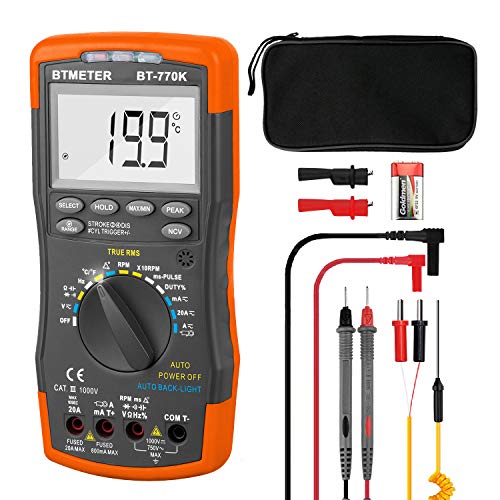
The one-meter solution for vintage ignition systems and points tuning.
If your project car has a distributor, this meter is almost purpose-built for it. The BTMETER BT-770K offers a switchable 3/4/5/6/8-cylinder dwell angle test, pulse width measurements in milliseconds, and a tachometer that goes up to 12,000 RPM. It also handles standard automotive tasks like AC/DC voltage up to 1000V, capacitance, and temperature from -4 to 1832°F.
what separates it is the hands-free design: the meter has a magnetic back plate, a hanger, and a kickstand, all so you can stick it to a fender or hang it under the hood while you twist leads. The auto backlight is a nice touch for dark bays. The functional feedback is positive—owners specifically buy it for the dwell feature—but accuracy and reliability get some mixed notes. The alligator clips are inexpensive and resistance readings can be slow to settle. It is a solid tool for what it does, but treat the probes as consumables.
Why owners pick it
- Dedicated dwell angle test for 3-8 cylinders
- Magnetic hanger, kickstand, and auto backlight for hands-free work
- Pulse width and tachometer for comprehensive ignition diagnostics
- Large 3-inch LCD display with auto backlight sensor
Real-world caveats
- Alligator clips are cheap and feel fragile
- Resistance readings can be slow to stabilize
Best for: the enthusiast restoring a classic car with a points-style ignition. The dwell function is the main event here, and it does that job well.
Look elsewhere if: you only work on modern CAN-bus vehicles. This meter’s specialty is old-school diagnostics, and its general accuracy is passable but not Fluke-grade.
5. Aoefg HY DT151Q Automotive Multimeter

The affordable way to get dwell, RPM, and True RMS in one kit.
This is the dark horse of the list—it is priced near entry-level but includes a feature set that should command more. The Aoefg HY DT151Q offers True RMS accuracy, CAT III 600V safety certification, and automotive-specific diagnostics: RPM tracking for 4-8 cylinder engines, duty cycle, and a dwell angle test. It can also measure temperature up to 1000°C using the included K-type thermocouple.
The build quality feels good in hand, and the kit is complete with test leads with clips and a 9V battery. The display is large and backlit, making it usable under a hood at night. Owners who bought it specifically for setting dwell on older cars (like a 1957 Corvette) found it worked great for that job. Some even say it is “just as good as my Fluke” for certain tasks. For the price, it is hard to find a meter that packs True RMS, dwell, and this many functions into a single unit that actually works.
Surprising depth for the price: Most budget meters force you to choose between safety and features. This one gives you CAT III certification and True RMS alongside RPM and dwell. The trade-off is that the brand does not have the decades-long reputation of Fluke or Innova, but the early owner feedback is overwhelmingly positive.
Grab this if: you want a single do-it-all meter for occasional car work, including classic car tuning, without spending over a hundred dollars. The safety rating and True RMS make it a trustworthy tool.
Pass if: you need the absolute fastest, most refined RPM reading for professional tuning. For that, the Fluke 88V is still the benchmark.
6. BTMETER BT-770M Digital Multimeter TRMS 6000 Count

The meter that physically prevents you from plugging leads into the wrong port.
Blowing the fuse (or the meter) by plugging the red lead into the current jack when you meant to measure voltage is a classic rookie mistake. This BTMETER solves that with a mechanical blocking system that stops the test leads from entering the wrong port. It is a brilliant safety net for beginners or for anyone working in a hurry.
Beyond that safety feature, it is a capable True RMS multimeter with a 6000-count display. It measures AC/DC voltage up to 1000V, current up to 20A, resistance, capacitance, frequency, and temperature up to 1832°F. It has an auto backlight that turns on in dim conditions, an NCV (non-contact voltage) detector, and a large back magnet for attaching to metal panels. The accuracy is a highlight here, with owners calling it reliable and comparing it favorably to much pricier meters. The mechanical port lockout gets mixed reactions—some find it annoying for daily use, while others love the protection it provides.
What stands out
- Mechanical port blocking prevents the most common meter mistake
- True RMS 6000-count accuracy
- Includes temperature probe and large back magnet
- Auto backlight and dial indicator light for dark work
The user feedback
- Port lockout can be frustrating for fast, repeated measurements
- No manual backlight switch—it is auto-only which some find inconvenient
Perfect for: apprentices, students, or anyone teaching themselves automotive electrical work. The mechanical blocking saves the meter (and your fuse budget) from a common error.
Not ideal for: a seasoned pro who needs to switch between functions quickly without a mechanical gate slowing them down. For experienced use, look at the Innova 3340 or the Fluke 88V.
7. ALLmeter WT501 6000 Counts Smart Digital Multimeter
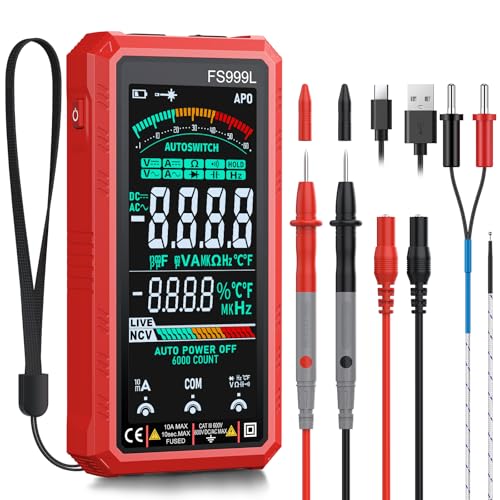
A smart auto-ranging meter with a colorful display that recharges via USB-C.
The ALLmeter WT501 stands out for its ease of use: it has a smart auto mode that automatically identifies AC/DC voltage, resistance, and continuity, so you do not have to manually select a function. The large 5-inch color display is crisp and easy to read across different angles, which is a big plus in a dim engine bay. It also has a built-in LED flashlight to illuminate fuse boxes and dark corners.
The convenience factor is high here. It is powered by a rechargeable 1000mAh lithium battery that charges via USB-C, meaning you never buy another 9V battery. It also includes a K-type thermocouple for temperature readings up to 1000°C. However, the main concern from owners is the screen durability. A few report that the screen is fragile and can become discolored if pressed. The probes are good for bench work but may not survive daily shop abuse. For the home garage, it is a very modern, user-friendly tool.
A modern take on the multimeter: The USB-C rechargeable battery is a genuine quality-of-life upgrade—no more digging for a 9V at the wrong moment. The trade-off is the screen construction; it needs to be handled with care. This is a meter for the thoughtful home mechanic, not for tossing into a tool chest with a set of impact wrenches.
Reach for this if: you want a modern, goof-proof meter for home and light automotive work. The smart auto mode and rechargeable battery make it very approachable.
pass on it if: you need a rugged daily driver for a professional shop. The screen fragility is a real concern for rough environments.
8. Lscsdf FS899L USB Rechargeable Digital Multimeter
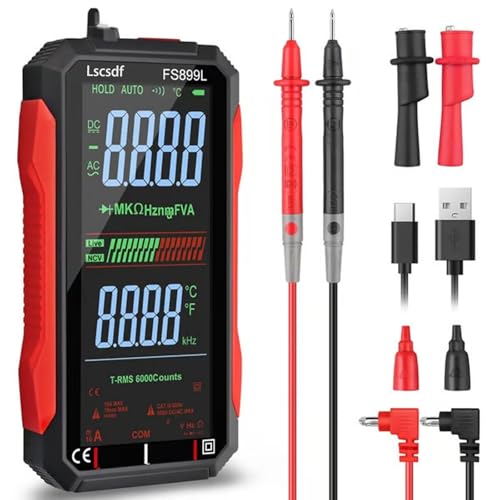
The bright-display, USB-rechargeable meter for home battery and outlet checks.
This Lscsdf multimeter focuses on making the basics easy and clear. It has a 4.8-inch color LCD that is bright and easy to read, even in dim conditions. It is USB rechargeable with a built-in battery, so there is no need to buy replacements. It measures AC/DC voltage, current, capacitance, resistance, and temperature, and includes NCV non-contact voltage detection and firewire/null wire recognition.
Owners praise its accuracy for home projects and its overall ease of use. It is a good tool for checking outlets, switches, car batteries, and basic electronics. The big color screen makes the readings very clear, and the auto-ranging function simplifies operation for beginners. It is not built for professional automotive diagnostics (no RPM, no dwell), but for the home mechanic who wants to troubleshoot a parasitic drain or check a sensor, it is a very solid and modern choice. The consensus is that it is great value for personal use.
What works well
- Very bright, large color display for easy reading
- USB-rechargeable, eliminating 9V battery changes
- Auto-ranging for simple operation
- Good accuracy for home and basic automotive projects
The honest scope
- No automotive-specific functions like RPM or dwell
- Not designed for professional shop abuse
Best for: the homeowner who wants a modern, easy-to-read multimeter for basic car battery tests, outlet checks, and DIY electronics. The USB charging and bright screen are the main draws.
Pass on this if: you need to tune a classic car’s points or measure RPM. It simply does not have those features.
9. Performance Tool W2972 Automotive Digital Multimeter
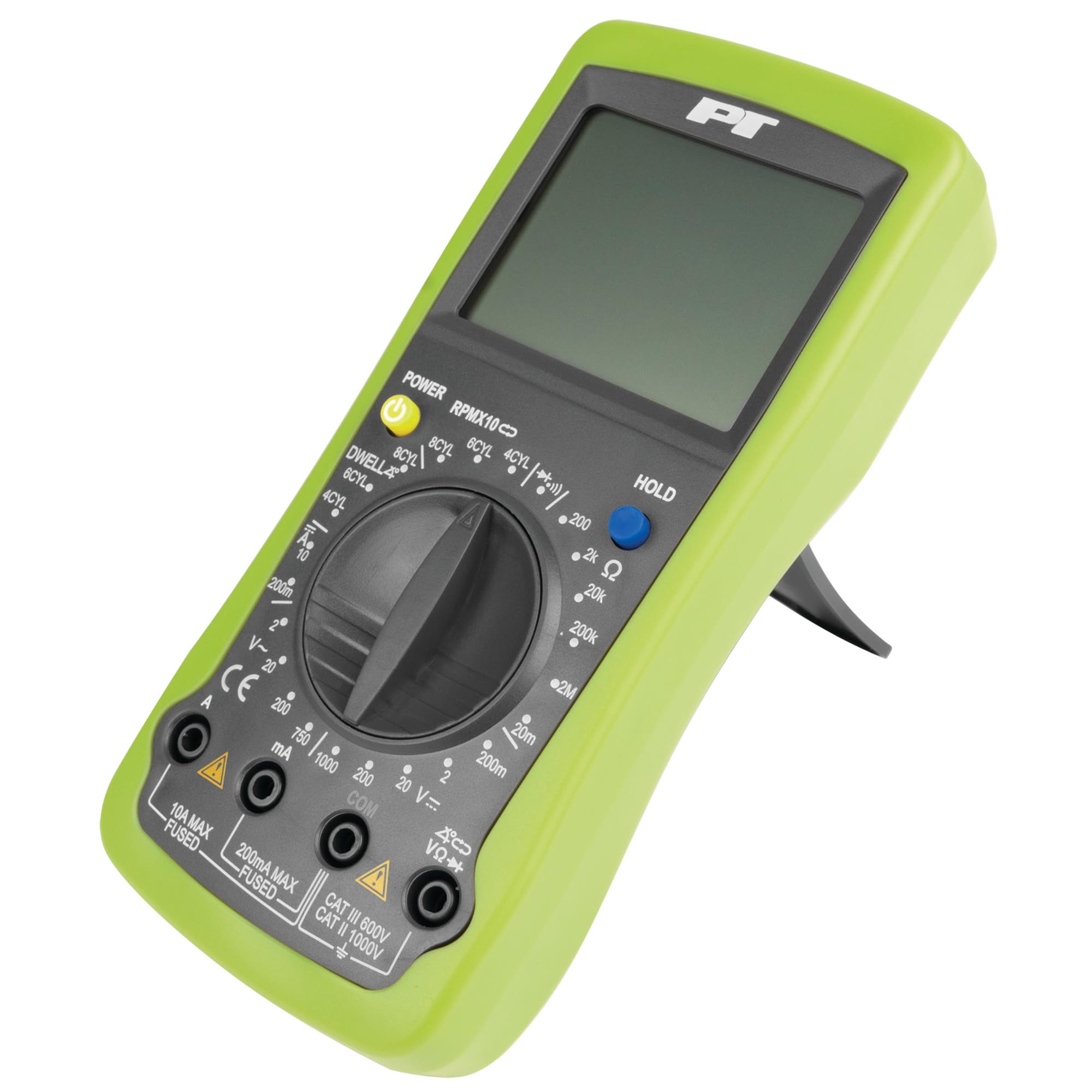
The bargain-bin dwell meter that works on some old cars but not all.
This is the most budget-conscious way to get a tachometer and dwell angle function into your toolbox. The Performance Tool W2972 has a large, easy-to-read LCD display and UL-listed lead probes that are 42 inches long. It is designed for standard electrical testing on cars and on the bench, measuring typical automotive functions including tach and dwell.
The experience here is genuinely mixed. Some owners find it works great, using it successfully to set dwell on vintage Fords. Others have found it completely fails to measure idle RPM and dwell on certain older cars like a ’44 Willys or a ’65 Corvette. The consensus is that the functionality is inconsistent—it either works well for your specific car or it does not work at all. It also comes with a fairly cheap-feeling construction. For the price, it is a gamble. If it works on your car, it is a great bargain. If it does not, you will be ordering a different meter.
A gamble with a specific purpose: This meter’s reputation is purely dependent on vehicle compatibility. It has helped some owners get their classic cars running, but it has also been sent back by others who found the RPM reading unreliable. It is hard to recommend with confidence, but it costs very little and works for some.
Good for: a very tight budget and a specific need to measure tach/dwell, but only if you are willing to return it if it doesn’t work on your engine.
Choose the Innova 3340 or BTMETER BT-770K instead: They are more expensive but have a proven track record of reliably measuring dwell and RPM across a wider range of vehicles.
Understanding the Specs
Input Impedance (10 MΩ)
This spec tells you how much the meter itself interferes with the circuit it is testing. A high input impedance of 10 MΩ (million ohms) means the meter draws almost no current from the circuit. This is critical for modern cars because it prevents the meter from loading down sensitive computer sensors and the ECU (Engine Control Unit), which can cause false readings or even damage. If a meter lacks high impedance, it is risky to use on any computer-controlled component.
CAT III Safety Rating
This is the safety standard for meters used on automotive and industrial electrical systems. A CAT III rating means the meter is built to survive the high-energy transient spikes (sudden voltage surges) that can happen when working on a car’s alternator, starter motor, or hybrid system. A meter without a proper CAT rating can arc over internally during a spike, creating a direct path for current through your hand to ground. For any automotive work, look for at least CAT III 600V.
FAQ
Can I use a standard household multimeter on my car?
What is the difference between a multimeter for mechanics and a standard one?
Do I need True RMS for automotive work?
What does a “Dwell” function do on a multimeter?
How does an inductive RPM clamp work?
What is a “10 MΩ input impedance” and why does it matter?
How long does a multimeter battery last?
Can I test a hybrid vehicle’s high-voltage system with any multimeter?
What is a “parasitic draw” test and how do I do it?
How do I know if a multimeter is accurate?
Final Thoughts: The Verdict
If you want one dependable pick, the best multimeter for mechanics is the Innova 3340 because it packs the most essential automotive diagnostic features (inductive RPM clamp, dwell, duty cycle, temperature probe) into a well-built, affordable package that thousands of owners trust. If you want the absolute shop-floor gold standard with legendary durability and hybrid-safe diagnostics, grab the Fluke 88V. And for the home mechanic who works on classic cars and needs a dedicated dwell and tachometer, the BTMETER BT-770K is the specialist to reach for.
How We Picked
We do not accept paid placement. Every pick is matched to a real buyer and a real use-case; we do not hands-on test units.
Sources & Methodology
Specifications: manufacturer listings and product documentation. Review insights: verified customer reviews, as of July 2026. Pricing: not shown on this page (it changes often); check the current price via the retailer link.
As an Amazon Associate, Trending Car earns from qualifying purchases. This does not affect which products we feature.