
Our readers keep the lights on and my garage snacks stocked. As an Amazon Associate, I earn from qualifying purchases.
Specs are compiled from manufacturer listings and verified buyer reviews and can change over time — please confirm the key details on the product page before buying.
A camper hitch that lets your trailer wag the truck instead of the other way around is a white-knuckle hazard you never forget. The right weight-distribution system keeps your tow vehicle level, your trailer tracking true, and your confidence high through crosswinds and mountain passes. This guide cuts through the jargon to match you with the best camper hitch for your specific trailer weight and towing style.
I’m Min Islam — the founder and writer behind Trending Car. This guide is built by comparing the manufacturers’ published specifications and the patterns across verified customer reviews, so you get each pick’s real strengths and trade-offs instead of marketing spin.
Whether you tow a lightweight weekend trailer or a 34-foot cross-country camper,, A well-chosen hitch turns a white-knuckle tow into a relaxed, controlled drive. — this roundup covers the five top contenders to help you decide.
Our Picks at a Glance
How To Choose The Best Camper Hitch
Every weight-distribution hitch does the same two things: it levels your truck and trailer, and it fights sway. But the way each achieves those goals creates very different real-world experiences. Understanding a few key specs simplifies the decision.
Match the Weight Rating to Your Rig
The two critical numbers are the Gross Trailer Weight Rating (GTWR) and the tongue weight rating.. Your hitch’s capacity must meet or exceed the loaded weight of your camper — buying a hitch rated for 8,000 pounds when your trailer weighs 7,000 pounds loaded gives you a safe margin. Tongue weight, typically 10-15% of the trailer’s total weight, is the force that the hitch ball carries, and you need a hitch that can handle that specific load too.
Pick Your Sway Control Type
Sway control types differ significantly in performance and convenience.. Friction-based systems use a sliding bar or pad to resist side-to-side movement. Integrated systems use a cam (a rotating piece) and spring arrangement that provides resistance through the entire turn and does not require removing bars when backing up. The more points of contact the system has, the more resistance it provides against sway.
Consider Installation and Adjustability
Some hitches install in an hour with basic tools; others require a torque wrench capable of 400+ ft-lb.. Adjustable brackets with multiple height settings make it easy to dial in the perfect ride height, while fewer adjustment points can make fine-tuning frustrating. Grease zerks, top-loading spring bars, and clear instructions save time and hassle on setup day..
Quick Comparison
| Model | Best For | GTWR | Sway Control Type | Ball Included | Amazon |
|---|---|---|---|---|---|
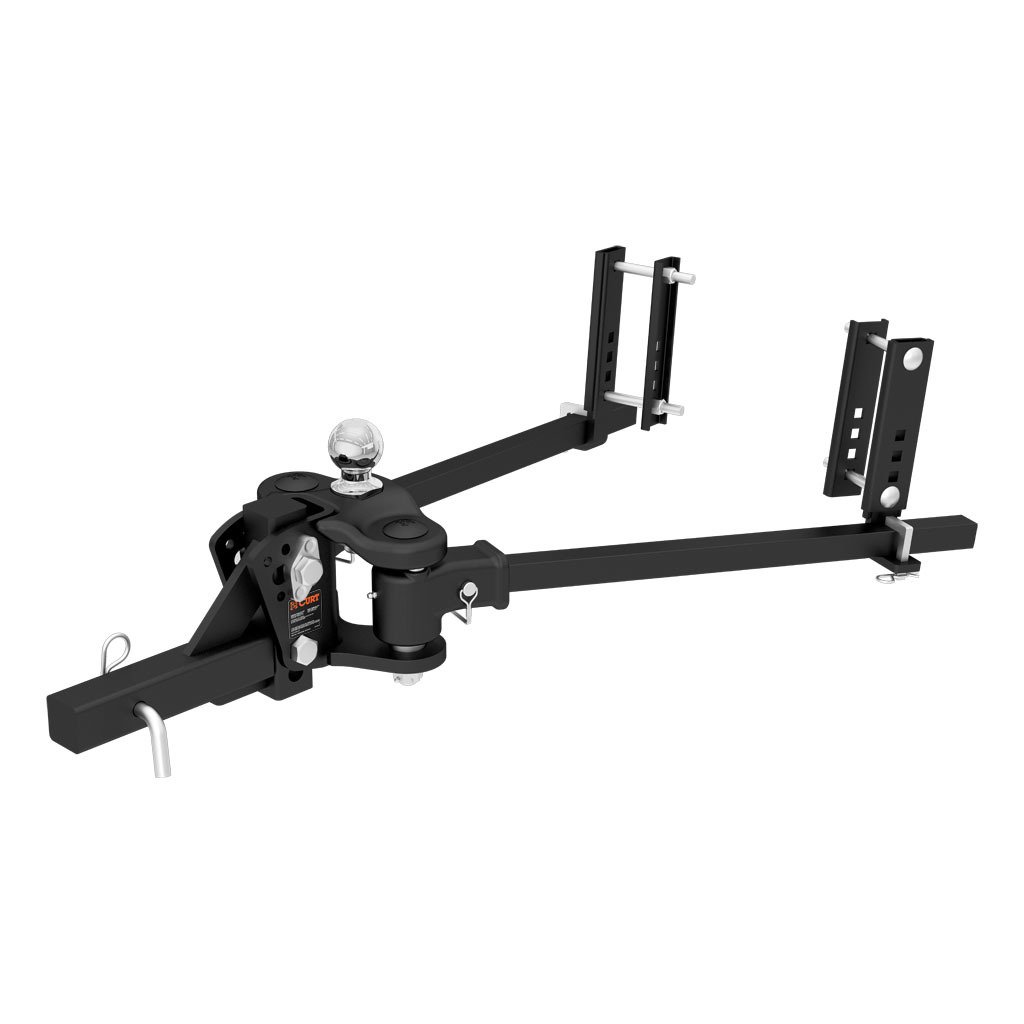
| CURT TruTrack★ Best Overall | Mid-size travel trailers on mountain roads | 10,000 lbs | Integrated 4-point (cam & spring) | Yes (2-5/16″) | Amazon |
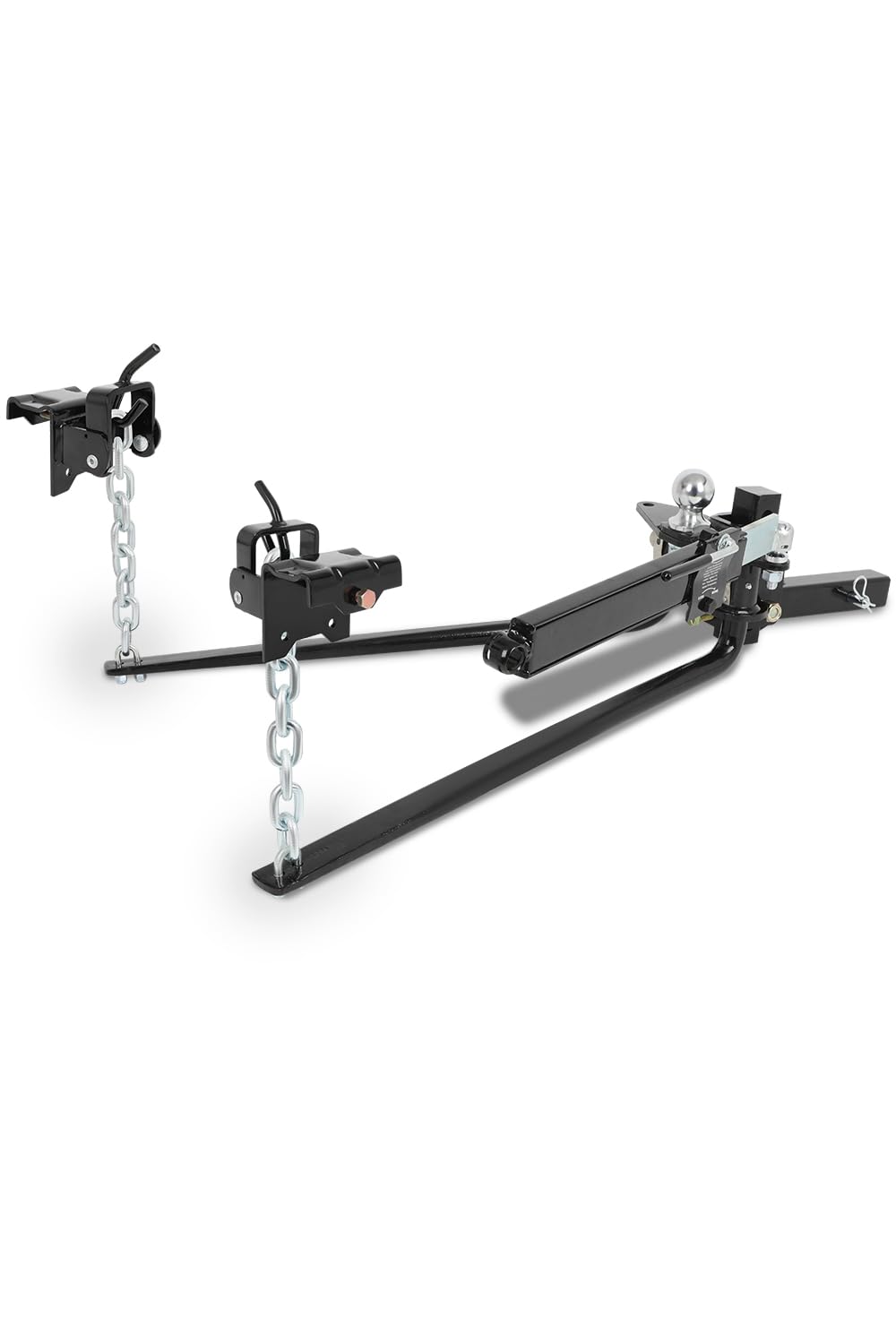
| FAHKNS Weight Distribution HitchPowerhouse Value | Heavy trailers on a budget | 14,000 lbs | Spring-loaded bars + anti-sway bar | Yes (2-5/16″) | Amazon |
| Fastway e2 Round Bar | First-time buyers wanting easy setup | 8,000 lbs | 2-point integrated | No | Amazon |
| Camco Eaz-Lift ReCurve R3 | Quiet, no-grease towing at speed | 12,000 lbs | Integrated (built into head) | Yes (2-5/16″) | Amazon |
| Equal-i-zer 4-Point | Long-haul travel with big campers | 10,000 lbs | Integrated 4-point | No | Amazon |
In‑Depth Reviews
1. CURT 17500 TruTrack Weight Distribution Hitch with Sway Control
Our pick — over 4.5★ from 550+ verified ratings; the strongest balance of quality and price.
This hitch makes mountain passes feel like straight highway. — it uses a cam-and-spring system (a built-in rotating piece and spring) that never needs friction-pad replacements.
The TruTrack uses a cam and spring system with hardened components — no friction pads to wear out. Four points of sway control actively keep the trailer aligned, and buyers report it eliminated sway up to 68 mph on an F-150 towing a 19-foot trailer, a noticeable improvement over the 55 mph ceiling they had before. It is rated to 10,000 pounds, which puts it in the balance for mid-size travel trailers between 3,500 and 6,500 pounds where most owners say it really shines.
Install runs about an hour for a typical weekend mechanic, though the box sometimes arrives looking a little beat up — a common shipping casualty with heavy steel. The welded head and forged steel spring bars give it a solid feel that owners describe as “heavy duty” and “worth the money.” Unlike some chain-based systems, the TruTrack offers higher ground clearance and uses grease zerks for easy lubrication. Compared to the FAHKNS model’s 14,000-pound rating, the CURT is lighter-duty but more refined, and the review consensus across hundreds of owners is that it delivers on the promise of a stable, confident tow without the drama.
What wins people over
- Integrated sway control with no separate add-on bars to manage, works through the full turn circle
- Higher ground clearance than traditional chain-style hitches makes hitching easier on uneven ground
- Grease zerks on the pivot points simplify maintenance; one owner noted “easy lube” as a daily perk
Know before you go
- Rated for 10,000 lbs but a few owners advise it is best kept under that for a comfortable margin — treat it as a solid 8,500-lb system
- Avoid 90-degree turns with spring bars engaged; you need to pop them off for extreme maneuvering
Reach for this if: you tow a single-axle or light tandem-axle travel trailer and want one integrated package that doesn’t need add-on sway bars — the crowd favorite among owners of 19- to 26-foot campers.
Look elsewhere if: your trailer is a heavy 8,000-plus pound rig or you plan to tow near the 10,000-lb limit regularly; the FAHKNS or Equal-i-zer handle heavier loads with more margin.
2. FAHKNS Weight Distribution Hitch with Sway Control, 14,000 lbs
A 14,000-pound brute that costs less than most 10,000-pound rivals — it carries 4,000 pounds more capacity than the CURT TruTrack at a lower price.
The FAHKNS pulls double duty: its spring-loaded bars distribute tongue weight (the downward force on the ball) across all axles, and a separate sway control bar adds an extra layer of resistance against trailer sway. The result is a system that quiets bounce and reduces the push from passing semi-trucks. At 46 kilograms (roughly 101 pounds), it is a heavy unit that signals serious materials — the stainless steel construction and powder-coated finish are built for years of outdoor exposure.
The biggest difference between this and the CURT TruTrack is the sheer capacity: the FAHKNS handles 14,000 pounds and 1,200 pounds of tongue weight, while the CURT tops out at 10,000. A buyer towing a large tandem-axle camper will appreciate that extra headroom. The main caveat, based on owner reports, is that shipping can be rough — a handful of packages arrive with damaged boxes, scuffed paint, or missing parts (the shank is the common absentee). One owner noted the seller reimbursed through eBay quickly, but it is worth inspecting the box before you open it. When it arrives intact, installation is under 30 minutes with clear instructions.
What it does well: the load equalization is effective — owners mention less bounce, less noise, and the sway reducer effectively handles wind and truck turbulence at highway speeds.
The honest limit: packaging consistency is the weak spot; if a pristine unboxing matters to you, order with awareness that you may need to inspect and request a replacement shank or hardware bag.
Who it fits: the budget-conscious towers hauling 8,000 to 12,000 pounds who need the highest capacity at the lowest investment — it carries a towing capacity of 14,000 lbs versus the Fastway e2’s 8,000 lbs.
Who should pass: anyone who wants a fuss-free out-of-box experience and prefers a single integrated sway system without a separate bar to manage.
3. Fastway e2 2-Point Sway Control Round Bar Hitch, 8,000 lbs

The 20-minute install hitch that turns a nervous first-timer into a confident tower — and it does not require removing bars to back up, unlike add-on friction systems.
The e2 combines weight distribution and built-in sway control into a round bar design that does not need to be removed when you back up — no more hopping out to detach bars in a crowded campground. It is rated for 8,000 pounds gross trailer weight and 800 pounds tongue weight, making it a natural fit for single-axle campers and smaller tandem-axle travel trailers. The 10-year limited warranty adds a layer of confidence that is rare at this price point.
What owners praise most is installation — 83 owners call it out as a standout feature, and many report it takes about 20 minutes with basic hand tools. The 2-point integrated sway control (two friction surfaces built into the head) handles crosswinds well; one owner described towing through 40+ mph winds with “no sway at all.” The trade-off is that the hitch triggers backup sensors on some trucks due to its size, and a few units arrive with missing parts — the 21 negative mentions on that specific issue make it worth checking the box contents immediately. Compared to the premium Equal-i-zer, the e2 is lighter-duty but also simpler to use for everyday towing without needing a torque wrench for setup.
The case for it: installation is genuinely easy, the ride quality improvement is dramatic (owners call it “best bang for your buck”), and the 10-year warranty backs a product that feels well-made.
The catch: the ball is not included, so you need to source a 2-5/16″ ball separately, and some owners note minor turning noise after a few hundred miles of use.
Best for: the first-time camper owner or anyone towing a 4,000 to 7,000 pound trailer who wants a no-drama setup they can install before their first trip.
Think twice if: you are towing near the 8,000-lb limit regularly or have a trailer that exceeds 800 lbs of tongue weight — you need one of the higher-capacity hitches in this lineup.
4. Camco Eaz-Lift ReCurve R3 Weight Distribution Hitch, 12,000 lbs
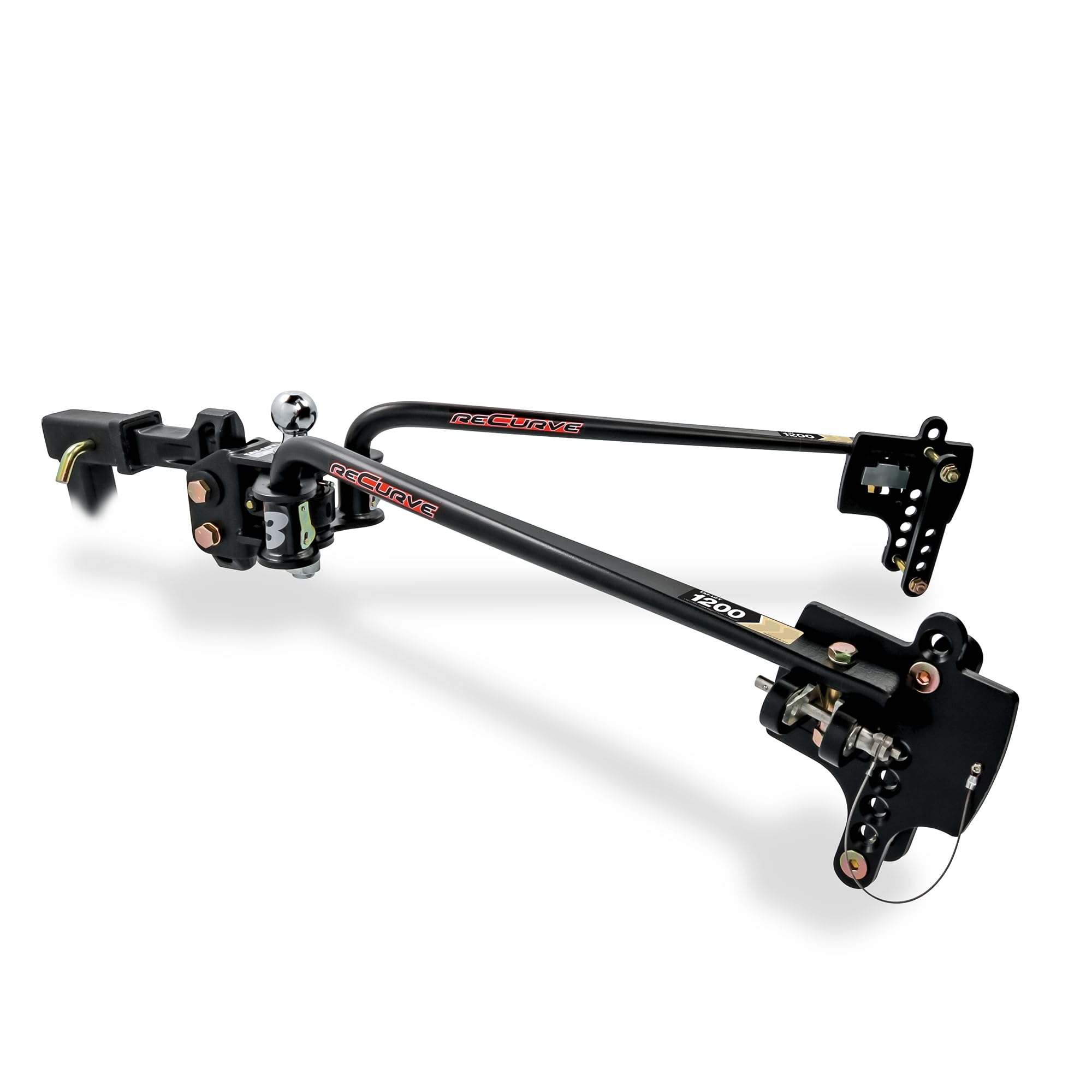
A grease-free hitch that delivers 70-mph stability without the clunk-and-creak chorus — its top-loading spring bars eliminate the chains and grease guns that round-bar hitches need.
The ReCurve R3 is built around a patented top-loading spring bar design that does away with chains and grease — you just lift the bars into the head and go. The integrated sway control is built directly into the hitch head, so there is no separate friction bar to install or adjust. It carries a 12,000-pound GTWR with a 1,200-pound tongue weight rating, and the 2-5/16″ ball is included in the box. Owners routinely report stable towing at 70 mph with no wiggle or sway, and the “no-noise” design lives up to its name — no clunking in turns, no creaking at stops.
The biggest difference between the R3 and the Fastway e2 is capacity: the R3 handles 12,000 lbs vs the e2’s 8,000 lbs, and it includes the ball, which the e2 does not. The trade-off is a heavier unit (89 pounds) and occasional frustration with support — a few owners note the instructions are for a different variant and the manufacturer’s online support is sparse. One reviewer flagged that a cheap lock washer failed during setup, so it is wise to have a few spare washers on hand. But the consensus is clear: if you want a hitch that keeps your camper stable and quiet without any grease mess, this is the one to grab.
top-tier traits
- Top-loading spring bars mean no chains, no grease, and easier hitching compared to traditional round-bar systems
- Built-in anti-sway provides constant resistance without an add-on friction bar; owners confirm it is stable at 70 mph
- On/off sway control feature lets you disengage for tight maneuvers, a flexibility the Fastway e2 lacks
Considerations
- Poor online support and a design change that made some instructions outdated — you may need to figure out adjustment on your own
- At 89 pounds, this is a heavy unit; physically lifting it into the receiver takes some effort
Choose this for: towing 5,000 to 10,000 pounds with minimal noise and no grease maintenance — it is especially praised by owners of 7,000-lb trailers who want a “smooth ride” and easy on/off.
Pass if: you prefer manufacturer support with a phone number and clear step-by-step guides; the R3’s documentation has been a sticking point for some.
5. Equal-i-zer 4-Point Sway Control Hitch, 10,000 lbs

Zero-sway performance for 34-foot campers, backed by a limited lifetime warranty — its 4-point design (four friction surfaces) resists sway even while backing up.
The Equal-i-zer uses an integrated 4-point sway control design — four friction surfaces work together to resist sway at all times, even during backing and tight turns. It is rated for 10,000 pounds gross trailer weight with 1,000 pounds of tongue weight, and it works with virtually all bumper-pull trailers (those that attach to a receiver hitch on the tow vehicle), including those with surge brakes (brakes activated by the trailer pushing forward). Customers note zero sway with trailers as long as 29 feet (a 5,000-lb Airstream) and 34 feet, calling it “essential” for big campers. The limited lifetime warranty adds a layer of long-term value that the shorter warranties in this lineup simply don’t match.
The same 4-point friction that gives it class-leading sway control also creates metal-on-metal noise — owners consistently mention creaking during turns, which is normal but noticeable. Setup requires a torque wrench capable of 425-430 ft-lb for the ball, and you need a thin-walled socket to fit into the recess. Unlike the Camco R3’s grease-free top-loading design, the Equal-i-zer greasing points help manage the noise but add an extra maintenance step. Compared to the CURT TruTrack, the Equal-i-zer is heavier at 102 pounds (1,632 ounces) and the installation is more tedious, but owners with 10,000+ miles towing report it delivers the most confidence-inspiring ride of any hitch they have used.
What makes it a legend: the 4-point sway control is class-leading — owners of 28- to 34-foot trailers say it eliminates sway completely, and many have towed thousands of miles without incident. Build quality and durability are the most-praised aspects (48 and 49 mentions respectively).
The honest trade-off: setup is labor-intensive, the noise is real (18 negative mentions), and you need to buy the ball separately. This is a hitch for the owner who values maximum safety over quick installation.
Reach for it when: you have a heavy 25-34 foot travel trailer and plan to tow long distances — the stability at highway speeds and in crosswinds is the best in this roundup.
skip it if: you want a quick, quiet, grease-free installation like the Camco R3 offers, or you are not comfortable tightening a hitch ball to over 400 ft-lb on your own.
Understanding the Specs
Gross Trailer Weight Rating (GTWR)
This is the maximum weight of your fully loaded camper the hitch can handle. It is not the dry weight from the dealer’s brochure — it includes water, propane, gear, and anything else you pack. Never exceed the GTWR; always leave a safety margin of at least 10-15% to protect your tow vehicle’s transmission, brakes, and frame.
Tongue Weight and Distribution
Tongue weight is the downward force the trailer tongue places on the hitch ball, typically 10-15% of the trailer’s total weight. A weight-distribution hitch takes that downward force and spreads it across the tow vehicle’s front axle and the trailer’s axles, keeping your front tires planted for steering and braking. Without it, a heavy tongue weight causes the back of the truck to squat and the front to lift, reducing steering control.
Integrated vs. Add-On Sway Control
Sway control resists the side-to-side oscillation caused by crosswinds, passing trucks, or uneven roads. Integrated systems (like the single-axle or 4-point designs) are built into the hitch head and work continuously, even when you back up. Add-on friction bars require manual disconnection for tight maneuvering and only resist sway through friction on a single sliding surface. Integrated systems are universally preferred for convenience and safety.
Spring Bar Type: Round Bar vs. Trunnion
Round bar hitches use cylindrical spring bars that sit below the hitch head and create tension through chains or a bracket system. Trunnion bars are rectangular and connect to the head on both sides, offering greater ground clearance and a more direct transfer of force. Trunnion systems are generally easier to attach and detach, especially on uneven ground, but they cost more.
FAQ
Can I use a weight-distribution hitch on any camper?
Do I need a sway control hitch if my trailer already has a sway bar?
Is the 2-5/16 inch ball the standard for all campers?
How long does a camper hitch last?
Do I need to remove the spring bars when backing up?
What is the difference between a “trunnion” and a “round bar” hitch?
Will a weight-distribution hitch work with a short-bed truck?
Can I install a camper hitch myself or do I need a shop?
Final Thoughts: The Verdict
Across the board, the best camper hitch winner is the CURT TruTrack because it delivers excellent integrated sway control, easy weekly maintenance, and a proven track record with thousands of owners on mid-size travel trailers. If you want maximum capacity for the lowest price, grab the FAHKNS. And for heavy cross-country towing with a 28-plus foot camper, the Equal-i-zer is the one to reach for — its 4-point sway control and limited lifetime warranty are tough to top when miles and safety matter most.
How We Picked
We do not accept paid placement. Every pick is matched to a real buyer and a real use-case; we do not hands-on test units.
Sources & Methodology
Specifications: manufacturer listings and product documentation. Review insights: verified customer reviews, as of July 2026. Pricing: not shown on this page (it changes often); check the current price via the retailer link.
As an Amazon Associate, Trending Car earns from qualifying purchases. This does not affect which products we feature.