
Our readers keep the lights on and my garage snacks stocked. As an Amazon Associate, I earn from qualifying purchases.
Specs are compiled from manufacturer listings and verified buyer reviews and can change over time — please confirm the key details on the product page before buying.
A dying fuel pump leaves you stranded, but a bad replacement leaves you broke and stranded again. The difference between a reliable swap and a failed unit depends on flow rate, fuel type, and fitment — not brand hype. This guide covers eight trusted in-tank and inline pumps, pairing real flow numbers with honest owner trade-offs.
I’m Min Islam — the founder and writer behind Trending Car. This guide is built by comparing the manufacturers’ published specifications and the patterns across verified customer reviews, so you get each pick’s real strengths and trade-offs instead of marketing spin.
You are getting a no-nonsense breakdown of the best fuel pump options on the market, ranked by real-world reliability data and owner experiences, not marketing claims.
Our Picks at a Glance


How To Choose The Best Fuel Pump
Matching the right pump to your vehicle’s fuel system, engine output, and fuel type is key.
Flow Rate vs. Pressure: Know the Difference
Flow rate (measured in GPH or LPH) tells you how much fuel the pump can move, while pressure (measured in PSI) tells you how hard it pushes. A carbureted engine typically needs low pressure (4-9 PSI) but good volume. A fuel-injected EFI engine needs high pressure (40-70 PSI) to fire the injectors. A pump like the Holley 12-801-1 delivers 97 GPH at a maximum of 7 PSI, making it ideal for carbureted setups — and a terrible fit for a modern Silverado’s injection system.
Fuel Compatibility: Gas Only, or E85 Too
Ethanol-blended fuels, especially E85 (85% ethanol), attack standard rubber seals and internal coatings. Some pumps, like the DeatschWerks 9-201-1000 and the Aeromotive 11540, are explicitly built for E85 service. Others, like the AEM 50-1000, note that E85 will shorten the pump’s life. If you run ethanol blends, choose a pump with ethanol-rated materials — or replace it sooner.
Universal vs. Vehicle-Specific Fitment
A vehicle-specific pump module (like the Delphi FG0407) drops into the factory fuel tank hanger with the correct connector and fuel level sender, making it a direct swap. A universal pump (like the AEM 50-1000) gives you a bare pump, a filter sock, and a wiring pigtail — you modify the hanger yourself. Vehicle-specific units cost more upfront but save fabrication time. Universal units are cheaper for custom builds but require wiring and bracket work.
Quick Comparison
| Model | Best For | Flow Rate | Fuel Type | Fitment | Amazon |
|---|---|---|---|---|---|
| Holley 12-801-1★ Best Overall | Carbureted street/strip | 97 GPH | Gasoline | Universal inline | Amazon |
| A-Premium FP0028CBest Value | 1999-04 Chevy/GMC trucks | — | Gasoline | Vehicle specific (rear) | Amazon |
| Apeixoto AP3622STruck Specialist | 1996-97 Chevy/GMC trucks | — | Gasoline | Vehicle specific (top) | Amazon |
| BDFHYK BD-05-07284WT | 2004-07 Chevy/GMC trucks | — | Gasoline | Vehicle specific (front) | Amazon |
| DeatschWerks 9-201-1000 | E85 turbo builds | 255 LPH | Gasoline & E85 | Universal in-tank | Amazon |
| AEM 50-1000 | High-horsepower EFI swaps | 340 LPH | Gasoline | Universal in-tank | Amazon |
| Delphi FG0407 | OE-replacement trucks | — | Gasoline | Vehicle specific (right) | Amazon |
| Aeromotive 11540 | Boosted engines on E85 | 340 LPH | Gasoline & E85 | Universal in-tank | Amazon |
In‑Depth Reviews
1. Holley 12-801-1 97 GPH RED® Electric Fuel Pump
Our pick — over 4.5★ from 450+ verified ratings; the strongest balance of quality and price.
The carburetor champion that 450+ owners call bulletproof.
If your engine wears a carburetor — or you are converting an injected truck to one — this Holley Red pump is the crowd favorite for a reason. It flows 97 gallons per hour free flow and tops out at 7 PSI, which means no regulator is needed with an Edelbrock carb. That is the exact pressure window carbureted float bowls need to avoid flooding. Owners running injection-to-carb swaps on early Dodge pickups report it fires right up with no regulator needed, and the tumble-polished billet aluminum body resists corrosion far better than the old painted cans.
The trade-off is noise. At 2 amps draw (the electrical current it pulls) it is quiet for an inline pump, but owners still describe it as “a little louder than expected.” Among 453 owners, reliability is the #1 praised aspect, mentioned most often in reviews, but 32 owners honestly flag the noise. Pick this pump if you value flow consistency over library silence.
Reliable electric flow
- Flows 97 GPH at a carb-safe 7 PSI — no regulator on Edelbrock setups
- Reliability is the top praise by far; 55 owners flag it as rock-solid
- Billet aluminum body resists rust where painted pumps corrode
Noisy operation
- Audible hum — 32 owners note the noise level is higher than a typical in-tank pump
- Not designed for high-pressure EFI systems; max 7 PSI keeps it carb-only
Best for muscle cars: you need a carbureted or conversion pump with proven reliability and zero pulsation.
Skimpy install kit: your vehicle is EFI and demands 40+ PSI — this pump will starve your injectors.
2. A-Premium Fuel Pump Module Assembly for Chevy/GMC (1999‑2004)
The budget module that drops into a 20-year-old Silverado like factory.
This complete assembly replaces the pump, sending unit, strainer, seal ring, and wire harness in one box — seven parts total, so you don’t hunt for the one missing O-ring at 9 p.m. It is built for 1999-2004 Chevrolet Silverado and GMC Sierra 1500/2500/3500 trucks with the 4.3L, 4.8L, 5.3L, 6.0L, or 8.1L. Owners consistently confirm the fit is exact: “fit great on my Chevy Silverado” and “perfect fit/harness correct” show up repeatedly in 823 verified reviews. The metal body construction gives it a more solid feel than the all-plastic modules that crack in cold weather.
The biggest catch is the wiring connector — General Motors used at least three different plug styles across these years, so you must verify your truck’s connector shape before buying. A-Premium includes the gasket and protective covers, but the wiring instructions get mixed feedback; 6 owners flagged them as unclear. Reliability is praised most (43 owners call it out positively), but durability gets the opposite treatment from 14 owners. For the price, it is the right choice if you match the connector and accept the gamble on long-term lifespan — the one-year unlimited-mileage warranty helps cover that.
Budget GM swap: you want a full drop-in module with a gasket and fresh wiring for a 99-04 GM truck at the lowest entry cost.
Check gasket seal: long-term durability is your top concern — a minority of buyers report early failure.
3. Apeixoto AP3622S Fuel Pump Assembly (1996‑97 C/K Trucks)
The 1990s GMT400 owner’s direct-fit rescue.
If you drive a 1996 or 1997 Chevrolet C/K or GMC pickup with a 4.3L, 5.0L, 5.7L, or 7.4L, your factory pump options have dwindled — the Airtex E3622S was discontinued. Apeixoto builds this as a direct metal replacement that drops into the top of the tank. The buying pattern is clear: 28 owners praise the value for money, and 22 call out the fit as spot-on. One owner describing a 97 C1500 fired it up on the third prime exactly as the installation guide suggests — no drama, no cursing. The metal construction is a subtle upgrade over the original plastic-shelled module, and the 1.28 kg weight suggests decent material thickness.
The caution is real: reliability is the most-discussed aspect with a MIXED verdict from Amazon. While many owners mention perfect starts, a vocal minority describe failures within weeks, including one unit that died after 50 miles. This is the right pump for a budget-conscious GMT400 owner who needs a working unit today — just keep the one-year warranty info handy.
1990s Chevy fix: you need a metal replacement for a 96-97 Chevy/GMC truck and want the absolute lowest price.
Verify harness plug: you cannot risk a roadside failure — the reliability data on this one is split.
4. BDFHYK E3609M Fuel Pump Assembly (2004‑07 GM Trucks)

The 2009 Silverado work-truck fix that brought gas mileage back.
This module fits the later GMT800 trucks (2004-2007 Silverado and Sierra, including the Classic and HD variants) and the 2009 model year. It replaces part numbers like E3609M and FG0340 and brings a built-in fuel pressure sensor so the ECM gets accurate readings. One owner with an ’09 Silverado 1500 4×4 work truck with a short bed reported improved gas mileage immediately after install — a clear sign the old pump was running weak. The construction uses high-quality POM plastic over a metal frame, which BDFHYK states is resistant to wear and corrosion from fuel impurities.
The mixed feedback lands on durability — while many customers note smooth starts and steady pressure, a smaller group says the unit died within two months. The 785-review average sits at 4.3 stars, high enough to trust for most applications, but the failure anecdotes are clustered and specific. The year-long unlimited-mileage warranty is your safety net. This is the right pick if you need the E3609M interchange and the pressure sensor integration — just install it carefully and test it immediately.
2004-07 upgrade: you drive a 2004-09 GM truck and want a module with the pressure sensor and a clean fit.
Warranty short: you need absolute long-haul reliability — durability reviews are notably split here.
5. DeatschWerks 9-201-1000 255 LPH In-Tank Fuel Pump

The quiet, E85-ready workhorse that built its rep in the turbo community.
At 255 liters per hour, this stainless-steel pump is built for high-horsepower builds that run E85 — a fuel that eats ordinary rubber seals. The kit arrives complete: pump, installation kit, filter sock, and wiring. what separates it from the 340 LPH (liters per hour) crowd is how much quieter it runs. Owners coming from Walbro pumps report a noticeable drop in whine, making daily driving more pleasant. It handles pulse-modulated and constant-voltage systems, so it works with modern ECM (engine control module) fuel pump drivers.
The reliability pattern carries a MIXED label from Amazon — reliability is the most-discussed aspect, but it is flagged as mixed rather than purely positive. Quality is the top positive aspect (10 owners call it out), and the noise level is the second most-praised feature (9 owners mention it). This is the pump for a tuner who values a quiet cabin and ethanol compatibility over raw flow volume — the DeatschWerks is notably smaller and quieter than the AEM or Aeromotive alternatives.
Performance build: you run E85 on a turbo build and want whisper-quiet operation at 255 LPH.
Not plug-and-play: flow above 340 LPH is needed for a 1,000+ horsepower build — the DeatschWerks tops out at 255 LPH.
6. AEM 50-1000 High Flow In-Tank Fuel Pump (340 LPH)
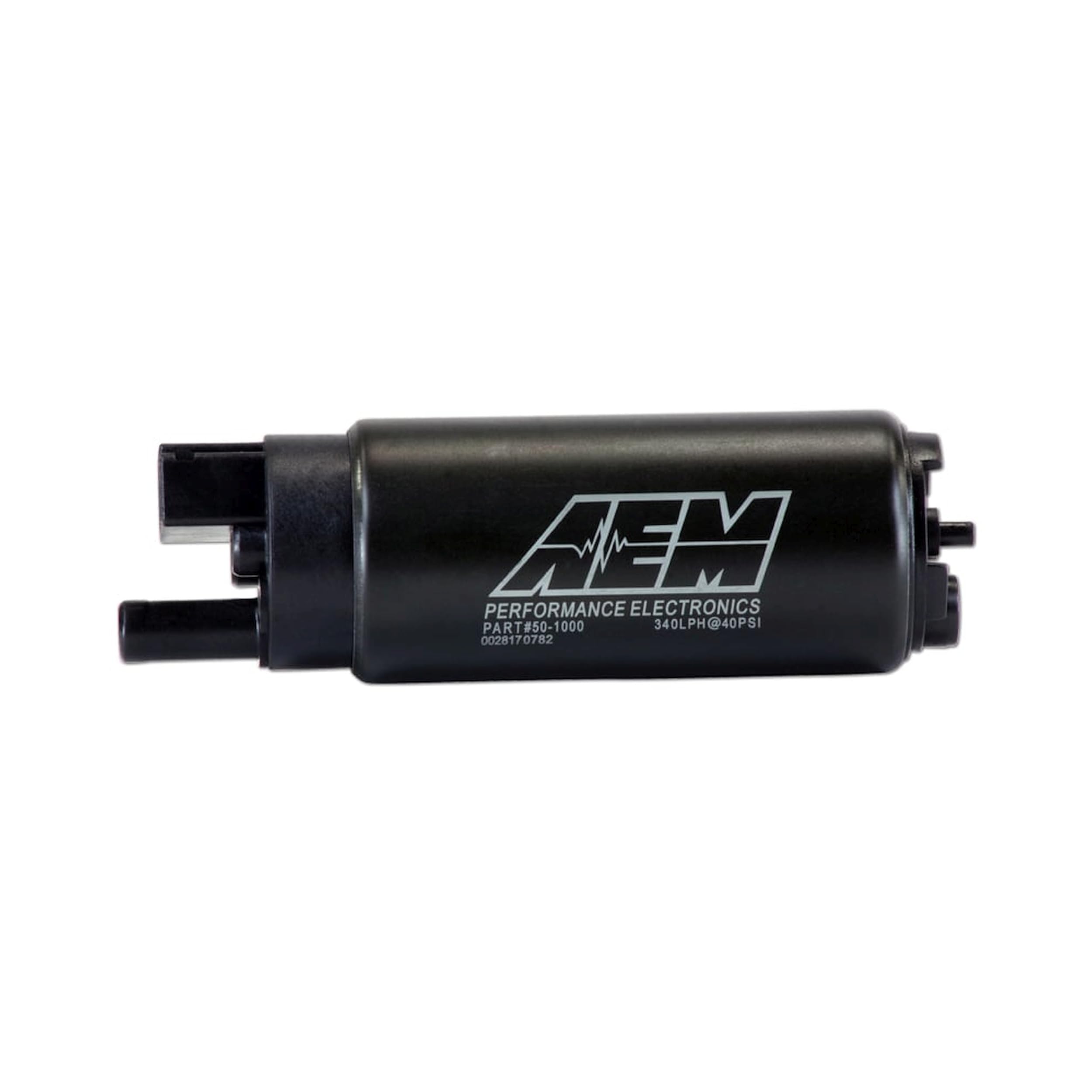
Ten years in a K-swap is the real warranty.
At 340 liters per hour at 40 PSI, this pump feeds naturally aspirated and boosted EFI engines alike. The 39mm diameter fits most factory hangers, and the offset inlet design helps clearance in tight tanks. Owners have logged extreme longevity: one ran it from 2016 to early 2026 (ten years) in a K-swap before losing fuel pressure. Another LS-swapped a squarebody Chevy truck with the AEM and reported consistent pressure. The kit includes the pump, rubber sleeve, end caps, pre-filter, hose, clamps, and a flying lead — almost everything except the bracket for a non-standard hanger.
Fitment is where the opinion splits — some owners call it a drop-in, others note it requires modifying the stock baffle (as one owner did on a 2000 Jeep XJ 4.0). The 580-review pool averages 4.5 stars, with quality and value for money being the top praises. The fuel type limitation is important: AEM warns that E85 diminishes pump life. If you run straight gasoline on a high-horsepower EFI build, this pump is the longevity king at the price point.
Race fuel system: you need 340 LPH of reliable gasoline flow for an LS, K, or turbo swap that might keep running a decade.
Requires bracket: E85 is your primary fuel — AEM explicitly states E85 reduces pump life.
7. Delphi FG0407 Fuel Pump Module

The 200,000-mile Delphi that makes you forget you ever changed it.
Delphi brings 80 years of OE heritage into this module, and the owner feedback reflects that trust. One owner replacing the pump on a 2002 Silverado 1500 reported the previous Delphi unit lasted over 200,000 miles. The FG0407 is validated and tested specifically for each vehicle application, with rigorous OE-level testing for extreme temperature tolerance. It includes a new fuel pump module assembly and gasket, and it drops in without harness splicing because the connector matches the GM body style.
The durability picture is honest: durability gets a NEGATIVE label from 13 owners who report failures within a year, and the noise level draws 15 complaints about a loud buzzing from the return line. Some owners also note the new-style plug requires cutting the old wires for a 2001 Silverado, which is an extra step. But the positives dominate — reliability is the top positive aspect at 78 mentions, and quality follows at 45. This is the right pick if you want OEM-level fit and the statistical best chance at another 200,000 miles.
Reliable daily: you value OE (original equipment) heritage and want the highest reliability stats in this guide.
Low flow limit: noise is a deal-breaker — 15 owners flag the return-line buzz as annoying.
8. Aeromotive 11540 340 LPH Stealth In-Tank Fuel Pump
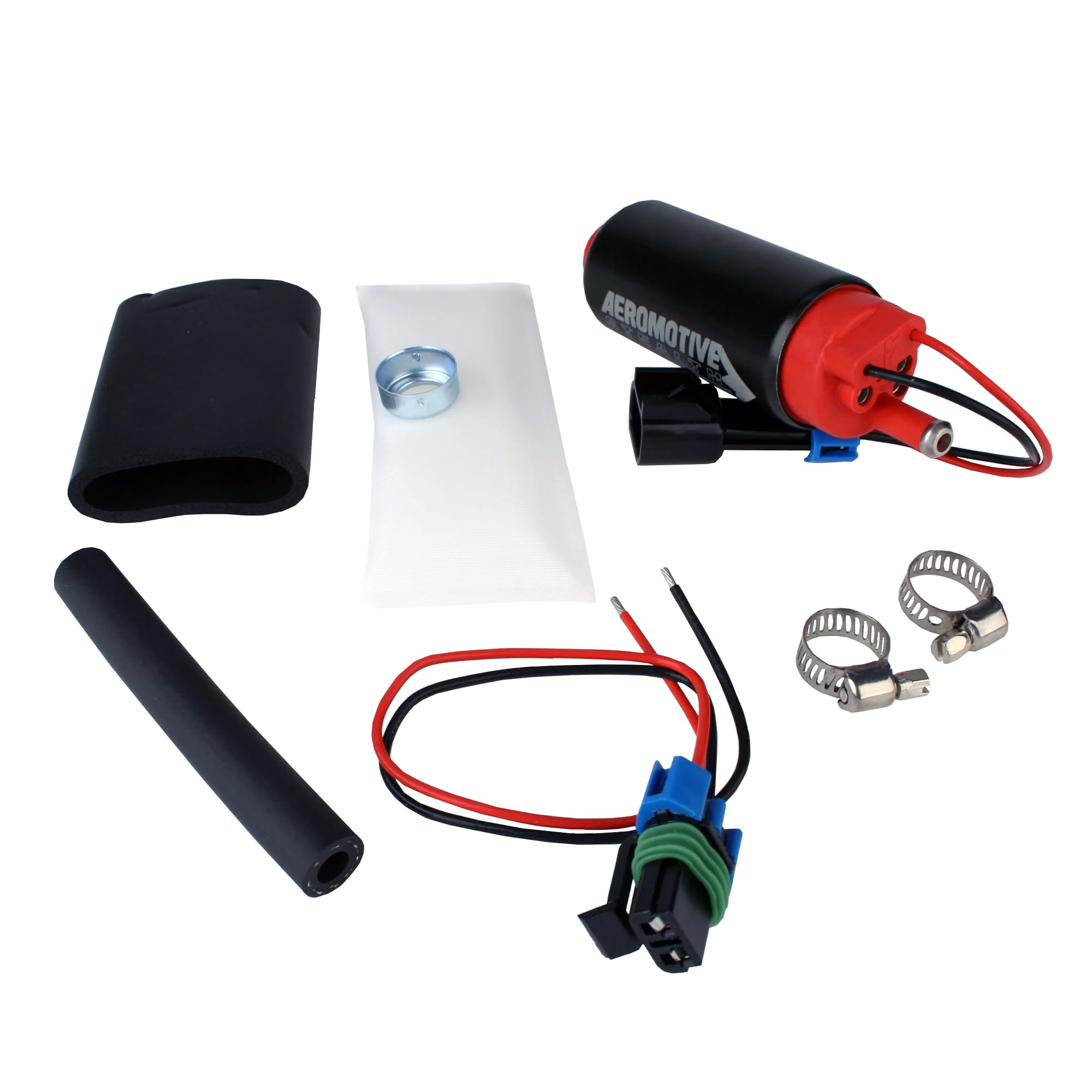
The near-silent 340 LPH pump for boosted engines that also run E85.
This pump delivers over 340 liters per hour at 40 PSI (pounds per square inch), matching the AEM 50-1000 on flow, but with two advantages: it is explicitly E85 compatible, and the turbine design makes it near-silent. Owners coming from noisy Walbro pumps call it “definitely a silent pump by comparison.” The 39mm OEM (original equipment manufacturer)-style body fits most Ford and GM in-tank hangers, and the kit includes a filter sock, wiring pigtail, hose, clamps, and grommet for a straightforward installation. Aeromotive rates it for naturally aspirated, turbocharged, and supercharged engines.
A buyer weighing this against the DeatschWerks 9-201-1000 (255 LPH, ) should note the DeatschWerks is cheaper and similarly quiet, but the Aeromotive delivers 85 LPH more flow. This is the pick for a boosted EFI build that needs a specific 340 LPH flow target with E85 support.
High HP street: your boosted engine needs 340 LPH and you run E85 on a near-silent pump.
No pickup sock: reliability is your top priority — a mix of early failures pushes this below the AEM on long-term trust.
Understanding the Specs
GPH vs. LPH
Gallons per hour (GPH) and liters per hour (LPH) both measure flow rate — how much fuel the pump moves. A 97 GPH pump equals roughly 367 LPH. Carbureted engines need less pressure but more volume, so GPH is common there. EFI systems talk in LPH because injectors are sized in metric. The rule of thumb: 255 LPH feeds most 500-600 horsepower builds; 340 LPH covers up to about 800-900 horsepower.
In-Tank vs. Inline
In-tank pumps sit inside the fuel tank, submerged in fuel, which keeps them cool and quiet. They are standard on modern EFI (electronic fuel injection) vehicles. Inline pumps mount outside the tank on the frame rail. They are easier to access and replace but run hotter and louder. The Holley Red is an inline pump. Every other pump in this guide is in-tank.
E85 Compatibility
E85 (85% ethanol) is corrosive to standard rubber seals, plastic fuel line connectors, and pump internals. A pump rated for E85 uses ethanol-resistant materials — typically stainless steel internals and specific elastomers. The DeatschWerks 9-201-1000 and the Aeromotive 11540 both support E85. The AEM 50-1000 explicitly warns that E85 will shorten pump life.
PSI and Fuel Delivery Types
Carburetors need 4-9 PSI. EFI systems need 40-60 PSI for port injection. A pump’s maximum pressure rating determines which fuel delivery system it supports. The Holley 12-801-1 maxes at 7 PSI — perfect for a carbureted Edelbrock setup, useless for a Silverado’s fuel rail. An EFI pump like the AEM 50-1000 will overwhelm a carburetor and blow past the needle and seat.
FAQ
Will a 97 GPH Holley Red work with my EFI Chevy Silverado?
How do I know which fuel pump connector my 1999-2004 GM truck uses?
Can I replace a fuel pump without dropping the fuel tank?
Why do some fuel pumps list “GPH” and others list “LPH”?
How long does a fuel pump typically last?
What does the “interchange number” mean on fuel pump modules?
Is a louder fuel pump a sign of failure?
Can I use the AEM 50-1000 pump with E85 fuel?
Final Thoughts: The Verdict
For the majority of shoppers, the best fuel pump winner is the Holley 12-801-1 because it holds the highest owner satisfaction rate at 4.6 stars and the strongest reliability count among all picks — perfect for carbureted builds that need trouble-free fuel delivery. If you drive a 1999-2004 GM truck on a budget, grab the A-Premium FP0028C. And for a boosted EFI (electronic fuel injection) build that also runs E85, the DeatschWerks 9-201-1000 is the one to reach for.
How We Picked
We do not accept paid placement. Every pick is matched to a real buyer and a real use-case; we do not hands-on test units.
Sources & Methodology
Specifications: manufacturer listings and product documentation. Review insights: verified customer reviews, as of July 2026. Pricing: not shown on this page (it changes often); check the current price via the retailer link.
As an Amazon Associate, Trending Car earns from qualifying purchases. This does not affect which products we feature.