
Our readers keep the lights on and my garage snacks stocked. As an Amazon Associate, I earn from qualifying purchases.
Specs are compiled from manufacturer listings and verified buyer reviews and can change over time — please confirm the key details on the product page before buying.
An overheating engine can strand you anywhere. On most cars, trucks, and swapped projects, the original factory fan struggles — especially if you added bigger tires, a heavy trailer, or a strong AC system. An electric radiator fan fixes that by pulling or pushing air exactly when your engine needs it. But the differences between slim universal models, exact-fit OEM replacements (original equipment manufacturer, meaning it matches the factory part), and high-CFM (cubic feet per minute, the volume of air moved) fans can be confusing. Choosing the right one depends on your mounting space, airflow needs, and if you want a pusher, puller, or reversible fan.
I’m Min Islam — the founder and writer behind Trending Car. This guide is built by comparing the manufacturers’ published specifications and the patterns across verified customer reviews, so you get each pick’s real strengths and trade-offs instead of marketing spin.
These are the best electric radiator fans you can buy right now, ranked by what they actually deliver under the hood.
Our Picks at a Glance


How To Choose The Best Electric Radiator Fans
An electric radiator fan does more than spin — it is your engine’s last defense against heat soak (when the engine gets too hot to cool itself). The wrong fan leaves you stuck; the right one keeps your temperature steady through summer traffic or a hard pass. Here is what to look for.
Airflow Capacity (CFM)
CFM stands for cubic feet per minute — the volume of air a fan moves. More CFM means more cooling power. A high-CFM fan like 1750 CFM or 3000 CFM handles heavy loads and hot climates. Smaller fans around 800 CFM work for light-duty projects where space is tight.
Fan Size and Bay Clearance
Measure your radiator core (the metal part where coolant flows) before you buy. A 10-inch or 12-inch fan fits most compact and mid-size engine bays. A 16-inch fan moves more air but needs more room. Slim fans about 2.5 inches thick help when clearance is tight between the radiator and the engine.
Push vs. Pull Configuration
Pusher fans sit in front of the radiator and blow air through it. Puller fans sit behind the radiator and suck air through. A reversible fan does both — you flip the blade and swap the wiring to change modes. Puller is usually more efficient for engine cooling.
Quick Comparison
| Model | Best For | Airflow (CFM) | RPM | Size | Amazon |
|---|---|---|---|---|---|
| Radiator Cooling Fan Assembly (Nissan Rogue Sport)★ Best Overall | Direct OEM Fit | — | — | 12V Factory Assembly | Amazon |
| A-Team Performance 16″ FanTop Performer | Maximum CFM & Kit | 3000 | 2500 | 16″ | Amazon |
| JDMSPEED 10″ Slim Fan | Universal High Airflow | 1750 | 2250 | 10″ | Amazon |
| GESEXI 12″ Slim Fan | Quiet Universal Use | 800 | 2000 | 12″ | Amazon |
| PartsFlow Fan Assembly (Honda Accord) | OE-Replacement Fit | — | — | 2-Pin Assembly | Amazon |
| SPAL 12″ Puller Fan | High-Performance Builds | 1226 | — | 12″ | Amazon |
In‑Depth Reviews
1. Radiator Cooling Fan Assembly (For Nissan Rogue Sport)
Our pick — over 4.5★ from 300+ verified ratings; the strongest balance of quality and price.
The drop-in fix that lets you skip a costly dealership repair.
This Goopool assembly is for anyone with a 2017-2022 Nissan Rogue Sport (2.0L engine) who wants cooling without the headache. It comes as a complete unit — fan, shroud, motor, all in one — so there is nothing to piece together. Buyers report a 1-hour install using basic hand tools (13mm, 10mm, Philips, pliers). The dealer quote for the same job reportedly runs over a thousand dollars; this assembly costs a fraction of that and drops straight into the factory spot. That is what makes it the easiest pick in this lineup.
What wins people over is the fit. Owners mention it goes in without forcing, the 3-pin connector (a plug with three wires: positive, negative, and a speed-control signal) matches the factory harness, and it is noticeably quiet compared to a failing stock fan. One owner says it keeps their Qashqai (the European version of the Rogue Sport) running at peak performance. The metal-and-plastic construction feels solid, and 28 buyers highlight overall performance. The main trade-off: a handful of customers note the unit arriving with cracked plastic or failing within weeks. Check yours on delivery and test it before you button everything up.
Best for owners of 2017-2022 Rogue Sports: who want a bolt-in replacement they can install in an afternoon.
skip it if you need a universal fan: this is a vehicle-specific assembly — it will not fit other makes or models without heavy modification.
Our take: the crowd favorite — with a near-perfect 4.8-star average from hundreds of owners, this is the most trusted direct-fit fan for this generation of Rogue Sport. Inspect it on arrival and you are set.
2. A-Team Performance 16″ Electric Radiator Cooling Fan Kit
More air than most engines will ever need — 3000 CFM on tap.
When you push an engine hard in Florida summer traffic, a heavy S10 pickup, or a hot-rod build, you want the biggest cooling fan you can fit. This A-Team Performance 16-inch fan delivers a massive 3000 CFM (cubic feet per minute, the volume of air moved) at 2500 RPM, while the GESEXI 12-inch fan provides 800 CFM. Its 10 curved blades are designed to move air quietly, and sealed ball bearings keep it running smooth for years.
The kit includes a thermostat switch that activates the fan at 200°F and shuts it off at 180°F — so it runs automatically without a manual toggle. Owners running S10s and other full-size rigs report it holds engine temps at 180°F to 185°F even in stop-and-go traffic. The installation is less easy than the direct-fit Rogue Sport fan; some reviewers point out the wiring instructions are sparse, and the temperature probe may not work with aftermarket gauge clusters (you might need an SN24 controller, an adapter for non-stock systems). But once wired in, it performs reliably. The thing everyone raves about is the sheer airflow — the fan moves enough to cool a radiator, oil cooler, and trans cooler at once.
Best for project cars, trucks, and full-size rigs: that need maximum cooling capacity and have room for a 16-inch fan.
pass on it if you are a wiring novice: the thermostat wiring takes patience, and you may need extra parts for an aftermarket temp gauge.
Our verdict: if your build needs peak cooling and you have the space, the 3000 CFM from this A-Team kit is hard to match at this level.
3. GESEXI 12 Inch Slim Fan Push Pull Electric Radiator Cooling Fan

At 30 dB, it is quiet enough for a shed — and strong enough for a tractor.
Not every cooling project needs a loud, high-CFM fan. For tractors, lawn equipment, auxiliary AC condensers, or attic ventilation, this 12-inch GESEXI fan is a smart pick. At 30 decibels (dB, a measure of sound pressure level), it produces about as much noise as a quiet library. That is 30 dB versus the 50 dB JDMSPEED fan — a real difference if you work near the engine bay or want a fan for a non-vehicle application.
The slim design is just 2.5 inches thick, which slides into tight gaps where a standard fan would not fit. Owners use it in gable vents with solar panels, on tractor AC boosters, and as a dog-crate fan. It is reversible — flip the blade and swap the wires to turn it from a puller to a pusher. The most-discussed trait among buyers is reliability (44 owners highlight it) and build quality. The recurring gripe: the included bolts can vibrate loose over time — a dab of thread-locker solves it before it starts.
Best for non-vehicle cooling or tight-bay auxiliary fans: where low noise and a slim profile matter more than peak CFM.
it’s not for you if you push an engine hard in hot climates: 800 CFM is light for a heavy motor swap.
Our call: the quietest 12-volt fan in this lineup and the most versatile for non-car projects — well worth a look for tractor and shed setups.
4. JDMSPEED 10″ Universal Electric Radiator Slim Cooling Fan
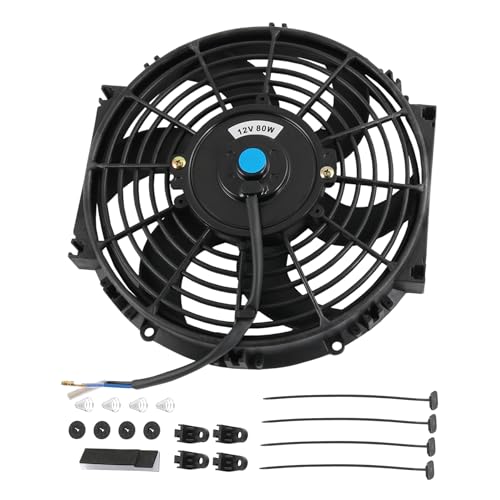
A 10-inch fan that moves 1750 CFM, while the GESEXI 12-inch moves 800 CFM.
This JDMSPEED fan is a surprise: a smaller 10-inch diameter yet 1750 CFM versus the GESEXI’s 800 CFM It moves 1750 CFM, while the GESEXI provides 800 CFM. It runs at 2250 RPM, which is 250 RPM faster than the 12-inch GESEXI fan, and that speed brings a trade-off: 50 decibels of noise. It is not silent, but owners who installed it on a Nissan Frontier with 33-inch tires and a trailer say the volume is worth it — the fan kept the transmission cool on long highway passes and across desert terrain.
The universal mounting kit works for most sedans, pickups, RVs, and even mini-excavators. A nice design touch is the reversible wiring: flip the blade over and swap the power leads to switch from puller to pusher mode. The downside, several owners note, is there are no printed instructions — you need basic wiring knowledge. One buyer also mentions a vibration after a few months if the mounting screws are not secured with thread-locker. The most-discussed positive is airflow; the fan moves a lot of air for its size.
Best for budget builders and off-road rigs: who need high CFM in a compact package and do not mind some fan noise.
look elsewhere if you need a quiet fan for a daily driver: the 50 dB hum gets noticeable inside the cabin at low speeds.
Our verdict: the best value-for-flow ratio in this list — 1750 CFM from a 10-inch frame at a budget-friendly price is tough to top.
5. PartsFlow Radiator Cooling Fan Assembly (Honda Accord 2003-2007)

Plug-and-play cooling for the 7th-generation Accord — no wiring, no guesswork.
If you drive a 2003-2007 Honda Accord (DX, EX, or LX sedan or coupe) with a 2.4L engine, this PartsFlow fan assembly is the simplest fix for an overheating problem. It is a complete assembly — fan, motor, and shroud — built to OE (original-equipment) standards, meaning it matches the factory part. The 2-pin connector plugs directly into the Accord’s factory harness, and shoppers say a straightforward bolt-in install that takes under an hour. One buyer says it “feels like an original part” on a 2007 Accord. It is simpler to install than the A-Team kit, though it lacks the A-Team’s 3000 CFM output.
The build combines metal and plastic for a balance of strength and weight. The most-praised aspects are installation ease (30 owners highlight it) and perfect fit (26 owners mention it). Several Honda buyers report their AC blows cold again after swapping out a broken factory fan — the fan provides enough airflow to keep the condenser (the part that cools the refrigerant) working. The real durability concern: a small number of owners mention the fan failing within 6 months. Test the unit before full installation and watch the bearings past the first season.
Best for 2003-2007 Accord owners: who want a direct replacement without cutting wires or modifying the shroud.
steer clear if you need a universal fan: this assembly is made specifically for this Accord generation only.
Our call: the go-to drop-in fan for the 2.4L Accord — installation is the most-discussed strength, and the price beats a dealer replacement by a wide margin.
6. SPAL 12″ Fan Puller Curved Blades — 30101522

Italian engineering with an IP68 rating — waterproof, dustproof, built for swaps.
SPAL is a name you see inside high-dollar builds and motorsport bays. This 12-inch puller fan delivers 1226 CFM (cubic feet per minute of airflow) from a compact, slim-profile frame — that is slightly less airflow than the JDMSPEED 10-inch fan but from a larger diameter and with far better durability. The key spec that separates it from every other fan in this list is the IP68 certification (Ingress Protection rating, meaning it is fully sealed against dust and can survive submersion in water). That makes it ideal for off-road rigs, race cars, and engine swaps where the fan sits low or in the path of water splash. The curved blades cut through air more quietly than straight-blade designs, though some owners still call the noise a mixed point.
Owners use it on everything from K24-swapped Civics to SBC-swapped S10 pickups and even Honda Odyssey conversions. The general consensus is that it runs cooler than the factory fan and is cheaper than a dealer replacement. The 12.56-inch by 13.19-inch frame fits tight engine bays, and the puller-only configuration (it pulls air through the radiator, not pushes) is the most efficient layout for engine cooling. The catch is its price — it costs roughly triple what the universal fans in this list cost. Owners who tried cheaper options first then switched to SPAL consistently praise the quality and reliability as worth the upgrade.
Best for swapped or high-performance builds: where space is tight, waterproofing matters, and you trust a proven brand over a generic unit.
skip it if you are on a strict budget or need a pusher fan: this is a puller-only fan at a premium price.
Our verdict: the SPAL is the most trusted electric fan for serious builders — the IP68 seal and Italian engineering justify the step up in price for a build you plan to keep.
Understanding the Specs
CFM (Cubic Feet per Minute)
This is the most important number for an electric fan — it tells you how much air the fan moves every minute. More CFM means the fan can pull more heat out of your radiator. A daily commuter needs 800 to 1200 CFM. For a truck, trailer-tower, or high-performance build, aim for 1750 CFM or more.
RPM and Noise Levels
RPM (revolutions per minute) measures how fast the fan blades spin. Higher RPM generally means more CFM, but it also means more noise, measured in decibels (dB). A fan at 30 dB is whisper-quiet for a tractor or auxiliary cooling. A fan at 50 dB is clearly audible, which is common for high-CFM universal fans. Balance your need for cooling power with your tolerance for hum.
FAQ
Can I install an electric radiator fan myself?
What size fan do I need for my car?
What is the difference between a pusher fan and a puller fan?
How many CFM do I really need?
Can I use a universal fan on any car?
How loud are electric radiator fans?
Will a radiator fan help my AC blow colder?
How long do electric radiator fans last?
What is the difference between a 2-pin and 3-pin fan connector?
Does a bigger fan always mean better cooling?
Final Thoughts: The Verdict
For most people, the best electric radiator fans winner is the Radiator Cooling Fan Assembly for the Nissan Rogue Sport because it is the easiest install with factory-level fit and the highest owner satisfaction. If you need maximum airflow for a project or truck, grab the A-Team Performance 16-inch kit with its 3000 CFM output. And for a high-performance build where space and durability matter, the SPAL 12-inch puller is the one to reach for.
How We Picked
We do not accept paid placement. Every pick is matched to a real buyer and a real use-case; we do not hands-on test units.
Sources & Methodology
Specifications: manufacturer listings and product documentation. Review insights: verified customer reviews, as of July 2026. Pricing: not shown on this page (it changes often); check the current price via the retailer link.
As an Amazon Associate, Trending Car earns from qualifying purchases. This does not affect which products we feature.