
Our readers keep the lights on and my garage snacks stocked. As an Amazon Associate, I earn from qualifying purchases.
Specs are compiled from manufacturer listings and verified buyer reviews and can change over time — please confirm the key details on the product page before buying.
Scratches on your car’s paint feel personal — that first key mark, the branch that swiped your door, the mystery scuff from a parking lot. A good compound is the single thing that erases them without sending you to a body shop. The trick is picking the right grit and formula for your specific scratch depth, because the wrong one either does nothing or grinds through your clear coat. This guide breaks down the top compounds by what they actually cut, how they finish, and who they suit best.
I’m Min Islam — the founder and writer behind Trending Car. This guide is built by comparing the manufacturers’ published specifications and the patterns across verified customer reviews, so you get each pick’s real strengths and trade-offs instead of marketing spin.
Whether you are dealing with light swirls from a careless wash or deep gouges from a rock chip, the goal is the same: return your paint to a smooth, glossy finish without introducing new damage. This roundup of the best car compound for scratches covers every depth level so you can match the product to the problem.
Our Picks at a Glance


How To Choose The Best Car Compound for Scratches
Compounds are not all the same. A mild polish-grade compound will barely touch a scratch that needs a heavy cut, and an aggressive compound can haze a light swirl if you use it wrong. Focus on three things: the grit number of the abrasive, the application method it suits, and the type of scratch you are tackling. Every product here has a specific job.
Match the Grit Number to Your Scratch Depth
The grit number tells you how coarse the abrasive particles are. A lower number, like 1000 grit, means a heavier cut that removes deeper material — ideal for deep scratches or sanding marks. A higher number, like 3000 grit, is a finer abrasive that polishes as it cuts, better for light surface swirls and hazing. If your scratch catches your fingernail, you need a low-grit compound; if it is barely visible under direct light, a higher-grit finishing compound is the safer starting point.
Choose Between Hand and Machine Application
Some compounds are designed exclusively for a dual-action (DA) polisher or rotary buffer, while others work fine with a microfiber cloth and elbow grease. A machine-driven compound typically cuts faster and more evenly, but it can also generate heat that you need to manage. Hand-applied compounds are more forgiving for a beginner — you have total control over pressure and can stop the moment the scratch disappears — but they take longer and demand more physical effort on large panels.
Consider Dust and Cleanup
Compounds that dry into a powder as you work create airborne dust that settles on nearby surfaces and requires a second wipe-down. Low-dust or zero-dust formulas (often water-based or containing advanced lubricants) stay wet longer, keep your workspace cleaner, and are much less likely to re-contaminate the paint you just polished. The trade-off is that low-dust compounds sometimes cost more per ounce, but the time saved on cleanup can make them worth the premium.
Quick Comparison
| Model | Best For | Grit Number | Volume | Application | Amazon |
|---|---|---|---|---|---|
| Meguiar’s D30032★ Best Overall | DA polisher scratch removal | 1500 | 32 oz | DA polisher only | Amazon |
| ABRO Rubbing CompoundBest Value | Budget hand or machine | Fine (unstated) | 10 oz | Hand or machine | Amazon |
| Menzerna Heavy Cut 1000Heavy Cut Pro | Deep scratch repair | 1000 | 8 oz | Hand or machine | Amazon |
| 3D ACA 500 | Sanding mark removal | 100 | 8 oz | Machine preferred | Amazon |
| Wizards Finish Cut | Light scratch finish work | 1500 | 32 oz | Hand or machine | Amazon |
| Meguiar’s Ultimate Compound 2-Pack | Everyday consumer use | Unstated | 30.4 oz (2 x 15.2 oz) | Hand or machine | Amazon |
| 3D One Scratch & Swirl Remover | One-step cut + polish | Unstated | 16 oz | Hand or machine | Amazon |
| Malco Super Duty Heavy Cut | Heavy oxidation + deep scratches | 800 | 32 oz | Machine preferred | Amazon |
| Wizards Mystic Cut | Nano abrasive finishing | 3000 | 32 oz | Hand or machine | Amazon |
In-Depth Reviews
1. Meguiar’s DA Microfiber Correction Compound D30032
Our pick — over 4.5★ from 450+ verified ratings; the strongest balance of quality and price.
The DA-polisher specialist that erases moderate defects without leaving new swirls behind.
This compound uses super-micro abrasive technology that removes moderate defects while producing a high gloss with no new swirls — a common pitfall of heavy-cut formulas. It carries a 1500 grit rating and is built for use with a DA polisher and a microfiber cutting disc, so it is not a grab-and-rub product. The concentrated formula delivers a lower cost per car compared to diluted alternatives, and the no-sling, low-dusting design means less prep and cleanup time. At 2 pounds, the 32-ounce bottle is a solid supply for multiple full-vehicle corrections. The bottle measures 3.8 x 2.85 x 9 inches, which is noticeably taller than the menzerna bottle at 8.3 x 1.9 x 1.9 inches.
What wins owners over is the scratch removal: the top positive aspect with 35 mentions. The crowd favorite — thousands of happy owners — consistently notes that the product “removes wet sand scuffs 100%, no swirl marks, zero sling.” Quality finishes second with 23 mentions. The less-dusty formula is a recurring highlight, and owners praise the finish it leaves. The only area with a mixed response is ease of cleaning (5 mentions), but that is a minor complaint given the results. It is a less aggressive alternative to a rotary buffer, so users coming from a rotary will find it more forgiving on OEM paint.
The defining strength: A 1500-grit formula that cuts fast enough to remove scratches but finishes fine enough to skip a separate polish step — ideal for DA polisher owners who want one-pass correction.
The honest limit: You need a DA polisher and a microfiber cutting disc; hand application will not give you the intended performance. If you work only by hand, look at the hand-applied picks below.
Reach for this if: you own a DA polisher and want a single compound that removes scratches, reduces swirls, and leaves a gloss-ready finish without a second product.
Look elsewhere if: you plan to apply compound by hand, as the D30032 is tune for machine use and will not cut effectively with a rag.
2. ABRO Rubbing Compound 10 oz
The wallet-friendly compound that handles oxidized paint and light scratches without a machine.
ABRO targets dull, faded, weathered, or oxidized paint that needs stronger correction than a basic polish. The formula uses fine-grit clay-based abrasives and is body-shop safe and silicone-free, so it is compatible with professional detailing workflows. It is a 10-ounce container at 300 grams, making it the most compact option in this lineup — ideal for a glove box or a quick spot repair. Buyers report that it works as an “effective rubbing compound for removing tree branch scratches after clay bar,” though the compound dries quickly during hand buffing, so a minimal dab is the right approach. The top positive aspects are effectiveness (68 mentions) and scratch removal (49 mentions), both strong scores. Quality follows at 32 mentions, with ease of use at 16. A few owners note the fuel-oil-like smell, so work in a ventilated area.
It is a very aggressive compound — owners caution against lingering on one spot because it can chew through paint. That makes it excellent for heavy oxidation and rust-area cleanup but risky for a beginner on clear coat. Use a dual-action microfiber cloth, apply minimal product, and stop as soon as the scratch disappears.
The standout: An aggressive, fast-cutting compound priced at the entry level, with proven results on sun-faded clear coat and heavy scuffs — the most cost-effective pick here.
The trade-off: Dries quickly on the surface and has a strong chemical odor; beginners need to move fast and avoid excessive rubbing in one spot.
Grab this for: a single aggressive pass on oxidized paint or tree branch scratches before you apply polish — especially if you are on a tight budget.
Think twice if: your car has soft clear coat or you are new to compounding; the aggressive cut demands careful control to avoid damaging the paint.
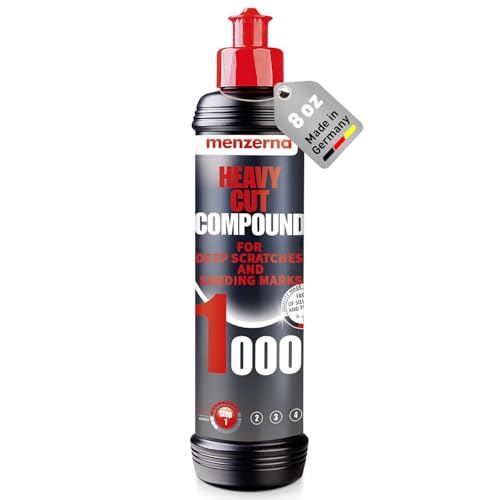
3. Menzerna Heavy Cut Compound 1000
The 1000-grit heavy hitter that demolishes deep scratches even by hand.
Menzerna’s Heavy Cut Compound 1000 is a true abrasive compound with 1000 grit, compared to the 1500-grit Meguiar’s D30032. It is designed to remove light to medium-deep scratches, sanding marks, swirls, and holograms, and it is compatible with a red Heavy Cut Foam Pad if you use a machine. The bottle is 8.3 x 1.9 x 1.9 inches and weighs 8 ounces, packaging a serious amount of cutting power in a small, shelf-friendly size. Owners mention that it is a “great cutting compound. cuts fast and well” — an exact quote from the review data. One owner used it with a cheap 3-inch foam buffing pad on a drill after wet sanding with 1500 grit and got a glossy finish. The top positive aspects are effectiveness (45 mentions) and quality (29 mentions). Scratch removing ranks third at 27 mentions.
The honest note here is dust — owners flag it with 10 mentions, making it the only aspect marked negative. The compound powders as you work, so expect to wipe down surfaces after compounding. That aside, the silicone-free formula is beginner-friendly and works with both an orbital machine and hand application.
The big advantage: A lower 1000-grit abrasive that cuts deeper than typical 1500-grit compounds — it removes scratches that lighter compounds leave behind.
The downside: Generates noticeable dust during buffing; you will need to clean surrounding trim and glass after the job.
Best for: deep gouges and scratches that catch your fingernail — the most aggressive cutting compound in this list that still finishes well enough to use as a standalone product.
Not ideal for: light swirl marks or shallow surface defects, where the heavy cut would remove more clear coat than necessary.
4. 3D ACA 500 Cutting Compound
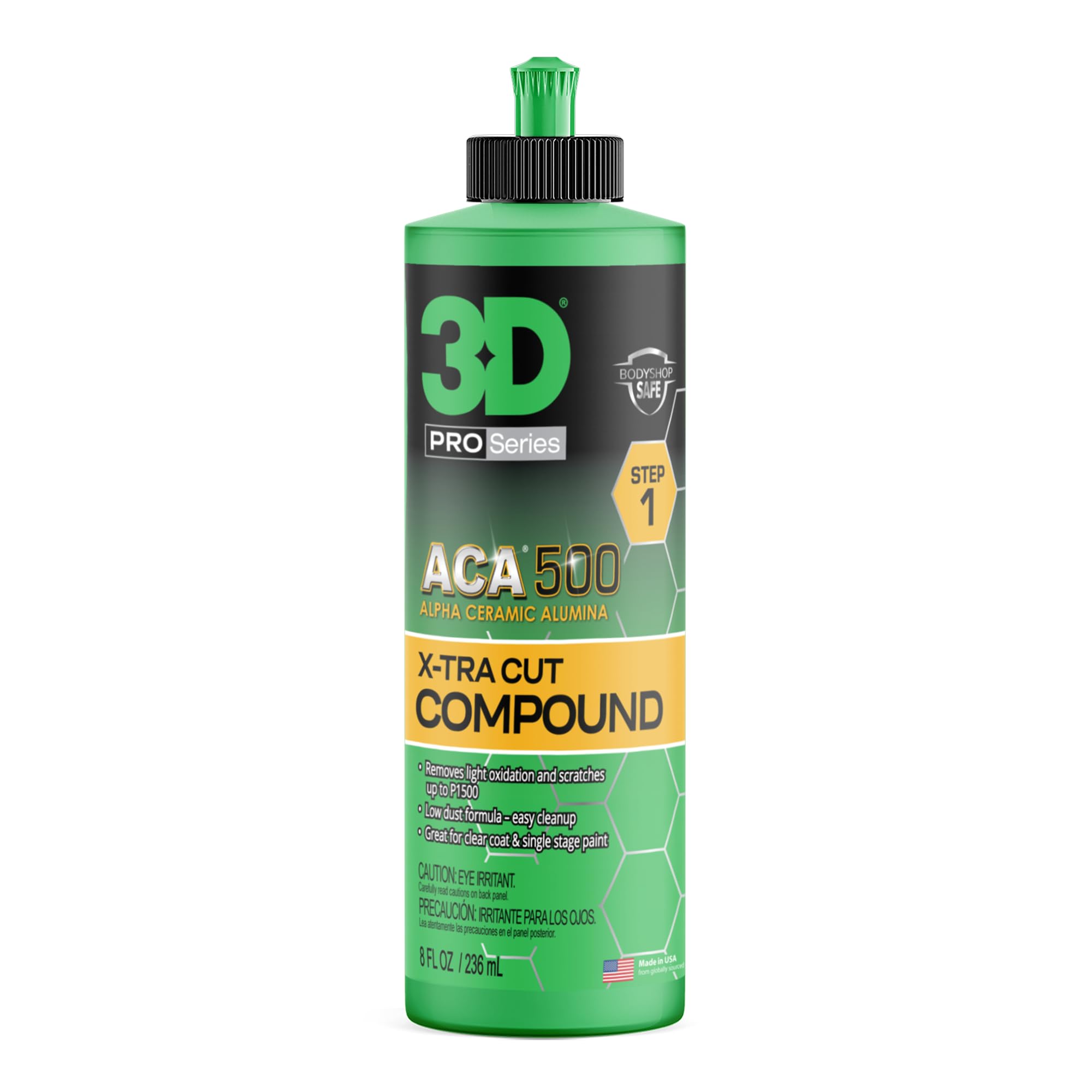
The ultra-coarse step-one compound built for after wet-sanding and serious defect removal.
This compound carries a 100 grit rating — the coarsest abrasive in this lineup — and is built specifically for removing P100 grit sanding marks, deep scratches, and heavy oxidation. It uses Advanced Alpha Ceramic Alumina (ACA) technology, which runs cooler during polishing to reduce heat buildup on modern clear coats. The low-dusting formula keeps your workspace cleaner than traditional cutting compounds. The bottle measures 2 x 2 x 7 inches and holds 8 fluid ounces. Owners who tested it by hand on sanded clear coat found it restored shine faster than a well-known polish, with no swirl marks. Effectiveness (19 mentions) and quality (12 mentions) are the top aspects, and finish comes in at 8 mentions. The recurring observation is that it does not finish as well as a dedicated polish, but that is expected — this is the first step in a two-step correction.
Because of the extreme cut, you should follow the ACA 500 with a finishing polish to restore full gloss. It is body-shop safe and made in the USA, and owners note it is forgiving for a heavy-cut product because it cleans up easily.
The defining spec: 100 grit abrasive — the only compound here that can level P100 sanding marks in a single pass, making it essential for post-sanding correction.
The necessary trade-off: Leaves a hazy finish that requires a secondary polish step; not a one-step product for most users.
Reach for this if: you wet-sanded your paint (with P100 grit or finer) and need a compound that can remove those sanding marks quickly.
Look elsewhere if: you want a single product for scratch removal and final gloss — the ACA 500 is purely a cutting compound and must be followed by a polish.
5. Wizards Finish Cut Compound

The water-based finish compound that levels 2000-grit imperfections and leaves a swirl-free show shine.
Wizards Finish Cut uses 1500-grit aluminum oxide abrasives in a non-greasy, water-based formula that cleans up easily with no wax or silicone residue. It is designed to remove 2000-grit sanding marks and light scratches, making it a second-step product after a heavy cut or a standalone for shallow defects. The bottle is 32 ounces at 2.4 pounds, and it is compatible with paint, glass, and marine gelcoat. Owners describe it as a product that leaves a “swirl-free shine” and is “much easier than sanding.” Effectiveness (18 mentions) and quality (17 mentions) are the top aspects, and ease of use ties appearance at 5 mentions each. The product works with both hand and machine, so you can spot-correct by hand without buying a polisher.
One thing to note: this is a finishing compound, not a heavy cutter. It will not remove deep scratches that a 1000-grit or 100-grit compound handles. But for light swirls, scuffs, and faded paint, it delivers professional-level gloss with a fraction of the effort of traditional two-step systems.
The standout: A water-based, non-greasy formula that levels 2000-grit sanding marks and leaves a high-gloss, swirl-free finish — ideal for final correction after sanding.
The limit: Not aggressive enough for deep scratches or heavy oxidation; it is strictly a finishing compound for light defects.
Best for: removing light scratches and swirls from clear coat or gelcoat and achieving a showroom finish without a separate polish.
Not for: deep scratches that penetrate the clear coat — you need a heavier cut compound like the Menzerna 1000 or Malco 800 first.
6. Meguiar’s Ultimate Compound (2-Pack)
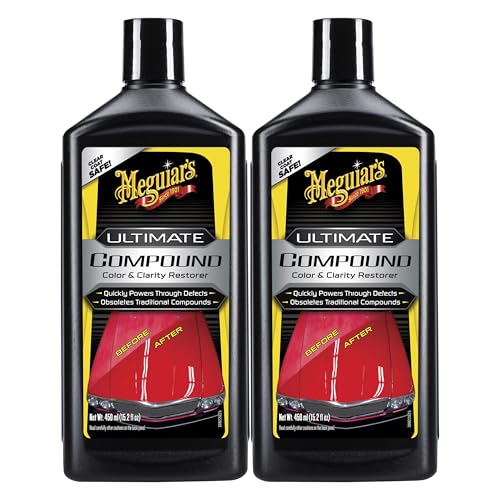
The clear-coat-safe crowd pleaser that removes light scratches with micro-abrasive tech — by hand or polisher.
This two-pack gives you 30.4 ounces total (2 x 15.2 oz bottles) of Meguiar’s Ultimate Compound, a consumer-focused formula that uses micro-abrasive technology to remove scratches, swirls, oxidation, and water spots without hazing the clear coat. It is clear-coat safe, so even a first-time DIY user can apply it with a foam applicator pad by hand or with a dual-action polisher. The crowd — with tens of thousands of ratings — reports that it removes superficial swirls in two to three passes and restores oxidized bumpers in three to four applications. The top aspects are effectiveness (over a thousand mentions) and quality (586 mentions), making it the most-reviewed product here by a wide margin.
The scratch retention aspect — 708 mentions — is marked mixed, meaning some users find that scratches return or were not fully removed. That is typical for a fine-cut compound on deeper defects. One owner noted it took “nearly all of the scratches completely out” from a car with bad scratches, even some that broke the paint. For light to moderate damage, this is the most user-friendly option on the list.
The defining strength: The most approachable formula for a beginner — safe on clear coat, works by hand, and backed by the largest owner community of any compound here.
The honest trade-off: Does not fully remove deep scratches that penetrate the clear coat; best suited for light scuffs, swirls, and oxidation.
Grab this for: a simple, safe introduction to paint correction — especially if you want a two-bottle supply for your home garage and a mobile kit.
Think twice if: you have deep scratches that catch your fingernail — you will need a heavier cut compound before finishing with this product.
7. 3D One Car Scratch & Swirl Remover

The hybrid formula that combines a heavy cut and a finishing polish into a single zero-dust bottle.
3D One is a one-step solution that acts as both a cutting compound and a finishing polish, removing swirls, scratches, and oxidation in a single pass. It uses a proprietary blend that finishes with mirror-like gloss and zero dust, which is a major convenience advantage over dust-generating compounds like the menzerna 1000. The bottle holds 16 ounces and measures 2.36 x 2.36 x 8.27 inches. It works with a DA polisher or by hand, and customers note it delivers a “great result” when used with a Rupes yellow pad. The consensus among owners is that the product is effective and easy to use, with a high-quality shine. It has a neutral pH formula that prevents water marks, so you can work in normal conditions without worrying about spotting.
One observation: a minority of users find it less effective on deeper scratches compared to dedicated heavy-cut compounds. The hybrid nature means it sacrifices some cut intensity to achieve a polish-ready finish. For deep gouges, pair it with a heavier compound first.
The advantage: Eliminates the second polishing step — 3D One cuts and finishes in one pass, saving time and product costs for moderate scratch repair.
The caveat: Not aggressive enough for deep scratches or sanding marks; best on surface-level swirls and light oxidation.
Best for: detailers who want a streamlined one-step process for light to moderate defects, especially on daily drivers and show cars.
Not ideal for: paint that has been wet-sanded or has deep scratches that need a dedicated heavy cut compound first.
8. Malco Super Duty Heavy Cut Compound
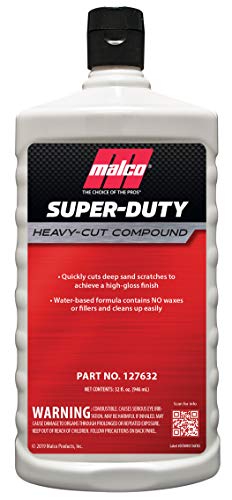
The 800-grit super-duty compound that zaps P1500 sand scratches and heavily oxidized paint in one pass.
If you need to erase deep sand scratches (P1500 grit and finer) or heavy oxidation from your car’s clear coat or a boat’s gel coat, the Malco Super Duty compound uses an 800-grit rating — the second-most-aggressive in this list after the 3D ACA 500 — to cut through that damage. It comes in a 32-ounce bottle and is safe for automotive, marine, and industrial coatings. The formula leaves a high-gloss finish and is designed to work best with a Malco 100% twisted white wool cutting pad on a machine. Reviewers point out it as a “night and day” improvement over other compounds on severely oxidized paint jobs. The top aspects buyers mention are effectiveness (49 mentions) and quality (23 mentions). Shine and cut performance are at 12 and 10 mentions respectively, with removability at 10 mentions — owners find it wipes off easily. This is a better fit for heavy restoration than for light swirls; if you only have fine scratches, a finer-grit compound like the 3D ACA 500 would be less aggressive and easier to finish.
Because of the 800-grit abrasive, this compound can be too aggressive for soft clear coats. Owners note it is less dusty than the Meguiar’s M105 compound. It also works well on gel coat, making it a dual-purpose option for boat owners who need the same bottle for their car and their watercraft.
The standout: An 800-grit heavy cut that handles P1500 sanding marks and heavy oxidation on both automotive and marine surfaces — among the most versatile heavy-cut compounds available.
The limit: Too aggressive for soft clear coats and light scratches; best reserved for serious paint correction with a machine.
Grab this for: restoring severely oxidized paint, removing P1500 sanding scratches, or cutting heavy oxidation on boats and RVs.
Look elsewhere if: your car has soft clear coat or you only need light scratch removal — this compound will remove more paint than necessary.
9. Wizards Mystic Cut Smart Abrasive
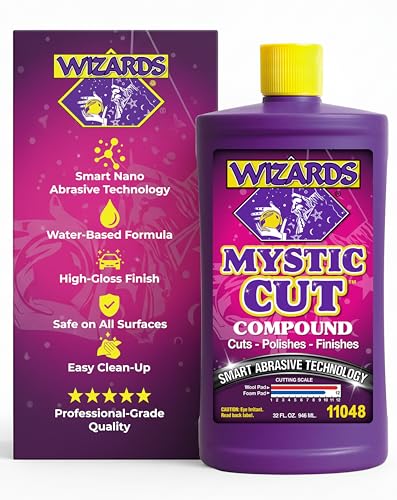
The 3000-grit nano abrasive that buffs out light pitting and fine scratches with zero dust.
Wizards Mystic Cut uses nano abrasives at a 3000-grit rating — the finest abrasive in this lineup — to remove surface swirls, defects, fading, and water spots with a progressive cutting action that leaves no gritty mess. It is a water-based compound that works on paint, fiberglass, gel coat, metallic flakes, chrome, and glass. The bottle is 32 ounces at 2.3 pounds. Shoppers say it removes light pitting from windshields in 30 minutes with just a towel and elbow grease — no buffer needed. One owner calls it “the best of all the detailing polishes” after 20-plus years of use. The top aspects are effectiveness (27 mentions) and quality (22 mentions), with ease of use and value for money both at 7 mentions.
The fine grit means it is not a scratch remover for deep damage. But for light pitting, fine swirls, and restoring faded gel coat on boats, this is the most refined option. It also handles 1500-grit sanding marks when used with a rotary buffer, according to owners.
The defining spec: 3000-grit nano abrasive — the finest in the roundup, delivering a mirror finish with no additional polish step required.
The honest note: Does not touch deep scratches or heavy oxidation; strictly for fine surface defects and final finishing.
Best for: removing light pitting, water spots, and fine swirls on paint, glass, and gel coat — especially on show cars and boats where a perfect finish is essential.
Not for: deep scratches or heavy oxidation — you need a lower-grit compound like the Malco 800 or Menzerna 1000 for those jobs.
Understanding the Specs
Grit Number
The grit number tells you how coarse the abrasive particles are. A lower number (like 100 or 800) means larger, more aggressive particles that cut deeper and remove more paint. A higher number (like 1500 or 3000) means finer particles that polish as they cut and leave a glossier finish. If your scratch catches your fingernail, you need a low-grit compound first, then a higher-grit one to finish. If the scratch is barely visible, start with a higher-grit compound to avoid removing too much clear coat.
Cutting vs Finishing
A heavy-cut compound is the first step in a two-step correction. It removes deep scratches and sanding marks but leaves a hazy or matte finish. A cutting compound (like the 3D ACA 500 at 100 grit) is for this step. A finishing compound or polish is the second step — it refines the surface to a high gloss with no swirls. Some products, like the 3D One, combine both steps into one pass, but they cannot match the depth of a dedicated heavy cut on deep scratches.
Application Method
Some compounds are tune for use with a dual-action (DA) polisher or a rotary buffer, while others are designed to work by hand. Machine-applied compounds generally cut faster and more evenly because the tool does the work. Hand-applied compounds give you more control over pressure and are less likely to burn through the paint, but they require more physical effort. A product like the Meguiar’s D30032 needs a DA polisher and microfiber cutting disc to perform — using it by hand will not give you the intended result.
Dust and Cleanup
Compounds that dry into a powder as you buff create airborne dust that settles on surrounding surfaces. Low-dust or zero-dust formulas (like 3D One and Wizards Mystic Cut) stay wet longer, producing less dust and requiring less cleanup. A water-based compound (like Wizards Finish Cut) cleans up with water and leaves no greasy residue. The trade-off is that low-dust compounds often cost more per ounce, but the time saved on cleanup can be worth it for frequent detailers.
FAQ
Can I use any compound by hand without a machine?
What does the grit number mean on a compound?
Will a compound remove scratches that go through the clear coat?
What does DA polisher mean and do I need one?
What is zero-dust formula and why does it matter?
Can I use a car compound on boat gel coat or fiberglass?
What is micro-abrasive technology in compounds?
How do I know if a compound is safe for clear coat paint?
What does silicone-free formula mean for a compound?
How much compound do I need to repair one scratch?
Final Thoughts: The Verdict
For the majority of shoppers, the car compound for scratches winner is the Meguiar’s D30032 because it delivers pro-grade scratch removal at a 1500-grit finish that skips a separate polish step — provided you own a DA polisher. If you want a budget-friendly pick that works by hand, grab the ABRO Rubbing Compound for its aggressive cut and proven results on oxidized paint. And for deep scratches that need maximum cutting power, the Menzerna Heavy Cut 1000 is the one to reach for — just be prepared for the dust it leaves behind.
How We Picked
We do not accept paid placement. Every pick is matched to a real buyer and a real use-case; we do not hands-on test units.
Sources & Methodology
Specifications: manufacturer listings and product documentation. Review insights: verified customer reviews, as of July 2026. Pricing: not shown on this page (it changes often); check the current price via the retailer link.
As an Amazon Associate, Trending Car earns from qualifying purchases. This does not affect which products we feature.