
Our readers keep the lights on and my garage snacks stocked. As an Amazon Associate, I earn from qualifying purchases.
Specs are compiled from manufacturer listings and verified buyer reviews and can change over time — please confirm the key details on the product page before buying.
A front dash cam is your silent witness on the road. The real trick is finding one that actually reads a license plate at night — not just one that claims to. You want crisp footage when it matters, a camera that does not bake in summer heat, and simple enough controls that you never fiddle with it while driving.
I’m Min Islam — the founder and writer behind Trending Car. This guide is built by comparing the manufacturers’ published specifications and the patterns across verified customer reviews, so you get each pick’s real strengths and trade-offs instead of marketing spin.
The list below cuts through the noise to the five smartest buys in best front dash cam territory, from a crowd-favorite value king to a mini powerhouse that hides behind your mirror.
Our Picks at a Glance

How To Choose The Best Front Dash Cam
You want a front dash cam that catches the license plate of the car that sideswipes you, not just a blur. The real differences are how clearly it records at night, whether it survives a hot dashboard, and if its parking mode starts recording when it senses a bump — not after the damage is done.
Video resolution and night vision
1080p at 30fps is the baseline — good enough for general driving. Jumping to 2K (1440p) or true 4K makes a real difference when you need to freeze a plate at speed. For night shots, a sensor like Sony STARVIS (the same tech used in security cameras) handles low light without washing everything out. The aperture rating (F1.6 or F1.8) tells you how much light the lens lets in — a lower number is better in the dark.
Parking mode — the one that matters
Not all parking modes work the same. Basic ones just record when they detect motion. The better kind — buffered parking mode — constantly keeps a short loop of video in memory, so when a bump triggers it, you also get the 15 seconds before the impact. That pre-event footage can show who hit you and run. You usually need a hardwire kit (sold separately) to keep the camera powered when the engine is off.
Heat tolerance and build
A car interior can hit 150°F in summer. Dash cams with a lithium-ion battery may swell or fail. Capacitor-powered models (widely called a “supercapacitor”) handle heat far better and last years longer. An aluminum alloy case also helps dissipate heat, unlike all-plastic housings that can warp.
GPS and extra features
GPS embeds your speed, route, and exact time into the video file — strong evidence in a dispute. Voice control lets you save a video clip without taking your hands off the wheel. A built-in polarizer cuts windshield glare, which many owners say makes the footage usable instead of a washed-out mess.
Quick Comparison
| Model | Best For | Resolution | Field of View | Max SD Card | Amazon |
|---|---|---|---|---|---|
| VIOFO A119 V3★ Best Overall | Best Overall | 1440P QHD+ 60fps | 140° | 256GB | Amazon |
| REDTIGER F4 4KTop Performer | Best for 4K | 4K 3840x2160P | 160° | 256GB | Amazon |
| Vantrue S1 Pro | Premium Mini | 1440P 60fps / 2.7K | 158° | 1TB | Amazon |
| BOOGIIO 1080P | Budget Workhorse | 1080P 30fps | 170° | — | Amazon |
| Garmin X110 | Best for Integration | 1080P 30fps HDR | 140° | 256GB | Amazon |
In‑Depth Reviews
1. VIOFO Dash Cam A119 V3
Our pick — over 4★ from 7,500+ verified ratings; the strongest balance of quality and price.
The compact 2K that reads plates like it is paid by the letter.
At 1440P QHD+ and 60 frames per second, this VIOFO is a sharper shooter than most. The 5MP STARVIS sensor and F1.6 aperture (a lens opening that gulps light) pull details out of shadows — night footage is where it earns its keep, with license plates readable even under harsh headlight glare. The field of view is a controlled 140 degrees, wide enough to catch a merging car without the fisheye distortion that makes plates look curved and unreadable. It also packs buffered parking mode (a continuous loop that captures 15 seconds before an impact and 30 seconds after), but you will need the separate HK3 hardwire kit to use it.
What wins owners over is the video quality and reliability. The camera uses a capacitor (a heat-tolerant component that stores power, not a lithium battery that can swell and fail on a hot dashboard) — buyers report: “capacitor handles heat.” The built-in GPS module records your speed and route, and syncs the clock via satellite automatically. On the quirk side: the mount sits a little deep, the menu system takes a moment to learn, and it uses micro-USB (not USB-C). But the crowd-favorite rating — 4.4 stars across thousands of owners — speaks to a dash cam that simply works, day after day, without drama. One owner bought a Samsung Pro Endurance 256GB card (U3 A2 V30) and calls it the perfect match.
There is an honest trade-off to weigh. A handful of owners reported that their unit died after a year, though many said VIOFO replaced it under warranty without a fight. The mount can feel a little wobbly, and the software occasionally freezes. These are not dealbreakers — more a reminder that even the best electronics have the occasional defect. If you want an attack-proof warranty card, the Vantrue S1 Pro below comes with an 18-month promise.
What makes it the top pick
- True 1440P at 60fps — sharp 1440P resolution with a 140-degree field of view
- Capacitor-based design stands up to summer car heat better than any lithium battery
- Buffered parking mode captures the 15 seconds before an impact, not just after
- Built-in GPS records speed and route data right onto the video file
Where it stumbles
- Owners mention the mount wobbles slightly over bumps
- Micro-USB port feels dated — no USB-C
- SD card slot is a bit fiddly to reach
- A minority of units fail after a year; warranty service is good but annoying
Reach for this if: crisp 2K night footage and a heat-tolerant capacitor are your top priorities — it is the best-balanced front dash cam you can buy today.
Look elsewhere if: you hate fiddling with tiny SD card slots or need the expandable 1TB support the Vantrue offers.
2. REDTIGER F4 4K Mini Front Dash Cam
True 4K resolution packed into a body small enough to hide.
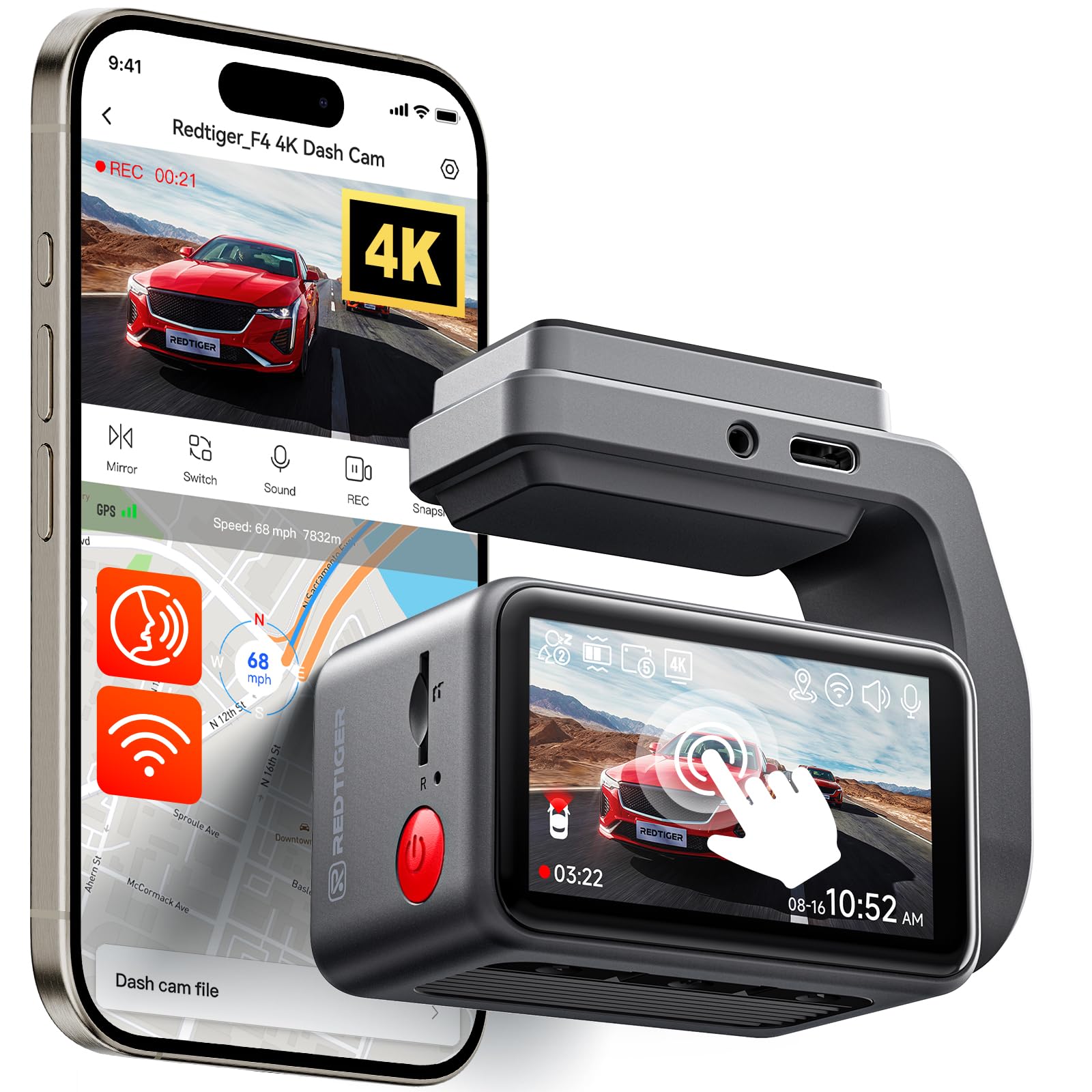
At its price point, the REDTIGER F4 is the only camera here delivering full 3840x2160P Ultra HD video. That extra resolution means you can zoom into a frame and still read a sign or plate that a 1080P camera would turn into a blur. The 160-degree wide-angle lens (compared to the VIOFO’s 140 degrees) catches cross-traffic sneaking into your lane from two lanes over. A 2.2-inch touch screen replaces the usual button-mashing — you swipe and tap to adjust settings, which owners consistently call intuitive and easy. Voice control is another convenience: say a command to save a video clip, and the camera grabs it without you taking a hand off the wheel.
For night driving, the advanced night vision and F1.8 aperture keep the image bright without washing out. The built-in GPS logs your route and speed, and Wi-Fi connectivity lets you pull clips straight to your phone via the REDTIGER app — no need to wrestle a memory card out of the dash mount. Parking mode is supported, but it requires a separate hardwire kit (the camera itself does not include one). The camera is batteryless — it uses a capacitor — so it does not risk the swelling issues that plague some battery-based budget models.
One honest note: the community is split on reliability. While many call the video “crisp” and love the compact size that tucks behind the rearview mirror, some owners mention the screen stops working after an hour of use. The maker offers an 18-month guarantee and 24/7 support, which is a solid safety net. The charger plug has a tiny LED that flickers, and a few owners found that mildly confusing. This is the pick if 4K is non-negotiable and you are okay with the trade-off that a newer model may have a few early-adopter quirks.
4K advantages
- True 3840x2160P — sharpest video in the lineup, unbeatable for plate zoom
- Touch screen and voice control keep your hands on the wheel
- Batteryless capacitor design handles heat without swelling
- Very compact — fits behind your rearview mirror, almost invisible
4K trade-offs
- A small number of owners saw the screen fail within an hour; warranty covers it
- Requires a separate hardwire kit for parking mode
- Charger LED flickers — some find it distracting
- SD card not included; you must buy one separately
Your pick if: 4K resolution is a must — you want to zoom in on plates or signs without loss, and you prefer a touch screen over physical buttons.
Think twice if: you want a rock-solid track record; the VIOFO above has been on the market longer with more feedback behind it.
3. Vantrue S1 Pro 2.7K Mini Dash Cam
The mini that hides, the clarity that finds every plate.
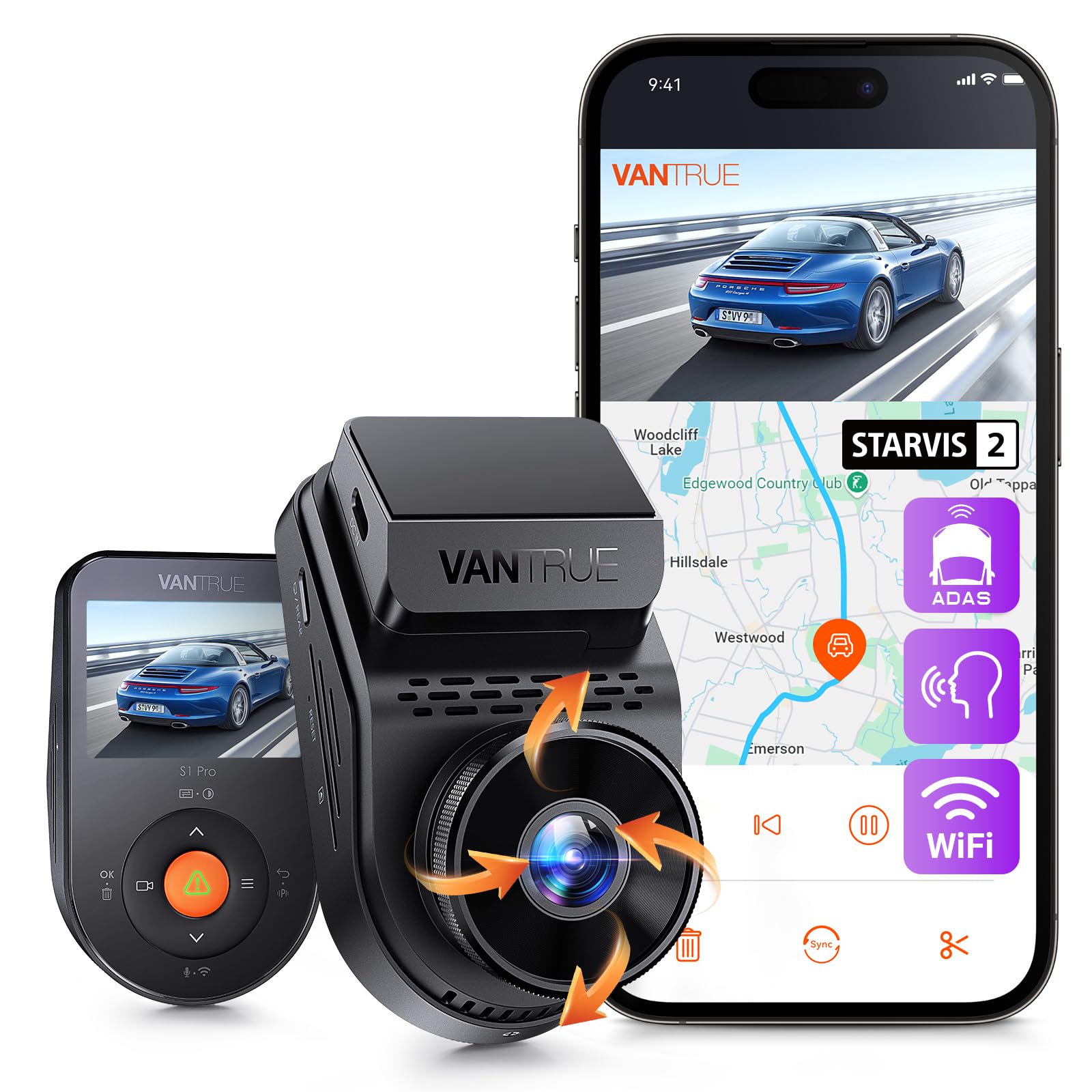
Vantrue packed its STARVIS 2 sensor into an ultra-compact body that sits flush behind your rearview mirror — you barely know it is there. The 1440P at 60fps mode is silky smooth, and the 2.7K mode (a step between 2K and full 4K) is a smart middle ground: sharper than 1080P without the storage appetite of 4K. The true 158-degree wide-angle lens gives a cinema-like sweep of the road ahead, and the F1.8 aperture teamed with Vantrue’s PlatePix technology claims 1.5x clearer license plates in low light. Several owners confirm they can “clearly see plates” at night, which is the whole point of spending more on a dash cam.
The Wi-Fi here is 5GHz, which transfers files faster than typical 2.4GHz Wi-Fi. The built-in GPS not only stamps your route and speed but also auto-adjusts for Daylight Saving Time — a tiny convenience that owners with other cameras have cursed the absence of. Parking mode uses a 15-second pre-buffer, so you get the context before the bump. You will need the separate Vantrue hardwire kit for 24/7 coverage. The device is batteryless and uses a capacitor, so there is no battery to degrade in the summer heat.
The catch: the default ADAS alerts (lane departure and collision warnings) are aggressive and the voice prompts have been called “annoying” by owners — you can turn them off in the app, but it takes a few minutes of setup. The 18-month warranty is better than most, and the support team is responsive. With a 4.3 star average from early buyers and consistently glowing feedback on build quality, this is the pick for someone who wants top-tier hardware in the tiniest footprint and values the 1TB card support (the VIOFO tops out at 256GB).
Mini powerhouse features
- STARVIS 2 sensor plus PlatePix tech — owners say plates are clearly readable at night
- 5GHz Wi-Fi for fast file transfers
- Supports memory cards up to 1TB — massive storage for frequent drivers
- Ultra-compact body hides behind the rearview mirror
Setup friction
- Default ADAS alerts are intrusive and require the app to disable
- Voice prompts described as annoying — no simple beep option
- No rear camera option if you later want one
- Requires a hardwire kit (sold separately) for parking mode
Best suited for: the buyer who prizes image quality and discreet size above all else — and wants the expansion room of 1TB card support.
Not your match if: you want a low-maintenance experience; the ADAS alerts demand an upfront app session to dial in.
4. BOOGIIO 1080P Front Dash Cam with 32GB SD Card

from the start and recording — the simplest start you will find.
BOOGIIO makes the most buyer-proof dash cam on this list. A 32GB microSD card is already installed in the camera. You stick the suction mount to the windshield, plug the charger into the cigarette lighter, and the moment your engine turns over, it starts recording at 1080P Full HD. That is seriously refreshing in a category where many high-end units ship without a memory card at all. The 3-inch IPS display is the largest in this lineup, making playback and angle checks easy on the eyes. The aluminum alloy case is a nice bonus at this price — it dissipates heat better than the plastic shells common in this tier.
The 170-degree wide-angle lens is the widest here, which is a double-edged sword. You catch more of your surroundings (including cars sneaking up from the side), but the curvature can make distant plates harder to read than on the 140-degree VIOFO. Night performance is aided by F1.8 aperture, WDR and HDR (a combo that balances bright headlights and dark shadows). One owner reported a power cable that was too short for a 2020 Jeep Cherokee, needing a 3-foot extension to reach the cigarette lighter — something to keep in mind for trucks or larger SUVs. The motion detection feature works as advertised, and G-sensor triggers automatic emergency recording on impact.
The most common praise across the reviews is reliability: owners mention these units lasting 4 to 5 years without issue. That is a strong track record. The minor downsides are that incident sensitivity can be too high even when disabled, and there is no cloud or WiFi connectivity — you access video by pulling the SD card or using the included USB card reader. If you need the cheapest way to get a reputable dash cam on your windshield today, this is it.
Why it wins at this price
- 32GB SD card included and pre-installed — truly ready from the start
- Aluminum alloy case handles heat better than plastic rivals
- 3-inch IPS screen is the biggest for easy viewing
- Customers note 4-5 year lifespans with no issues
Corners cut
- 170-degree lens introduces curvature that makes distant plates less readable
- Power cable is too short for some SUVs and trucks
- No WiFi or app — you must use the SD card to transfer video
- Incident sensitivity can trigger false emergency saves
Grab this if: you want a no-brainer install, a 32GB card already inside, and a proven 4-year track record without spending more than necessary.
skip it if: you need smartphone app access or 2K video; the VIOFO is a meaningful step up in sharpness.
5. Garmin Dash Cam X110

A name you trust, with a polarizer that kills windshield glare.
Garmin brings its navigation DNA into the dash cam world. The X110 records at 1080p at 30fps with HDR, which is the baseline standard — not the sharpest on this list, but more than adequate for documenting an incident. The standout feature is the built-in Clarity polarizer lens, a physical filter that cuts windshield glare so your footage is not washed out by a low sun or oncoming headlights. Owners consistently call the image quality “superb,” and the 2.4-inch LCD screen makes playback and angle confirmation easy — one owner noted it “confirms angle, avoiding misalignment after car washes.”
Voice control is available in multiple languages and lets you save video clips without touching a button. GPS features driver alerts: forward collision warnings, lane departure nudges, and speed camera alerts (availability depends on region). The parking guard can send a notification to your phone if an incident happens while parked — but this requires the paid Vault subscription and a constant Wi-Fi connection. That subscription model is the main catch: live view and remote clip access are locked behind a monthly fee. The camera itself is compact and uses a lithium-ion battery, which is the biggest durability difference from the capacitor-powered options above.
Reliability gets mixed feedback. Many owners call it a “safe option” and report years of good service. Others say the unit stops working within 20 minutes. The setup instructions are described as vague by a few buyers, and the Garmin Drive app can feel slow for file transfers — one recommendation is to just pull the microSD card and plug it into a PC instead. This is the right choice if you already live in the Garmin ecosystem, want a trusted brand, and value the polarizer and voice features above raw resolution.
Brand advantages
- Built-in Garmin Clarity polarizer reduces windshield glare noticeably
- 2.4-inch screen for easy angle setup — avoids misalignment
- Voice control works in 6 languages, hands-free video saving
- Driver alerts (forward collision, lane departure, speed cameras)
Trade-offs to know
- Parking guard live view requires a paid Vault subscription
- 1080p at 30fps — the VIOFO and Vantrue are significantly sharper
- App transfers can be slow; pulling the SD card is faster
- Setup instructions are vague per several owners
Reach for this if: you value brand reliability and the polarizer — it is the easiest way to get glare-free footage without an aftermarket filter.
Look elsewhere if: you want 2K-or-better video or dislike subscription models; the VIOFO and Vantrue offer sharper video without any ongoing fees.
Understanding the Specs
Resolution & Frame Rate
The clearest difference between a and a dash cam. 1080p at 30fps covers basic needs — you can see the car and the scene. Jump to 1440p (2K) at 60fps, and you freeze motion twice as smoothly, making a fast-moving plate readable when you pause the video. True 4K has the most zoom potential but eats up storage fast — a short commute can fill a 32GB card in under a day. A good middle ground is 2.7K (the Vantrue S1 Pro uses this), which is sharper than 1080p but far more storage-efficient than 4K.
Field of View (FOV)
Measured in degrees, this tells you how much of the road the lens captures from side to side. A 140-degree FOV (like the VIOFO and Garmin) gives a clean, natural view with minimal distortion — plates stay readable. A 170-degree FOV (like the BOOGIIO) catches more peripheral traffic but introduces a curved, “fisheye” look that can make distant plates harder to zoom in on. Choose wider if you park on a busy street; choose narrower if your priority is reading plates at highway speed.
STARVIS Sensors
STARVIS is Sony’s back-illuminated sensor technology designed for security and dash cams. It fundamentally performs better in low light than standard sensors because it collects light from the back side of the chip — more light hits each pixel, which means less noise and grain at night. The newer STARVIS 2 (found in the Vantrue S1 Pro) improves on this further with higher dynamic range, meaning it handles the contrast between a dark road and bright headlights without washing out either area.
Capacitor vs Battery Power
A capacitor stores energy like a small, fast-draining battery — but it has no liquid electrolyte and no chemical reaction. That means it is virtually immune to the 150°F+ heat of a car dashboard, while a lithium-ion battery can swell, degrade, or fail. Every capacitor-powered camera on this list (VIOFO, Vantrue, REDTIGER) will outlast the battery-powered ones in hot climates. The trade-off: a capacitor cannot run parking mode for long periods unless it is connected to a hardwire kit that pulls constant power from the car battery.
FAQ
What is the most important spec in a front dash cam?
Does a higher resolution always mean better footage?
Will any front dash cam fit in my car?
What is parking mode and do I need it?
How long does a dash cam memory card last?
Is GPS important in a dash cam?
Can I use a dash cam without a subscription?
What is the difference between a capacitor and a battery dash cam?
How do I read a license plate at night?
Can a dash cam drain my car battery?
Final Thoughts: The Verdict
If you want one dependable pick, the best front dash cam winner is the VIOFO A119 V3 because it delivers 1440P QHD+ clarity (sharper than standard 1080P), uses a heat-tolerant capacitor, and has buffered parking mode (records a few seconds before the impact) — all at a price that beats far more expensive rivals in real-world image quality. If you want true 4K and a touch screen, grab the REDTIGER F4 4K. And for the smallest footprint with the best night sensor, the Vantrue S1 Pro hides behind your mirror and reads plates like a pro.
How We Picked
We do not accept paid placement. Every pick is matched to a real buyer and a real use-case; we do not hands-on test units.
Sources & Methodology
Specifications: manufacturer listings and product documentation. Review insights: verified customer reviews, as of July 2026. Pricing: not shown on this page (it changes often); check the current price via the retailer link.
As an Amazon Associate, Trending Car earns from qualifying purchases. This does not affect which products we feature.