
Our readers keep the lights on and my garage snacks stocked. As an Amazon Associate, I earn from qualifying purchases.
Specs are compiled from manufacturer listings and verified buyer reviews and can change over time — please confirm the key details on the product page before buying.
The right 0W-30 oil determines whether your engine starts cleanly on a cold morning and whether your turbo lasts beyond 100,000 miles. 0W-30 balances cold flow for instant startup protection with high-temperature film strength for timing chains and direct-injection fuel systems. These seven oils meet API SP, ILSAC GF-6, and ACEA C2 or A3/B4 standards, and owners confirm smoother cold starts, lower noise, and longer drain intervals across vehicles from a Honda CR-V to a BMW X1.
I’m Min Islam — the founder and writer behind Trending Car. This guide is built by comparing the manufacturers’ published specifications and the patterns across verified customer reviews, so you get each pick’s real strengths and trade-offs instead of marketing spin.
Whether you drive a modern turbocharged daily commuter or a high-mileage European sedan, this breakdown of the best 0w 30 car oil options will help you match the right chemistry to your engine’s specific needs and your budget.
Our Picks at a Glance

How To Choose The Best 0W-30 Car Oil
Picking the perfect 0W-30 oil is about matching the chemistry to your engine’s design, not just grabbing the cheapest jug. The “0W” rating means the oil flows like a thin 0-weight grade down to -35°C, protecting parts instantly at startup. The “30” rating means the oil thickens at high temperatures to maintain a durable film between metal surfaces under full throttle. Your three key decisions are the manufacturer-mandated spec, desired drain interval, and whether your engine has a DPF or GDI system.
ACEA C2 vs. A3/B4: Match the Chemistry
European engines often call for an ACEA classification. ACEA C2 is a “mid-SAPS” oil — lower levels of sulfated ash, phosphorus, and sulfur — designed to protect sensitive after-treatment devices like DPFs and catalytic converters without clogging them. It is the right choice for modern diesel and some direct-injection gasoline engines that specify a C2 or low-viscosity oil. ACEA A3/B4 is a higher-performance spec built for high-output gasoline and diesel engines that need thicker viscosity at operating temperature and stronger wear protection; it tends to have higher SAPS levels, so it is not suitable for engines requiring C-standard oils. Ignoring this distinction can lead to fouled emissions equipment or insufficient protection.
API SP and ILSAC GF-6: Protection for Modern Gasoline Engines
API SP is the current gasoline-engine standard, replacing SN and SN Plus. It adds tests for low-speed pre-ignition (LSPI) — a destructive knock event common in turbocharged direct-injection engines — and for timing-chain wear protection. ILSAC GF-6 (often paired with the API SP donut) focuses on fuel economy, deposit control, and seal compatibility for gasoline engines, particularly in Asian and American vehicles. An oil with both API SP and ILSAC GF-6 starburst is future-proof for late-model cars.
Full Synthetic vs. “Full Synthetic” Label
Legally, “full synthetic” in the U.S. can mean any severely hydrocracked Group III base oil, not necessarily the chemically engineered Group IV (PAO) or Group V (ester) bases. A true synthetic — PAO or ester-based — offers better thermal stability, superior cold-flow, and longer oxidation life, especially for high-mileage or turbo engines. For long drain intervals (15,000+ miles) or extreme heat, choose oils that explicitly state PAO or ester content.
Quick Comparison
| Model | Best For | Viscosity | Size (Quarts) | API/ACEA Spec | Amazon |
|---|---|---|---|---|---|
| Mobil 1 Advanced Fuel Economy★ Best Overall | Daily drivers / fuel savings | 0W-30 | 5 | ILSAC GF-6, API SP | Amazon |
| TRIAX Synergy SRTTop Performer | Max wear protection / extended drains | 0W-30 | 5 | API SP | Amazon |
| Castrol EDGE Euro | European / BMW / Mercedes long-life | 0W-30 | 6 | ACEA A3/B4, BMW LL-01 | Amazon |
| LIQUI MOLY Special Tec V | Volvo / long change intervals | 0W-30 | 5.3 (5 L) | Volvo VCC, ACEA A5/B5 | Amazon |
| Motul 8100 ECO-clean | Low-emissions / DPF engines | 0W-30 | 5.3 (5 L) | ACEA C2, Ford WSS-M2C950-A | Amazon |
| Pennzoil Platinum Euro LX | European high-performance / turbo | 0W-30 | 6 | ACEA C2, BMW LL-12 | Amazon |
| MANNOL 7730 | Long life / stop-start driving | 0W-30 | 5.3 (5 L) | ACEA C3, Mid SAPS | Amazon |
In‑Depth Reviews
1. Mobil 1 Advanced Fuel Economy Full Synthetic 0W-30, 5 Quart
Our pick — over 4.5★ from 550+ verified ratings; the strongest balance of quality and price.
The crowd-winning synthetic that proves everyday value and advanced chemistry do not have to be separate purchases.
You get quieter cold starts and smoother idle the moment this 0W-30 leaves the bottle — Mobil 1’s Triple Action Formula works to keep up with engine performance, protection, and cleanliness simultaneously. The formula meets ILSAC GF-6 standards, which means it is engineered to prevent low-speed pre-ignition (a destructive knock in turbo direct-injection engines) and timing chain wear, both common failure points in modern powertrains. Owners running this in everything from a Corvette to a 2026 Hyundai Palisade report it holds up well in high heat and high mileage alike.
A buyer running a 2014 Honda CR-V on this oil (normally spec’d 0W-20) reports the 0W-30’s higher high-temp viscosity provides better protection for aging seals and bearings, with 4,000-mile change intervals running smooth and trouble-free. The crowd favorite — 4.9 stars across 579 ratings — is anchored by the two things owners praise most: oil quality is the standout, followed closely by value for money. For a 5-quart jug at a competitive entry point, this is the easiest recommendation in the category.
fuel economy boost: Low-viscosity formulation saves fuel without sacrificing protection; backed by a massive owner consensus on quality and value.
low viscosity risk: Not ideal for European engines requiring ACEA A3/B4 or LL-01 — check your manual for ACEA requirements before ordering.
fuel savers: You drive a mainstream gasoline car (Ford, GM, Honda, Hyundai, Toyota) and want outstanding protection at a practical price.
heavy duty: Your engine requires a specific ACEA C2 or A3/B4 Euro-spec oil — this carries API and ILSAC approvals, not ACEA.
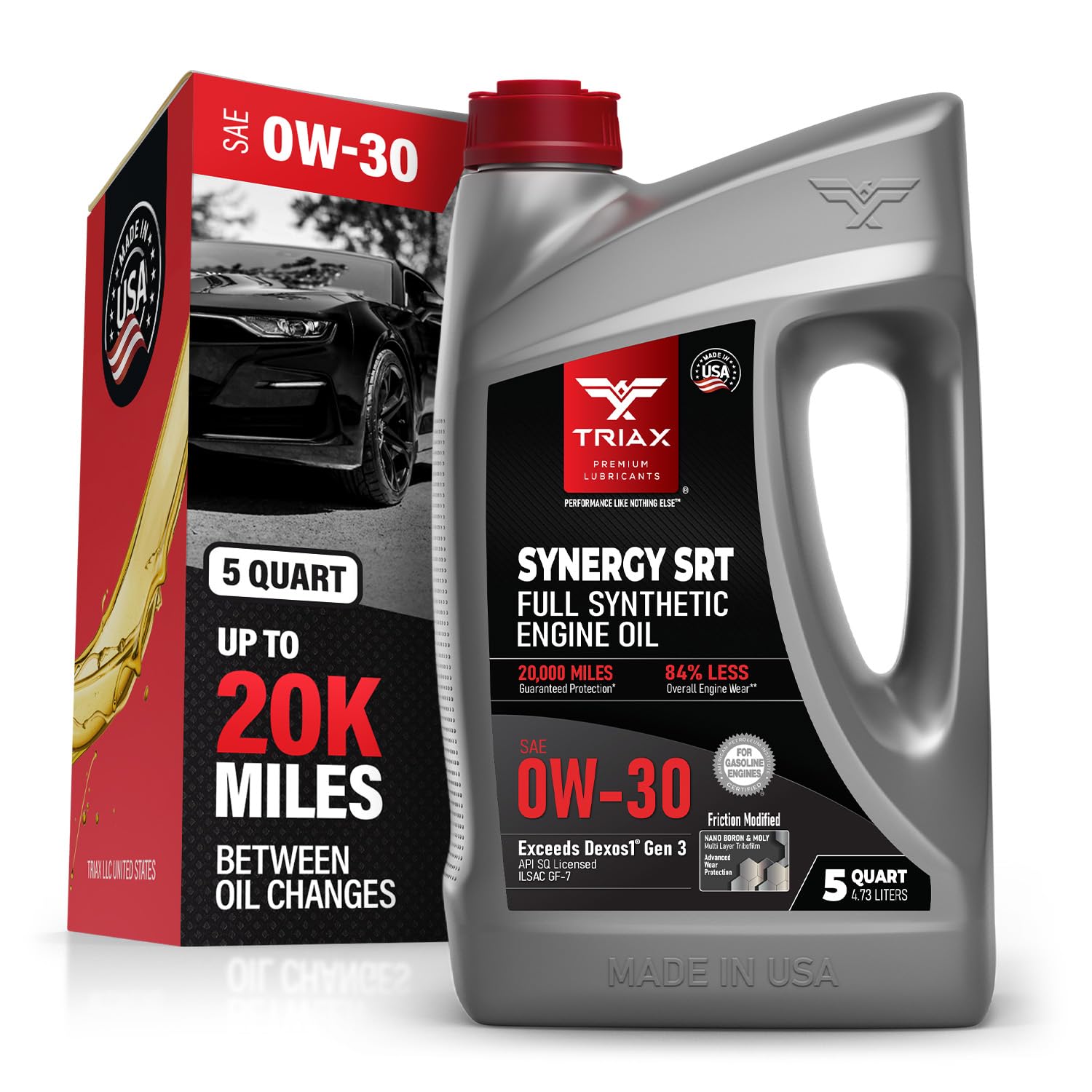
2. TRIAX Synergy SRT 0W-30 Full Synthetic, API SP Licensed, 5 Quart
A friction-modified powerhouse that promises 20,000 miles of protection and cuts wear by 84 percent versus industry standards.
TRIAX packs Nano Boron and Moly friction modifiers into this 0W-30, ingredients that bond to metal surfaces and keep working long after conventional oil shears down. The result, backed by an API SP license, is up to 84 percent less wear than API and OEM performance standards demand — a claim that matters most for high-stress components like camshafts, turbo bearings, and the crankshaft. The extended drain interval of up to 20,000 miles or two years is real for controlled driving habits, and the formula targets 50 percent fewer deposits than OEM specs, which helps keep sludge from forming inside the engine block for up to 250,000 miles.
Buyers report a 2018 Nissan Maxima (300 horsepower) gained noticeable throttle responsiveness and smoothness after switching from the factory oil. The trade-off is cost: it sits at a higher price point than the Mobil 1 above, and the bottle labels carry ILSAC GF-6A while one reviewer noted the listing mentioned GF-7, a minor spec inconsistency note on a premium purchase. For someone running a gas truck, SUV, or a high-horsepower daily driver, the extra investment buys a genuinely longer-lasting lubricant film.
superior wear protection: Up to 84 percent less wear vs. API limits is a real, measurable lead over almost every other 0W-30 on this list.
price premium: A few owners noted the bottle label may show GF-6A instead of the advertised GF-7 — functionally identical but worth checking if you are label-conscious.
engine longevity: You want maximum protection for a turbo engine or truck and prefer to change oil once a year rather than every 5,000 miles.
budget builds: You need a Euro-spec oil with ACEA approval — this is API SP only, not formulated for ACEA C2 or A3/B4 engines.
3. Castrol EDGE Euro 0W-30 A3/B4 Advanced Full Syn Motor Oil, 1 Qt (Pack of 6)

The German-made Class IV synthetic that keeps BMW turbo engines clean past 170,000 miles.
Castrol EDGE Euro 0W-30 is specifically built to ACEA A3/B4 standards, which means it carries a thicker high-temperature film than many competitor 0W-30 oils — exactly what high-output European engines need for valve-train and turbo protection. It boasts a 42 percent better rating on fighting power-robbing deposits compared to conventional and synthetic blends, a claim backed by Mercedes-Benz 229.5, Volkswagen 505.00, and BMW Longlife 01 approvals. Owners mention popping the valve cover on a 170,000-mile BMW X1 and finding the engine “clean as new,” proof of the deposit-fighting additive package. The casting is made in Germany and uses PAO/ester base oils, a true Group IV synthetic that resists thermal breakdown better than Group III alternatives.
At six quarts, this pack covers most European oil-change capacities in one purchase. It is a step up in price from standard synthetics, but the crowd — 4.7 stars across 472 ratings — consistently praises the oil quality and the value of getting a true German-make oil at a lower price than dealership bottles, with long engine life and quiet operation as recurring themes.
euro spec certified: 42 percent better deposit protection vs. conventional and synthetic-blend oils — a real benefit for turbocharged, direct-injection engines that build carbon quickly.
thicker at cold: ACEA A3/B4 is the correct spec for most European long-life applications, but it is not suitable for engines requiring ACEA C2 or C3 low-SAPS oil (check your manual).
European cars: You drive a BMW, Mercedes, VW, or Volvo that specifies BMW LL-01 or ACEA A3/B4, especially with a turbocharger.
gasoline only: Your engine needs a low-SAPS C2/C3 oil for DPF or catalytic converter protection — this has higher ash content by design.
4. LIQUI MOLY Special Tec V 0W-30 Motor Oil, 5 L

The German-engineered fluid built specifically for Volvo’s demanding long-life service intervals.
LIQUI MOLY Special Tec V 0W-30 is fully synthetic and formulated primarily for Volvo models that require the VCC 0W-30 specification, though owners also run it in BMWs with confidence. It is tune for modern diesel and petrol engines with multi-valve technology, turbochargers, and variable-valve timing systems — the kind of engineering that lives in Scandinavian powertrains. The 5-liter bottle (roughly 5.3 quarts) covers most European sump capacities in one shot, and the 4.8-star average across 129 ratings indicates very few complaints. One owner drove 5,000 miles on a fill and reported the oil still looked “fairly clean,” suggesting good oxidation resistance.
The catch is fit: this is listed as “Vehicle Specific Fit” rather than Universal Fit, meaning it is tuned for Volvo’s specific additive demands (Volvo VCC RBS0-2AE). If you drive a non-Volvo European car, it will likely work for many models that require a 0W-30 ACEA A5/B5, but it is safest to confirm compatibility with your manufacturer’s spec sheet before buying.
owner satisfaction: The oil stays visibly cleaner for longer miles — a sign of strong detergent chemistry and thermal stability in daily driving.
limited availability: Designed for Volvo, but BMW customers note excellent results; check for VCC or A5/B5 requirement before purchase.
daily drivers: You own a Volvo that needs the VCC 0W-30 spec and want a German brand with a long reputation.
racing use: Your engine demands ACEA C2 or C3 low-SAPS oil — this is formulated to ACEA A5/B5 standards.
5. Motul 8100 ECO-clean 0W-30, 100% Synthetic, 5 Liter

The low-emissions specialist that protects DPFs and catalytic converters without compromising engine oil film strength.
Motul 8100 ECO-clean is a 100% synthetic oil built on ACEA C2 standards — a Mid SAPS formulation that deliberately limits sulfated ash, phosphorus, and sulfur to keep diesel particulate filters and catalytic converters from clogging prematurely. That makes it a first-choice for modern gasoline and diesel engines fitted with after-treatment systems, including many Ford models requiring Ford WSS-M2C950-A. Owners swapping from standard full synthetics notice a smoother ride immediately, as the low-friction 0W-30 viscosity reduces internal drag. The 9.7-pound jug comes in at 5 liters, enough for most European sumps with a bit left over.
With 663 ratings and a 4.8-star average, this is the second-most-reviewed oil on the list, and the high approval tells a consistent story: reviewers point out it works in Jaguars, Veloster Ns, and other turbocharged platforms that need C2-rated protection. The phrase “REAL 100% synthetic oil” appears in reviews because Motul explicitly uses Group IV/V base stocks rather than hydrocracked Group III — a meaningful distinction for those who do extended drain intervals or track days.
clean burn tech: Mid SAPS (reduced sulfated ash, phosphorus, and sulfur) means it protects your emissions equipment while maintaining excellent lubrication — a balance many oils get wrong.
short change interval: Not for older engines requiring ACEA A3/B4 or higher ash content for flat-tappet cam protection.
eco conscious: You drive a DPF-equipped diesel, a GDI gasoline engine, or a Jaguar/Ford requiring ACEA C2 — especially if you care about emissions system longevity.
high mileage: Your engine calls for a high-SAPS oil like ACEA A3/B4 (typically pre-2010 European models or some performance applications).
6. Pennzoil Platinum Euro LX Full Synthetic 0W-30, 1 Quart (6 Pack)
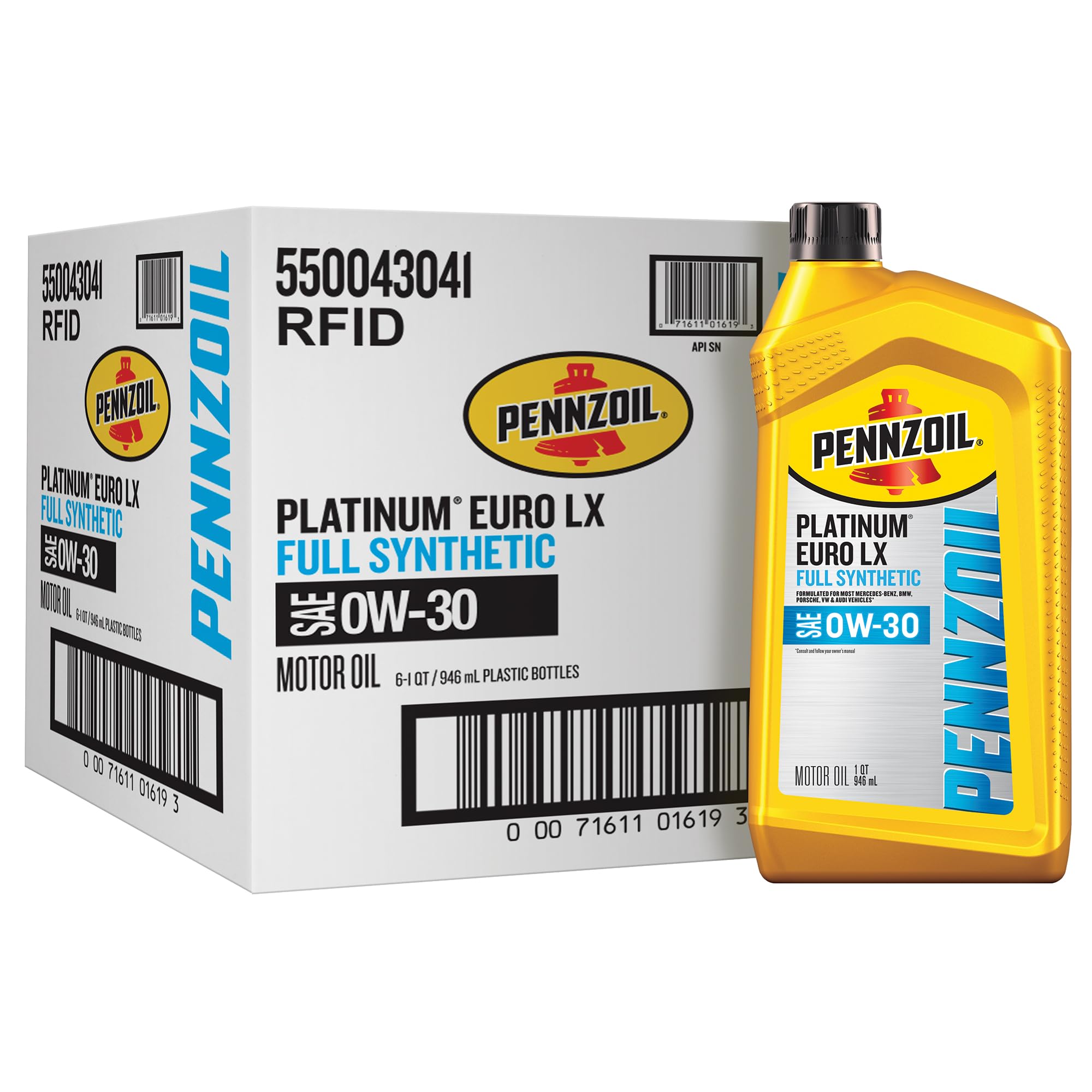
A gas-to-liquid synthetic that delivers factory-clean engines for up to 500,000 miles of service life.
Pennzoil Platinum Euro LX is made from natural gas using Shell’s gas-to-liquid (GTL) process, which produces a base oil that is purer than crude-derived Group III oils. The result is a 0W-30 that provides faster low-temperature flow in winter and maintains protection in extreme heat, plus a guarantee to protect for up to 15 years or 500,000 miles (whichever comes first). It is formulated for European high-performance gasoline and diesel engines — specifically Fiat, BMW, Mercedes-Benz, Porsche, and VW — and carries ACEA C2 approval as well as BMW LL-12. Owners running it in a VW Atlas report that even after 8,000 miles on the same fill, an oil analysis came back clean enough to keep going.
The six-quart case format is ideal for Alfa Romeo Giulia and Jeep Renegade owners who need a long-life C2 oil, and the 4.8-star average across 214 ratings reinforces that quality and value are the top praise points. If you drive a modern European car that calls for a low-SAPS 0W-30, this is a smart, proven pick that costs less per quart than many boutique Euro oils.
lowest pour point: Backed by a 500,000-mile / 15-year engine life guarantee — one of the strongest longevity claims in the category, tied to the pure GTL base.
quart only: Some owners found the 1-quart bottles more convenient than a single 5-liter jug for topping off or topping up between changes.
cold climates: You drive a BMW, Alfa Romeo, Fiat, VW, or Jeep that requires a C2-rated 0W-30 and you want a trusted brand at a sensible price.
bulk buyers: Your engine needs an ACEA A3/B4 high-SAPS formulation — this is a low-to-mid SAPS oil designed for modern emissions equipment.
7. MANNOL 7730 Premium Engine Oil 0W-30, 5L
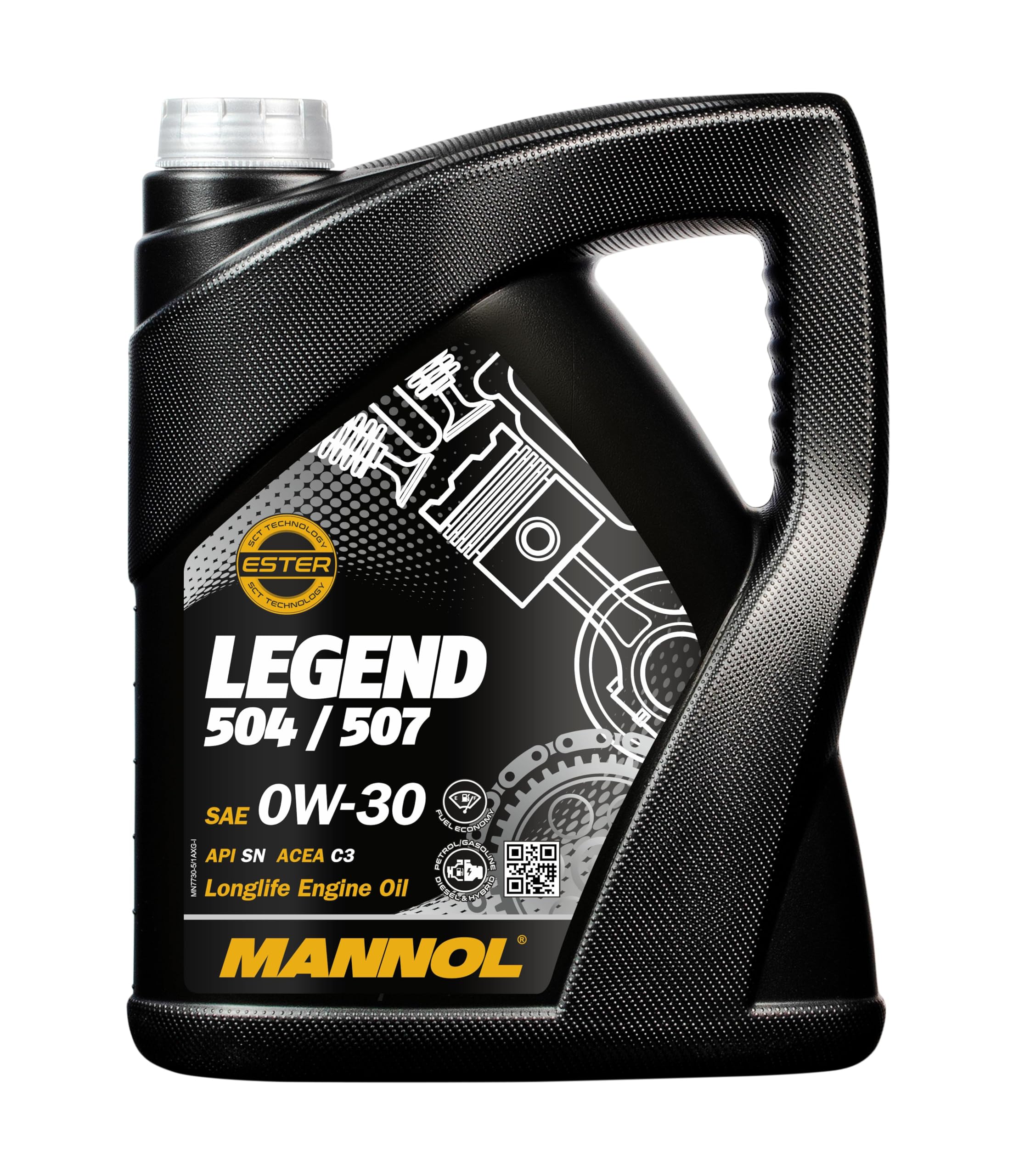
Bi-synthetic chemistry (PAO + esters) at a price that undercuts almost every other premium 0W-30 on the shelf.
MANNOL 7730 uses a bi-synthetic base of polyalphaolefin (PAO) and esters — the same building blocks found in much more expensive oils — to achieve exceptional film strength and thermal-oxidative stability. It is a Mid SAPS formulation compatible with DPF, TWC, EGR, and SCR exhaust systems, and is rated for extended oil change intervals up to 30,000 kilometers (roughly 18,600 miles). The flash point sits at 230 degrees Celsius, which is excellent resistance to vaporization under high heat. For stop-start city driving, the ester component helps the oil cling to metal surfaces during shutdown cycles, reducing startup wear.
Owners of VW Tourans, Audis, and other European cars report that after switching, the engine runs more quietly and fuel consumption drops slightly. A few international reviews mention the oil performs at a level comparable to “blasonati” (top-tier) brands at roughly half the price. The 4.7-star average over 82 ratings is solid, though the review count is smaller than the giants above. If you drive a light SUV, minibus, or car that calls for a 0W-30 Mid SAPS oil and you want to save significant money, this is an excellent hidden gem.
value for price
- PAO+ester chemistry usually found in + oils, at a lower price point
- Mid SAPS formulation protects DPFs and catalytic converters
- Excellent 230°C flash point resists high-temp evaporation
unknown brand
- Smaller owner community (82 ratings) means less long-term data vs. the 500+ ratings on Mobil 1 and Castrol
- European brand with less U.S. retail presence — harder to find locally if you need a top-up
budget pick: You want true PAO+ester full synthetic at a budget-friendly price for a VW, Audi, or any modern car requiring ACEA C3 or Mid SAPS 0W-30.
name brand loyalists: You prefer the reassurance of a brand with thousands of ratings (Mobil 1 or Castrol) or need an ACEA A3/B4 high-SAPS formulation.
Understanding the Specs
SAE Viscosity: 0W-30
The “0W” means the oil flows like a thin 0-weight grade when cold, as low as -35°C, which reduces startup wear and gets oil to the top end of the engine almost instantly. The “30” means at 100°C operating temperature, it thickens to a 30-weight film that maintains a strong barrier between metal surfaces — enough to protect 300-horsepower turbos without being so thick that it creates drag. This dual nature makes 0W-30 versatile for both cold-climate daily driving and hot-weather highway miles.
API SP / SN / SN Plus
The American Petroleum Institute (API) updates its “S” (Service) categories to reflect modern engine demands. API SP is the current standard for gasoline engines, adding resistance to low-speed pre-ignition (LSPI) in turbo direct-injection engines and better timing-chain wear protection. SN was the previous standard and is being phased out; SN Plus was an interim spec for LSPI protection. If your car is a 2020 or newer, look for the API SP donut on the bottle. For older cars, SN or SN Plus still provides good protection but lacks the latest turbo-specific tests.
ACEA Classifications: A3/B4 vs. C2 vs. C3
European automakers use ACEA rather than API. A3/B4 is a “high performance” spec for gasoline (A3) and diesel (B4) engines that demand High High-Shear Viscosity (HTHS) — meaning the oil film stays thick and strong under extreme pressure, ideal for turbocharged BMWs and Mercedes. C2 and C3 are “low” or “mid” SAPS (sulfated ash, phosphorus, sulfur) oils designed for engines with diesel particulate filters (DPF) and catalytic converters; C2 is a lower HTHS variant for fuel economy, while C3 is slightly thicker for protection. Putting an A3/B4 oil in a C2 engine may eventually clog your DPF; putting a C2 oil in an A3/B4 engine may cause excessive wear under heavy load.
Drain Interval and Total Base Number
The Total Base Number (TBN) measures how much acid-neutralizing additive is in the oil — a high TBN (around 8–12) means the oil can stay effective longer before turning acidic. While you won’t see TBN printed on the bottle, extended-drain oils like the TRIAX and MANNOL on this list typically carry higher TBN values and stronger anti-oxidation chemistry to last 15,000–20,000 miles. If you use a standard 5-quart oil and drive in severe conditions (stop-and-go, dusty roads, short trips), you should change it at 5,000–7,500 miles regardless of the bottle’s claim.
FAQ
Can I use 0W-30 instead of 5W-30 or 0W-20?
What happens if I use an oil with the wrong ACEA spec (e.g., A3/B4 instead of C2)?
Is more expensive 0W-30 oil worth the extra cost?
Will 0W-30 improve my fuel economy?
Can I mix different brands of 0W-30 oil if I am low on oil?
How long can I safely run a 0W-30 oil between changes?
What is the difference between “full synthetic” and “100% synthetic”?
Is 0W-30 safe for high-mileage engines (over 150,000 miles)?
Which 0W-30 is best for a turbocharged engine?
Can I use a 0W-30 oil in a lawnmower, generator, or small engine?
Final Thoughts: The Verdict
For most buyers, the best 0w 30 car oil winner is the Mobil 1 Advanced Fuel Economy because it pairs a strong API SP/ILSAC GF-6 formulation with an accessible price and a massive owner base of nearly 600 ratings that nearly universally praise its quality and value. If you drive a European turbo car that needs ACEA A3/B4 protection, grab the Castrol EDGE Euro — it has the 42% deposit-fighting edge and the BMW/Mercedes approvals to back it. And for maximum wear protection with extended drain intervals, the TRIAX Synergy SRT is the one to reach for, with its 84% less wear and 20,000-mile capability.
How We Picked
We do not accept paid placement. Every pick is matched to a real buyer and a real use-case; we do not hands-on test units.
Sources & Methodology
Specifications: manufacturer listings and product documentation. Review insights: verified customer reviews, as of July 2026. Pricing: not shown on this page (it changes often); check the current price via the retailer link.
As an Amazon Associate, Trending Car earns from qualifying purchases. This does not affect which products we feature.