
Our readers keep the lights on and my garage snacks stocked. As an Amazon Associate, I earn from qualifying purchases.
Specs are compiled from manufacturer listings and verified buyer reviews and can change over time — please confirm the key details on the product page before buying.
Picking the right 0W-30 motor oil depends on one question: how much protection do you want between oil changes? The wrong bottle means sludge buildup, higher engine wear, and a dip in fuel economy. Here are five real contenders that diesel and gasoline engines trust — from a value-packed crowd favorite for daily drivers to a premium European-spec pour for turbocharged performance cars.
I’m Min Islam — the founder and writer behind Trending Car. This guide is built by comparing the manufacturers’ published specifications and the patterns across verified customer reviews, so you get each pick’s real strengths and trade-offs instead of marketing spin.
The keyword here is 0w 30 motor oil, and every recommendation below is rooted in the actual cold-flow viscosity, high-temp stability, and OEM approvals that keep an engine running clean mile after mile.
Our Picks at a Glance

How To Choose The Best 0W 30 Motor Oil
Choosing 0W-30 motor oil is less about brand loyalty and more about matching three things: your engine type, your climate, and the oil’s “recipe” of additives. 0W-30 pours like water at -30°C, which gets that thin layer of oil onto bearings and camshafts fast during a winter start, then thickens enough at 100°C to hold a film under highway loads. But not every 0W-30 is the same — some are formulated for modern gasoline engines with turbochargers, others for older diesel blocks with particulate filters. The right 0W-30 oil delivers instant cold-flow protection and sustained high-temp film strength.
OEM Approvals and Spec Sheets
The quickest shortcut to a safe buy is looking for the letters your owner’s manual demands — things like ILSAC GF-6, ACEA C2, or a specific BMW Longlife-01 rating. These certifications mean the oil passed actual bench tests for timing chain wear protection, low-speed pre-ignition control, and deposit prevention. Pouring an oil that does not carry your car’s spec is a gamble with sludge and valvetrain noise.
Base Oil Quality: Class III vs. Class IV
Every synthetic starts with a base stock. A “full synthetic” label can mean a highly refined petroleum base (Group III) or a true synthetic made from PAO/esters (Group IV). Group IV oils resist oxidation longer at high temperatures, so they tend to stay in grade longer between changes. If you push oil changes to 8,000 or 10,000 miles, you want a Group IV or a mid-SAPS formula that holds viscosity without breaking down.
High-Mileage Compatibility
Engines above 100,000 miles often have looser clearances than a new block. An owner of a Honda CR-V with 150,000 miles reported that stepping up from 0W-20 to a 0W-30 with better high-temp viscosity stopped a knocking sound. If your engine has ticked past six digits, a thicker hot-grade oil like 0W-30 can help seal worn rings and reduce oil consumption.
Quick Comparison
| Model | Best For | Viscosity Grade | Volume | Key Approval | Amazon |
|---|---|---|---|---|---|
| Mobil 1 Advanced Fuel Economy★ Best Overall | Everyday daily drivers | 0W-30 | 5 qt | ILSAC GF-6 | Amazon |
| Motul 8100 ECO-cleanBest Value | Modern DI + DPF engines | 0W-30 | 1 L | ACEA C2, Ford WSS-M2C950-A | Amazon |
| Castrol EDGE Euro | European performance cars | 0W-30 A3/B4 | 6 qt | BMW LL-01, MB 229.5 | Amazon |
| LIQUI MOLY Special Tec V | Volvo + high-load intervals | 0W-30 | 5 L | Volvo VCC | Amazon |
| Pennzoil Platinum Euro LX | Turbo Euro (Alfa, VW, BMW) | 0W-30 | 6 qt | BMW LL-04, MB 229.51 | Amazon |
In‑Depth Reviews
1. Mobil 1 Advanced Fuel Economy Full Synthetic 0W-30, 5 Quart
Our pick — over 4.5★ from 550+ verified ratings; the strongest balance of quality and price.
The crowd favorite that keeps 10,000 miles between you and a sludge problem.
This Mobil 1 uses a Triple Action Formula that fights oxidation and deposit buildup, which is exactly what you want for a daily commuter or family SUV. Owners running it in everything from a 2026 Hyundai Palisade to a Corvette report quieter cold starts and smoother idle — a direct result of the low-viscosity 0W-30 base that circulates instantly on freezing mornings. The 160 fluid ounce jug (5 quarts) covers most standard oil changes without needing a second bottle.
This Mobil 1 oil meets ILSAC GF-6 standards at a price that undercuts most premium Euro oils. It meets the latest ILSAC GF-6 standard, which specifically addresses low-speed pre-ignition — a real concern in modern turbocharged four-cylinders. Owners note it outpaces cheaper blends in high-temperature stability, especially in hot climates like Florida. The only catch is that high-mileage engines coming from a thinner 0W-20 may occasionally see a slight change in oil pressure, but most drivers find the swap smooth and beneficial.
Why It Wins the Garage
- ILSAC GF-6 approved for timing chain and LSPI protection
- Helps protect critical parts up to 10,000 miles between changes
- 45 owners praise the oil quality — the most-celebrated aspect by far
The Trade-Off
- Not formulated for Euro-specific ACEA C2 or mid-SAPS requirements
- 5-quart bottle is heavy to handle if you do your own oil changes
Reach for this if: you drive a mainstream gas car (Honda, Toyota, Chevy, Hyundai) and want a proven full synthetic that outperforms cheap blends without breaking the budget.
Look elsewhere if: your car requires a strict European ACEA C2 or BMW Longlife-specific oil to protect a diesel particulate filter.
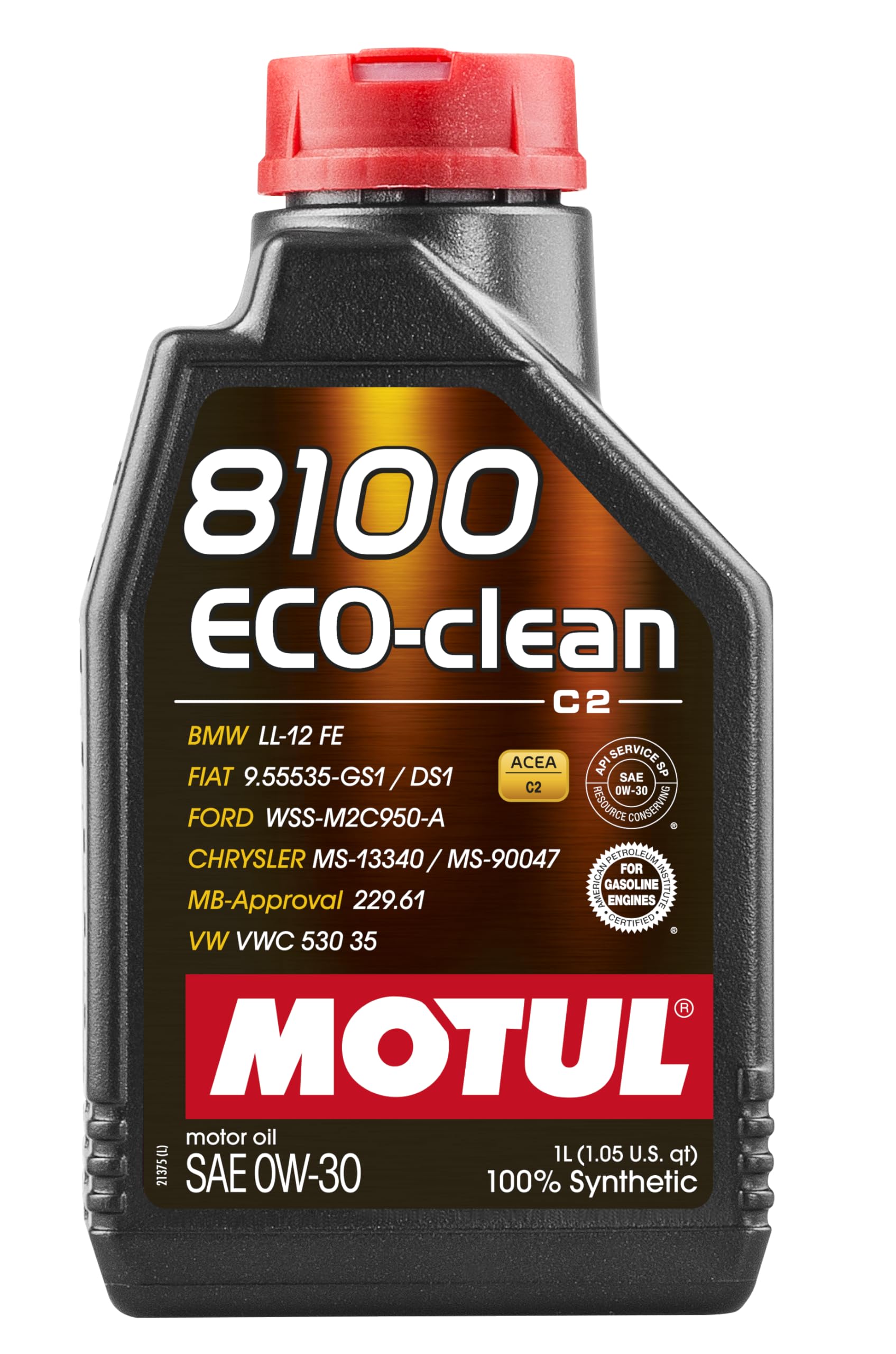
2. Motul 8100 ECO-clean 0W-30 – 100% Synthetic, 1 Liter
A true 100% synthetic that protects the catalytic converter while delivering a smooth ride.
Motul is a favorite among owners of modern direct-injection engines and diesel cars that wear a DPF. This 8100 ECO-clean uses Mid SAPS technology — meaning it lowers the sulfated ash, phosphorus, and sulfur content that can clog a catalytic converter or a diesel particulate filter over time. One Veloster N owner reported a noticeably smoother ride after swapping to Motul, attributing it to the low-friction formula that cuts internal drag.
It meets ACEA C2 and Ford WSS-M2C950-A specifications, which covers a wide swath of European and Asian turbo engines. Owners praise this as “REAL 100% synthetic oil” rather than a petroleum-based “full synthetic” blend. The one-liter bottle format is handy for topping off or for cars that need a precise measure, but you will need multiple bottles for a full drain-and-fill.
What Owners Love
- Mid SAPS formulation protects DPFs and catalytic converters
- ACEA C2 and Ford WSS-M2C950-A certified
- Low-friction base oils deliver real “smoother ride” change feedback
The Catch
- Sold per liter, so a full change needs 4-6 bottles
- Not an ILSAC oil — skip this for Honda/Toyota daily drivers
Grab this if: you drive a European sedan, a turbocharged Hyundai/Kia, or any gasoline direct-injection car that demands an ACEA C2 oil for emissions health.
skip it if: you just need a simple jug pour for an American or Japanese family car that runs on ILSAC specs.
3. Castrol EDGE Euro 0W-30 A3/B4 Advanced Full Syn, 1 Qt (Pack of 6)

The German-made Class IV synthetic that BMW owners trust through 170,000 miles.
This Castrol is a certified Group IV oil (a high-performance synthetic base oil) using PAO (polyalphaolefin, a man-made oil molecule) and ester base stocks — the chemistry that keeps a BMW running clean well past 100,000 miles. One owner of an X1 with 170,000 miles reported that when the valve cover came off for a gasket change, “the engine is clean as new.” That kind of long-term deposit control is the direct result of the A3/B4 formulation (a European oil specification for high-performance engines) resisting oxidation and wear at high temperatures.
It holds approvals for BMW Longlife-01, Mercedes-Benz 229.5, and Volkswagen 502.00/505.00. Owners say the six-quart pack is cost-effective compared to buying single bottles at auto parts stores. The most-discussed downside is that oil quality is undeniably high (64 positive mentions), but a minority of buyers question whether it truly meets the newest BMW Longlife spec — an occasional worry with older certification labels. For a turbocharged M2 or a Volvo C30 T5, owners confirm this Castrol is the oil they buy on repeat.
Why It Stands Out
- German-made Class IV full synthetic (PAO/Esters)
- BMW LL-01, MB 229.5, VW 502.00 approved
- Buyers report engine internals look “clean as new” after 170K miles
The Fine Print
- Mixed feedback on whether it carries the newest BMW LL-01 certification
- Heavier A3/B4 hot-viscosity means slight fuel economy trade-off vs LL-04 oils
Best for: BMW, Mercedes, Volkswagen, or Volvo owners who want a true synthetic that delivers engine cleanliness over high intervals.
Think twice if: you need a low-SAPS C2 oil for a diesel particulate filter — this is an A3/B4 full-SAPS formula.
4. LIQUI MOLY Special Tec V 0W-30 Motor Oil, 5 L

A 5-liter jug designed for long change intervals and high-load highway miles.
LIQUI MOLY developed this Special Tec V primarily for Volvo models, but its fully synthetic formula works with any modern petrol or diesel engine that calls for 0W-30 viscosity. The oil is engineered for long-drain intervals and sustained high loads — exactly the kind of punishment a highway commuter or a weekend road-trip car dishes out. One owner who drove 5,000 miles and pulled the drain plug noted the oil “still looked fairly clean,” a strong real-world sign of oxidation resistance.
The 5-liter (169 fluid ounce) bottle is a generous single-fill for many Euro and Asian vehicles. It handles Valvetronic systems, turbochargers, and intercoolers without issue. A few owners specifically use it in their BMWs and comment that the German formula suits German metal well. The main trade-off is availability — this is not the oil you find at every generic auto parts chain, and the price point reflects its premium positioning as a niche OEM-focused product.
Biggest Strengths
- 5-liter jug fits many engines in one shot
- Excellent oxidation resistance — oil stays visibly clean after 5K miles
- Works with turbochargers, multi-valve, and diesel particulate filters
Before You Buy
- Primarily spec’d for Volvo VCC — verify compatibility with other makes
- Premium pricing vs comparable 5-quart bottles from major US brands
Choose this if: you own a Volvo, a high-mileage European car, or prefer a single 5-liter bottle for convenience and hate buying quart packs.
pass on it if: you need a low-cost jug for a simple domestic sedan — the value is in the longevity, not the up-front price.
5. Pennzoil Platinum Euro LX Full Synthetic 0W-30, 1 Quart (6 Pack)
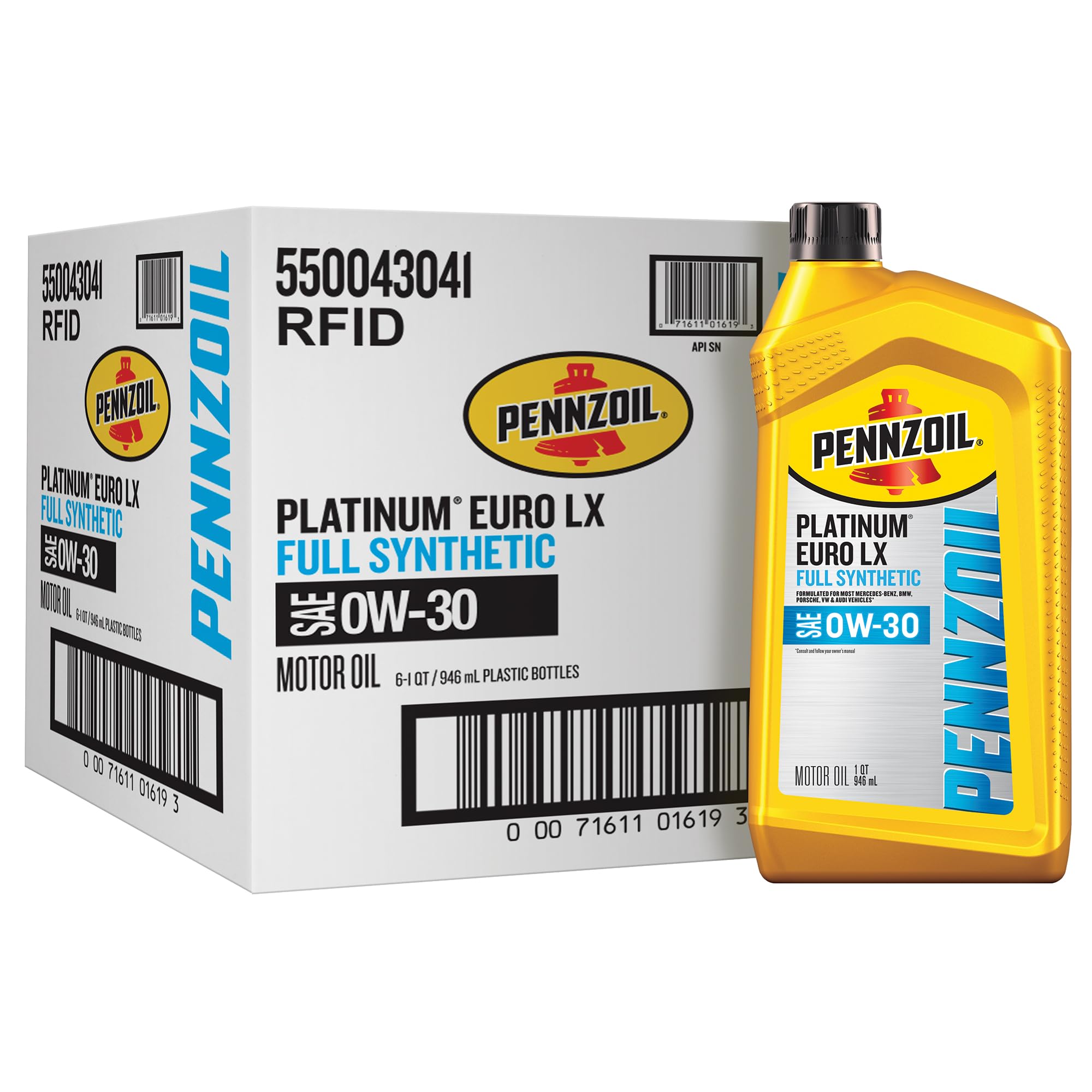
A gas-to-liquid synthetic that covers BMW and Alfa Romeo from cold starts to 500,000 miles.
Pennzoil Platinum Euro LX is unique in this lineup — it is made from natural gas rather than crude oil, a base-oil process that results in fewer impurities and a cleaner burn. Owners of a VW Atlas, a 2021 Jeep Renegade, and a 2017 Alfa Romeo Giulia 2.0 all report it delivers excellent results, with one buyer sending out an oil sample at 8,000 miles that the lab said “looks great and could be ran even longer.” It meets BMW Longlife-04 and Mercedes 229.51 specifications, which are the stricter low-SAPS (low sulfated ash, phosphorus, and sulfur) standards required for modern emissions systems.
Pennzoil backs this oil with a protection guarantee of up to 15 years or 500,000 miles. This is a serious claim for a turbocharged European engine, where oil breakdown quickly leads to costly repairs. The six-quart case covers most Euro engines in one order. The honest downside is that the bottle count makes it a higher upfront spend than a single jug, and the “Euro LX” formulation is specifically designed for cars that demand a low-SAPS lubricant — you pay for that precision even if your engine does not strictly need it.
what separates it
- Natural gas-to-liquid base for fewer impurities
- BMW LL-04 and MB 229.51 certified — low-SAPS for DPF engines
- Protection guarantee: up to 15 years or 500,000 miles
The Consideration
- Six-quart case is a larger initial investment than a single jug
- Euro-specific formulation is overkill for older non-turbo engines
Reach for this if: your daily is a European turbo (BMW, Alfa Romeo, VW, Porsche) and you want the cleanest base oil chemistry plus a 500,000-mile protection promise.
Look elsewhere if: you drive a standard Asian or American car that is not spec’d for low-SAPS Euro oil — a ILSAC formula like the Mobil 1 is a better price-to-need fit.
Understanding the Specs
Viscosity: 0W-30
The “0W” (Winter) rating tells you the oil behaves like a very thin fluid at -30°C, cranking your engine faster on the coldest morning. The “30” is the hot-grade — at 100°C (normal operating temp) the oil thickens enough to keep a stable film between moving metal parts. This means the oil is thin enough to flow instantly at startup yet thick enough to protect from wear under hard acceleration.
ACEA vs. ILSAC Standards
ACEA is the European standard — C2 and C3 spec oils use “mid SAPS” chemistry to keep ash away from diesel particulate filters. ILSAC GF-6 is the American standard that focuses on low-speed pre-ignition (LSPI) timing chain wear protection for modern turbo gasoline engines. Your owner’s manual will specify one or the other; mixing them can lead to a clogged DPF or insufficient chain protection.
Flash Point
This is the temperature at which oil vapor can ignite. Mobil 1 lists a flash point of 226°C. A higher flash point means the oil resists burning off inside the combustion chamber, which reduces oil consumption and deposits on valves. Anything above 220°C is considered good for a synthetic 0W-30.
Low SAPS vs. Mid SAPS vs. Full SAPS
SAPS stands for Sulfated Ash, Phosphorus, and Sulfur. Modern cars with diesel particulate filters (DPF) or catalytic converters need low or mid SAPS oil to prevent the filter from clogging. Full SAPS oils (like the Castrol A3/B4) offer stronger wear protection for older engines but will slowly plug a DPF. Check your Euro-spec car’s manual before buying.
FAQ
Can I use 0W-30 instead of 5W-30?
Is 0W-30 good for high-mileage engines?
What is the difference between 0W-30 and 0W-40?
What does ACEA C2 mean for my car?
Can I mix different brands of 0W-30 oil?
How often should I change 0W-30 synthetic oil?
Is 0W-30 OK for a turbocharged engine?
What is the flash point of 0W-30 oil and why does it matter?
Does 0W-30 improve fuel economy?
What happens if I use 0W-30 in a car that calls for 0W-20?
Final Thoughts: The Verdict
For most daily drivers, the 0w 30 motor oil winner to buy is the Mobil 1 Advanced Fuel Economy because it hits the balance of ILSAC GF-6 (International Lubricant Standardization and Approval Committee’s latest gasoline-engine standard) protection, 10,000-mile intervals, and a price that undercuts most premium Euro oils. If you drive a turbocharged European car with a DPF (diesel particulate filter, a device that traps soot), the Motul 8100 ECO-clean delivers genuine 100% synthetic chemistry that protects your emissions system while keeping the engine smooth. And for owners of BMW, Mercedes, or Volkswagen who want the proven long-run cleanliness of a Class IV base oil (a high-performance synthetic base stock), the Castrol EDGE Euro has the real-world track record — valve covers coming off spotless at 170,000 miles — to back up the price.
How We Picked
We do not accept paid placement. Every pick is matched to a real buyer and a real use-case; we do not hands-on test units.
Sources & Methodology
Specifications: manufacturer listings and product documentation. Review insights: verified customer reviews, as of July 2026. Pricing: not shown on this page (it changes often); check the current price via the retailer link.
As an Amazon Associate, Trending Car earns from qualifying purchases. This does not affect which products we feature.