
Our readers keep the lights on and my garage snacks stocked. As an Amazon Associate, I earn from qualifying purchases.
Specs are compiled from manufacturer listings and verified buyer reviews and can change over time — please confirm the key details on the product page before buying.
When the power goes dark, cell towers go silent, or you are miles past the last trail marker, a handheld radio is your only tether to the world. But not every model is built for the same job — some are emergency power stations, others are pocket-sized comms tools, and a few are heavy-duty worker radios. The difference between a radio that saves your trip and one that sits dead is knowing which one matches your real scenario.
I’m Min Islam — the founder and writer behind Trending Car. This guide is built by comparing the manufacturers’ published specifications and the patterns across verified customer reviews, so you get each pick’s real strengths and trade-offs instead of marketing spin.
Whether you are prepping for a storm, packing for a hike, or running a job site, here is a clear, no-hype breakdown to find the right handheld radio for what you actually do.
Our Picks at a Glance
How To Choose The Best Handheld Radio
The right handheld radio depends on one thing: what you need it for. A camping buddy needs weather alerts and long battery life. A construction foreman needs rugged durability and group-call features. A ham radio hobbyist wants wide frequency coverage and lots of channels. Here are the three specs that cut through the noise.
Power and Range — Watts and Miles
Radio power is measured in watts (the strength of the transmitter), and range is measured in miles (how far the signal travels). More watts generally means more reach, but terrain changes everything. In open fields with few obstructions, a 5-watt radio like the BAOFENG GM-15 Pro can cover 4-5 miles, while inside a city with concrete buildings, that same radio drops to about 2-3 miles. For short-range communication across a warehouse or a campground, 1-2 watts is enough. For serious backcountry trips, aim for 5 watts or more.
Battery Capacity and Charging Methods
Battery capacity is listed in mAh (milliampere-hours) — the higher the number, the longer the radio runs between charges. A 1250mAh battery can last 10-12 hours on a single charge, which is fine for a weekend trip. A 12000mAh battery, by contrast, can keep the radio and lights running for days during a blackout. Emergency radios often add a hand crank and a solar panel, so you can recharge even when the grid is down. Look for USB-C charging, which lets you top up from a power bank, car, or laptop.
Frequency Bands and Licensing
Handheld radios use different frequency bands for different purposes. AM and FM are the standard broadcast bands for news and music. NOAA weather channels (around 162 MHz) broadcast real-time severe weather alerts. GMRS (General Mobile Radio Service) and FRS (Family Radio Service) are for two-way communication — GMRS requires a license from the FCC, while FRS does not. Ham radios (like the BAOFENG UV-5RM) cover UHF and VHF bands but require a technician-class license to transmit. Always check which band you need and whether a license is required before you buy.
Quick Comparison
| Model | Best For | Battery | Max Range | Frequency Bands | Amazon |
|---|---|---|---|---|---|
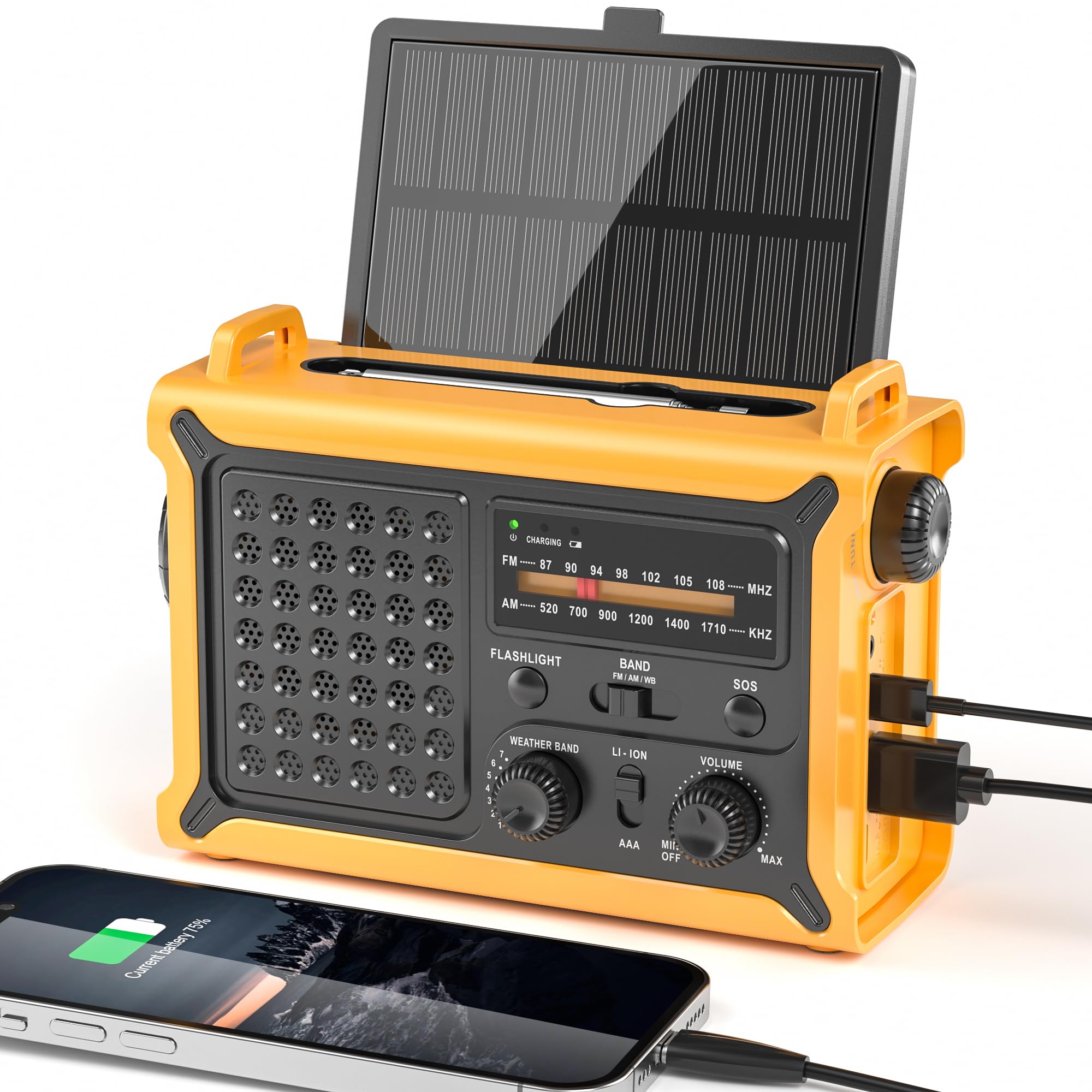
| Mesqool Weather Radio★ Best Overall | Emergency Prep / Off-Grid Power | 12000mAh | — | AM, FM, NOAA | Amazon |
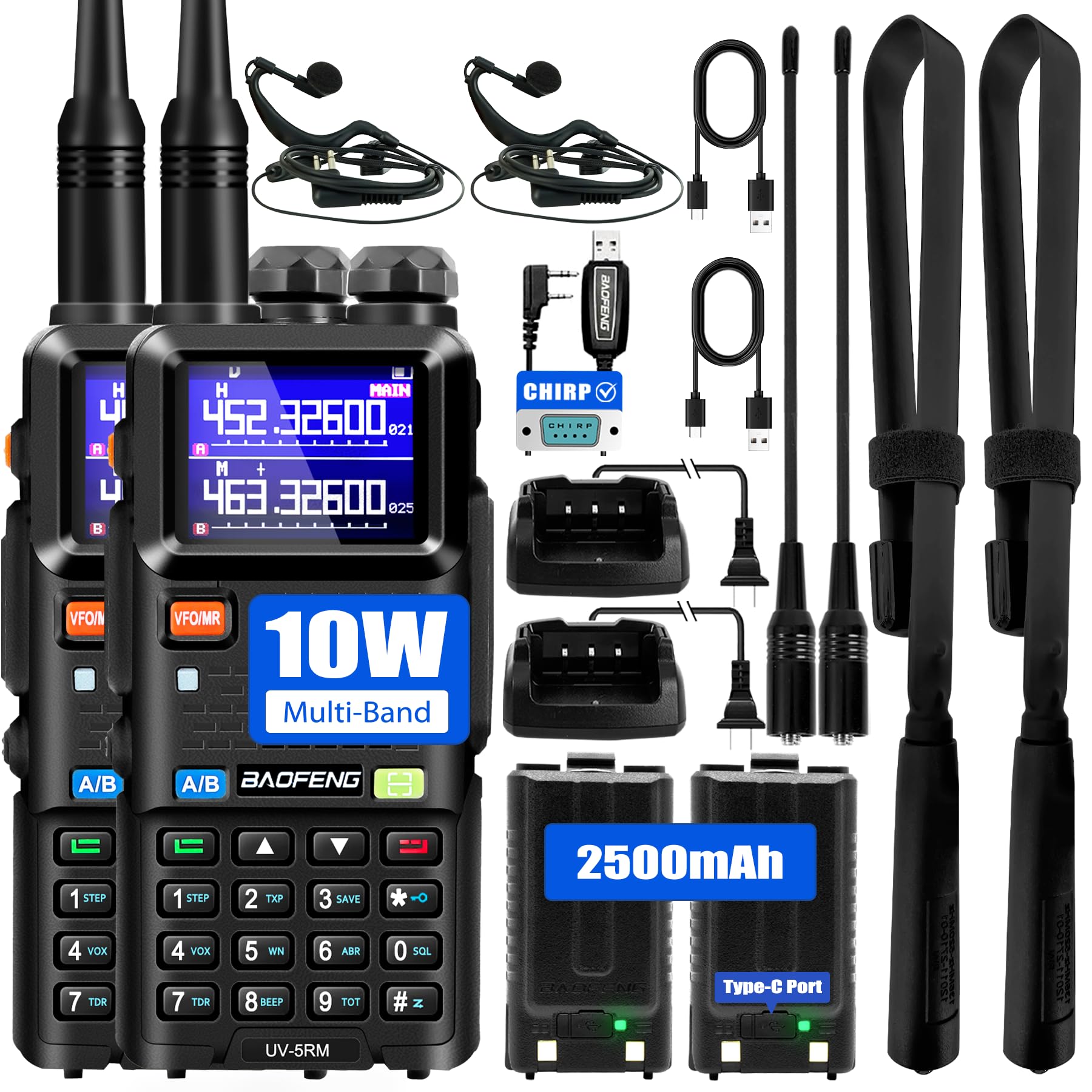
| BAOFENG 5RM Ham RadioTop Performer | Ham Radio Enthusiasts / Long Range | 2500mAh | 15 Miles | UHF, VHF, AM, NOAA | Amazon |
| BAOFENG GMRS GM-15 Pro | Hunting / Family Outings | 1500mAh | 5 Miles | GMRS, NOAA | Amazon |
| Midland T77VP5 | Camping / Overlanding | Rechargeable Pack | — | FRS, NOAA | Amazon |
| Vokida Emergency Radio | Survival Kit / Multi-Tool | 10000mAh | — | AM, FM, NOAA | Amazon |
| Jazmm Pocket Radio | Daily Commute / Travel | 1250mAh | — | AM, FM, SW, NOAA | Amazon |
| SAMCOM FPCN30A | Construction / Business Teams | 1500mAh | 5 Miles | UHF (406-470 MHz) | Amazon |
In‑Depth Reviews
1. Mesqool Weather Radio — 12000mAh Solar Power Station
Our pick — over 4.5★ from 850+ verified ratings; the strongest balance of quality and price.
This is the radio that doubles as your emergency power bank, keeping you charged and informed for days.
You get uninterrupted listening and the ability to charge your phone through a storm because the Mesqool packs a genuine 12000mAh lithium battery A massive 8500mm² monocrystalline solar panel on top captures sunlight far faster than the decorative 2000mm² panels found on budget models, so even on a cloudy afternoon the radio keeps pulling power. When there is no sun, the upgraded hand crank generator claims to deliver nearly 2x the charging efficiency of standard cranks, giving you enough juice in 3 minutes to power the radio or your phone.
The radio receives NOAA, AM, and FM bands with a high-sensitivity chip and noise-reduction circuitry, meaning weather alerts come through crisp even during a downpour. It also includes a powerful flashlight that casts a beam up to 260 feet, plus a frosted reading lamp with a soft, warm glow. Buyers report that the large tuning knob and labeled buttons make it easy to operate in the dark, which matters when every second counts during a power outage. At 6.8 x 4.7 x 2.9 inches and 1.59 pounds, it is bigger than the pocket radios below, but the trade-off is a battery that lasts through multi-day emergencies without needing a wall outlet.
Powerhouse endurance: With 12000mAh capacity, solar charging, and a fast hand crank, this radio keeps working long after the grid fails.
Weight consideration: At 1.59 pounds it is heavier than travel-focused models, so it fits a bug-out bag or emergency kit better than a daily carry.
Reach for this if: you want a single device that handles radio, flashlight, and phone charging through extended power outages or off-grid camping trips.
Look elsewhere if: you need something small enough to slip into a jacket pocket every day — the pocket-size radios below are better for that.
2. BAOFENG 5RM Ham Radio — 10W Power with 999 Channels
A massive 15-mile range and 999 programmable channels make this the serious communicator’s radio.
It covers UHF (136-512 MHz), VHF, AM, and NOAA weather bands, so you can listen to everything from local ham repeaters to NOAA weather alerts across 10 weather channels. An 18.5-inch foldable tactical antenna and a speaker microphone help pull in weak signals and cut background noise.
The 2500mAh battery is smaller than the 12000mAh emergency radio, but that is fine for a ham radio because the focus here is on transmission features, not days of standby. It supports USB-C charging, Chirp programming, and a one-key frequency copy function that lets you quickly clone frequencies from another radio. The package includes two radios, a programming cable, earphones, speaker mics, and two antennas. One reviewer noted that the frequency scan and copy key simplified setting up a shared channel with a buddy on the trail. Note that this is a ham radio — you need a technician-class license from the FCC to transmit legally.
Long-range muscle
- 10-watt transmit with a 15-mile maximum range
- 999 programmable channels for serious frequency management
- USB-C charging and included programming cable
License requirement
- Requires an FCC ham license to transmit — not for casual users
- 2500mAh battery is modest compared to emergency radios
Ideal for: licensed ham operators or hikers ready to study for the technician exam who want a feature-packed radio with a 15-mile range and easy programming.
Not for: anyone who just wants to press a button and talk without a license — the BAOFENG GMRS below is simpler for that.
3. BAOFENG GMRS GM-15 Pro — 8W GMRS with Repeater Capability

An 8-watt GMRS radio with 250 memory channels and a 5-mile range, ready for family outings and hunting trips.
You can talk to family members on the trail without complicated setups because the GM-15 Pro comes with 30 default channels pre-loaded, including 22 GMRS channels and 8 repeater channels — just turn it on and go. It also supports 24 customizable repeater channels, which can extend your communication distance beyond the standard line-of-sight. The radio includes 154 privacy codes (50 CTCSS and 104 DCS) to block interference from other users on the same frequency. Owners mention that the USB-C charging is convenient, letting them top up from a power bank or car charger.
In open areas, the range reaches 4-5 miles, while inside a forest it drops to 3-4 miles, and in a city to 2-3 miles — the 8-watt transmitter pushes further than most entry-level FRS radios. The radio also features 11 NOAA channels for weather alerts, a built-in flashlight, and an SOS alarm. Each unit comes with a 1500mAh battery and a USB-C charger.
Ready-to-go GMRS: Pre-loaded channels and 154 privacy codes mean you spend time outdoors, not fiddling with settings.
Range depends on terrain: 5 miles in open fields is realistic, but urban use drops to around 2 miles — know your environment.
Best for: families who want a straightforward, powerful GMRS radio for camping and hunting, with repeater capability for longer reach.
Look elsewhere if: you need a radio for on-the-air hobbyist scanning across multiple bands — the BAOFENG 5RM covers more frequencies.
4. Vokida Emergency Radio — 10000mAh Survival Kit with Thermal Blanket
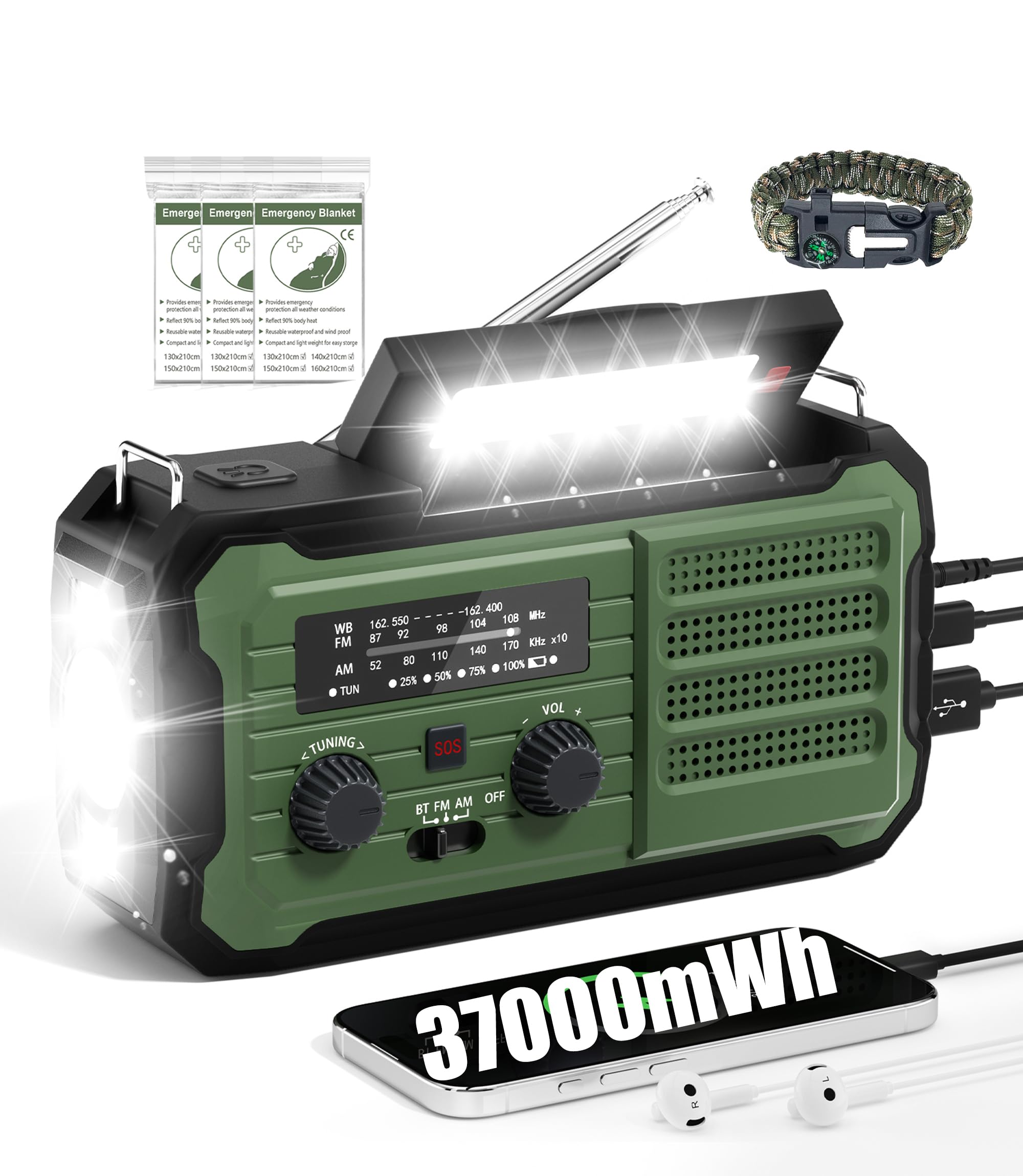
This radio packs a survival blanket and a paracord bracelet, making it a complete emergency kit in one box.
A 37000mWh (roughly 10000mAh) rechargeable battery sits at the core, with three ways to recharge — hand crank, solar panel, and internal lithium-ion via USB. When the power is out for days, you can keep the radio running and even charge your phone. The NOAA weather feature automatically scans 7 weather band channels, locking onto the strongest alert even while you sleep. Buyers appreciate that the radio includes a thermal blanket that reflects body heat and doubles as a rescue signal, plus a 5-in-1 survival paracord bracelet with a compass, blade, whistle, and fire rod.
The radio itself measures 6.5 x 3.5 x 2.4 inches, making it similar in size to the Mesqool but with a slightly different feature set. The built-in flashlight is bright enough for dark trails, and the SOS button triggers a loud siren with a flashing red light. The Vokida comes with three thermal blankets, a USB charging cable, and the survival bracelet. One buyer mentioned that the hand crank felt smooth and generated usable power in about 3 minutes of cranking. The package is a solid grab-and-go option for a vehicle emergency kit or a bug-out bag.
Complete survival bundle
- Three charging methods (crank, solar, USB) plus a 10000mAh battery
- Includes thermal blankets and a multi-tool paracord bracelet
- Automatic NOAA scan across 7 weather channels
Less power than the top pick
- 10000mAh is lower than the 12000mAh Mesqool, though still excellent for emergencies
- Solar panel is smaller than the Mesqool’s 8500mm² panel
Reach for this if: you want a single kit that includes a radio, thermal blanket, and survival tools for car emergency bags or camping base camps.
Look elsewhere if: battery capacity is your top priority — the 12000mAh Mesqool gives you more power in the same size class.
5. Midland T77VP5 X-TALKER — FRS Walkie-Talkie for Camping

A no-license-needed FRS radio that locks onto weather alerts and keeps conversations private with 121 privacy codes.
You can hand these to anyone in your camping group without worrying about licenses because the Midland T77VP5 operates on FRS frequencies, which are free for public use. The radio has 121 CTCSS privacy codes across 2,662 channel combinations, so your group can talk without bleed-over from other campers. The NOAA Weather Scan automatically cycles through 10 weather band channels and locks onto the strongest broadcast, alerting you of severe weather before you see it. Customers note that the 15-hour battery life from rechargeable packs is enough for a long weekend, and you can swap in standard alkaline batteries when the rechargeables run out.
Each bundle includes two radios, rechargeable battery packs, a drop-in desktop charger, a hard carrying case, and headsets — everything you need to start communicating immediately. At 1.4 x 2.6 x 6.1 inches and 1 pound per unit, the Midland is compact enough for backpack pockets. The X-TALKER series is known for clean audio on both ends of the call, and the T77VP5 maintains that reputation. It is not as powerful as the 8-watt GMRS radios, but for casual camping and overlanding, the ease of use wins.
License-free simplicity: FRS operation and a complete bundle make this the easiest pick for family trips.
Lower power: FRS radios are limited to 2 watts, so range is shorter than GMRS — expect about a half-mile to a mile in wooded terrain.
Ideal for: families and casual campers who want a ready-to-go two-way radio with weather alerts and no license paperwork.
Not for: hunters or hikers needing 4-5 mile range through dense forest — the BAOFENG GMRS is better suited to that.
6. Jazmm Bluetooth AM FM Shortwave Radio — 5W Speaker in a 1.3-Inch Thin Body

A 2.3-inch long radio that fits in a shirt pocket but still delivers full-band AM, FM, shortwave, and NOAA alerts.
The Jazmm is the smallest radio in this lineup at just 2.3 x 4 x 1.3 inches, yet it crams in a 5W large speaker that sounds fuller than you expect. It covers AM (520-1710 KHz), FM (87-108 MHz), shortwave (4.75-21.85 MHz), and NOAA weather band (162.400-162.550 MHz) — all four bands in a package you can slip into a jacket or attach to your belt with the included back clip. The 1250mAh battery delivers 10-12 hours of listening per charge via USB-C. Buyers mention that the digital tuner with LCD display makes station selection precise, eliminating the drift you get with analog dials.
Beyond radio, the Jazmm doubles as a Bluetooth 5.4 speaker, so you can stream music from your phone. It also has a TF card slot and USB port for MP3 playback, plus six EQ sound effects (rock, pop, jazz, etc.) to tailor the audio. A flashlight is built in for emergencies. This radio is much smaller than the Mesqool, making it the obvious choice for daily carry, though the 1250mAh battery is much smaller than the Mesqool’s 12000mAh. It is perfect for listening on a commute, at a picnic, or in a tent — not for days without power.
Ultra-portable powerhouse
- Covers AM, FM, shortwave, and NOAA in a 1.3-inch thick body
- Bluetooth 5.4 streaming and MP3 playback from TF card or USB
- 5W speaker delivers clear, loud audio despite small size
Modest battery life
- 1250mAh is only enough for 10-12 hours of listening, not multi-day emergencies
- No solar or hand crank charging — relies entirely on USB-C
Best for: everyday carry — commuters, travelers, and casual listeners who want a tiny radio with big sound and full-band coverage.
Not for: emergency preparedness where days of autonomy matter — the Mesqool or Vokida are far better for that.
7. SAMCOM FPCN30A — 6-Pack UHF Radio for Construction Teams

A rugged 6-pack business radio built to survive construction dust, drops, and weather while covering 300,000+ square feet indoors.
On a job site, you can split crews across 20 UHF channels and still reach everyone with one press of the GROUP button, which broadcasts site-wide announcements over all channels simultaneously. The SAMCOM FPCN30A transmits at 5 watts, strong enough to cover 300,000+ square feet inside large buildings, including through concrete walls and steel beams that defeat lesser radios. The 1500mAh battery lasts 8+ hours of continuous use and 12+ hours of standby, matching a full shift with overtime. Buyers appreciate that the radio is drop-proof, weather-proof, and rainproof, with a hard plastic shell that withstands rough handling.
These are FCC Part 90 certified Land Mobile Radios (LMR) for the 406.1-470 MHz UHF band, meaning they comply with professional-use regulations but require an appropriate license for operation. The package includes six radios, six 1500mAh batteries, six antennas (6.7 inches), six K-type earpieces, and six dock chargers — everything to equip a medium-sized team. The VOX (voice-activated transmission), squelch, low battery alert, and keypad lock features are tailored for workers who cannot fiddle with settings while on a ladder or operating machinery. At 11 inches tall and 0.9 pounds, these are larger than leisure radios but justified by the sturdy build and extended coverage.
Built for work sites: 5-watt UHF transmission and a GROUP call feature keep teams connected across large, obstacle-filled indoor areas.
Licensing required: FCC Part 90 license needed for operation — check with your employer or apply yourself if using commercially.
Reach for this if: you manage a construction team, warehouse crew, or event staff needing a durable multi-pack with site-wide broadcast capability and reliable indoor penetration.
Look elsewhere if: you need a personal radio for camping or emergency use — the lighter, cheaper options above are more practical for general consumers.
Understanding the Specs
Battery Capacity (mAh) and Power Autonomy
The battery capacity tells you how long the radio runs before needing a recharge. It is measured in mAh (milliampere-hours), like on your phone charger. A higher mAh means more runtime. The Mesqool leads here with 12000mAh — enough to keep the radio and lights on for days, plus charge your phone. The Jazmm has 1250mAh, which is fine for a day of listening but not for multi-day emergencies. For true off-grid independence, aim for 5000mAh or more, and look for models that also recharge via hand crank or solar panel. If you only need a radio for a camping trip where you can recharge nightly, 1250mAh is perfectly adequate.
Frequency Bands and Licensing Requirements
Handheld radios cover different parts of the radio spectrum. AM and FM are the standard broadcast bands for music, news, and sports — no license needed to receive. NOAA weather channels (around 162 MHz) broadcast severe weather alerts automatically. Two-way radios operate on GMRS, FRS, or ham bands: FRS is license-free and good for short-range family use; GMRS requires a simple FCC license (covers your whole family) and offers higher power and repeater access; ham radio (the BAOFENG 5RM) covers UHF and VHF but requires passing a technician exam. Business radios like the SAMCOM operate on UHF frequencies under FCC Part 90, and the company using them must have a license. Always check the license requirements before buying a two-way radio.
FAQ
Do I need a license to use a GMRS radio like the BAOFENG GM-15 Pro?
How far can a handheld radio really reach?
What is the difference between FRS and GMRS radios?
Will a handheld radio work during a power outage?
Can I charge my phone with a handheld emergency radio?
What does NOAA weather alert mean and do I need it?
Is the Jazmm pocket radio good for shortwave listening?
How durable is the SAMCOM FPCN30A for construction work?
Can I listen to music on these handheld radios?
How long does it take to fully charge a handheld radio’s battery?
Final Thoughts: The Verdict
For most people, the best handheld radio winner is the Mesqool Weather Radio because its 12000mAh battery, fast solar panel, and hand crank deliver days of emergency power and clear NOAA reception in one rugged package. If you want a compact travel companion with Bluetooth and full-band coverage, grab the Jazmm Pocket Radio. And for serious team communication on a job site, the standout is the SAMCOM FPCN30A six-pack with its GROUP call and concrete-penetrating UHF range.
How We Picked
We do not accept paid placement. Every pick is matched to a real buyer and a real use-case; we do not hands-on test units.
Sources & Methodology
Specifications: manufacturer listings and product documentation. Review insights: verified customer reviews, as of July 2026. Pricing: not shown on this page (it changes often); check the current price via the retailer link.
As an Amazon Associate, Trending Car earns from qualifying purchases. This does not affect which products we feature.