
Our readers keep the lights on and my garage snacks stocked. As an Amazon Associate, I earn from qualifying purchases.
Specs are compiled from manufacturer listings and verified buyer reviews and can change over time — please confirm the key details on the product page before buying.
Nothing ends a good day on the water faster than turning the key and hearing a click instead of a roar. The battery tucked under your deck is the most important piece of gear you never think about — until it lets you down. A proper marine starter battery must deliver a massive burst of power instantly, survive the constant vibration from pounding waves, and handle damp, salty air without corroding into uselessness.
I’m Min Islam — the founder and writer behind Trending Car. This guide is built by comparing the manufacturers’ published specifications and the patterns across verified customer reviews, so you get each pick’s real strengths and trade-offs instead of marketing spin.
Choosing the right marine starter battery depends on matching Cold Cranking Amps (CCA) to your motor, picking between AGM and lithium chemistries, and finding a size that fits your tray without rattling loose.
Our Picks at a Glance


How To Choose The Best Marine Starter Battery
Picking the right battery is about more than just voltage. You need to match the battery’s chemistry and power output to your engine’s demands and your boat’s layout. Get these three factors right, and you will avoid the most common failures boat owners face.
Cold Cranking Amps (CCA) and Your Engine
CCA (Cold Cranking Amps) measures how many amps a battery can deliver for 30 seconds at 0°F (-18°C) while staying above 7.2 volts. Your outboard or inboard motor needs a minimum CCA to crank over in cold weather. A rule of thumb is at least one CCA per cubic inch of engine displacement. A battery with too few CCA will struggle on chilly mornings, while one with generous CCA gives a fast, confident start every time.
Battery Chemistry: AGM vs. Lithium
AGM (Absorbed Glass Mat) batteries are the modern standard for marine use. They are sealed, spill-proof, and handle vibration far better than old flooded lead-acid batteries. Lithium (LiFePO4) batteries are much lighter — often half the weight — and last thousands of cycles, but they cost more upfront and need a compatible charging system.
BCI Group Size and Physical Fit
Batteries come in standard BCI (Battery Council International) group sizes that dictate the external dimensions. A Group 24M is roughly 10 x 6.8 x 8.9 inches, while a Group 31M is about 13 x 6.8 x 9.4 inches. Measure your battery tray carefully — too tall and the hatch won’t close, too short and the hold-down clamp won’t grip.
Quick Comparison
| Model | Best For | CCA | Weight | Type | Amazon |
|---|---|---|---|---|---|
| OPTIMA 34M BLUETOP★ Best Overall | Compact, vibration-proof starting | 800 CCA | 38.4 lbs | AGM (Spiralcell) | Amazon |
| Litime 12V 165Ah LithiumHidden Gem | Lightweight, long-life starting | 1200 CCA | 33.5 lbs | LiFePO4 | Amazon |
| Interstate 31M-AGM (100Ah)Also Great | High-capacity dual-purpose | 825 CCA | 64.5 lbs | Pure Lead AGM | Amazon |
| Weize BCI Group 24M | Budget dual-purpose value | 550 CCA | 50.7 lbs | AGM | Amazon |
| UPLUS Group 24M | Mid-range engine starting | 550 CCA | 50.7 lbs | AGM | Amazon |
| Interstate 24M-AGM (70Ah) | Trusted brand, moderate power | 750 CCA | 44.6 lbs | Pure Lead AGM | Amazon |
| OPTIMA D31M BLUETOP | Max starting power, large boats | 900 CCA | 59.8 lbs | AGM (Spiralcell) | Amazon |
In‑Depth Reviews
1. OPTIMA® Batteries High Performance 34M BLUETOP® Sealed AGM Boat and RV Starting Battery
Our pick — over 4★ from 450+ verified ratings; the strongest balance of quality and price.
Survives wave pounding better than any flat-plate battery because its spiral-wound guts lock the lead in place.
This battery uses OPTIMA’s SpiralCell Technology, which wraps 99.99% pure lead into six tightly wound coils instead of stacking flat plates. According to the maker, that makes it fifteen times more resistant to vibration than a standard flooded battery — a huge advantage when your boat slams through chop. You get 800 Cold Cranking Amps and a Marine Cranking Amps (MCA, measured at 32°F) rating of 1000, so your motor fires quickly even on a damp, cool morning. At 38.4 pounds, it is noticeably lighter than many AGM batteries with similar CCA, which makes hauling it into a tight battery compartment less of a chore.
It is a dual-purpose design, meaning it can handle both starting and light deep-cycle duty, though its C20 capacity of 50 amp-hours (AH) is modest for serious trolling motor use. The dual terminals — both SAE posts and 5/16-inch stainless steel studs — give you flexible connection options. Buyers report that the compact size (10.06 inches long) fits easily where larger Group 24 or 27 batteries will not squeeze in, making it a favorite for smaller center consoles and bass boats. The trade-off is price: this sits at the premium end of the mid-range, but owners say the reliability over years of use justifies the upfront cost.
Best for tight spaces: If your battery tray is small and your boat vibrates hard, this SpiralCell AGM delivers reliable starts in a compact 38.4-pound package with 800 CCA.
The one limit: At only 50 AH of deep-cycle capacity, you will want a separate house battery if you run electronics for hours.
Reach for this if: you have a smaller boat with limited tray space and need a battery that survives rough water without failing.
Look elsewhere if: you need a single battery to both start a big outboard and power a trolling motor all day.
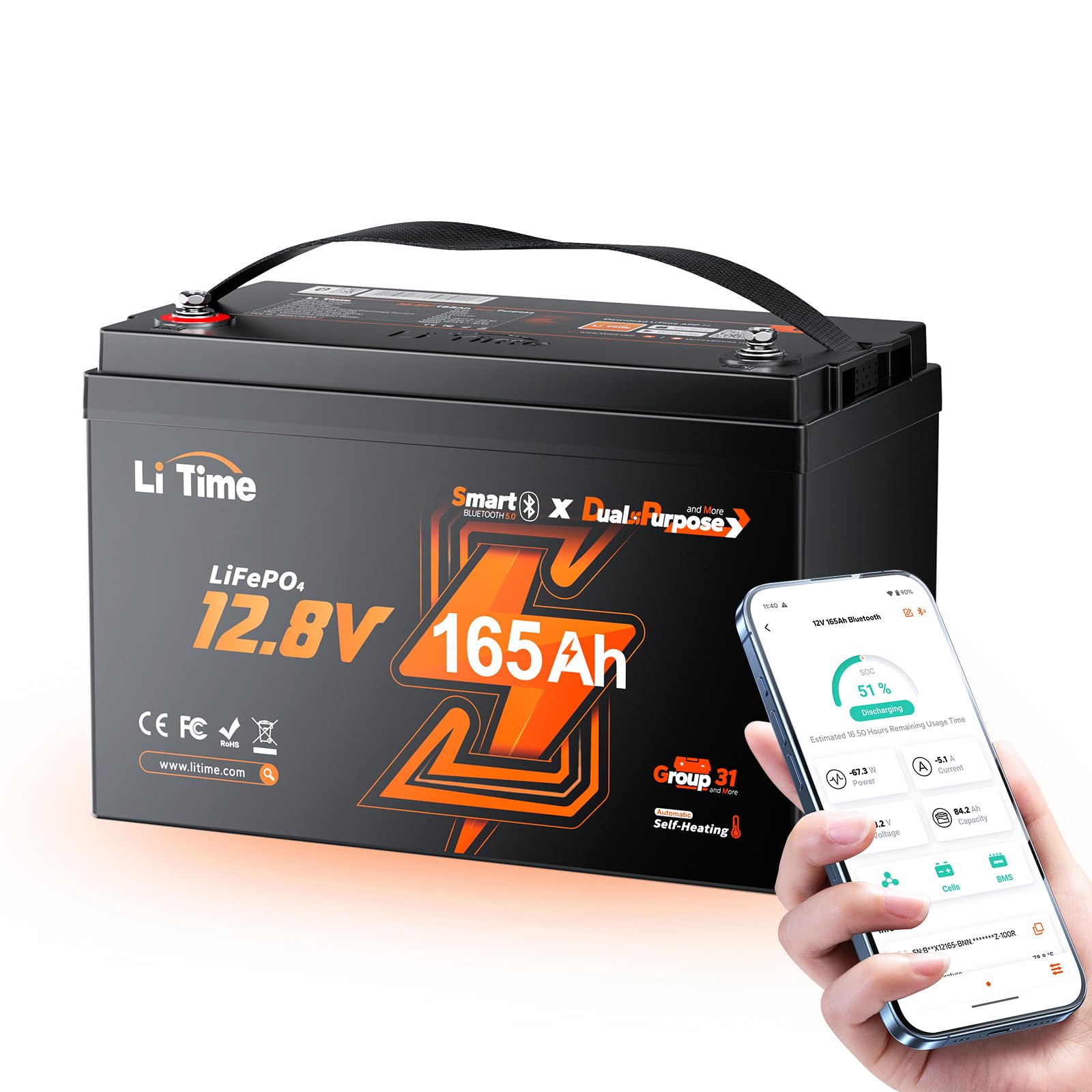
2. Litime 12V 165Ah Dual Purpose Lithium Marine Starting & Storage Battery
The lightest battery here at 33.5 pounds but delivers a massive 1200 CCA — more than any other pick — and runs accessories all day.
This is the lightest battery in the roundup at just 33.5 pounds, yet it delivers a massive 1200 CCA — more than any other battery here. That is enough to spin even a big V6 or V8 outboard in freezing weather. It is a LiFePO4 (Lithium Iron Phosphate) chemistry, which gives you 5000+ starting cycles or 4000+ deep cycles at 100% depth of discharge. Compared to a lead-acid battery’s typical 200-500 cycles, that is a massive lifespan advantage. It also packs 165 amp-hours of storage capacity, so you can run your fish finder, radio, and lights for hours after you kill the motor.
The Litime includes auto-heating technology that activates when the temperature drops below 32°F, warming the battery to 50°F so it can charge normally. It also has built-in Bluetooth 5.0 monitoring via the LiTime app, letting you check the state of charge from your phone. It is ABYC-compliant and fits a Group 31 tray (13 x 6.77 x 8.5 inches). The main hurdle is the upfront investment — this is the most expensive battery here. However, for the boater who wants one battery to do everything and plans to keep the boat for years, the total cost of ownership often comes out lower than replacing lead-acid batteries every few seasons.
Buyers specifically praise how quickly it cranks big outboards in cold weather, and the app gives confidence with real-time status. One potential catch: if your boat’s alternator is a simple old-style regulator, you may need a DC-to-DC charger to top up a lithium battery fully.
Weight and power king: 33.5 pounds with 1200 CCA and 165Ah capacity — no other battery here matches that power-to-weight ratio.
Smart features matter: Bluetooth monitoring and auto-heating turn a battery into a connected system you can trust remotely.
For the serious boater: if you want one battery that starts reliably, powers your electronics, and lasts a decade, this is the one.
Not ideal if: you are on a strict budget or your boat’s charging system is not compatible with lithium without an add-on charger.
3. Interstate Batteries Marine/RV Battery 12V 100Ah 825CCA Dual Purpose (Group 31M)
Gives you 825CCA and 100Ah in one sealed package — 50% more cranking power than the Weize budget pick and a full 43% more storage than Interstate’s own 70Ah 24M.
Interstate Batteries has been a trusted name for decades, and this Group 31M model shows why. It delivers 825 Cold Cranking Amps — a 50% more gap over the 550CCA of the Weize dual-purpose — and a full 100 amp-hours of capacity, which is a 43% more gap over Interstate’s own 70Ah 24M version. That combination means it will spin a large engine easily and then power your lights, livewell pump, and radio for extended periods. It uses pure, non-alloy lead in an AGM construction, which the maker claims lasts 2x longer than conventional alloy AGM batteries and 3x longer than flooded batteries.
That weight comes from the thick lead plates that give it both high cranking power and deep-cycle endurance. It is a dual-purpose design, so you can use it as a single-battery solution for moderate house loads. Buyers with twin-engine setups and large cabin cruisers appreciate the headroom. Interstate backs it with a 2-year free replacement warranty. The trade-off is the size: at roughly 13 inches long, it requires a Group 31M tray — measure your compartment before ordering.
Powerful and versatile: 825CCA and 100Ah in one sealed AGM package gives you starting confidence and hours of accessory runtime.
Heavy but tough: At 64.5 pounds it is a workout to install, but that weight means thick plates that hold up to repeated deep discharges.
Best for: larger boats with a Group 31 tray that need one battery to start a big motor and run moderate electronics.
Skip if: you need to save weight for performance or your battery compartment cannot fit a 13-inch-long battery.
4. OPTIMA® Batteries High Performance D31M BLUETOP® Dual Purpose Deep Cycle and Starting Sealed AGM Boat and RV Battery

The biggest OPTIMA with 900 CCA and a 155-minute reserve — enough to spin a 250hp outboard like a small motor, according to one owner.
This is the flagship of the OPTIMA BLUETOP line. It delivers 900 Cold Cranking Amps and an MCA rating of 1125, making it the highest-cranking SpiralCell battery in this list. For boats with large V6 or V8 outboards, or twin-engine setups, this headroom means every start is instant and confident even in near-freezing weather.
At 59.8 pounds and 12.81 inches long, it is the biggest and heaviest OPTIMA here. It is also the most expensive of the three OPTIMA models. The 9.38-inch height may also be an issue in shallow compartments. Like the other SpiralCell batteries, it is fifteen times more resistant to vibration than flooded batteries and can be mounted in virtually any position except upside down. Buyers who run large offshore boats with multiple electronics suites often use one D31M for starting and a second for house power. One owner mentioned the 900 CCA spins a 250hp outboard like it is a small motor.
Top-tier cranking: 900 CCA and 1125 MCA mean this battery laughs at cold starts on big engines.
Big and premium-priced: At nearly 60 pounds and 12.8 inches long, it demands space and a larger budget.
Best for: large boats with twin engines or a single big block motor where maximum starting power is non-negotiable.
Not for: small boats with limited compartment space or budgets that do not stretch to the flagship price tier.
5. Interstate Batteries Marine/RV Battery 12V 70Ah 750CCA (24M-AGM) Dual Purpose
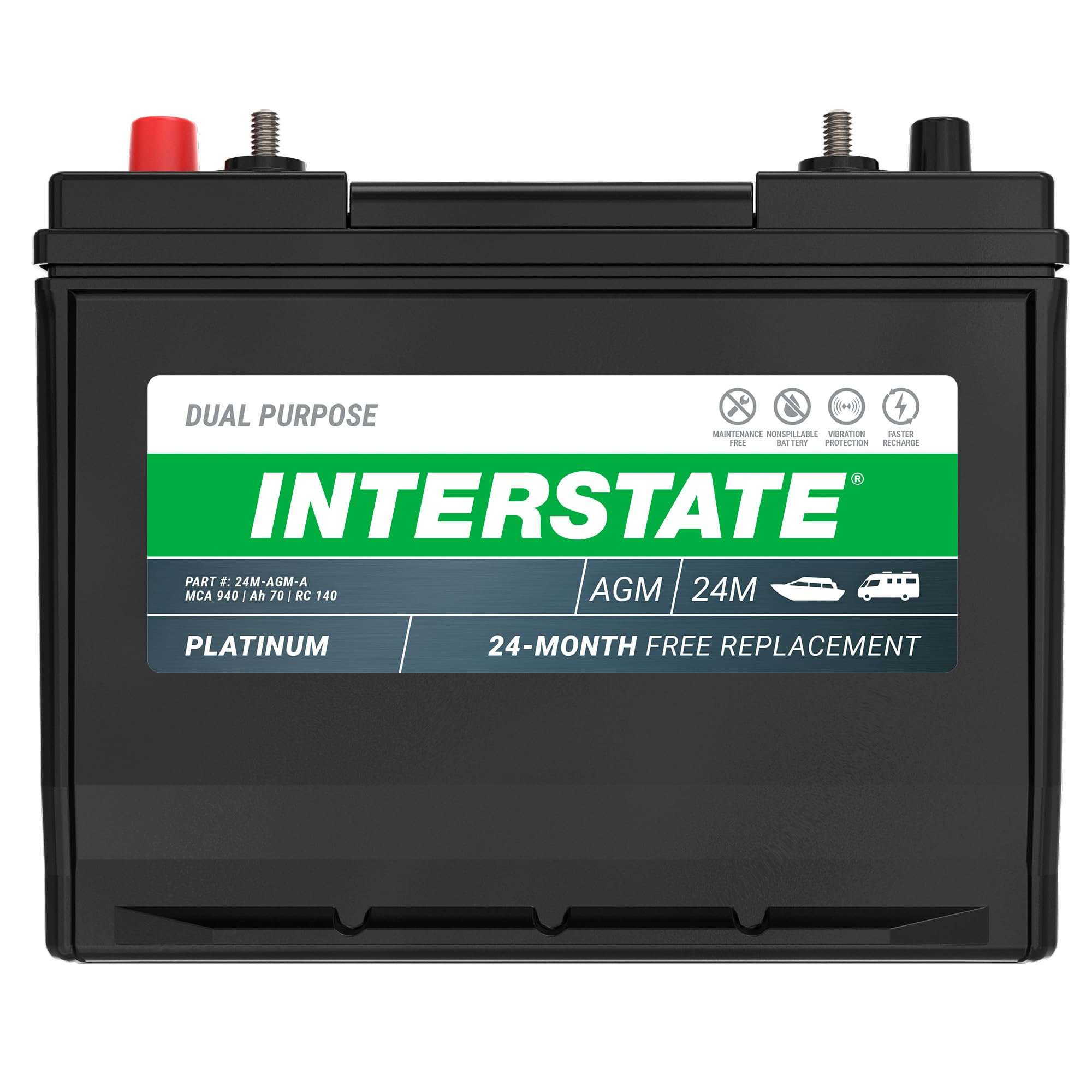
Offers 750 CCA and 70Ah in a Group 24M size that is 20 pounds lighter than the 100Ah Interstate 31M, making it much easier to carry.
Interstate brings its 70-year reputation to this Group 24M pure lead AGM battery. It delivers 750 Cold Cranking Amps and 70 amp-hours of capacity, making it a solid match for mid-size outboards up to around 200hp. At 44.6 pounds, it is nearly 20 pounds lighter than the 100Ah Interstate 31M, making it much easier to carry and install. The pure lead construction is claimed to last 2x longer than conventional alloy AGM batteries and 3x longer than standard flooded batteries.
It is a dual-purpose design, so it can start your motor and also run your depth finder, radio, and lights while you are anchored. The dimensions (11 inches wide, 8.98 inches tall) are standard Group 24M, so it should fit most factory battery trays. Interstate backs it with a 2-year free replacement warranty, which adds confidence. The main trade-off compared to the 100Ah version is that 70Ah is less capacity for long days of electronics use. However, for many weekend boaters, 70Ah paired with 750 CCA is the right balance of power, weight, and price.
Owners mention that it cranks reliably even after a few seasons of use, and the sealed AGM design means no checking water levels or dealing with corrosion on terminals.
Trusted brand, strong CCA: 750CCA in a manageable 44.6-pound package from among the most recognizable battery names in the US.
Less deep-cycle capacity: 70Ah is adequate for modest accessory use but will run short on a full day of heavy electronics.
Best for: the weekend boater with a mid-size outboard who wants a reliable, moderate-weight AGM from a brand they know.
Consider the 100Ah version if: you run a lot of electronics or spend long days on the water without running the engine to recharge.
6. Weize Dual Purpose AGM Battery BCI Group 24M, 550CCA 12V 90AH Sealed Marine & RV Battery
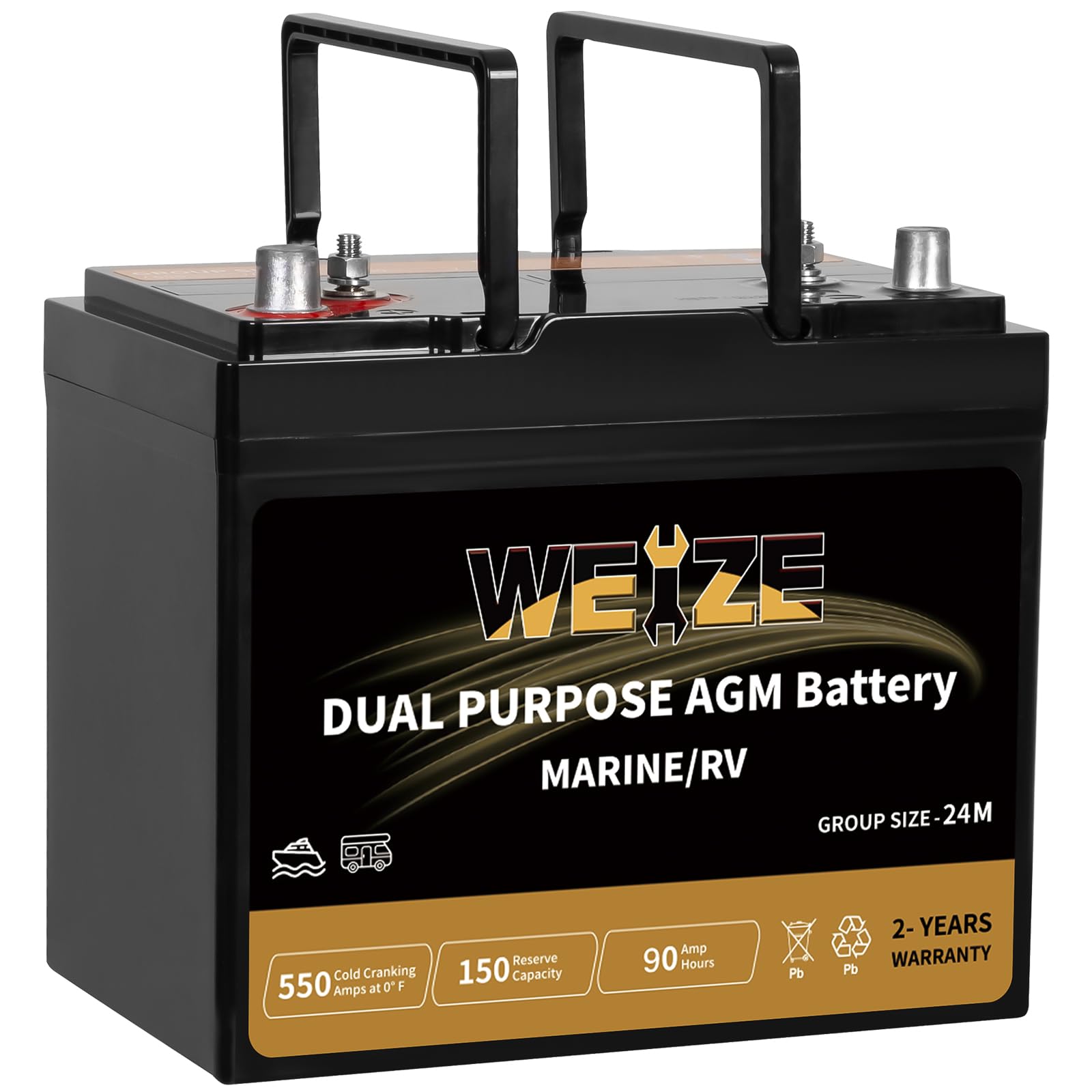
Offers 550CCA and 90AH for less money than most, but that CCA is 50% lower than the Interstate 31M — fine for small motors, not for cold-weather big blocks.
Weize offers the lowest CCA of any battery in this roundup at 550CCA — a 50% less gap compared to the Interstate 31M’s 825CCA. For small outboards up to about 150hp, that is usually enough for reliable starting in mild weather. The key selling point is the 90 amp-hours of capacity in a Group 24M size, which is generous for the price tier. It is a dual-purpose AGM battery, meaning it can handle starting duty and moderate deep-cycle use like powering electronics and lights at anchor.
Weize claims this battery charges up to five times faster than conventional flooded batteries and offers 20 times more vibration resistance. It is backed by a 2-year warranty. At 50.7 pounds, it is heavier than the Interstate 24M (44.6 pounds) but offers 20 more amp-hours of capacity. Customers note that the terminals are SAE/M8 threaded posts, giving you flexible connection options. The main limitation is the 550CCA — if you boat in colder climates or have a large-block motor, you will want more cranking power. For a small aluminum fishing boat or a pontoon with a modest outboard, this is a budget-friendly way to go AGM.
High capacity for the price: 90Ah in a budget-friendly AGM makes it great for boats that need more runtime than cranking power.
CCA is the trade-off: 550CCA is fine for small to mid motors, but not enough for big outboards or cold-weather starting.
Best for: smaller boats with modest outboards where budget is a primary concern, and you value deep-cycle capacity over raw CCA.
skip it if: you run a 200hp+ outboard or regularly start your boat in near-freezing temperatures.
7. UPLUS BCI Group 24M Dual Purpose Marine Battery, 12V 79AH 550CCA AGM
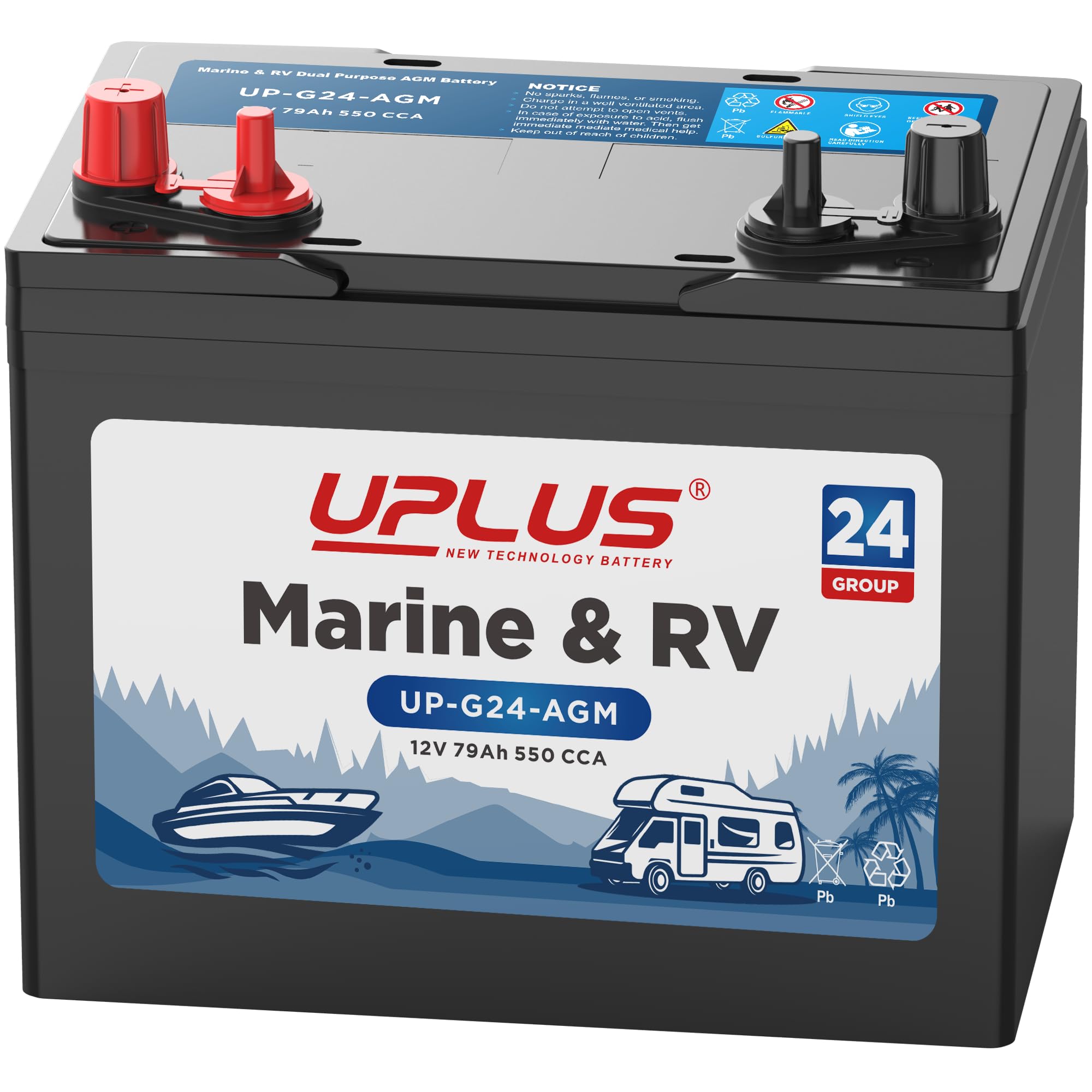
Matches the Weize on 550CCA but holds 11 fewer amp-hours and stands nearly an inch taller — a tight-fit issue for low-deck hatches.
UPLUS targets the same budget-conscious buyer as Weize with identical 550CCA and 50.7-pound weight. The difference is capacity: 79 amp-hours vs Weize’s 90Ah, and a taller case at 9.17 inches compared to the Weize’s 8.19 inches. That extra height (a 15% more gap) could be the deciding factor if your battery tray has a low top cover. UPLUS says this battery can start engines up to 350hp, which seems optimistic for 550CCA — most boaters find 550CCA suits outboards up to about 150-175hp in moderate climates.
It uses thicker full-frame cast plates for durability and a sealed AGM design that resists vibration from wave pounding and trailering. UPLUS offers a 2-year warranty with a 60-day refund window, and the company has a US-based office and warehouse in California with local after-sales support. The dual-purpose design saves space by combining starting and deep-cycle functions. For a boater on a tight budget with a small to mid-size engine, this gets you an AGM battery with modern features at an entry-level price. Just be aware that the 550CCA and 79Ah mean it is best suited for modest power needs.
Buyers with small fishing boats and pontoons say it fires up reliably and holds a charge well between trips.
Same CCA, less capacity: 550CCA like the Weize, but 79Ah instead of 90Ah, so slightly less runtime for accessories.
Watch the height: At 9.17 inches tall, it may not fit under low deck hatches where shorter batteries will.
Best for: budget-minded boaters with small outboards who need an AGM battery and do not mind the slightly taller case.
Choose the Weize instead if: you need the extra 11Ah of capacity or your tray has a tight vertical clearance.
Understanding the Specs
Cold Cranking Amps (CCA) vs. Marine Cranking Amps (MCA)
CCA measures how many amps a battery delivers at 0°F for 30 seconds. MCA (Marine Cranking Amps) measures the same thing but at 32°F, which is more relevant for most boating conditions. MCA ratings are always higher than CCA for the same battery. When comparing batteries, use CCA for cold-weather confidence and MCA as a warmer-weather reference. A good rule: match or exceed your engine manufacturer’s minimum CCA recommendation.
Reserve Capacity (RC) and Amp-Hours (Ah)
Reserve Capacity is the number of minutes a fully charged battery can run a 25-amp load before dropping below 10.5 volts. Amp-hours (Ah) at the 20-hour rate (C20) tells you how much total energy the battery stores. For a dual-purpose battery, higher RC means more time running electronics after the engine is off. If you run a trolling motor or livewell pump for hours, aim for at least 80Ah or 120+ minutes RC.
FAQ
What is the difference between a starting battery and a deep cycle battery?
How many CCA do I need for my boat motor?
Can I use a car battery in my boat?
What does BCI Group Size mean and why does it matter?
How long does a marine starter battery last?
Can I install a lithium battery as a direct replacement for my AGM battery?
What is the difference between AGM and flooded marine batteries?
Do I need a battery box for my marine battery?
Final Thoughts: The Verdict
For most boaters, the marine starter battery winner is the Interstate 31M-AGM 100Ah because it delivers 825CCA and 100Ah in a trusted AGM package that handles both starting and moderate house loads. If you want the absolute lightest battery with the highest CCA and longest lifespan, grab the Litime 165Ah Lithium. And for a compact, vibration-proof battery in tight spaces, the OPTIMA 34M BLUETOP is the top choice.
How We Picked
We do not accept paid placement. Every pick is matched to a real buyer and a real use-case; we do not hands-on test units.
Sources & Methodology
Specifications: manufacturer listings and product documentation. Review insights: verified customer reviews, as of July 2026. Pricing: not shown on this page (it changes often); check the current price via the retailer link.
As an Amazon Associate, Trending Car earns from qualifying purchases. This does not affect which products we feature.