
Our readers keep the lights on and my garage snacks stocked. As an Amazon Associate, I earn from qualifying purchases.
Specs are compiled from manufacturer listings and verified buyer reviews and can change over time — please confirm the key details on the product page before buying.
Handing the keys to a new driver is nerve-wracking. You wonder if they’re braking hard, taking corners too fast, or glancing at their phone when they should be watching the road. A dash cam doesn’t just capture a fender-bender — it teaches responsibility and gives you concrete answers when something happens. This guide breaks down the specs that actually matter for a teenage driver, so you pick a camera that protects them without feeling like a parole officer watching from the back seat.
I’m Min Islam — the founder and writer behind Trending Car. This guide is built by comparing the manufacturers’ published specifications and the patterns across verified customer reviews, so you get each pick’s real strengths and trade-offs instead of marketing spin.
Here are the smartest choices for a dash cam for teenage drivers, focused on reliable evidence, easy setup, and features that guard against the most common new-driver mistakes.
Our Picks at a Glance
How To Choose The Best Dash Cam for Teenage Drivers
A dash cam for a new driver needs to be more than just a camera. You want reliable recording, easy app access so you can spot-check driving habits, and a parking mode that protects the car when it’s parked at a school lot. Here are the features that separate a useful safety tool from a gadget that just collects dust on the windshield.
Channels: Why Three Is Better Than Two
A single-channel cam (front only) captures what’s ahead, but a 3-channel system adds a cabin-facing camera. That cabin view is your window into distractions — a quick glance at a phone or a back-seat passenger acting up. For a teenage driver, three channels give you the full story of any incident.
Parking Mode: Protection When They’re Not Driving
Parking mode records motion or collisions when the car is off. A teen might park in a busy lot at school or a friend’s house. Buffered recording (saving a few seconds before an impact) means you catch the whole event, not just the aftermath. Most cameras need a hardwire kit for this, so budget for a small extra installation cost.
Night Vision and Low-Light Performance
Teens often drive at night — part-time jobs, late study groups, or weekend hangouts. A dash cam with a STARVIS 2 sensor and a wide aperture (like F1.6 or F1.8) captures clear license plates and road details even in dim streetlight. Without this, night footage looks like a blurry mess when you need evidence most.
Quick Comparison
| Model | Best For | Channels | Front Resolution | Max Storage | Amazon |
|---|---|---|---|---|---|
| REDTIGER 4K Dual★ Best Overall | Mid-Range Dual Cam | 2 | 4K | 512 GB | Amazon |
| Vantrue N5SMaximum Coverage | Total 360° Coverage | 4 | 2.7K | 1 TB | Amazon |
| VIOFO A329S | Ultra-Smooth Footage | 2 | 4K 60FPS | 4 TB SSD / 512 GB microSD | Amazon |
| ROVE R2-4K Dual PRO | Premium Dual-STARVIS 2 | 2 | 4K | 1 TB | Amazon |
| 70mai T800E | 3-Channel with Wi-Fi 6 | 3 | 4K | 512 GB | Amazon |
| TERUNSOUl 4K 3-Channel | Budget 3-Channel with 128GB Card | 3 | 4K | 512 GB | Amazon |
| Virrow X5 | Entry-Level with Included 64GB | 2 | 4K | 256 GB | Amazon |
In‑Depth Reviews
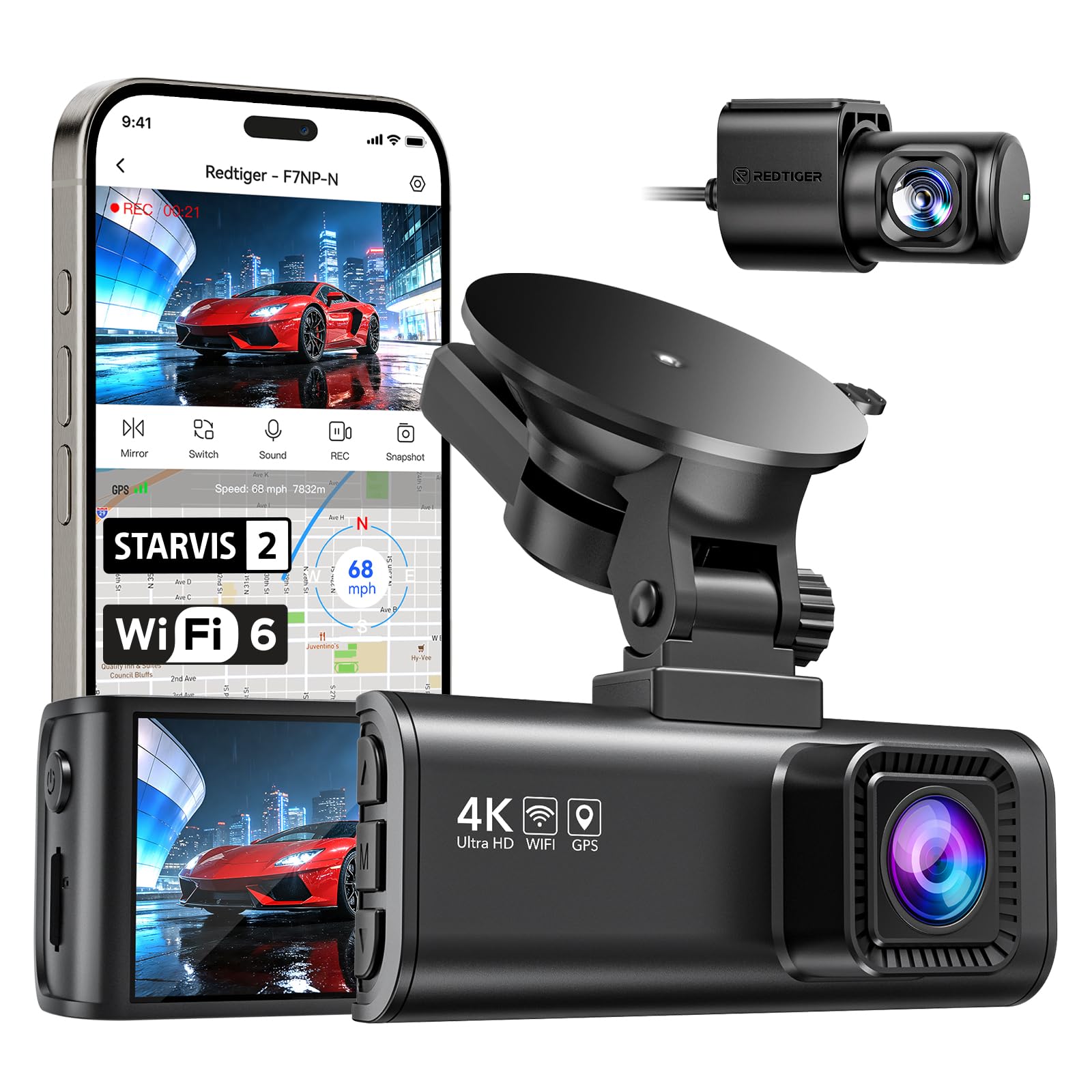
1. REDTIGER Dash Cam 4K Front and 1080P Rear
Our pick — over 4★ from 25,000+ verified ratings; the strongest balance of quality and price.
A proven front-and-rear setup from a trusted brand, backed by over 25,000 ratings.
REDTIGER is a household name in the dash cam world, and this model shows why. It records 4K on the front camera using a STARVIS 2 sensor, and 1080P on the rear. The 170° wide-angle front lens and rear lens give broad coverage for capturing road signs and cross-traffic from both ends. The HDR and WDR technology balance exposure between bright sunlight and dark shadows, so license plates do not wash out in harsh light. The built-in 5.8GHz Wi-Fi connects to the Redtiger Cam app for instant viewing and downloads up to 20MB/s.
You get proven reliability from a large user base: 25,325 ratings and a 4.2 out of 5 score — the biggest review sample in this guide. Buyers consistently mention clear daytime footage and easy video retrieval through the app. Loop recording automatically overwrites old footage that is not locked, while the G-sensor (a small motion sensor that detects a bump) instantly locks event videos when it feels a sudden impact. Parking mode offers two smart formats: time-lapse recording to capture long periods in space-saving frames, or impact detection that triggers emergency recording when a collision happens while parked.
One downside is the 0.25-pound weight — light but feels less premium than the VIOFO or ROVE. The supercapacitor (a component that stores energy without a chemical battery) offers better heat resistance and safety than a lithium battery, making it suitable for hot cars. The 18-month warranty provides confidence. Note that an SD card is not included, unlike many picks here.
Why It’s Trusted
- Over 25,000 ratings on Amazon show proven real-world reliability and user satisfaction
- STARVIS 2 sensor with HDR and WDR delivers dependable footage in changing light conditions
- Two smart parking modes (time-lapse and impact detection) cover different monitoring needs
The Limitations
- No cabin camera — this is strictly a front and rear setup
- No SD card included — you must budget for a separate purchase
- Only 2-channel coverage limits evidence to forward and rear events
The safe bet for a teenager’s first car: If you want a reliable dual-cam with a proven track record and solid app support, the REDTIGER is the most tested option here.
Not the one for cabin monitoring: Without an interior camera, you will miss the view of your teen’s driving habits and back-seat distractions.
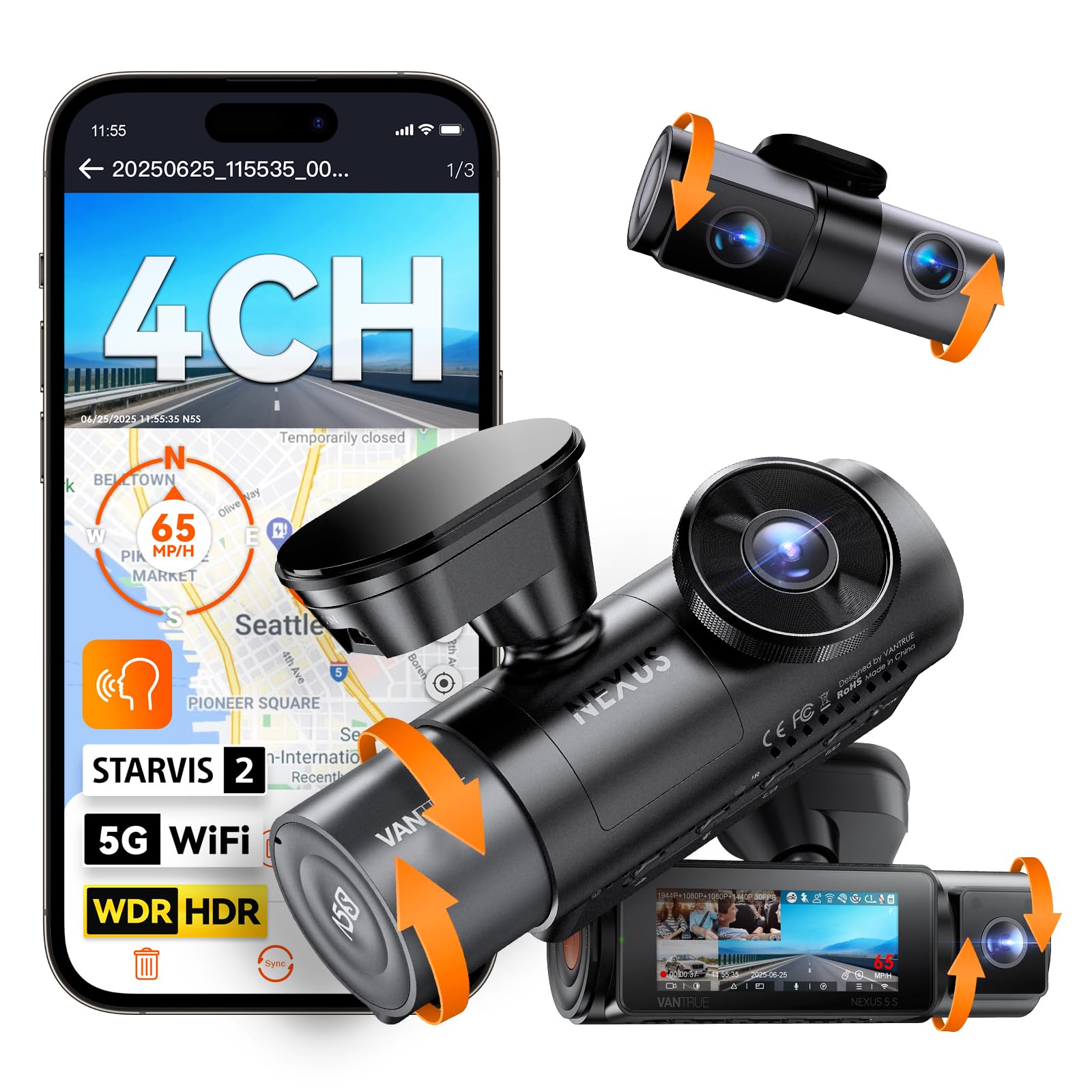
2. Vantrue N5S 4 Channel 360 Degree 2.7K Dash Cam
Four lenses, zero blind spots — the closest thing to a security blanket for your teen’s car.
This is the coverage king because it records in 4 channels — 2.7K front, 1080P (cabin and left/right), and a 1440P rear camera. That means you see every angle: what’s ahead, the back seat, and both side windows. For a teenage driver, the cabin camera is the real win. It catches texting, rowdy friends, or a distracted glance — all in clear detail thanks to the STARVIS 2 sensors across all four cameras. Unlike many two-channel cams, you are not guessing what happened inside the car during an incident.
The 24/7 buffered parking mode is a trump card for when the car sits in a school lot. It records 10 seconds of footage before any motion or collision event, so you see the full scene — not just the aftermath. Buyers report that the advanced HDR processing helps capture license plates clearly even at 20 MPH in mixed lighting. The main catch is the price, and you will need a separate hardwire kit (ASIN B083XB8T7T) for parking mode. But if your budget stretches, this is the only camera that gives you a complete picture of every trip.
The built-in dual-system GPS and 5GHz Wi-Fi make checking your teen’s route easy through the Vantrue App. You can see the exact location, speed, and a mileage report. The supercapacitor design handles extreme temperatures, from -4°F to 140°F, so it won’t fail in a hot car or a freezing winter.
what separates it
- 4-channel 360-degree coverage eliminates all blind spots — front, rear, cabin, and side views
- All four cameras use STARVIS 2 sensors for superior night vision — 100% higher low-light performance than standard STARVIS
- Buffered parking mode records 10 seconds before an impact event, capturing the full scene
The Trade-Offs
- Premium price point — the highest on this list
- Requires a separate hardwire kit for parking mode functionality
- Complex installation due to four separate camera runs
Perfect for the over-protective parent: If you want total visibility into every drive and every moment the car is parked, this is the only camera that gives you 360-degree evidence.
Harder sell for tight budgets: The installation complexity and hardwire kit requirement mean a higher overall cost that might not suit a low-mileage new driver.
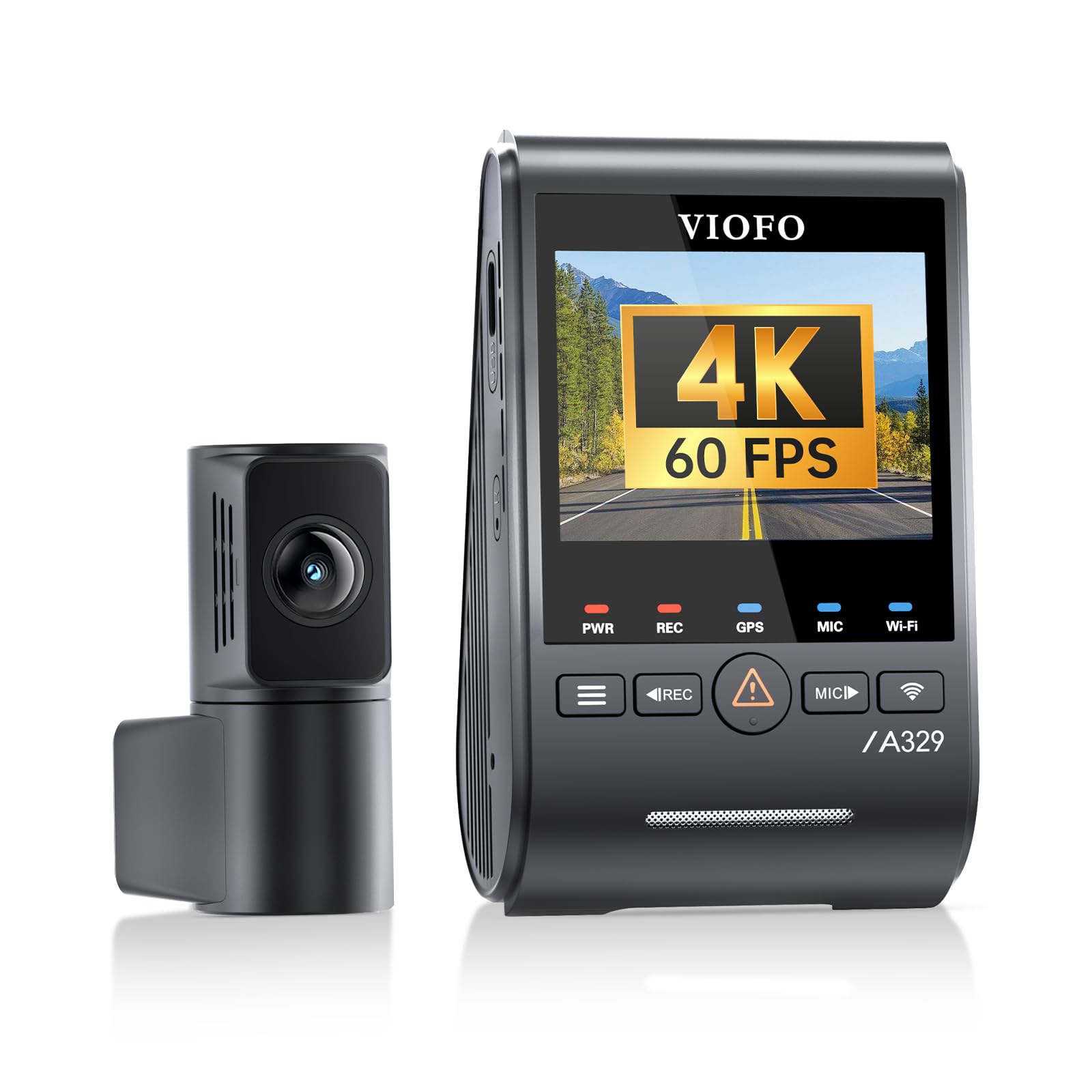
3. VIOFO A329S 4K 60FPS Dash Cam Front and Rear
Buttery-smooth 60 frames per second front footage that freezes every detail of a fast-moving teen.
Most dash cams record at 30 FPS (frames per second). The VIOFO A329S doubles that to 60 FPS in 4K on the front, meaning motion blur is almost non-existent — crucial when a teenager swerves or brakes abruptly. The rear camera records at 2K, keeping the same quality. It uses dual STARVIS 2 sensors (IMX678 front, IMX675 rear), which makes low-light footage exceptionally clear. Owners mention that the 2-channel HDR feature balances bright headlights against dark backgrounds so license plates are readable even in fast-moving scenarios.
This is a 2-channel system (front and rear), so unlike the 3 and 4-channel options above, it does not cover the cabin. That might be fine if you trust your teen but want rock-solid driving evidence. The power-saving parking mode is a standout — it uses an ultra-low-power setting that waits to detect an impact before waking up, which minimizes battery drain. The Wi-Fi 6 transfer is fast, reaching up to 30MB/s. Customers note they can download a 1-minute 4K video in under 10 seconds through the app.
The biggest perk for long road trips is the support for up to a 4TB external SSD or a 512GB microSD card. That is over three weeks of continuous recording before any loop overwrite. The built-in GPS module taps into four satellite systems (GPS, BeiDou, Galileo, GLONASS) to embed precise location and speed data directly into the footage.
The Edge It Holds
- 4K 60FPS front recording provides the smoothest, clearest footage for capturing sudden events
- Supports up to 4TB external SSD for uninterrupted recording on long trips
- Two-channel HDR with Starvis 2 sensors captures license plates even in fast motion
Where It Falls Short
- No cabin camera — you can’t see what your teen is doing inside the car
- Premium price point may feel like overkill for a low-mileage new driver
- 4K 60fps mode disables HDR, so you have to choose between smooth motion or balanced lighting
Pick this for clarity over coverage: If your top priority is reading a license plate from a fast-moving vehicle in a legal dispute, this is the sharpest evidence-gatherer on the list.
Not the one for cabin monitoring: Without a third interior camera, you miss the one view that tells you if a distraction caused the accident.
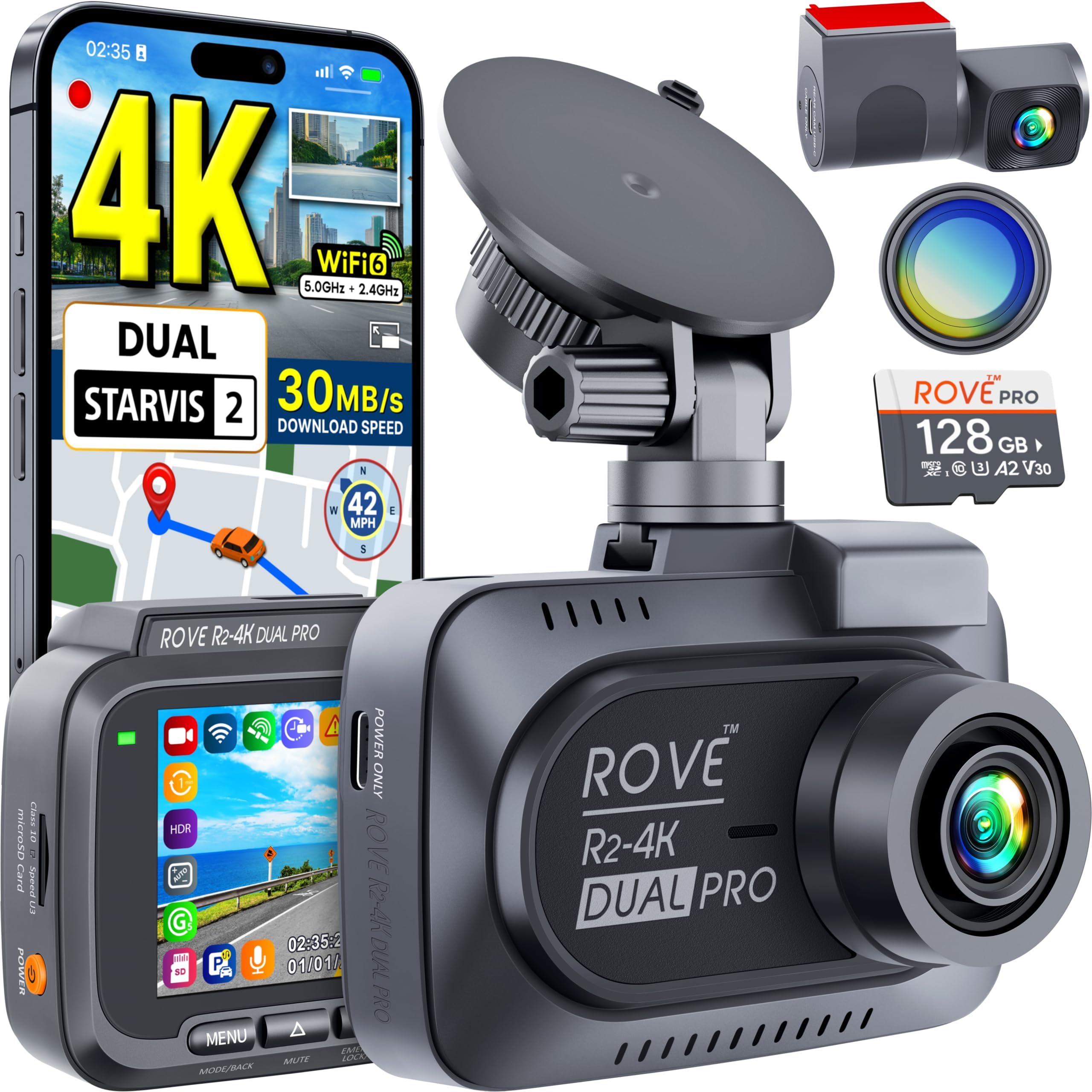
4. ROVE R2-4K Dual PRO Dash Cam Front and Rear
Sony’s latest Starvis 2 sensors in front and rear mean night footage that feels like day.
The ROVE R2-4K Dual PRO combines a 4K front camera (powered by Sony’s IMX678 sensor) with a 2K rear camera (IMX675 sensor). Both are the latest STARVIS 2 generation, delivering higher light sensitivity and less motion blur than standard STARVIS sensors. The front lens aperture is F1.7, and the rear is F1.55 — both wide openings that let in plenty of light, so night driving captures license plates without the grain typical of cheaper cams. The 150° front and 140° rear ultra-wide angles cover most of the surroundings without the fisheye distortion some cameras introduce.
One of the smartest features for a parent is the 24-hour parking mode with voice alerts. When the car is parked, the camera records in 3 modes: 1FPS time-lapse, motion detection, or collision detection. If an impact happens, it locks a 1-minute event video and says a voice alert the next time the engine starts. That way, your teen knows if a hit-and-run happened while the car was at the mall. The ROVE App has Wi-Fi 6 with up to 30MB/s download speeds, so you can offload video fast without pulling the SD card. The kit includes a 128GB ROVE PRO microSD card and a CPL (circular polarizing lens) filter to kill windshield glare — saving you from buying those extras separately.
The quad-mode GPS (GPS, BeiDou, Galileo, GLONASS) gives accurate route and speed data, which you overlay on footage using the free ROVE Dash Cam GPS Player. That is direct evidence if you are disputing a ticket or proving your teen was not speeding. It supports up to 1TB microSD cards for long recording times.
Why It Stands Out
- Dual STARVIS 2 sensors (IMX678 + IMX675) provide the top-tier low-light performance for both cameras
- Includes a free 128GB microSD card and CPL filter — no extra purchases needed to get started
- Intelligent parking mode with voice alert notifies your teen if an incident happened while parked
What It Lacks
- No cabin camera — you lose the view of what your teen is doing inside the vehicle
- Mid-premium price point is an investment for a first car
- Parking mode requires a separate hardwire kit (sold separately)
Grab this for the best night vision: If your teen drives home late from jobs or evening sports, the dual Starvis 2 sensors provide the most reliable nighttime evidence in this lineup.
skip it if cabin monitoring is essential: With only two channels, you will need an additional separate camera if you want to see the driver’s behavior.
5. 70mai 4K Dash Cam Front and Rear Inside (T800E)

Three-channel coverage plus a cabin-facing IR camera to watch for distracted driving in the dark.
The 70mai T800E records 4K on the front camera, with 1080P for both the interior and rear cameras. The interior camera has switchable infrared (IR) recording, so you can see the cabin clearly even in pitch black. That is a huge deal for parents — if your teen is driving at night, you can see if they are looking at the road or at a phone. The front camera uses an F1.55 aperture which pulls in more light than many rivals. The HDR imaging and 3D noise reduction ensure that license plates stay sharp even in low light.
The Wi-Fi 6 connection is the fastest standard on this list, offering file transfer speeds up to 10 MB/s. That is five times faster than standard Wi-Fi 4, according to the maker. You can also control the camera by voice — commands like “take photo” or “lock video” work without hands leaving the wheel. This is a neat safety feature for a young driver. The 70mai App is user-friendly for pulling footage. The kit includes a 64GB SD card, but it supports up to 512GB for those who want more storage. Reviewers point out that installation is straightforward with the included adhesive mount and plug-and-play setup.
The supercapacitor design means it handles extreme temperatures from 14°F to 140°F without the swelling or failure risks of a lithium battery. This is essential if your teen’s car sits in summer heat. Parking monitoring works through a G-sensor, automatically locking footage when it detects an impact or motion while the car is off. A hardwire kit is needed for 24/7 parking mode.
Best Features
- 3-channel setup with a switchable IR interior camera — perfect for monitoring nighttime driving habits
- Wi-Fi 6 delivers up to 5x faster file transfers than standard Wi-Fi 4
- 5-mode built-in GPS provides precise location, speed, and route tracking for every trip
Possible Downsides
- Included 64GB SD card is modest; you will likely want a larger card for 4K 3-channel recording
- Does not support 4G connectivity for remote live viewing
- App experience can vary based on phone compatibility
Excellent for hands-off monitoring: The voice control and IR cabin camera make it easy for a teen to use and for a parent to review, all without taking hands off the wheel.
Needs a larger storage card: The 64GB card fills up fast with 4K tri-channel recording, so budget for a bigger microSD card soon.
6. TERUNSOUl 4K 3 Channel Dash Cam Front and Rear
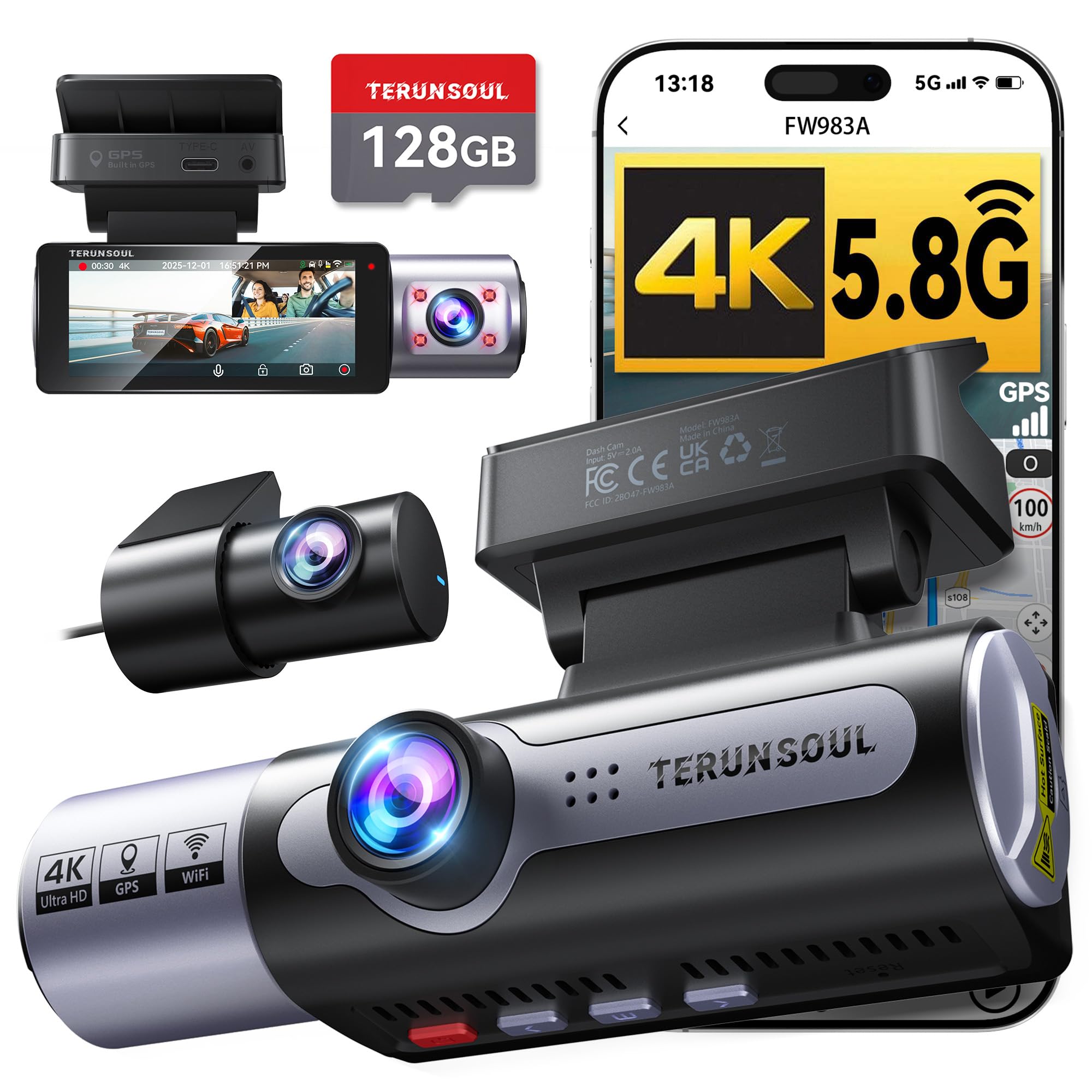
Three channels of recording for a price that undercuts most dual-cams — and the memory card is free.
This dash cam records in UHD 4K on the front camera, 1080P on the rear camera, and 1080P on the cabin camera. That is a full 3-channel setup at a mid-range price, including a pre-installed 128GB memory card. The front camera has a 170° ultra-wide angle, while both the rear and cabin cameras offer 165° wide angles. That creates near 360-degree panoramic coverage around the car and inside the cabin. For a parent, that cabin camera is the most important piece — it sees the driver’s behavior and any passengers in the back.
The collision sensor automatically locks footage when a severe impact is detected, and the loop recording feature overwrites the oldest non-critical footage to keep the card from filling up. The built-in high-precision GPS records driving routes, real-time speed, location, and a compass. You can review GPS-tagged footage on a computer via the free GPS player. The 5.8GHz Wi-Fi connects to the TERUNSOUl App for instant previewing and downloads up to 20MB/s. The starlight night vision, powered by a premium five-layer lens and an F1.6 aperture with HDR, works well in low light — comparable to the REDTIGER above but with a wider F1.6 aperture vs F1.8.
The main limitation is no included parking mode functionality without a separate hardwire kit (ASIN B0G4LLMKG8). The support for up to a 512GB microSD card gives plenty of room for growth. Buyers give this a 4.6 out of 5 rating from 242 reviews, noting the value proposition of a 3-channel system with a free memory card.
The Bang-for-Buck
- 3-channel (front, rear, cabin) coverage at a mid-range price point, making it the best value multi-channel pick
- Comes with a free 128GB memory card ready to use from the start
- Starlight night vision with F1.6 aperture delivers clear low-light footage without paying a premium
The Savings Trade-Off
- Supports up to 512GB microSD — less than the ROVE or Vantrue’s 1TB support
- No included parking mode functionality without buying a separate hardwire kit
- Brand has a smaller presence than 70mai or REDTIGER, which might affect future app support
Perfect for value-conscious parents: If you want three channels of recording and do not want to buy a memory card separately, this is the most cost-effective entry point for full cabin monitoring.
Not ideal for long-term parking: If you need parking monitoring from day one, factor in the hardwire kit cost and installation complexity.
7. Virrow X5 4K+2.5K Dual Dash Cam Front and Rear
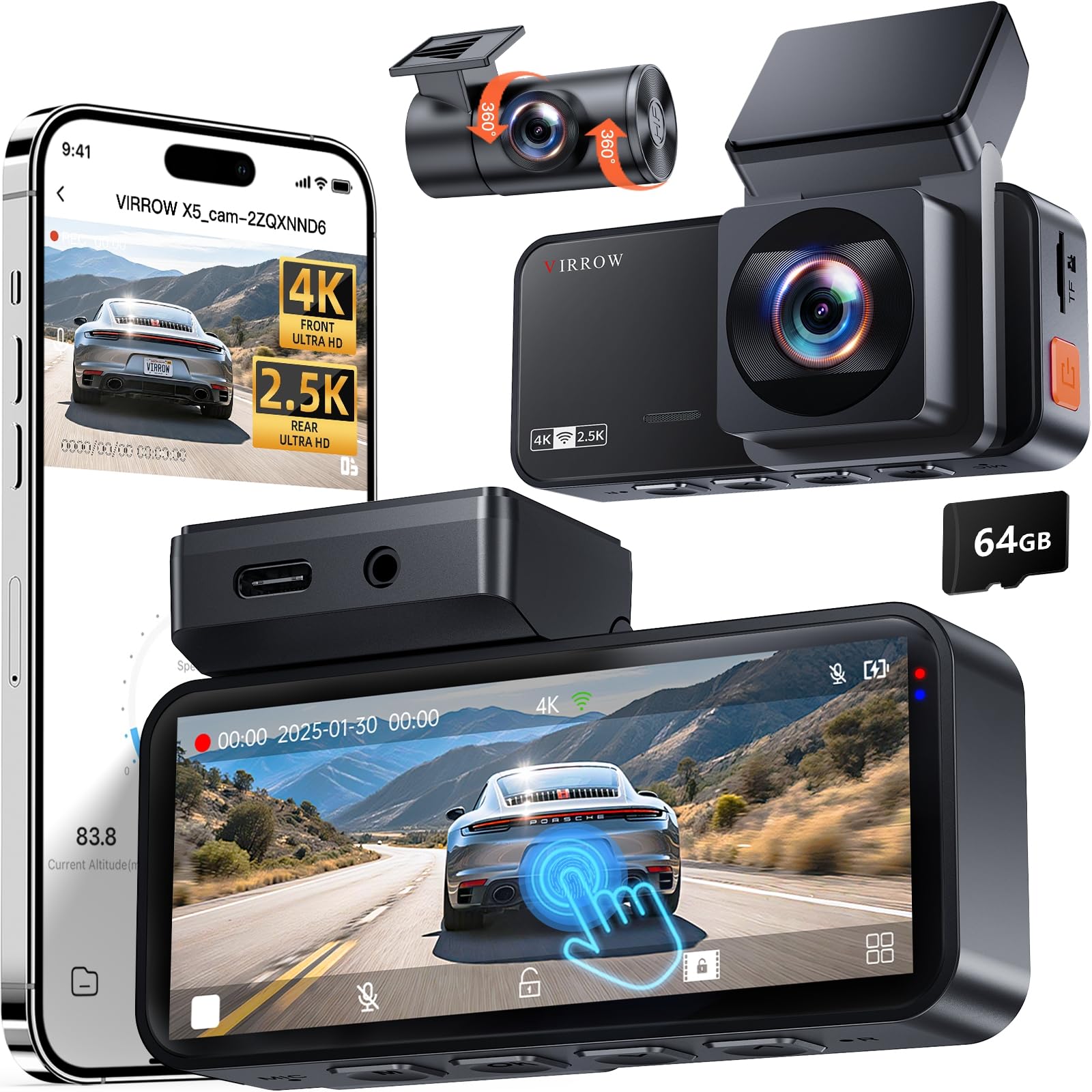
4K front and 2.5K rear plus a free 64GB memory card — ready to record in under 10 minutes.
The Virrow X5 delivers a 4K front camera and a 2.5K rear camera — a noticeably sharper rear picture than the 1080P rear cameras on many budget dual-cams. The front lens has a 170° ultra-wide field of view, which is 3% wider than some comparable options like the TERUNSOUl that offers 165°. The rear camera has a 165° wide angle. The 3.39″ touchscreen is larger than many displays in this price range, making it easier for a teen to navigate settings or review footage without pulling out a phone. The built-in G-sensor automatically locks footage when a collision is detected, storing it in a protected folder to prevent overwriting.
This is the most budget-friendly option here, and it comes with a free 64GB memory card so you do not need to buy anything extra. The night vision uses an F1.8 aperture and a 6-layer lens combined with SC2336 sensor and WDR tech. Shoppers say that this setup works well enough for suburban streetlights and well-lit parking lots, though it won’t match the STARVIS 2 sensors on the VIOFO or ROVE models in pitch-dark conditions. The 24/7 parking guard includes a time-lapse mode that condenses 24 hours into minutes, saving memory — though a hardwire kit (sold separately) is required for continuous use.
The 18-month warranty is standard for this category. The kit includes an electrostatic film for easy windshield installation without leaving sticky residue. One limitation is the maximum supported flash memory of 256 GB — that is half the 512 GB limit of the REDTIGER and a big gap compared to the 1 TB support of the ROVE and Vantrue models.
The Entry-Level Wins
- 4K front + 2.5K rear provides noticeably sharper rear footage than 1080P alternatives at this tier
- Free 64GB memory card included — no need to buy accessories separately
- Large 3.39″ touchscreen makes on-camera review and settings changes easy for a teen
The Trade-Offs
- Maximum flash memory supported size is 256 GB — significantly less storage headroom than the ROVE (1 TB) or Vantrue (1 TB)
- No cabin camera — this is only a front and rear system
- Budget-tier sensor may struggle with license plate capture in very low light compared to STARVIS 2 models
Best for a tight budget: If you need a reliable dual-cam with a sharp rear view and cannot stretch the budget further, the included 64GB card makes this a true plug-and-play solution.
Limited upgrade path: The 256 GB max storage limit means you cannot run high-resolution recording for long periods without overwriting, so plan to offload footage regularly.
Understanding the Specs
3-Channel vs 2-Channel
A 2-channel dash cam (front and rear) records what is ahead and behind the car. A 3-channel system adds a third camera that points inside the cabin. For a teenage driver, that cabin camera is the most valuable piece. It catches phone use, distracted passengers, or drowsy driving. Without it, you only know what happened outside the car, not why it happened.
STARVIS 2 Sensor
STARVIS 2 is Sony’s latest sensor technology for dash cams. It is much more sensitive to light than the original STARVIS, meaning it records clearer footage in dark conditions — like a residential street at midnight without streetlights. If your teen drives at night, look for a dash cam that specifically mentions “STARVIS 2” or “Starvis 2” in the specs; it will capture readable license plates instead of dark blurry shapes.
FAQ
Will a dash cam drain my teenager’s car battery if left in parking mode?
Can I see my teen’s driving history without taking out the memory card?
What is the difference between a supercapacitor and a battery in a dash cam?
How much storage do I need for continuous 4K recording?
Is it legal to have a camera pointed inside the car at my teenage driver?
What size microSD card should I buy for a dash cam?
How does the G-sensor work in protecting evidence?
Can I install the dash cam myself, or do I need professional help?
What does loop recording mean and why does it matter?
Final Thoughts: The Verdict
For most parents, the dash cam for teenage drivers winner is the Vantrue N5S because its 4-channel 360-degree coverage and cabin-facing camera give you total visibility into every aspect of your teen’s driving — including distractions and passenger behavior. If you want ultra-smooth 4K 60FPS footage (60 frames per second, so fast movement stays sharp) for irrefutable evidence of speed and movement, grab the VIOFO A329S. And for the best value in a 3-channel system with a free memory card, the TERUNSOUl 4K 3-Channel is the budget pick.
How We Picked
We do not accept paid placement. Every pick is matched to a real buyer and a real use-case; we do not hands-on test units.
Sources & Methodology
Specifications: manufacturer listings and product documentation. Review insights: verified customer reviews, as of July 2026. Pricing: not shown on this page (it changes often); check the current price via the retailer link.
As an Amazon Associate, Trending Car earns from qualifying purchases. This does not affect which products we feature.