
Our readers keep the lights on and my garage snacks stocked. As an Amazon Associate, I earn from qualifying purchases.
Specs are compiled from manufacturer listings and verified buyer reviews and can change over time — please confirm the key details on the product page before buying.
That grinding sound when you turn the key after a long day on the trail means one thing — your battery gave out before you did. Off-road batteries need to survive deep discharges from your winch, fridge, and lights, then still have enough juice to crank a cold engine the next morning. A standard car battery will die fast under that abuse; a true dual-purpose or deep-cycle unit handles the punishment and keeps you moving.
I’m Min Islam — the founder and writer behind Trending Car. This guide is built by comparing the manufacturers’ published specifications and the patterns across verified customer reviews, so you get each pick’s real strengths and trade-offs instead of marketing spin.
After digging into the specs and owner experiences, these eight batteries stand out as the best current contenders for anyone searching for a reliable off-road battery to power their rig through serious terrain and long trips.
Our Picks at a Glance
How To Choose The Best Off-Road Battery
Picking the wrong battery for off-road use usually means getting stuck twice — first in the mud, then with a dead battery. Here is what actually matters for a rig that sees dirt, rocks, and long idle periods with electronics running.
Dual Purpose vs Deep Cycle vs Starting
You need a battery that can start your engine AND run your accessories. A pure starting battery (high CCA, low reserve) will die quickly if you drain it running a winch or a cooler. A pure deep-cycle battery (high Ah, low CCA) might not crank a cold V8. A dual-purpose battery does both — it delivers the cranking amps to start your rig and the deep-cycle endurance to power your gear.
Cold Cranking Amps (CCA) and Reserve Capacity (RC)
CCA tells you how much starting power the battery has in cold weather. For a typical off-road rig, 550 to 800 CCA is a safe range. Reserve Capacity (RC) tells you how many minutes the battery can run essential electronics if the alternator fails. Higher RC means more time to winch or drive out with your hazards on.
Weight and Chemistry: AGM vs LiFePO4
AGM (Absorbed Glass Mat) batteries are heavy, tough, and spill-proof. They handle vibration well and cost less upfront. A typical AGM in Group 24 size weighs around 50 pounds. Lithium LiFePO4 batteries weigh about half that — around 22 pounds for the same 100Ah capacity — and last many more cycles. The trade-off is price and charging. Lithium costs more and needs a compatible charger (14.4–14.6V CC/CV profile). It also cannot be charged below 32°F (0°C), which is a big deal for winter off-roaders.
Group Size and Physical Fit
You must match the BCI group size to your vehicle’s battery tray. Group 24 and Group 24M are common in trucks and SUVs. Group 31 is larger and fits some heavy-duty trucks. Measure your tray dimensions before buying — a battery that is too tall or too wide will not secure properly and can be damaged by vibration.
Quick Comparison
| Model | Best For | Type | Capacity | CCA | Amazon |
|---|---|---|---|---|---|
| Mighty Max MM-G24M★ Best Overall | Best Overall AGM | AGM | 90Ah | 550 | Amazon |
| Litime 12V 100Ah LiFePO4Best Overall Lithium | Best Overall Lithium | LiFePO4 | 100Ah | — | Amazon |
| SUPER EMPOWER 12V 100Ah LiFePO4Bargain Lithium | Budget Lithium | LiFePO4 | 100Ah | — | Amazon |
| Interstate 8-31MAGMDC | Premium AGM | AGM | 100Ah | 825 | Amazon |
| OPTIMA DH6 YELLOWTOP | Premium Dual Purpose | AGM | 72Ah | 800 | Amazon |
| WEIZE Dual Purpose Group 24M | Mid-Range Value | AGM | 90Ah | 550 | Amazon |
| UPLUS Dual Purpose Group 24M | AGM for Smaller Engines | AGM | 79Ah | 550 | Amazon |
| Newport 12V50Ah Deep Cycle | Lightweight Budget AGM | AGM | 50Ah | — | Amazon |
In‑Depth Reviews
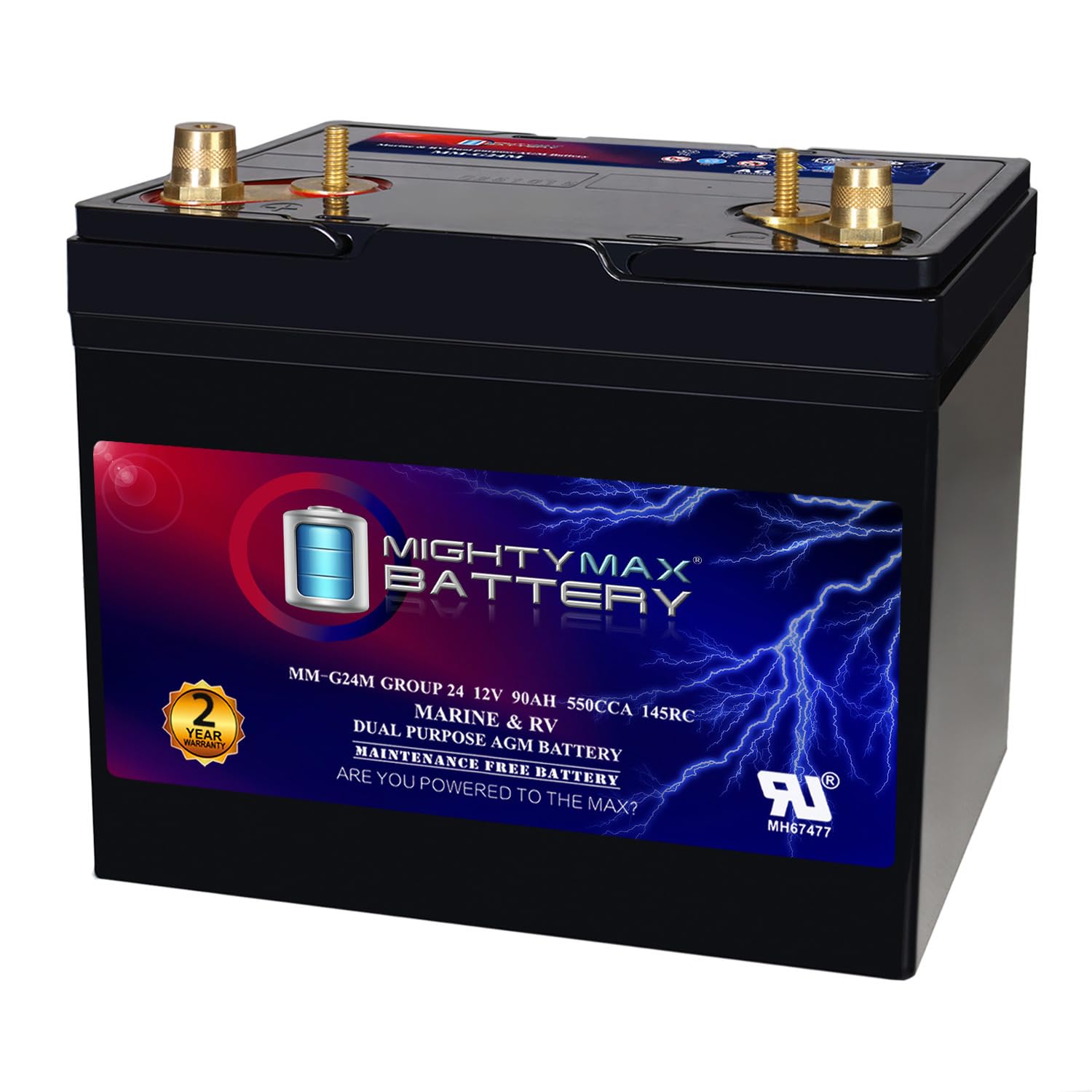
1. Mighty Max Battery MM-G24M
Our pick — 4.5★ from 1,500+ verified ratings; the strongest balance of quality and price.
The heavy lifter that cranks your engine and powers your camp for hours.
The Mighty Max MM-G24M is a dual-purpose AGM that does both jobs a real off-road battery needs to do: it delivers 550 CCA to start your engine and 700 MCA (marine cranking amps) for extra starting punch, and it provides 145 RC (reserve capacity) to keep your electronics running if the alternator dies. With a 90Ah capacity and a tough ABS (a hard, impact-resistant plastic) shell, it is built for the vibration and heat of rough terrain.
This is an old-school lead-acid AGM, so it weighs 54.4 pounds — compared to the lithium options above such as the Litime at 22.16 lb and SUPER EMPOWER at 21.58 lb. But it also costs less upfront, works with any standard battery charger, and has no temperature lockout for charging. You can use it as a single battery in a truck or SUV and it will start your engine in the morning after running your lights all night. The manufacturer claims up to 700 cycles at 50% depth of discharge, which is good for an AGM but nowhere near the lithium numbers. With 1682 ratings and a 4.5-star average, it is the most reviewed battery here — a strong sign of reliability from a large owner base.
What owners love
- 550 CCA and 700 MCA — plenty of starting power for a V6 or small V8
- 145 RC means you get over two hours of reserve power for accessories
- Maintenance-free, spill-proof, and vibration-resistant thanks to AGM design
- 1,682 reviews at 4.5 stars — proven reliability
Honest downsides
- 54.4 lb, while the SUPER EMPOWER lithium is 21.58 lb
- 700 cycles at 50% DOD is far less than a lithium battery
- Lead-acid chemistry means you lose usable capacity if you regularly drain it below 50%
Go with this if: You want a single battery that starts your engine, powers your accessories, works with any charger, and does not care about freezing temps. A proven workhorse for a straightforward rig.
Pick something else if: You need to save weight, want an auxiliary house battery for heavy loads, or plan to cycle it deeply every day.
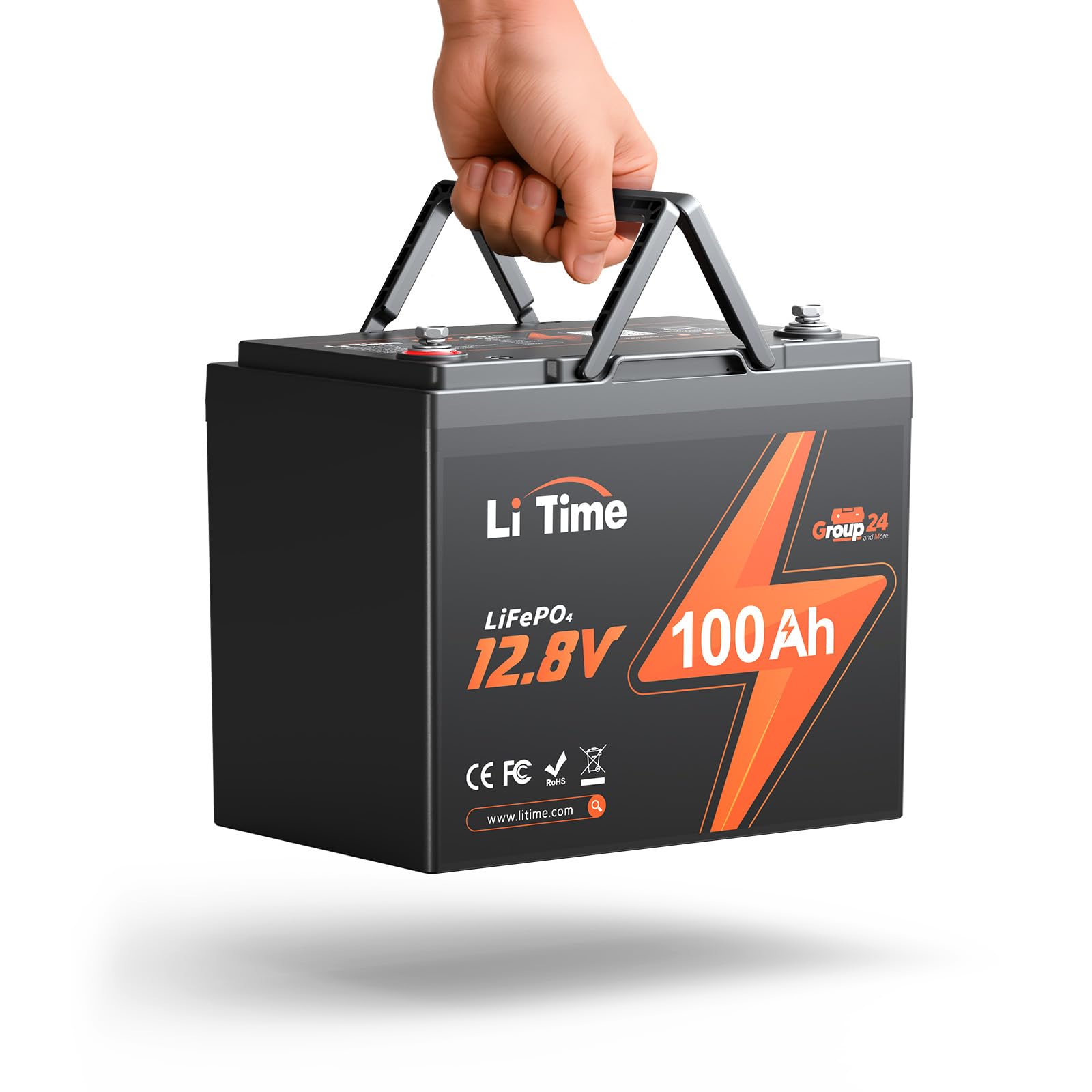
2. Litime 12V 100Ah LiFePO4 Battery
The lithium champion at 22.16 lb with 1280Wh of usable energy.
If you are building a serious overlanding setup with a fridge, lights, and a winch, the Litime gives you 1280Wh of usable energy in a package that weighs only 22.16 pounds. That is 22.16 lb, while a comparable Group 24 AGM like the Mighty Max weighs 54.4 lb. You get the full 100Ah capacity for your accessories, whereas a lead-acid battery of the same size only gives you about 60% of its rating before you damage it.
The built-in 100A BMS (a smart circuit board that manages the battery) protects against overcharging, deep discharge, short circuits, and overheating. You can expand up to 4 in series and 4 in parallel for a 20.48kWh system if you need more capacity later. The battery comes with a 5-year warranty and is covered by AIG Product Liability Insurance. The catch is winter use — the BMS disables charging below 32°F (0°C), so you need to warm the battery before recharging in freezing conditions.
Buyers report that the terminals use standard M8 bolts, which make installation into existing battery trays straightforward. The 4000-plus deep cycles mean you will likely replace your truck before this battery wears out.
Why it leads the list
- 1280Wh of usable energy
- At 22.16 lb and the Interstate AGM at 64.5 lb
- 4000-plus deep cycles vs roughly 500-700 for an AGM
- Expandable to 4S4P for 20.48kWh total capacity
The one real limitation
- Cannot be charged below 32°F (0°C) — the BMS locks out charging
- Needs a LiFePO4-specific charger (14.4–14.6V CC/CV profile)
- No CCA rating means it is a deep-cycle battery only — not for starting your engine
Reach for this if: You run a fridge, lights, or a winch and want the lightest, longest-lasting power source. It pairs well with a separate starting battery for confidence.
skip it if: You need a single battery to both start your engine and run accessories in freezing weather — the BMS will stop you from charging it.
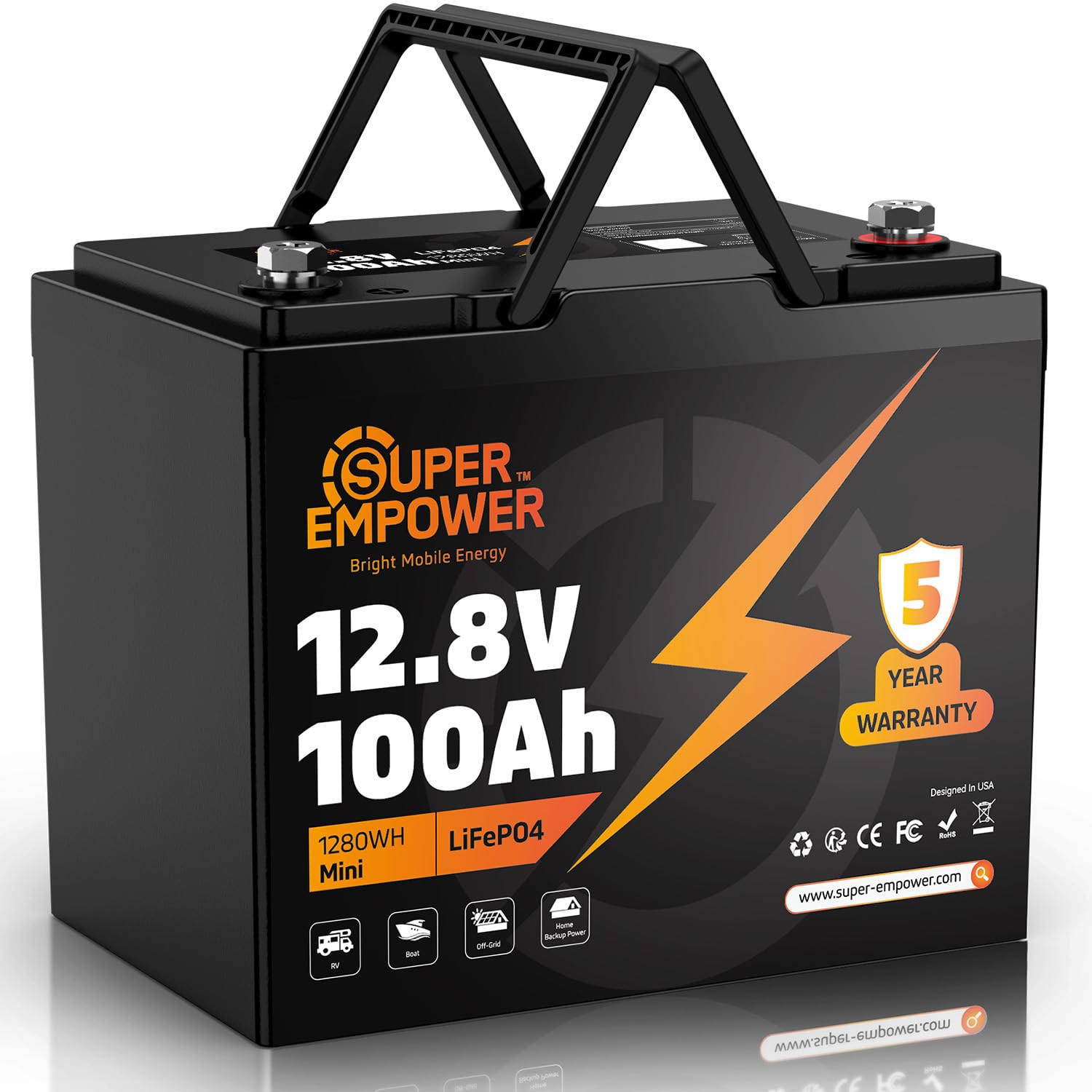
3. SUPER EMPOWER 12V 100Ah LiFePO4 Battery
A lithium drop-in that costs less than many AGM batteries of the same capacity.
The SUPER EMPOWER brings the weight and cycle-life advantages of lithium to a price point that competes directly with premium AGM. At 21.58 pounds, compared to the Mighty Max AGM’s 54.4 pounds. The BCI Group 24 dimensions (6.49″D x 10.24″W x 8.98″H) fit standard battery boxes without any tray modifications.
The built-in BMS handles low-temperature charging protection, pausing recharging below 32°F (0°C) and allowing discharge down to -4°F (-20°C). It supports up to 4 in series and 4 in parallel, so you can build a 51.2V 400Ah system with 20.48kWh if you need it for a larger off-grid setup. The company backs it with a 5-year warranty and claims 5000 cycles at 100% depth of discharge, 6000 at 80%, and 15000 at 60%. Just remember that like all lithium batteries, this is designed for deep-cycle energy storage — it will not start your engine.
What makes it a value leader
- 21.58 lb — the lightest full-size 100Ah battery on this list
- 100Ah capacity at a cost that undercuts most AGM options
- 5-year warranty and support for 4S4P expansion
- Discharges down to -4°F (-20°C) even though charging locks at 32°F (0°C)
Trade-offs to know
- No CCA rating — pure deep-cycle battery, not a starter
- Charging is disabled below 32°F (0°C)
- Fewer customer reviews (162) compared to the established AGM brands
Best suited for: Budget-conscious overlanders who want lithium weight savings and cycle life without paying the premium. Use it as a house battery paired with your existing starter battery.
Not for you if: You need a single battery to crank a cold V8 in winter — this battery will not deliver starting amps.
4. Interstate Batteries 8-31MAGMDC

A massive 825 CCA of pure-lead starting power for diesel trucks and heavy rigs.
The Interstate 8-31MAGMDC is a Group 31M battery built for the biggest off-road trucks and RVs. It delivers 825 CCA — the highest starting power on this list — and a 100Ah deep-cycle capacity to run your accessories. The pure lead (non-alloy) design gives it an expected service life that the manufacturer claims is 2 times longer than conventional alloy AGM and 3 times longer than a flooded battery. Faster recharging than standard AGM is another benefit of the pure lead plates.
At 64.5 pounds, this is the heaviest battery here, and you will need a Group 31 battery tray. The thick plates are designed for repeated deep discharges without degrading, which is exactly what you need when you are running a winch or powering a camper. Interstate has been in the battery business for 70 years, and the 2-year warranty reflects their confidence. The catch is size and weight — it will not fit a standard Group 24 tray, and moving it around is a two-person job.
Strengths
- 825 CCA — more than enough for large V8s and diesel engines
- 100Ah capacity for sustained accessory power
- Pure lead AGM construction for longer life and faster recharge
- 70-year brand reputation with a 2-year warranty
Weaknesses
- 64.5 lb — very heavy, requires a Group 31 tray
- No RC (reserve capacity) figure published in the data
- More expensive than the Mighty Max or WEIZE AGM options
Perfect for: Heavy-duty trucks, diesel rigs, and large RVs where starting power is essential and you have the tray space for a Group 31. Reliable brand, serious cranking amps, and decent deep-cycle capacity.
Too much for you if: You drive a mid-size SUV with a Group 24 tray and do not need 825 CCA. The weight and size will be a hassle for no benefit.
5. OPTIMA DH6 YELLOWTOP

The spiral-wound AGM that is fifteen times more vibration resistant than a flooded battery.
The OPTIMA YELLOWTOP DH6 uses a unique spiral cell design instead of flat plates. The manufacturer states it is fifteen times more resistant to vibration than standard flooded batteries, which matters when you are bouncing down a rocky trail. It delivers 800 CCA for strong starting power and 140 minutes of reserve capacity (RC) — over two hours of accessory run time if your alternator fails.
At 54 pounds and a compact Group 48 size (10.94″L x 6.89″W x 7.5″H), it fits many European and domestic SUVs. The Din-type A1 terminals are specific, so check your vehicle’s connectors. The capacity is 72Ah (C20 rating), which is lower than the AGM options above, but the 140 RC is competitive. OPTIMA backs it with a 36-month guarantee. The main limitation for off-road use is the modest 72Ah capacity — if you run a fridge and lights for a weekend, you may run out of juice faster than with a 90Ah or 100Ah battery.
Unique advantages
- 15x more vibration resistant than standard flooded batteries
- 800 CCA for reliable starting in cold weather
- 140 minutes reserve capacity
- Spill-proof and can be mounted in almost any position (not upside-down)
Practical limits
- 72Ah capacity is lower than the 90-100Ah AGM competitors
- Din-type A1 terminals may require adapter cables
- Higher cost per amp-hour than other AGM options
Ideal for: A daily-driver SUV that also sees moderate off-road use. Strong starting power and excellent vibration resistance make it reliable for weekend trips without needing a dual-battery setup.
Not the best for: Heavy overlanding with a fridge and winch. The 72Ah capacity will limit how long you can run accessories before recharging.
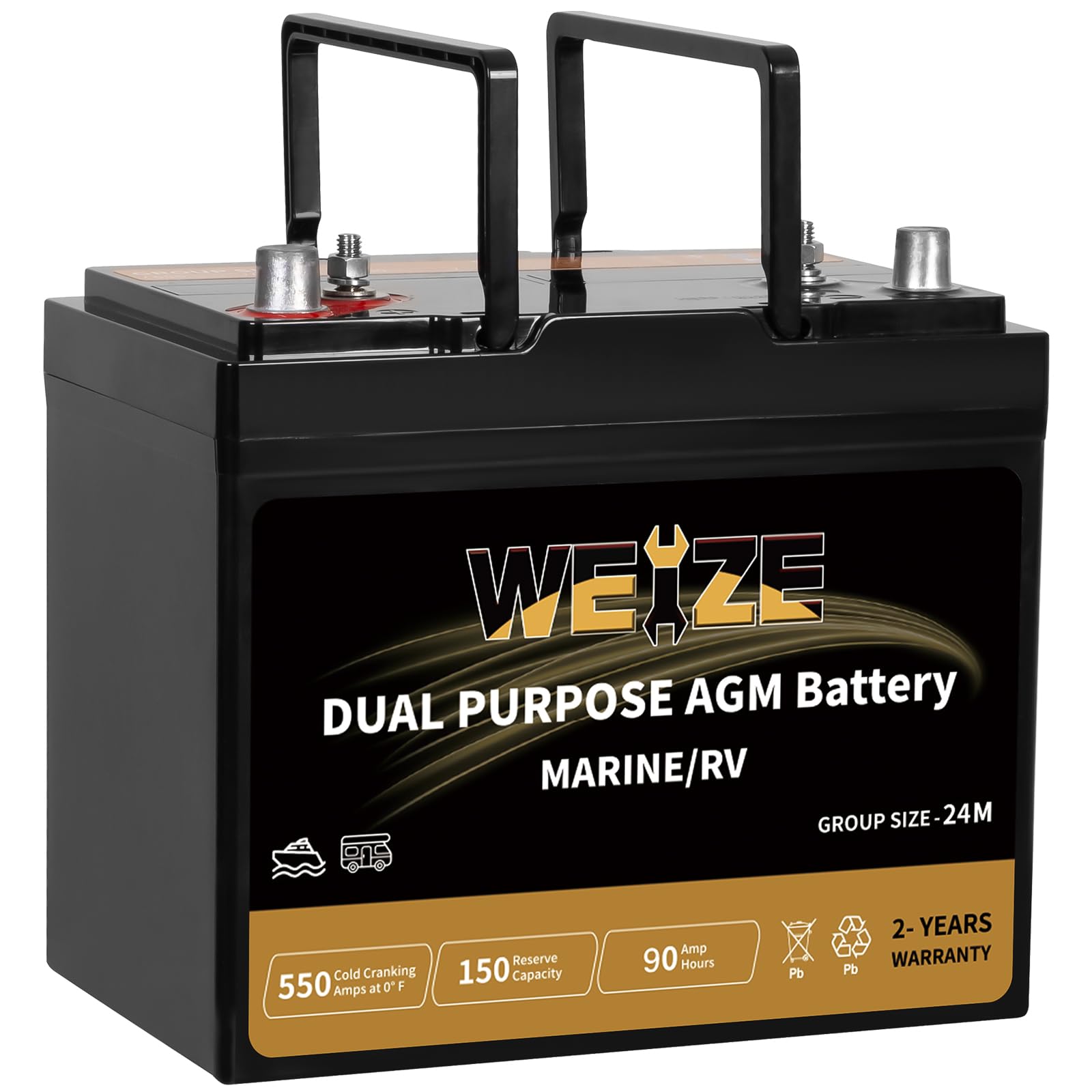
6. WEIZE Dual Purpose Group 24M
A solid dual-purpose AGM that charges fast and handles vibration without complaint.
The WEIZE BCI Group 24M is a direct competitor to the Mighty Max, with similar specs and a slightly different package. It delivers 550 CCA and 90Ah of capacity, and it features quick charging that the manufacturer says is up to five times faster than standard flooded batteries. The AGM construction includes 20 times more vibration resistance than flooded batteries, per the manufacturer — useful for trails and washboard roads.
At 50.7 pounds and the Mighty Max at 54.4 pounds, both are close in real terms. The WEIZE comes with a 2-year warranty and has 232 ratings at 4.4 stars. The manual specifies charging at 14.4V ± 0.1V with a maximum current of 15.8A for proper maintenance. It uses multiple terminal types (DT, SAE/M8 Stud, SAE/M8 Threaded Post, WNT), giving you flexibility for different cable connectors. The main thing to watch is the 90Ah capacity — adequate for most, but if you run heavy loads, you may want the 100Ah of the Interstate or a lithium option.
What works well
- 550 CCA and 90Ah — a capable dual-purpose battery for most trucks
- Quick charging feature saves time between trips
- Multiple terminal options for easy installation
- 2-year warranty at a competitive price point
What to consider
- 50.7 lb — still heavy compared to lithium alternatives
- No RC (reserve capacity) figure published
- AGM cycle life (typically 500-700 cycles) is far below lithium
Best for: A compact pickup or mid-size SUV where you want a reliable, affordable AGM that can start the engine and run lights/a winch. The 2-year warranty adds confidence.
You might skip this if: You plan to cycle it deeply and frequently — an AGM will wear out faster than a lithium house battery.
7. UPLUS Dual Purpose Group 24M
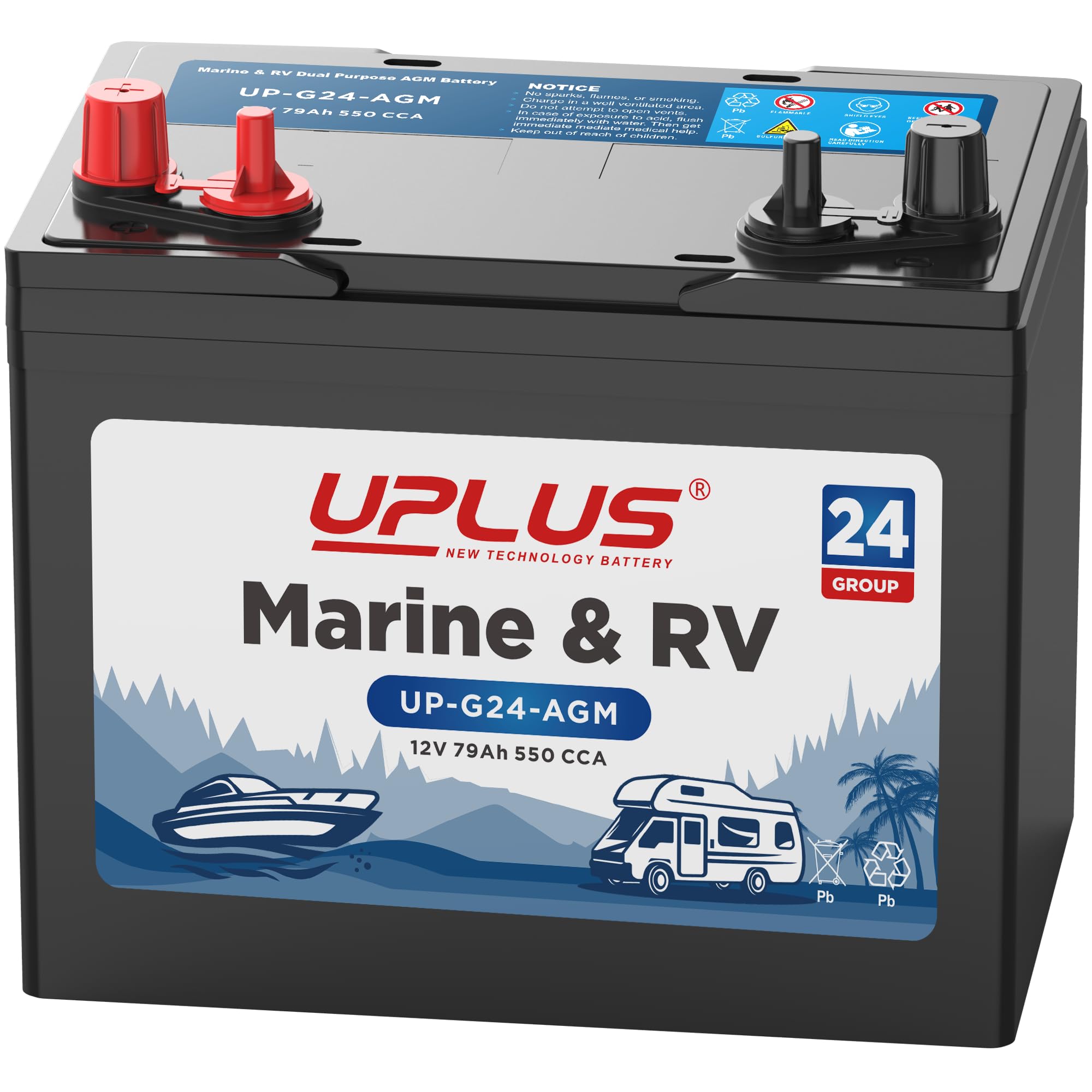
A dual-purpose battery specifically sized to start engines from 70 to 350 horsepower.
The UPLUS Group 24M is built for boats and RVs, but its specs translate directly to off-road vehicles. It delivers 550 CCA and 79Ah of capacity with a reserve capacity of 150 RC — that is 5 minutes more reserve than the Mighty Max (145 RC). The manufacturer says it can start engines up to 350hp, which covers most V6 and small V8 truck engines. The dual-purpose design means you get one battery that both starts and deep cycles, saving space and simplifying wiring.
At 50.7 pounds with dimensions of 10.24″ x 6.61″ x 9.17″, it fits Group 24M trays. UPLUS uses thicker full-frame cast plates for durability, and the sealed AGM construction resists vibration from rough roads and trailer transport. The company offers a 24-month warranty with a 60-day refund window, and they are based in California with local after-sales support. The 79Ah capacity is lower than the 90Ah options, so you will need to manage your accessory draw more carefully during long camping stops.
Strong points
- 150 RC — the highest reserve capacity of any Group 24 AGM on this list
- 550 CCA suitable for engines up to 350hp
- 24-month warranty with local US-based support
- Saves weight and space by combining starting and deep-cycle in one unit
Limitations
- 79Ah is the smallest capacity of the dual-purpose AGM options here
- Only 21 customer reviews — limited real-world feedback
- Heavier than it needs to be compared to lithium, like all AGM batteries
Choose this for: A small to mid-size SUV or truck where you want the highest reserve capacity for emergency power. The 150 RC gives you more run time for lights and hazards if the alternator fails.
Not ideal for: Heavy power users who run a fridge, inverter, and winch simultaneously. The 79Ah capacity will drain faster than a 100Ah option.
8. Newport 12V50Ah Deep Cycle AGM
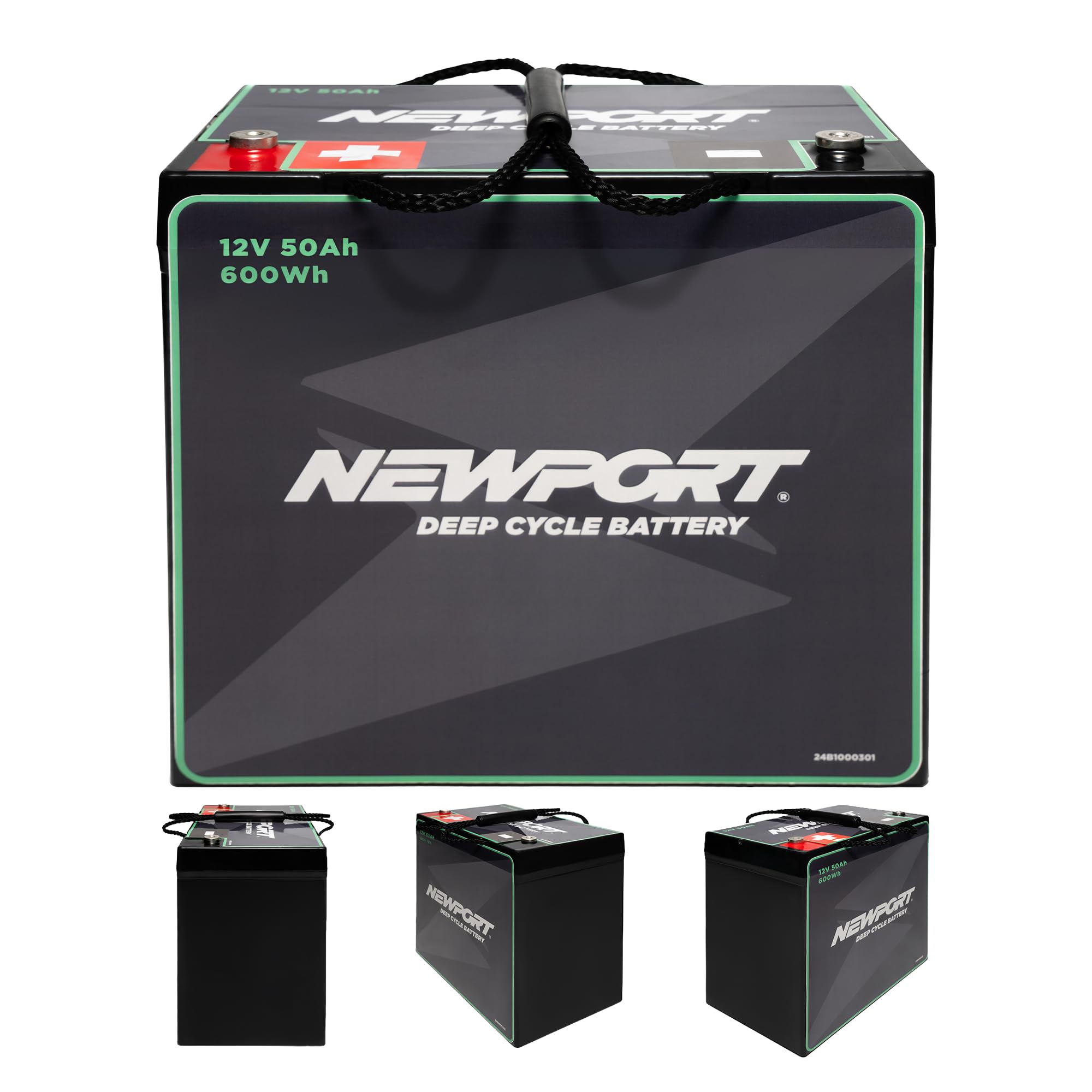
A lightweight 32-pound AGM that is easy to move but meant for light accessory duty.
The Newport 12V50Ah is a pure deep-cycle battery — it is not designed to start your engine. It is meant as an auxiliary or house battery for powering a trolling motor, a small fridge, or lights. At 32 pounds, it is the lightest AGM here, which makes it easy to install in tight spaces or carry to a campsite. The sealed AGM construction is leak-proof and maintenance-free, so you can mount it on its side if needed.
The 50Ah capacity is half of what the larger AGM batteries offer. You will get around 600Wh of usable energy (at 50% depth of discharge, which is the safe limit for lead-acid). That is enough to run a 12V fridge for about 8-12 hours depending on the model, but not enough for a winch or heavy inverter loads. It works smoothly with trolling motors, which is its primary design target. With a 1-year limited warranty and a 4.5-star rating from 414 reviews, it is a trusted budget option for light off-road camping setups.
Why it works for some
- 32 lb — very easy to handle and install compared to 50+ lb AGM batteries
- Sealed, leak-proof, maintenance-free AGM construction
- 414 reviews with a 4.5-star average — proven reliability
- Specifically compatible with trolling motors
Where it falls short
- 50Ah is the smallest capacity on this list, compared to the 100Ah options
- Pure deep-cycle battery — no CCA rating, cannot start your engine
- Lead-acid means you only get about 25Ah of usable capacity if you want to preserve battery life
Ideal as: A second battery for a small fridge or lights in a camping setup. Light enough to carry or move around, reliable for light duty, and very affordable.
Avoid as your main battery if: You need to start an engine. This battery has no cranking power. Also skip if you run a winch — the 50Ah capacity will drain too fast.
Understanding the Specs
Cold Cranking Amps (CCA)
CCA measures how many amps a battery can deliver for 30 seconds at 0°F (-18°C) while maintaining at least 7.2 volts. For off-road use, 550-800 CCA is a safe range for most gas engines. Diesel trucks and large V8s benefit from 800+ CCA. A battery with 550 CCA, like the Mighty Max or WEIZE, will start a small V8 on a cold morning. A battery with 800+ CCA, like the Interstate or OPTIMA, gives you a bigger margin for cold starts and high-compression engines.
Amp-Hours (Ah) and Reserve Capacity (RC)
Ah tells you how many amps a battery can deliver over one hour. A 100Ah battery can theoretically provide 100 amps for one hour, or 10 amps for 10 hours. With lead-acid batteries, you should only use about 50% of that to avoid damage (so 50Ah usable from a 100Ah battery). With lithium LiFePO4, you can use nearly 100% (100Ah usable from a 100Ah battery). RC tells you how many minutes the battery can deliver 25 amps at 80°F. Higher RC means more emergency run time for your vehicle.
FAQ
Can I use a regular car battery for off-road?
What is the difference between AGM and lithium LiFePO4 for off-road?
Will a Group 24 battery fit my truck?
Can I mix a lithium house battery with an AGM starter battery?
How long will a lithium off-road battery last in cold weather?
What does dual-purpose battery mean exactly?
How many cycles will an AGM off-road battery last?
Can I charge a LiFePO4 battery with my vehicle’s alternator?
What size battery do I need for a winch?
Is a higher CCA always better for off-road?
Final Thoughts: The Verdict
For most overlanders running a fridge, lights, and accessories, the best off-road battery is the Litime 12V 100Ah LiFePO4 because Litime gives you 1280Wh of usable energy at 22 pounds with over 4000 cycles and a 5-year warranty. If you want a single dual-purpose battery that starts your engine and works with any charger in any weather, go with the Mighty Max MM-G24M with 550 CCA and 145 RC at a straightforward price. And if you are on a tight budget and need a lightweight house battery for a fridge or trolling motor, the Newport 12V50Ah is a reliable 32-pound AGM that gets the job done for light duty.
How We Picked
We do not accept paid placement. Every pick is matched to a real buyer and a real use-case; we do not hands-on test units.
Sources & Methodology
Specifications: manufacturer listings and product documentation. Review insights: verified customer reviews, as of July 2026. Pricing: not shown on this page (it changes often); check the current price via the retailer link.
As an Amazon Associate, Trending Car earns from qualifying purchases. This does not affect which products we feature.