
Our readers keep the lights on and my garage snacks stocked. As an Amazon Associate, I earn from qualifying purchases.
Specs are compiled from manufacturer listings and verified buyer reviews and can change over time — please confirm the key details on the product page before buying.
Front and rear dash cams are your silent witnesses on the road, capturing everything from a fender-bender to a road trip highlight. The real challenge isn’t picking one that records—it’s picking one that actually reads plates at night and doesn’t lock up in the sun. This guide compares the four strongest contenders so you can find the setup that covers your six, no matter the budget.
I’m Min Islam — the founder and writer behind Trending Car. This guide is built by comparing the manufacturers’ published specifications and the patterns across verified customer reviews, so you get each pick’s real strengths and trade-offs instead of marketing spin.
We break down the image sensors, night vision performance, parking modes, and storage expansion limits to help you choose the right dash cams front and rear for your car and driving style.
Our Picks at a Glance
How To Choose The Best Dash Cams Front and Rear
A front and rear dash cam is an insurance policy on a memory card. To pick the right one, you need to match its specs to the conditions you actually drive in.
Look at the Image Sensor First
The sensor is the camera’s eye. A Sony STARVIS 2 sensor, like the IMX678 or IMX675, captures far more light, so your footage stays clearer in tunnels, garages, and night drives. A standard CMOS sensor will handle daytime fine but often loses detail as the sun drops.
Check the Front and Rear Resolution
Not all “dual HD” systems are equal. A 4K front camera has 3840×2160 pixels, compared to 1080p’s 1920×1080 pixels, which provides more detail and helps when you need to read a plate 30 feet away. Look for a rear camera that is at least 1080p—a lower-res rear camera can blur the details of a car that taps your bumper.
Review the Field of View
A wider field of view covers more lanes. A 170-degree lens spans roughly six lanes, while a 125-degree lens covers about four. Wider is better for catching side-swipe action, although it can slightly distort the edges of the frame.
Parking Mode Requires a Hardwire Kit
Nearly every dash cam advertises “24-hour parking monitor,” but the reality is that you need a hardwire kit (sold separately) to run the camera off your car’s fuse box instead of the built-in battery. Without it, most cameras shut down a few minutes after the engine is off.
Quick Comparison
| Model | Best For | Front Resolution | Field of View | Max Storage | Amazon |
|---|---|---|---|---|---|
| FAIMEE 4K+2K★ Best Overall | Budget value with 4K front | 4K (3840x2160P) Front / 2K Rear | 170° Front | 256 GB | Amazon |
| ROVE R2-4K DUAL PRO | Max clarity & night vision | 4K (3840x2160P) | 150° Front / 140° Rear | 1 TB | Amazon |
| Pelsee P1 Pro 4K | Six-lane coverage & voice control | 4K HDR Front / 1080P WDR Rear | 170° Front | 512 GB | Amazon |
| 70mai A410 | Low-light performance on a budget | 2.5K (2560x1440P) Front / 1080P Rear | 125° Front | 256 GB | Amazon |
In‑Depth Reviews
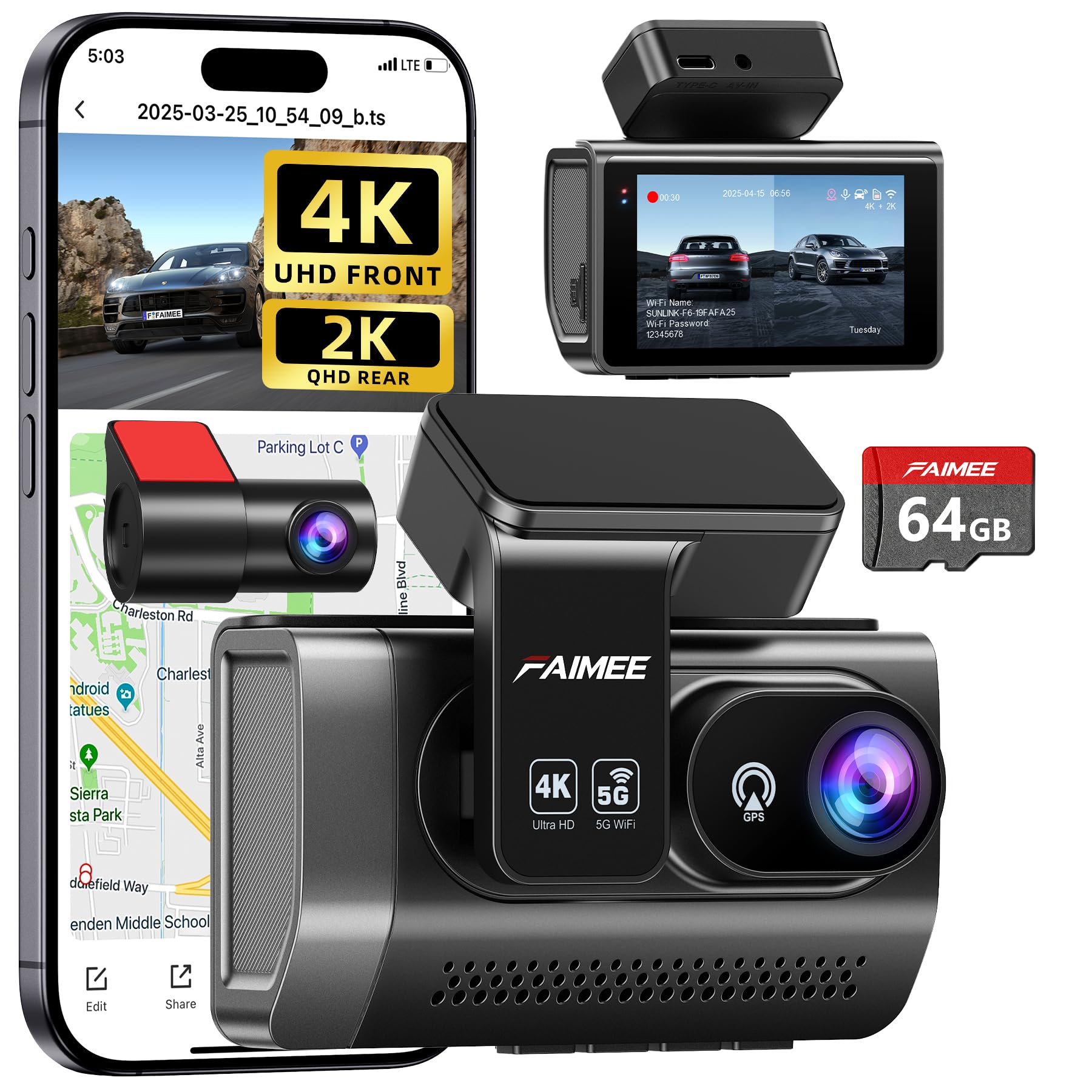
1. FAIMEE 4K+2K Dash Cam Front and Rear
Our pick — 4.5★ from 800+ verified ratings; the strongest balance of quality and price.
A budget-friendly 4K front cam that still delivers a 2K rear for sharp rear views.
Most sub- units drop the rear to 1080P, but the FAIMEE gives you 4K at 3840x2160P up front and a 2K (2304x1296P) rear camera. That rear resolution is a meaningful step up from basic 1080P, especially for picking out a license plate on the bumper behind you. The 170-degree wide-angle front lens covers about six lanes, similar to the Pelsee.
The dual-band Wi-Fi (5.8GHz/2.4GHz) connects to the FAIMEE app for live-view and downloads. The built-in GPS tracks your speed, route history, and location coordinates automatically. The 3-inch IPS screen is compact enough to hide behind the rearview mirror without blocking your view.
Buyers appreciate that it comes with a 64GB card already installed and ready to record. One caution: the field of view, while wide at 170 degrees, is on the same 256GB max storage as the 70mai, so the 4K+2K files will fill the card faster than a 1080P setup.
What stands out
- 4K front and 2K rear is rare at this price point
- 170-degree front coverage for wide lane awareness
- Built-in GPS and dual-band Wi-Fi included
What holds it back
- Max storage of 256GB is half the Pelsee’s limit
- Night vision is decent but not STARVIS 2 level
Reach for this if: Your budget is tight but you refuse to sacrifice 2K rear clarity for insurance-level evidence.
Look elsewhere if: You regularly drive rural unlit roads at night—the night capability, while adequate, does not match Sony STARVIS 2 performance.
2. ROVE R2-4K DUAL PRO Dash Cam Front and Rear
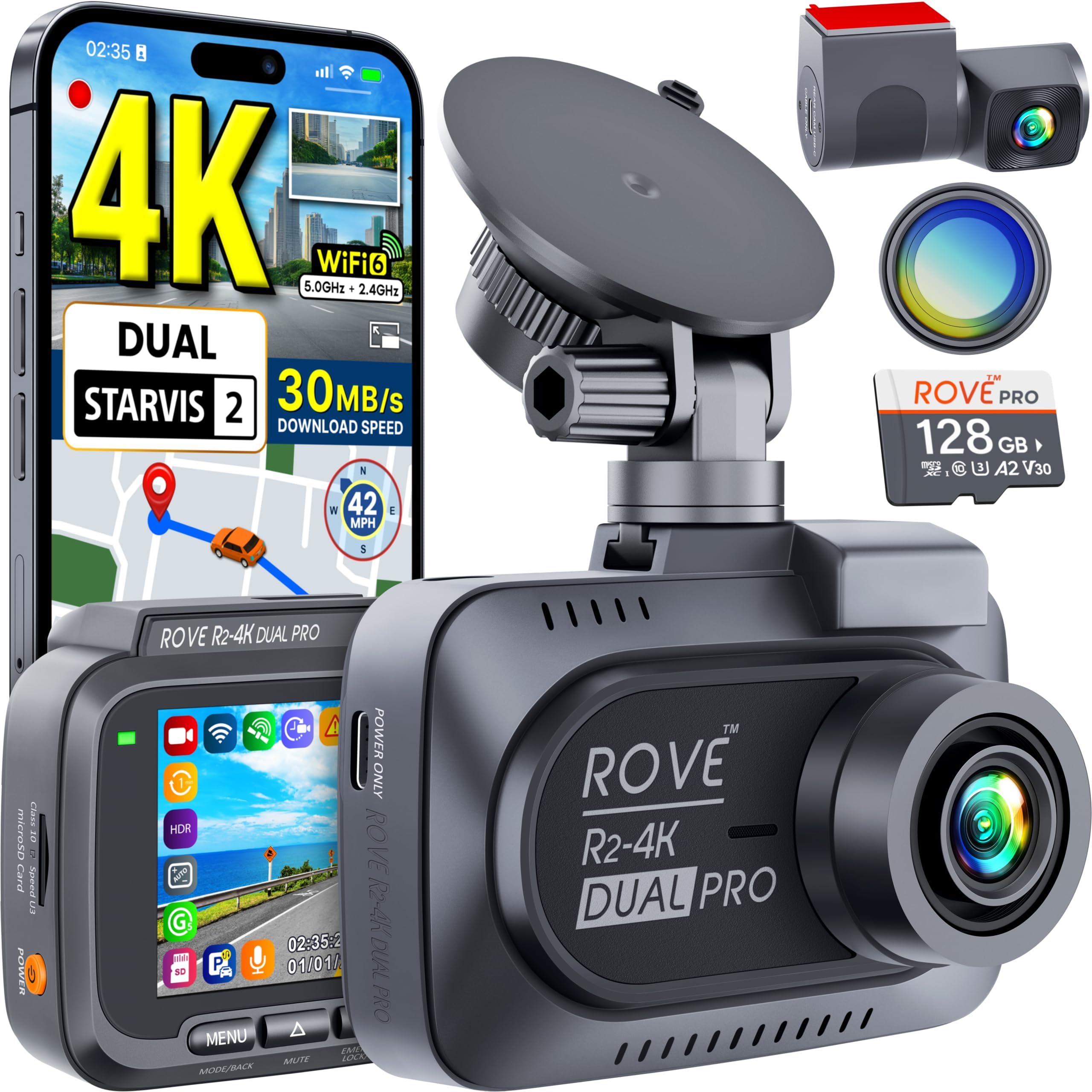
The premium option that puts dual Sony STARVIS 2 sensors in both front and rear cameras.
You get 4K resolution (3840x2160P) up front at 30fps and a sharp 2K (2560x1440P) rear camera. Both use Sony’s advanced IMX678 (8MP) and IMX675 (5MP) sensors, which soak up light more efficiently than standard sensors. The result is footage that stays smooth and clear through tunnels, rain, and direct headlight glare on dark highways. The ultra-wide front lens is 150 degrees, with the rear covering 140 degrees, so you get broad lane coverage without the fish-eye distortion at the edges.
The included 128GB ROVE PRO microSD card is a huge convenience—most competitors at this price ship with half the storage—and the bundled CPL filter cuts windshield glare. On the connectivity side, the dual-band Wi-Fi 6 with speeds up to 30MB/s means you can pull large 4K clips to your phone in seconds. The built-in quad-mode GPS (GPS, BEIDOU, GALILEO, GLONASS) logs speed and your exact route for trip playback or insurance documentation.
Buyers highlight the night video quality as a standout, noting the ROVE delivers noticeably sharper plate readability in low light compared to budget units. The caveat on every dash cam applies here too: 24-hour parking mode needs a hardwire kit (sold separately).
What makes it worthy
- Superior Sony STARVIS 2 sensors front and rear for class-leading night capture
- Included 128GB card and CPL filter save you -40 in extras
- Wi-Fi 6 at 30MB/s for fast wireless downloads of big 4K files
- Quad-mode GPS for precise route and speed logging
The trade-offs
- Premium price reflects the advanced sensor tech
- Parking mode requires separate hardwire kit purchase
Who this is for: The driver who wants the best possible video evidence day or night, with enough storage from the start to not think about it again.
One smaller catch: The included card is 128GB—if your commute is very long, you may eventually want the max 1TB card for even longer loop cycles.
3. Pelsee P1 Pro 4K Dash Cam Front and Rear
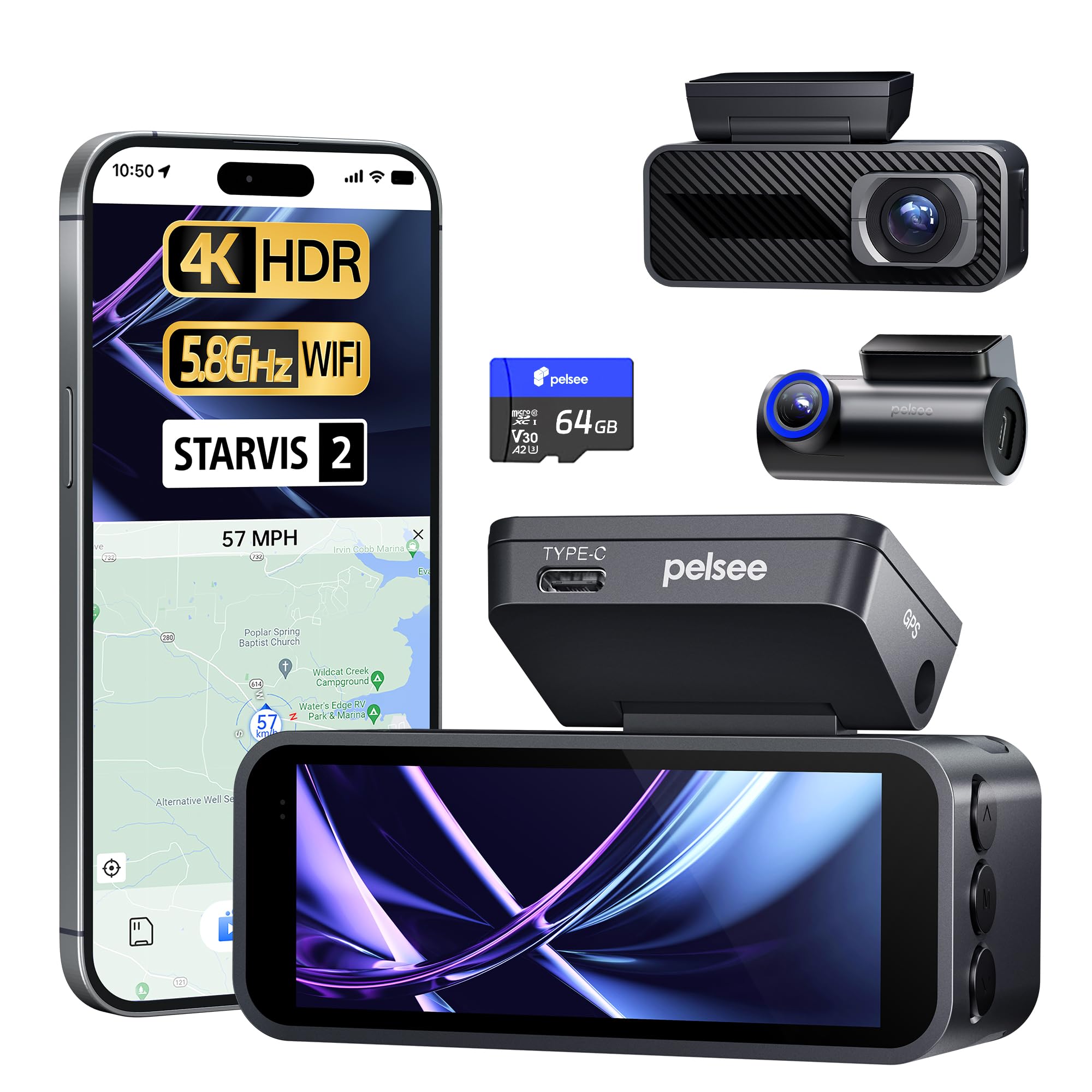
The widest field of view in this list, covering 170 degrees up front.
The Pelsee records 4K HDR from the front using a Sony STARVIS 2 sensor, which delivers full-color night vision even in near-dark starlight conditions. The rear cam captures 1080P with WDR (wide dynamic range) to handle fog or bright tunnel exits. With that 170-degree front lens, the Pelsee covers about six lanes side-to-side, compared to a 125-degree camera like the 70mai which covers about four lanes, making it a strong pick for multi-lane highway driving.
Voice control adds a unique safety layer—you can say “Lock the video!” or “Take a photo!” without taking your hands off the wheel. The 3.39-inch IPS screen is generous for live previews, and the 5.8GHz Wi-Fi transfers 4K clips to the app smoothly. The built-in GPS logs speed and coordinates, and the ADAS (Advanced Driver Assistance System) gives you lane-departure and forward-collision alerts.
Buyers frequently mention the easy 3-step snap installation and the crisp daytime video quality. As with the other picks, the 24-hour parking mode requires a hardwire kit (not included).
The big advantage: The 170-degree front angle is the widest here—ideal for catching activity in adjacent lanes or at intersections.
The main constraint: The rear camera is capped at 1080P, so the video isn’t as detailed as the 2K rear on the ROVE.
Best for: City and highway drivers who often change lanes and want to see the full side-to-side picture, plus the convenience of voice commands.
Consider skipping if: You insist on matching rear resolution—the 1080P in the back can blur fine details like a plate at close range.
4. 70mai A410 Dash Cam Front and Rear
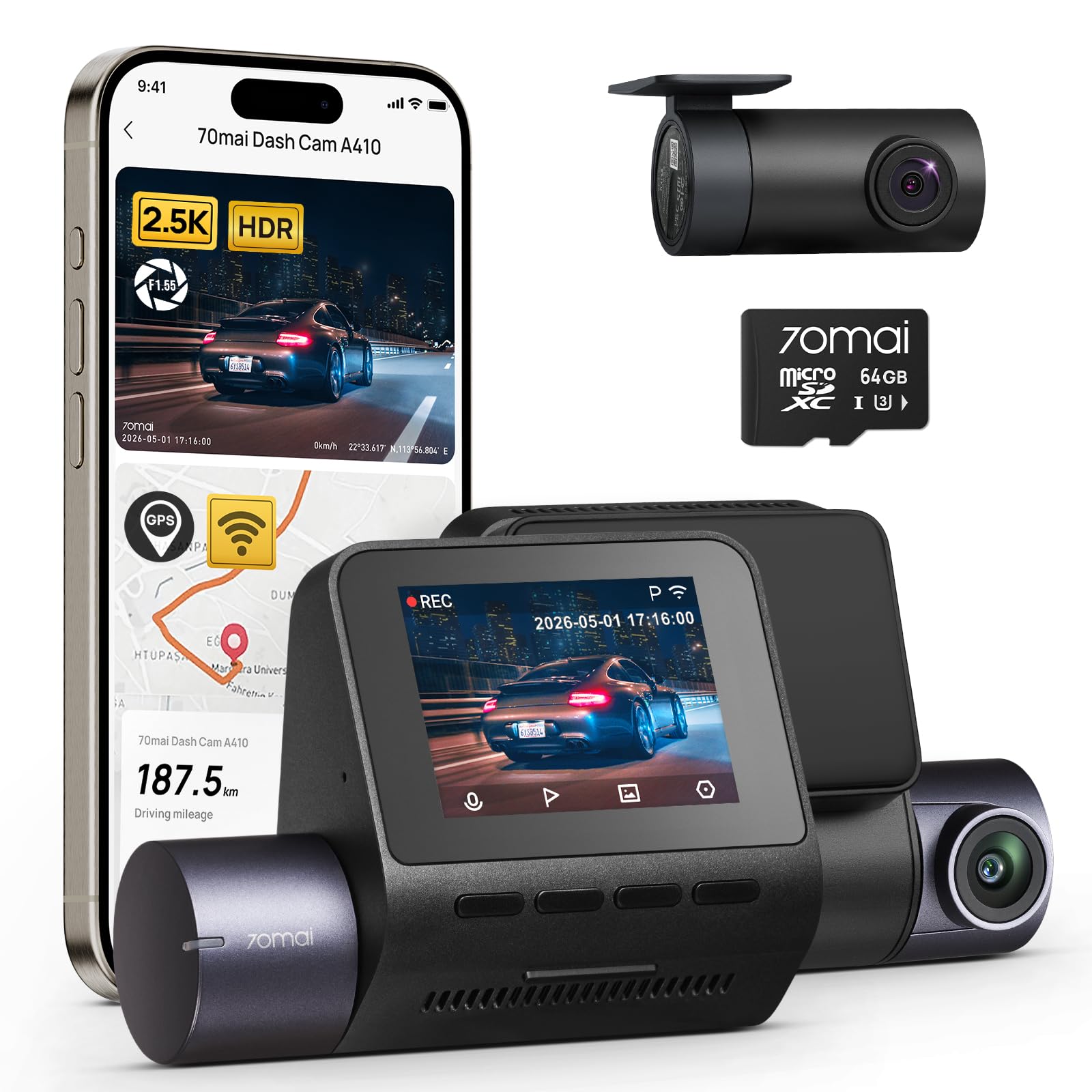
The punchiest night-time performer in the budget tier, thanks to an F1.55 aperture and HDR.
This 70mai captures 2.5K (2560x1440P) from the front and 1080P from the rear, which is less total resolution than the 4K units. However, the F1.55 aperture (a very large lens opening that lets in more light) combined with HDR technology gives it a real advantage after sunset. On dark backroads or unlit parking lots, it pulls in license plate details that many standard 2.5K cameras miss.
The field of view is 125 degrees, which covers about four lanes. Compared to the 170 degrees on the FAIMEE or Pelsee, the 70mai is less suited for capturing side-swipes in adjacent lanes, but it reduces the fish-eye barrel distortion you sometimes see on wider lenses. The built-in GPS embeds speed, coordinates, and timestamps into the footage, and the app makes it easy to adjust G-Sensor sensitivity or resolution.
Buyers report that the electrostatic sticker mount (a static-cling adhesive that leaves no sticky residue) holds firmly, so it works well for leased cars. The included 64GB memory card is ready to use right from the start, and the 18-month warranty gives you some confidence.
The defining strength: F1.55 aperture plus HDR means this camera sees better in the dark than many 4K units with smaller lens openings.
A clear compromise: The 125-degree view covers four lanes versus the six lanes of a 170-degree unit—fine for most but not a wide-angle champ.
Pick this if: You drive mostly at night or park in poorly lit areas and want the best low-light performance for your money.
skip it if: You need a very wide field of view to cover side lanes or intersections regularly.
Understanding the Specs
Sony STARVIS 2 Sensor
STARVIS 2 is a back-illuminated CMOS sensor technology from Sony. It delivers excellent low-light sensitivity, so your dash cam picks up color details in near-dark conditions that older sensors would render as black shapes. If night-time plate reading is a priority, look for a camera that specifies STARVIS 2 for the front, or even better, for both front and rear.
Field of View (FOV)
This is the width of the scene the lens can capture, measured in degrees. A 170-degree FOV spans roughly six lanes of traffic, giving you coverage of side-swipe events and pedestrians entering from the curb. A 125-150 degree FOV covers about four lanes, which is plenty for a single-lane commute but has narrower peripheral capture. Wider FOVs can add a slight fish-eye curve at the edges, but they capture more usable evidence.
Storage and Loop Recording
Most dash cams support a microSD card up to 256GB or 512GB, and the highest-end units like the ROVE support up to 1TB. Loop recording means the camera automatically overwrites the oldest video file when the card is full, so you never have to manually clear space. A larger card means you keep more history before the old footage is recycled—helpful if you don’t check the cam every day.
Parking Mode and Hardwire Kits
Parking mode uses motion detection or G-Sensor impact detection to record while your car is parked. However, the dash cam’s internal battery can’t sustain this for long. A hardwire kit connects the camera directly to the car’s fuse box, usually to a constant 12V circuit and an ignition-switched circuit, so it runs on the car battery with a voltage cutoff to prevent a dead battery. If you want 24-hour monitoring, budget for a hardwire kit (typically -).
FAQ
Do I need a hardwire kit for parking mode with these dash cams?
What size microSD card do I need for a 4K front and rear dash cam?
Is a 170-degree field of view better than 125 degrees?
Can I use the dash cam in a truck or RV?
What is the difference between HDR and WDR?
How does GPS help in a dash cam?
Does a higher front resolution always mean better night video?
What does the G-Sensor do in a dash cam?
Can I connect these dash cams to my phone?
Final Thoughts: The Verdict
If you want one dependable pick, the best dash cams front and rear is the ROVE R2-4K DUAL PRO because it pairs dual Sony STARVIS 2 sensors (low-light image sensors that capture clear video in dim conditions) with a free 128GB card and CPL filter (a circular polarizing lens that cuts dashboard glare). If you want the widest lane coverage and hands-free voice control, grab the Pelsee P1 Pro 4K. And for the strongest night performance at the lowest cost, choose the 70mai A410 with its F1.55 aperture (a wide lens opening that lets in more light) and HDR (high dynamic range, which balances bright and dark areas in the same frame).
How We Picked
We do not accept paid placement. Every pick is matched to a real buyer and a real use-case; we do not hands-on test units.
Sources & Methodology
Specifications: manufacturer listings and product documentation. Review insights: verified customer reviews, as of July 2026. Pricing: not shown on this page (it changes often); check the current price via the retailer link.
As an Amazon Associate, Trending Car earns from qualifying purchases. This does not affect which products we feature.