
Our readers keep the lights on and my garage snacks stocked. As an Amazon Associate, I earn from qualifying purchases.
Specs are compiled from manufacturer listings and verified buyer reviews and can change over time — please confirm the key details on the product page before buying.
An engine bay collects a caked-on layer of oil, road film, and cooked-on grease faster than almost any other part of a car. The wrong cleaner leaves behind sticky residue, hazy plastic, or a lingering chemical smell. The right one safely dissolves the grime without damaging rubber hoses, painted valve covers, or electrical connectors, and rinses completely clean so nothing is left to trap heat.
I’m Min Islam — the founder and writer behind Trending Car. This guide is built by comparing the manufacturers’ published specifications and the patterns across verified customer reviews, so you get each pick’s real strengths and trade-offs instead of marketing spin.
Here is what really matters when choosing a degreaser for engine bay — which formulas cling to vertical surfaces, which ones are safe on sensor-rich engines, and which budget bottles actually match the performance of professional gallons.
Our Picks at a Glance

How To Choose The Best Degreaser for Engine Bay
Picking the wrong cleaner can leave your engine looking worse than when you started, or even damage critical components. Focus on a few simple traits to get a safe, thorough clean every time.
Gel vs. Liquid: Cling Matters
A thin spray runs off a vertical engine block before it has time to work. A gel or thick formula clings to the surface, meaning you do not waste half the bottle on the garage floor. If your engine has lots of nooks and awkward angles, a gel that stays put is worth the extra cost.
Sensor and Material Safety
Modern engine bays are full of oxygen sensors, rubber vacuum lines, aluminum parts, and plastic trim. A safe degreaser should explicitly state it will not harm rubber, plastic, paint, or electrical components. Avoid products with harsh solvents that can dry out hoses or leave a residue on sensors that triggers a check-engine light.
A Clean Rinse Matters Most
The goal is a residue-free finish. If a degreaser leaves a film, it attracts new dirt immediately, and in some cases, it can cook onto hot exhaust components and smoke. Look for formulas that rinse completely clean and do not require special neutralizers before you wash them away.
Quick Comparison
| Model | Best For | Form / Volume | Weight | Material Safety | Amazon |
|---|---|---|---|---|---|
| GUNK Engine Brite Gel★ Best Overall | Clings to vertical surfaces | Gel / 15 oz (12-pack) | — | Safe on plastic & rubber | Amazon |
| Malco Red ThunderBest Value Gallon | Versatile professional use | Liquid / 1 gallon | — | Aluminum, carpet, plastic safe | Amazon |
| Spray Nine Grez-Off | Heavy grease cutting | Liquid, Spray / 1 gallon | 8.6 Pounds | Petroleum free | Amazon |
| SONAX Engine Cleaner | Sensor-safe deep clean | Liquid / 500 ml | — | Safe on metal, plastic, rubber | Amazon |
| KRAKEN BOND Engine Cleaner | Budget-friendly 2-pack | Spray / 2×12.3 fl oz | 1.9 Pounds | No harm to electronic circuits | Amazon |
| Oil Eater Original | Ultra concentrated cleaning | Liquid / 32 oz (2-pack) | 2 Pounds | Noncorrosive | Amazon |
| Adam’s All Purpose Cleaner | Light duty & interior use | Liquid / 16 oz | 1.1 Pounds | Dilutable for delicate surfaces | Amazon |
In‑Depth Reviews
1. GUNK EBGEL-12PK ‘Engine Brite’ Engine Degreaser Gel – 15 oz. (Case of 12)
Our pick — 4.5★ from 750+ verified ratings; the strongest balance of quality and price.
A thick gel that stays exactly where you spray it, even on a hot vertical block.
Gravity is your enemy when cleaning an engine bay, but this gel sticks where you spray it. The GUNK Engine Brite Gel comes in a 15 oz can (sold in a case of 12) and clings to vertical surfaces without running off, so it stays on a grimy valve cover or the underside of an intake manifold long enough to dissolve grease. GUNK has been making engine cleaners from Charlotte, NC, for over 75 years, and this formula keeps the same chemistry that tradesmen and DIYers have relied on.
It is designed specifically for dirty, greasy engines and is safe on most under-hood rubber, plastic, and paint. Unlike the diluted spray of Adam’s all-purpose cleaner further down this list, the gel gives you contact time without dripping onto the ground. Reviewers with older, leaky engines note that the gel dissolves baked-on sludge in minutes without attacking the wiring loom or hoses.
Why the gel wins
- Gel stays on vertical surfaces and does not run off
- Safe on rubber, plastic, and painted surfaces under the hood
- 75-year brand reputation for engine-specific formulas
Things to know
- Sold only as a 12-pack case
- Unscented — lacks any citrus or masking fragrance
Your best bet if: you have a heavily soiled, leaky engine and need a gel that clings longer for deep cleaning.
Pass on this if: you only clean one car per year and do not have shelf space for a dozen cans.
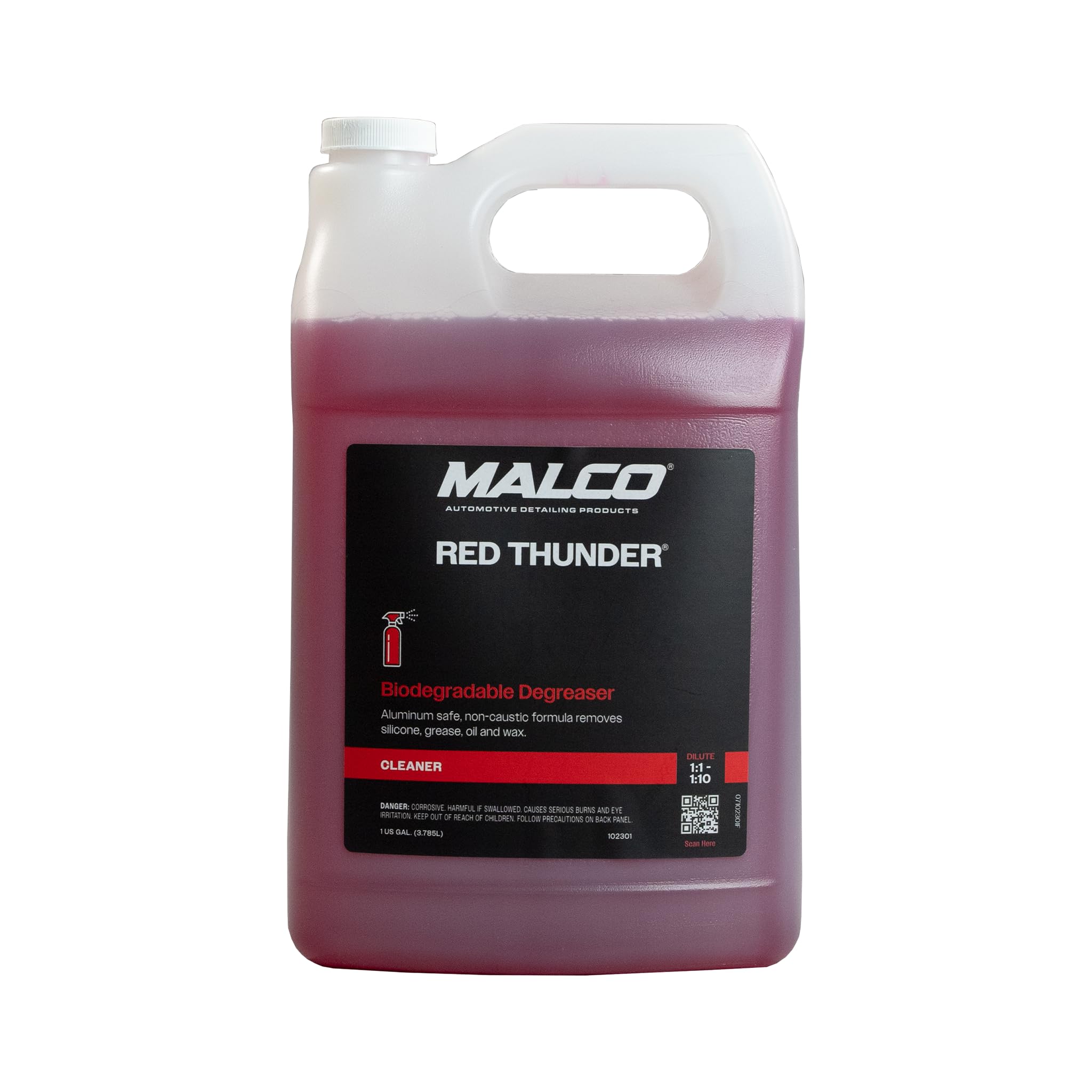
2. Malco Red Thunder – Automotive Degreaser and Cleaner – 1 Gallon (102301)
A full gallon of concentrated power that also cleans wheels, tires, and carpets.
Malco Red Thunder is a high-performance automotive degreaser that cuts through tough grime, grease, and road residue quickly. At 1 gallon, it offers the most cleaning per dollar toward the premium end of the spectrum. The formula works on engines, tires, and wheels, and it is body-shop and aluminum safe, meaning you can use it on a polished intake manifold or aluminum cylinder head without etching or pitting.
It is biodegradable and phosphate-free, which matters if you rinse your engine bay and the runoff goes into a driveway drain. Unlike the Spray Nine Grez-Off below, Malco rinses without leaving a sticky film, so the engine stays cleaner between washes. Buyers report that the liquid penetrates tight spaces well, yet it is versatile enough to shampoo carpets and upholstery when diluted. The main drawback is the price — at about per gallon it costs more up front than smaller spray cans, but you get professional-grade chemistry that lasts many cleanings.
Standout traits
- Concentrated gallon gives dozens of cleaning sessions
- Biodegradable and phosphate-free for low-maintenance rinsing
- Safe on aluminum, carpets, plastic, and vinyl
One consideration
- Higher up-front cost than single spray bottles
- Unscented — no fragrance to mask the degreasing smell
Reach for this when: you want one do-it-all cleaner for your engine, wheels, tires, and interior carpets without switching products.
Look elsewhere if: your budget is under and you only need a quick spray for a single engine detail.
3. Spray Nine 22701 Grez-Off Heavy Duty Degreaser, 1 Gallon

A no-fuss gallon that cuts through industrial-grade grease without fumes.
You get a lot of cleaning power per dollar with Spray Nine Grez-Off. It is a ready-to-use heavy-duty degreaser that weighs 8.6 pounds per gallon — that is 7.8 times heavier than the Adam’s 1.1-pound bottle on this list, so you are buying a large volume of chemistry. The formula quickly removes heavy-duty automotive soils, grease, and dirt from engines, machinery, tools, and garage floors. It is non-flammable, biodegradable, and compliant with VOC (volatile organic compound) regulations, so you do not have to worry about strong chemical odors in a closed garage.
Unlike the SONAX cleaner below, this one has no fumes or unpleasant odors, making it more bearable to use on a hot summer day. Reviewers value the fact that it is ready to use with no mixing required — just spray it on, let it dwell, and rinse. The main trade-off is the low viscosity: because it is a liquid rather than a gel, it can run off vertical engine surfaces quickly if you apply too much at once. You will want to apply in thin layers and give it time to work, especially on caked-on oil sludge.
Points of strength
- Ready-to-use, no mixing or diluting required
- No unpleasant fumes during application
- Will not harm condenser coils or chrome
Where it falls short
- Thin liquid runs off vertical engine walls compared to gel formulas
- At 8.6 Pounds, the gallon is heavy to hold and pour
Best for shops that clean multiple engines: the gallon volume and low-odor formula make it practical for daily professional use.
Not ideal if you need cling: the thin spray formula drips off quickly on steeply angled engine components.
4. SONAX Engine Cleaner | Powerful Engine Degreaser for Oil & Grease Removal | 500 ml

A solvent-free formula that reaches tight crevices without harming sensors or hoses.
SONAX Engine Cleaner is gentle on all engine bay components — metal, plastic, and rubber — while quickly dissolving oil and grease. At 500 ml (roughly 17 oz), it is a smaller bottle than the gallon options above, but its outstanding penetration ability means it seeps into cramped spaces between hoses and under intake runners where a thicker gel might not flow. The phosphate-free and solvent-free formula is eco-friendly and safe for regular use, even on cars with sensitive oxygen sensors (O2 sensors, which monitor exhaust gases).
Buyers specifically call out that it does not stain or discolor air conditioning lines, brake lines, or plastic covers — a common complaint with harsher degreasers that turn black plastic white or leave a dull haze. Compared to the KRAKEN BOND below, SONAX is less aggressive on baked-on carbon deposits, making it better for routine maintenance than for a first-time rescue of a severely neglected engine. The 4.6-star rating across 618 reviews reflects consistent satisfaction among European car owners who value safe chemistry more than brute force.
Why it is a safe choice
- Phosphate and solvent-free — gentle on sensors and plastic
- Excellent penetration into hard-to-reach nooks
- Will not discolor lines, hoses, or plastic covers
The catch
- Small 500 ml bottle is less economical per ounce than gallon jugs
- Less aggressive on heavy carbon buildup compared to gel formulas
Choose this for routine maintenance: its gentle, non-staining chemistry is ideal if you clean your engine every few months.
Skip this for heavy sludge: if your engine is caked with years of grime, a more aggressive degreaser will save you time.
5. KRAKEN BOND Engine Cleaner Spray – (2×12.3 fl. Oz) Engine Degreaser for Engine Bay, 2 Pack
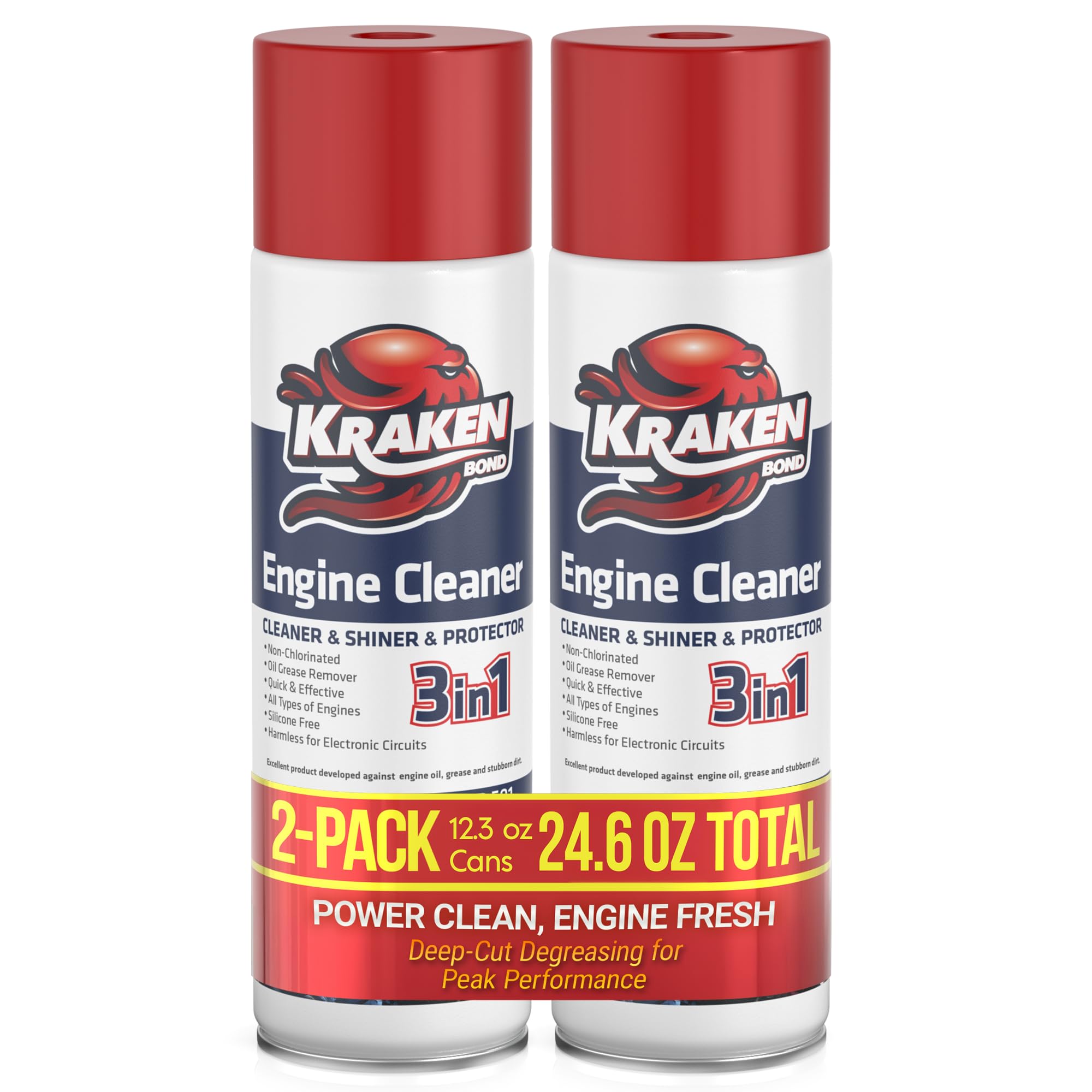
Two affordable cans that handle routine grease while staying affordable.
KRAKEN BOND delivers a 2-pack of 12.3 fl oz spray cans that are specifically designed to remove burned oil from around valve covers and dirt cooked onto the top of the engine cover. The product dimensions are compact at 2.55 x 5 x 9.25 inches — roughly half the footprint of the Oil Eater gallon below — making it easy to store in a trunk or garage shelf. The formula is harmless to electronic circuits and contains ozone-friendly propellants, so you do not need to worry about damaging the alternator or ECU connectors.
Owners mention that the instructions say never to spray on a hot engine, which is standard for almost all degreasers. For the price of a single fast-food meal, you get two full cans suitable for automobiles, motorcycles, and even lawnmower engines. Compared to the GUNK gel, this is a thinner spray that works best on warm (not hot) engines where the grease is soft enough to lift with a microfiber towel. The concentrated formula tackles tough jobs but does not have the cling of a gel, so expect to use more product on vertical surfaces.
What makes it worth it
- Very affordable 2-pack for budget-conscious buyers
- Safe on electronic circuits and wiring
- Compact can size fits in tight gloveboxes
What to watch for
- Thin spray runs off vertical surfaces — less dwell time than gel
- 2×12.3 fl oz total is less volume per dollar than gallon options
Great first-time buy: the low price and safety make it a no-regret trial for someone who has never cleaned an engine bay before.
Not your best bet if: you are detailing a high-mileage, oily engine that needs extended soaking time on vertical walls.
6. Oil Eater Original 32 oz All-Purpose Cleaner and Degreaser – Pack of 2

An ultra-concentrated cleaner that the USDA itself approves for kitchen grease too.
Oil Eater is not just an engine degreaser — it is a USDA-approved cleaner for food service facilities (ratings A1, A4, A8), which tells you how versatile the formula is. The 2-pack provides two 32 oz bottles that you can use on engines, stovetops, BBQs, driveways, laundry stains, and carpet spots. The product dimensions are 5.25 x 6.5 x 10 inches per bottle, giving you a package size that is noticeably larger than the KRAKEN BOND 2-pack (which is a 2.1x gap in box size).
The biodegradable formula contains no harsh solvents and is noncorrosive, so it will not damage paint or aluminum parts in your engine bay. Because it is ultra-concentrated, you can dilute it with water for lighter cleaning jobs like grills or patio furniture, and use it full-strength for engine degreasing. The major trade-off is that it is a liquid, not a gel, so on a grimy vertical engine wall, you may need to apply multiple coats or use a spray bottle with an aggressive nozzle to get the dwell time (the time the cleaner sits on the surface) you need.
Why people love it
- USDA-approved for food facilities — safe around kitchens
- Ultra-concentrated — dilute for light jobs, use full-strength for engines
- Biodegradable and noncorrosive, no harsh solvents
The trade-off
- Liquid consistency may run off vertical surfaces quickly
- Unscented — no added fragrance to cover the cleaning smell
Perfect if you clean more than just engines: use it on the BBQ, driveway oil stains, and garage tools from the same bottle.
Less ideal for dedicated engine detailers: a gel-style degreaser gives better results on vertical cylinder heads with one application.
7. Adam’s All Purpose Cleaner (16oz) – Professional Heavy Duty Industrial Cleaner & Degreaser

A versatile spray that weighs just over a pound and dilutes down for interior panels.
At only 1.1 pounds for the 16 oz bottle, Adam’s All Purpose Cleaner is the lightest product on this list — 7.8x lighter than the Spray Nine Grez-Off gallon. That makes it an easy grab-and-go option for a quick engine bay wipe-down without dragging a heavy jug out of the garage. The formula is built with Nano Technology (tiny cleaning particles) that lifts dirt, grime, and tar at a molecular level, according to the manufacturer. At full strength it cuts tough grease, and when diluted up to 90% it is gentle enough for body panels, interior carpet, and even leather.
Buyers mention this is a strong degreaser that removes bug splatters, tire brake dust, and engine grime with ease. However, compared to the GUNK gel or the Malco Red Thunder, this 16 oz bottle will run out faster if you are cleaning a large SUV or a heavily greased engine. It works best as an all-around detailer for light maintenance and interior use rather than a dedicated heavy-duty engine degreaser for low-maintenance cars.
What makes it useful
- Extremely light — easy to carry around the car during a detail
- Dilutable up to 90% for cleaning sensitive surfaces
- Versatile: engine bays, tires, leather, and even upholstery
Where it runs short
- 16 oz bottle is small for a fully soiled engine bay
- Thin liquid may require more product on vertical surfaces
Good for the casual detailer: the light bottle and dilutable formula let you clean the engine and then switch to interior panels without grabbing a second chemical.
Not the one for heavy engine sludge: you will run out of product quickly on a caked-on V8 or diesel engine.
Understanding the Specs
Gel vs. Liquid: Why Cling Time Matters
A gel formula (like the GUNK Engine Brite) is thicker and stays on the engine surface longer without dripping onto the ground. This gives the chemicals more time to dissolve grease. A liquid formula runs off faster, so you may need to apply more product or scrub sooner. For a vertical engine block, a gel typically means less waste and a more thorough clean.
Biodegradable and Solvent-Free Labels
A biodegradable degreaser (like Malco Red Thunder or Spray Nine Grez-Off) breaks down naturally when rinsed into a drain or soil, which matters if you live in an area with strict runoff regulations. Solvent-free formulas (like SONAX) avoid harsh petroleum-based chemicals, making them safer for rubber hoses, gaskets, and plastic engine covers that can otherwise become brittle over time.
FAQ
Can I spray any engine degreaser on a hot engine?
Will an engine degreaser damage my oxygen sensors?
Do I need to rinse the engine bay after using a degreaser?
Is it safe to use a gel degreaser on plastic engine covers?
Can I use a kitchen degreaser like Oil Eater on my car engine?
How much degreaser do I need to clean one engine bay?
What is the difference between an engine degreaser and an all-purpose cleaner?
Will degreaser harm my car’s paint if it drips onto the fender?
Final Thoughts: The Verdict
For most people, the degreaser for engine bay winner is the GUNK Engine Brite Gel because its thick gel sticks to vertical engine walls, safely dissolves grease on rubber and plastic, and comes from a brand with 75 years of engine-cleaning expertise. If you prefer a single gallon that cleans your engine, wheels, and interior carpets, grab the Malco Red Thunder. And for a budget-priced 2-pack that is safe on electronic circuits and handles routine engine maintenance without worry, the KRAKEN BOND Engine Cleaner is a solid pick.
How We Picked
We do not accept paid placement. Every pick is matched to a real buyer and a real use-case; we do not hands-on test units.
Sources & Methodology
Specifications: manufacturer listings and product documentation. Review insights: verified customer reviews, as of July 2026. Pricing: not shown on this page (it changes often); check the current price via the retailer link.
As an Amazon Associate, Trending Car earns from qualifying purchases. This does not affect which products we feature.