
Our readers keep the lights on and my garage snacks stocked. As an Amazon Associate, I earn from qualifying purchases.
Specs are compiled from manufacturer listings and verified buyer reviews and can change over time — please confirm the key details on the product page before buying.
Marine engines demand far more from a jump starter than a car does — between battery-draining electronics, damp storage compartments, and the sheer size of many boat motors, you need a unit that won’t quit after one try or short out near water. The right pick gets you back to the dock without a tow.
I’m Min Islam — the founder and writer behind Trending Car. This guide is built by comparing the manufacturers’ published specifications and the patterns across verified customer reviews, so you get each pick’s real strengths and trade-offs instead of marketing spin.
Whether you pilot a small outboard or a twin-diesel cabin cruiser, you need a battery pack that will not let you down in a chop — here is the breakdown of the very best jump starter for boats across every power tier and marine scenario.
Our Picks at a Glance

How To Choose The Best Jump Starter for Boats
A marine jump starter must handle bigger engines, damp lockers, and months of disuse. Here is what to look for.
Peak Amps vs Real-World Needs
Your boat’s engine needs enough cold-cranking amperage to spin over a heavy flywheel, especially when the battery is old or deeply discharged. For a small outboard (3.0L or less), a unit rated around 600 amps is usually enough. For twin V8s or a diesel inboard, you want 1250 amps or more — the extra reserve means you are not waiting for the battery to surface-charge between attempts.
Engine Displacement Limits Matter
Every jump starter lists a maximum engine size it can handle (e.g., “up to 8.0L gas and 6.0L diesel”). That is the most reliable number for matching a unit to your boat. If your boat’s total displacement is close to that limit, step up to the next tier so the jump starter isn’t working at its ragged edge every time you use it.
Lithium vs Lead-Acid
Lithium jump starters are dramatically lighter and hold their charge much longer between uses — both huge advantages on a boat where weight and infrequent use are real issues. The trade-off is cost: lead-acid units like the Schumacher SJ1329 are cheaper but weigh 7.8 pounds and need more frequent top-ups.
Safety & Build
Look for reverse polarity protection (spark-proof clamps that won’t send power unless hooked up correctly) and temperature protection. On a boat, also pay attention to how the unit is stored — a unit with a carrying case or that lies flat in a locker is much easier to keep dry and accessible.
Quick Comparison
| Model | Best For | Peak Amps | Weight | Battery Capacity | Amazon |
|---|---|---|---|---|---|
| Schumacher SL1562★ Best Overall | All-in-One + Air Compressor | 1200A | 4.7 lb | 12000 mAh | Amazon |
| CRAFTSMAN CMXCESM264Also Great | Best Overall Marine Pick | 1500A | 3.8 lb | 10000 mAh | Amazon |
| Antigravity XP-20-HD | High-Capacity Compact | 930A | 2.1 lb | 24000 mAh | Amazon |
| Schumacher SL1648 | Ultra-Thin Marine Backup | 1250A | 2.7 lb | 8000 mAh | Amazon |
| Battery Tender 030-1000-WH | Smallest / Budget Boat | 600A | 0.8 lb | 6400 mAh | Amazon |
In‑Depth Reviews
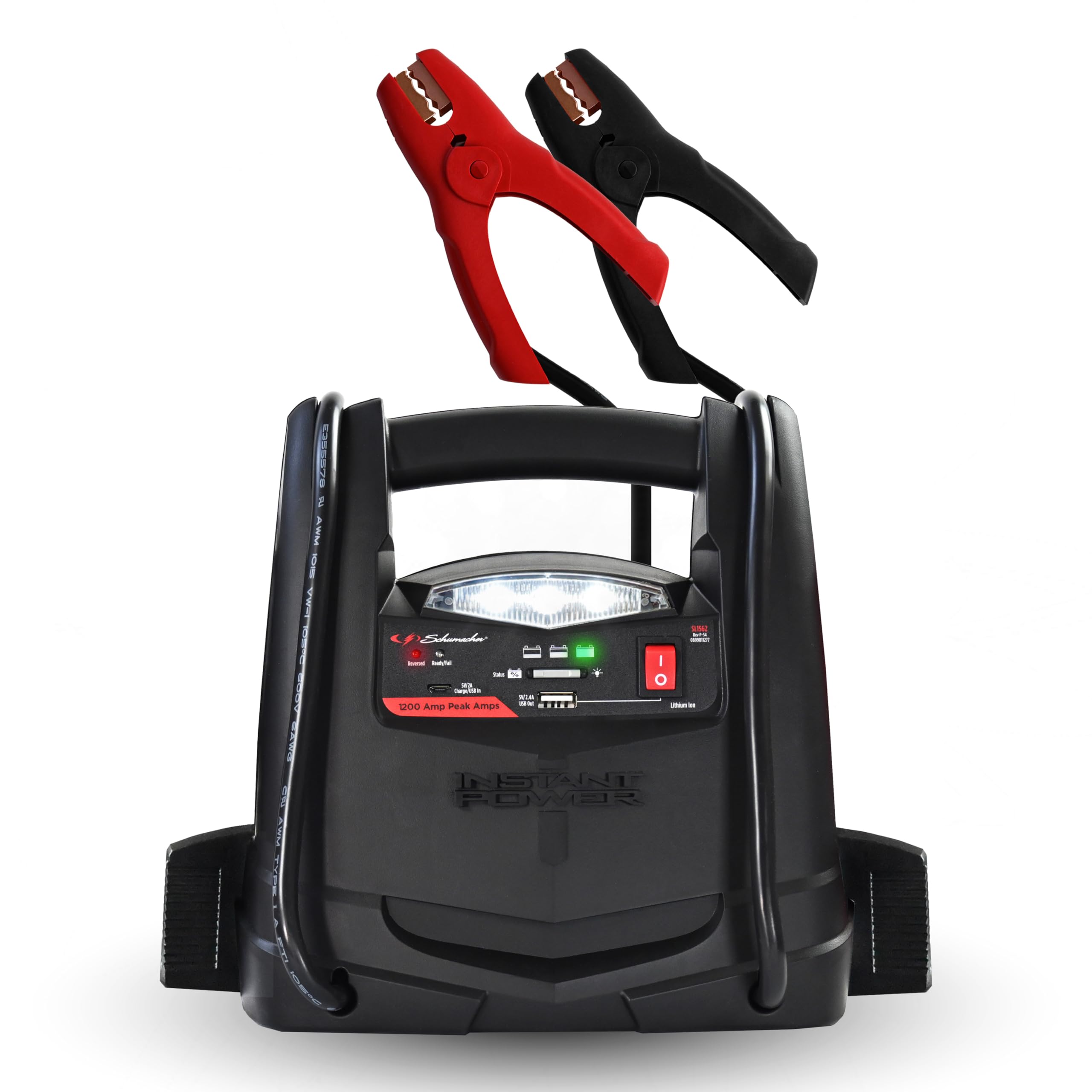
1. Schumacher Electric 1200A Lithium Jump Starter SL1562
Our pick — over 4★ from 400+ verified ratings; the strongest balance of quality and price.
The 4-in-1 marine companion with a 150-PSI air compressor for inflatables and tire leaks
This Schumacher SL1562 is a full 4-in-1 device: a 1200A jump starter, a 150-PSI air compressor with auto shut-off to prevent overheating, a 2.4A USB-A charger for devices, and an LED work light. The 12000 mAh lithium battery is rated for gas engines up to 8.0L and diesel engines up to 6.0L — covering the vast majority of recreational marine engines. It weighs 4.7 pounds, which is heavier than the pure jump-start units but understandable given the integrated compressor.
Reviewers point out it “jumped 2500 Ram diesel with 2 batteries after waiting a few minutes” and that it “works well; recharges easily.” The air compressor has been described as loud and slow but functional. The unit includes reverse polarity protection, short circuit protection, and temperature protection. Pre-Boost and Pre-Heat technology adds a pre-charge to warm up cold batteries for easier starting. Recharging the internal four-cell 44.4 Wh battery takes 3 to 4 hours. The package includes three air compressor adapters and a storage bag.
The main trade-off: the air compressor is not fast, and some buyers felt the unit was bulky compared to dedicated jump starters. However, if your boat has inflatable fenders or you tow a trailer, having the compressor onboard saves you from carrying a separate pump.
Reliable mid-range
- 150-PSI air compressor with thermal auto shut-off
- 1200A peak for 8.0L gas / 6.0L diesel marine engines
- Pre-Boost & Pre-Heat for cold batteries
- 12000 mAh battery with reverse polarity protection
Slower recharge
- 4.7 lb is heavier than pure jump-start units
- Compressor is loud and slow, per buyers
ideal for: Boaters who want a do-it-all unit — jump-start, inflate fenders, charge phones, and light up the deck — all from one device.
skip it for: Those who prioritize minimal weight and only need jump-starting power.
2. CRAFTSMAN 1500A Lithium Car Battery Jump Starter CMXCESM264
The 1500-amp CRAFTSMAN that muscles through 8.0L gas engines without breaking a sweat
This CRAFTSMAN delivers 1500 peak amps, enough to fire up 8.0L gas and 4.5L diesel engines — covering everything from a midsize bowrider to a twin-engine cruiser. The 10000 mAh lithium battery inside means you get multiple jump attempts before needing a recharge, and it weighs just 3.8 pounds, so it packs easily into a glove box or tackle locker.
On top of the jump-starting power, you get a 2.4A USB-A port for charging phones or a fish finder, plus an LED flashlight with three modes (steady, SOS, and strobe) that works as an emergency beacon on the water. Buyers report it is easy to use and holds its charge well between trips. The Pre-Boost and Pre-Heat technology give deeply discharged marine batteries a gentle wake-up current before the full crank, which prevents the sudden load that can trip a battery protector.
Recharging the internal four-cell 37 Wh battery takes about 3 hours with the included car charger or 5 to 6 hours via USB-C. The carrying case has built-in cable storage, so everything stays together in a damp locker. Compared to the Schumacher SL1562 below, this CRAFTSMAN offers 1500 peak amps compared to the Schumacher SL1562’s 1200, for roughly the same physical footprint, giving you a bigger safety margin for large marine engines.
Powerful compact starter
- 1500A peak handles big marine engines easily
- Lightweight 3.8-lb lithium design for boat storage
- Pre-Boost & Pre-Heat for deeply discharged batteries
- Carrying case with built-in cable storage
Limited battery capacity
- No air compressor — you need a separate pump for inflatables
best for most boaters: If you run gas engines up to 8.0L or a diesel up to 4.5L, this gives the best balance of raw starting power, portability, and price.
skip it for: Very large twin-diesel setups where 1500A may not leave enough reserve for a second attempt without recharging.
3. Antigravity XP-20-HD

A 2.1-pound lithium pack with 24000 mAh that fits in your boat’s smallest compartment
Despite its compact size (1.9″ deep x 4″ wide x 9.4″ tall), the XP-20-HD packs 24000 mAh — 24000 mAh capacity — but weighs only 2.1 pounds, making it the best power-to-weight ratio in this guide. It delivers 930 peak amps and is rated for gas engines up to 10.0L and diesel engines up to 8.0L. USB-C PD 100W fast charging means you can refill the unit from a compatible charger in about 2.5 hours from 77% to full, according to a buyer.
The unit includes a heavy-duty jumper cable set, a carrying case, and a USB-C charging cable, though customers note you need to supply your own USB-C wall charger (the unit does not include one). The LCD power display shows remaining battery life, so you always know whether it needs a top-up before heading out. An older model owner upgraded specifically for the higher amperage and confirmed it started a car in Boston at night, saving an hour-long AAA wait. The tactical light and 12VDC socket add camping and utility value beyond just jumping.
One trade-off: at 930A peak, this is less raw cranking amperage than the Schumacher 1250A units, but the enormous 24000 mAh capacity means it can crank longer before dropping voltage. Buyers recommend checking and topping off the charge every 4 months.
Versatile power bank
- 24000 mAh capacity at just 2.1 lb — class-leading density
- USB-C PD 100W fast charging input
- LCD battery status display
- 2-year manufacturer warranty
Premium price
- 930A peak is lower than most 1500A+ units
- Wall charger not included
grab it for: The best capacity-to-weight ratio — ideal for small boat lockers where every ounce matters but you still need multiple jump attempts.
skip it for: Very large twin-diesel setups where the lower peak amperage may struggle on the first crank.
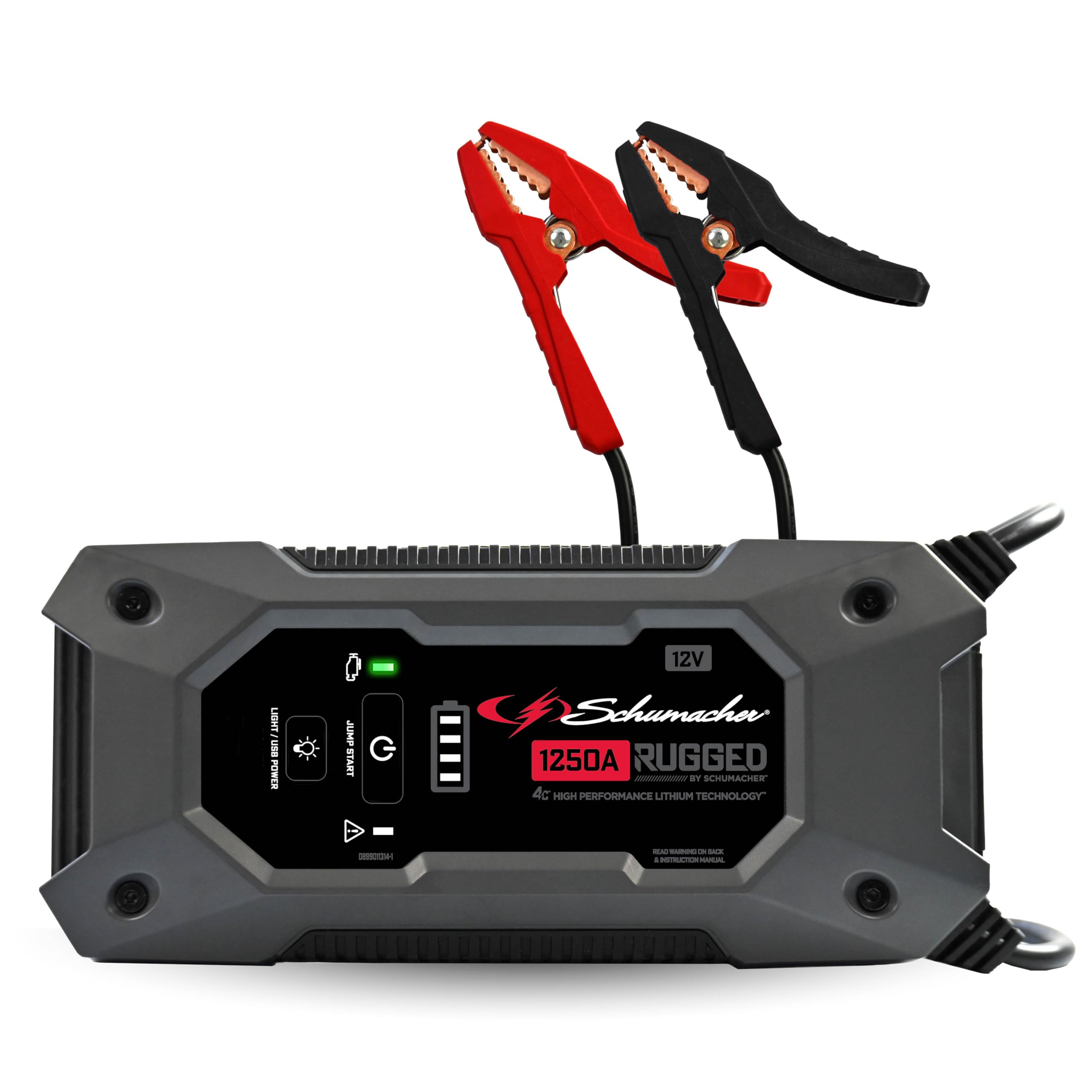
4. Schumacher Electric 1250A Rugged Lithium Jump Starter SL1648
A 1.75-inch-thin lithium booster that slips into a marine nav-station drawer
The SL1648 is the slimmest unit here at just 1.75 inches deep by 8.13 inches wide by 3.75 inches tall, making it easy to stow in a shallow boat locker or electronics compartment. It delivers 1250 peak amps versus the 600A Schumacher SJ1329 and is rated for gas engines up to 6.0L and diesel engines up to 3.0L — enough for most midsize sterndrives and outboards. It weighs 2.7 pounds.
Safety features include reverse polarity protection, short circuit protection, and temperature protection. A Jump Start Override Mode lets you manually jump deeply discharged low-voltage batteries that the sensors might not recognize, which is useful for a boat battery that has sat all winter. The LED flashlight has steady, SOS, and strobe modes. Pre-Boost and Pre-Heat technology helps warm a cold marine battery. Shoppers say it starts diesels and V8s, and one owner uses it for a RAV4 Hybrid, noting the “longer, heavier cables reach RAV4 Hybrid ground.”
Recharge the internal four-cell 29.6 Wh lithium battery in 4-5 hours by USB or 2 hours with the included DC car charger. Compared to the CRAFTSMAN 1500A, this unit has fewer peak amps (1250 vs 1500) but at a noticeably slimmer profile for tight storage spaces. The battery capacity is 8000 mAh, so expect fewer jump attempts before needing to recharge than the 10000 mAh CRAFTSMAN.
Rugged construction
- Ultra-slim 1.75″ profile for tight lockers
- 1250A peak handles 6.0L gas and 3.0L diesel
- Jump Start Override for deeply discharged batteries
- 2-hour DC car charger recharge
Heavy weight
- 8000 mAh battery is smaller than other mid-range units
- No air compressor or 12V outlet
reach for this if: Storage space on your boat is extremely tight — it is the thinnest unit here and still carries real 1250A starting power.
consider the craftsman instead: You want more peak amps and a larger battery reserve for roughly the same price.
5. Battery Tender 600 AMP Lithium Jump Starter 030-1000-WH

The 0.8-pound featherweight that still wakes up a V6 — small enough for any boat
At just 0.8 pounds, the Battery Tender 030-1000-WH is the lightest jump starter in this roundup — at 0.8 pounds versus the Schumacher SJ1329 at 7.8 pounds. It delivers 600 peak amps and is designed for 12-volt batteries in gas and diesel engines up to a V6, making it ideal for smaller outboards, personal watercraft, and runabouts. The 6400 mAh lithium-ion battery is compact enough to slide into a lifejacket pocket or console cubby.
The unit features spark-proof and reverse polarity protection — no charge is sent unless the alligator clips are connected securely and correctly. It includes input and output USB-C, plus USB 2.4A and USB 2A quick charging ports, a 12V DC output, and a 12V jump start port. The soft carrying case stores the jump starter and accessories neatly. Buyers report it works well for 2.0L diesels and V6 engines but note the short clamps are solid and the rubberized grip is handy. One reviewer called it “compact with enough power for everyday emergencies.”
The main limitation: at 600A and a V6 maximum, it is not suitable for large marine diesels or big-block gas inboards. It also does not include a wall charger; it charges via USB-C. For a small dinghy or a 4-stroke outboard, this is an almost weightless safety net.
Compact and portable
- 0.8 lb — lightest option, disappears in any bag
- Spark-proof and reverse polarity protection
- USB-C input/output plus standard USB ports
- Soft carrying case included
Lower peak amps
- 600A max — not for V8s or marine diesels
- No wall charger included
ideal for: Small boats, jet skis, and low-horsepower outboards where every ounce of gear matters and you just need a basic safety net.
skip it for: Any engine larger than a V6 — step up to the CRAFTSMAN 1500A or Schumacher SL1648 for real marine insurance.
Understanding the Specs
Peak Amps (Cranking Power)
This is the maximum current the jump starter can deliver in a short burst to crank the engine. For a boat, more is generally better because marine engines often have heavier flywheels and may sit for weeks. A 600A unit works for small outboards and V6s; 1200A+ is the balance for midsize sterndrives and V8s; 3000A is for large diesels and twin-engine setups. The peak amps number tells you the raw turning force the unit can apply.
Battery Capacity (mAh)
This tells you how much energy the jump starter stores — like the size of its fuel tank. A higher mAh number means more jump-start attempts before the unit needs recharging. For example, 6400 mAh is enough for a few small-engine starts, while 26800 mAh can handle multiple heavy cranks. On a boat without daily shore power, higher mAh capacity ensures multiple jump attempts.
Engine Displacement Limits
Every marine jump starter lists a maximum engine size (e.g., “up to 8.0L gas and 6.0L diesel”). This is the single most reliable guide for matching a unit to your boat. If your boat’s total displacement is close to that limit, the jump starter has to work hard and may need a cooldown between attempts. Choose a unit rated well above your engine size for a comfortable margin.
Lithium vs Lead-Acid
Lithium units (like the CRAFTSMAN, Antigravity, and most Schumacher models) are much lighter, hold a charge longer in storage, and recharge faster. Lead-acid units (like the Schumacher SJ1329) are heavier and cheaper but more rugged and compatible with every battery chemistry. For boats, lithium is the smarter choice unless you need a low-cost dock-box beater.
FAQ
Can I use a car jump starter on my boat?
How many amps do I need to jump start a boat engine?
Will a lithium jump starter work with a deep-cycle marine battery?
How often should I recharge the jump starter if I store it on the boat?
Is it safe to use a jump starter in a damp marine environment?
What is the difference between peak amps and cranking amps?
Can I jump start a boat engine that has been sitting all winter?
Which jump starter is best for a small inflatable boat with an outboard?
Final Thoughts: The Verdict
For most boaters, the best jump starter for boats is the CRAFTSMAN 1500A because it delivers serious 1500-amp starting power for 8.0L gas and 4.5L diesel marine engines in a portable 3.8-pound lithium package with USB charging and a versatile LED light. And for a tiny backup that disappears into any locker, the Battery Tender 600A gives you a lightweight 0.8-pound safety net for small outboards and runabouts.
How We Picked
We do not accept paid placement. Every pick is matched to a real buyer and a real use-case; we do not hands-on test units.
Sources & Methodology
Specifications: manufacturer listings and product documentation. Review insights: verified customer reviews, as of July 2026. Pricing: not shown on this page (it changes often); check the current price via the retailer link.
As an Amazon Associate, Trending Car earns from qualifying purchases. This does not affect which products we feature.