
Our readers keep the lights on and my garage snacks stocked. As an Amazon Associate, I earn from qualifying purchases.
Specs are compiled from manufacturer listings and verified buyer reviews and can change over time — please confirm the key details on the product page before buying.
Your diesel truck, van, or SUV is hard to start on a cold morning, or you are tired of that clattery idle noise. The oil you pour in is the single biggest lever you can pull. The wrong viscosity (thickness when cold vs hot) or a conventional formula can leave sludge inside your engine, wear out the valve train (the parts that open and close the valves), and choke your emissions gear like the DPF. The right full synthetic, matched to your engine’s age and your climate, transforms cold cranking, quiets the valvetrain, and keeps soot under control for the full drain interval.
I’m Min Islam — the founder and writer behind Trending Car. This guide is built by comparing the manufacturers’ published specifications and the patterns across verified customer reviews, so you get each pick’s real strengths and trade-offs instead of marketing spin.
Finding the right engine oil for diesel depends on matching the viscosity grade (like 5W-40 vs 15W-40), the API certification standard, and the synthetic base stock to your specific engine’s demands and your climate. This matters whether you drive a heavy-duty pickup, a European turbo-diesel car, or a fleet truck that racks up miles daily.
Our Picks at a Glance

How To Choose The Best Engine Oil for Diesel
Picking the right diesel engine oil is not just about grabbing a gallon off the shelf. The wrong choice can lead to sluggish starts in winter, excessive soot buildup in the crankcase (the lower part of the engine where the crankshaft spins), or even damage to the diesel particulate filter (DPF — a device that traps soot from the exhaust) in newer trucks. Here are the three things you need to get right.
Viscosity Grade: The “Thickness” That Matters
The SAE J300 viscosity grade (the official standard for oil thickness) tells you how the oil flows at different temperatures. A 5W-40 grade flows like a thin 5-weight oil in the cold (the “W” stands for winter), so it cranks faster at low temperatures, then thickens to a 40-weight at operating temperature for high-load protection. A 15W-40 is thicker when cold, better suited to hot climates or older engines with looser internal tolerances. If you regularly deal with sub-zero starts, a 5W-40 is usually the smarter choice because it pumps faster to critical engine parts.
API CK-4 vs CJ-4 Certification
The API (American Petroleum Institute) service category tells you which emissions systems the oil is safe for. CK-4 is the current standard for 2017-and-newer diesel engines with exhaust after-treatment gear like DPF and SCR (selective catalytic reduction). It is backward-compatible with CJ-4, so a CK-4 oil works in older engines too. CJ-4 oils, however, may not provide enough protection for the latest low-emission engines. Always check your owner’s manual for the required API level to avoid costly repairs.
Full Synthetic vs Conventional
Full synthetic oil is chemically engineered from base stocks that resist viscosity breakdown under high heat and flow better in the cold than a conventional or semi-synthetic blend made from crude oil. The trade-off is cost — synthetic costs more per gallon. But when you factor in the longer drain intervals and reduced wear, many drivers find the premium worth it, especially for turbocharged engines that run hotter and put more stress on the oil film.
Quick Comparison
| Model | Best For | Viscosity Grade | API Rating | Volume | Amazon |
|---|---|---|---|---|---|
| Mobil 1 Turbo Diesel Truck★ Best Overall | Cold-start confidence in light trucks & vans | 5W-40 | CK-4 | 1 Gal (3.8 L) | Amazon |
| Triax Fleet SupremeAlso Great | Extreme cold starts & extended drains | 15W-40 | CK-4 | 1 Gal | Amazon |
| Valvoline Heavy Duty Full Synthetic | Budget-friendly full synthetic for daily drivers | 15W-40 | CK-4 | 1 Gal | Amazon |
| Lucas Oil Heavy Duty | Quieting older engines at a moderate price | 15W-40 | CK-4 | 1 Gal | Amazon |
| Delo 400 XSP Synthetic | Smooth idle & cooler crankcase temps | 5W-40 | CK-4 | 1 Gal | Amazon |
| Schaeffer SynShield OTR Plus | Ultra-long drains with oil analysis backup | 5W-40 | CK-4 | 1 Gal | Amazon |
| Motul 8100 X-clean | European turbo-diesel cars with DPFs | 5W-40 | ACEA C3 / dexos2 | 5 L | Amazon |
In‑Depth Reviews
1. Mobil 1 Turbo Diesel Truck Full Synthetic Motor Oil 5W-40
Our pick — over 4.5★ from 700+ verified ratings; the strongest balance of quality and price.
A cold diesel van fires up instantly with this jug, even when every other oil leaves you cranking.
One buyer summed it up: “My Diesel van started in very cold weather like most diesel do. Since I been using this oil, it fires right up without hesitation. I drive about 3000 miles a week and don’t have every issue.” That 5W-40 winter rating — a 3.0x viscosity gap versus a thicker 15W-40 — is the reason. At a flash point (the temperature at which oil vapor can ignite) of 234 degrees Celsius, it resists burning off under high-temperature load. It meets CK-4 and earlier API standards for mixed fleet use, which means it works in various diesel engines and years.
Another reviewer directly compared it to a premium Amsoil 5W-30 and reported the Mobil 1 made his 4N15 turbo diesel quieter and smoother, while coming in at a lower price. The universal-fit jug works in light trucks, heavy-duty vans, and some passenger-grade diesel SUVs. The main catch: the manufacturer describes it as designed for “super high-performance diesel applications including low emission engines,” but some owners of older high-mileage engines with looser tolerances may prefer a 15W-40 for a thicker film at idle. Still, at this price point and reputation — 706 ratings with a 4.8 average — it is the easiest recommendation for a daily-driven diesel truck or van that sees four-season weather.
Why It Stands Out
- 5W-40 flows thin in winter for reliable cold starts, as buyers confirm on high-mileage vans
- Meets CK-4 standards for modern low-emission diesel engines and mixed fleet use
- Owners mention it runs quieter and smoother than Amsoil 5W-30 in turbo diesel engines
One Consideration
- Older engines with looser clearances may benefit more from a 15W-40 for added film thickness
Grab this for: a diesel truck or van in a four-season climate where you want reliable cold starts without overspending.
skip it if: your high-mileage engine has looser clearances and calls for a heavier winter viscosity.
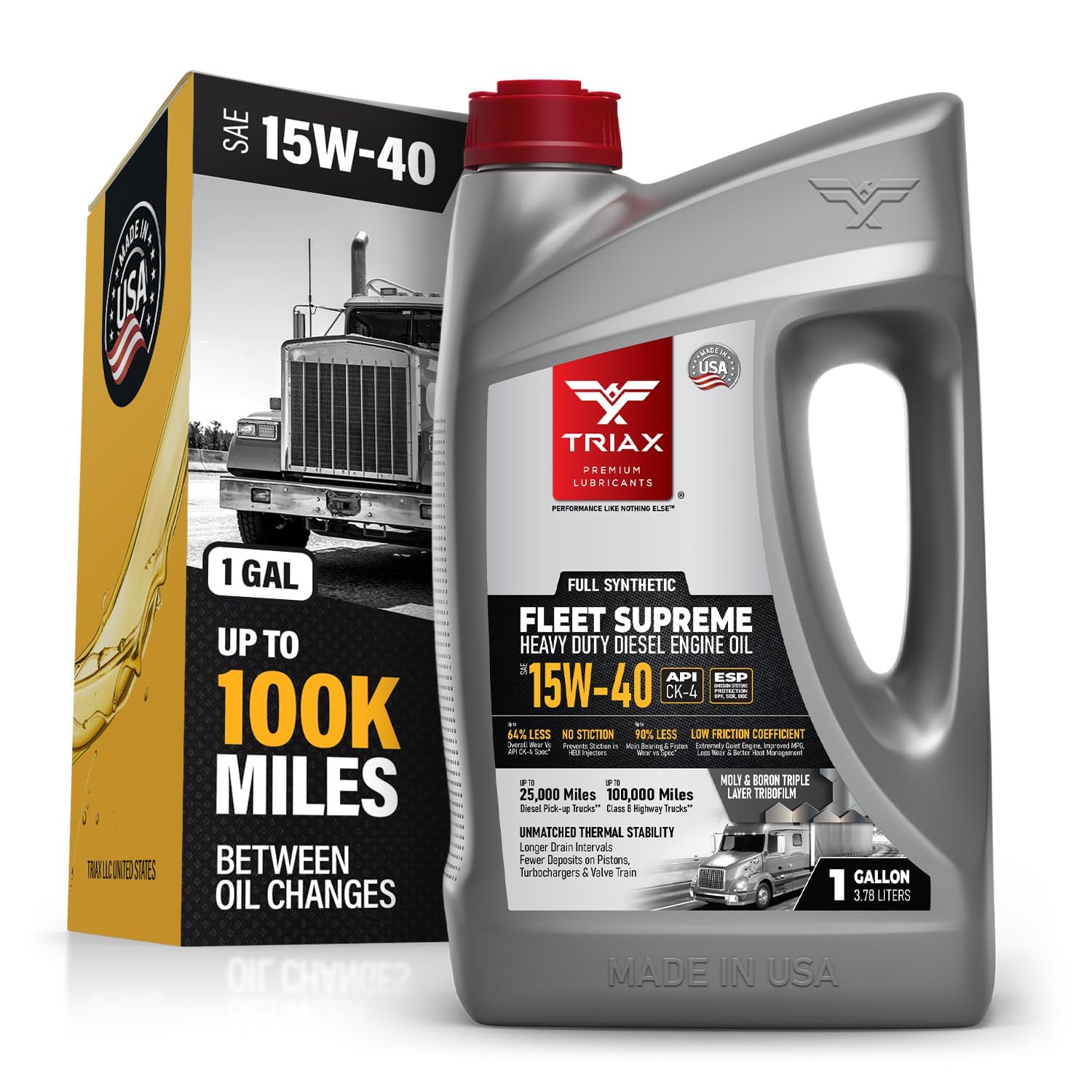
2. Triax Fleet Supreme 15W-40 API CK-4 Full Synthetic Heavy Duty Diesel Engine Oil
It turns sub-zero cranking into a non-event and stretches oil changes past 100,000 miles in highway rigs because of its moly and boron friction modifiers.
You have watched a diesel struggle to turn over at -20°F. That is why the Triax’s extended-drain claim matters. The maker states it is capable of drain intervals exceeding 100,000 miles for highway trucks and 30,000 miles for Super Duty pickups. That puts it in a different league from most gallon jugs on the shelf. The secret is the moly and boron friction modifiers (chemicals that reduce friction between moving metal parts). Triax says these deliver up to 48% lower wear than OEM (original equipment manufacturer) standards and a friction coefficient 50% lower than typical competition. One reviewer noted that after 15,250 miles, an oil analysis (a lab test of the used oil) showed less than 15-20% additive depletion and viscosity still holding in the 15W-40 spec with no stabilizer needed.
The trade-off is that this is a 15W-40, not a 5W-40. So the cold-flow advantage comes from the synthetic base and additives rather than a thinner winter rating. Buyers report the engine idles smoother and oil temperature runs 8 to 10 degrees cooler — a welcome change for a hard-towing Powerstroke. Unlike the more budget-friendly Lucas Oil, the Triax carries real extended-drain data from customer oil analysis. It is for a driver who runs a heavy-duty pickup or semi and wants to push drain intervals past the 15,000-mile mark without losing sleep.
What Makes It a Standout
- Rated for drain intervals over 100,000 miles in highway trucks and 30,000 miles in heavy-duty pickups
- Moly and boron friction modifiers cut friction coefficient 50% lower than the competition per the maker
- Buyers confirm excellent cold-start performance at -20°F with additive depletion under 20% at 15,250 miles
What to Keep in Mind
- 15W-40 winter rating is thicker than 5W-40 options for extreme sub-zero cranking
- Premium price puts it above most mid-range gallon options
Buy this for: a heavy-duty diesel pickup or semi if you want lab-verified long drain intervals with friction-modified wear protection.
Buy a 5W-40 instead if: your truck faces -30°F winters and you need the thinnest possible cold-flow oil.
3. Delo 400 XSP SAE Heavy Duty Synthetic Diesel Engine Oil 5W-40

Customers note the MOS2 additive in this Chevron synthetic drops crankcase temperature by 30°F and quietens the idle noticeably.
What sets the Delo 400 XSP apart is the MOS2 (molybdenum disulfide, an extreme-pressure lubricant) that clings to metal surfaces. One buyer mentioned their engine idles quieter and smoother, and the crankcase runs 30°F cooler thanks to the MOS2. They also said “oil stays thick unlike Mobil 1/Castrol” — meaning the oil holds its viscosity under heat rather than shearing thin. The 5W-40 rating also helps cold starts: the same buyer noted “first pull vs multiple pulls” on small engines.
The catch some buyers point to is that this oil needs a longer warm-up before the flow is fully smooth compared to Rotella or Mobil 1. That is typical of a high-viscosity-index synthetic with strong EP additives. However, the combination of cooler operating temps and quieter valvetrain makes it a strong choice for anyone who tows heavy loads and monitors oil temperature closely. It is also SN-rated (a gasoline engine oil standard), so it works in gasoline turbo engines too — one buyer ran it 7,500 miles in a Mazda CX-5 turbo with zero oil consumption.
What You Get
- MOS2 additive helps reduce crankcase temperature by 30°F according to buyer reports
- 5W-40 winter rating provides reliable cold starts, even in small engines
- SN-rated for diesel and gasoline turbo engines, as one buyer confirmed in a Mazda CX-5 turbo
What to Note
- Requires more warm-up time for smooth flow compared to Rotella or Mobil 1
- Premium price point sits above mid-range options
Pick this for: a heavy-towing truck or engine where you monitor oil temps and want the MOS2 cooling effect.
Not for you if: you need the absolute fastest warm-up flow and dislike a longer idle warm-up.
4. Schaeffer Manufacturing Co. SynShield OTR Plus Full Synthetic Diesel Engine Oil 5W-40

One owner runs this oil to 20,000 miles with lab tests still showing it in good shape.
Schaeffer’s SynShield has a cult following among diesel owners who run oil analysis. One owner reported: “With oil testing, I run this oil to 20k miles and it still tests good. 10k oil filter changes. Highest EP additive molybdenum in oils that I found.” Another owner who inherited a poorly maintained 6.0 Powerstroke found that switching to Schaeffer’s 5W-40 with a Motorcraft filter cut his start time in half after just 100 miles. The SAE 5W-40 grade is key: it provides the cold-weather flow of a 5-weight while maintaining a 40-weight hot film for high-load protection.
The downside is the price tag, which sits at the higher end of this list. But for someone who runs 50,000 miles a year — as one buyer with a 2024 6.7 Cummins does — the value swings back when you change oil half as often. The maker claims it “maintains fuel economy without sacrificing engine durability” and “withstands higher heat range than conventional oils.” Unlike the Triax, which uses moly and boron, Schaeffer relies on a very high molybdenum content for extreme-pressure wear protection. Buyers consistently recommend it for extended drain intervals where you monitor via lab analysis.
Why It’s a Favorite
- Reviewers point out running to 20,000 miles with oil analysis still showing good condition
- Highest molybdenum EP additive among tested oils per customer feedback
- 5W-40 provides cold-flow ease plus high-heat film strength for heavy-duty use
What to Know
- Premium price per gallon is the highest of the domestic heavy-duty options
- Best value achieved only if you run long drain intervals with oil analysis
Best suited for: high-mileage drivers (50k+ per year) who use oil analysis to push drains confidently.
Not the best pick if: you change oil every 5,000 miles and will not recoup the cost of the extended-drain chemistry.
5. Motul 8100 X-clean 5W-40 Full Synthetic Motor Oil (5L)

This 5-liter jug is built for European turbo-diesel cars that need a low-SAPS formulation to protect the DPF from clogging.
The Motul 8100 X-clean carries a Mid SAPS (a formula with controlled levels of sulfated ash, phosphorus, and sulfur) that produces fewer deposits to clog a diesel particulate filter (DPF) or catalytic converter. It meets ACEA C3 (a European oil standard) and GM dexos2 standards, and is approved for Mercedes-Benz 229.51, VW 505 00 / 505 01, and Renault specs. This makes it the top pick for modern European diesel sedans, SUVs, and vans where a typical heavy-duty CK-4 oil is too high in ash. One owner uses it in both a VW Touareg and a Porsche Boxster, reporting “smooth operation, quiet startup, and consistent performance across all temperatures.”
The 5-liter bottle size is a practical detail — one customer observed it is nearly the perfect amount for a Subaru EJ25, eliminating the gallon-plus-fraction problem. The liquid volume is 5 liters vs the 1-gallon jugs of the other picks. The catch: this oil is not CK-4 certified, so it is not designed for a heavy-duty diesel pickup’s extended drain or extreme soot loading. It is a passenger-vehicle and light-commercial formulation. Buyers confirm it works well in high-performance turbo engines — one ran it for three years in a 2017 Camaro SS without issues. If you drive a European diesel car or a DPF-equipped SUV, this formulation keeps the emissions system clean.
What Makes It Different
- Mid SAPS formula protects DPF and catalytic converters from ash blockages
- OEM approvals cover Mercedes-Benz, VW, BMW, Fiat, and Ford for European vehicles
- 5-liter bottle is a convenient single-fill size for many European and Japanese engines
What to Watch For
- Not API CK-4 certified, so not intended for heavy-duty pickup extended-drain service
- Higher cost per liter than bulk heavy-duty gallon jugs
Get this if: you own a European diesel car or SUV with a DPF and need a low-SAPS ACEA C3 oil.
Not for you if: you drive a heavy-duty diesel pickup that requires API CK-4 and extended-drain capability.
6. Valvoline Heavy Duty Full Synthetic 15W-40 Diesel Engine Oil
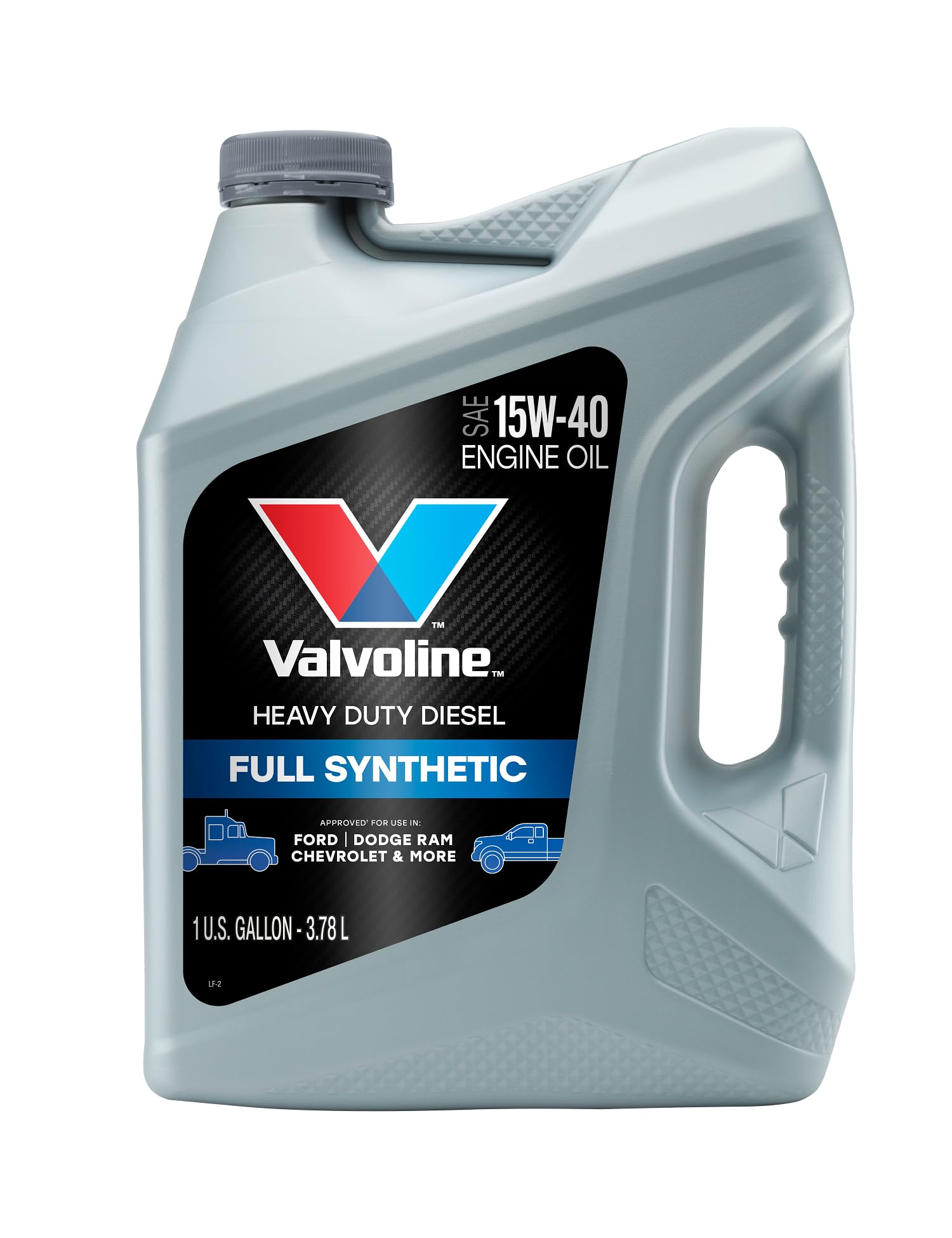
This full synthetic CK-4 delivers a 35% reduction in valve train wear at a price that beats most competitors.
Valvoline claims this formula delivers a 35% reduction in valve train wear vs. industry standards, as tested in the Cummins ISB engine test, and up to 28% longer oil life vs. standards in the Volvo T-13 test. Those are concrete numbers out of a mid-range price jug, which is unusual at this tier. The 15W-40 viscosity is the standard for many over-the-road trucks and older pickups — it provides a thick oil film at operating temperature that handles high soot loading. One buyer simply said it is “perfect for a 5.9 Cummins.” The CK-4 certification means it is safe for 2017-and-newer trucks with DPFs, and it is backward-compatible with CJ-4 and the older CH-4 engine standards.
The trade-off is that at 15W-40, it does not have the cold-flow advantage of the 5W-40 synthetic options. If your winter starts are regularly below 0°F, you will notice a difference when cranking compared to a 5W-40. But for moderate climates or summer-heavy driving, this is the most cost-effective full synthetic with test-backed wear numbers. Shoppers say a “great value and even better diesel oil” at a price that sits below most of the synthetic competition. It is a smart default for a 5.9 Cummins or similar workhorse engine that does not see extreme cold.
What Makes It a Value Pick
- Full synthetic CK-4 at a price point below most premium synthetic jugs
- 35% reduction in valve train wear vs. industry standards per the maker’s Cummins ISB testing
- Compatible with a wide range of OEM specs including Cummins, Ford, Volvo, Detroit Diesel, and Caterpillar
What to Consider
- 15W-40 winter rating means slower cold starts than 5W-40 synthetics in sub-zero climates
Reach for this: for a daily-driven diesel pickup or fleet truck in moderate climates if you want full synthetic protection without the premium price.
Think twice if: you regularly start below 0°F and need a thinner winter oil for reliable cranking.
7. Lucas Oil 10287 SAE 15W-40 API CK-4 Heavy Duty Motor Oil
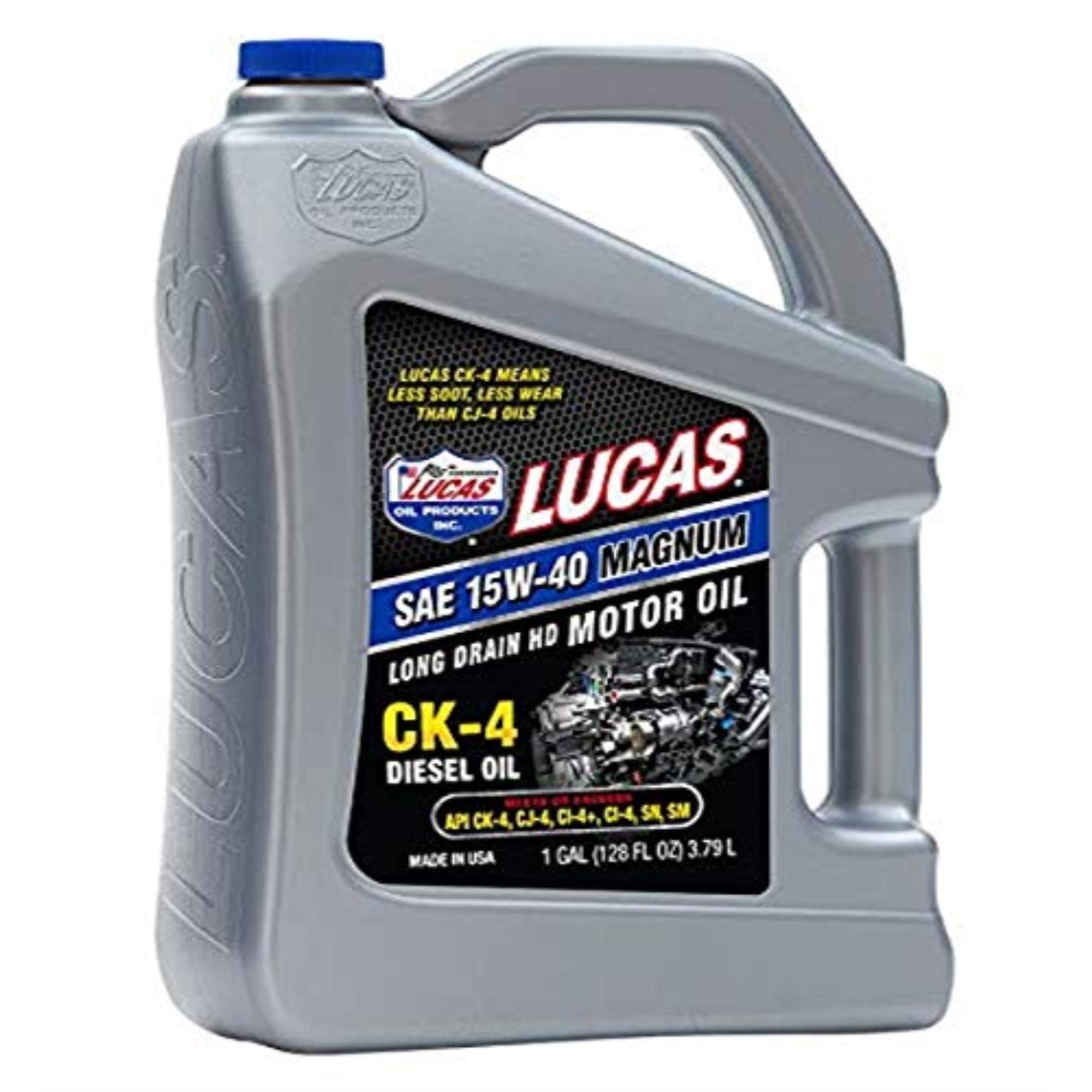
One user highlighted this gallon made a 45-year-old diesel motor in a classic truck sound quieter and run smoother.
One shopper added: “Amazing! Makes the 45 year diesel motor in my truck sound quieter and run smoother. No placebo, just daily driving it.” The Lucas Oil 15W-40 is a CK-4-certified conventional-plus formulation that focuses on reducing engine noise and extending engine life. It shows up in a variety of equipment — buyers use it in John Deere walk-behind mowers, backhoes, and Dixie Chopper mowers as well as pickup trucks. That speaks to its universal compatibility across diesel engines. The 128-fluid-ounce jug weighs 3.55 kilograms and is a standard heavy-duty gallon.
The catch is that Lucas does not publish the same detailed wear-reduction or extended-drain data that Triax or Schaeffer do. If you need lab-backed long-drain certainty, the higher-tier synthetics are a better fit. But if you have an older diesel — a farm tractor, a classic pickup, or a backhoe — and you want a solid CK-4 oil that quietens the valvetrain without a huge investment, this is a proven gallon. Buyers across multiple engine types report consistent satisfaction, and the price lands in the mid-range, making it a safe budget-friendly choice for non-severe use.
What It Does Well
- Buyers report noticeably quieter idle and smoother running in older diesel engines
- CK-4 certification means it is safe for newer emissions equipment too
- Works across a wide range of equipment — from pickups to mowers to backhoes
What Is Missing
- No published extended-drain or wear-reduction data comparable to premium synthetics
- 15W-40 viscosity is not ideal for extreme cold-start conditions
A solid choice for: older diesel engines, farm equipment, or classic pickups where quieting a noisy valvetrain is the priority over extended drain intervals.
pass on it if: you rely on oil analysis for long drain intervals and need manufacturer-backed extended-drain data.
Understanding the Specs
SAE J300 Viscosity Grade
This is the standard that rates how thin or thick the oil is at different temperatures. The first number followed by a “W” (like 5W) tells you the cold-weather flow — a lower number means easier cranking in winter. The second number (like 40) tells you the oil’s thickness at 212°F operating temperature — a higher number means a stronger oil film under heavy loads. A 5W-40 flows thin when cold for easy starts but thickens up for towing, while a 15W-40 is thicker all around and better for hot climates or older engines with looser clearances.
API CK-4 and Low SAPS
The API (American Petroleum Institute) service category on the bottle tells you what emissions equipment the oil is safe for. CK-4 is the latest heavy-duty diesel standard, designed for 2017-and-newer engines with diesel particulate filters (DPF) and selective catalytic reduction (SCR). It replaces CJ-4 and works backward in older engines. Low SAPS and Mid SAPS refer to the levels of sulfated ash, phosphorus, and sulfur — these numbers matter because high ash can clog a DPF. For European diesel cars, you will often see ACEA C3 instead of API CK-4, which is a similar low-ash standard.
FAQ
Can I use a 5W-40 diesel oil in an engine that normally takes 15W-40?
What is the difference between API CK-4 and CJ-4 diesel oil?
How often should I change full synthetic diesel engine oil?
Can I use diesel engine oil in a gasoline engine?
What does the flash point temperature mean in diesel engine oil?
Is a 15W-40 synthetic better for towing than a 5W-40?
What is the difference between full synthetic and conventional diesel oil?
Will a low-SAPS or Mid-SAPS oil work in my older diesel truck?
Final Thoughts: The Verdict
For the majority of shoppers, the engine oil for diesel winner is the Triax Fleet Supreme 15W-40 because the moly-boron friction modification and verified extended-drain data make it a genuine step up from the competition for anyone who tows or racks up highway miles. If you want the most reliable cold-start performance for a daily-driven diesel van or truck, grab the {“@context”: “https://schema.org”, “@graph”: [{“@type”: “ItemList”, “name”: “7 Best Engine Oil for Diesel”, “url”: “https://trendingcar.com/best-engine-oil-for-diesel/”, “numberOfItems”: 7, “itemListElement”: [{“@type”: “ListItem”, “position”: 1, “name”: “Mobil 1 Turbo Diesel Truck Full Synthetic Motor Oil 5W-40”, “url”: “https://trendingcar.com/best-engine-oil-for-diesel/#product-2”}, {“@type”: “ListItem”, “position”: 2, “name”: “Triax Fleet Supreme 15W-40 API CK-4 Full Synthetic Heavy Duty Diesel Engine Oil”, “url”: “https://trendingcar.com/best-engine-oil-for-diesel/#product-1”}, {“@type”: “ListItem”, “position”: 3, “name”: “Delo 400 XSP SAE Heavy Duty Synthetic Diesel Engine Oil 5W-40”, “url”: “https://trendingcar.com/best-engine-oil-for-diesel/#product-3”}, {“@type”: “ListItem”, “position”: 4, “name”: “Schaeffer Manufacturing Co. SynShield OTR Plus Full Synthetic Diesel Engine Oil 5W-40”, “url”: “https://trendingcar.com/best-engine-oil-for-diesel/#product-4”}, {“@type”: “ListItem”, “position”: 5, “name”: “Motul 8100 X-clean 5W-40 Full Synthetic Motor Oil (5L)”, “url”: “https://trendingcar.com/best-engine-oil-for-diesel/#product-5”}, {“@type”: “ListItem”, “position”: 6, “name”: “Valvoline Heavy Duty Full Synthetic 15W-40 Diesel Engine Oil”, “url”: “https://trendingcar.com/best-engine-oil-for-diesel/#product-6”}, {“@type”: “ListItem”, “position”: 7, “name”: “Lucas Oil 10287 SAE 15W-40 API CK-4 Heavy Duty Motor Oil”, “url”: “https://trendingcar.com/best-engine-oil-for-diesel/#product-7”}]}, {“@type”: “Product”, “position”: 1, “name”: “Mobil 1 Turbo Diesel Truck Full Synthetic Motor Oil 5W-40”, “image”: “https://m.media-amazon.com/images/I/71Wv9jDDozL.jpg”, “brand”: {“@type”: “Brand”, “name”: “Mobil”}, “url”: “https://www.amazon.com/dp/B003EQ85IG/?tag=tcarmin-20”, “offers”: {“@type”: “Offer”, “url”: “https://www.amazon.com/dp/B003EQ85IG/?tag=tcarmin-20”}}, {“@type”: “Product”, “position”: 2, “name”: “Triax Fleet Supreme 15W-40 API CK-4 Full Synthetic Heavy Duty Diesel Engine Oil”, “image”: “https://m.media-amazon.com/images/I/71Tplp38jHL.jpg”, “brand”: {“@type”: “Brand”, “name”: “Triax”}, “url”: “https://www.amazon.com/dp/B07MMYN4WH/?tag=tcarmin-20”, “offers”: {“@type”: “Offer”, “url”: “https://www.amazon.com/dp/B07MMYN4WH/?tag=tcarmin-20”}}, {“@type”: “Product”, “position”: 3, “name”: “Delo 400 XSP SAE Heavy Duty Synthetic Diesel Engine Oil 5W-40”, “image”: “https://m.media-amazon.com/images/I/81Z9SwbBKaL.jpg”, “brand”: {“@type”: “Brand”, “name”: “Delo”}, “url”: “https://www.amazon.com/dp/B0097SBCB2/?tag=tcarmin-20”, “offers”: {“@type”: “Offer”, “url”: “https://www.amazon.com/dp/B0097SBCB2/?tag=tcarmin-20”}}, {“@type”: “Product”, “position”: 4, “name”: “Schaeffer Manufacturing Co. SynShield OTR Plus Full Synthetic Diesel Engine Oil 5W-40”, “image”: “https://m.media-amazon.com/images/I/815boV+qhiL.jpg”, “brand”: {“@type”: “Brand”, “name”: “Schaeffer”}, “url”: “https://www.amazon.com/dp/B08BW72P1H/?tag=tcarmin-20”, “offers”: {“@type”: “Offer”, “url”: “https://www.amazon.com/dp/B08BW72P1H/?tag=tcarmin-20”}}, {“@type”: “Product”, “position”: 5, “name”: “Motul 8100 X-clean 5W-40 Full Synthetic Motor Oil (5L)”, “image”: “https://m.media-amazon.com/images/I/915U-AxScVL.jpg”, “brand”: {“@type”: “Brand”, “name”: “Motul”}, “url”: “https://www.amazon.com/dp/B00V5ERDOQ/?tag=tcarmin-20”, “offers”: {“@type”: “Offer”, “url”: “https://www.amazon.com/dp/B00V5ERDOQ/?tag=tcarmin-20”}}, {“@type”: “Product”, “position”: 6, “name”: “Valvoline Heavy Duty Full Synthetic 15W-40 Diesel Engine Oil”, “image”: “https://m.media-amazon.com/images/I/71BRbueyBSL.jpg”, “brand”: {“@type”: “Brand”, “name”: “Valvoline”}, “url”: “https://www.amazon.com/dp/B0FBQRGY8K/?tag=tcarmin-20”, “offers”: {“@type”: “Offer”, “url”: “https://www.amazon.com/dp/B0FBQRGY8K/?tag=tcarmin-20”}}, {“@type”: “Product”, “position”: 7, “name”: “Lucas Oil 10287 SAE 15W-40 API CK-4 Heavy Duty Motor Oil”, “image”: “https://m.media-amazon.com/images/I/718ytx5e8OL.jpg”, “brand”: {“@type”: “Brand”, “name”: “Lucas”}, “url”: “https://www.amazon.com/dp/B074PBRFHJ/?tag=tcarmin-20”, “offers”: {“@type”: “Offer”, “url”: “https://www.amazon.com/dp/B074PBRFHJ/?tag=tcarmin-20”}}, {“@type”: “FAQPage”, “mainEntity”: [{“@type”: “Question”, “name”: “Can I use a 5W-40 diesel oil in an engine that normally takes 15W-40?”, “acceptedAnswer”: {“@type”: “Answer”, “text”: “Yes, as long as the oil meets the API certification your engine requires (CK-4 or CJ-4). The 5W-40 will be thinner at startup, making cranking easier in cold weather, while still providing the same 40-weight hot film strength. Some owners of older engines with looser clearances, however, may prefer a 15W-40 for a slightly thicker hot idle film.”}}, {“@type”: “Question”, “name”: “What is the difference between API CK-4 and CJ-4 diesel oil?”, “acceptedAnswer”: {“@type”: “Answer”, “text”: “CK-4 is the newer standard designed for 2017-and-newer diesel engines with advanced emissions after-treatment systems. It provides improved oxidation resistance, aeration control, and shear stability compared to CJ-4. CK-4 is backward-compatible with older engines that call for CJ-4 or earlier standards, but CJ-4 may not fully protect a newer engine with a DPF and SCR system.”}}, {“@type”: “Question”, “name”: “How often should I change full synthetic diesel engine oil?”, “acceptedAnswer”: {“@type”: “Answer”, “text”: “It depends on the oil and your driving. Conventional heavy-duty diesel oil is typically changed every 5,000 to 7,500 miles. Some full synthetics, like the Schaeffer SynShield or Triax Fleet Supreme, are designed for extended drains — owners mention running them to 20,000 or even 30,000 miles with oil analysis confirming the oil is still in good condition. Always follow the owner’s manual as a baseline and use oil analysis to verify extended intervals.”}}, {“@type”: “Question”, “name”: “Can I use diesel engine oil in a gasoline engine?”, “acceptedAnswer”: {“@type”: “Answer”, “text”: “Generally yes, if the oil carries an API \”S\” (Service) rating like SN, which many CK-4 diesel oils do. The Delo 400 XSP, for example, is SN-rated and buyers have used it in Mazda CX-5 turbo engines with zero oil consumption. However, diesel oils have higher levels of detergents and soot-dispersing additives than gasoline oils, which may not be ideal for all gasoline engines. Check the bottle for \”SN\” or \”SP\” service classification to confirm gasoline compatibility.”}}, {“@type”: “Question”, “name”: “What does the flash point temperature mean in diesel engine oil?”, “acceptedAnswer”: {“@type”: “Answer”, “text”: “The flash point is the temperature at which the oil’s vapor can ignite in the presence of an open flame. A higher flash point (like 234°C for Mobil 1 Turbo Diesel or 437°F for Valvoline Heavy Duty) means the oil resists burning off under high heat. This is important in turbocharged diesel engines where oil can get much hotter than the coolant temperature. A higher flash point generally means less oil consumption and better high-temperature stability.”}}, {“@type”: “Question”, “name”: “Is a 15W-40 synthetic better for towing than a 5W-40?”, “acceptedAnswer”: {“@type”: “Answer”, “text”: “Both provide a 40-weight hot film at operating temperature, so the difference is mainly during warm-up. A 5W-40 will circulate faster on a cold start, reducing wear during the first few minutes of driving. A 15W-40 stays thicker at idle, which some drivers prefer for older high-mileage engines with looser clearances. For heavy towing, both grades provide adequate protection — the key is choosing the correct API certification for your engine.”}}, {“@type”: “Question”, “name”: “What is the difference between full synthetic and conventional diesel oil?”, “acceptedAnswer”: {“@type”: “Answer”, “text”: “Full synthetic diesel oil is chemically engineered from base stocks that provide better low-temperature flow, higher heat resistance, and longer oil life than conventional crude-oil-based diesel oil. Synthetics handle higher operating temperatures without shearing down in viscosity and resist sludge formation better. The trade-off is cost — synthetics cost more per gallon, but allow for longer drain intervals that can offset the per-mile cost.”}}, {“@type”: “Question”, “name”: “Will a low-SAPS or Mid-SAPS oil work in my older diesel truck?”, “acceptedAnswer”: {“@type”: “Answer”, “text”: “Yes, a low-SAPS or Mid-SAPS oil (like the Motul 8100 X-clean) is safe to use in older diesel engines that do not have a DPF or SCR. The lower ash level simply means less protection against valve recession in some older engines with high sulfur fuel, but for most on-road use in the US, it is perfectly fine. The primary downside is that low-SAPS oils are often more expensive than standard CK-4 heavy-duty oil.”}}]}]}