
Our readers keep the lights on and my garage snacks stocked. As an Amazon Associate, I earn from qualifying purchases.
Specs are compiled from manufacturer listings and verified buyer reviews and can change over time — please confirm the key details on the product page before buying.
Buying cheap coilovers means walking a narrow line between a sporty stance and a ride that does not rattle your fillings loose. The real trick is not just finding the lowest price — it is matching spring rates and damping adjustability to your specific car and how you actually drive it, so you get the handling upgrade without the headaches.
I’m Min Islam — the founder and writer behind Trending Car. This guide is built by comparing the manufacturers’ published specifications and the patterns across verified customer reviews, so you get each pick’s real strengths and trade-offs instead of marketing spin.
Whether you daily-drive a Civic or track a Mustang, these nine kits represent the most value-focused options available — this review of the best cheap coilovers on the market breaks down which ones deliver reliable performance and which ones cut corners you will feel in the driver’s seat.
Our Picks at a Glance


How To Choose The Best Cheap Coilovers
The budget corner of the coilover market is crowded, and a low price tag can hide a rough ride or a part that fails after a few thousand miles. Here is what you actually need to look at before clicking “buy.”
Spring Rate — The Number That Defines Your Ride
Spring rate is measured in kg/mm (kilograms per millimeter of compression). A front rate of 8 kg/mm means it takes 8 kg of force to compress the spring one millimeter. Higher rates (10 kg/mm and up) reduce body roll but make bumps sharper — better for track use but punishing on broken pavement. Lower rates (5-7 kg/mm) are more forgiving for daily driving. Match the rate to your car’s weight and your tolerance for a stiff ride, not to what looks aggressive in the product photos.
Adjustability — Damping Clicks vs. Height-Only
Some budget coilovers only let you change ride height (via the spring perch) without any damping adjustment. That means you cannot fine-tune how the shock responds to bumps after you set the height. “24-level” or “32-click” rebound damping lets you dial in a softer street feel or a stiffer track setup from the same set of struts. If you plan to drive the car daily and occasionally push it on back roads, skip the non-adjustable kits — you will regret the fixed stiffness on your commute.
Construction — Twin-Tube vs. Mono-Tube
Twin-tube dampers (two concentric tubes) tend to have a longer stroke and a more forgiving ride, making them common on budget-friendly daily-driver kits. Mono-tube dampers (a single larger tube) dissipate heat better and offer more consistent performance during hard driving, which is why they show up on higher-end sport kits. On a cheap coilover, a mono-tube design typically signals better performance pedigree, while a twin-tube usually means the manufacturer prioritized ride comfort over track readiness.
Verifying Fitment — Double-Check Before You Buy
The single biggest mistake buyers of budget coilovers make is assuming “fits 1996-2000 Civic” covers every trim and sub-model. Brake caliper clearance, top-mount bolt patterns, and rear shock fork width vary even within the same chassis generation. Scroll through recent customer reviews for your exact year and trim — if you see “needed to dremel spindle holes” or “rear top studs did not align,” that kit likely needs modifications for your car. Professional installation is recommended in nearly every product listing for a reason.
Quick Comparison
| Model | Best For | Front Spring Rate | Rear Spring Rate | Damping Adjust | Amazon |
|---|---|---|---|---|---|
| ECCPP (Accord / TSX)★ Best Overall | Entry-Level / Test Fit | 10 kg/mm | 5 kg/mm | None | Amazon |
| Rev9 Hyper-Street II (BMW E46)Street Value | Budget Sport Sedan | Not listed | Not listed | 32 clicks | Amazon |
| Rev9 Hyper-Street II (Honda Civic FA/FG)Top Performer | Daily + Occasional Track | 8 kg/mm | 10 kg/mm | 32 clicks | Amazon |
| maXpeedingrods (Mustang SN95) | American Muscle Lowering | 8 kg/mm | 7 kg/mm | 24 clicks | Amazon |
| maXpeedingrods (Honda Civic EG/EK) | Versatile Compact Tuning | 8 kg/mm | 5 kg/mm | 24 clicks | Amazon |
| FAPO Coilover (Civic 2012-2015) | 9th Gen Civic Daily | 6 kg/mm | 10 kg/mm | None | Amazon |
| MOSTPLUS (Civic 1996-2000) | Aggressive Low / Low Budget | 8 kg/mm | 6 kg/mm | None | Amazon |
| SCITOO (Accord 1990-1997) | Vintage Accord Lowering | Not listed | Not listed | None | Amazon |
In‑Depth Reviews
1. ECCPP Coilover Struts — Honda Accord 2003-2007 / Acura TSX 2004-2008
The most affordable option on this list — but the spring rate split (10 kg/mm front, 5 kg/mm rear) is as uneven as its customer reviews.
This is a height-adjustable-only kit with no damping adjustment. The alloy steel construction and pre-assembled design make installation faster than unboxing and building separate springs and struts. One Accord sedan owner reported a perfect fit on a 2005 model and called the kit “very worthy,” noting ease of installation. Another buyer who ran them “years later” said they were “still working as it should with potholes and bumps,” suggesting decent long-term durability for the price.
The reliability picture is mixed, though. One buyer who installed them on a Civic after an initial error reported a “passenger front clunks” at 5,000 miles and a broken strut, concluding “good value but unreliable.” The front spring rate of 10 kg/mm is stiff for a daily-driven sedan — buyers should expect a noticeably firm ride. Professional installation is strongly recommended, not just for safety but because the pre-assembled design still requires proper torque and alignment. This is the cheapest entry point into coilovers on the list, and the reviews reflect that you get what you pay for.
Why it is worth considering
- Lowest entry price on this list — gets you into coilovers for minimal cash outlay.
- Pre-assembled struts reduce installation time if you do the work yourself.
- A few shoppers say years of trouble-free use on Accord sedans.
The significant risks
- 10 kg/mm front spring rate is very stiff for a daily-driven sedan.
- One reviewer noted a strut failure and clunking at 5,000 miles — durability is inconsistent.
- No damping adjustment means you accept the factory valving with no tuning option.
Who it is for: the Accord or TSX owner on a razor-thin budget who understands the trade-offs in durability and ride comfort.
Who should pass: anyone who values long-term reliability and plans to keep the car for more than a year or two.
2. Rev9 Hyper-Street II Coilovers — BMW 3-Series E46 (1999-2006 RWD)
The budget E46 kit that gives BC Racing a run for its money — without the premium price tag.
You get independent spring tension and ride height settings, meaning you can lower the car for stance without pre-loading the spring so much that the ride turns harsh. Owners rave about the build quality for the price: one reviewer called it a “great product, fit right into 2001 E46 Sedan,” noting improved highway ride control and even better MPG after the swap. Another buyer who competes on back roads found the setup “very smooth on around 12-16 clicks for daily driving” and “super responsive at around 24 clicks” for spirited runs.
At this price point, reviewers consistently call it a better deal than maXpeedingrods for the E46 chassis, citing better damping adjustability and quieter operation. A minor caveat: some owners recommend reinforcing the rear shock mounts with aftermarket plates to prevent noise over time. The hardware uses Grade 12.9 and stainless fasteners — a step above what you usually find on budget kits.
Why it stands out
- 32-click rebound adjustment lets you go from a soft highway cruise to a stiff drift setup.
- Mono-tube shock body sheds heat better during extended driving.
- Separate height and spring preload adjusts independently — rare at this price.
A real-world catch
- No installation instructions included — have an experienced shop do the work.
- Some buyers added reinforcement plates for the rear top mounts to silence a noise.
Perfect for the E46 driver who wants: 32-way damper tuning and mono-tube build quality without paying for a big brand name.
Look elsewhere if: you expect a bolt-in with zero extra hardware — budget for reinforcement plates and professional labor.
3. Rev9 Hyper-Street II Coilovers — Honda Civic FA/FG (2006-2011)
Eight years of daily Wisconsin winters and zero failures — that is the kind of durability budget coilovers rarely deliver.
The spring rates land at 8 kg/mm front and 10 kg/mm rear — a stiffer rear setup that helps rotate the car through corners without excessive understeer. The mono-tube damper with 32-way rebound adjustment means you can dial in a compliant daily ride and stiffen it up for an autocross day in a few minutes. One reviewer who ran them for seven or eight seasons through Wisconsin weather reported they “lasted 7-8 years in WI through all seasons with zero issues,” calling them comparable to TruHart and a “great value.”
Buyers consistently mention the easy installation and proper fitment on the FA/FG chassis. The pillow-ball camber plates give you front camber adjustment without needing aftermarket top hats. Unlike the BMW E46 version, this kit includes top mounts, saving you a separate purchase. A couple of owners noted the rear can go lower than the front allows, so plan your drop carefully to keep the car level.
What adds real value
- 32-click rebound adjustability gives you 32 distinct settings from plush to race-ready.
- Pillow-ball camber plates included — no extra cost for front alignment tweaks.
- Long-term durability proven by owners in harsh winter climates.
Where it trips up
- Front-to-rear drop balance needs attention — the back can go lower than the front.
- No printed installation manual — rely on an experienced mechanic.
Reach for this if: you intend to keep your 8th-gen Civic for years and want a coilover that can handle salt, snow, and the occasional track day.
skip it if: you want a super-low stance without doing the math on front vs. rear drop — you might end up raked.
4. maXpeedingrods Coilovers — Ford Mustang SN95 (1994-2004)

The SN95 Mustang finally gets a budget-friendly coilover with real damping adjustability instead of a fixed-rate drop.
Front spring rate is 8 kg/mm and rear is 7 kg/mm — a progressive spread that keeps the nose planted without making the live axle feel like a pogo stick. The 24-level rebound damping gives you a usable range: the manufacturer suggests full soft for comfortable cruising, 16 clicks for spirited driving, and full stiff for light track use. Buyers report the fitment is accurate for both GT and base SN95 coupes and convertibles, with one buyer confirming the fronts “work well with proper clearance.”
The 6061 aluminum alloy with T6 heat treatment is a legit material upgrade for a kit in this price bracket — it resists corrosion and adds structural stiffness. A few buyers hit snags: one rear unit lacked sufficient spring preload adjustment, limiting shock travel and causing a rougher ride after installation. Another owner received a defective front coilover that popped on turns, and the warranty process was slow. Inspect both units thoroughly before installing, and set the preload correctly from the start.
What works well
- 24 damping levels let you switch from boulevard soft to spirited stiff.
- 6061-T6 aluminum construction resists rust and adds strength.
- Direct fit for SN95 GT and base models — no special fabrication needed.
What needs attention
- Rear spring pre-load range is limited — check the ride height before you bolt everything tight.
- A few units shipped with defects — inspect dampers for leaks and noise before final assembly.
Who it fits: the SN95 owner who wants a functional lowering kit with real damping adjustability, not just a static drop.
Who should pass: anyone who cannot afford a potential warranty headache or lacks a shop to handle pre-install inspection.
5. maXpeedingrods Coilovers — Honda Civic EG/EK / Integra / CRX / Del Sol

With over 160 ratings and a 4.4-star average, this is the best-reviewed cheap coilover for the most popular tuner chassis on the planet.
The spring rates are 8 kg/mm front and 5 kg/mm rear — a deliberate soft-rear setup that helps a front-wheel-drive car rotate without lifting the inside rear wheel mid-corner. The twin-tube damper design provides a longer stroke than a mono-tube, which translates to a more forgiving ride on rough pavement. The 24-level rebound damping covers three use bands: levels 0-8 are meant for street cruising, 9-16 for mountain roads, and 17-24 for track use. Reviewers confirm the ride is “smooth” once you set the dampers near the stiffest end to match the near-stock feel.
One owner who has run them for six months praised the “good bang for your buck” and recommended pre-setting ride height before installation to save time. Another who installed them on a 2000 Civic EX reported they “work great” and that after adjusting the dampers to full stiff, the bounciness settled into a near-stock feel over bumps. A minority of buyers had a negative experience — one called the ride quality “horrible” and complained about chasing suspension issues afterward. If you buy these, budget time to dial in the dampers and height properly; the worst reviews come from owners who rushed the install.
Why it earned the top spot
- 24 levels of damping give three distinct ride profiles from one kit.
- Twin-tube design makes the 8 kg/mm front spring rate livable on daily roads.
- Proven fitment across Civic EG, EK, CRX, Del Sol, and Integra DA/DC chassis.
The honest limits
- Not all owners had a good experience — a few report a rough, bouncy ride that required extra parts to fix.
- Twin-tube construction means less heat capacity for extended track sessions compared to mono-tube kits.
Who should pick this: the EG/EK/DC2 owner wanting a proven, adjustable budget coilover for daily driving and occasional back-road fun.
Who should think twice: anyone planning frequent track days who needs the heat management of a mono-tube damper.
6. FAPO Coilover — Honda Civic 2012-2015 (FG/FB) / Civic Si / Acura ILX
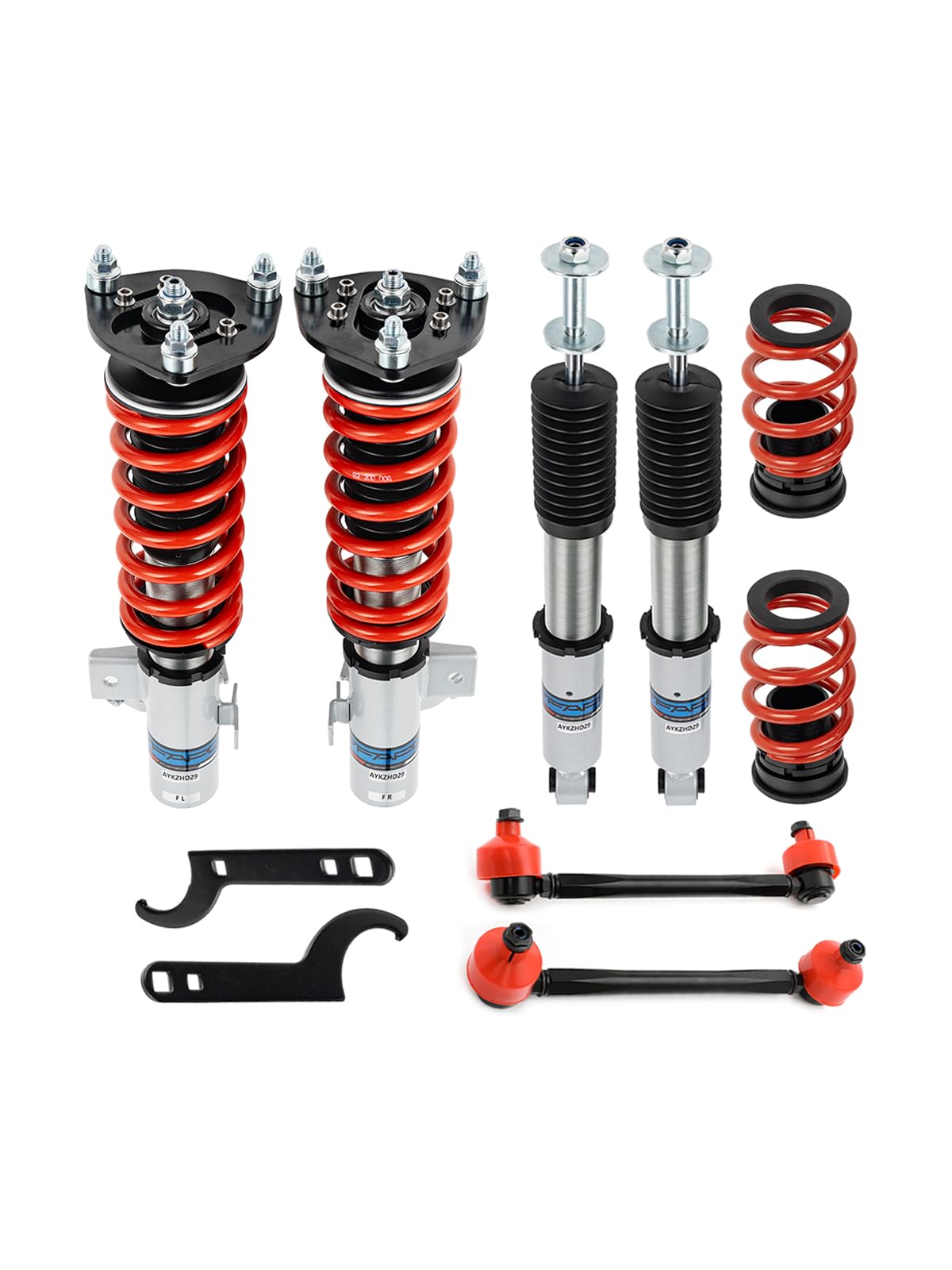
The 9th-gen Civic and ILX share a surprisingly sporty platform — this mono-tube kit gives it the handling it deserves at an entry-level price.
The spring rate split is unusual: 6 kg/mm front and 10 kg/mm rear. The soft front helps the heavy nose absorb bumps on daily drives, while the stiff rear fights body roll in corners and helps rotate the chassis. That is a purposeful setup for a front-wheel-drive platform where you want the rear to follow the front without washing wide. FAPO uses a mono-tube damper with a painted body that the company says undergoes a “self-developed surface treatment” for rust resistance.
Customers note the ride is noticeably stiffer than stock — one owner described it as “you get what you paid for” but was still pleased with the handling improvement. The full-length adjustable body lets you lower by one to three inches without affecting damper stroke. A few installation caveats: the kit does not include top mounts for all applications, so check compatibility with your specific year and trim. Some 9th-gen Civic Si owners needed to reuse their factory top hats, adding a step to the install.
What makes it a good buy
- Mono-tube damper design improves heat dissipation over twin-tube budget rivals.
- Unusual soft-front/stiff-rear spring rate suits FWD handling well.
- Full-length adjustable body lets you lower without compressing the spring prematurely.
Where it falls short
- No damping adjustment — the stiffness is fixed at whatever the valve dictates.
- No top mounts included for some applications — factor in the cost of reusing or buying them.
Reach for this if: you drive a 9th-gen Civic or ILX daily and want a mono-tube upgrade without adjustable dampers you will never touch.
Look elsewhere if: you need tuning flexibility — this is a set-it-and-drop-it kit with no damping fine-tuning.
7. MOSTPLUS 4pcs Full Lowering Coilovers — Honda Civic 1996-2000 / Acura Integra 1986-1989

With 886 ratings and a reputation for getting cars low while staying affordable, this is the volume king of budget Civic coilovers.
Front springs are 8 kg/mm and rear are 6 kg/mm — a mild stagger that keeps the car planted without turning every expansion joint into a chiropractic event. The twin-tube construction provides a longer stroke than a mono-tube, which the manufacturer says “provides a more comfortable riding experience” by reducing pressure and minimizing friction. The 45-degree adjustable camber plates on top give you front alignment flexibility without extra parts. Buyers consistently describe the build as “excellent build quality, heavy aluminum, durable,” with one installing them on an AE92 Corolla and reporting a 3.5-inch drop with a firm ride and precise steering.
The catch: many reviewers point out needing to modify bolt holes. One reviewer had to “dremel spindle holes for OEM camber bolts and rear top stud holes,” and warned that alignment shops may not adjust the top camber. Another buyer needed a larger drill bit for the knuckle holes. If you are not comfortable with minor fabrication, budget for a shop that is. The kit is designed to lower your car by about 5-10 cm and will not return to stock ride height.
Where the popularity comes from
- 8/6 kg/mm spring rate is comfortable enough for daily driving while handling corners well.
- 45-degree camber plates included — front alignment adjustment ready from the start.
- Twin-tube construction delivers a balanced street ride for the price.
Where the extra work comes in
- Bolt holes often need drilling or enlarging — this is not a true bolt-on for every chassis.
- No damping adjustment — you get one ride character, and that is it.
Who it works for: the Civic or Integra owner who wants a low, firm stance on a tight budget and is prepared to do minor fabrication work.
Who should skip it: anyone expecting a factory-bolt-on experience — modification is nearly guaranteed.
8. SCITOO Coilover Suspensions Kit — Honda Accord 1990-1997
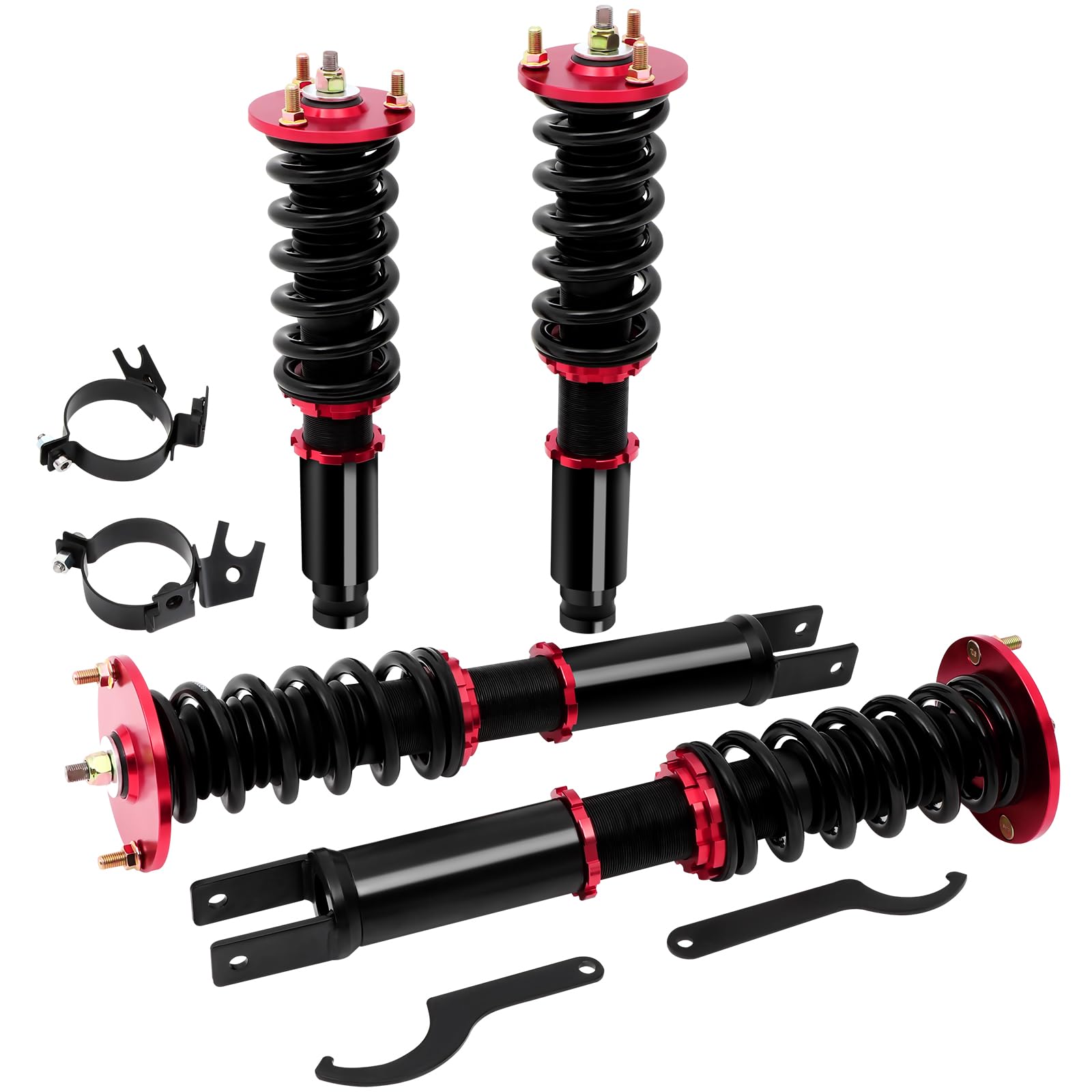
The 1990s Accord chassis finally gets a budget lowering option that does not require a custom fabrication shop.
This is a height-adjustable-only kit with no damping adjustment — you change the ride height by sliding the lower mount, but the shock valving stays fixed. The listing emphasizes easy control and improved stability “when bumping or cornering,” along with vibration dampening for rough road conditions. One owner who installed them on a 1992 Accord wagon said they were a “top tier product” with zero noise and called the switch from expensive shocks a “no brainer.”
A different buyer, however, loved the build quality and noted the drop was deeper than expected — the car ended up with 2.5 inches of side clearance and 2.75 inches at the front and rear at full extension. Another reviewer pointed out a limitation: the front would not go as low as they wanted, which could frustrate stance-oriented owners. The 12-month manufacturer warranty adds confidence, but the fixed damping means you will have to accept the stock ride firmness level — typically described as “a little more stiffer than stock” by buyers.
What buyers appreciate
- Direct fit for 1990-1997 Accord — one of the few affordable options for this chassis.
- 12-month manufacturer warranty covers defects.
- Lower mount adjustment does not affect damper stroke.
Where it falls short
- No damping adjustment — the firmness is fixed and stiffer than stock.
- Front lowering range is limited compared to the rear.
Best for the CB/CG Accord owner who wants: a simple height drop with a warranty, without fussing over damping settings.
Not for: anyone who wants to slam the front end — the front travel limit will stop you short of a full tuck.
Understanding the Specs
Spring Rate (kg/mm)
Spring rate tells you how much weight it takes to compress the spring one millimeter. A 10 kg/mm spring needs 10 kilograms of force for every millimeter of compression. Higher numbers mean a stiffer ride with less body roll; lower numbers mean more comfort but more lean in corners. For cheap coilovers, the front and rear rates are often different — a stiffer rear helps rotate a front-wheel-drive car, while a stiffer front keeps a heavy engine bay under control. Always match the rate to your car’s weight distribution and your personal tolerance for a firm ride.
Damping Adjustment (Clicks)
Damping adjustment controls how fast the shock allows the spring to compress and rebound. A 24-click damper gives you 24 distinct settings from fully soft (fast rebound) to fully stiff (slow rebound). More clicks mean finer tuning — 32-click dampers let you dial in a smoother daily ride and then stiffen up for track time without changing the spring. Non-adjustable dampers lock you into one fixed behavior. On a budget build, adjustable damping adds significant versatility for a small price premium.
FAQ
Will cheap coilovers fit my car without modifications?
How much lower will my car sit with cheap coilovers?
Are 24 damping clicks actually useful for daily driving?
How long do budget coilovers usually last?
Can I install cheap coilovers myself in my garage?
What does spring rate mean in kg/mm and how do I choose the right one?
What is the difference between twin-tube and mono-tube dampers on cheap coilovers?
Will cheap coilovers make my ride much rougher than stock?
Final Thoughts: The Verdict
If you want the most damping control for the money and drive a BMW E46 or Honda FA/FG Civic, the Rev9 Hyper-Street II delivers 32 clicks of rebound tuning and a mono-tube damper at a price point that punches well above its class. And for the lowest entry price into coilovers, the ECCPP kit for the Accord and TSX gets you installed for the least cash, though the stiff 10 kg/mm front springs and mixed reliability reviews mean it is only for the most budget-constrained buyer.
How We Picked
We do not accept paid placement. Every pick is matched to a real buyer and a real use-case; we do not hands-on test units.
Sources & Methodology
Specifications: manufacturer listings and product documentation. Review insights: verified customer reviews, as of July 2026. Pricing: not shown on this page (it changes often); check the current price via the retailer link.
As an Amazon Associate, Trending Car earns from qualifying purchases. This does not affect which products we feature.