
Our readers keep the lights on and my garage snacks stocked. As an Amazon Associate, I earn from qualifying purchases.
Specs are compiled from manufacturer listings and verified buyer reviews and can change over time — please confirm the key details on the product page before buying.
If the gearbox feels notchy or the clutch starts slipping on aggressive upshifts, the oil you pour in is usually the culprit. The right 10W-40 motorcycle oil keeps your wet clutch plates engaged firmly, your gearbox shifts crisp, and your engine temperature under control—without you having to think about it. That is the whole point: pick the wrong bottle and you feel it in every shift; pick the right one and the bike just works.
I’m Min Islam — the founder and writer behind Trending Car. This guide is built by comparing the manufacturers’ published specifications and the patterns across verified customer reviews, so you get each pick’s real strengths and trade-offs instead of marketing spin.
Whether you ride a commuter twin, a high-revving sportbike, or an air-cooled thumper, these seven bottles represent the best 10w40 motorcycle oil options you can buy right now, ranked by real-world protection and shifting feel rather than sticker price alone.
Our Picks at a Glance


How To Choose The Best 10W40 Motorcycle Oil
The wrong bottle of oil can make your bike feel sluggish at the shift lever and cause your clutch pack to glaze over. Here are the three real factors that separate a decent oil from one that protects your transmission and your wallet.
JASO MA and JASO MA2 Certification
JASO (Japanese Automotive Standards Organization) created the MA and MA2 ratings specifically for 4-stroke motorcycle engines that share oil between the engine and the wet clutch. An MA2 oil has friction modifiers tuned so your clutch plates lock up properly without slipping. If you pour in a car oil that lacks the JASO stamp, the clutch shudders or slips under hard acceleration, and you end up doing the job twice. Always look for the JASO MA or MA2 marking on the bottle.
Full Synthetic vs. Synthetic Blend vs. Conventional
A full synthetic oil like those from Royal Purple or Motul flows better at cold start-up and resists viscosity breakdown when the engine gets hot. That matters more on a high-revving sportbike or an air-cooled thumper that runs hard in summer. A synthetic blend (like the Quicksilver option) costs less and still offers good protection for a daily commuter or a UTV that sees moderate loads. Conventional or mineral oils are cheapest but degrade faster under high heat and high shear loads. For most riders, a full synthetic or a quality blend hits the balance between longevity and price.
Viscosity Grade and Flash Point
The “10W-40” number means the oil behaves like a thin 10-weight oil in cold weather (the “W” stands for winter) so the engine cranks easily, and it thickens to a 40-weight at operating temperature so you get a stable film on gears and bearings. The flash point tells you how hot the oil can get before it starts to vaporize. A higher flash point (say 204°C or 250°C) means the oil resists burning off in a hot-running engine, keeping your level higher between changes and reducing deposits inside the engine.
Quick Comparison
| Model | Best For | Volume | Type | JASO Spec | Amazon |
|---|---|---|---|---|---|
| Royal Purple 01315 Max Cycle★ Best Overall | Wet clutch feel & wear protection | 1 Quart | Full Synthetic | JASO MA2 | Amazon |
| Yamaha Yamalube 10W-40 4T FSOEM Match | OEM spec & thermal stability | 1 Quart | Full Synthetic | JASO MA | Amazon |
| Motul 300V 10W40 Synestre | Track/race-level performance | 4 Liters | Full Synthetic (Double Ester) | JASO T904 | Amazon |
| Lucas Oil 10767 High Performance | Value per quart (pack of 2) | 2 Quarts (pack of 2) | Full Synthetic | JASO certified | Amazon |
| Quicksilver 10W-40 Synthetic Blend | UTV/ATV commuting | 1 Quart | Synthetic Blend | Wet clutch compatible | Amazon |
| TRIAX XTerra 4T 10W-40 | All-season smooth shifting | 1 Quart | Full Synthetic (Ester) | JASO MA2 | Amazon |
| Valvoline 4-Stroke 10W-40 | Budget 6-pack for multiple bikes | 1 Quart (case of 6) | Mineral/Conventional Blend | Anti-shudder technology | Amazon |
In‑Depth Reviews
1. Royal Purple 01315 Max Cycle 10W-40 High Performance Synthetic Motorcycle Oil
Our pick — over 4.5★ from 950+ verified ratings; the strongest balance of quality and price.
The synthetic that makes a 20-year-old gearbox feel tighter than the day it rolled off the showroom floor.
Royal Purple uses its own Synerlec additive technology (a package of friction modifiers and anti-wear chemistry) to reduce metal-on-metal contact inside your transmission and crankshaft. That means you get a flash point of 204°C (which tells you the oil won’t burn off in a hot air-cooled single), and the viscosity stays stable through a full service interval. One buyer riding a modified XR650L in Arizona summer heat over 105°F reported the oil held up without any clutch fade after hundreds of hard desert miles.
The wet clutch feedback is the real story here. A reviewer on a Can-Am Spyder noted that after switching to Royal Purple, the clutch action improved noticeably. “The one thing I definitely noticed was the clutch worked better,” they said. The JASO MA2 classification gives you the friction profile that helps clutch plates engage fully without slipping, so you get clean shifts every time. The 1-quart bottle suits a single oil change for most bikes, and the 2-pound weight means it ships without a heavy surcharge.
Compared to the Quicksilver blend lower down this list, the Royal Purple is a true full synthetic with a higher load-carrying capacity and better oxidation resistance. If you ride in extreme heat, hammer the bike through mountain passes, or just want one oil that protects every part of your engine without compromise, this is the quart to reach for.
Why it wins
- Synerlec additive package reduces friction at the clutch and bearing surfaces.
- 204°C flash point prevents oil evaporation in hot, air-cooled engines.
- Near-perfect 4.9/5 rating from nearly 1,000 reviews confirms consistent quality.
The trade-off
- 1-quart bottle means you need to buy two bottles for a twin-cylinder engine that holds 2 quarts.
- Premium price per quart versus a synthetic blend.
A confident pick for: Riders who want the best synthetic protection for their drivetrain, especially air-cooled singles and twins that run hot.
skip it if: Your bike takes more than 1 quart per change and you want a multi-pack to save on shipping — the Lucas two-pack below is a smarter buy there.
2. Yamaha Yamalube 10W-40 4T Full Synthetic Hi-Performance Engine Oil
Factory-spec oil that has kept thousands of Yamaha engines running past 40,000 miles without a hiccup.
This Yamalube is formulated using a fully synthesized base oil (no conventional or semi-synthetic mix) so it stays stable under high thermal stress. The thermal stability claim means the oil resists thickening or breaking down when the engine runs at high RPM on the highway, which is exactly what a multi-cylinder sport-tourer like the FJ-09 demands. One owner reported running it on a 2017 Yamaha FJ-09 Tracer for 40,000 miles, changing it every 3,500 miles, and seeing no sludge or mechanical issues across a temperature range from 30°F all the way to 110°F.
It meets both JASO MA and API SL certifications, so you know the friction profile is correct for a wet clutch and the additive package is strong enough for modern four-stroke engines. A slight clutch slip on aggressive upshifts near the end of the 3,500-mile interval is the signal to change it, according to that same long-term reviewer. That is a useful real-world tell: if the clutch starts to slip during hard acceleration, the oil’s friction package has worn out and it is time for a fresh bottle. The 1-quart size works perfectly for a single change on most bikes, and the price is consistent with other premium OEM-branded synthetics.
What stands out
- Proven 40,000-mile track record with 3,500-mile change intervals in extreme temps.
- Full synthetic base resists thermal breakdown better than a blend.
- Certified JASO MA and API SL for clutch-friendly operation.
Things to note
- Some riders report slight clutch slip on aggressive upshifts near the end of the oil change interval.
- Bottle size is 1 quart; you will need multiple bottles for larger engines.
Best for: Yamaha owners who want a factory-matched oil with a verified long-term performance record, or any rider who values thermal stability in extreme climates.
The catch: If your bike’s manufacturer recommends a JASO MA2 spec specifically, the Yamalube is JASO MA — still clutch-safe but with slightly different friction modifiers.
3. Motul 300V 10W40 Synestre 4L

Double-ester chemistry engineered to let a sportbike rev to redline without the oil film breaking.
Motul uses double ester technology — two different types of ester molecules that bond to metal surfaces — to provide extreme lubricity even under the shear forces of a high-performance engine at maximum RPM. The result is a flash point of 250°C (noticeably higher than the 204°C of the Royal Purple above), meaning the oil resists vaporization inside a hot race engine and stays where it belongs. The 4-liter bottle (4,000 mL) is enough for most twin- and four-cylinder bikes that hold 3.5 to 4 quarts, making it a better buy than buying multiple single quarts for a larger sump.
Reviewers consistently mention smoother shifting and cooler engine temperatures after switching to 300V. One rider stated, “Superior smooth shifting, cooler engine temps, better cold starts, and slight power gain from reduced friction.” However, the trade-off is maintenance frequency: the oil lacks detergents because it is designed for track use where you change oil every 1,000 to 1,800 miles, not for a commuter who wants to stretch every oil change. A long-term owner noted “Stress tested for about 500 miles” on a Yamaha FZ1000 and found the clutch action held up well. The green-tinted oil also makes it easy to spot in the sight glass during checks.
Performance highlights
- Double ester formulation provides the highest load-carrying and anti-wear protection in this lineup.
- 250°C flash point handles extreme heat without burning off.
- 4-liter bottle is cost-effective for riders with larger-capacity engines.
Daily-life trade-offs
- Short change intervals — 1,000 to 1,800 miles — due to lack of detergents.
- Premium price per quart versus conventional or blend options.
Grab this if: You own a high-performance sportbike or track bike and you are comfortable with frequent oil changes to get the absolute best engine and clutch protection.
Look elsewhere if: You commute daily and want to stretch changes past 3,000 miles — the Royal Purple or Yamalube will save you time and cost over a season.
4. Lucas Oil 10767 High Performance Synthetic SAE 10W-40 Motorcycle Oil
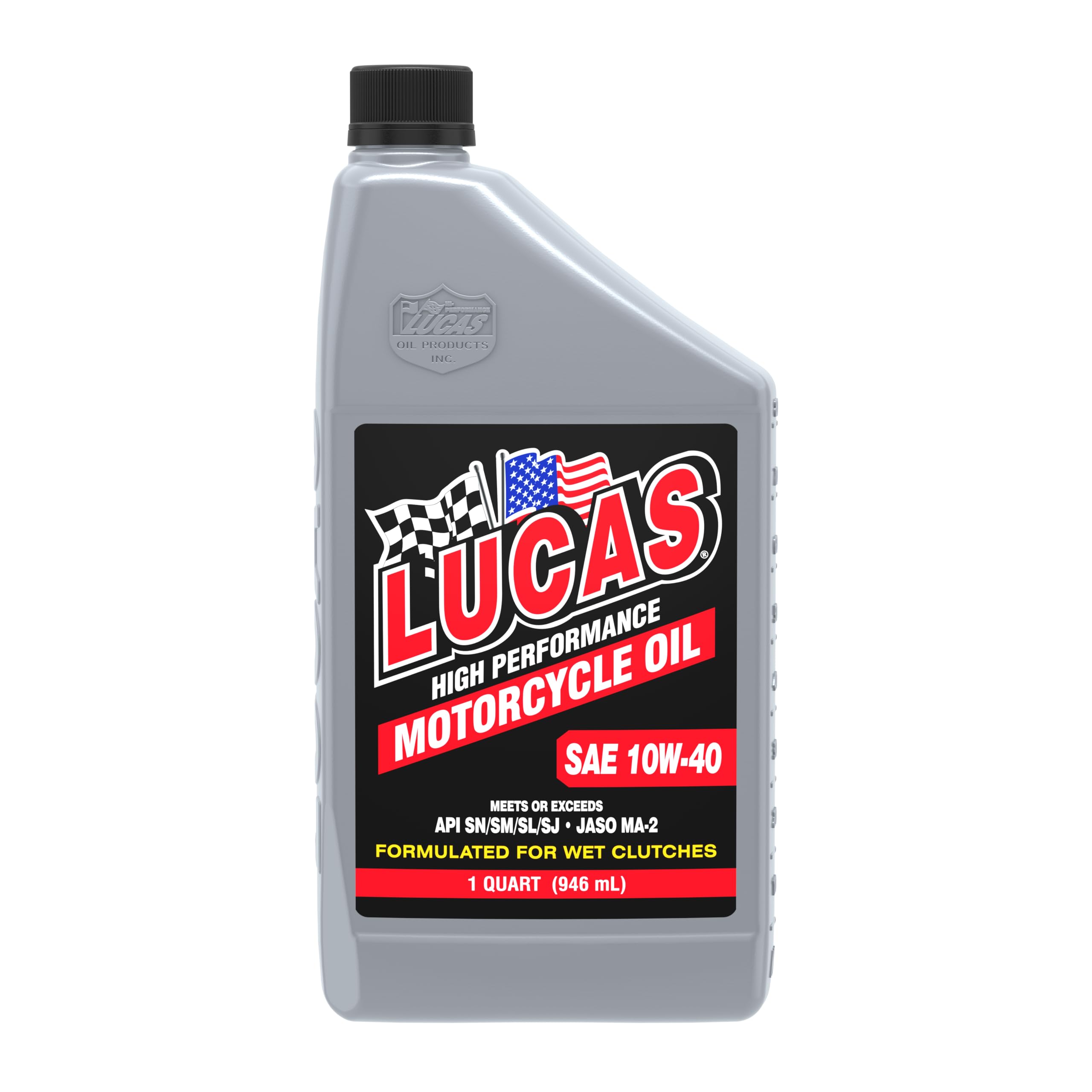
Two quarts of Lucas synthetic that cover a twin-cylinder engine with proven 15-year brand trust.
Lucas is among the most recognized names in the American lubrication industry, and the High Performance Synthetic 10W-40 carries a JASO certification that guarantees it is safe for your wet clutch. The pack includes two 1-quart bottles, which is exactly the volume most parallel-twins and V-twins need for a single oil change. The claimed benefits are lower oil temperatures, longer oil life, and less noise — all common with a high-quality synthetic. One long-time Lucas user summed it up: “It’s Lucas!!! Works like it should, quality oil and the only brand I use and have used for 15 years now.”
While the Royal Purple comes in a single quart, the Lucas two-pack gives you twice the liquid volume for a dollar amount that sits in the same tier, making it a better buy per quart if your engine holds 2 quarts. The 2-pound weight per unit is manageable, and the bottles are easy to pour without a funnel thanks to a clean spout design. If you maintain multiple bikes or UTVs, having the two-pack on hand means you can change oil on a single-cylinder bike and have a quart left over for top-ups. The only real downside is that Lucas does not publish a specific flash point or additive package detail as explicitly as some competitors, but the brand’s decades of reputation and consistent 4.8/5 rating from over 300 buyers speak for the product.
Why it stands out
- Two quarts in one pack — perfect for a twin-cylinder engine that needs exactly 2 quarts.
- Trusted brand with a history spanning over 15 years from many repeat buyers.
- JASO-certified for wet clutch safety.
A minor limitation
- Flash point and specific additive chemistry are not published on the bottle, so hard-data shoppers may prefer Royal Purple or Motul for verifiable numbers.
- Some users report the oil is slightly thinner at operating temperature compared to premium esters.
Reach for this if: Your bike takes 2 quarts per change and you want a single Amazon order that covers the whole refill without ordering a second quart.
pass on it if: You run an extremely high-performance engine that demands the absolute highest flash point and ester-based protection — the Motul 300V is in a different class there.
5. Quicksilver 10W-40 Synthetic Blend ATV, UTV, Motorcycle Oil
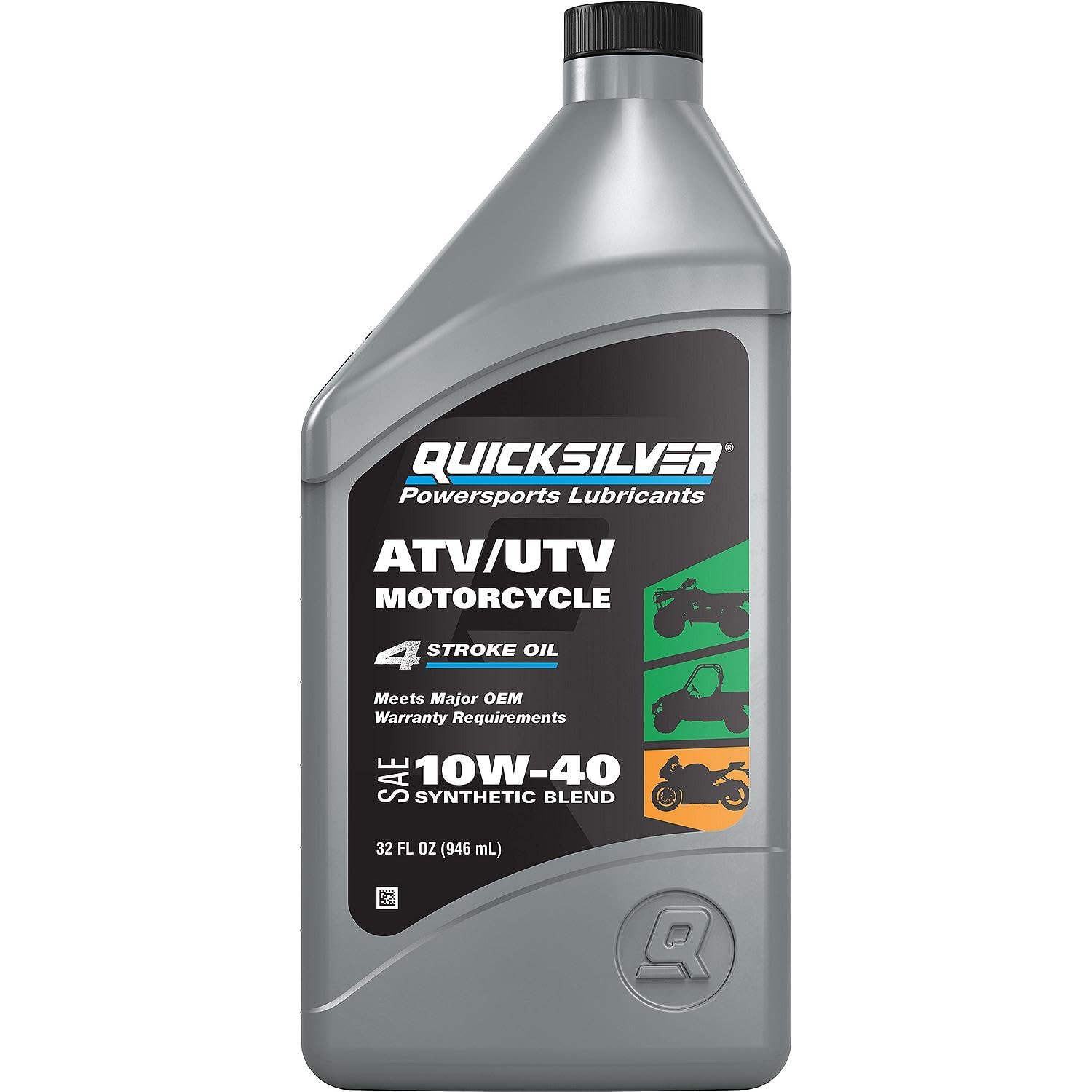
A synthetic-blend workhorse that keeps a Coleman-style mini bike from burning through oil after a month of daily riding.
Quicksilver is the same company behind Mercury Marine, and this oil is a synthetic blend designed for 4-stroke ATVs, UTVs, and motorcycles. The formula is wet-clutch compatible, which means you do not have to worry about your clutch plates slipping even in a side-by-side that works under load. One reviewer ran it daily for almost a month on a 200cc mini bike (a Coleman-style machine known for gulping oil) and reported no performance loss or overheating. The 32-fluid-ounce bottle matches the standard 1-quart measure, and the price per quart is lower than any full synthetic in this list, making it a strong budget option if you change oil frequently.
Compared to the full synthetics above, the Quicksilver is a blend — it mixes synthetic base stocks with conventional mineral oil — so its high-temperature shear resistance is not as sturdy as a 100% synthetic like the Royal Purple or Lucas. However, for a bike that sees moderate street duty, a UTV used for light trail work, or an ATV that gets changed every season, the blend is perfectly adequate and saves you a few dollars per quart. The bottle meets warranty specs for Honda, Kawasaki, Suzuki, and Yamaha, so if you are still under a manufacturer warranty and want to keep your paperwork clean, this is a safe choice that won’t void anything.
Where it shines
- Synthetic blend delivers better cold-flow and heat protection than conventional oil without the full-synthetic price.
- Wet-clutch-compatible formula prevents clutch slip in ATVs and side-by-sides.
- Meets warranty specs for the four biggest Japanese brands.
The limit
- Not a true full synthetic — for high-RPM or extreme-heat use, upgrade to a full-synthetic option like the Lucas or Royal Purple.
- Only 355 ratings (lower than the 978 of Royal Purple) means less long-term crowd data.
Best for: Daily commuters on a budget and owners of ATVs or UTVs that see moderate loads and regular seasonal changes.
The honest trade-off: If you plan to ride aggressively or keep the oil in the engine past 3,000 miles, step up to a full synthetic — the blend is fine for shorter intervals.
6. TRIAX XTerra 4T 10W-40 Full Synthetic 4 Stroke Engine Oil
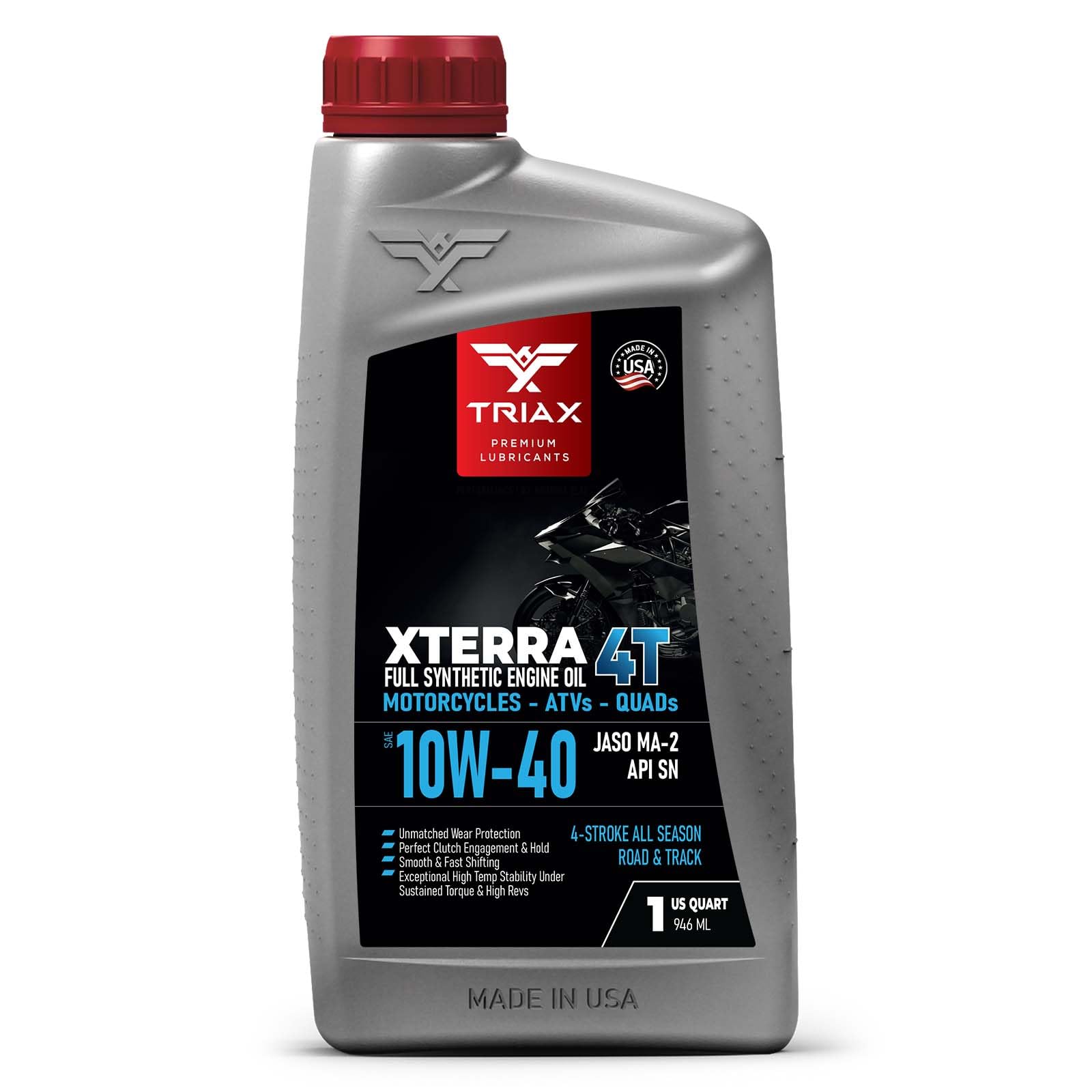
Ester-based synthetic that delivers JASO MA2 protection for Japanese bikes without the boutique price tag.
TRIAX packs this quart with a 100% synthetic ester formulation (the same base stock technology used by Motul in the 300V but at a lower price tier) that resists oxidation and viscosity breakdown under thermal stress. The oil exceeds JASO MA-2 and API SL/SN specifications, which covers most modern Japanese OEs like Honda, Kawasaki, Yamaha, Suzuki, and even Polaris and Can-Am. Buyers report smooth shifting and solid clutch feel after switching. One reviewer stated they “Stress tested for about 500 miles” on a Yamaha FZ1000 and found the clutch action held up without slipping.
The 1-quart bottle is the standard size, and the cap is designed for clean pouring, which sounds like a small thing until you have dripped oil down your engine case. Compared to the Quicksilver blend above, the TRIAX is a true full synthetic with a higher flash point and better cold-flow properties, so you get a faster start on a freezing morning. If the Yamalube is sold out or you want a non-OEM-branded alternative that still meets JASO MA2, this is the bottle to grab. The only knock is that TRIAX is not as widely known as Lucas or Royal Purple, but the 4.8/5 rating from 374 reviews suggests that most who try it stick with it.
Key strengths
- 100% synthetic ester formulation provides high shear stability and thermal resistance.
- Exceeds JASO MA-2 and API SL/SN for broad OEM compatibility.
- Positive reviewer reports on smooth shifting and clean clutch action.
Minor concerns
- Brand awareness is lower than Lucas or Royal Purple, so some riders prefer a name they recognize.
- Only 374 ratings — solid but lower than the 978 and 941 of the top two picks.
Choose this if: You want a full synthetic ester oil with JASO MA2 certification but want to pay less than the premium-tier Royal Purple or Motul.
Not for: Riders who stick strictly to brand names they have used for a decade — Lucas or Yamalube may feel safer if brand recognition matters to you.
7. Valvoline 4-Stroke Motorcycle SAE 10W-40 Motor Oil, Case of 6
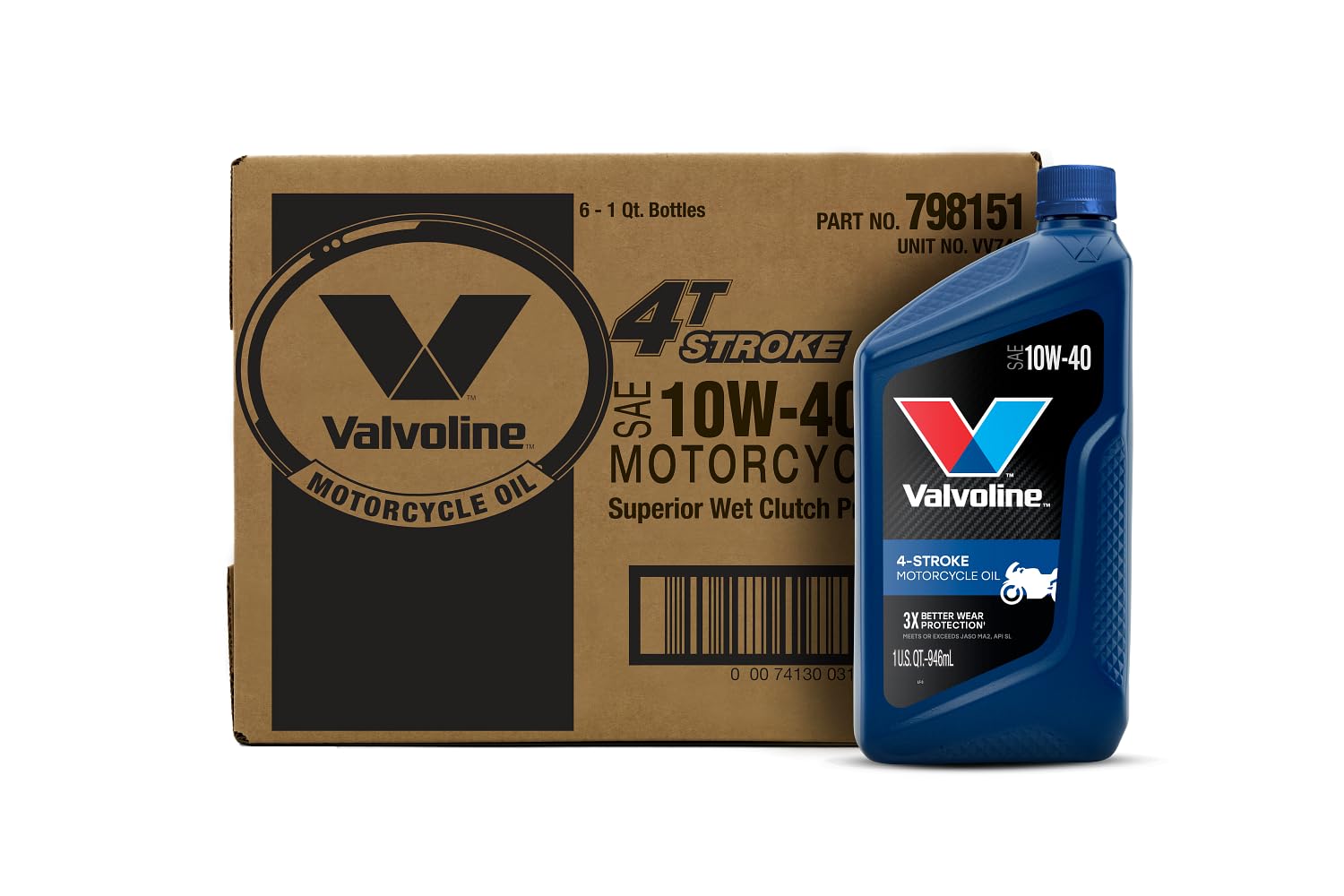
A six-quart case that brings anti-shudder tech to budget-conscious owners of multiple machines.
Valvoline is a century-old oil company, and this motorcycle-specific 10W-40 comes with anti-shudder protection (friction modifiers tuned to dampen clutch chatter at engagement) that helps smooth out the nervous bucking that cheap oils can cause on takeoff. The liquid volume is 32 fluid ounces per quart — the standard size — and the case of 6 gives you enough volume for three oil changes on a bike that takes 2 quarts, or six changes on a single-cylinder bike. The flash point is 394°F (which converts to roughly 201°C), so it resists burning off in a hot engine nearly as well as the Royal Purple’s 204°C.
This is a conventional/mineral-based oil — not a synthetic or even a blend — so it does not have the cold-flow properties or oxidation resistance of the full synthetics above. For a high-mileage street bike that gets changed every 2,000 miles, the conventional base is fine, but if your bike sits in traffic in 100°F heat for an hour, the synthetic options will hold viscosity longer. One owner summed it up simply: “Best oil you can run! I run this in all my bikes.” That opinion is shared by plenty of riders who value consistency over the latest chemistry. the strength here is the case-of-6 format: if you maintain a fleet of ATVs, scooters, or small-cc bikes, having a stock of six quarts on the shelf means you never have to panic-buy at a gas station.
The big advantage
- Six quarts in one box — lowest per-quart cost in this lineup and enough for multiple changes.
- Anti-shudder technology reduces clutch chatter on engagement.
- 394°F flash point is surprisingly high for a conventional oil.
Where it falls short
- Conventional base oil — not a synthetic, so it breaks down faster under high heat and high-RPM use.
- Not JASO MA or MA2 certified on the bottle, though Valvoline claims it is safe for wet clutches.
Grab this if: You maintain multiple bikes or small engines and want the lowest cost per quart, and you are comfortable with frequent oil changes at 2,000-mile intervals.
it’s not for you if: You ride a high-RPM sportbike or a hard-working UTV that runs hot — the conventional base will not last your full season safely.
Understanding the Specs
JASO MA / JASO MA2 Certification
JASO (the Japanese Automotive Standards Organization) created the MA and MA2 standards specifically for 4-stroke motorcycle oils that share lubrication between the engine and the wet clutch. An MA2 rating means the oil has a controlled friction coefficient that lets your clutch plates lock up without slipping, while still providing enough anti-wear protection for the gearbox. If an oil does not carry a JASO stamp, it might contain friction modifiers designed for dry clutches in cars, which will make your wet clutch shudder and glaze over within a few thousand miles. Always check the bottle for JASO MA or MA2 — it is the single most important spec after viscosity.
Ester Formulation and Flash Point
Ester oils are a type of full synthetic made from organic acid and alcohol compounds that bond to metal surfaces. This “polar attraction” means the oil clings to bearings and cylinder walls even when the engine is off, so you get immediate protection on start-up. The flash point is the temperature at which the oil vapors ignite — a higher number (like 250°C on the Motul 300V) tells you the oil is less likely to burn off inside a hot combustion chamber or crankcase. For an air-cooled engine that runs 240°F oil temps in summer, a flash point above 200°C is a good safety margin that keeps the oil level stable between changes.
FAQ
Can I use car engine oil in my motorcycle?
What does the 10W-40 number actually mean?
How often should I change my 10W-40 motorcycle oil?
Is a full synthetic oil worth the extra cost for my commuter bike?
What happens if I use a 20W-50 instead of a 10W-40 in my motorcycle?
Can I mix two different brands of 10W-40 motorcycle oil?
How much oil does a typical single-cylinder motorcycle need?
Does a higher flash point always mean better oil?
Is a case of 6 quarts from Valvoline a good value for a household with multiple ATVs?
Do I need a JASO MA2 oil for my KTM or can I use JASO MA?
Final Thoughts: The Verdict
For most riders, the best 10w40 motorcycle oil winner is the Royal Purple Max Cycle because its Synerlec additive package and 204°C flash point deliver consistent clutch feel and wear protection across a wide range of engine types and riding conditions. If you want OEM-specific thermal stability and a verified 40,000-mile track record, grab the Yamaha Yamalube. And for track days or aggressive canyon riding where every shift counts at high RPM, the standout is the Motul 300V double-ester formulation.
How We Picked
We do not accept paid placement. Every pick is matched to a real buyer and a real use-case; we do not hands-on test units.
Sources & Methodology
Specifications: manufacturer listings and product documentation. Review insights: verified customer reviews, as of July 2026. Pricing: not shown on this page (it changes often); check the current price via the retailer link.
As an Amazon Associate, Trending Car earns from qualifying purchases. This does not affect which products we feature.