
Our readers keep the lights on and my garage snacks stocked. As an Amazon Associate, I earn from qualifying purchases.
Specs are compiled from manufacturer listings and verified buyer reviews and can change over time — please confirm the key details on the product page before buying.
If your engine has piled on the miles, you have likely noticed the telltale signs: a clattering lifter at startup, a little blue smoke on the overrun, or oil disappearing faster than before. These aren’t signals to give up on the car — they are signals that the clearances have opened up and the old seals have hardened, which is exactly where the right additive can bring back quiet starts and stable oil pressure.
I’m Min Islam — the founder and writer behind Trending Car. This guide is built by comparing the manufacturers’ published specifications and the patterns across verified customer reviews, so you get each pick’s real strengths and trade-offs instead of marketing spin.
Whether your daily driver has 100k miles or 300k miles, the right engine oil additive for older engines can reduce friction, restore seal flexibility, and stretch the time between top-ups without needing a rebuild.
Our Picks at a Glance


How To Choose The Best Engine Oil Additive for Older Engines
A high-mileage engine isn’t broken — it is just worn. The pistons have more room to rock, the valve seals have hardened and shrunk, and the oil pump may not build the pressure it once did. You don’t want a general friction reducer designed for a brand-new motor; you want an additive that targets the specific gaps, seals, and surfaces of an engine that has seen heavy use.
Start With Your Symptom
If the main noise is a rhythmic clatter at idle that fades as the engine warms, the problem is often lifters that have lost their hydraulic prime. A friction-modified additive that thickens the oil film and reduces internal bleed-down can quiet that noise. If your engine is leaving drops on the driveway or burning oil at a rate of a quart every thousand miles, you need a seal conditioner — a chemical that swells and softens dried-out rubber and plastic valve stem seals. Products like the Liqui Moly Motor Oil Saver are specifically formulated to address external leaks and blue smoke from aged seals.
Viscosity and Compatibility
Older engines were designed around thicker oil weights, so an additive that boosts viscosity slightly is generally safe. However, you still need a product that blends cleanly with whatever you are running — conventional, synthetic, or a blend. Every product on this list is labeled for use with all motor oil types, but pay attention to whether the additive replaces a quart of oil or is a smaller concentrate added on top. Lucas products are designed to be substituted for a quart of engine oil, while a 15-ounce bottle of Lubegard is a top-off concentrate.
Chemistry Matters: PTFE vs. Ester vs. Seal Swell
You will see three main chemistries here. Polytetrafluoroethylene (PTFE, the same basic material as Teflon) creates a dry-film barrier on metal surfaces and is found in the Slick 50 Original Engine Treatment. Synthetic ester technology, used in Lubegard’s Bio/Tech formula, bonds chemically to metal to reduce friction under boundary-layer conditions — the exact moment when a piston ring is scraping against a cylinder wall. Third, seal-swell agents (esters and other polymers) are designed to restore the flexibility of hardened valve stem seals. No single chemistry fixes every issue, so match the product to the sub-symptom your engine is actually displaying.
Quick Comparison
| Model | Best For | Volume | Weight | Key Chemistry | Amazon |
|---|---|---|---|---|---|
| Slick 50 Original Engine Treatment | 32 oz.★ Best Overall | Long-term friction coating | 32 oz. | 2 lb | PTFE ceramic | Amazon |
| Liqui Moly Motor Oil Saver (300 mL) 2-PackSeal Savior | Seal leaks & oil consumption | 300 mL | — | Seal-swell ester | Amazon |
| Lucas Oil 40001 Heavy Duty Oil Stabilizer – 1L | Raising oil pressure | 1 Liter | 0.92 kg | Viscosity boost | Amazon |
| Dura Lube Engine Treatment | 32 oz. | Friction reduction & fuel economy | 946 mL | 1.7 lb | Protective barrier | Amazon |
| Bg MOA Part # 110 Engine Oil Supplement | Extended oil change intervals | 473 mL | — | Anti-wear supplement | Amazon |
| Lubegard 30901 Bio/Tech Engine Oil Protectant, 15 oz. | Cold-start quieting & performance | 15 oz. | — | Synthetic ester | Amazon |
| LUCAS Oil 10118 High Mileage Oil Stabilizer (Pack of 2) | Friction & heat control | 64 oz. | — | Clings-to-metal coating | Amazon |
In‑Depth Reviews
1. Slick 50 Original Engine Treatment | 32 oz., Single
Our pick — over 4.5★ from 850+ verified ratings; the strongest balance of quality and price.
The old-school PTFE formula that kept a VW Beetle running after the fan belt snapped.
Slick 50 has been around since the 1950s, and its Original Engine Treatment uses Cerflon PTFE technology — a combination of ceramic and PTFE particles that coats engine surfaces with a durable barrier to reduce friction and wear. The 32-ounce bottle weighs 2 pounds, which is 0.3 pounds heavier than the same-size Dura Lube bottle, reflecting the denser PTFE suspension. The manufacturer says it works with all oil types and is recommended for all gasoline engines brand new to old engines in need of restoration.
One verified review tells the kind of story that makes this product famous: a 2012 Impala with 160,000 miles had an oil filter gasket failure that caused a massive oil leak. After adding Slick 50 with fresh oil, the engine ran like new. Another buyer owned a VW Beetle where the fan belt broke while driving — the engine kept running without locking up because of the Slick 50 coating, and after replacing the belt, the car started and ran perfectly. Those are not controlled lab tests, but they are real-world stress scenarios that a friction coating is designed to survive.
The limitation here is that the formula may have changed slightly over the decades — one long-term user noted that the instructions shifted from a once-and-done application to yearly addition, raising doubts about consistency. The product still earns 4.8 out of 5 stars from nearly 900 ratings, so it clearly still works. Among the 32-ounce bottles in this list, it is the heaviest at 2 pounds, which gives you a sense of the PTFE load. If you want a friction coating that has been tested on engines since the 1950s, this is the historical benchmark.
Heritage Coating
- PTFE ceramic barrier reduces friction and wear
- Can keep engine running even after oil loss
- Compatible with all oil types and viscosity
- Budget-friendly price for 32 oz.
Legacy Concerns
- Formula may have changed from once-and-done
- PTFE particles can settle in oil passages over time
Choose this if: you want a proven friction coating with decades of real-world testing in high-mileage engines.
pass on it if: you are worried about PTFE settling in your engine’s oil galleys.
2. Liqui Moly Motor Oil Saver (300 ML) – 2 Pack
The one that targets aged seals instead of just coating metal surfaces with goo.
If your older engine is puffing blue smoke on deceleration or leaving a few drops on the driveway after every trip, you are likely dealing with hardened valve stem seals, not worn rings. The Liqui Moly Motor Oil Saver is specifically formulated to maintain and regenerate rubber and plastic seals in the engine oil circuit of gas and diesel engines. The manufacturer says it reduces oil consumption from aged and hardened valve stem seals, which eliminates blue exhaust smoke and reduces external leaks. It also dampens engine noise, a nice side effect when the seals start doing their job again.
Unlike the Slick 50 or Dura Lube options that build a friction coating on metal, this additive works on the rubber components that are the primary leak source in many high-mileage engines. Buyers report it works slowly but thoroughly — one reviewer noted it reduced a large oil leak significantly after 500 miles and stabilized the oil level. Another used it on a 2013 Nissan Xterra with 138k miles and reported oil consumption stopped entirely after the second treatment. That is a specific claim on a known problem engine (plastic valve seats in the Nissan VQ platform).
The catch is that Liqui Moly does not give you a big immediate viscosity bump, so if you are chasing oil pressure instead of leaks, you might prefer the Lucas Heavy Duty Oil Stabilizer instead. But for blue smoke and weeping gaskets, this is the most targeted fix in the list. The 300 mL bottle treats a standard oil change, and the 2-pack gives you a follow-up dose to fully restore the seals on a neglected engine.
What Regenerates
- Regenerates hardened rubber and plastic seals
- Eliminates blue smoke from valve stem seals
- Reduces or stops external oil leaks
- Works in both gas and diesel engines
What It Does Not Fix
- Does not raise oil pressure like a viscosity booster
- Slow acting — may need 500 miles to see results
- Higher upfront cost for the 2-pack
Reach for this if: your engine burns oil or leaks from aged seals rather than worn rings.
Look elsewhere if: you need immediate oil pressure support for an engine that is knocking on startup.
3. Lucas Oil 40001 Heavy Duty Oil Stabilizer-1L

The thick stuff that fights oil consumption and raises pressure on a worn pump.
Lucas Oil’s Heavy Duty Oil Stabilizer is essentially a viscosity modifier that clings to metal surfaces and fills the widened clearances inside a high-mileage engine. The maker claims it increases oil life by at least 50%, reduces oil consumption, eliminates dry starts, and raises oil pressure. It is a 1-liter bottle designed to replace 1 quart of engine oil at each change, not just a small top-off. The weight is notable here at 0.92 kg — this is a thick, honey-like fluid that will instantly change how your engine feels at idle.
Where the Liqui Moly focuses on seals, the Lucas works on hydraulic pressure. One buyer mentioned that an LS-swapped Jeep YJ saw oil pressure rise from the bottom of the spec range to a comfortable reading after adding this stabilizer. That kind of feedback from a modified engine — notoriously sensitive to oil pressure — is a strong signal that the additive works for the specific problem of worn bearings and pump clearances. It also works in race cars, according to multiple buyers, which speaks to its ability to handle high-stress conditions without shearing down.
The trade-off is that this is not a seal conditioner. If your engine is leaking externally, the Lucas Oil 40001 might actually increase pressure behind the weak gasket and make the leak worse. It is also not ideal for very cold climates because the high viscosity can make cold starts harder — though the product’s claim of eliminating dry starts suggests the cling film is there from the previous shutdown. For a tired engine that just needs pressure and quiet, this is a benchmark choice.
Pressure Support
- Raises oil pressure noticeably
- Eliminates dry starts with cling-coating
- Reduces oil consumption
- Extends oil life by 50%
Viscosity Trade-off
- May worsen external oil leaks
- Thick consistency can be harder on cold starts
Best for: drivers whose oil gauge needle is lower than it used to be and who want immediate pressure support.
skip it if: the engine has visible external oil leaks that could be aggravated by higher pressure.
4. Dura Lube Engine Treatment | 32 oz., Single
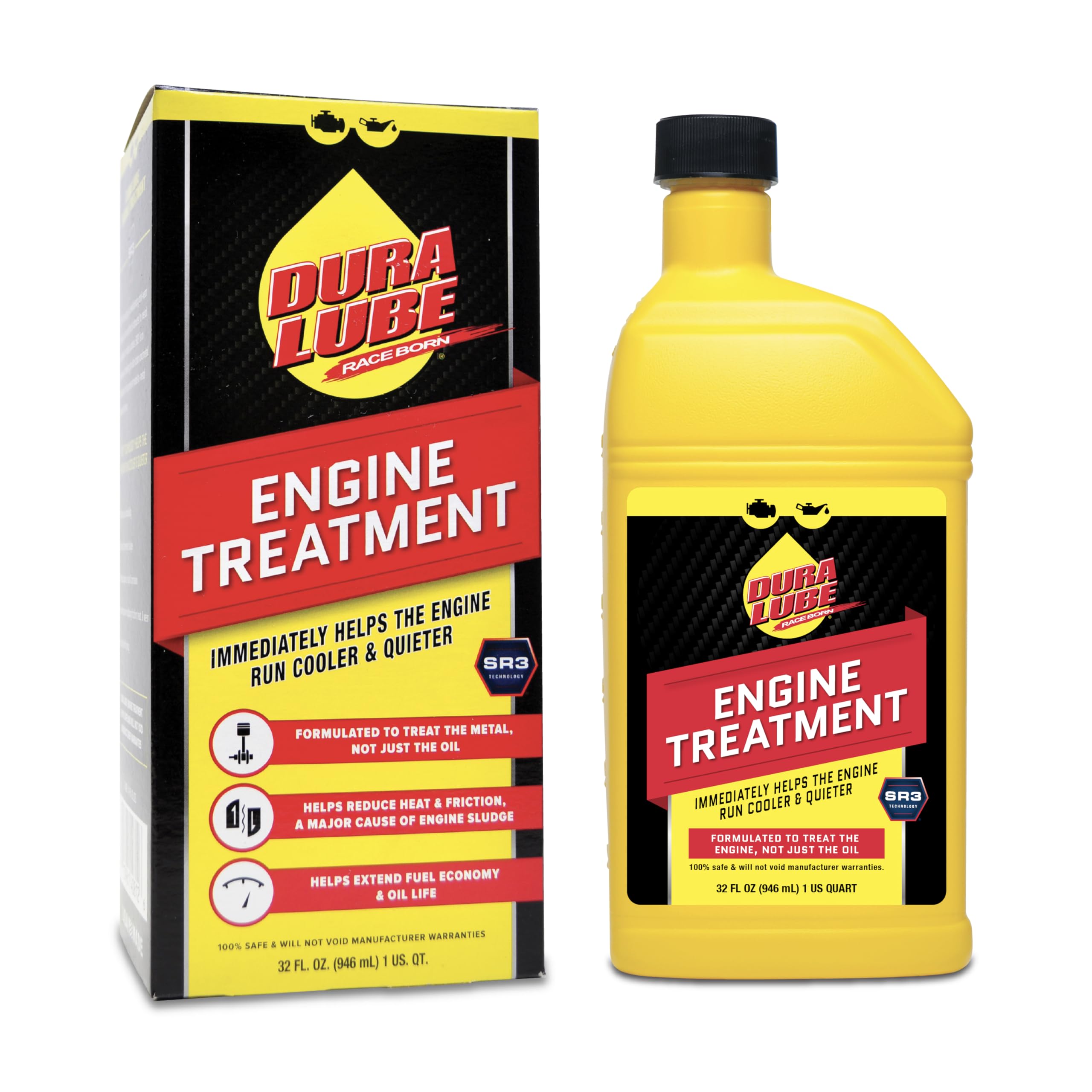
A 1.7-pound bottle that has quietly carried engines past half a million miles.
Dura Lube is one of those products that has been around long enough to build a cult following among high-mileage owners who simply refuse to let their cars die. The 32-ounce bottle contains 946 mL of a friction-reducing formula that the manufacturer says forms a protective barrier on internal engine components, minimizes friction, and protects during cold starts. It also claims to lower operating temperatures and improve fuel economy — and multiple long-term owners back that up with hard numbers from the odometer.
One owner reported using it for about 2 years and seeing a definite increase in miles per gallon, but the more impressive claim is that the car starts with barely a half turn of the crankshaft. Another verified owner sold a Subaru Legacy with 645,000 miles for and credits Dura Lube for the engine’s longevity. That is a level of buyer loyalty that is hard to fake. The flash point of 495 degrees Fahrenheit is also a useful spec — it means the additive holds up under high operating temperatures without burning off, which is critical for older engines that may run hotter due to sludge deposits.
The Dura Lube bottle is lighter than the Slick 50 at 1.7 pounds vs 2 pounds, but it packs the same 32-ounce volume. It is an entry-level priced product that behaves like a premium friction modifier. The only real downside is the lack of seal-swell or viscosity-boosting claims — this is purely a friction-coating additive, so if you have active oil leaks, it will not fix the rubber seals. But for an engine that is mechanically sound and just needs reduced friction, this is the volume champion.
Longevity Data
- Proven track record beyond 600,000 miles
- Cold-start protection with half-crank starts
- High flash point at 495°F resists burn-off
- Compatible with gas and diesel engines
Scope Limits
- No seal-conditioning chemistry
- No viscosity boost for low oil pressure
Grab it for: a mechanically healthy older engine that you want to protect for the next 200,000 miles.
Pass if: you are chasing low oil pressure or a visible external leak.
5. Bg MOA Part # 110 Engine Oil Supplement

The shop-recommended can that rescued a Dodge Ram that ran 3-4 quarts low.
BG Products has a strong reputation in professional service bays, and the MOA (Motor Oil Additive) Part # 110 is their can-based supplement designed to allow safe extended oil change intervals and ensure reliability of critical engine components. The Liquid Volume here is 473 mL — exactly half the volume of the Dura Lube bottle. That smaller can is intentional: BG recommends using the entire can at each oil change as a concentrate, not a quart replacement.
Several verified reviews back up the maker’s claims in dramatic fashion. One buyer wrote that “MOA saved Dodge Ram engine after running 3-4 quarts low oil; eliminated ticking noise.” That truck had 300,000 miles on it, and the owner used BG MOA with high-quality synthetic oil at every change. Another reviewer — a body shop owner — said the product significantly quieted his 100k-mile Northstar V8 and improved smoothness. The Northstar V8 is notorious for oiling issues, so a product that earns a recommendation from a shop owner for that specific engine is meaningful.
The BG MOA is not a viscosity booster like the Lucas, and it is not a PTFE coating like the Slick 50. It is an anti-wear supplement that works by reducing friction in boundary-layer conditions — exactly when the oil film is thin enough that metal-to-metal contact can occur. The smaller bottle means you pay less per treat, but each bottle only does one oil change. Compared to the Dura Lube at 946 mL, the BG MOA at 473 mL is a different value proposition — you are paying for a concentrated additive pack, not bulk volume.
Professional Pedigree
- Can quiet a dry or low-oil engine
- Allows safe extended oil change intervals
- Strong shop and owner recommendations
- Prevents excessive oil consumption
Bottle Math
- Smaller 473 mL bottle means one can per change
- Does not thicken oil for pressure support
Ideal for: the owner who wants a shop-grade supplement and follows a strict oil change schedule.
Skip if: you need a viscosity boost to raise oil pressure.
6. Lubegard 30901 Bio/Tech Engine Oil Protectant, 15 oz.

A scientifically-backed ester that makes a 188k-mile engine sound like it just left the factory.
Lubegard’s Bio/Tech formula uses synthetic ester technology, which is a different chemistry from the PTFE or viscosity-boost approaches used by other brands. Esters are polar molecules that bond chemically to metal surfaces — they do not just sit on top of the oil film; they become part of it. The result, according to the manufacturer, is tune horsepower, improved fuel economy, reduced wear on metal components, and the elimination of lifter noise on startup, especially in cold weather. The 15-ounce bottle treats a standard oil change and is designed for both diesel and gasoline engines.
One verified reviewer on a 2002 Toyota Solara with 188,000 miles wrote that the product “literally changed the quality and sound of my engine and transmission.” The same owner had neglected the fluids before restoring the car and called Lubegard “a big piece in the puzzle.” Another buyer reported getting 1.5 miles more per gallon of gas after adding the Bio/Tech protectant. That specific 1.5 MPG figure is a concrete gain that you can realistically expect on an older engine if friction reduction is the main bottleneck to efficiency.
The one catch is that this is a 15-ounce bottle, which is smaller than the 32-ounce bottles from Slick 50 and Dura Lube. You get less physical volume for your money, but the chemistry is more sophisticated. Unlike the Slick 50, which relies on PTFE particles suspended in oil, the Lubegard esters are fully soluble and will not settle out or clog oil passages. It is probably the most technologically advanced product on this list, and the cold-start benefit is a real differentiator for a daily driver that sits overnight in a cold garage.
Ester Advantage
- Bonds chemically to metal surfaces
- Eliminates cold-start lifter noise
- Improves fuel economy by reducing friction
- Protects and extends oil life by 30%
Volume Trade-off
- Smaller 15-ounce bottle per treatment
- Higher price per ounce than bulk additives
Best suited for: the owner who wants advanced friction chemistry and cares about cold-start noise protection.
Not for: someone looking for a large-volume, low-cost bulk additive for a truck fleet.
7. LUCAS Oil 10118 High Mileage Oil Stabilizer (Pack of 2)

Two cans of the clinging stabilizer that gave an LS-swapped Jeep comfortable oil pressure.
LUCAS Oil’s 10118 High Mileage Oil Stabilizer comes as a 2-pack, giving you 64 total fluid ounces of a 100% petroleum product designed to reduce friction and heat, eliminate dry starts, and provide maximum reliability and lubricity. The key difference from the standard Lucas Heavy Duty Oil Stabilizer (Product 2 above) is that this version is specifically formulated for high-mileage engines, according to the packaging. The manufacturer says it creates a coating that clings to metallic surfaces — the same cling-film benefit that prevents dry starts on the first crank after the engine has been sitting.
One verified buyer used it on an LS-swapped Jeep YJ and reported that the oil pressure rose from the bottom of the specification range to a comfortable range, while also providing a protective coating for cold starts. That is a useful data point because LS engines are known for specific oil pressure behavior at idle. Another reviewer has used Lucas oil products for 20-plus years across multiple vehicles including a 1998 Ford F-250 with 179,000 miles. The consistency of buyer loyalty across Lucas products is genuinely impressive — this is not a brand that relies on one-hit-wonder chemistry.
The 2-pack format is the main differentiator here: it is the best value for the Lucas cling-film technology if you have multiple vehicles or plan to treat the same engine twice. Each can is 32 fluid ounces, and Lucas recommends substituting one can for one quart of oil at each change. The High Mileage formulation also means it has a slightly different viscosity profile than the standard 40001 stabilizer, tailored for engines with more wear.
2-Can Value
- 64 total ounces — most volume in the list
- Cling-film coating eliminates dry starts
- Raised oil pressure in a swapped LS engine
- 20 years of positive buyer reports
Consider This
- High Mileage formula may be thicker than some engines need
- 2-pack may be overkill for a single vehicle owner
Best for: the owner with two high-mileage vehicles or one engine that needs a double-dose of cling-film protection.
it’s not for you if: you only need a single treatment and prefer a seal-conditioning chemistry over viscosity support.
Understanding the Specs
Liquid Volume
The total amount of additive in the bottle, measured in milliliters or fluid ounces. A larger volume like 946 mL (32 oz) from Dura Lube gives you more product for the money, but a smaller, concentrated formula like 473 mL (BG MOA) or 300 mL (Liqui Moly) can be just as effective if the chemistry is more advanced. You are not buying motor oil here — you are buying a chemical treatment. Compare volume only after you consider the chemistry that each bottle contains.
Additive Chemistry: PTFE vs. Ester vs. Seal Swell
This is the most important decision you will make. Polytetrafluoroethylene (PTFE, the same material as Teflon) creates a dry-film coating on metal surfaces and is used in Slick 50. Synthetic esters bond chemically to metal and are used in Lubegard. Seal-swell agents are polymers that restore flexibility to hardened valve stem seals and gaskets, used in Liqui Moly. Viscosity boosters like the Lucas products thicken the oil to fill wider clearances. No single chemistry fixes every problem, so match the chemistry to your symptom: seals for leaks, esters for quiet running, PTFE for friction coating, viscosity for pressure.
FAQ
Will an oil additive fix a knocking rod bearing in my older engine?
Can I use a high-mileage additive with synthetic oil in a 200k-mile engine?
How often should I add a treatment to an older engine?
Will an additive stop blue smoke from the exhaust on a high-mileage engine?
Can I use two different oil additives at the same time?
Will the additive raise my oil pressure if my gauge shows low pressure?
How long does a friction coating like Slick 50 last in the engine?
Is BG MOA worth the higher price per bottle?
Can I use a diesel-engine additive in a gas engine?
Will the Liqui Moly Motor Oil Saver fix a rear main seal leak?
Final Thoughts: The Verdict
For most owners of an older engine, the engine oil additive for older engines winner is the Liqui Moly Motor Oil Saver 2-Pack because it targets the most common failure point in a high-mileage engine — hardened seals — rather than just coating metal surfaces. If you want to raise oil pressure and improve viscosity support, grab the Lucas Oil 40001 Heavy Duty Oil Stabilizer. And for an engine that just needs reduced friction and smoother cold starts with proven chemistry, the Lubegard 30901 Bio/Tech Engine Oil Protectant is the best match.
How We Picked
We do not accept paid placement. Every pick is matched to a real buyer and a real use-case; we do not hands-on test units.
Sources & Methodology
Specifications: manufacturer listings and product documentation. Review insights: verified customer reviews, as of July 2026. Pricing: not shown on this page (it changes often); check the current price via the retailer link.
As an Amazon Associate, Trending Car earns from qualifying purchases. This does not affect which products we feature.