
Our readers keep the lights on and my garage snacks stocked. As an Amazon Associate, I earn from qualifying purchases.
Specs are compiled from manufacturer listings and verified buyer reviews and can change over time — please confirm the key details on the product page before buying.
Your engine feels sluggish, ticks louder than it used to, or your fuel economy is sliding. The cause is often hidden inside your oil passages. Years of combustion by-products, varnish, and sludge build up silently, choking oil flow, robbing power, and wearing out parts early. An engine flush treats the oil before a change, dissolving that gunk so fresh oil can do its job. Picking the right formula matters far more than most drivers realize.
I’m Min Islam — the founder and writer behind Trending Car. This guide is built by comparing the manufacturers’ published specifications and the patterns across verified customer reviews, so you get each pick’s real strengths and trade-offs instead of marketing spin.
We cover high-mileage commuters, turbocharged daily drivers, and diesel trucks. We cut through the solvent-versus-detergent noise to help you find the best engine flush for your engine’s condition and your maintenance habits.
Our Picks at a Glance

How To Choose The Best Engine Flush
Your choice depends on your engine’s age, your maintenance history, and if you want a quick clean or a deeper restoration. An aggressive solvent can dislodge large chunks of sludge that block oil pickup screens. A gentler detergent formula takes longer but is much safer for high-mileage engines with unknown history. Understand the chemistry before you pour.
Solvent-Based vs. Detergent-Based Flushes
Solvent flushes dissolve deposits rapidly, but they also thin your engine oil considerably during the idle period. That reduces the protective film between moving parts. Detergent-based flushes use dispersants (additives that break up and suspend particles) and polar esters (special molecules that attach to deposits and lift them off surfaces) to clean without stripping lubrication. This makes them the safer choice for turbocharged engines, high-mileage vehicles, and engines with rubber seals you want to keep intact.
Engine Type and Oil Capacity
Not every bottle treats the same volume of oil. Liqui Moly’s 500 ml can is designed for up to 5 liters of oil, so larger engines (6 quarts or more) may need two bottles. The TRIAX 16-ounce formula treats up to 10 quarts, making it a better fit for trucks and SUVs with bigger sumps. Always match the treatment capacity to your engine’s oil capacity, or you will dilute the cleaning chemistry below its effective concentration.
Quick Comparison
| Model | Best For | Formula Type | Bottle Size | Max Oil Capacity | Amazon |
|---|---|---|---|---|---|
| Liqui Moly 2427 Pro-Line Flush★ Best Overall | Trusted brand for high-mileage engines | Detergent-Based | 500 ml | 5 liters | Amazon |
| TRIAX Pro Engine FlushTop Performer | Deep clean with turbo safety | 100% Synthetic Oil-Based | 16 fl oz | 10 quarts | Amazon |
| Berryman 1216 Oil Change Flush | Aggressive solvent for heavy sludge | Solvent & Detergent Blend | 16 fl oz | — | Amazon |
| Lubegard 95030 Engine Flush | Gentle maintenance on a budget | Premium Synthetic Detergent | 15 fl oz | — | Amazon |
| Motul Engine Clean | Emission-system safe cleaning | Dispersant-Based | 300 ml | — | Amazon |
| XADO ATOMEX Total Flush | Soak-style deep clean with revitalizant | Detergent with Revitalizant | 250 ml | — | Amazon |
| Liqui Moly 2037 Flush (6-Pack) | Multi-vehicle bulk maintenance | Detergent-Based | 6 x 500 ml | 5 liters per can | Amazon |
In‑Depth Reviews
1. Liqui Moly 2427 Pro-Line Engine Flush
Our pick — over 4.5★ from 14,000+ verified ratings; the strongest balance of quality and price.
Over 14,000 ratings back this German-made flush — the most tested pick in the lineup.
The Liqui Moly 2427 is the most-reviewed engine flush here, with over 14,000 ratings and a 4.7-star average. That broad buyer base gives you a reliable picture of how it performs across different engines. One buyer used it in a 2011 Chevy Silverado 2500HD with the 6.0L Vortec engine. They let it idle for 10 minutes and watched the drained oil come out “as black as diesel oil.” They repeated the flush with cheap oil and saw the second drain come out equally dark, confirming the flush kept pulling deposits through the second cycle. The 500-milliliter can treats up to 5 liters of oil, so drivers of larger engines like the Silverado will need a second bottle — unlike the TRIAX which covers 10 quarts in one.
Reviewers highlight its effectiveness at improving cold starting and quieting idle on high-mileage engines. One buyer with a Ford 7.3 diesel noted that both cold idle and starting improved with no negative side effects. The formula is silicone-free and unscented, so you do not deal with harsh chemical odors while it works. At 8.1 ounces, the single bottle is noticeably lighter than the 1.1-pound Berryman can, but the cleaning power is concentrated into a smaller volume.
What buyers praise
- Proven on high-mileage diesel and gas engines
- Easy 10-minute idle procedure
- Neutral to seals and catalytic converters
The one limit
- 500 ml covers only 5 liters — larger engines need two bottles
Best for: Anyone who values real-world proof at scale — tens of thousands of drivers have tested this on Silverados, BMWs, and Subarus.
One-bottle warning: If your engine holds more than 5 quarts of oil, buy a second can or step up to the TRIAX for a single-bottle solution.
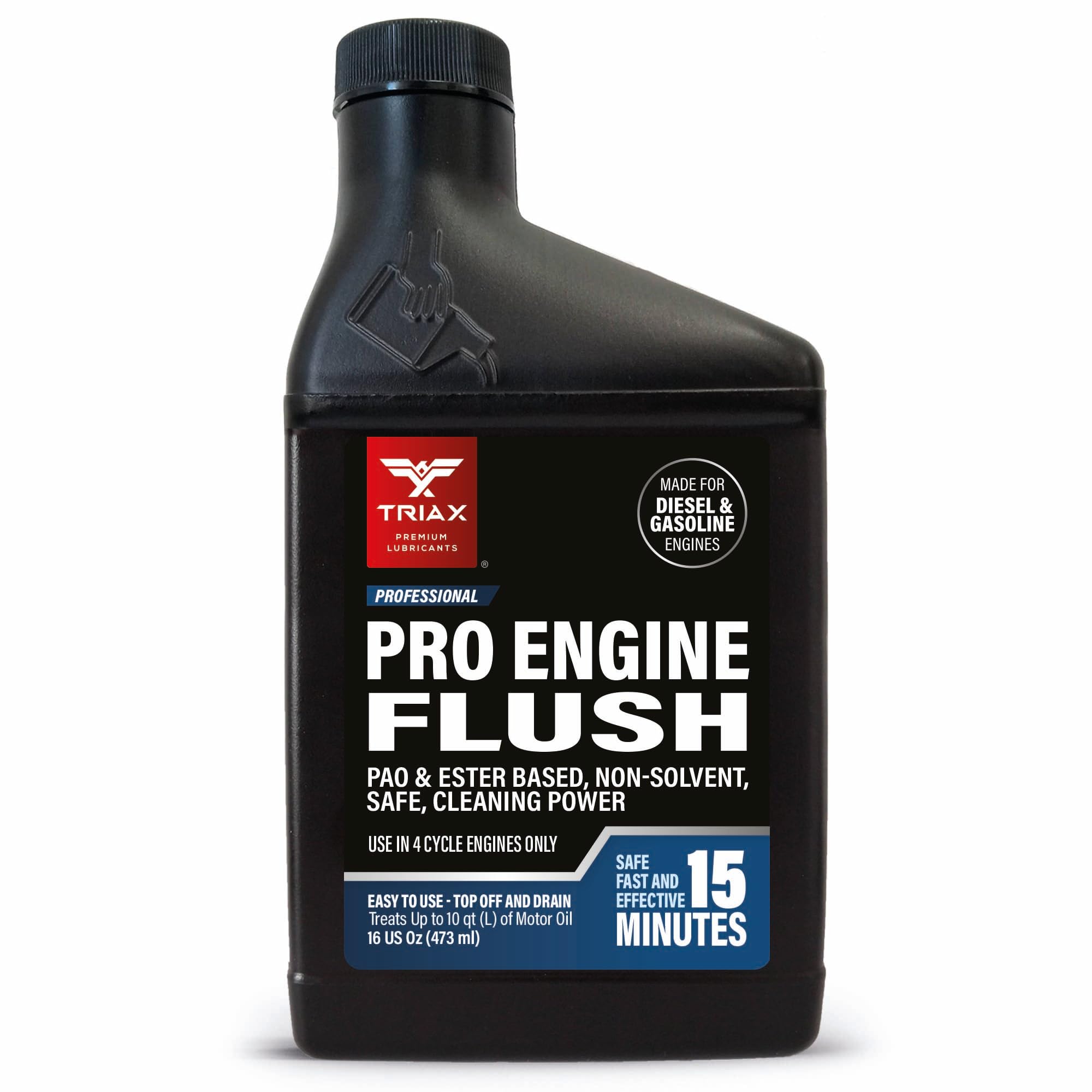
2. TRIAX Pro Engine Flush
This flush protects your engine as it cleans — a safety net most others lack.
The TRIAX flush stands apart because it pre-loads ZDDP (zinc dialkyl dithiophosphate, an anti-wear additive that forms a sacrificial layer on metal surfaces). Most flushes strip away your oil’s protective layer during the idle period. TRIAX maintains a lubrication film, so metal-to-metal contact and turbo wear are suppressed throughout the whole flush. It uses a 100% synthetic oil base with polar esters — molecules that penetrate deposits on piston rings, bearings, and the valve train — and PIB succinimide to keep loosened debris suspended so nothing settles back down.
Buyers report shocking results. One owner of a 2014 Honda CRV-LX with 176,000 miles warmed the engine, added the TRIAX, ran it for 15 minutes, and drained oil that came out “literally Jet Black” yet still oily in consistency — not thinned out like the Liqui Moly flush they had tried previously. The TRIAX treats up to 10 quarts per 16-ounce bottle, so it works for larger V-8 engines and trucks where the Liqui Moly 2427 (which covers only 5 liters) falls short. At 1 pound, the bottle weighs roughly the same as the Berryman 1216, but the chemistry is entirely different: oil-based rather than solvent-based, which makes it markedly safer for seals and injectors.
Owners mention the engine quiets down and runs smoother after a single treatment, and that no extra “cleanup flush” with cheap oil is needed afterward. The manufacturer recommends a simple idle of 10 to 15 minutes before draining.
Why it wins the top spot: Pre-loaded ZDDP anti-wear chemistry, high 10-quart capacity, and real buyer reports of jet-black drain results without the risk of a bare-metal flush.
Reach for this if: You want the safest deep clean for a turbocharged, high-mileage, or diesel engine and are willing to pay a small premium for anti-wear protection during the flush.
Look elsewhere if: You need a budget-friendly single-use bottle for a small four-cylinder engine — there are thinner margin options below.
3. Lubegard 95030 Engine Flush

A gentle synthetic-blend flush that keeps fresh oil cleaner for longer — not a one-shot sludge buster.
Lubegard takes a noticeably gentler approach than most flushes. It uses a premium synthetic blend of detergents and dispersants — no harsh solvents — specifically to remove varnish, sludge, and combustion by-products without threatening rubber seals or gaskets. The manufacturer recommends bringing the engine up to normal operating temperature before adding the flush, which means the cleaning chemistry relies on heat to activate. One reviewer noted using this flush nearly every oil change in a vehicle with a high-capacity oil pan and said the new oil stayed “almost clear as water for well over a month” after two consecutive treated changes.
At 15 ounces, the bottle is slightly smaller than the 16-ounce Berryman and TRIAX options. The real trade-off is cleaning speed: Lubegard requires a 5-minute idle, while competitors like TRIAX and Motul call for 10 to 15 minutes. A few customers note they could not detect a difference after a single use, which makes sense given the product’s emphasis on gradual maintenance rather than dramatic one-shot sludge removal. It is recyclable and unscented, which keeps disposal clean.
Maintenance-first approach: The Lubegard is less likely to dislodge a big chunk of sludge that blocks an oil passage, making it a smart pick for engines with unknown service history. It will not clean as fast as the Berryman on a sludged engine, but it is safer.
Reach for this if: You do routine flushes every few oil changes and want a formula that protects seals while keeping fresh oil bright.
Look elsewhere if: You have a sludged engine that needs one aggressive clean — the Berryman 1216 solvent blend will work faster.
4. Berryman 1216 Oil Change Flush

This American-made solvent blend rescued a 272,000-mile F-150 that could barely idle.
Berryman’s 1216 is the most aggressive formula in this roundup. It uses detergents and dispersants that suspend sludge deposits and open restricted oil passages. It does not contain acetone, toluene, or xylene — so it avoids the worst harsh solvents — but it is still a more assertive clean than the detergent-only options like Lubegard or Motul. The standout customer story is a 2010 F-150 with 272,000 miles that could barely idle. The owner poured in a can, revved the engine to near redline for 30 seconds, smoke cleared, and the engine ran smooth again.
At 1.1 pounds, the Berryman is the heaviest single bottle here. It is the only product explicitly marketed as safe for diesel engines with a water-removal feature for corrosion resistance. Reviewers advise caution on engines with unknown maintenance history. A 4-star review on a 2007 Saturn Ion with 100,000 miles noted that the drained oil showed some color change but the owner would not repeat the flush, preferring consistent synthetic changes instead. Priced as a budget option, the Berryman delivers old-school cleaning power for users who know their engine can handle it — it is faster-acting than the Lubegard for heavy sludge, but riskier for fragile seals.
Where it excels
- Fast-acting on heavy sludge and varnish
- Removes water for corrosion protection
- Safe for diesel engines
Where to be careful
- Not ideal for engines with unknown history — could dislodge large debris
Best for: The driver who knows their engine is sludged and wants a strong, fast clean — especially on high-mileage American trucks where it outpaced the slower Lubegard by a wide margin.
skip it if: Your engine has fragile seals or you follow religious synthetic oil changes and only need light maintenance — stick with TRIAX or Lubegard.
5. Motul Engine Clean

This flush protects your catalytic converter and DPF while it cleans — most flushes do not mention emissions.
Motul Engine Clean is unique in this lineup for explicitly addressing emissions. Its dispersant-based formula is compatible with catalytic converters and diesel particulate filters (DPFs, the part that traps soot in the exhaust), so you are not putting anything through the exhaust that could clog or damage downstream components. It uses detergent chemistry — no harsh solvents — to dissolve sludge, varnish, and combustion by-products from piston rings, lifters, and turbo oil lines. The maker recommends a 15-minute idle, which is on the longer side. It targets both gasoline and diesel engines, including turbocharged and naturally aspirated types.
One reviewer who used it on a Fiat 500 Abarth reported that it effectively cleaned oil passageways and recommended using it every other oil change to combat direct-injection sludge. At 300 milliliters (10.1 fluid ounces), the bottle is smaller than most competitors, so it is better suited to four-cylinder engines. A few buyers noted they saw no immediate difference, which is typical of gentler maintenance flushes — the benefit accumulates over repeated uses. The 0.18-kilogram weight makes it the lightest bottle on this list.
Emissions-first philosophy: Motul prioritized DPF and catalytic converter safety above maximum cleaning speed. This is a flush you can use regularly without worrying about downstream effects.
Reach for this if: You drive a modern diesel with a DPF or a direct-injection engine and want a gentle, emission-safe maintenance flush.
Look elsewhere if: You need a single treatment to break up severe sludge — a more aggressive formula like the Berryman will deliver faster results.
6. XADO ATOMEX Total Flush Revitalizant

You drive around for 50 miles with this flush in the oil — not just idle in the driveway.
XADO takes a fundamentally different approach. You add the 250-milliliter bottle to your engine oil, then drive normally for about 100 miles (or at least 50 miles, per many user reports) before draining. This soak-style method lets the Revitalizant (a proprietary cleaning and protective additive) work through multiple heat cycles, reaching areas a short idle flush cannot fully penetrate. One buyer bought a 2018 Jeep Wrangler with 50,000 miles, left the XADO in for 50 miles, drained oil that was “Wow…was it black,” then ran cheap oil for 500 miles before switching to synthetic.
Another reviewer who had let oil changes slip for 25,000 miles saw fuel economy return to the level the car delivered when new after a single XADO soak and drain. The 250-milliliter bottle is the smallest in this list, but the cleaning mechanism compensates with time rather than chemical aggression. The formula is suitable for all engine types, including turbo and supercharged engines, and the anti-carbon effect targets combustion deposits specifically. The 4.6-star average across over 600 ratings confirms consistent results across a wide range of vehicles — more ratings than the Berryman but fewer than the Liqui Moly 2427.
Why drivers like it
- Deep clean through extended driving, not just idle
- Revitalizant leaves a protective barrier behind
- Effective on neglected engines with 25K-mile intervals
The time cost
- Requires planning — you need to drive 50–100 miles before the oil change
Best for: Anyone who has neglected oil changes and wants a thorough, multi-cycle clean that goes beyond what a 10-minute idle can achieve. It is the deepest clean without tearing the engine apart.
pass on it if: You do not have the flexibility to drive 50+ miles before your oil change — the short-idle flushes like TRIAX or Liqui Moly are more convenient.
7. Liqui Moly 2037 Pro-Line Flush (6-Pack)

Six cans of the same trusted Liqui Moly flush — a smart stock-up that cuts the per-can cost.
This is the exact same Pro-Line Engine Flush chemistry as the 2427 reviewed above, but packaged as six 500-milliliter cans for those who go through flushes regularly. Each can treats up to 5 liters of oil. The formula is gentle and rapid-cleaning, neutral to seals and catalytic converters, suitable for both gasoline and diesel engines. If you maintain a fleet of vehicles — or you intend to flush every oil change for a year — the 6-pack brings the per-can cost down considerably compared to buying single bottles of the 2427.
Reviewers point out the same experience as the single-can version. One buyer mentioned “I felt the difference instantly” after the pour. Another confirmed it “helped get rid of stuck lifters” and pulled out “a ton of sludge.” If you only need one flush per year, the 6-pack may take up shelf space. But for multi-car owners, it is the easiest option on this list — you never run out mid-project.
Best bulk play: Identical chemistry to the 4.7-star Liqui Moly 2427, but at a lower per-unit cost when you buy the six-pack.
Reach for this if: You own multiple vehicles, or you want to flush consistently at every oil change for a year without reordering.
Look elsewhere if: You only need a single flush — the 2427 single can is simpler and avoids leftover inventory.
Understanding the Specs
Solvent vs. Detergent Formulas
Solvent flushes (like Berryman 1216) dissolve deposits chemically but thin out oil significantly, reducing the protective film between moving parts during operation. Detergent-based flushes (like TRIAX, Lubegard, and Motul) use dispersants to break up and suspend particles without stripping lubrication, making them safer for seals, turbo bearings, and high-mileage engines. The TRIAX formula goes a step further by pre-loading ZDDP (an anti-wear additive that forms a sacrificial layer on metal surfaces) to protect against metal-to-metal contact during the flush itself.
Bottle Size and Engine Capacity
A 500-milliliter can from Liqui Moly treats up to 5 liters of oil. The TRIAX 16-ounce bottle covers 10 quarts, making it a stronger choice for trucks and SUVs. The XADO 250-milliliter bottle is the smallest in volume but compensates with a longer soak period. Always match the treatment capacity to your engine’s oil capacity. Using half the recommended dose dilutes the cleaning chemistry below its effective concentration and risks an incomplete flush.
FAQ
Can I use an engine flush on a high-mileage engine with unknown history?
How long should I let the engine flush run before draining the oil?
Is it safe to use an engine flush in a turbocharged engine?
Will an engine flush harm my catalytic converter or DPF?
How often should I use an engine flush?
Can I use an engine flush in a diesel engine?
What is the difference between a flush and a fuel system cleaner?
Does an engine flush fix a noisy engine or ticking lifters?
Can I leave the flush in the engine longer than recommended?
Should I change the oil filter after using an engine flush?
Final Thoughts: The Verdict
For most people, the best engine flush winner is the TRIAX Pro Engine Flush because it delivers professional-grade cleaning with pre-loaded ZDDP anti-wear protection — a safety net no other flush in this list offers. If you want a trusted, traditional flush backed by over 14,000 ratings, grab the Liqui Moly 2427. And for the deepest possible clean on a neglected engine, the XADO ATOMEX Total Flush with its 50-mile soak method is the single best choice you can make without tearing the engine apart.
How We Picked
We do not accept paid placement. Every pick is matched to a real buyer and a real use-case; we do not hands-on test units.
Sources & Methodology
Specifications: manufacturer listings and product documentation. Review insights: verified customer reviews, as of July 2026. Pricing: not shown on this page (it changes often); check the current price via the retailer link.
As an Amazon Associate, Trending Car earns from qualifying purchases. This does not affect which products we feature.