
Our readers keep the lights on and my garage snacks stocked. As an Amazon Associate, I earn from qualifying purchases.
Specs are compiled from manufacturer listings and verified buyer reviews and can change over time — please confirm the key details on the product page before buying.
You spot a new scratch on your car’s paint and it stings. A shopping cart ding, a rogue key, or a parking lot scuff can make your whole car feel tired. You do not need a professional detailing shop to fix it. The right compound and some elbow grease can bring the finish back to life.
I’m Min Islam — the founder and writer behind Trending Car. This guide is built by comparing the manufacturers’ published specifications and the patterns across verified customer reviews, so you get each pick’s real strengths and trade-offs instead of marketing spin.
After looking at the abrasiveness, ease of use, and real-world results of seven different formulas, this guide has identified the best paint scratch remover for every type of blemish and budget.
Our Picks at a Glance

How To Choose The Best Paint Scratch Remover
Not all car scratches are the same. The best product depends on how deep the damage goes. Pick the wrong abrasive level and you either leave the scratch untouched or burn through your clear coat. Here are the key factors to consider before you buy.
Use the “Fingernail Test”
Run your fingernail across the scratch. If your nail does not catch, the damage is only in the clear coat. A fine polish can buff it out. If your nail catches, the scratch is down into the color layer or primer. You will need a heavier cutting compound (an abrasive paste that removes paint), and even then, you may only reduce its visibility.
Compound vs. Polish: Know the Difference
A rubbing compound is an aggressive abrasive that cuts into the paint to remove deeper scratches and oxidation. A polish is finer. You use it after a compound, or on its own, to restore gloss and remove light swirl marks (tiny circular scratches in the clear coat). Many scratch remover kits combine both steps, but buying them separately gives you more control.
Quick Comparison
| Model | Best For | Abrasiveness | Weight | Application | Amazon |
|---|---|---|---|---|---|
| Meguiar’s Quik Eraser Kit★ Best Overall | Light blemishes & scuffs | Fine (Grit 220) | 4.2 oz | Drill-mounted pad | Amazon |
| Griot’s Garage BOSS Correcting CreamAlso Great | Moderate defects & swirls | Medium (Grit 120) | 16 oz | Machine buffing | Amazon |
| Chemical Guys V32 Extreme Compound | Sanding scratches (1200-1500 grit) | Fine (Grit 1500) | 16 oz | Rotary or DA polisher | Amazon |
| Jescar Correcting Compound | Sanding marks (P1500 grit) | P1500 | 8 oz | DA polisher | Amazon |
| Menzerna Super Finish Plus 3800 | Mirror-finish and hologram removal | Medium | 8 oz | Orbital polisher or hand | Amazon |
| Turtle Wax Hybrid Solutions Scratch Repair Kit | Surface scratches & paint transfer | Fine | 1.0 Count (kit) | Hand applicator block | Amazon |
| ABRO Rubbing Compound | Oxidized paint & heavy scratches | Fine | 10 oz | Hand or machine buffer | Amazon |
In‑Depth Reviews
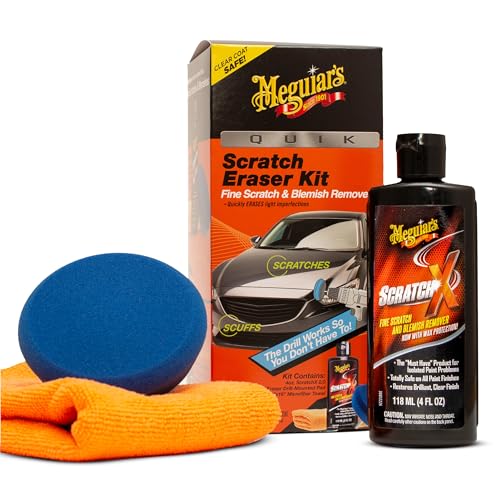
1. Meguiar’s Quik Eraser Kit
Our pick — over 4★ from 11,500+ verified ratings; the strongest balance of quality and price.
This drill-powered scratch eraser turns a power tool into a DIY detailer.
This kit removes the elbow grease by letting your standard electric drill do the spinning. The Car Scratch Eraser Pad uses ScratchX micro-abrasive technology (a fine grit formula) to remove light scratches, scuffs, and paint transfer without hazing (a cloudy residue). One owner reported that the kit “reliably removed noticeable scuff on white car bumper in under 10 minutes.” It is a fantastic solution for spot repairs on light blemishes.
That is fine for one or two touch-ups, but you will run out quickly for larger projects. Multiple reviewers point out it works only on scratches that do not catch your fingernail; deeper damage needs a professional. The included microfiber towel is a welcome touch.
Smart approach: wash the area, prime the pad, apply a dab of ScratchX, run the drill at low speed in overlapping circles for 30-60 seconds, and wipe clean. Light blemishes improve almost instantly.
Best for: drivers who want a quick, drill-powered fix for surface scuffs, paint transfer, and fine scratches.
Not for: heavy oxidation or scratches you can feel with your nail — the fine grit 220 formula lacks the cutting power for those jobs.
2. Griot’s Garage BOSS Correcting Cream
This pro-grade cream wipes off easily and cuts through swirls without dusting up your garage.
You get a single product that handles both light scratches and deeper swirl marks in the clear coat. The Griot’s Garage BOSS Correcting Cream uses a medium-grit aluminum oxide formula (rated at Grit 120, meaning coarser particles that cut aggressively) to remove moderate defects while adding depth and clarity. Buyers report it restored a 12-year-old Acura MDX black paint to a mirror finish in 4-5 passes per panel using a microfiber cloth.
The extended work time comes from a high-lubricity formula that will not dry out or dust. This gives you room to work a panel thoroughly before wiping off. The brand says it pairs with the BOSS Fast Correcting Foam Pad, but one owner noted it works well with similar orange pads. Unlike the ABRO compound below, which owners mention “dries too easily” if you linger, this cream stays wet and forgiving. You get 16 ounces — double the 8 ounces of the Menzerna and Jescar compounds.
Why It Earns The Top Spot
- Rated 4.8 out of 5 stars from 881 reviews — the highest average rating in this guide
- No dust residue during buffing for a cleaner workflow
- Versatile on cars, boats, and even acrylic dust covers (customers note)
The Only Real Trade-Off
- Ineffective on deep scratches that have penetrated the color layer — no home compound can fix those
Reach for this if: you want one cream that corrects moderate defects, finishes glossy, and works with any dual-action polisher.
Look elsewhere if: you need a budget-friendly hand-applied solution for a single light scuff.
3. Chemical Guys V32 Optical Grade Extreme Compound

This ceramic-ready compound cuts through modern hard clear coats and demanding correction jobs.
Engineered specifically for scratch-resistant and ceramic clear coats, the Chemical Guys V32 removes 1200-1500 grit sanding scratches — the kind you get from wet-sanding a paint job. This is not a gentle polish. It is an optical-grade compound with a long cycle time that lets you work the product before it breaks down. One reviewer used it on a black Xterra with severely oxidized paint, applying two passes with a DA (dual-action) polisher and finishing with V38 polish, achieving results that looked very good outdoors.
The brand says it is formulated without silicone or fillers (hidden additives that temporarily hide scratches), so what you cut is what stays — no hidden fillers that wash out after a week. A buyer also reported success removing hard water spots from 2019 GMC Denali truck windows using felt pads and a handheld sander, noting it “cut through spots quickly.” At 16 ounces, it matches the Griot’s Garage BOSS in volume but is priced slightly higher.
The one catch: it can dust slightly if you use too much product or push the buffer too hard. A few buyers experienced this but attributed it to user error.
Best if: you drive a modern car with ceramic clear coat and need to cut through sanding marks or heavy oxidation.
skip it if: your scratches are shallow paint transfer marks — a finer polish like the Menzerna 3800 will get the job done faster.
4. Jescar Correcting Compound
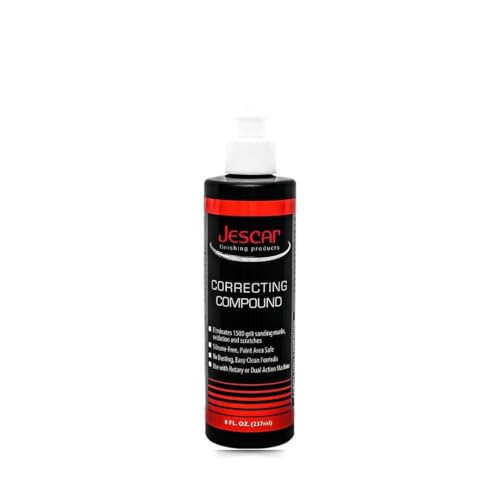
This professional’s choice eliminates P1500 sanding marks without the messy powdering.
When you wet-sand a panel (use fine sandpaper with water to smooth paint), you need a compound aggressive enough to cut those P1500 grit scratches. The Jescar Correcting Compound is built for that job. It uses advanced aluminum oxide abrasives designed for fiberglass and painted materials, making it a go-to for body shops. One reviewer described it as “the best correcting compound for DA polishers,” highlighting its minimal dusting compared to other heavy-cut compounds.
Users recommend applying just three pea-size dots per 2×2 foot area with an orange foam pad, performing three passes with medium pressure. This technique delivers a glass-like finish. Unlike the ABRO compound which one reviewer noted “dries too easily,” the Jescar stays workable with easy wipe-off. The 8-ounce bottle is smaller than the 16-ounce Griot’s Garage, so factor that in for large panel jobs.
Standout Performance
- Rated 4.8/5 with 371 reviews — tied for highest average rating with Griot’s Garage
- No powdering residue during use
- Specifically rated for P1500 grit sanding mark removal
Consider Before Buying
- Priced higher than American brands like Meguiar’s, per one reviewer
- Best used with a dual-action machine polisher, not by hand
Perfect for: anyone repairing a wet-sanded panel or needing a true correction compound without the dust storm.
Not ideal for: casual touch-ups on a single parking-lot scuff — the Turtle Wax kit is a simpler, cheaper choice for that.
5. Menzerna Super Finish Plus 3800
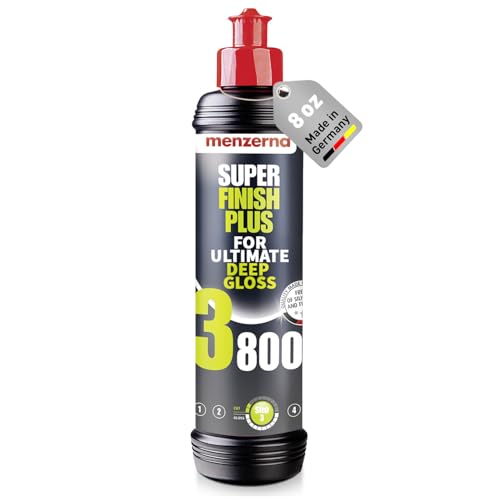
This detailing purist’s finishing polish chases away holograms and leaves a liquid-glass shine.
If you have ever used a rotary polisher (a high-speed spinning tool), you know the dreaded hologram effect — those ghostly swirls that appear under light. The Menzerna Super Finish Plus 3800 is the finishing compound designed to fix that. One owner reported that after a rotary polisher using Meguiar’s Ultimate Polish left holograms on their black paint, a single pass with Menzerna on a red jeweling pad removed every micro-abrasion, leaving the paint crisp. It delivers a “mirror-like finish” by recreating the high shine of a show car, especially on darker colored coats.
The bottle is slim at 8.3 x 1.9 x 1.9 inches and holds 8 ounces — half the volume of the 16-ounce Griot’s Garage. It is beginner-friendly: shake it, apply a small amount to a green Soft Cut Foam Pad, work in a criss-cross pattern until the milky film turns translucent, then wipe clean. The silicone-free formula is body shop safe.
The trade-off: this is a finishing polish, not a heavy cutter. It cannot remove fingernail-catching scratches. Pair it with a more aggressive compound like the Jescar for a full 2-step correction.
Ideal for: owners of dark-colored cars (black, navy, deep red) who notice holograms or want a show-ready gloss.
Less suited for: oxidized or heavily scratched paint that needs aggressive cutting first — the ABRO compound is better for that.
6. Turtle Wax 53836 Hybrid Solutions Scratch Repair Kit

This kit does more than buff — it fills scratches with a clear coat resin for a lasting repair.
Most scratch removers only polish the clear coat. This Turtle Wax kit includes a clear coat resin that both fills and protects the damaged area. After using the polishing compound to refine the surface, you apply the resin to seal the scratch with instant gloss and color uniformity. A buyer reported that the industrial-grade resin “restores clear coat, removes deep scratches, faded finish” and lasts over a year when applied correctly with fresh microfiber.
The kit includes a polishing compound, clear coat resin, foam applicator block, three non-linting cloths, and gloves — everything in one box. Unlike the Meguiar’s Quik Eraser Kit that requires a drill, this is a hand-applied system, making it accessible for anyone without power tools. One buyer mentioned it minimized noticeable brush scratches on a Jeep to where “close inspection” was needed to see remnants.
What Makes It Unique
- Two-step system: abrasive compound + filling clear coat resin
- All accessories included (applicator block, 3 cloths, gloves)
- Rated 4.3/5 with consistent praise for deep scratch reduction
What It Will Not Do
- While it reduces visibility, it will not make a deep scratch (down to primer) fully disappear
Reach for this if: you want a complete home kit that fills as well as buffs, especially for clear coat scratches.
Think again if: you need a heavy cut for oxidized paint — the compound here is designed for fine, controlled correction.
7. ABRO Rubbing Compound 10 oz

This aggressive cutting compound wakes up faded clear coats without emptying your wallet.
If your car’s paint looks chalky, dull, or severely oxidized, the ABRO Rubbing Compound is a budget-friendly workhorse. One buyer describes it as a “very aggressive compound; excellent on sunfaded/oxidized clearcoat and heavy scratches.” It is the first step in a 3-step process (compound → polish → wax) designed to bring back color to weathered panels. The silicone-free formula is body shop safe for use on metal, glass, plastic, and composite surfaces.
The 10-ounce container holds 25% more compound than the 8-ounce Menzerna bottle, giving you more value per application. You can apply it by hand for spot correction or with a machine buffer for larger panels. But one reviewer warned that it “dries slightly during hand buffing” and has a fuel oil smell. Another owner cautioned that sitting in one spot with a buffer can burn through the paint — this is a strong cutter that requires care.
Why It Stands Out
- Fast-cutting ability for oxidized clearcoat and heavy scratches (shoppers say)
- Largest volume in the budget tier at 10 oz
- Works on multiple surfaces: paint, metal, glass, plastic
Watch Out For
- Dries quickly during hand buffing — work in small sections
- Aggressive formula can damage clear coat if misapplied
Choose this if: you are tackling a daily driver with sun-faded paint or deep scuffs on a tight budget.
Pass if: you need a gentle finishing polish for a dark-colored car where fine holograms are a concern.
Understanding the Specs
Grit Rating & Abrasiveness
The grit number (like 120 on the Griot’s Garage or 1500 on the Jescar) tells you how coarse the abrasive particles are. A lower number means a more aggressive cut. Grit 120 is good for removing moderate defects, while Grit 1500 is a finer compound for polishing out sanding marks. In this context, “fine grit” (like the 220 on the Meguiar’s kit) is safest for clear-coat-only scratches and less likely to damage the paint if you are a beginner.
Compound vs. Polish: The Right Order
A rubbing compound (like the ABRO) is the heaviest abrasive, designed to cut through oxidation and deep scratches. A polish (like the Menzerna Super Finish Plus 3800) is a finer abrasive that removes the haze left by a compound and restores gloss. The correct order is always compound first for correction, then polish for refinement. Some all-in-one kits combine a mild abrasive with a filler resin (like the Turtle Wax kit) for a simpler one-step process.
FAQ
Can a paint scratch remover fix any scratch on my car?
What is the difference between a rubbing compound and a scratch remover?
How do I know if a scratch is too deep for a remover?
Can I use these removers on a car with matte paint?
How long does a professional-grade compound like the Jescar last in storage?
What does “Grit 120” or “Grit 1500” mean on a compound?
Do I need a machine buffer to use a scratch remover effectively?
Why does the Menzerna 3800 say it removes “holograms”?
Final Thoughts: The Verdict
For most buyers, the paint scratch remover winner is the Griot’s Garage BOSS Correcting Cream. It delivers professional correction without the dust, has the highest verified rating of 4.8/5, and offers 16 ounces of versatile medium-grit compound. If you want a complete kit that also fills scratches with a resin, grab the Turtle Wax Hybrid Solutions Scratch Repair Kit. And for heavy oxidation on a budget, the raw cutting power of the ABRO Rubbing Compound is your best bet.
How We Picked
We do not accept paid placement. Every pick is matched to a real buyer and a real use-case; we do not hands-on test units.
Sources & Methodology
Specifications: manufacturer listings and product documentation. Review insights: verified customer reviews, as of July 2026. Pricing: not shown on this page (it changes often); check the current price via the retailer link.
As an Amazon Associate, Trending Car earns from qualifying purchases. This does not affect which products we feature.