
Our readers keep the lights on and my garage snacks stocked. As an Amazon Associate, I earn from qualifying purchases.
Specs are compiled from manufacturer listings and verified buyer reviews and can change over time — please confirm the key details on the product page before buying.
A compressor fridge plugs into your van’s 12V system, cools to freezing or below, and holds a steady temperature without ice. It plugs into your van’s 12V system, cools down to freezing (or below), and holds a steady temperature without a single ice cube. The right choice depends on your capacity, efficiency, and feature needs. This guide compares nine 12V compressor fridges, from compact weekend boxes to dual‑zone units that refrigerate and freeze simultaneously.
I’m Min Islam — the founder and writer behind Trending Car. This guide is built by comparing the manufacturers’ published specifications and the patterns across verified customer reviews, so you get each pick’s real strengths and trade-offs instead of marketing spin.
If you plan on living or traveling out of your van long term you will eventually need to stop messing with wet ice and switch to a real campervan fridge — this list shows you the best models at every budget so you can buy with confidence without overpaying for features you do not actually need.
Our Picks at a Glance


How To Choose The Best Campervan Fridge
Your choice depends on your camping style, power availability, and if you need freezing or just cooling. Here are the three specs that matter most.
Capacity: 21 Quarts vs 64 Quarts
A 21‑quart unit like the ICECO GO20 fits behind the driver’s seat and handles a few days of drinks and lunch meat. A 64‑quart unit like the EKOJUCE holds two full weeks of groceries for a couple. For solo or weekend use, choose a fridge under 30 quarts. If you live in the van full-time, 40 quarts or more saves you from constant resupply runs.
Dual Zone vs Single Zone
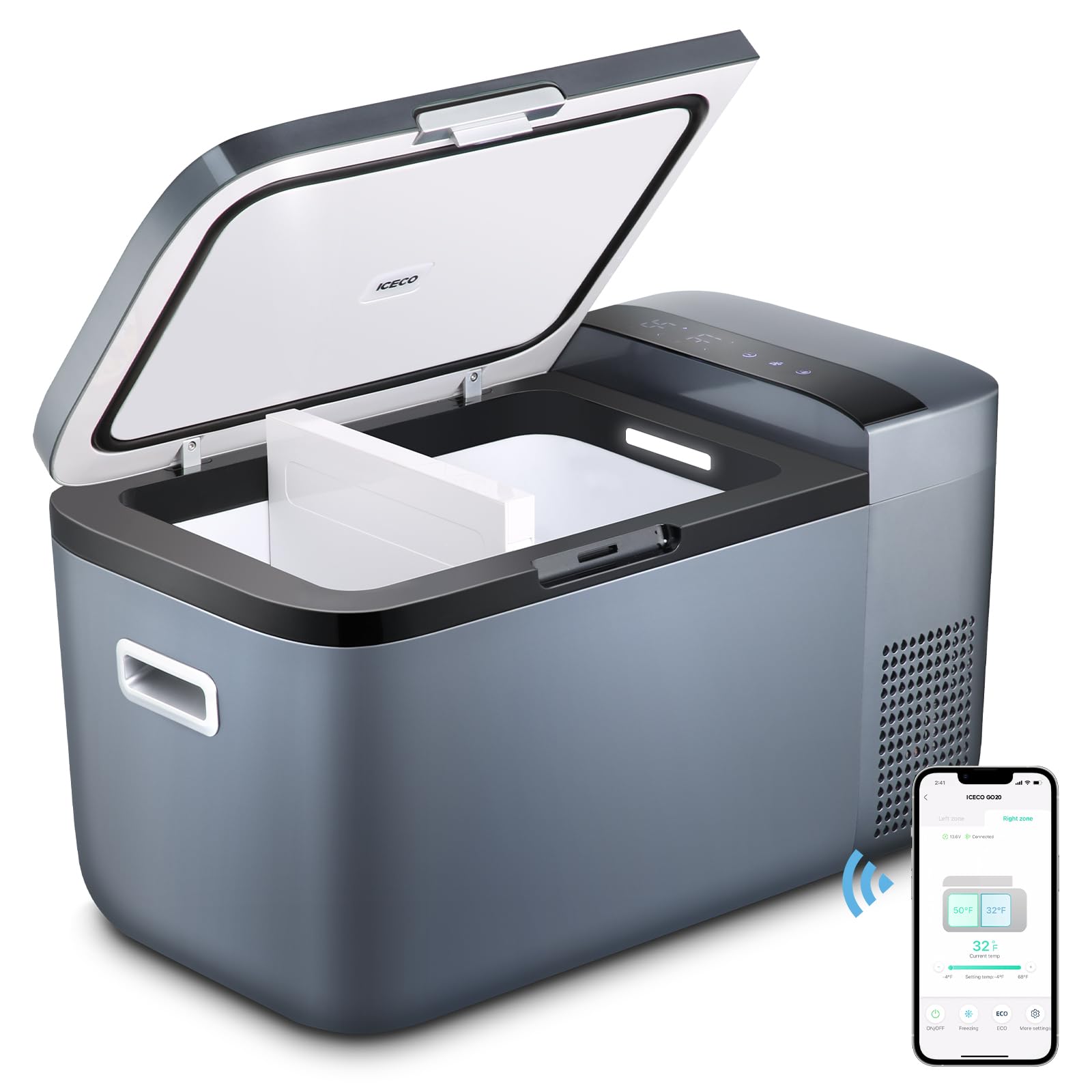
A single‑zone fridge lets you pick one temperature — either fridge mode (around 34°F to 40°F) or freezer mode (0°F or lower). A dual‑zone model, such as the ICECO GO20 or the Kohree 42 Quart, has a removable or fixed divider so one side can freeze meat while the other keeps vegetables at fridge temp. If you eat frozen meals or raw meat on the road, dual‑zone is worth the premium.
Power Efficiency and Battery Protection
Every compressor fridge draws power when the compressor runs. Efficiency is measured in annual energy consumption (kWh per year) or average watts. A fridge that uses 28W in ECO mode, like the Setpower, is much gentler on a 100Ah battery than a model pulling 60W. Also look for three‑level battery protection (usually labeled L/M/H or H1/H2/H3) — this automatically shuts the fridge off before it drains your starter battery dead.
Quick Comparison
| Model | Best For | Capacity | Annual Energy | Temp Range | Amazon |
|---|---|---|---|---|---|
| ICECO GO20 Dual Zone★ Best Overall | Premium dual‑zone, fast cool | 21 quarts | 275 kWh | 0°F to 50°F | Amazon |
| Megiu 23 QuartBest Value | Budget pick, great capacity | 23 quarts | 113 kWh | -18°C to 15°C | Amazon |
| Setpower RF20Ultra Low Power | Ultra‑low power, 50h backup | 21 quarts | — | -4°F to 68°F | Amazon |
| EUHOMY 32 Quart | Built‑in battery, app control | 32 quarts | 150 kWh | — | Amazon |
| Alpicool 37 Quart | Large capacity at low price | 37 quarts | 150 kWh | -4°F to 68°F | Amazon |
| EKOJUCE 64 Quart | Massive storage, quietest | 64 quarts | — | -4°F to 68°F | Amazon |
| Kohree 42 Quart Dual Zone | True dual‑zone with wheels | 42 quarts | — | -4°F to 68°F | Amazon |
| BougeRV CRPRO VIP 30 Quart | Insulated cover keeps cold 37h | 30 quarts | 256 kWh | -8°F to 50°F | Amazon |
| Dometic CFX2 28L | Premium brand, solar/AC/DC | 28 liters | — | -7°F to 68°F | Amazon |
In‑Depth Reviews
1. ICECO GO20 Dual Zone 12V Refrigerator
Our pick — 4.5★ from 950+ verified ratings; the strongest balance of quality and price.
A Red Dot Award winner that cools a hot burger to fridge temp in four minutes flat.
This is the fridge you reach for when you want two separate temperature zones in a compact 21‑quart body. You pull out a detachable partition to switch between single and dual‑zone mode, each with its own digital controller — so the left side can hold drinks at 38°F while the right side freezes meat at 0°F. The SECOP compressor is an anti‑bump design, meaning bumpy forestry roads will not knock it off‑kilter. Buyers report it “cools to temp in 4 min, holds within 5°F,” which backs up the maker’s claim of a fast‑cooling mode that uses limited power to boost the effect. The annual energy consumption runs 275 Kilowatt Hours — that is the price you pay for that instant‑cooling punch and dual‑zone flexibility. It ships with both a 2.5m cigarette lighter cord and a home AC adapter, and the app control works reliably. The 5‑year compressor warranty and 1‑year parts warranty plus 24‑hour Amazon message support add real confidence for long‑term van dwellers.
The trade‑off is capacity. It is also the most expensive fridge in the mid‑range tier, which puts it in competition with larger single‑zone units at the same price.
What stands out
- Dual‑zone with independent digital controls
- SECOP compressor cools to temp in 4 minutes
- Red Dot Design Award and ETL certified
- 5‑year compressor warranty
Where it pinches
- 21 quarts is tight for extended trips
- 275 kWh annual consumption is higher than most
- Some units needed a replacement 12V adapter
Grab it for: van lifers who want true freezer + fridge in one box and value instant cooling over maximum capacity.
Pass on it if: you need to store more than a weekend’s worth of food for two people — the Megiu below holds 2 more quarts at 113 kWh per year versus 275 kWh.
2. Megiu Car Refrigerator 23 Quart
Shoves 23 quarts of storage into an 18.5‑pound frame that sips 113 kWh per year.
If your campervan power system is modest — say a 618Wh power station — this Megiu is the math that works. Its annual energy consumption of 113 Kilowatt Hours Per Year is at 113 kWh per year versus the ICECO GO20’s 275 kWh, meaning it drains your battery bank much slower. It reaches 35°F in 2 hours on 110V according to one buyer, and another ran it for 17 continuous hours off a power station in Florida July heat. The DC inverter compressor draws an average of 45W and operates below 40 decibels, quiet enough that you can sleep with it running. The touch‑screen panel and LED display let you toggle from fridge mode at 59°F all the way down to -0.4°F freezer mode. The removable basket doubles as a serving tray, and the ABS shell stands up to road vibration.
The catch is quality control consistency. One buyer got a unit that never dropped below 62°F on the first try, and another reported a 13°F display error. The manual is printed in poor English. The second unit worked perfectly for those who exchanged, but the gamble means you should test it at home before you drive away.
Why it makes sense
- 113 kWh/year is the most efficient in this list
- 23 quarts holds 10% more than the ICECO GO20
- 18.5 lb is easy to lift in and out of a van
- 3‑year compressor warranty
The risk
- Some units arrive with temperature accuracy issues
- Poor English manual
- Plastic smell reported by several buyers
Perfect match for: budget‑minded van travelers with limited solar or battery capacity who need a fridge that won’t dominate the power budget.
Think twice if: you cannot afford the risk of a faulty unit — order early enough to test and return if needed.
3. Setpower 12V Refrigerator 21 Quart
A 28‑watt sipper that keeps food cold for 50 hours after the power cuts.
This Setpower lives in a different efficiency tier. Its Smartele compressor pulls only 28W in ECO mode and 40W in MAX mode — the lowest draw of any fridge on this list — which means it consumes far less than 1kWh per day. It also packs a built‑in ice pack that doubles as a divider, letting it keep food cool up to 50 hours after a blackout or if you accidentally leave it unplugged. The fast‑cooling claim is 15 minutes from 77°F down to 32°F, and 45 minutes to hit -4°F. One reviewer who had been using a Peltier cooler that burned a constant 60W called this “high performance, high efficiency, good quality, good price” and noted the shift to compressor‑based cooling eliminated the battery‑killing problem of his old unit. The external dimensions are 24.3″D x 13.1″W x 11.9″H and it weighs 22.1 lb. App control via phone is included alongside the physical control panel.
Where it falls short: owners mention “not a whole lot of room” — at 31 liters (roughly 21 quarts) it is comparable to the ICECO GO20 in capacity. This is a solo‑traveler or weekend‑getaway size. The manual also suggests avoiding direct sunlight for long periods, which can be a challenge in a small van parked in the sun.
Efficiency highlights
- 28W ECO mode is the lowest power draw on the list
- 50‑hour backup cooling via built‑in ice pack
- 15‑minute cool‑down to 32°F
- 3‑year compressor tech support
Size limits
- 21‑quart capacity fits one person for 2–3 days
- Ice pack divider reduces usable space
- Needs shade to maintain efficiency
Best for: solo van dwellers or minimalist campers who run on a small battery bank and need every watt to count.
skip it if: you typically carry food for two people for more than a weekend — the Alpicool 37 Quart below costs a little more but more than doubles capacity.
4. EUHOMY 32 Quart 12 Volt Refrigerator

A 32‑quart fridge with a rechargeable battery that keeps drinks cold for six hours without any power cord.
This EUHOMY is unique in the lineup because it contains a battery that keeps the compressor running for six hours after a full charge — so you can unplug it from the van and carry cold food into a tent, campsite, or cab of a truck. The compressor cools from 77°F to 32°F in 15 minutes using an average 45W draw, and it consumes 150 Kilowatt Hours annually. The control panel uses Bluetooth and an app, and the three‑level battery protection system (adjustable from 9.6V to 12.4V in L/M/H modes) prevents draining your van’s starter battery. Two recessed handles and a built‑in LED light make late‑night reach‑ins easy, and the USB port on the front keeps your phone charged. Owners say it holds 33°F consistently, is “very quiet,” and one reported that the manufacturer replaced the unit free of charge even after the 2‑year warranty expired. The frosted door orientation is reversible.
The battery is the headline feature but also the main compromise. It only lasts six hours, so it is a convenience for short stops, not a substitute for a house battery. Some buyers mention the battery accessory was not available until mid‑2026, and the app had not been fully tested at launch.
Unique advantage
- Internal battery provides 6 hours of cordless use
- 32 quarts is a good middle‑ground size
- Frost‑free defrost system
- Excellent customer service reviews
Limitations
- Battery runtime is too short for all‑night unplugged use
- 150 kWh/year is moderate, not class‑leading
- App not fully reliable at launch
Reach for this if: you often move between spots and want the freedom to carry the fridge away from the vehicle for a few hours without losing cooling.
Look elsewhere if: you are on a minimalist power budget — the Setpower above draws 28W in ECO mode, compared to the EUHOMY’s 45W average draw.
5. Alpicool Car Refrigerator 37 Quart
Holds 63 cans of cola at 45 decibels — the budget route to serious freezer space.
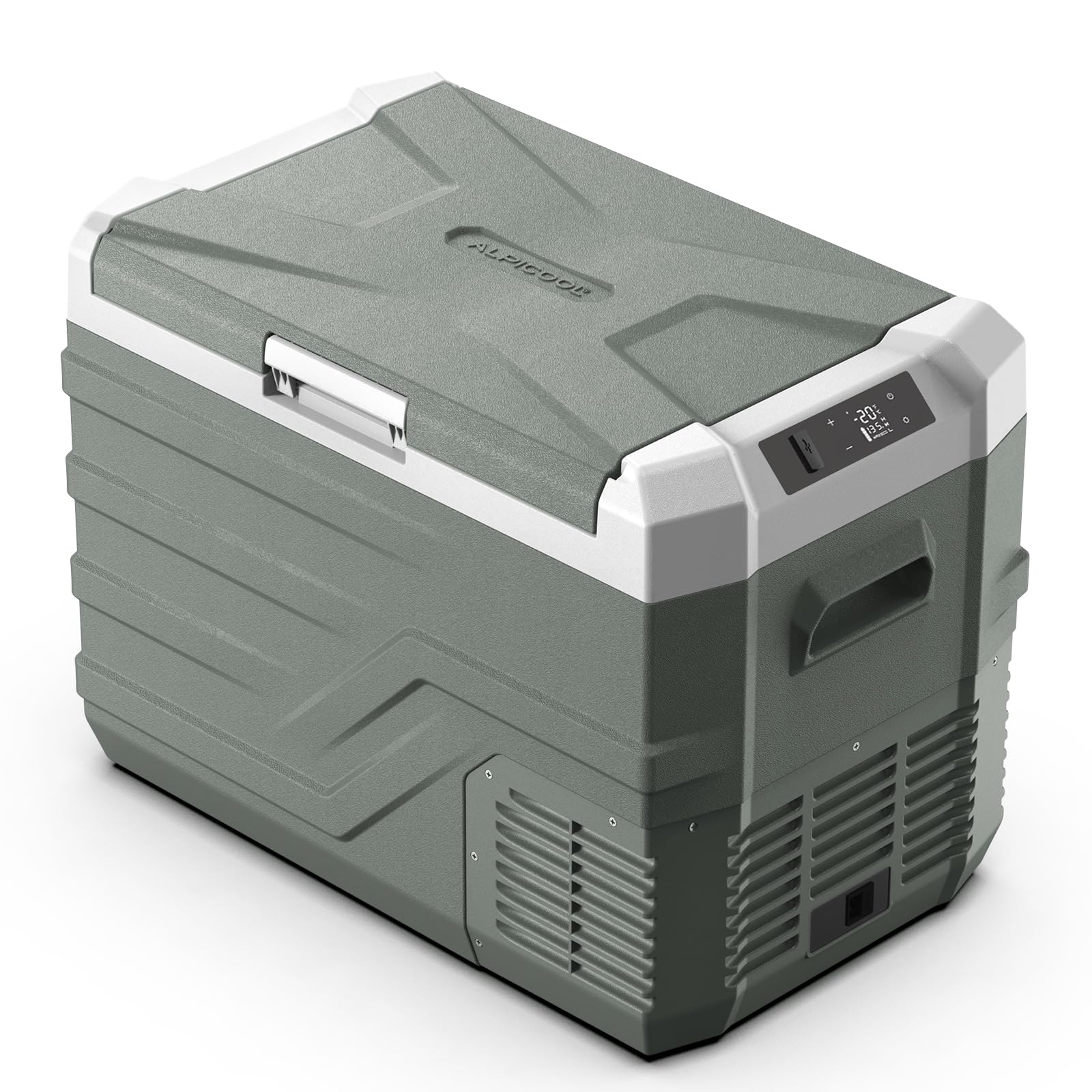
The Alpicool crams 37 quarts of capacity into a top‑load chest format, enough for 63 cola cans or 48 water bottles. That is nearly double the 21‑quart capacity of the ICECO GO20 or Setpower, yet the annual energy consumption sits at 150 Kilowatt Hours Per Year — the same 150 kWh as the smaller EUHOMY. The compressor cools from 77°F to 32°F in 15 minutes and hits -4°F within an hour. A reversible door, interior LED lights, and a bottom drain hole for easy cleaning are all standard. The three‑level battery protection (H1/H2/H3) fits cars, SUVs, and vans, and the anti‑tilt design handles inclines up to 45°. One traveler reported that with a 150Ah battery the fridge ran 48 hours with no charge drop to 60%, while 200W of solar barely kept up — so size your bank accordingly. Buyers praise its quick cooling in Texas summer heat.
The caveats pile up at this price. There is no internal light, no baskets, and no Bluetooth control. The lid protrudes about 1/4″ when closed, making packing a puzzle. Vegetables touching the sides or bottom freeze because there is no internal divider — the insulation is thin on the bottom. The temp display can show a 5°F error when set below 10°F. For the price it is a good value, but the lack of refinements shows.
What you get
- 37 quarts holds 63 cans
- 150 kWh/year — efficient for the size
- 15‑minute cool‑down to 32°F
- Reversible door and drain plug
What you give up
- No interior light, baskets, or Bluetooth
- Thin insulation — items freeze against walls
- Temperature display error near -4°F
Go for it if: you need max storage on a minimal budget and do not mind manually managing food placement to avoid freezing.
Pass if: you want app control, baskets, or precise sub‑zero performance — the EKOJUCE below adds those features.
6. EKOJUCE 64 Quart 12 Volt Refrigerator
A cavernous 64‑quart box that runs at 32 decibels — quieter than a library.
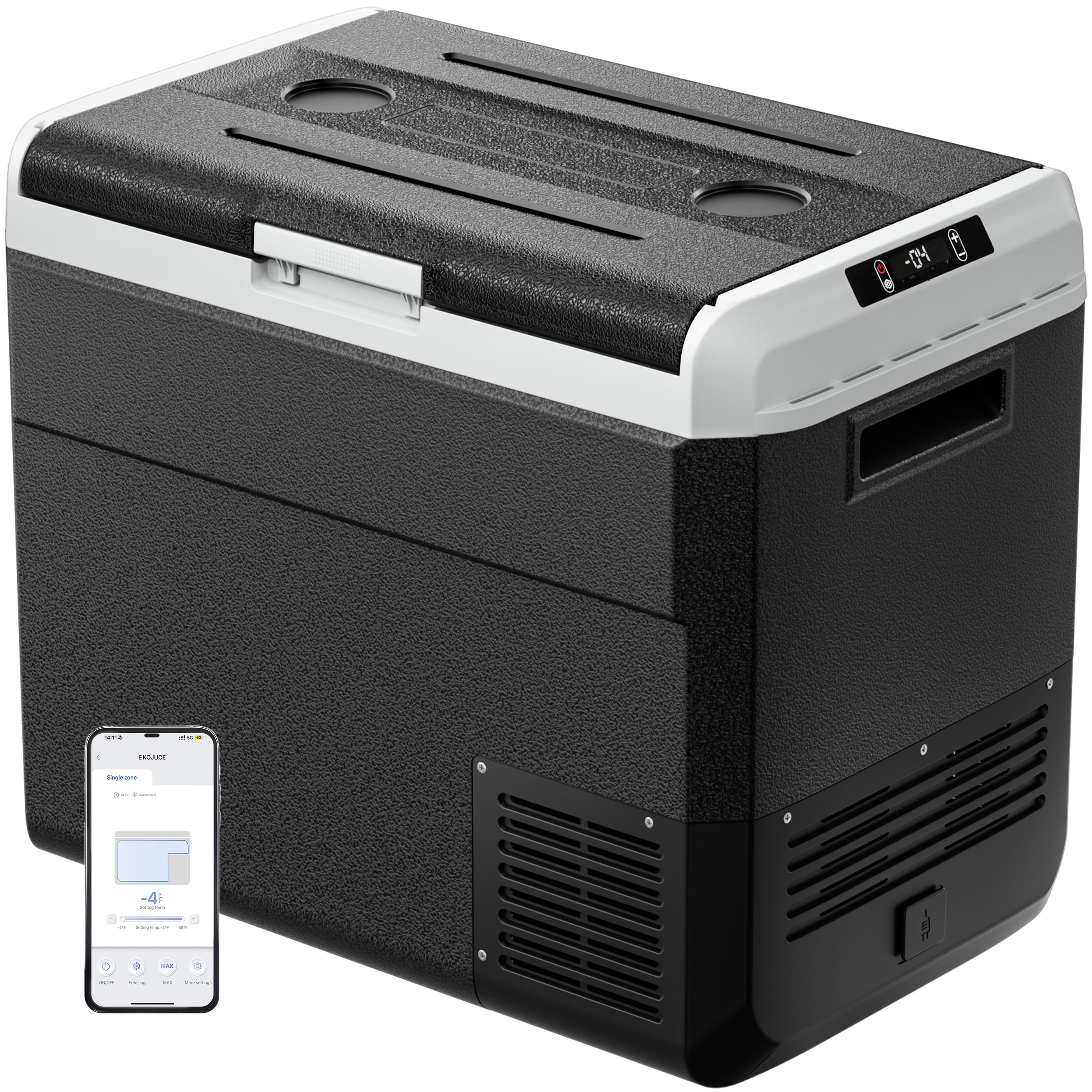
At 64 quarts this EKOJUCE is the largest fridge on the list, built for full‑time van dwellers or family road trips where a weekend’s worth of food disappears in one meal. The high‑performance compressor drops temperatures 60°F in 20 minutes, even in Florida heat. Noise sits at 32 decibels — noticeably quieter than the 45 dB Alpicool or BougeRV — so you will not hear it cycling at night. The LCD panel and Bluetooth app control let you switch between -4°F and 68°F and toggle MAX vs ECO modes. A three‑level battery protection system guards against overload or battery exhaustion. Customers note it “holds a ton,” has a useful LED interior light, and the app makes monitoring easy from the driver’s seat. The unit includes two electronic device slots and cup holders on top, a nice touch for truck or van use.
One reviewer noted the small upper compartment runs about 12°F warmer than the main compartment, which is fine for butter but not for milk. On 12V in a hot car it struggles to cool below ambient quickly — one test went from 90°F to 68°F in 1.5 hours, so pre‑cooling at home helps. At 64 quarts it is also heavy when full, so securing tie‑downs is essential.
Big fridge benefits
- 64 quarts holds two weeks of groceries
- 32 dB is the quietest unit tested
- Cools 60°F in 20 minutes on MAX
- Bluetooth app with ECO/MAX modes
Things to know
- Upper compartment runs 12°F warmer than the main
- Slow cool‑down on 12V in hot vehicles
- Large footprint requires secure mounting
Perfect for: families or full‑time van lifers who need huge capacity and want the quietest possible operation.
Not for: small rigs or minimalists — the 64‑quart footprint eats up significant floor space.
7. Kohree 42 Quart Dual Zone Car Fridge

A true dual‑door fridge with independent temperature controls — freezer on one side, fridge on the other, no mixing odors.
The Kohree splits its 42‑quart capacity into a 30‑quart large zone and an 11‑quart small zone, each with independent temperature control from -4°F to 68°F. That means you can set the small side to 0°F for frozen meat while the large side stays at 38°F for vegetables and drinks — and because the zones are physically separated by doors, odors do not cross. The doors themselves are detachable and reversible, letting you change which side opens on which side. It rolls on non‑slip wheels and has a two‑length adjustable handle for transport. The 12V fridge also includes a USB charging port, a built‑in LED light, and a chopping board that sits on top. Reviewers point out it “maintains temperatures pretty constantly” even after a week on the road, and one owner called it “amazing for work and travel.” The three‑level battery protection (Low, Medium, High) keeps your van battery safe.
The dual‑zone layout means each compartment is narrower than a single‑zone fridge of the same total size, so packing a wide pizza box or large watermelon may not work. One buyer mentioned the lid is thin, so setting the temperature lower than the target by a few degrees is necessary. Also, at 36.32 quarts actual capacity, it is slightly smaller than the 42‑quart label suggests.
Dual zone perks
- Two independent doors keep odors separate
- Removable doors — reversible opening
- Wheels and adjustable handle for easy moves
- Includes a chopping board and USB port
Design notes
- Each zone is narrower — odd‑shaped items may not fit
- Thin lid means you may need to set temp a few degrees lower
- Actual capacity is 36 quarts, not the advertised 42
Best for: campers who want true compartment separation — frozen meat on one side, drinks on the other — without the single‑box compromise of a removable partition.
pass on it if: you need to fit large irregular items like a full watermelon or sheet pan.
8. BougeRV CRPRO VIP 30 Quart

Keeps frozen meat cold for 37 hours after power is cut — a security blanket for off‑grid campers.
The CRPRO VIP technology is the headline here: when the fridge is off and the meat inside is at -4°F, it stays frozen for around 37 hours thanks to the insulated design. That is a huge safety margin if your battery bank runs flat overnight. The unit goes all the way down to -8°F, the lowest set point on any fridge in this guide, which means you can flash‑freeze items. Annual energy consumption is 256 Kilowatt Hours — higher than the 150 kWh units, but the trade‑off is that cold retention. The compressor draws a max of 2.5A (37W) and runs at 45 dB. Four tie‑down points on both sides let you secure it firmly in a truck bed or van floor, and the included storage box holds a 266Wh power station and accessories. One owner reported it “flash freezes to -8°F” and runs 10 hours on battery after pre‑cooling to 0°F. An insulated blanket cover (sold separately) improves battery efficiency by ~50% according to one reviewer.
The fine print: the temperature display reads 3–4°F colder than the actual interior temp, so set it a few degrees lower than your target. Frost can build up in high humidity, and the display is dim in daylight. The 2‑year tech support is shorter than the 3‑year warranties on some competitors.
Cold retention win
- 37‑hour cold hold after power loss at -4°F
- -8°F max low — the coldest set point here
- Four tie‑down points for secure mounting
- Storage box fits power station + cables
Not perfect
- 256 kWh/year is less efficient than the Megiu or Setpower
- Temperature display reads 3–4°F too cold
- Frost builds in high humidity
Choose it for: extended off‑grid stays where a drained battery is a real risk — the 37‑hour cold hold buys you time.
Look elsewhere if: you prioritize low power draw above cold retention — the Megiu at 113 kWh/year is far more efficient.
9. Dometic CFX2 28L Electric Cooler
A lightweight 28‑liter Dometic that ran for nine days at 10,000 feet off solar and a Jackery.
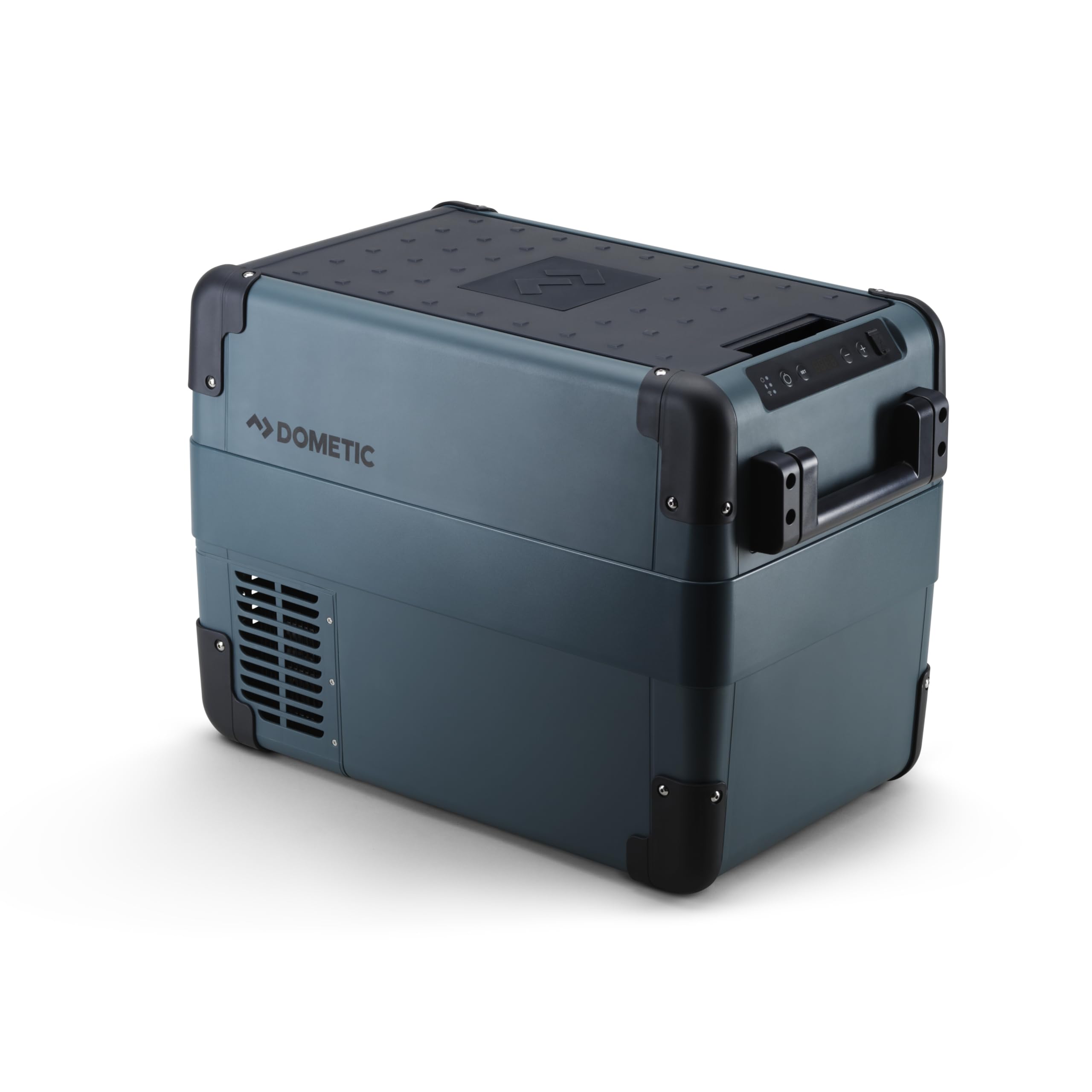
Dometic is the established name in campervan refrigeration, and this CFX2 28L model shows why. It holds 36 cans or three 1.5L bottles in a compact, 29.3‑pound package that fits a sleeper berth or SUV trunk. The temperature range goes from -7°F all the way up to 68°F, giving you full fridge or freezer control. It connects to 12/24V DC car power or 100–240V home AC, and it can also run off solar panels via a charge controller. The three‑stage battery protection system prevents draining your vehicle battery. Bluetooth control via the Mobile Cooling app lets you monitor and adjust temperature from your phone. One owner reported using it for nine days at 10,000 feet in Colorado, keeping food and drinks at 27°F while drawing only 35% of a Jackery battery daily via two solar panels — completely eliminating ice anxiety. Another said it uses roughly 0.67 Ah/hr in mid‑80°F ambient temps. The polyurethane foam insulation helps hold temperature efficiently.
The catch is price: at over it costs more than double the Megiu or Setpower for a smaller (28‑liter) capacity. The 12V cigarette socket on one unit broke when removing a tight cord. Bluetooth/WiFi instructions are only available online, not printed in the box. For the price, some buyers expect a more generous warranty duration.
Why it costs more
- -7°F to 68°F range with tight temperature control
- Very efficient — 0.67 Ah/hr in moderate temps
- Bluetooth app monitoring and control
- Three‑stage battery protection
The premium trade‑offs
- 28‑liter capacity is smaller than many cheaper units
- 12V socket can break if cord is pulled tight
- No printed app instructions in the box
Worth the money for: dedicated overlanders who want a proven brand, tight temp control, and the efficiency to run on solar for a week plus.
Overkill for: casual weekend campers who can get a larger 23‑quart Megiu for a lower price.
Understanding the Specs
Annual Energy Consumption (kWh)
This number tells you how much electricity the fridge uses over a typical year. Lower is better for your battery bank and solar setup. The Megiu leads at 113 kWh per year, while the ICECO GO20 uses 275 kWh per year. For a standard 100Ah lithium battery (about 1,280 watt‑hours), a 113 kWh/year fridge uses roughly 0.31 kWh per day, meaning the battery can run it for about four days before needing a recharge. A 275 kWh/year fridge uses about 0.75 kWh per day, cutting that to under two days. Pair high‑efficiency fridges with smaller battery banks; plan larger banks for higher‑draw units.
Battery Protection Levels
Every compressor fridge has a voltage cutoff that shuts the unit off when your vehicle battery voltage drops too low. Most models offer three levels — typically Low (L), Medium (M), and High (H). Low allows the fridge to run until the battery is nearly dead (around 9.6V), Medium cuts off earlier (around 11.1V), and High stops the fridge sooner to preserve starting power (around 11.8V–12.4V). If you have a dedicated house battery with a low‑voltage cut‑off built in, set the fridge to Low. If the fridge shares power with your starter battery, set it to High so you never get stranded. Megiu and EKOJUCE use the H1/H2/H3 naming; Alpicool uses H1/H2/H3; ICECO and Dometic each have their own internal logic — always check the manual for the exact voltages.
FAQ
Can I run a campervan fridge off a 100Ah battery?
How long does a 12V fridge take to cool down from room temperature?
Will a 12V fridge drain my car battery overnight?
What is the difference between a compressor fridge and an absorption fridge for a campervan?
Can I use a campervan fridge as a freezer?
How much solar do I need to run a campervan fridge?
What does dual‑zone mean in a campervan fridge?
Do 12V fridges make noise when running?
What size campervan fridge do I need for 2 people?
How do I secure a portable fridge in my campervan?
Final Thoughts: The Verdict
For most buyers, the campervan fridge winner is the Megiu 23 Quart because it balances the lowest annual energy consumption (113 kWh) with a 23‑quart capacity, a lightweight 18.5‑lb frame, and a price that makes it accessible. If you want a true dual‑zone with instant cooling, grab the ICECO GO20. And for massive storage at the quietest decibel level, the standout is the EKOJUCE 64 Quart.
How We Picked
We do not accept paid placement. Every pick is matched to a real buyer and a real use-case; we do not hands-on test units.
Sources & Methodology
Specifications: manufacturer listings and product documentation. Review insights: verified customer reviews, as of July 2026. Pricing: not shown on this page (it changes often); check the current price via the retailer link.
As an Amazon Associate, Trending Car earns from qualifying purchases. This does not affect which products we feature.