
Our readers keep the lights on and my garage snacks stocked. As an Amazon Associate, I earn from qualifying purchases.
Specs are compiled from manufacturer listings and verified buyer reviews and can change over time — please confirm the key details on the product page before buying.
You just spent hours or months building your engine. Do not ruin it with the wrong oil. The first minutes after you turn the key decide if your rings seat properly or if your cam wipes a lobe. Standard motor oil is too slippery for this job — it stops rings from wearing into cylinder walls and starves flat tappet cam lobes of the zinc-based anti-wear additive (ZDDP) they need. A dedicated break-in oil gives you the right friction via high ZDDP (zinc dialkyldithiophosphate, an anti-wear additive) and the right base stock (conventional mineral oil, not synthetic) so your fresh engine parts wear into each other instead of glazing over.
I’m Min Islam — the founder and writer behind Trending Car. This guide is built by comparing the manufacturers’ published specifications and the patterns across verified customer reviews, so you get each pick’s real strengths and trade-offs instead of marketing spin.
We break down the top seven contenders for the best engine break-in oil, from a budget quart to a premium six-pack, so you know exactly which viscosity and formula fits your next rebuild.
Our Picks at a Glance


How To Choose The Best Engine Break-in Oil
Pick the wrong oil and you can ruin the ring seal on the first start. Here is what to look for.
ZDDP Level — The Flat Tappet Lifesaver
ZDDP (zinc dialkyldithiophosphate) is the anti-wear additive that protects cam lobes and lifters during high-pressure sliding contact. Modern “energy-conserving” oils cut ZDDP to around 800 ppm (parts per million) to protect catalytic converters — too low for flat tappet cams. A proper break-in oil should have ZDDP in the 1,400-1,800 ppm range so your cam lobes survive the first startup without wiping.
Conventional vs. Synthetic Base Stock
You want a conventional (mineral) base, not synthetic. Synthetic oil forms a strong film that prevents metal-to-metal contact — the opposite of what you need to seat rings. Rings need enough friction to wear into the cylinder wall hone pattern. Use conventional for the first 500-1,000 miles, then switch to synthetic for long-term protection.
Viscosity — Matching the Clearance
Thicker oil like 20W-50 or 15W-50 cushions loose-clearance race engines and quiets worn bearings. Thinner oil like 10W-30 flows faster on cold starts so oil pressure reaches tight-tolerance modern engines quicker. Match the viscosity to your engine builder’s recommendation — the clearances dictate the grade, not the weather.
Non-Detergent vs. High-ZDDP Detergent
Some break-in oils are non-detergent so assembly debris circulates without being suspended and gets caught in the filter. Others are high-ZDDP with a mild detergent package. Most builder-recommended oils today are high-ZDDP with detergents — the filter catches the trash. Avoid any “energy-conserving” or “resource-conserving” label — those indicate reduced ZDDP.
Quick Comparison
| Model | Best For | Viscosity | Volume | Weight | Amazon |
|---|---|---|---|---|---|
| Royal Purple 11487 (1‑qt)★ Best Overall | Premium Single Quart | 10W-30 | 1 Liter | 1.75 lbs | Amazon |
| Royal Purple 11487 (6‑pack)Also Great | Best Overall Rebuilds | 10W-30 | 6 Quarts | — | Amazon |
| Lucas Oil 10636 | Big-Block & Race Engines | 20W-50 | 5 Quarts | 9.6 lbs | Amazon |
| Driven Racing Oil BR | High-ZDDP Flat Tappet | 15W-50 | 1 Quart | — | Amazon |
| Motul 2810QTA | European Built Engines | 10W-40 | 1 Quart | 1.9 lbs | Amazon |
| Premium Break In 10w30 | Motorcycles & Generators | 10W-30 | 1 Liter | 2 lbs | Amazon |
| PENN GRADE 1 71206 | Diesel & Gasoline Flat Tappet | SAE 30 | 1 Quart | 1 lb | Amazon |
In‑Depth Reviews
1. Royal Purple 11487 High Performance Engine Break-in Oil – 1 Quart Bottle
Our pick — over 4.5★ from 550+ verified ratings; the strongest balance of quality and price.
One quart of the same proven Royal Purple 10W-30 formula, for small jobs like generator break-ins and cam swaps where a 6-pack is overkill.
If you do not need a whole six-pack, this single bottle covers one oil fill for a generator, a lawn tractor, or a cam shaft break-in. Royal Purple says this 10W-30 is excellent for flat tappet and roller cam engines — it is the same oil in the 6-quart box, just sold alone.
One buyer bought four quarts to break in a new generator and says the engine “runs like a sewing machine” after switching to fully synthetic 10W-30. Another ran the oil for 3 hours under 30% load on a Harbor Freight Predator 9500 inverter generator and says it came out “really clean.” At 1 liter per bottle, this is 6x less volume than the 6-quart pack, but at 1/6 the upfront cost it makes sense for light duty.
A buyer mentioned the oil “seems fine” and the price was right, though a few wished the quart were cheaper. Still, at a 4.8-star average across 585 ratings, this is among the most-reviewed single quarts on the market.
Small-job specialist: Perfect for a generator, a small engine, a cam swap, or any situation where you need exactly one quart without leftover bottles.
The volume penalty: On a per-quart basis the single bottle costs more than buying the six-pack.
Grab this one if: You need one quart for a generator or a small engine break-in and you want the highest-rated single bottle on the list (4.8 stars over 585 ratings).
pass on it if: You are doing a full engine rebuild that takes 5-6 quarts — the 6-pack is more economical and saves you a second purchase.
2. Royal Purple 11487 Engine Break In Oil 10W30 Pack of 6 Quarts
You get exactly one full oil change for most V8s in a single box — 6 quarts of Royal Purple 10W-30 that fit a 2.3L Ranger or a 454 Chevy rebuild.
This 6-quart pack of Royal Purple 10W-30 gives you the oil you need for the initial fill plus the first change. Buyers report following the “Motorman” procedure: drain at 50 miles, again at 200, then every 500 miles up to 3,000, and one owner measured 70 psi oil pressure at idle after highway driving. That is the kind of ring seal you want.
The Lucas 20W-50 below is thicker, but the 10W-30 flows faster on cold starts for a modern or moderately built engine with tighter clearances. This pack holds 6 quarts total, compared to 1 quart of Driven Racing Oil, so you buy in bulk without mixing different batches. One reviewer noted that compression and leak-down numbers were “spot on” after break-in.
Reviewers also mention this oil has served them across multiple engines. It is the go-to for anyone who wants one trusted brand through the entire break-in period rather than shopping per quart.
Why it wins: The 6-pack is the most economical way to buy Royal Purple 10W-30 for a full rebuild — you avoid hunting for six separate bottles.
The trade-off: This is the most expensive single purchase on the list, though per-quart it works out to a mid-range price. skip it if you only need one quart for a cam swap or generator break-in.
Perfect for the full rebuild: Any engine builder who wants a single carton for a complete V8 or inline-six build and values trusted brand consistency over nickel-and-diming per quart.
Not for the one-quart job: If you only need one quart for a cam or a small generator, the 6-pack is overkill — grab the single Royal Purple 1-quart bottle instead.
3. Lucas Oil 10636 SAE 20W-50 Racing Engine Break-in Oil – 5 Quart
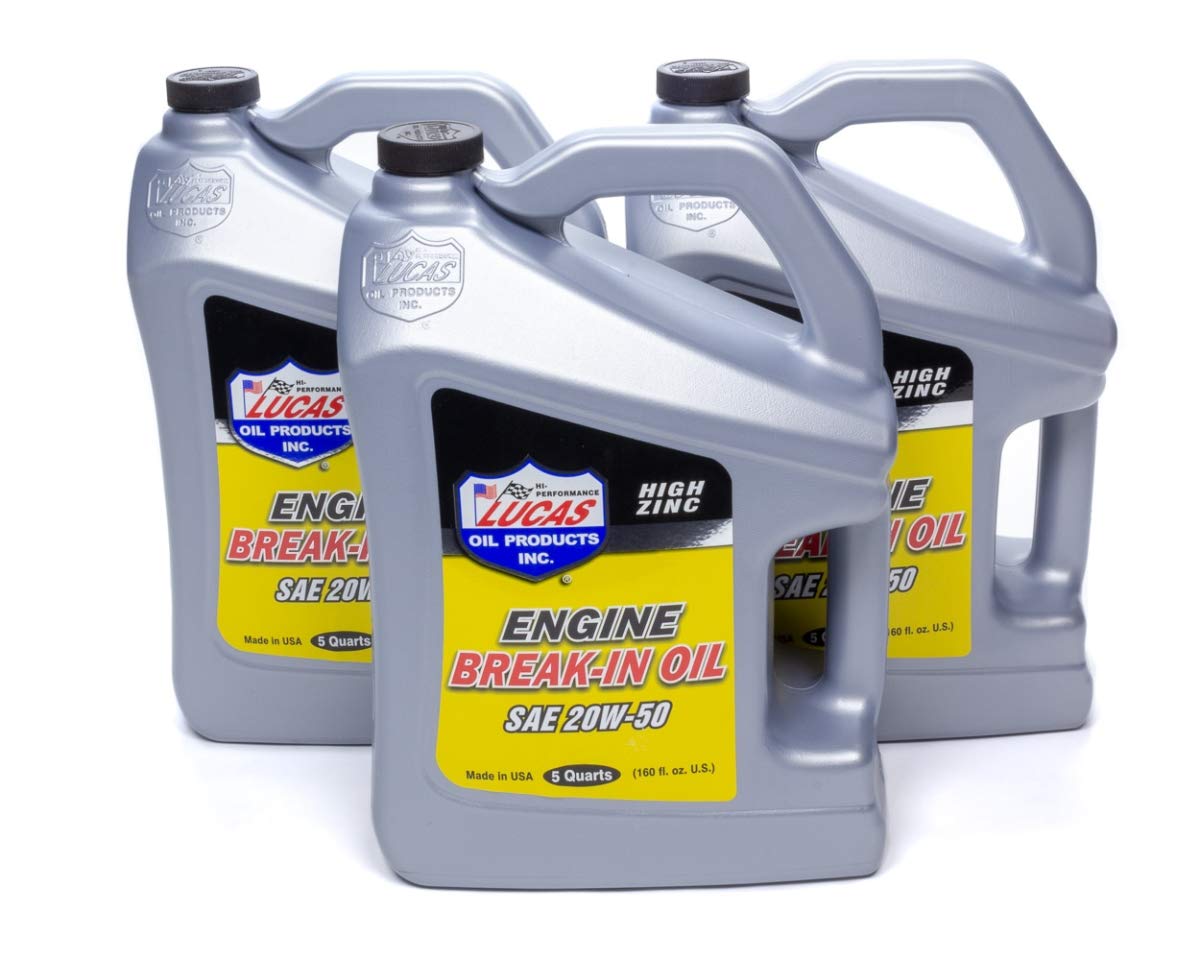
You get a thicker oil film for big-clearance race engines that need a heavy cushion at startup — this Lucas 20W-50 is a thicker SAE 20W-50 grade compared to the thinner Royal Purple 10W-30.
Lucas recommends this 20W-50 for initial break-in of both flat tappet and roller camshaft applications, then says to switch to their racing-only line after break-in. At 4.73 liters (5 quarts), it holds 5 quarts compared to a single quart of Royal Purple — enough for most V8s and large-displacement builds in one jug.
The 20W-50 viscosity matters if your engine has looser bearing clearances or you want to quiet down a noisy valvetrain during the first idle. One buyer used it to break in a new cam on a Polaris quad and reports it “worked great.” Reviewers also say the price is reasonable for a 5-quart container of this grade.
Lucas claims this oil delivers quicker, more efficient ring seal and excellent on-track performance before switching to the racing line. Keep in mind that a 20W-50 is too thick for a tight-tolerance modern engine — the oil can struggle to reach every bearing on a cold morning.
Big jug for big motors: The 5-quart format is ideal for a V8 or a large-displacement race engine that needs a thick 20W-50 film to cushion loose clearances during the first fire-up.
The cold-start caution: Do not use this in a modern street engine with tight bearing clearances — the thick oil may not flow fast enough to protect on a cold start. Stick with 10W-30 for tighter builds.
Reach for this if: You are breaking in a big-block, a race engine, or a high-mileage rebuild with loose clearances and you want a single 5-quart jug at a good per-quart price.
Look elsewhere if: You have a modern EFI engine with tight clearances — the 20W-50 is too thick for cold flow. Choose a 10W-30 break-in oil instead.
4. Driven Racing Oil BR Conventional Break In Motor Oil 15w-50 1 Quart Bottle

A hefty dose of ZDDP (zinc dialkyldithiophosphate) in a 15W-50 viscosity — specifically to stop flat tappet cams from wiping a lobe on first startup.
Driven Racing Oil’s BR (Break-In) formula is fortified with a high level of ZDDP to prevent cam lobe wipe — that grinding noise you hear when a flat tappet lifter spins off a lobe. At 15W-50 it sits between Royal Purple’s 10W-30 and Lucas’s 20W-50, giving a thicker cushion than most passenger-car oils while still flowing well enough for modern overhead-valve engines.
One buyer calls Driven BR “one of the best for this type of oil” and uses it on every engine he builds and dynos.
Driven Racing Oil says the formula chemically seals piston rings and protects bearings and journals. If you are building a high-performance engine and need a heavy ZDDP dose, this quart is a must-have.
Cam-saver formula: The high ZDDP content is exactly what a flat tappet cam needs to survive the first 30 minutes of high-pressure sliding contact. A “must have” for cam swaps, say the reviews.
The viscosity match: 15W-50 is a good middle ground — thicker than 10W-30 for loose-clearance engines, not as sluggish as 20W-50 on cold starts. Do not use in a modern tight-tolerance engine.
Reach for it if: You are swapping a cam or building a high-performance engine and need that heavy ZDDP dose to protect flat tappet lobes on first start-up. The name “Driven” comes up constantly in builder forums.
Look elsewhere if: You need a full sump of break-in oil for a 6-quart engine — buy the Royal Purple 6-pack and use its proven formula. This quart is for cam jobs and small engines.
5. Motul 2810QTA 10W-40 Break-in Oil – 1 Quart

This oil smells like bananas and is the go-to for European built blocks — IAG, a well-known Subaru performance shop, specifically recommends it.
Motul’s 10W-40 break-in oil is a niche pick favored by European performance engine builders. One buyer mentioned IAG recommends this oil for breaking in their built blocks. At 1.9 pounds it is lighter than the Premium Break In 10w30’s 2 pounds; the weight comes from a medium-to-high viscosity that sits between a standard 10W-30 and a 15W-50.
Owners mention this oil has a “neon yellow tint” and “smells like bananas” when it gets hot. One owner used it on a freshly built European performance engine and said it worked well for break-in and after two oil changes, then switched to regular oil. Another buyer used it to break in a new generator and called it “good stuff.”
The 10W-40 viscosity is a useful middle ground — it protects better than a thin 10W-30 on hot days without being as sluggish as a 20W-50. If your engine builder calls for Motul, this is the exact product they mean.
Builder-recommended: IAG Performance and other European shops trust this oil for their built blocks. If you own a Subaru, BMW, or other import, this is the oil to buy.
The weight vs. Royal Purple: At 1.9 pounds it is 5% heavier than the 2-pound Premium Break In, but the 10W-40 grade is a useful middle viscosity for engines that need something between 10W-30 and 15W-50. The banana smell is real and a quirk owners seem to like.
Grab this if: You need a European shop-recommended break-in oil for an imported built block, or you want a 10W-40 middle viscosity that is not too thin and not too thick.
it’s not for you if: You are breaking in a standard American V8 or small engine — the Royal Purple or Lucas oils are more widely tested for those applications and likely cheaper per quart.
6. Premium Break In 10w30

You get a JASO MA2-certified oil (the standard for wet-clutch safety) that protects your motorcycle or ATV clutch during break-in while seating the rings.
Maxima’s Premium Break In 10w30 is designed specifically for motorcycles, scooters, and ATVs. It meets JASO MA2 standards, meaning it has the right friction modifiers for a wet clutch and will not cause your clutch plates to slip. At 2 pounds for a 1-liter bottle versus Motul’s 1.9-pound quart, it is heavier; but the weight difference is negligible for most uses.
Reviewers have used this oil to break in Predator 212 engines and two small gas generators, reporting it “worked very well” for seating rings. The shear-stable formula (it resists thinning under high heat) keeps the oil film thick even during that first hard run. Maxima also says it exceeds API SL and JASO MA2 specifications, so you get a certified wet-clutch-safe oil.
If you are breaking in a motorcycle, a scooter, or any engine with a shared sump (oil and clutch share the same oil), this is a safer choice than a car break-in oil that might contain friction modifiers that cause clutch slip. One buyer called it an “excellent product” and highly recommends it.
Wet-clutch safe: JASO MA2 certification means this oil will not ruin your motorcycle or ATV clutch during break-in. Car oils with friction modifiers can cause slip.
The compact size: A 1-liter bottle is enough for most small engines and motorcycles. If you need more, look at the 6-quart Royal Purple or 5-quart Lucas.
Perfect for the rider: If you are breaking in a motorcycle, scooter, or ATV with a wet clutch, this is the safest break-in oil on the list — it protects both the engine and the clutch.
Not for a car: If you are breaking in a standard car engine, the Royal Purple or Lucas oils are more cost-effective and widely tested for automotive use. This is a niche specialty oil.
7. PENN GRADE 1, 71206, Break-In Oil SAE 30, Works with Diesel and Gasoline Engines, 1 Quart

You get a single-grade SAE 30 oil rich in ZDDP — the traditional choice for pre-1985 flat tappet engines and machinery that need a simple, thick mineral oil.
PENN GRADE 1 (also called Brad Penn) is a single-viscosity SAE 30 break-in oil that works with both diesel and gasoline engines. One reviewer called it “excellent for older hi-perf engines with solid lifters due to high ZDDP” and recommended a specific break-in procedure of 25-30 minutes at 2,000-2,500 RPM. At 1 pound for a 32-fluid-ounce quart, this is the lightest bottle in the group — same volume as Motul but at a lower weight (1 pound versus 1.9 pounds), likely due to a different bottle design.
Other buyers used it for a 1937 Dodge break-in (ran 300 miles, then contacted Brad Penn for winter storage advice) and a Pontiac 400 rebuild (used 7 quarts total — 6 for the sump, 1 for assembly lube). Reviewers stress that this is a conventional mineral oil, not synthetic, which is essential for proper ring seating. The high ZDDP level protects flat tappet cams but can slowly poison catalytic converters over extended use.
If you are breaking in a classic car engine, a diesel generator, or any pre-1985 engine that needs a high-ZDDP SAE 30, this is the most traditional choice on the list. Do not use it in a modern car with tight clearances — the single-grade SAE 30 is too thick for cold starts in cold weather.
Classic engine partner: The high ZDDP and conventional base oil formula is exactly what pre-1985 engines with flat tappet cams and solid lifters need to survive break-in without wiping a lobe.
The single-grade limit: SAE 30 is a single grade — it does not have the cold-flow properties of a multi-grade like 10W-30. Do not use this in cold weather or in a modern engine with tight clearances.
Reach for it if: You are breaking in a classic car, a pre-1985 engine, a diesel generator, or any engine that specifically calls for SAE 30 conventional oil with high ZDDP. The reviews from classic-car owners are very positive.
Look elsewhere if: You need a multi-grade oil for a modern engine or cold-weather starting — the single-grade SAE 30 will struggle to flow below freezing. Choose a 10W-30 Royal Purple instead.
Understanding the Specs
ZDDP (Zinc Dialkyldithiophosphate)
ZDDP is the zinc-based anti-wear additive that forms a sacrificial layer on metal surfaces — it is the single most important ingredient in a break-in oil. Modern “energy-conserving” motor oils cap ZDDP at around 800 ppm to protect catalytic converters, but flat tappet cam lobes need roughly 1,400-1,800 ppm to survive the first start. Break-in oils like Driven, Penn Grade 1, and Royal Purple all carry improve ZDDP levels. Look for labels that say “high zinc” or “ZDDP fortified” and avoid anything with the “energy-conserving” API donut on the bottle.
Viscosity Grade (SAE J300)
The SAE viscosity grade (like 10W-30, 15W-50, or 20W-50) tells you how thick the oil is at different temperatures. The lower the first number (the “W” winter rating), the better it flows in cold weather. The second number is the hot operating thickness. For break-in, match the viscosity to your engine’s bearing clearances: tight modern engines need a 10W-30 or 10W-40; loose race engines or big-blocks need a 20W-50 or 15W-50. Using too thin an oil in a loose engine can cause low oil pressure; using too thick an oil in a tight engine can starve bearings on a cold start. Always follow the engine builder’s clearance-based recommendation.
Conventional vs. Synthetic Base Stock
Break-in oils must use a conventional (mineral) base, not synthetic. Synthetic oil forms such a strong film that it prevents the microscopic metal-to-metal contact needed for piston rings to wear into the cylinder walls. Without that initial wear, rings never fully seat and oil blow-by becomes permanent. Every product on this list uses a conventional base — do not substitute a synthetic racing oil for the break-in phase. After the first 500-1,000 miles you can safely switch to synthetic for the long haul.
JASO MA2 (Motorcycle Compatibility)
JASO MA2 is a Japanese standard that indicates the oil is safe for wet clutches (clutches that share the same oil as the engine). Car oils often contain friction modifiers that make a wet clutch slip. If you are breaking in a motorcycle, ATV, or scooter that uses a shared sump, you need a JASO MA2-rated oil — like the Premium Break In 10w30 from Maxima. Using a car break-in oil in a motorcycle can cause clutch slip on the first ride and potentially damage the clutch plates.
FAQ
Can I use regular motor oil for engine break-in?
How long should I run break-in oil before switching to synthetic?
What viscosity break-in oil should I use for a small generator?
Is break-in oil the same as high-ZDDP racing oil?
Will break-in oil damage my catalytic converter?
Can I use diesel engine break-in oil in a gasoline engine?
Do I need break-in oil for a roller cam engine?
What is the difference between SAE 30 and 10W-30 break-in oil?
Final Thoughts: The Verdict
For most people, the best engine break-in oil winner is the Royal Purple 10W-30 6-Pack because it delivers a proven high-ZDDP formula in the exact volume a full engine rebuild needs, with a 4.8-star average across 304 ratings confirming it works across V8s, generators, and small engines. If you want a budget-friendly single quart for a generator or cam swap, grab the single Royal Purple quart. And for a big-block race engine or loose-clearance build, the standout is the Lucas 20W-50 5-Quart for its thick-film protection at a reasonable per-quart price.
How We Picked
We do not accept paid placement. Every pick is matched to a real buyer and a real use-case; we do not hands-on test units.
Sources & Methodology
Specifications: manufacturer listings and product documentation. Review insights: verified customer reviews, as of July 2026. Pricing: not shown on this page (it changes often); check the current price via the retailer link.
As an Amazon Associate, Trending Car earns from qualifying purchases. This does not affect which products we feature.