
Our readers keep the lights on and my garage snacks stocked. As an Amazon Associate, I earn from qualifying purchases.
Specs are compiled from manufacturer listings and verified buyer reviews and can change over time — please confirm the key details on the product page before buying.
If you are bringing your RV off-grid, the single question that decides everything is whether your power station can actually start and run your roof air conditioner without tripping itself off. Most portable power stations fail right there. The picks here are built to handle that real-world RV load, giving you silent, fume-free AC power for your fridge, microwave, and lights wherever you park.
I’m Min Islam — the founder and writer behind Trending Car. This guide is built by comparing the manufacturers’ published specifications and the patterns across verified customer reviews, so you get each pick’s real strengths and trade-offs instead of marketing spin.
Each station below has been selected for its ability to deliver enough continuous AC wattage and usable capacity to run RV essentials. This is your no-fluff, spec-driven guide to finding the power station for rv that fits your rig and your budget.
Our Picks at a Glance

How To Choose The Best Power Station for RV
Choosing the right portable power station for your RV depends on three critical specs: capacity in watt-hours, continuous AC output in watts, and how fast you can recharge it from solar or a wall outlet. You do not need to be an electrician — but you do need to match these numbers to your appliances.
Battery Capacity (Wh) — Your Total Energy Tank
The capacity, measured in watt-hours (Wh), tells you how much energy the station stores. A 1,000Wh station can run a 100W fridge for about 10 hours. For an RV, you generally want at least 1,000Wh to get through a night comfortably. If you plan to run an air conditioner, look for 2,000Wh or more.
AC Output (W) — What You Can Actually Power
This is the number that determines if the station can start your RV’s roof air conditioner or run a microwave. Most RV air conditioners need around 1,500W to run and up to 2,500W to start. A station with a “Power Lifting” or “X-Boost” mode can handle these startup surges, so check that spec carefully.
Solar Input (W) — Recharging Off the Grid
If you plan to boondock without hookups, the solar input wattage tells you how fast you can replenish the battery from the sun. A higher number — 500W or more — means you can top off the station in a few good sun hours, keeping you off the generator for days.
Quick Comparison
| Model | Best For | Capacity (Wh) | AC Output (W) | Solar Input (W) | Amazon |
|---|---|---|---|---|---|
| EF ECOFLOW DELTA 2★ Best Overall | Budget-friendly entry | 1,024Wh | 1,800W | 500W | Amazon |
| Anker SOLIX F3000Full-Timer’s Choice | Full-time RV living | 3,072Wh | 3,600W | 2,400W | Amazon |
| EF ECOFLOW DELTA 3 UltraWhisper-Quiet Power | Whisper-quiet backup | 3,072Wh | 3,600W | — | Amazon |
| EF ECOFLOW DELTA Pro | Extreme expansion | 3,600Wh | 3,600W | 1,600W | Amazon |
| EF ECOFLOW DELTA 3 Max | Fast solar recharging | 2,048Wh | 3,400W | — | Amazon |
| Jackery Explorer 2000 Plus | Simple expandability | 2,042.8Wh | 3,000W | — | Amazon |
| Anker SOLIX C2000 Gen 2 | Compact & lightweight | 2,048Wh | 2,400W | — | Amazon |
| DJI Power 2000 | Near-silent operation | 2,048Wh | 3,000W | — | Amazon |
| BLUETTI AC200L | Heavy RV AC duty | 2,048Wh | 2,400W | 1,200W | Amazon |
In‑Depth Reviews
1. EF ECOFLOW Portable Power Station DELTA 2
Our pick — over 4.5★ from 5,000+ verified ratings; the strongest balance of quality and price.
A 1,024Wh starter station that recharges to 80% in just 50 minutes.
The DELTA 2 is the most affordable entry point into the EcoFlow ecosystem, with 1,024Wh of capacity and a 1,800W AC output. It is not built for running a large RV air conditioner continuously, but it handles smaller loads like a fridge, TV, and lights easily. The expandable capacity goes up to 3kWh, so you can add an extra battery later as your RV power needs grow. One buyer mentioned it “powered a mirror photobooth (camera, mini PC, 2 LED lights, fill light) for about 6 hours.”
At 27 lbs, it is the lightest station on this list by a wide margin — at 27 lbs versus the BLUETTI AC200L’s 61.4 lbs. It charges from 0 to 80% in 50 minutes and fully in 80 minutes. The 500W solar input lets you recharge from panels during the day. Reviewers consistently praise its solid build and reliability, calling it a workhorse for camping, road trips, and home backup.
Why it is a great starter
- At 27 lbs it is genuinely portable — easy to carry into an RV or tent.
- 500W solar input is solid for a station this size and price point.
- Built to last with a LiFePO4 battery rated for 3000+ cycles.
Where it runs out of steam
- Its 1,024Wh capacity is less than the 2,048Wh of mid-range stations.
- The 1,800W output is at 1,800W versus the DELTA 3 Max’s 3,400W, so it may struggle with larger RV air conditioners.
Ideal for: new RV owners who want a lightweight, affordable station for basic power — fridges, lights, fan, and charging devices.
You will outgrow it quickly if: you plan to run a rooftop AC or microwave regularly — step up to the DELTA 3 Max or BLUETTI AC200L instead.
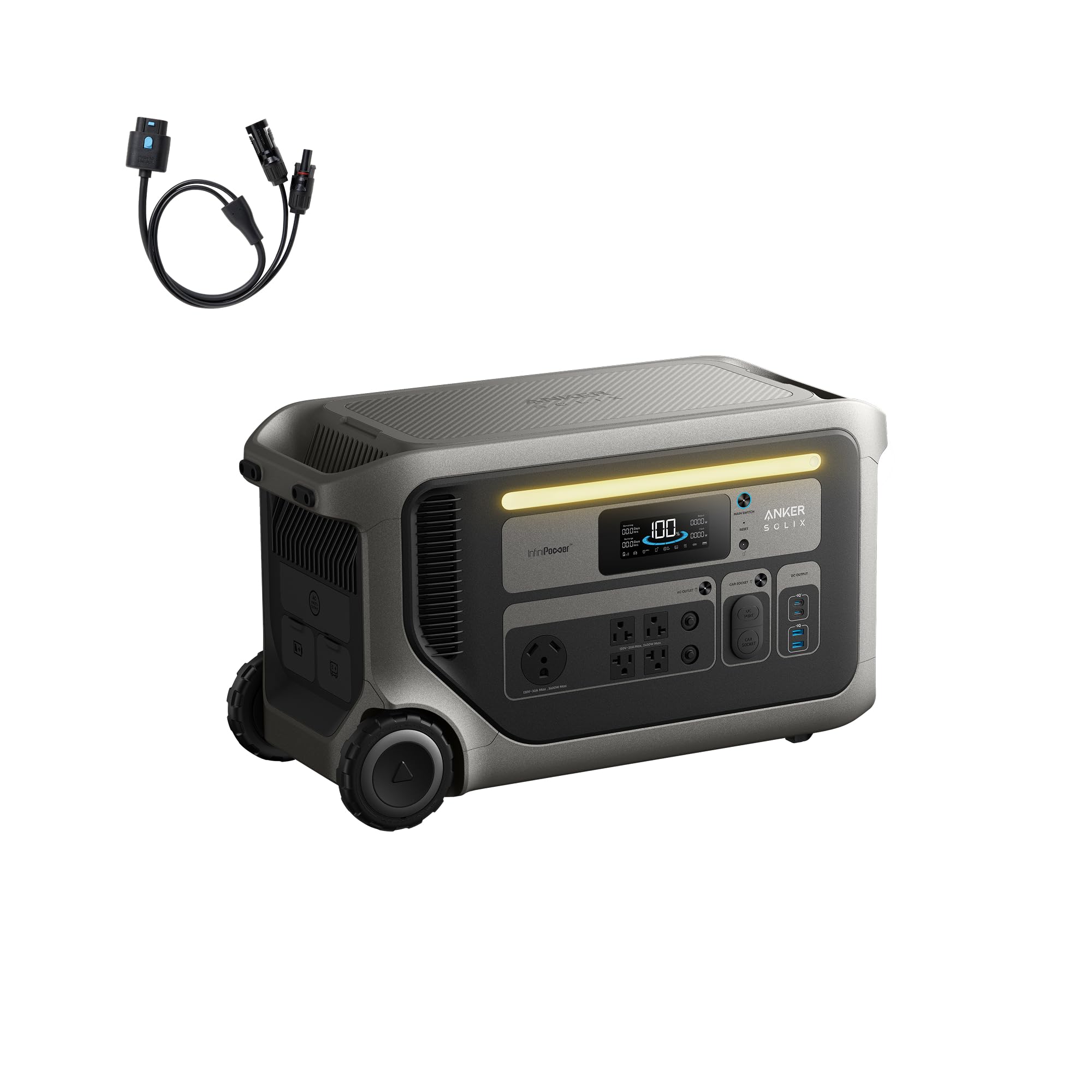
2. Anker SOLIX F3000 Portable Power Station
The big battery that powers your RV’s fridge and AC for days, not hours.
This station gives you 3,072Wh of usable energy right from the start, enough to run a 190W fridge for up to 42 hours, according to the manufacturer. You get a continuous 3,600W AC output, which handles most RV air conditioners and microwaves without breaking a sweat. If you need even more, you can expand the capacity up to 24kWh with extra batteries — that is enough for 80 hours of outage-proof energy.
Buyers report that at 91.5 lbs, the built-in wheels are a lifesaver for moving it around your RV or campsite. The real standout here is the 6,000W hyper-fast recharging, which combines a fuel generator and solar to top up the battery in emergencies. One reviewer noted it powered their RV AC for over 4 hours with no issues, calling it a great all-in-one package for full-time living.
What makes it a workhorse
- Huge 3,072Wh starting capacity covers an RV fridge for 42 hours.
- Ultra-low idle power use gives 125 hours of AC standby time.
- Pass-through charging lets you recharge from a generator while running appliances at full power.
Where it stumbles
- At 91.5 lbs it is not a carry-on — the wheels are necessary.
- Expansion batteries add significant cost to reach the full 24kWh.
Reach for this if: you live in your RV full-time or need a truly expandable home backup system that can run your AC all day.
Consider something lighter if: you plan to move the station between your RV and house frequently — the weight makes that a two-person job.
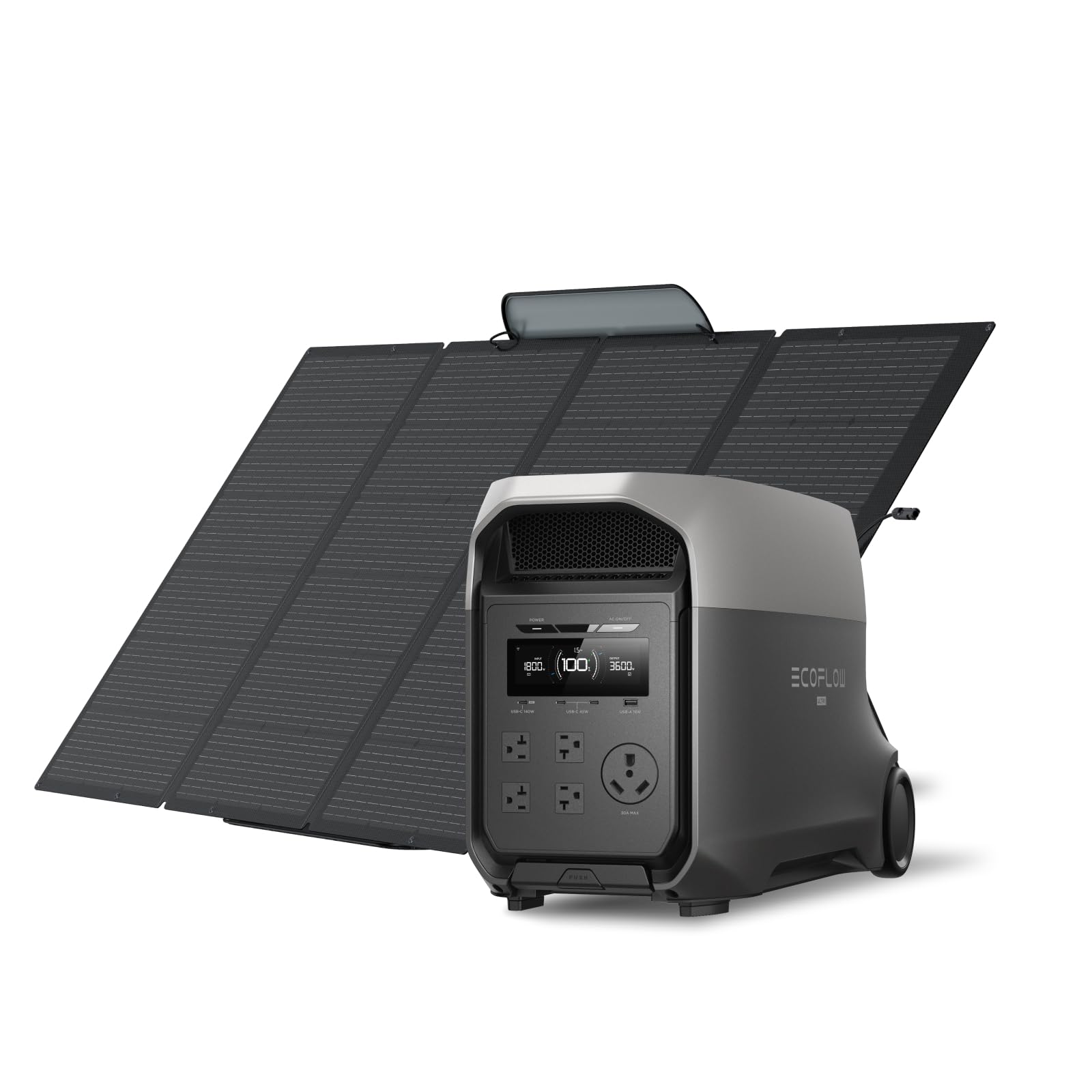
3. EF ECOFLOW DELTA 3 Ultra Portable Power Station with 400W Solar Panel
So quiet you will forget it is running, even under a heavy load.
This unit pairs a 3,072Wh LiFePO4 battery with a 400W solar panel, giving you a complete off-grid solution in one purchase. The 3,600W continuous output — with a surge up to 7,200W — can start your RV’s air conditioner or run power tools without hesitation. What really separates it is the noise: it runs at just 25dB under load, which is quieter than a whisper, making it perfect for overnight use in an RV where silence matters.
Owners mention the solar panel unfolds easily and starts pulling in energy even on cloudy days. One buyer mentioned it kept their fridge, lights, laptop, and tools running with ease. The catch is the weight — the unit itself is substantial, and the 400W solar panel is described as a “beast” to lug around. If you can find a central location on the ground floor of your RV, you will not have to move it often.
Why it stands out
- Runs at 25dB — barely audible, ideal for quiet campgrounds.
- Auto-switches to battery in under 10ms, keeping sensitive devices like a CPAP or router powered.
- Comes with a 400W solar panel, so you are ready to charge from the sun from the start.
What to watch
- Heavy and bulky — not easy to move between locations without a dolly.
- One owner reported the battery did not charge to 100% and had difficulty getting a refund.
Ideal for: RVers who prioritize noise-free operation above all else, especially for sleeping areas or quiet campgrounds.
Look at a lighter option if: you need to frequently move your power station between your RV and outdoor setups — this one is basically a stationary unit.
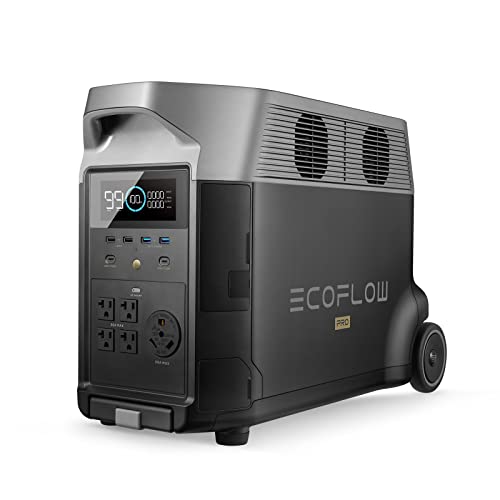
4. EF ECOFLOW Portable Power Station 3600Wh DELTA Pro
The platform that grows from 3.6kWh to 25kWh as your RV power needs grow.
With a starting capacity of 3,600Wh and a continuous 3,600W AC output, the DELTA Pro is built for the heaviest RV loads, including roof air conditioners and electric cooktops. You can expand it up to 25kWh by adding extra batteries, and pairing two units together delivers a massive 7,200W output. Recharging is equally flexible — you can use EV station charging, solar, wall outlets, or a smart generator.
Reviewers mention it runs an oxygen concentrator for nearly 11 hours, giving total confidence for medical needs. One customer observed it powers a heat press for vendor markets with no voltage drops. At 99 lbs, it is the heaviest on this list, but the five standard 120V AC outlets mean you do not need a power strip for your RV essentials.
Strengths
- Massive 3,600Wh starting capacity powers even large RV appliances.
- Expandable up to 25kWh, so you can start small and grow over time.
- Five AC outlets let you plug in multiple devices directly.
Trade-offs
- 99 lbs makes it a stationary unit for most RV setups.
- Full expansion requires a significant additional investment in extra batteries.
Perfect for: full-time RVers or mobile businesses who need massive, expandable power and do not plan to move the station daily.
A more portable station is a better fit if: you need to take power outside your RV for tailgating or day trips.
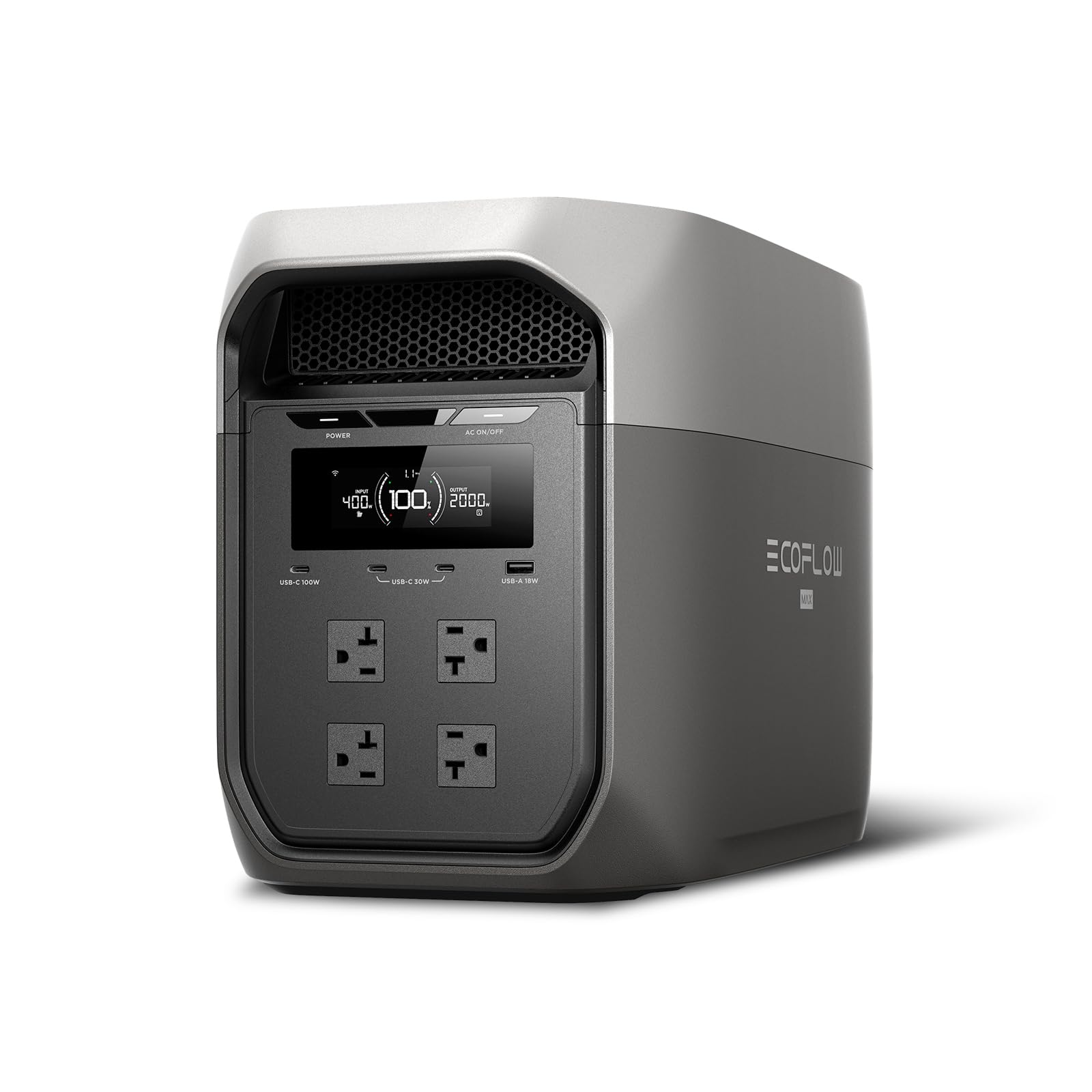
5. EF ECOFLOW Portable Power Station DELTA 3 Max
Zero to eighty percent in just over an hour so you are never waiting for power.
The DELTA 3 Max packs 2,048Wh into a frame that is lighter than you might expect, and its 3,400W X-Boost output handles 99% of appliances including fridges, microwaves, and power tools. Its ultra-fast X-Stream technology recharges from 0 to 80% in just 1.13 hours, which means you can top off during a lunch stop and have power for the next two days of boondocking.
One user highlighted it works perfectly as a UPS for a desktop PC, keeping everything running through a storm outage without interruption. The dual handles make it easier to carry than heavier units in this capacity class. Compare this to the DELTA 2 below: the DELTA 3 Max delivers 3,400W AC output compared to the DELTA 2’s 1,800W for the same footprint, making it a much better choice for starting an RV air conditioner.
What impresses
- Ultra-fast 1.13-hour recharge to 80% from a wall outlet.
- 3400W X-Boost output covers nearly all RV appliances.
- Light and durable build with dual handles for easier carrying.
Room for improvement
- No built-in solar input spec listed, so you need to check compatibility for off-grid recharging.
- Some buyers reported delivery issues with signatures not required.
Buy this for: fast recharging and enough power for most RV AC units without the weight of a 3kWh+ station.
Skip if: you need a full day of running an AC on battery alone — you would want the F3000 or DELTA Pro instead.
6. Jackery Explorer 2000 Plus Portable Power Station

Jackery’s first LiFePO4 station that scales from 2kWh to 24kWh as your needs grow.
This station uses Jackery’s ChargeShield technology to boost battery life by 50%, and the LiFePO4 cells are rated for up to 10 years of use. The 3,000W AC output can run an RV air conditioner for about 2 hours, according to one buyer who said it “fast charges to 100% in about an hour” and kept their solar panels charging it while running. You can expand it up to 12kWh with extra battery packs, or parallel two stations for a full 24kWh at 240V.
Customers note the retractable handle and wheels make the 62-lb unit manageable, though the telescopic handle feels a bit flimsy. One buyer called it “better than a gasoline generator” for heavy-duty jobs like running a rotary hammer. The 30A RV outlet makes connecting to a transfer switch straightforward.
Why it works
- LiFePO4 battery lasts up to 4000 cycles to 70% capacity.
- Expandable up to 24kWh by paralleling two stations.
- 30A RV outlet included for easy connection to your RV’s electrical system.
The downsides
- At 62 lbs it is heavy, and the handle feels less sturdy than competitors.
- Extra battery packs are expensive, making full expansion a big investment.
Go with this one if: you want the reliability of the Jackery brand and a clear, simple path to expand from weekend camping to full-time RV living.
Consider a different brand if: you need a one-unit solution without buying extra batteries — other stations offer larger starting capacities.
7. Anker SOLIX C2000 Gen 2 Portable Power Station

A full 2,048Wh station that is compact and lightweight.
At just 41.7 lbs, the C2000 Gen 2 is shockingly easy to move for its 2,048Wh capacity. It delivers a rated 2,400W AC output, with a peak of 4,000W to handle the startup surge of most RV air conditioners. It sips only 9W on standby, so you can run a dual-door fridge for up to 32 hours on a single charge. The 58-minute full recharge from AC is one of the fastest in this whole list.
One shopper added it powered their BougeRV 30qt fridge for 5 to 7 days on a cross-country trip, calling it reliable and compact for minivan camping. Another reviewer mentioned it charges incredibly fast and displays both charge/depletion time and internal temperature. The 800W alternator charging is a unique bonus — you can top it off from your vehicle’s alternator in about 3 hours.
What makes it special
- At 41.7 lbs it is the lightest 2kWh station here for its capacity.
- Full charge in just 58 minutes from AC power.
- Ultra-low 9W standby power extends fridge runtime to 32 hours.
Limitations
- If you run a high-draw RV AC, its 2,400W rated output may be tight — stick with units like the DELTA 3 Max for more headroom.
Buy this if: portability is your top priority and you want a station you can easily move from your RV to your car or tent.
Look for a more powerful unit if: you need to run a large roof air conditioner continuously — the C2000 Gen 2 is better for fridges, lights, and smaller ACs.
8. DJI Power 2000 Portable Power Station
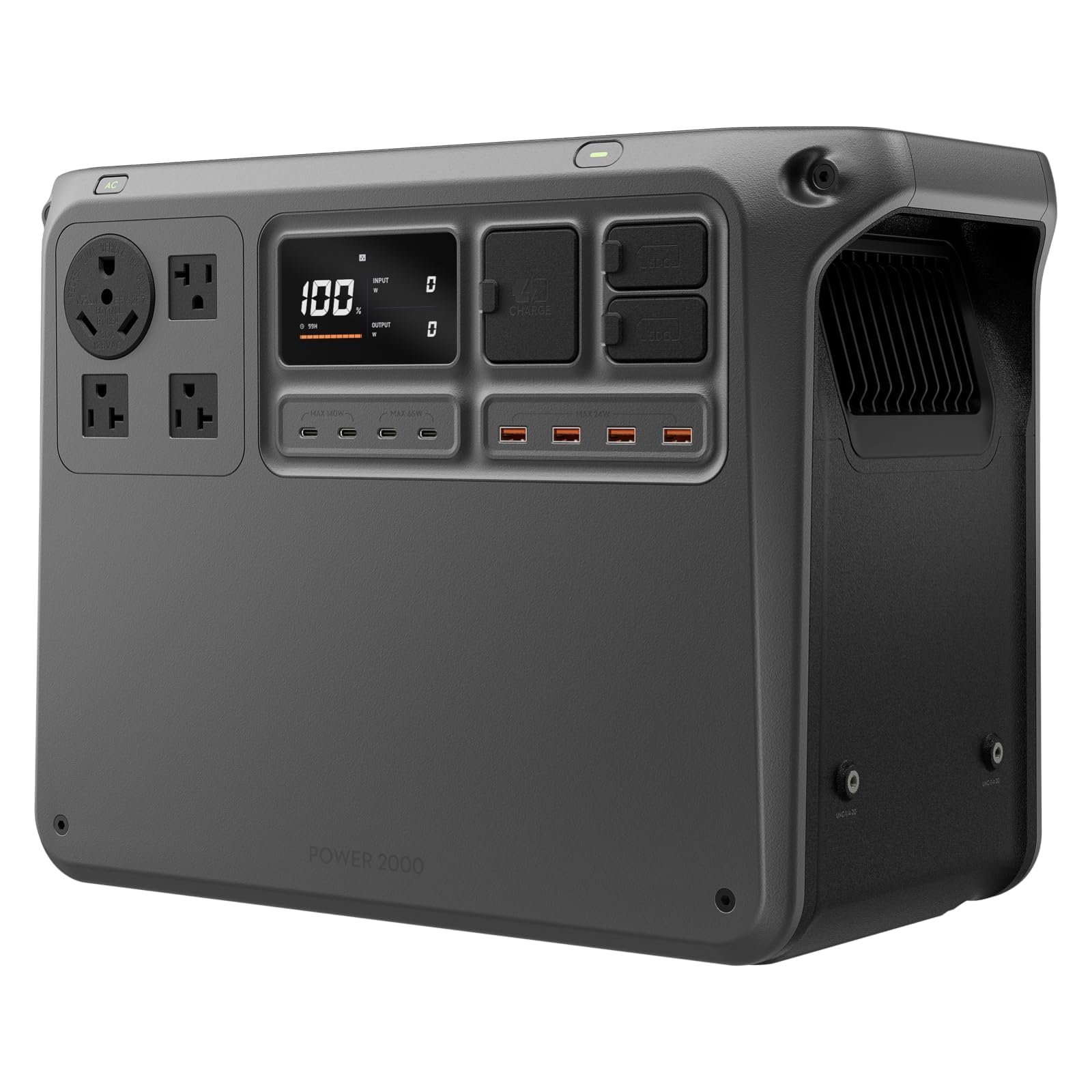
A near-silent 2kWh station that one reviewer noted ran their whole camper for 40 hours.
The DJI Power 2000 delivers 2,048Wh from an LFP battery and a continuous 3,000W output. It runs as low as 30dB — about as loud as a quiet library — which means you can sleep undisturbed while it charges devices inside your RV. The station recharges to 80% in 55 minutes, putting it among the fastest in this category. Its compact dimensions (17.64″L x 8.86″W x 12.76″H) are versus the DELTA 2’s 15.7″L x 8.3″W x 11.3″H, making it easier to stow under a bench or in a cabinet.
Reviewers point out the unit powers everything in their camper with no noise complaints, calling it “absolutely quiet” and “amazing” for replacing a small gas generator. One owner noted that with everything running, the system showed it could last around 40 hours. The DJI Home app lets you monitor and adjust settings remotely, making it a convenient choice for RV trips. Some units may ship set for 50Hz power, so check your unit upon arrival.
Key strengths
- Operates at 30dB — essentially silent for night-time RV use.
- Supports expansion up to 22.5kWh for long-term off-grid living.
- smooth UPS with 10ms switch time protects sensitive electronics.
Potential issues
- MPPT and car charging modules are not built-in; you need separate adapters for solar or alternator charging.
- One buyer received a gray-market unit set to 50Hz instead of 60Hz for US power.
Best suited for: RVers who want whisper-quiet operation and appreciate DJI’s ecosystem integration, especially if you already use DJI drones or cameras.
Consider a BLUETTI or EcoFlow instead if: you need built-in solar charging without buying extra adapters.
9. BLUETTI AC200L Portable Power Station

The 61.4-pound station that one RV owner said “starts roof A/C with no surge issue.”
The AC200L delivers 2,048Wh with a 2,400W AC output, boosted to 3,600W via Power Lifting mode for starting heavy loads. It includes a dedicated 30A RV port, making it a direct plug-and-play option for many rigs. Solar input reaches 1,200W, which is compared to the DELTA 2’s 500W, meaning a full recharge from the sun in about 1.7 to 2.2 hours — perfect for boondocking without a generator.
Buyers confirm it starts a roof air conditioner with no surge issue, and the app lets you monitor grid and solar usage easily. One reviewer called it “great for an RV” and noted the fast AC charging up to 1,800W with a 20A plug. The proprietary power cord is the main drawback — if it fails, you need to order a replacement rather than grabbing a standard cable at a hardware store.
Strengths
- 2400W AC output with 3600W Power Lifting starts RV AC reliably.
- 30A RV port provides a simple, direct connection to your rig.
- 1200W solar input recharges in under 2 hours with enough panels.
Weak points
- At 61.4 lbs it is heavy — though still lighter than the DELTA Pro or F3000.
- Proprietary power cord means you cannot easily replace it with a standard cable.
Reach for this station if: you run a roof air conditioner and want a direct 30A RV plug without adapters. The high solar input is a big bonus for off-grid sun recharging.
skip it if: you need a light, portable unit — at 61.4 lbs, the Anker C2000 Gen 2 is much easier to move.
Understanding the Specs
Watt-Hours (Wh) — Your Energy Budget
This tells you how much total energy the station holds. A 2,048Wh unit can run a 100W fridge for about 20 hours. For an RV, think of it as your total overnight budget — enough to power lights, a fridge, charge phones, and maybe run a fan or a small AC for a few hours. Always estimate higher than you think you need, because running a microwave or AC will drain it faster than the fridge alone.
AC Output (W) — The Immediate Grunt
This is the maximum wattage the station can deliver at any moment. It matters most for starting appliances that have a compressor, like an RV air conditioner or a fridge. Those devices need a surge of power to start, then settle into a lower running wattage. Stations with “Power Lifting” or “X-Boost” modes can deliver that startup surge without tripping, so check that feature if you plan to run a rooftop AC.
FAQ
How many watt-hours do I need to run an RV air conditioner?
Can I charge my power station while driving my RV?
What is the difference between LiFePO4 and standard lithium-ion batteries?
Can I use a portable power station as a UPS for my RV electronics?
How long does a 2,048Wh station last in an RV?
What does X-Boost or Power Lifting mean on a power station?
Can I connect solar panels directly to any of these stations?
Is a portable power station quieter than a gas generator?
Final Thoughts: The Verdict
For most RV owners, the power station for rv that strikes the best balance of capacity, output, and portability is the EF ECOFLOW DELTA 3 Max because its 3,400W X-Boost output and 2,048Wh capacity handle a roof AC and cooktop while recharging in just over an hour. If you want the absolute longest runtime for full-time living, grab the Anker SOLIX F3000 with its 3,072Wh starting capacity and expandability to 24kWh. And for a lightweight, fast-recharging station that fits easily into a small RV or camper van, the standout is the Anker SOLIX C2000 Gen 2 at just 41.7 lbs.
How We Picked
We do not accept paid placement. Every pick is matched to a real buyer and a real use-case; we do not hands-on test units.
Sources & Methodology
Specifications: manufacturer listings and product documentation. Review insights: verified customer reviews, as of July 2026. Pricing: not shown on this page (it changes often); check the current price via the retailer link.
As an Amazon Associate, Trending Car earns from qualifying purchases. This does not affect which products we feature.