
Our readers keep the lights on and my garage snacks stocked. As an Amazon Associate, I earn from qualifying purchases.
Specs are compiled from manufacturer listings and verified buyer reviews and can change over time — please confirm the key details on the product page before buying.
Choosing the wrong oil for your diesel engine hits your wallet with hard cold starts, noisy injectors, and wear that shows up years early. The right viscosity grade protects your engine from the moment you turn the key. The difference between a good oil and a great one depends on three things: viscosity, additive package, and API standard. This guide compares the specs and real buyer experiences for seven oils to show you which ones deliver for trucks, tractors, and diesel pickups.
I’m Min Islam — the founder and writer behind Trending Car. This guide is built by comparing the manufacturers’ published specifications and the patterns across verified customer reviews, so you get each pick’s real strengths and trade-offs instead of marketing spin.
From cold-start performance in a 5W-40 formula to the extreme-temperature film strength of a 15W-40, these seven oils represent the best grade oil for diesel engine options you can buy right now across different budgets and driving styles.
Our Picks at a Glance
How To Choose The Best Grade Oil for Diesel Engine
Diesel engines run hotter, compress harder, and produce more soot than gasoline engines. Your oil has to handle higher temperatures and hold suspended contaminants longer. You just need to match three things: viscosity, API service category, and the right base oil for your driving.
Viscosity Grade: 5W-40 vs 15W-40
The first number with a “W” tells you how the oil flows in cold weather. A 5W-40 stays thinner at freezing than a 15W-40, which matters if you live where winter starts hard. The second number is the hot-thickness rating. Both grades hold their film strength at operating temperature, but a 5W-40 gets to the moving parts faster on a cold morning. A 15W-40 gives a slightly thicker cushion in a hot, heavy-hauling engine. Check your owner’s manual — some modern diesels with turbochargers specify 5W-40 specifically.
API CK-4 vs CJ-4: Which One Protects Your Emissions System?
The API (American Petroleum Institute) service category on the bottle tells you if the oil is formulated for modern diesel particulate filters and selective catalytic reduction systems. CK-4 is the current standard. It is backward-compatible with CJ-4 engines and designed for low-emission engines burning ultra-low-sulfur diesel. CJ-4 is still fine for older trucks but may not provide the same soot-handling and catalyst protection in newer engines. For any diesel built after 2010, stick with CK-4.
Synthetic vs Conventional: When the Extra Cost Pays Off
Full synthetic base oils resist thermal breakdown at higher temperatures and flow better in subzero cold than conventional or blended oils. If you do long-haul towing, extended oil-change intervals (15,000+ miles), or operate in extreme cold, synthetic pays for itself by maintaining viscosity longer and reducing sludge. For a low-mileage farm tractor or a gentler daily driver, a quality conventional or blend at the right viscosity grade still does the job.
Quick Comparison
| Model | Best For | Viscosity | API Category | Flash Point | Amazon |
|---|---|---|---|---|---|
| Royal Purple 06154-6PK 15W-40★ Best Overall | Fuel-mileage improvement in diesel pickups | 15W-40 | CJ-4 | — | Amazon |
| Triax Fleet Supreme ESP 5W-40Extreme Protection | Extreme wear protection with moly additives | 5W-40 | CK-4 | 400°C | Amazon |
| Mobil 1 Turbo Diesel Truck 5W-40 | Proven long-drain in hard-working vans/trucks | 5W-40 | CK-4 | 234°C | Amazon |
| Delo 400 XSP 5W-40 | Sub-zero cold starts and extreme-temperature stability | 5W-40 | CK-4 | — | Amazon |
| Hot Shot’s Secret Green Diamond 15W-40 | Fuel-economy gain and reduced wear in high-mileage engines | 15W-40 | CK-4 | — | Amazon |
| Valvoline Heavy Duty Full Synthetic 15W-40 | Balanced protection with 35% less valve-train wear | 15W-40 | CK-4 | 437°F | Amazon |
| Lucas Oil 10287 15W-40 | Quieting older, high-mileage diesel motors | 15W-40 | CK-4 | — | Amazon |
In‑Depth Reviews
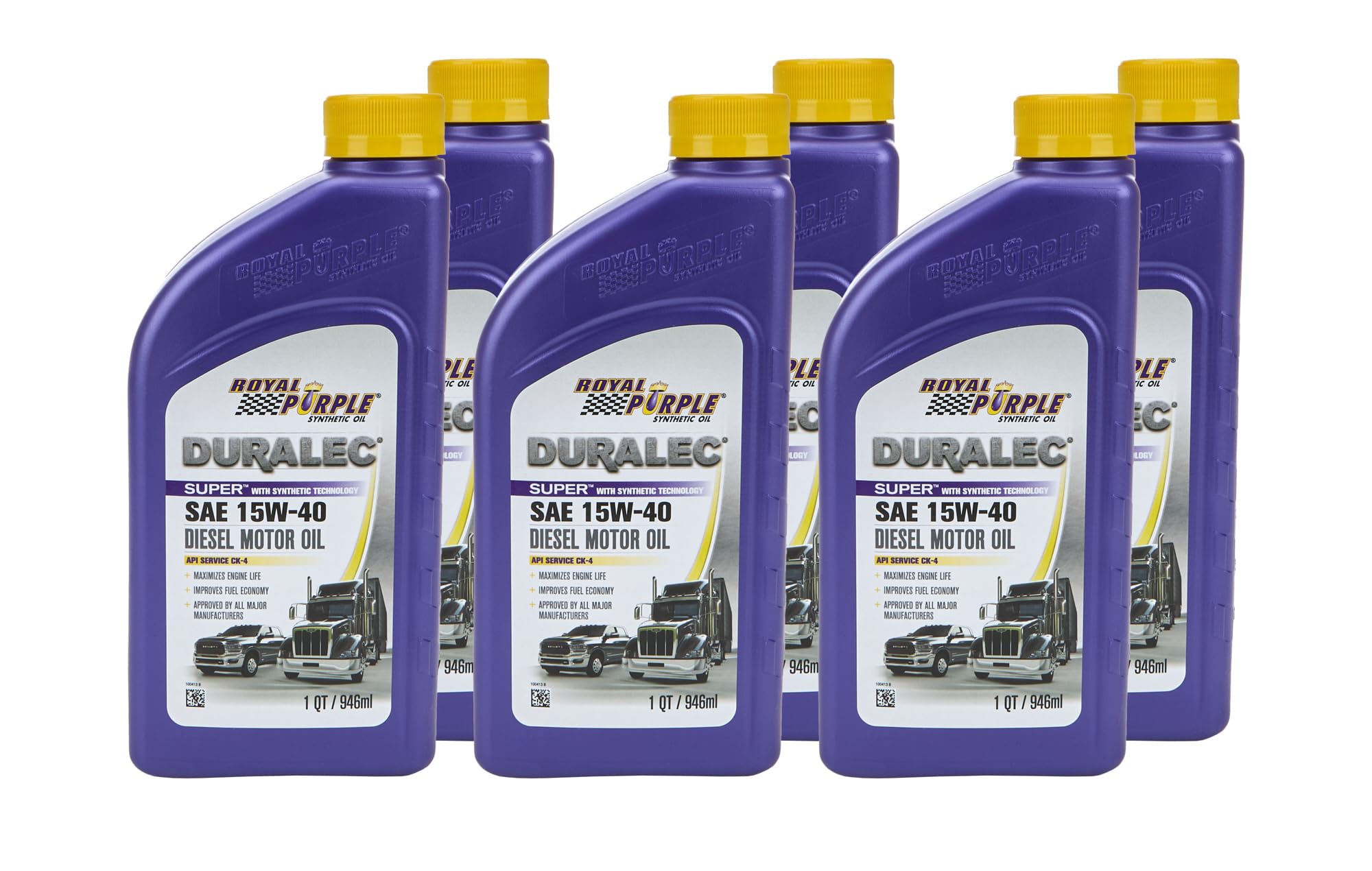
1. Royal Purple (06154-6PK) API-Licensed Heavy Duty CJ-4 SAE 15W-40 High Performance Synthetic Motor Oil
Our pick — over 4.5★ from 750+ verified ratings; the strongest balance of quality and price.
A 15W-40 synthetic that one buyer credits with a three-MPG gain after a simple oil change.
Royal Purple has a strong following among diesel owners who want better fuel efficiency without switching to a thinner viscosity. The SAE J300 viscosity grade is 15W-40, and it is API-licensed CJ-4, which covers older and mid-range diesel engines and protects catalytic emission systems. It comes as a case of six 1-quart bottles. One buyer reports resetting their fuel mileage monitor after switching and seeing three more miles per gallon — a real-world improvement that matches the brand’s reputation for reduced internal friction.
It carries a 4.8 out of 5 rating from nearly 800 reviews, with feedback consistently positive for wear protection and performance. The catch is that Royal Purple is one of the pricier 15W-40 synthetics per quart. The six-pack format means a higher upfront cost, even though you get exactly the right quantity for most oil changes. If you have an older diesel pickup or tractor and want a premium synthetic that may pay for itself in fuel savings, this is a strong contender.
Why fans love it
- Real buyer reported 3 MPG improvement after switching
- API CJ-4 certified to protect catalytic emissions systems
- High 4.8 rating from 797 reviews shows consistent owner satisfaction
A couple of notes
- CJ-4 rating — not ideal for the newest low-emission CK-4 engines
- Premium price per quart, and the six-pack case is a larger upfront cost
Best for: Diesel pickup and tractor owners looking for a premium synthetic that may improve fuel economy in a CJ-4 compatible engine.
Look elsewhere if: You have a 2010+ diesel that requires CK-4 oil, or you prefer a bulk gallon format instead of six individual quarts.
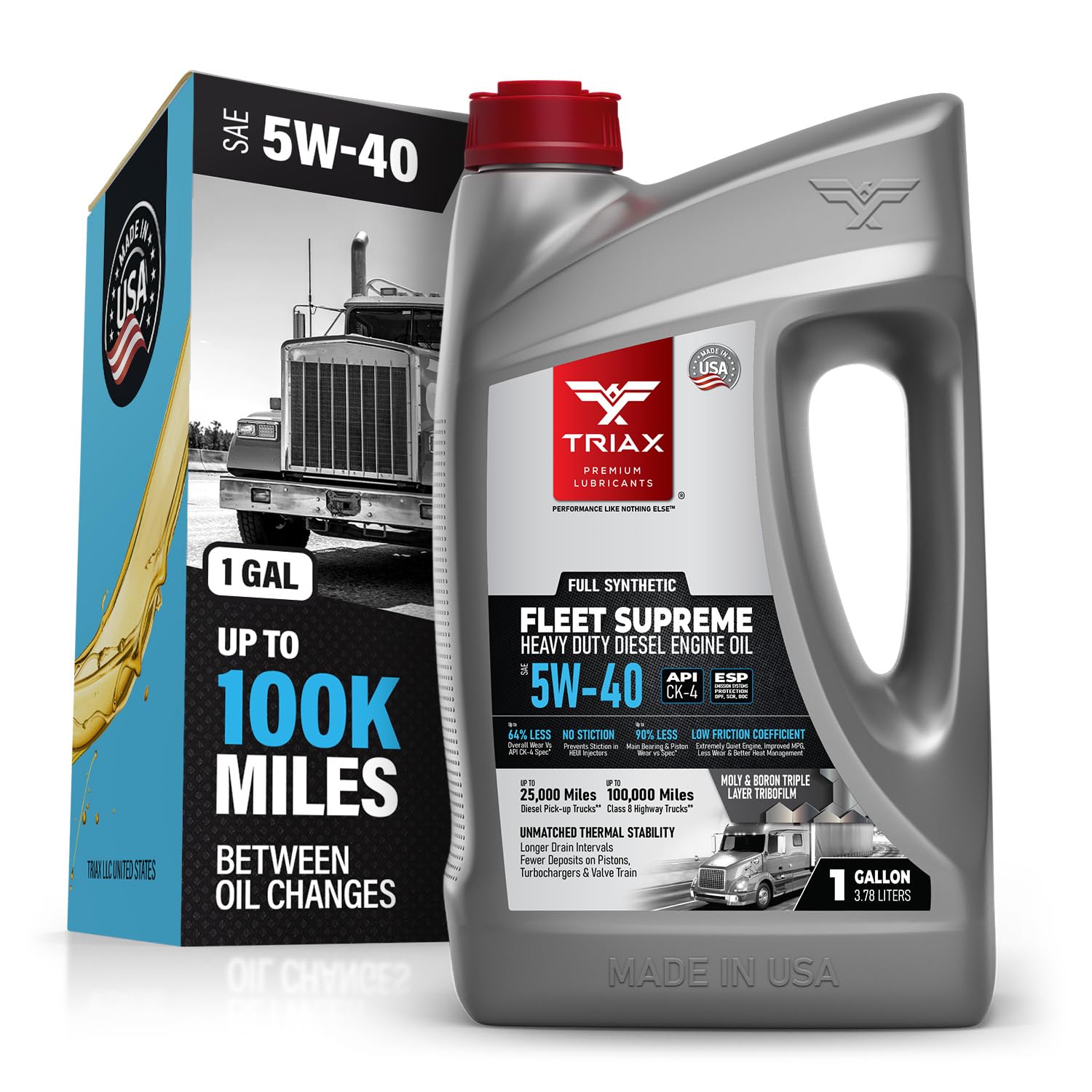
2. Triax Fleet Supreme ESP 5W-40 API CK-4 Full Synthetic Heavy Duty Diesel Engine Oil
This oil resists burning off better than any other on this list, thanks to a 400-degree-Celsius flash point that is 166 degrees higher than the Mobil 1 5W-40.
Reach for this oil when your diesel sees extreme heat — towing a trailer up a mountain grade or running heavy equipment in summer. It resists vaporizing and burning off at high cylinder temperatures. The flash point is 400 degrees Celsius, which beats the Mobil 1 5W-40’s 234 degrees Celsius by a clear 166-degree margin. Triax boosts the formula with nano-boron and moly friction modifiers (the maker claims up to 68 percent less wear than industry standards), and the SAE J300 viscosity grade is 5W-40, so it also starts well in cold weather down to minus 45 degrees Fahrenheit.
Buyers report that hard cold starts on a 2022 RAM 1500 EcoDiesel disappeared after switching from Mopar OEM 5W-40. But one driver noted oil temps rose from 206 degrees Fahrenheit to 219 degrees Fahrenheit. The trade-off for extreme film strength is a slight increase in oil temperature during sustained heavy use. The brand also claims it can handle drain intervals over 100,000 miles on highway semis and 30,000 miles on super-duty pickups — but you should run an oil analysis to be sure.
Why you’d pick it
- 400°C flash point beats every other oil here for heat resistance
- Moly and boron friction modifiers help quiet HEUI injectors and reduce wear
- 5W-40 viscosity handles both severe cold (-45°F) and hot, heavy loads
The catch
- Oil temps can run higher than standard 5W-40 oils under sustained load
- Premium price — you pay extra for the extreme-additive package
Who needs this: You tow, haul, or work your diesel in extreme conditions and want the highest flash-point protection and friction-reducing additives on the market.
Look elsewhere if: You just need a basic reliable oil for light-duty commuting — the extra cost and higher operating temps won’t benefit your driving pattern.
3. Mobil 1 Turbo Diesel Truck Full Synthetic Motor Oil 5W-40

A reliable full synthetic 5W-40 that one buyer says starts clean in bitter cold at 3000 miles a week.
Mobil 1 has decades of reputation behind this formula, and the numbers back it up. It meets API CK-4, SN, and a long list of OEM approvals including Cummins CES 20086, Volvo VDS-4.5, and Mack EOS-4.5. That means it works across mixed fleets. One buyer who drives about 3000 miles a week reported no issues starting in very cold weather after switching to this oil — exactly the scenario where the 5W-40 viscosity shines over a thicker 15W-40. The flash point is 234 degrees Celsius. That is lower than the Triax, but still well within safe range for normal highway driving and moderate towing.
Owners mention it runs quieter and smoother than Amsoil 5W-30 Max Duty in a 4N15 turbo diesel, and at a more accessible price point. It is a full synthetic 5W-40 (SAE J300 viscosity grade), which reduces low-temperature sludge and high-temperature deposits. If you log heavy highway miles and need a reliable oil across multiple diesel platforms without breaking the budget, this is the natural pick.
What makes it worth it
- 5W-40 flows fast in sub-freezing temps for reliable cold starts
- Approved by major OEMs for mixed-fleet operations
- Proven track record at high mileage — 3000 miles per week reported
One trade-off
- 234°C flash point is lower than premium options like Triax
- Not as friction-modified as moly/boron oils for extreme wear reduction
Best suited for: High-mileage highway drivers and mixed fleets that need a reliable, affordable full synthetic that starts in very cold weather.
Not the right fit for: Extreme heavy-towing conditions where you need flash-point protection above 250°C or specialized wear additives.
4. Delo 400 XSP SAE Heavy Duty Synthetic Diesel Engine Oil 5W-40

A Chevron synthetic designed to start consistently in sub-zero temperatures while resisting shear better than many thinner synthetics.
Delo 400 XSP uses a 5W-40 viscosity grade specifically to promote consistent cold engine starting in sub-zero temperatures. The formula resists thermal breakdown better than many conventional synthetics. One reviewer noted that in a 10HP generator running in 99-degree weather, the oil came out of the crankcase still thick, unlike several other full synthetic 5W-30 and 10W-30 oils. It is fully backward-compatible with older engines while meeting CK-4 and SN ratings for modern emissions systems.
The 5W-40 viscosity also benefits motorcycle diesel applications and high-revving turbo engines. One owner on a 15,000 rpm sport bike noted the oil holds up longer before it shears than similar Rotella T oil. The trade-off is it feels slightly thicker when cold and needs to warm up before the shifting smooths out. It ships as a 1-gallon jug at a mid-tier price, making it a strong value for owners of turbodiesel SUVs, Duramax pickups, and Powerstroke trucks in cold climates.
Why it stands out
- 5W-40 viscosity ensures reliable starts in sub-zero temperatures
- Excellent shear stability — does not thin out like some synthetics in heat
- Works with both diesel and gasoline engines (SN rated)
The small trade-off
- Feels thicker at cold startup than some 5W-40 alternatives — needs a momentary warm-up
- Premium-priced for a synthetic, though competitive with other CK-4 5W-40 oils
Pick this for: Cold-weather diesel owners and turbo gasoline engines that need an oil that does not shear thin under high RPM.
Choose something else for: Hot-climate heavy-towing where you would prefer a high-flash-point oil like the Triax.
5. Hot Shot’s Secret Green Diamond 15W-40 Full Synthetic Diesel Engine Oil

A full synthetic 15W-40 with patented FR3 nanotechnology that is designed to cut fuel use by up to 3 percent in high-mileage diesels.
Hot Shot’s Secret uses Group III base oils combined with its patented FR3 nanotechnology. The maker says it creates smoother surfaces in engine crevices to reduce metal-on-metal contact. The SAE J300 viscosity grade is 15W-40, a standard thickness for hot-running diesels, and it carries the CK-4 rating to protect modern DPF (diesel particulate filters) and SCR (selective catalytic reduction) systems. One buyer with an LLY Duramax at 265,000 miles reported MPG improved from 18 to 22 at 70 mph on 33-inch tires, along with a quieter engine and better throttle response.
The formula claims a 71 percent reduction in wear compared to CJ-4 spec oils. Another owner on a 2017 Cummins 6.7 noted slightly higher oil pressure and a quieter idle after hot cycles, though the emissions smell seemed more pungent — possibly due to higher zinc content. It is one of the pricier 15W-40 options here. But if you are chasing fuel economy and wear reduction in a high-mileage pickup, the real-world results stand out.
Its strongest points
- Real-world MPG improvement reported by multiple buyers on high-mileage diesels
- FR3 nanotechnology targets wear in tight engine crevices
- CK-4 formulation keeps DPF clean and protects low-emission engines
What to consider
- Higher price point than many 15W-40 full synthetics
- One buyer mentioned a more pungent emissions smell — may indicate high zinc levels
Go for this if: You drive a high-mileage diesel pickup and want measurable fuel-economy gains with proven wear protection on an older engine.
skip it if: You are on a tight budget or only need a basic 15W-40 for light-duty use — the premium price is not justified for casual driving.
6. Valvoline Heavy Duty Full Synthetic 15W-40 Diesel Engine Oil (1 Gallon)
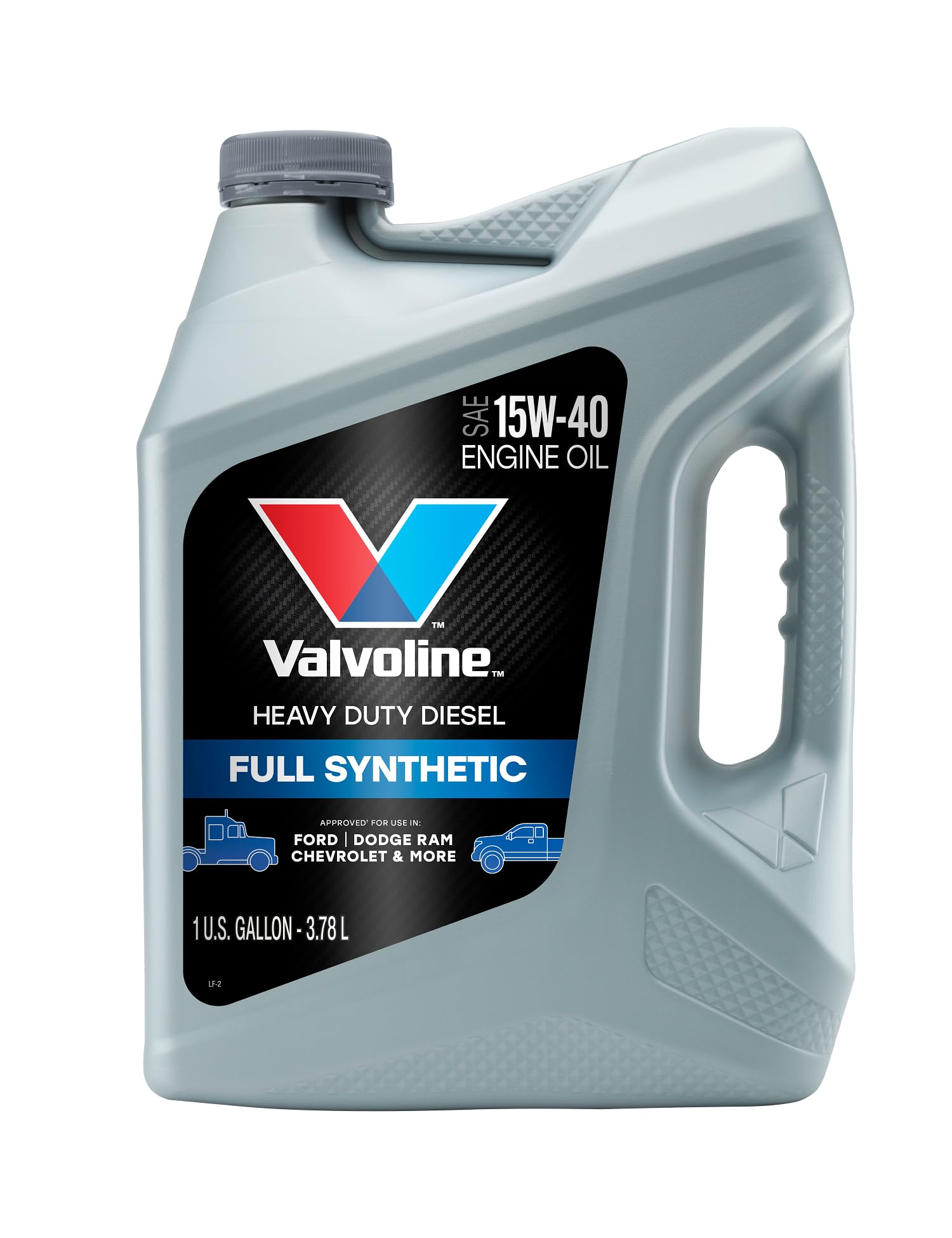
This full synthetic 15W-40 gives you CK-4 protection and a 437-degree Fahrenheit flash point at a budget-friendly price — a better heat-resistance number than the Mobil 1 5W-40’s 234°C.
Valvoline’s Heavy Duty full synthetic 15W-40 is the value champion of this list without cutting corners on the important numbers. It meets API CK-4, CJ-4, CI-4 PLUS, and even SN (gasoline). That covers virtually every diesel engine from a 5.9 Cummins to a modern Ford Powerstroke. The flash point is 437 degrees Fahrenheit, which translates to strong resistance against oil burn-off under heavy load. Valvoline cites a 35 percent reduction in valve train wear versus industry standards as tested in a Cummins ISB engine, and up to 28 percent longer oil life compared to industry baselines in the Volvo T-13 test.
Buyers consistently call it great value for money, and many specifically mention it works perfectly in 5.9 Cummins engines. It comes in a 1-gallon jug rather than a case of quarts, which makes it convenient for a single oil change on most trucks. The only real difference versus premium oils like Triax or Hot Shot’s Secret is that it does not contain specialized moly-boron or FR3 nanotechnology additives. But for a daily-driven pickup that does not see extreme towing, the protection levels are excellent for the price.
Value highlights
- 437°F flash point gives reliable heat resistance for heavy hauling
- 35% less valve-train wear than industry standards (Cummins ISB test)
- CK-4 rating covers virtually all modern and older diesel engines
A small difference
- No specialized friction modifiers like moly/boron or FR3 nanotechnology
- Not designed for extreme extended-drain intervals beyond 15,000 miles
Reach for this if: You want a full synthetic CK-4 15W-40 with proven wear-test results and a strong flash point at a price that beats most premium synthetics.
Look elsewhere if: You need extreme additives for quieting noisy injectors or long 30,000+ mile drain intervals.
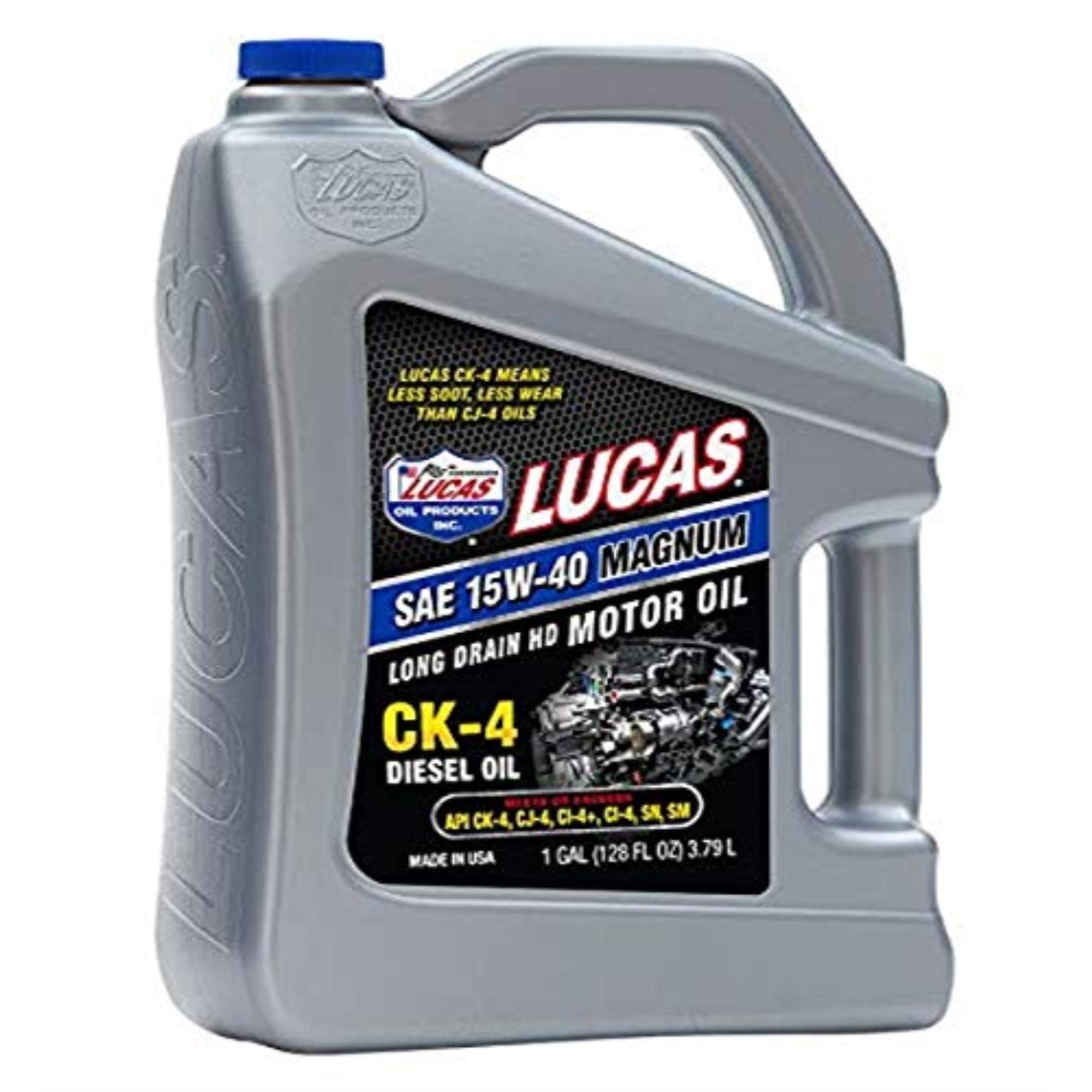
7. Lucas Oil 10287 SAE 15W-40 API CK-4 Heavy Duty Motor Oil (1 Gallon)
A budget-friendly CK-4 15W-40 that one owner says makes a 45-year-old diesel motor sound quieter and run smoother.
Lucas Oil has built a name in the heavy-duty world by focusing on longer engine life and less filter maintenance. This 15W-40 (SAE J300 viscosity grade) carries the API CK-4 rating, so it works in modern low-emission diesel engines as well as older ones. It comes in a 1-gallon bottle (128 fluid ounces) and weighs 3.55 kilograms. One buyer with a 45-year-old diesel truck reported it made the engine sound quieter and run smoother in daily driving.
Other owners use it in John Deere walk-behind mowers and backhoes, showing Lucas is a versatile pick for mixed fleets including highway trucks and off-road equipment. It is rated 4.7 out of 5 from 149 reviews. The price is firmly in the budget-friendly tier for a 15W-40 heavy-duty oil. If you have an older diesel engine that could benefit from a quieter idle and smoother operation, Lucas 10287 is worth a try — especially at its accessible price point.
Standout qualities
- Real testimonial of quieter, smoother operation on a 45-year-old diesel motor
- CK-4 rated — works with both modern low-emission engines and older models
- Good value for a 1-gallon jug of heavy-duty diesel oil
A couple of limits
- Not a full synthetic — it is a conventional (non-synthetic) heavy-duty oil
- Lower rating count (149) compared to premium picks on this list
Best for: Owners of older diesel engines — trucks, tractors, and mowers — who want a budget-friendly CK-4 oil that may quiet a noisy motor.
Not the one for: Modern turbo-diesel pickups that require a full synthetic for extended drain intervals or extreme-weather performance.
Understanding the Specs
SAE Viscosity Grade (5W-40 vs 15W-40)
The Society of Automotive Engineers (SAE) viscosity grade tells you how thick the oil is at different temperatures. The first number with a “W” (for Winter) is the cold-flow rating. A 5W-40 is thinner than a 15W-40 at 0 degrees Fahrenheit, so it helps your starter turn the engine over on a bitter morning. The second number (40) is the hot-thickness rating. Both grades hold a similar film strength at operating temperature, but the 15W-40 starts out thicker and stays thicker when cold, which can help older, looser engines maintain oil pressure. Your owner’s manual specifies which grade works best for your climate and engine design.
API Service Category (CK-4 vs CJ-4)
The American Petroleum Institute (API) service category tells you which emissions systems the oil protects. CK-4 is the current heavy-duty standard for 2010 and newer diesel engines with diesel particulate filters and selective catalytic reduction. It is backward-compatible with CJ-4 engines, so it works in older trucks too. CJ-4 was the previous standard and still works fine in pre-2010 diesels, but it lacks the soot-handling and catalyst-protection properties that newer low-emission engines need. If your truck was built after 2010, always choose CK-4 to keep your emissions warranty valid.
FAQ
Can I use 5W-40 instead of 15W-40 in my diesel engine?
What does API CK-4 mean for my diesel engine?
How often should I change diesel engine oil?
Can I mix 5W-40 and 15W-40 diesel oil?
What is flash point and why does it matter for diesel oil?
Is full synthetic diesel oil worth the extra cost?
What does SAE J300 viscosity grade tell me?
How do I know if a diesel oil is compatible with my DPF system?
Final Thoughts: The Verdict
For the majority of shoppers, the best grade oil for diesel engine winner is the Triax Fleet Supreme ESP 5W-40 — its 400-degree-Celsius flash point and moly-boron additives give the highest heat resistance and wear protection for serious towing and heavy loads. If you want a proven daily-driver synthetic that starts easily in cold weather at a fair price, grab the Mobil 1 Turbo Diesel Truck 5W-40. And for a budget-friendly CK-4 15W-40 that punches above its price tag, the Valvoline Heavy Duty Full Synthetic 15W-40 protects a 5.9 Cummins or any modern diesel pickup without the premium cost.
How We Picked
We do not accept paid placement. Every pick is matched to a real buyer and a real use-case; we do not hands-on test units.
Sources & Methodology
Specifications: manufacturer listings and product documentation. Review insights: verified customer reviews, as of July 2026. Pricing: not shown on this page (it changes often); check the current price via the retailer link.
As an Amazon Associate, Trending Car earns from qualifying purchases. This does not affect which products we feature.