
Our readers keep the lights on and my garage snacks stocked. As an Amazon Associate, I earn from qualifying purchases.
Specs are compiled from manufacturer listings and verified buyer reviews and can change over time — please confirm the key details on the product page before buying.
That orange check-engine light staring at you from the dash is the most expensive little symbol on your dashboard — not because car problems are always costly, but because a trip to the shop just to read the code can run you a hundred bucks. A car OBD scanner plugs into your vehicle’s diagnostic port and tells you, in plain language, exactly what that light means, so you can decide if it is a loose gas cap or a costly sensor failure before you pay a mechanic.
I’m Min Islam — the founder and writer behind Trending Car. This guide is built by comparing the manufacturers’ published specifications and the patterns across verified customer reviews, so you get each pick’s real strengths and trade-offs instead of marketing spin.
From a twenty-five-dollar code reader that Scotty Kilmer personally recommends to a full-system diagnostic tool with bidirectional control, the best car obd scanner for your situation depends on whether you scan one family car or a driveway full of different makes.
Our Picks at a Glance


How To Choose The Best Car OBD Scanner
Not every scanner reads every system. The biggest decision you will make is if you need a simple check-engine code reader or a tool that talks to your airbags, brakes, and transmission. Here are the three factors that separate a smart purchase from a regret.
System Coverage: Engine Only vs. Full System
The cheapest scanners only read powertrain (engine and transmission) codes. If your airbag light or ABS warning comes on, a basic OBD scanner cannot see those codes at all. Mid-range and premium scanners add SRS (airbag) and ABS (brake) coverage, and the highest-end tools also scan the body control module, HVAC, and TPMS. Look at what systems your car has warned you about in the past and match accordingly.
Bidirectional Control and Special Functions
A scanner that can only read codes is half the story. Bidirectional control lets you send a command directly to a component — for example, you can command the fuel pump to turn on while you listen for a hum, or tell a window to roll down to test the motor. Likewise, special reset functions (oil life, brake pad service, TPMS, battery registration) save you a trip to the dealer after DIY maintenance. These features live on scanners in the premium tier.
Connection Type and Software Updates
Wired scanners are plug-and-play and never lose a connection, but they keep you tethered near the port. Wireless Bluetooth models let you sit in the driver’s seat with your phone as the display, offering more data visualization (graphs, gauges, trip logs). The trade-off is battery drain if the dongle does not auto-sleep. Also check if the software requires a paid subscription for updates — some brands (like XTOOL and TOPDON) offer lifetime free updates, which keeps the scanner useful for years.
Quick Comparison
| Model | Best For | Systems Covered | Connection | Display | Amazon |
|---|---|---|---|---|---|
| ANCEL AD310★ Best Overall | Budget-friendly basic reader | Engine (emission-related codes) | Corded | 128×64 LCD | Amazon |
| TOPDON AL400Smart Buy | Compact color-screen reader | Engine (10 OBDII functions) | Corded | 2.4-inch color | Amazon |
| XTOOL AD20 Pro | Wireless deep-scan w/ AI advice | Engine, ABS, SRS, Transmission, TPMS, A/C | Bluetooth 5.0 | Phone app | Amazon |
| INNOVA 5310 | ABS & SRS + battery health | Engine, ABS, SRS, Battery | Bluetooth | 2.8-inch + phone app | Amazon |
| TOPDON AD600S | Standalone pro-grade tool | Engine, Transmission, ABS, SRS, 9 resets | Standalone (Wi-Fi updates) | 5-inch 1280×720 | Amazon |
| KINGBOLEN Ediag Elite | Bidirectional control on a budget | Full systems, 15 resets, bidirectional | Bluetooth 5.2 | Phone app | Amazon |
| A-Premium AD200 | Data-stream graphing on a budget | Engine, live data (50+ params) | Corded | 1.77-inch | Amazon |
In‑Depth Reviews
1. ANCEL AD310 Classic Enhanced Universal OBD II Scanner
Our pick — over 4.5★ from 65,000+ verified ratings; the strongest balance of quality and price.
The budget workhorse that 65,000 buyers and a famous mechanic trust for quick code pulls.
You get a straightforward, no-app-required tool that plugs into the OBDII port under your dash with a 2.5-foot cable. The insulation is thick and flexible — strong enough to survive a drop onto concrete, which buyers report happens often when working in a car. It reads and clears emission-related diagnostic trouble codes (DTCs, the fault numbers a car computer stores) for any vehicle from 1996 onward that follows the common OBD2 protocols (KWP2000, J1850 VPW, ISO9141, J1850 PWM, and CAN — Controller Area Network, the standard data bus). At 12 ounces and measuring 8.9 by 6.9 by 1.4 inches, it is notably larger than the TOPDON AL400 below — at 8.9 by 6.9 by 1.4 inches versus the TOPDON AL400’s 2.95 by 0.96 by 5.67 inches — but that extra footprint gives you a large, readable 128×64 screen and clearly labelled buttons that do not require reading glasses.
Owners mention the AD310 is a “Simple OBD2 scanner for basic check engine light diagnosis.” It needs no batteries or charger because it draws power from the OBDII connector itself. The catch: this scanner only reads emission-related codes. If your check engine light comes on for a non-emission fault, or if you need to see ABS (anti-lock brake system) or SRS (supplemental restraint system, meaning airbag) codes, the AD310 cannot help.
One-trick specialist: If all you want is to confirm “loose gas cap” or “bad O2 sensor” with zero setup and no phone pairing, this is the one to grab. The price means it pays for itself the first time you avoid a shop diagnostic fee. But if you drive a European car from 2000 or an Asian model from 2008, check compatibility with ANCEL support first, because some older protocols behave differently per region.
Reach for this if: you drive a single US-market car from 1996 or newer, you just need engine-emission diagnostics, and you want a tool that works without a smartphone or app.
Look elsewhere if: your car’s check engine light could be triggered by an ABS, SRS, or transmission fault, or if you need wireless freedom while scanning.
2. TOPDON AL400 OBD2 Scanner, Full OBDII Code Reader
A palm-sized reader with a color screen that fits in a glove box and shows you code severity at a glance.
At 2.95 by 0.96 by 5.67 inches and only 7.8 ounces, the AL400 is dramatically smaller than the chunky ANCEL AD310 — versus the ANCEL AD310’s 8.9 by 6.9 by 1.4 inches — yet it adds a 2.4-inch color display with 240×320 resolution. The screen is bright enough to read in direct sunlight or in a dark garage. This scanner covers all ten OBDII functions including I/M readiness (Inspection/Maintenance readiness, which tells you if your car’s emissions monitors are ready for a smog test), EVAP (evaporative emissions), O2 sensor, and catalyst monitor. It also gives you a three-color LED (light-emitting diode: red for permanent trouble codes, yellow for pending, green for no faults) so you know the severity at a glance without even reading the screen.
Customers note that the AL400 “works great for pulling codes on multiple vehicles with on-screen definitions; easy to use.” The DTC lookup is built directly into the device — no phone needed — which is a real time-saver. The downside: a few owners note the connection can feel slow, and the included mini-USB port for firmware updates is dated. The free lifetime updates, however, keep the scanner current without any subscription fees, which makes this a solid jump up from the AD310 if you want a modern display and a more portable package.
Form meets function: That compact body and color screen make the AL400 the entry-level reader that actually feels like a modern gadget rather than a 1990s diagnostic brick. The I/M readiness test alone helps you avoid failing a smog check over a monitor that just was not ready yet — a feature the basic AD310 lacks.
Best suited for: the DIYer who wants a self-contained scanner with on-screen code definitions, a color display, and a small-enough footprint to live in the center console.
Not the choice for: anyone who needs ABS, SRS, or bidirectional functionality — this is engine-only diagnostics, same as the AD310, just faster and prettier.
3. XTOOL AD20 Pro OBD2 Scanner – No Subscription, Full System Car Diagnostic Scan Tool with AI Analysis
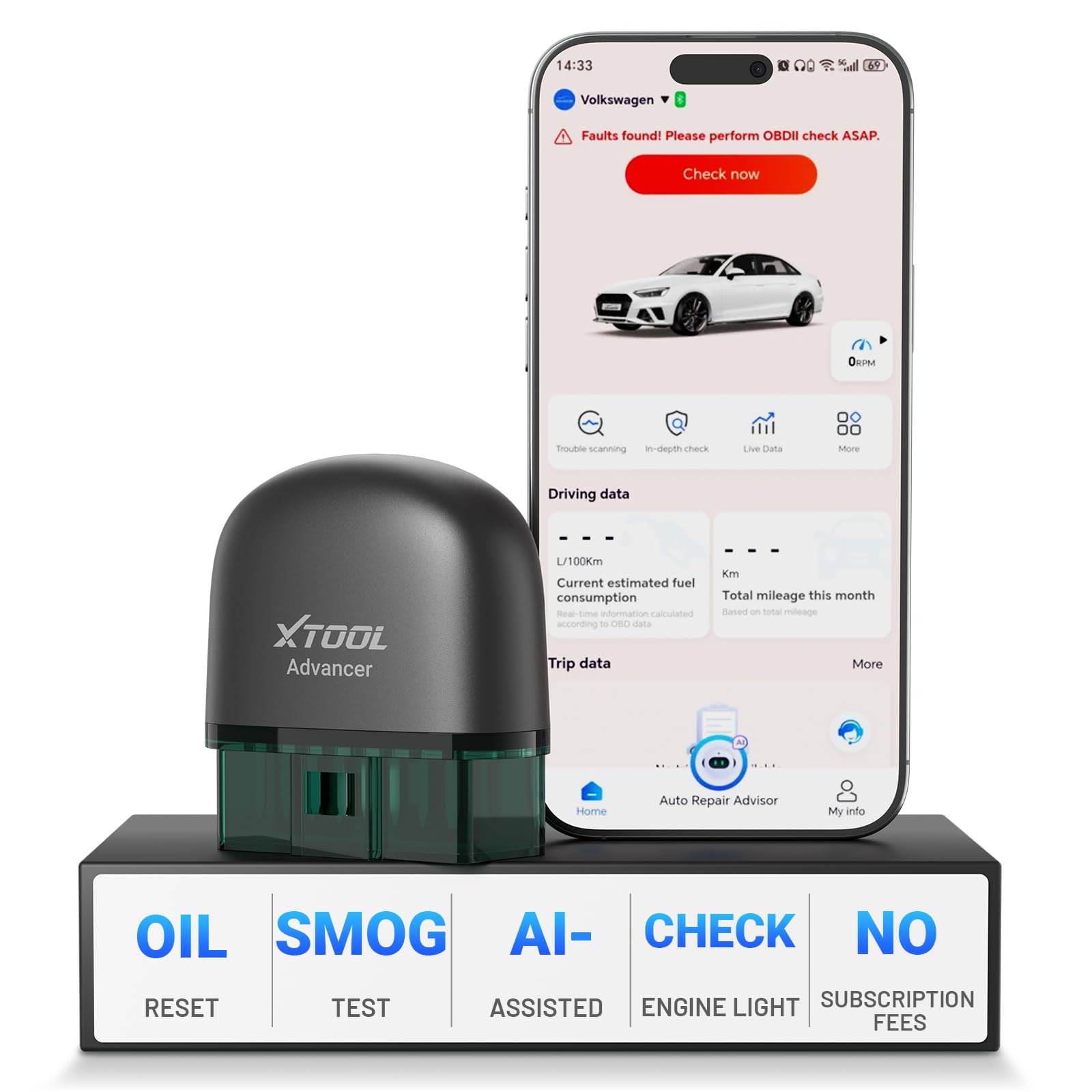
A feather-light Bluetooth dongle that turns your phone into a full-system diagnostic bay with AI repair tips.
Unlike the wired code readers above, the AD20 Pro is a tiny wireless dongle (1.13 ounces) that stays plugged into your OBD2 port. It communicates with your smartphone via Bluetooth 5.0 from up to 33 feet away. It goes well beyond engine codes — it performs a deep scan of the ABS, SRS, Transmission, TPMS (Tire Pressure Monitoring System), and A/C systems. It also includes CAN FD (Controller Area Network Flexible Data-Rate) hardware, a newer data bus standard that makes it compatible with 2020-plus GM and Chevrolet vehicles that older scanners cannot read. The AI diagnostic engine does not just display a code number; the brand says it explains the root cause in plain English and suggests verified fixes, which reviewers point out is a massive confidence boost for DIYers who “save hundreds of dollars on shop labor.”
A unique a neat extra: the AD20 Pro includes an automatic low-power sleep mode that stops the dongle from draining your battery when the engine is off, so you can leave it plugged in 24/7. It also offers an Oil Reset function, a Performance Test that measures 0-60 mph times, and a Smart Dash that turns your phone into a live data dashboard with RPM, coolant temp, and fuel trim gauges. Shoppers say it “scans like a professional scan tool” and handles multiple makes (Dodge, Mazda, Honda, BMW) without issues. The only real drawback is that it lacks bidirectional controls — you cannot command a fuel pump or window motor to test it — and the all-plastic dongle can be hard to spot against a dark interior.
Why it stands out
- No subscription fees and unlimited vehicle scans — a true one-time purchase
- Full system diagnostics plus CAN FD support for newer GM models
- AI-driven repair guidance translates trouble codes into actionable steps
The trade-offs
- No bidirectional control for component testing
- Scroll-back button on some Android phones requires a swipe rather than a tap
Grab this if: you own a 2020+ GM vehicle and want full system diagnostics without a subscription, or if you prefer phone-based user interfaces with wireless freedom.
Look elsewhere if: you need to run active tests (like cycling a relay or actuating a valve) — for that, you want the KINGBOLEN Ediag Elite below.
4. KINGBOLEN Ediag Elite OBD2 Scanner Bluetooth, Bidirectional Test Scanner
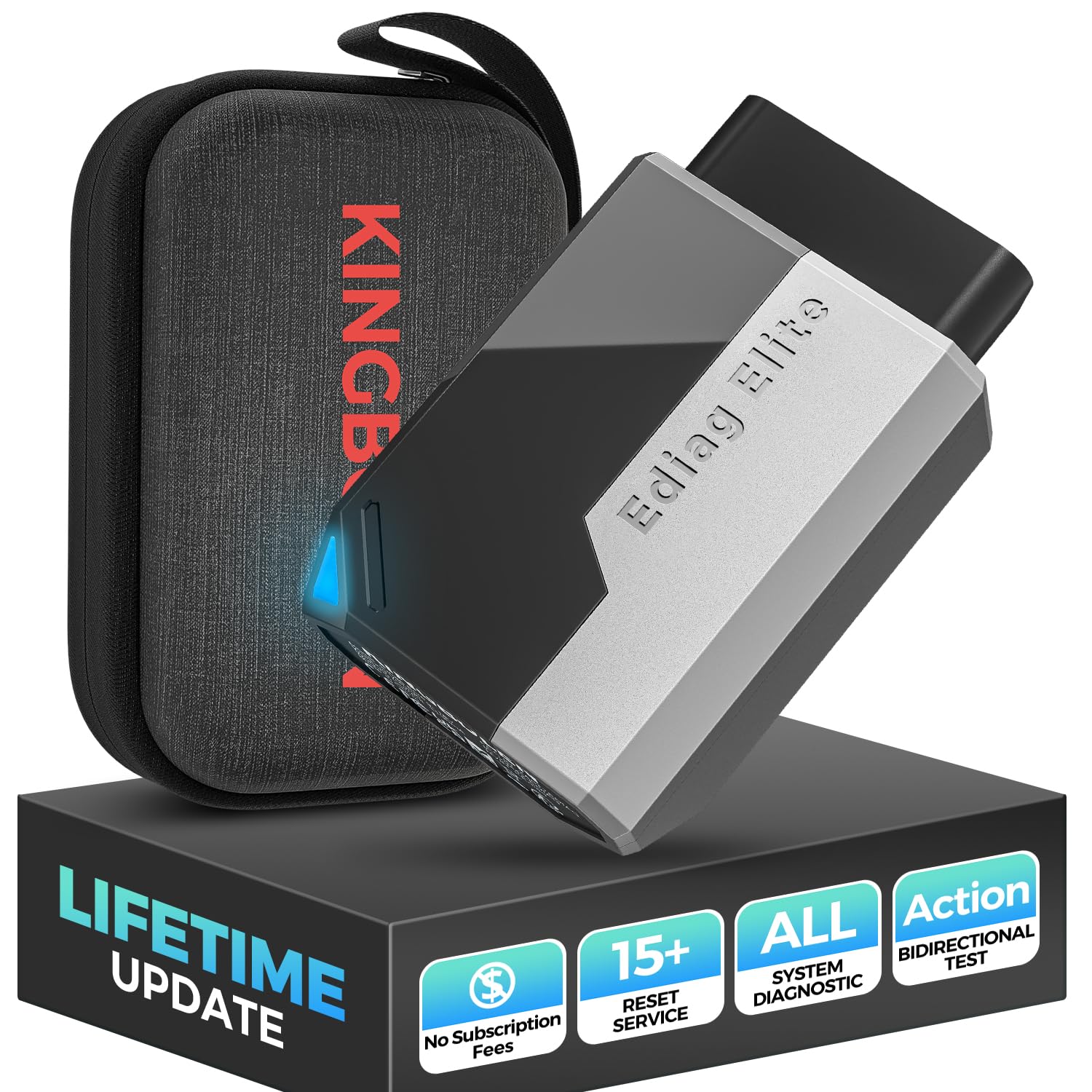
A pocket-sized Bluetooth scanner that lets you test parts by commanding them to move from your phone.
Where the XTOOL AD20 Pro can read, the Ediag Elite can also talk back. The bidirectional control feature lets you send a command directly to a component — for example, you can tell the air conditioning clutch to engage, make a window roll down, or trigger the fuel pump. That way you confirm a part works (or does not) without meters and jumper wires. It also includes 15 maintenance reset functions including Oil Reset, TPMS Reset, BMS Reset (Battery Management System reset, needed after a new battery install), Gear Box Relearn, Throttle Learning, and SAS Reset (Steering Angle Sensor reset). Plus it adds FCA AutoAuth for Chrysler, Dodge, Jeep, and Ram vehicles that otherwise lock the diagnostic port behind a security gateway.
Buyers report that the tool “saves time and money” and that the lifetime software updates are genuinely free — no yearly renewal fees. The Bluetooth 5.2 connection provides stable communication up to 33 feet, and the AutoVIN recognition eliminates manual vehicle selection. One limitation: the Ediag Elite does not do ECU (Engine Control Unit) coding, TPMS sensor programming, or key fob addition, so it is not a replacement for a dealer-level tool. Some users also wish the dongle had a rubberized exterior for a better grip.
Two-way street: The ability to command a window or pump from your phone transforms how you diagnose — instead of reading code P0xxx and guessing, you can cycle the part and confirm the failure. That alone makes this a stronger diagnostic tool than any read-only scanner, including the more expensive INNOVA 5310 above.
Choose this for: DIY owners who want professional-level testing (bidirectional control) without professional-level pricing, and especially those with Chrysler/Dodge/Jeep/Ram vehicles that need AutoAuth.
skip it if: you need ECU coding or TPMS sensor programming — those tasks require a dealer or a high-end scan tool like the TOPDON AD600S.
5. INNOVA 5310 OBD2 Scanner – ABS & SRS Code Reader, Check Engine Light Diagnostic Tool
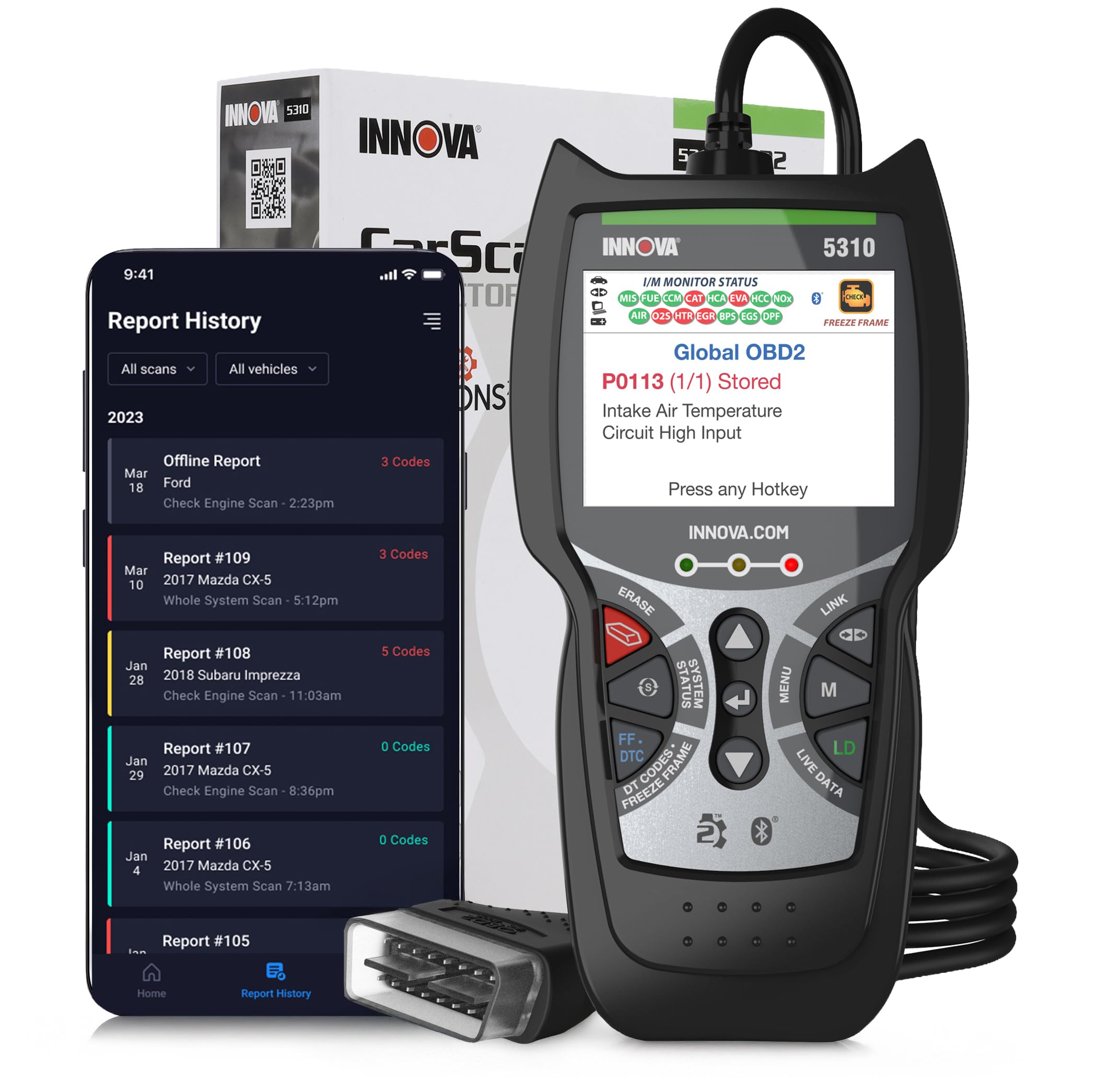
The first scanner on this list that reads airbag and ABS codes, plus it checks your battery and alternator health.
Unlike the previous picks that stop at engine diagnostics, the INNOVA 5310 reaches into the ABS (anti-lock brake) and SRS (airbag) systems — a critical feature if that red airbag light is staring at you. One buyer bought this specifically to diagnose an airbag light on a 2004 Jeep Wrangler TJ after two different Topdon scanners with “SRS capability” failed to pull those codes. The 5310 succeeded. It also runs a battery and alternator test to tell you whether your charging system is healthy, and it reads live data (RPM, speed, oil temperature) through the free RepairSolutions 2 phone app, which offers verified fixes and links to exact replacement parts.
The scanner itself weighs 12.8 ounces and sports a 2.8-inch screen with a long cable that reaches comfortably from the port to your lap. It supports English, Spanish, and French menu languages. The main limitation is that it does not offer bidirectional control — you are reading and clearing only, not commanding parts to move. It also lacks the deeper reset functions (brake service, TPMS reset) that the TOPDON AD600S and KINGBOLEN Ediag Elite provide.
Airbag-savvy: If you drive a Jeep, a European car, or an older vehicle where the airbag or ABS light has come on, this is the only mid-priced scanner on this list that, according to buyer reports, can pull those specific codes. The battery health test is a useful bonus for winter-season owners who want to know if their car will start.
Pick this for: addressing ABS and SRS warning lights without visiting a dealer, and for the integrated battery/alternator health check.
Not for you if: you need to run a bidirectional test or reset service lights after a brake job — for those tasks, step up to the KINGBOLEN Ediag Elite or the TOPDON AD600S.
6. A-Premium AD200 Professional OBD2 Scanner Car Diagnostic Tool
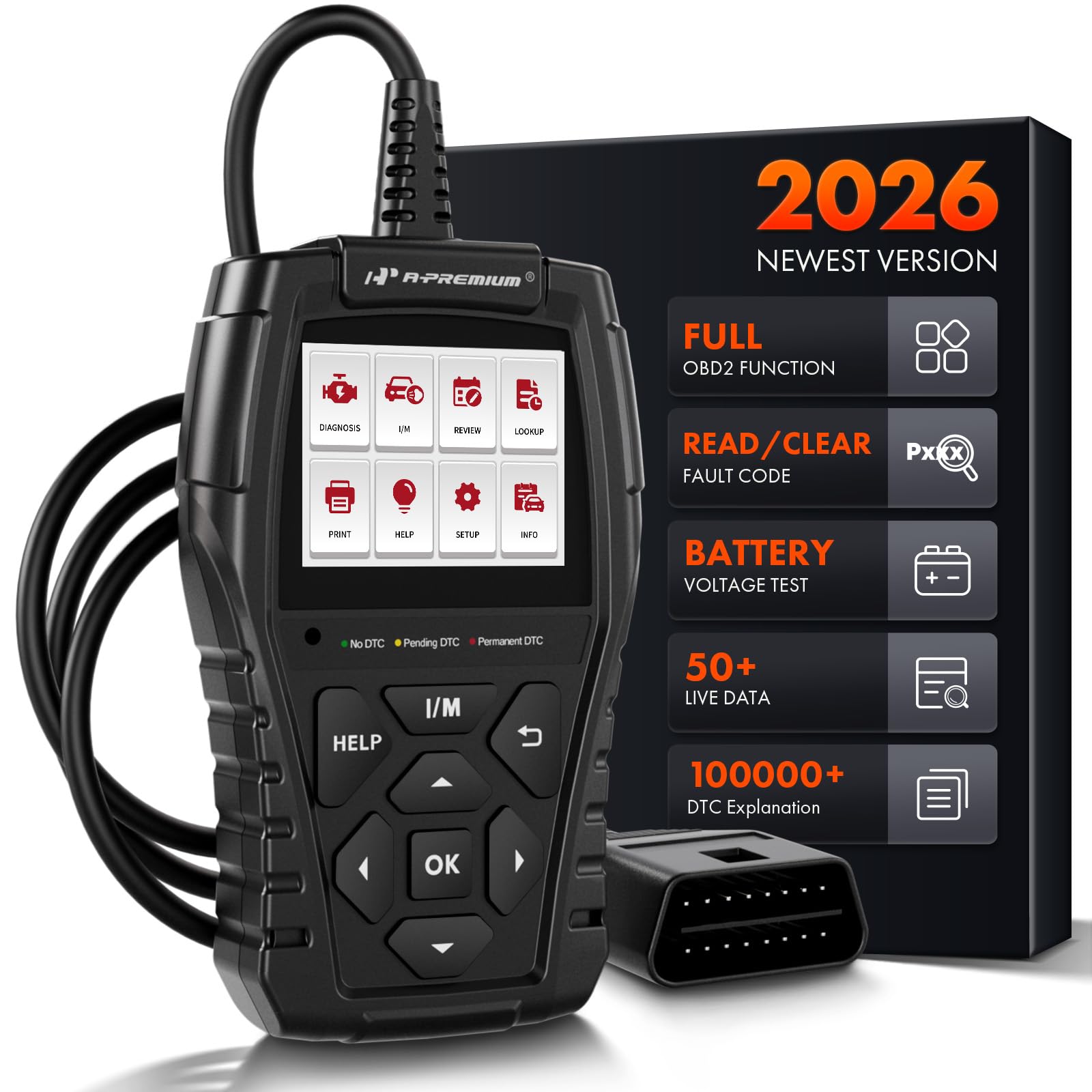
A wired scanner that shows 50 live data parameters on real-time graphs — not just codes but curves.
Most entry-level scanners give you a code number and a static freeze-frame. The AD200 goes deeper: it can read up to 50 data streams (battery voltage, coolant temperature, engine RPM, air flow rate, oil temperature, fuel rail pressure, transmission gear status) and display them as live-time visual curves on its 1.77-inch screen. That graphing ability helps you spot abnormal sensor fluctuations — a slowly climbing coolant temp that never quite overheats, for example — rather than guessing from a single number. It also records fault data for review and can generate a printable diagnostic report to share with a mechanic.
The unit runs on an ARM CPU (a type of processor, often used in mobile devices) and the body is made of strong plastic that survives drops. A 3.9-foot cable gives you enough slack to sit in the driver’s seat with the tool in your lap. Three warning LEDs (green, yellow, red) instantly tell you the severity of the fault. The catch: the 1.77-inch screen is small, and while the graphing is impressive for the price, reading detailed curves on that tiny display is not as comfortable as viewing them on a phone app. Also, no ABS, SRS, or bidirectional coverage — this is a deep engine-data tool, not a full-system diagnostic.
top-tier data streaming
- 50-plus live parameters viewable as real-time graphs — not just numbers
- Fault data recording and printable reports for mechanic sharing
- Fast ARM CPU, drop-resistant plastic body, and a generous 3.9-ft cable
Know before you buy
- No ABS, SRS, or transmission diagnostics — engine and emission only
- The 1.77-inch display is small for reading detailed graphs
Grab this for: diagnosing intermittent sensor problems (fluctuating coolant temp, erratic MAF readings) where a graph reveals what a single freeze-frame cannot.
Move on if: you need to read airbag or brake codes — this scanner cannot see those systems.
7. TOPDON Upgraded AD600S OBD2 Scanner, Diagnostic Tool, ABS SRS Transmission Engine Code Reader

A full Android tablet dedicated to diagnostics — no phone needed, no pairing required.
This is the only pick that stands alone as a complete diagnostic tool. The TOPDON AD600S runs Android 11.0 on a 5-inch display with 1280×720 resolution, plus 32GB of ROM (read-only memory) for storing diagnostic reports and software updates. It covers four systems — Engine, Transmission, ABS, and SRS — and includes 9 one-click reset functions: Oil, BMS, ABS, SAS, EPB (Electronic Parking Brake), DPF (Diesel Particulate Filter), TPMS, Throttle, and Injector Coding. The AutoVIN feature automatically fetches your vehicle’s identification the moment you plug it in, and the tool supports over 10,000 models across 67 global brands.
Buyers praise the “easy interface” and “lifetime free Wi-Fi updates” that keep the software current without fees. One buyer with a Chevy Silverado noted that the AD600S “helped me find and diagnose my issues” and that “feel[5] so much more professional working on my own vehicles” — a common theme among owners who stepped up from basic readers. The 5-inch touchscreen is large enough to read live O2 sensor graphs and transmission temperature data without squinting. The notable limitation: it cannot auto-scan the VIN reliably on every vehicle (some users report needing to enter it manually), and the battery-powered design means you need to keep it charged if you use it away from the vehicle’s port power.
All-in-one workshop: The AD600S replaces both a basic code reader and a separate service-reset tool. The lifetime free updates mean this tool stays relevant as your car ages or when you buy a newer model.
Perfect for: the serious DIYer or small shop owner who needs engine-to-ABS coverage plus maintenance resets in a single standalone device — no smartphone tethering required.
Not ideal for: someone who only scans a single older car once a year — the upfront investment makes more sense if you maintain multiple vehicles or do regular work.
Understanding the Specs
System Coverage
The number of vehicle computers a scanner can talk to determines what problems you can diagnose. A basic OBD code reader only covers the powertrain (engine and transmission). Adding ABS and SRS coverage lets you see airbag and brake codes. Full-system tools also scan body modules, HVAC, and TPMS. The more systems your scanner covers, the fewer warning lights stay a mystery — but coverage costs more, so match it to the warning lights your car actually shows.
Bidirectional Control
A read-only scanner shows you a trouble code and a description. A bidirectional scanner goes further — it sends a command from your smartphone or tablet to a specific part in your car, such as activating the fuel pump, cycling a window motor, or engaging the AC clutch. This lets you confirm whether a part is actually dead or just reporting a sensor error. It is the single biggest feature separating a code reader from a diagnostic tool, and it is essential for serious DIY troubleshooting.
Communication Protocols: CAN FD
CAN FD (Controller Area Network Flexible Data-Rate) is a newer communication standard found in many 2020-and-later vehicles, particularly GM, Chevrolet, and GMC models. Older OBD scanners lack the hardware to decode CAN FD signals, so they will not connect to those cars at all. If you drive a newer domestic truck or SUV, check that your scanner explicitly lists CAN FD support — otherwise, you are buying a tool that cannot talk to your vehicle.
Connection Type and Portability
Wired scanners plug directly into the OBD2 port and draw power from the car. They never lose connection, but the cable keeps you tethered near the steering column. Wireless Bluetooth dongles broadcast to your phone from up to 33 feet away, giving you the freedom to sit anywhere in or around the car while scanning. The trade-off is that some dongles drain the car battery if left plugged in — look for an auto-sleep feature that shuts the dongle down when the engine is off.
Service Reset Functions
After performing routine maintenance like changing oil, replacing brake pads, rotating tires, or installing a new battery, many modern vehicles need a computerized reset to turn off a dashboard light or recalibrate a sensor. Service reset functions (Oil Reset, BMS Reset, EPB Reset, SAS Reset, TPMS Reset, Throttle Learning) let you perform these resets yourself instead of paying a dealer. The number of reset functions a scanner offers — from 9 to 15, depending on the model — dictates how much of your own maintenance you can truly complete on your own.
Standalone Device vs. App-Based Tool
App-based scanners (like the XTOOL AD20 Pro and KINGBOLEN Ediag Elite) are tiny Bluetooth dongles that rely on your smartphone for the interface. They offer richer data visualization (graphs, gauges, trip logs) and convenient over-the-air updates, but they drain your phone battery and require a compatible device. Standalone scanners (like the TOPDON AD600S) have their own screen and operating system, so they work entirely independently — no phone, no pairing, no app store. The trade-off is size and cost: standalone units are larger and more expensive because they pack a full computer into the device.
FAQ
Will a Car OBD Scanner work on my 1998 Honda Accord?
Can I leave a Bluetooth OBD scanner plugged in all the time?
What is the difference between reading codes and bidirectional control?
My car has an ABS light on. Will a basic OBD scanner read that?
Do I need a subscription for software updates on these scanners?
What does CAN FD mean and do I need it?
Can a Car OBD Scanner fix my check-engine light by itself?
What is the difference between a code reader and a diagnostic scan tool?
Do these scanners work on diesel vehicles?
Can I use these scanners to reset the oil life light after an oil change?
Final Thoughts: The Verdict
For most users