
Our readers keep the lights on and my garage snacks stocked. As an Amazon Associate, I earn from qualifying purchases.
Specs are compiled from manufacturer listings and verified buyer reviews and can change over time — please confirm the key details on the product page before buying.
You want your bike to sound aggressive, not like a sewing machine. A good exhaust pulls real power from your engine and drops weight you didn’t know you were carrying. The right slip-on or full system transforms throttle response from low-end grunt to top-end pull.
I’m Min Islam — the founder and writer behind Trending Car. This guide is built by comparing the manufacturers’ published specifications and the patterns across verified customer reviews, so you get each pick’s real strengths and trade-offs instead of marketing spin.
Whether you ride a sportbike, a cruiser, or a dual-sport, finding the motorcycle exhaust that fits your bike, your budget, and your sound preference depends on knowing a few key specs and matching them to your specific model — and that is exactly what this guide walks you through.
Our Picks at a Glance


How To Choose The Best Motorcycle Exhaust
Picking the right exhaust starts with one question: what sound and performance gain do you want? Slip-on mufflers are the most common upgrade — they replace just the can at the end of your stock header, which is usually enough to drop weight and wake up the note without remapping. Full systems swap everything from the engine flanges back, which can add real horsepower but often require a fuel tuner to run right. Your bike model dictates the flange pattern, inlet diameter, and mounting points, so always check the fitment list before you buy.
Slip-On vs Full System
A slip-on muffler bolts onto your existing header pipe and is the fastest way to change sound, cut weight, and improve the look of your bike’s tail end. A full exhaust system includes the headers too, which improves gas flow from the engine ports and can open up more power across the rev range. Full systems are heavier on the wallet and usually need a matching fuel controller to avoid running too lean (a condition where the engine gets too much air and not enough fuel, causing overheating or backfiring).
Construction Materials and Their Trade-Offs
Mufflers are typically built from stainless steel, carbon fiber, aluminum, or titanium. Stainless steel is heavy but durable and takes heat well; carbon fiber is light and looks aggressive but can discolor over time; aluminum is mid-weight and common on mid-range systems; titanium is the lightest and strongest but costs the most. Choose based on whether you prioritize weight, looks, or longevity.
Baffle Design and Noise Level
The baffle is the internal tube or packing inside the muffler that quiets the exhaust pulse. Some exhausts come with a removable baffle so you can choose between a mellow daily ride or a full race scream. A packed baffle uses fiberglass or steel wool to absorb sound; a straight-through design gives you a louder, more aggressive note. If you live in an area with noise ordinances or ride on public trails, check whether the muffler includes a spark arrestor (a mesh screen that stops hot particles from leaving the pipe) — many aftermarket systems do not and are not USFS-approved.
Quick Comparison
| Model | Best For | Weight | Inlet Diameter | Material | Amazon |
|---|---|---|---|---|---|
| M4 GP Series (GSXR)★ Best Overall | Sportbike race tone | — | — | Stainless/Aluminum | Amazon |
| Vance & Hines 47943Also Great | Premium cruiser sound | 7.1 lbs | — | Alloy Steel | Amazon |
| M4 GP19 (ZX-6R)Premium Pick | Top-end sport power | — | — | Stainless Steel | Amazon |
| SHARKROAD Super Loud (Tour) | No-baffle cruiser loudness | 10.43 kg | 2.5 Inches | Chrome/alloy | Amazon |
| SHARKROAD 4″ Chrome (Touring) | Deep rumble, easy install | — | 2.5 Inches | Chrome/alloy | Amazon |
| JFG RACING (Dirt/Hawk) | Budget dual-sport upgrade | — | 38 mm | Aluminum/Titanium | Amazon |
| Fast Pro Full System (TTR230) | Full pipe for trail bikes | 3.1 kg | 38 mm | 304 SS / 6061 Alu | Amazon |
| 4into1 Chrome Shortys | Universal café/chopper look | — | 1.5 or 1.75 in | Alloy Steel | Amazon |
| Carbon Fiber Slip-On | Budget value, light weight | 1.17 kg | 2.0 in | Carbon/SS/Alu | Amazon |
In-Depth Reviews
1. M4 GP Series Slip-On (GSXR600/750)
Our pick — over 4.5★ from 350+ verified ratings; the strongest balance of quality and price.
The slip-on that makes your GSXR sound like a full race bike but leaves the baffle in for daily riding.
If you ride a Suzuki GSXR600 or 750 from 2011 to 2016, this M4 GP Series is the exhaust every forum thread points to. It is a direct-fit slip-on that measures 26 x 7 x 7 inches in the box and connects to the stock header with a spring and bracket system. A buyer who left a detailed 5-star review noted the install took about 15 minutes using only a metric Allen wrench and a metric socket wrench, plus they emphasized leaving the old muffler gasket off when you swap the rubber grommet over — a small tip that saves you from buying a separate gasket.
The sound profile is what sells this unit. At low RPMs it growls deep, and as the revs climb it screams like a proper supersport bike without crossing into obnoxious territory. One reviewer living in an upscale apartment complex said they left the baffle in and the note was “absolute music to the ears” without angering neighbors. Another pointed out that the hanger spring is a bit fiddly — a long flat-head screwdriver helps stretch it into place — but once mounted, the fit is perfect and the bike sounds way healthier than the stock unit.
Where this exhaust really shines is that it does not require a remap unless you also remove the catalytic converter. A verified buyer mentioned they spoke to an ASE mechanic who confirmed no remap is needed as long as the cat box stays in place. That saves you the cost of a fuel controller and a dyno session, making this a true bolt-and-go upgrade. The 4.7-star average across 380 reviews tells you this is not just hype — it is the standard for GSXR owners.
What Makes It Great
- 15-minute install using basic metric tools, confirmed by multiple buyers.
- No remap needed with stock catalytic converter, saving you money.
- Deep idle growl that turns into a full race scream at high RPM.
- 4.7 stars from 380 reviews — the highest count in this guide.
Know Before You Buy
- Optional heat shield not included; factory shield must be reused.
- Hanger spring requires a bit of muscle or a long screwdriver to seat.
Reach for this if: You own a 2011-2016 GSXR and want the most-reviewed, best-sounding slip-on that does not force you to remap the ECU.
Pass it up for: Bikes that are not Suzuki GSXR600 or 750 — fitment is model-specific.
2. Vance & Hines 47943 Hi-Output Slip-On
The slip-on that turns a moped-like buzz into a proper Harley growl in under five minutes.
This is the one that keeps popping up in every cruiser conversation for good reason. The Vance & Hines Hi-Output Slip-On weighs 7.1 pounds, so it is noticeably lighter than the bulky stock muffler on bikes like the Harley Street XG500. Buyers report that the install took them less than 5 minutes — no cutting, no welding, just a simple swap using the included hardware — which is about as painless as an exhaust upgrade gets.
Riders on both the XG500 and larger touring models say the sound is a night-and-day difference. One reviewer noted their Street went from sounding “like a moped to a big hog,” and another said the bike “sounds like a real Harley” now. The note is deep and loud — one owner mentioned their wife can hear them coming from the house — but it stays controlled enough that you are not drowning out your own ride. Unlike straight pipes that drone at highway speeds, this slip-on lets you carry a conversation while still giving you that classic V-twin bark when you twist the throttle.
The catch is that this is a single muffler, so if your bike is a twin-shock model that needs two cans, you will need to buy a second unit or look at a paired set. Also, because it is made of alloy steel, it is durable but not the lightest option — carbon fiber alternatives from other picks shave more weight if grams matter to you. Still, for the rider who wants a proven, bolt-on sound upgrade with zero guesswork, this is the benchmark.
Why It Works
- 5-minute install with no special tools — buyers confirm it is tool-free simple.
- Deep, authoritative sound that makes smaller Harleys sound like big twins.
- Weighs 7.1 pounds, so you drop noticeable mass off the rear.
- High 4.7-star average from 148 reviews.
The Trade-Offs
- Single muffler only — twin-shock bikes need a second purchase.
- Alloy steel is heavier than carbon fiber or titanium options.
Best for: Cruiser and Street owners who want the easiest, most proven way to sound like a real Harley without a trip to the shop.
Look elsewhere if: You ride a bike that needs two mufflers and you want to keep the total weight as low as possible.
3. M4 GP19 Slip-On (Kawasaki ZX-6R)
The track-inspired slip-on that wakes up a 600cc inline-four without the cost of a full system.
For owners of the 2009-2024 Kawasaki ZX-6R (ZX636), the M4 GP19 is the go-to upgrade when you want a serious weight reduction and a sound that actually matches the bike’s aggressive styling. It is a stainless steel muffler with a round black can that clamps directly to the stock header. Multiple buyers confirm a roughly 30-minute install time, though one noted the DB killer (a removable baffle that lowers the volume) is stubborn to remove and can leave minor scratches on the inner pipe if you force it.
The sound is the star here — owners describe it as “super loud, but not annoying,” with a hard bark that a cellphone video does not do justice. One reviewer who has run the exhaust for two years says it holds up well and still looks great, though they recommend pairing it with a servo buddy (a small electronic module that prevents the exhaust valve servo from throwing a check-engine light) to keep the ECU happy. Another tip from a veteran rider: do not wear shorts while riding with this pipe, because your leg will get a blister from the heat.
Compared to the Vance & Hines Hi-Output above, the GP19 is built for a different audience — it is for the sport rider who values high-RPM scream over low-end grunt. The 4.7-star rating from 129 reviews shows a similarly enthusiastic customer base, but the install is fussier and the heat risk is real. If you own a modern ZX-6R and want an exhaust that sounds like it belongs on a racetrack, this is it.
What Stands Out
- Massive sound improvement on the ZX-6R — loud and aggressive without being raspy.
- 30-minute install for most riders; no heavy modification needed.
- Stainless steel construction holds up well over years of use.
Watch Out For
- DB killer removal can scratch the inner pipe if you are not careful.
- Runs hot — wearing shorts near this pipe will burn your leg.
- May need a servo buddy module to avoid a check-engine light.
Grab this for: A 2009-2024 ZX-6R rider who wants race-level sound and does not mind spending a few extra minutes on the install.
skip it if: You want a quick, tool-free swap like the Vance & Hines above — the GP19 needs more patience with the baffle and bracket.
4. SHARKROAD Super Loud Slip-Ons (Harley Touring 2017-2023)

The slip-on that comes with zero baffles inside so you get full straight-pipe volume the second you start the engine.
If “loud” is not loud enough for you, this SHARKROAD set is designed specifically for Harley Touring models from 2017 to 2023 — Road King, Street Glide, Electra Glide, Road Glide, and Ultra Limited. These are a pair of 4-inch chrome mufflers that bolt onto the stock header pipe with a 2.5-inch inlet, and they weigh a hefty 10.43 kilograms per set. The key selling point is right in the name: “Super Loud Version” means there is no baffle inside at all, so you get maximum volume from idle to redline without needing to remove anything.
Buyers confirm the install takes about 30 to 45 minutes including removing and reinstalling the saddlebags, and the sound is exactly what you expect — “OMG Loud,” as one reviewer put it. Another owner who had previously spent on Vance & Hines slip-ons said these SHARKROAD units were way louder and cost a fraction of the price. A rider with a 2021 Street Glide mentioned that the stock mufflers were so quiet they had to look at the tachometer to know when to shift, and these pipes finally gave the bike the bark it needed.
The honest trade-off is that no baffle means no sound dampening at all. If you ride long distances, the drone at highway speeds could be fatiguing, and your neighbors will definitely hear you leave every morning. One reviewer appreciated the deep rumble but admitted they might be too loud for some purposes. Also, because these are designed for stock Harley headers, they may not fit aftermarket header brands. If you want controlled loudness with the option to quiet it down later, look at the next SHARKROAD pick with an included baffle.
The Big Appeal
- No baffle design means instant straight-pipe volume right from the start.
- Easy 30-45 minute install with included hardware, per multiple riders.
- Much cheaper than premium brands like Vance & Hines or Rhinehart.
The Noise Tax
- No baffle means non-stop loud — no option to tone it down for highway cruising.
- Will not fit aftermarket header pipes, only Harley stock headers.
- Heavy set at 10.43 kg compared to lighter slip-ons.
Perfect if: You want the loudest possible Harley touring exhaust on a budget and never plan to run a baffle.
Not for you if: You want the option to baffle-up for longer rides or quiet zone cruising — the standard SHARKROAD set is a better match.
5. SHARKROAD 4″ Chrome Slip-Ons (Harley Touring 2017-2023)

The budget-friendly Harley touring slip-on that gives you a deep rumble without waking the whole block.
These are the more civilized cousin of the Super Loud version above. They share the same 2.5-inch inlet and 4-inch chrome outlet, fit the same 2017-2023 Touring models (Road King, Street Glide, Electra Glide, Road Glide, Ultra Limited), and come with a built-in baffle that keeps the volume at a neighbor-friendly level while still giving you a deep, throaty tone. The manufacturer claims a 15-minute install time from start to finish, and buyers agree — one said they fit “perfectly with no issues at all” on a 2019 Electra Glide.
The sound is the main differentiator here. Reviewers describe it as a “nice deep rumble” that is louder than stock but not annoyingly loud — exactly what you want if you need to commute daily without fatigue. One rider who bought a full SHARKROAD header system to match these slip-ons loved the sound but noted that the chrome tips developed some rust over time, which knocked their rating to 4 stars. The other 190 reviewers mostly praise the value: you get a similar-looking set of pipes.
Compared to the Super Loud version, this is the smarter daily-driver pick. The baffle-controlled rumble means you get presence without punishment. One reviewer also mentioned that a small extra washer on the bolt stud helps clear the side bags during install — a tiny adjustment that makes the job even smoother. If you want to transform your touring bike’s sound without the relentless drone, this is the set to choose.
Why Buy It
- Deep, controlled rumble that sounds great without being offensive to neighbors.
- 15-minute install with included hardware, confirmed by buyers.
- Costs significantly less than premium-brand touring slip-ons.
Watch Out
- Some reports of chrome tip rusting over time, especially in wet climates.
- Not as loud as the no-baffle SHARKROAD option if you want maximum volume.
Best suited for: Daily riders who want a big sound upgrade for their Harley touring bike without the highway drone or early-morning noise complaints.
Look at the Super Loud set instead if: You cannot get enough volume and plan to remove every baffle anyway — skip the rust risk and go straight to no-baffle.
6. JFG RACING Dirt Bike Slip-On (Hawk 250 / CRF / TTR)
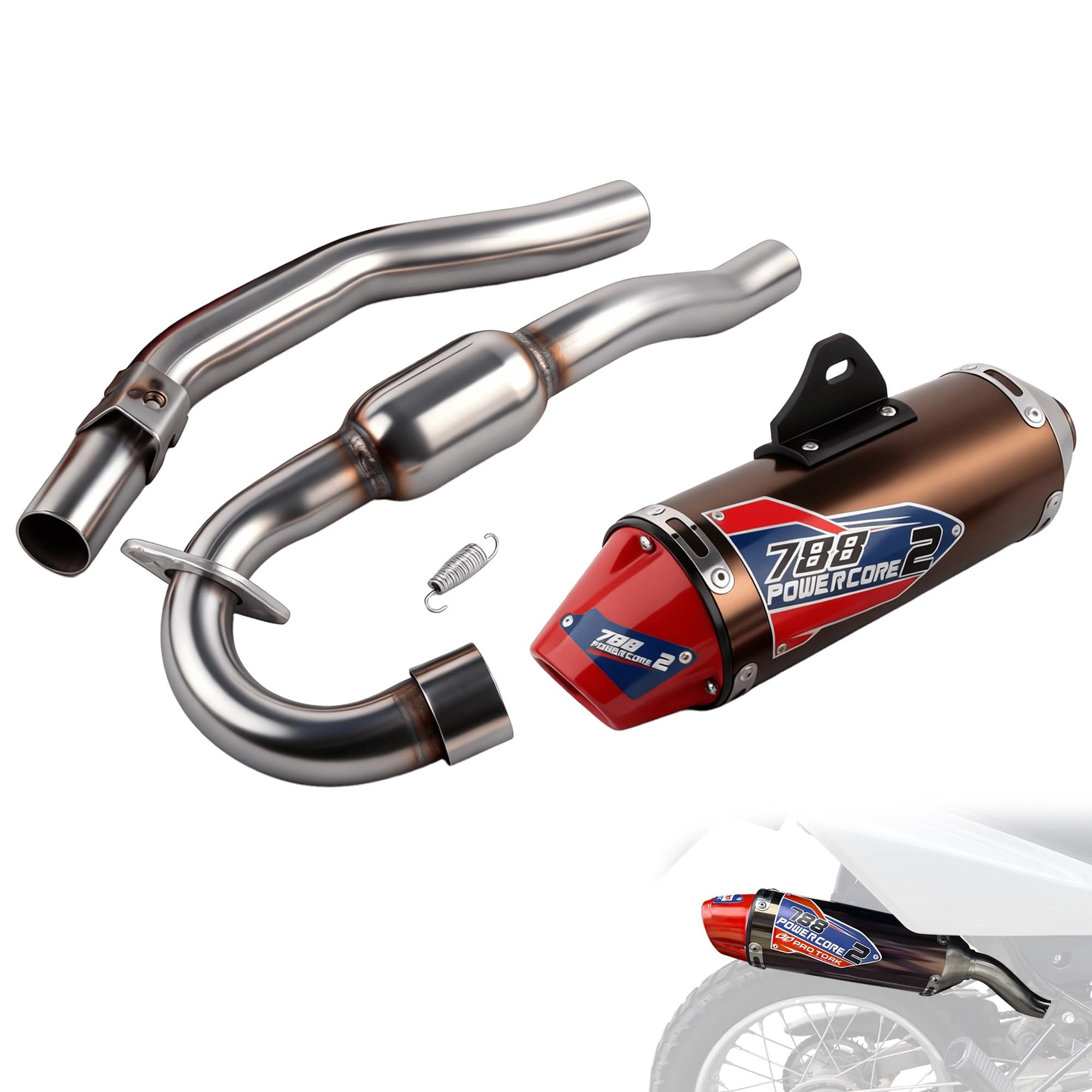
The budget exhaust that turns a struggling Hawk 250 into a bike that holds 75 mph on the highway.
It is a full kit made of aluminum, stainless steel, and titanium that connects to a 38mm header pipe. The top-end improvement is dramatic: one buyer mentioned that their Hawk 250 “went from falling on face at 60 to maintaining 75 mph,” with better hill pulling power to match. That sort of real-world performance gain from a simple muffler swap is rare at any price point.
Buyers on CRF150F, CRF230F, and Yamaha TTR125 models confirm it fits after minor adjustments. One rider on a 2006 CRF230F noted that the kit needed a loose assembly first, plus a new crush washer, but the end result added an aggressive motocross sound and enough low-end power gain to lift the front wheel on hills. A Trailmaster TM35 owner said the exhaust was “insanely loud — like 22 caliber loud” and reported a huge horsepower increase that made longer gears usable. The trade-off is the noise: it is not USFS-approved as a spark arrestor, so you cannot legally ride it in some off-road areas or national forests.
This JFG system is the polar opposite of the polished M4 and Vance & Hines options above — it is raw, loud, and requires some minor fabrication like drilling a new bolt hole or bending the mid-pipe for a perfect fit. But if you ride a budget dual-sport and want real speed gains instead of just a new sound, the 4.3-star rating across 481 reviews shows this kit delivers.
The Performance Edge
- Real top-end speed gains — Hawk 250 jumped from 60 mph to 75 mph.
- Aggressive motocross sound that gives the bike a completely different character.
- Constructed from aluminum, stainless steel, and titanium for a good weight balance.
The Catch
- No USFS spark arrestor, so not legal for all off-road riding areas.
- Extremely loud — some owners describe it as “gunshot loud.”
- May require minor drilling or bracket modification for perfect fit on some bikes.
Buy it for: A Hawk 250, TBR7, or CRF230F owner who needs real horsepower gains and does not care about noise limits.
Steer clear if: You need a spark arrestor for trail riding or want a slip-on that bolts on with zero modification.
7. Fast Pro Full Exhaust (TTR230 2005-2016)

The full pipe kit that replaces the entire restrictive exhaust on a TTR230 and transforms its trail manners.
This is a full exhaust system — not just a slip-on — made specifically for the Yamaha TTR230 from 2005 to 2016. The header pipe is 304 stainless steel and the muffler is 6061-T6 aluminum, with a total muffler length of 17 inches (430mm) and a 38mm connection diameter. The unit weighs 3.1 kilograms, which is noticeably heavier than the generic carbon fiber slip-on in this guide (1.17 kg), but you are getting a full replacement system that flows far more air than the stock pipe ever could.
Owners mention a wide range of fitment experiences. Some say it bolted on perfectly in minutes, while others had to trim about an inch off the center pipe to align the slip joint. A 2018 TTR230 buyer said it fit perfectly and sounded great, but multiple reviewers noted you will need to re-jet the carburetor to a 38/130 jet combination to prevent a lean condition (where too much air and not enough fuel causes the engine to run hot). The system also does not include a spark arrestor, which is an important detail if you ride in areas that require one.
Compared to the JFG RACING system above, this Fast Pro kit is more refined — it fits the TTR230 specifically rather than being a universal dirt-bike solution. But the install is not always straightforward: the slip joint was misaligned on one unit, and the hardware bag includes extra parts with no instructions to guide you. If you are comfortable with minor modifications and carb tuning, this full system delivers the sound and power your trail bike needs.
The Full-Pipe Advantage
- Replaces both header and muffler for maximum airflow improvement.
- 304 stainless steel header resists corrosion better than standard steel.
- Sounds noticeably louder and more aggressive than the stock TTR230 exhaust.
Install Reality
- Some units need pipe trimming or bracket bending for proper alignment.
- Carburetor re-jetting is almost always required to avoid a lean engine condition.
- No spark arrestor included — check local trail regulations before riding.
Reach for this if: You own a TTR230, are comfortable with a little pipe adjustment and carb tuning, and want a full exhaust system that transforms your bike’s character.
pass on it if: You want a precise bolt-on fit with no modifications — you might be happier with a slip-on specifically matched to your model’s stock header.
8. 4into1 Chrome Shorty Mufflers (Universal Fit)

The custom builder’s go-to pair of chrome shorty mufflers that fit almost any header size.
If you are building a cafe racer, bobber, or chopper, the 4into1 Chrome Shorty Mufflers are a universal fit two-pack that works on motorcycles, ATVs, go-karts, and even custom golf carts. Each muffler is 12 inches long and comes with a reversible design that lets you mount it on either the left or right side of your bike, plus a 2-way design that fits either 1.5-inch or 1.75-inch header pipes. The straight-through design uses a removable glass-pack baffle to control the noise level.
Buyers from all sorts of builds have good things to say. A Honda Rebel 250 owner said they cut off the old mufflers and these bolted right on with a nice low burble and chrome that shined brighter than the rest of the bike. Another rider on a Honda CB650 mentioned the chrome finish is flawless and the mufflers greatly reduce noise compared to open headers — though they had to cut a slit in the clamp end for a perfect seal. A 1982 Honda GL500 owner called them plug-and-play, with no carburetor jetting needed when paired with the stock exhaust. The one common tip from several reviews: re-pack the mufflers with fresh fiberglass packing because the factory packing is sparse, which quiets them down significantly and improves the tone.
These shortys are not for the sportbike crowd or the dual-sport rider — they are for the builder who needs a clean, chrome look and a universal fit that can be adapted with basic tools. The 4.5-star rating from 61 reviews reflects a solid product for its purpose, though the sound is not for everyone: one rider on a Suzuki Intruder rated it 3 stars, saying the sound was just okay and required custom work to fit. If you want the classic chopper look and are ready to do a little adaptation, this set delivers.
Why Builders Love Them
- Universal 2-way adapter fits 1.5-inch and 1.75-inch header pipes without extra adapters.
- Reversible mounting works on left or right side, perfect for custom builds.
- Bright chrome finish that many owners say outshines the rest of their bike.
Custom Work Required
- Factory packing is sparse — re-packing is recommended for better sound control.
- Some models need a slit cut in the clamp or a custom mounting bracket for a good seal.
- Sound quality varies by bike; one buyer found it just okay on a Suzuki Intruder.
Best for: Custom builders who want affordable chrome shortys that can be adapted to almost any vintage or rebuilt bike with basic hand tools.
Not ideal for: Riders who want a precise, model-specific bolt-on exhaust with no modifications needed.
9. Generic Carbon Fiber Slip-On (Multifit)

The lightweight carbon fiber slip-on that costs less than a full tank of premium gas on some bikes.
This is the cheapest route to a carbon fiber slip-on on this list, but do not let the price fool you — buyers confirm it is real carbon fiber. The muffler weighs just 1.17 kilograms, making it the lightest option in this guide by a wide margin (the Fast Pro full system is 3.1 kg, for comparison). It has an overall length of 8.26 inches (210mm) and a 2.0-inch (51mm) connection diameter, which makes it a universal fit for bikes with a matching inlet like the Z900, GSXR750, CBR650, Kawasaki Z800, and Yamaha XSR-900.
Sound is the biggest talking point in the reviews — it is loud. Several owners say it is much louder than stock, with one buyer on a 2024 Ninja 500 saying you can hear it from about half a mile away. The carbon outer shell and stainless steel construction give it a premium appearance that riders say looks more expensive than it is. A Kawasaki Z800 owner said the install took them three minutes at most, and the material quality surprised them. Another buyer on a Yamaha XSR-900 removed their catalytic converter and fabbed up custom piping, calling the muffler a great alternative to spending on a name-brand can.
The honest downside is that this is a universal part, so fitment depends heavily on your adapter setup. One owner reported that depending on your bike model, you may need to weld one of the springs to the mounting bracket. The 4.2-star rating across 82 reviews is solid but a notch below the M4 and Vance & Hines picks because of these fitment variables. If you have a bike with a 2-inch exhaust pipe and want a real carbon fiber muffler for an entry-level price, this is a great experiment — just be ready to do a little fabrication work.
What Impresses
- Weighs just 1.17 kg — shaves serious mass off your bike’s tail section.
- Real carbon fiber construction with a premium look, confirmed by buyers.
- Very loud exhaust note — exactly what budget-minded sport riders want.
Know the Limits
- Universal fit may require welding custom spring mounts or adapters.
- Not a model-specific system — fitment success depends on your fabrication skills.
- Generic brand with no specific warranty support beyond standard FBA rules.
Pick this if: You already have a project bike or you enjoy fabricating custom mounts, and you want a real carbon fiber can for the lowest possible price.
Avoid it if: You want a guaranteed bolt-on fit — the model-specific picks like the M4 or Vance & Hines will save you the headache of custom fabrication.
Understanding the Specs
Inlet Diameter
This is the size of the opening where the muffler connects to your header pipe, usually measured in millimeters or inches. A 38mm (1.5-inch) inlet is common on smaller dual-sport and dirt bikes, while a 2.0-inch or even 2.5-inch inlet fits larger sportbikes and Harley Touring models. If your muffler inlet does not match your header outlet, you need an adapter or you will have exhaust leaks — so always confirm this spec against your bike’s stock pipe before ordering.
Baffle Design
The baffle is the internal structure inside the muffler that manages sound waves and backpressure. A removable baffle lets you choose between a tamer daily note and a full race scream. A straight-through or “no baffle” design gives you maximum volume and flow but can make your bike unbearably loud on long rides. Packed baffles use fiberglass or steel wool to absorb sound; they wear out over time and can be re-packed to freshen the tone. If you ride on public trails, also check for a spark arrestor — a mesh screen that prevents glowing particles from exiting the pipe and starting a fire. Many aftermarket exhausts, like the JFG RACING and Fast Pro kits, do not include one.
Weight
Motorcycle exhaust weight is measured in kilograms or pounds. Dropping a heavy stock muffler for a lighter slip-on changes how your bike handles at low speeds and in corners. The lightest option here is the universal carbon fiber slip-on at 1.17 kg, while the heaviest is the SHARKROAD Super Loud set at 10.43 kg (for a pair). A lighter exhaust reduces unsprung weight at the rear, which improves suspension response — but a heavy set from a premium brand might be built from thicker materials that resist denting and corrosion longer. Decide what matters more for your riding style: weight savings or durability.
Material
Exhaust materials directly affect weight, heat retention, and lifespan. Stainless steel is heavy but lasts almost forever and handles extreme heat without rusting. Carbon fiber is very light and looks aggressive, but it can discolor or yellow over time from UV exposure and heat cycles. Aluminum is a mid-weight compromise common on mid-range systems. Titanium is the lightest and strongest, but you pay a premium for it. The Fast Pro full system uses a 304 stainless steel header with a 6061-T6 aluminum muffler — a common combo that balances cost with durability. If you ride in wet or salty conditions, stainless steel or chrome is a safer bet than raw aluminum.
FAQ
Will a slip-on exhaust make my motorcycle faster?
How do I know if an exhaust fits my specific motorcycle model?
Do I need to re-jet my carburetor or add a fuel controller after installing an aftermarket exhaust?
What is the difference between a slip-on and a full exhaust system?
How loud is too loud for a motorcycle exhaust?
What does a spark arrestor do and do I need one?
Which material lasts the longest for a motorcycle exhaust?
Can I install a motorcycle exhaust myself without special tools?
How often do I need to re-pack a motorcycle muffler?
Final Thoughts: The Verdict
For most riders, the motorcycle exhaust winner is the Vance & Hines 47943 Hi-Output Slip-On because it combines the fastest install time, a deep authoritative sound, and a proven track record across cruiser and Street models. If you ride a sportbike and want a track-level scream, grab the M4 GP Series for GSXR or the M4 GP19 for ZX-6R. And for the budget dual-sport rider who needs real speed gains, the standout is the JFG RACING slip-on for value-to-performance ratio.
How We Picked
We do not accept paid placement. Every pick is matched to a real buyer and a real use-case; we do not hands-on test units.
Sources & Methodology
Specifications: manufacturer listings and product documentation. Review insights: verified customer reviews, as of July 2026. Pricing: not shown on this page (it changes often); check the current price via the retailer link.
As an Amazon Associate, Trending Car earns from qualifying purchases. This does not affect which products we feature.