
Our readers keep the lights on and my garage snacks stocked. As an Amazon Associate, I earn from qualifying purchases.
Specs are compiled from manufacturer listings and verified buyer reviews and can change over time — please confirm the key details on the product page before buying.
Out on a rocky trail where your phone has no signal, the wrong GPS turns a day ride into a survival test. You need a unit that takes a beating, reads clearly in direct sunlight, and holds preloaded off-road maps so you never lose the path. The best off-road motorcycle GPS does all that without demanding a cellular signal to work.
I’m Min Islam — the founder and writer behind Trending Car. This guide is built by comparing the manufacturers’ published specifications and the patterns across verified customer reviews, so you get each pick’s real strengths and trade-offs instead of marketing spin.
First-time buyers often grab a car GPS, but those lack rugged waterproofing and trail-specific mapping. The key specs to sort through are screen brightness for daylight reading, battery life for all-day trips, and preloaded map quality for the type of terrain you ride. Here we break down four models purpose-built for dirt, rocks, and mud in this guide to the off-road motorcycle gps.
Our Picks at a Glance

How To Choose The Best Off-Road Motorcycle GPS
Picking an off-road GPS means thinking about where you ride, how long you stay out, and if you need to follow tracks or just find a way back to pavement. Here are the main factors to consider before you buy.
Screen Brightness & Readability
A phone screen washes out the moment the sun hits it, but an off-road GPS needs to stay readable at full daylight. Look for units described as “ultrabright” or “sunlight-readable” — typically over 1000 nits of brightness — so you can see trail junctions without squinting. A glove-friendly touchscreen is also key: you do not want to pull off a glove to tap a waypoint when it is 40 degrees and raining.
Battery Life & Mount Power
Most trail rides run 4 to 8 hours. A GPS with a 6-hour internal battery covers a shorter day, but if you ride dawn to dusk you will need to hardwire the unit to your bike’s battery to keep it powered. Check whether the mount kit includes a hardwiring cable or relies purely on the internal battery.
Preloaded Maps & Trail Data
Off-road units should come with topographic maps, Forest Service Motor Vehicle Use Maps (MVUM), or OpenStreetMap data built in. Some units also let you download satellite imagery over Wi-Fi before a trip. The type of map matters more than the brand: if you ride snow, look for snowmobile trail content; if you explore public land, look for property-line overlay data.
Quick Comparison
| Model | Best For | Screen Size | Battery Life | Water Rating | Amazon |
|---|---|---|---|---|---|
| Garmin zūmo XT2★ Best Overall | All-round trail & pavement | 6 in | 6 Hours | IPX7 | Amazon |
| CHIGEE AIO-6 LTE | Smartphone integration plus 4G | 6 in | — | IP69 | Amazon |
| Garmin Tread 2 | Extreme off-road & snowmobile | 6 in | 7 Hours | IP67 | Amazon |
| TomTom Rider 550 | Budget-friendly basic nav | — | — | — | Amazon |
In‑Depth Reviews
1. Garmin zūmo XT2
Our pick — over 4★ from 350+ verified ratings; the strongest balance of quality and price.
The go-to trail navigator that pairs a bright 6-inch screen with reliable Bluetooth connectivity and a built-in visual route planner.
You get a larger and brighter 6-inch sunlight-readable display — that is the same 6-inch screen size as the CHIGEE AIO-6 LTE but with Garmin’s proven off-road map ecosystem. The unit is built to withstand weather and handlebar vibrations with an IPX7 design (meaning it survives immersion in one meter of water for 30 minutes). Buyers report the glove-friendly touchscreen works well in direct sun and connects reliably via Bluetooth and Wi-Fi for Spotify control and live traffic.
The visual route planner lets you pick between efficient routing or more thrilling adventures, and you can see popular motorcycle paths using satellite imagery on the device. Owners mention the high-resolution screen is readable even in direct sunlight and dimmable for night riding, though they note you need to hardwire it to your bike battery to avoid the unit shutting off when the ignition is off — the internal battery lasts 6 hours, which covers a moderate day ride.
One owner had a frustrating experience where the first unit failed during an update and the second unit’s screen dimmed to black, calling it unreliable for adventure travel. That is a real risk to weigh against the strong overall rating of 4.3 out of 5 from 378 ratings. For most riders, the Garmin zūmo XT2 hits the balance of off-road map coverage, screen brightness, and accessory support (it works with the inReach Mini 2 satellite communicator and BC 50 wireless backup camera) that makes it the top choice for mixed trail and pavement riding.
Why it earns the top spot
- Sunlight-readable 6-inch display stays clear even at noon on a dusty trail
- Visual route planner and satellite imagery make pre-trip map study easy
- Group ride tracking shows other riders’ positions on the screen
The real-world trade-offs
- 6-hour internal battery means you must hardwire for full-day rides
- A minority of customers note units failing during updates or screens dimming permanently
Reach for this if: you want a dedicated off-road GPS from a trusted brand with a bright screen and the ability to share GPX files and tracks with other riders on the Tread app.
Look elsewhere if: you need a unit with a longer internal battery or you dislike the idea of hardwiring to your bike — the internal 6-hour battery alone may not cover a full day of exploring.
2. CHIGEE AIO-6 LTE
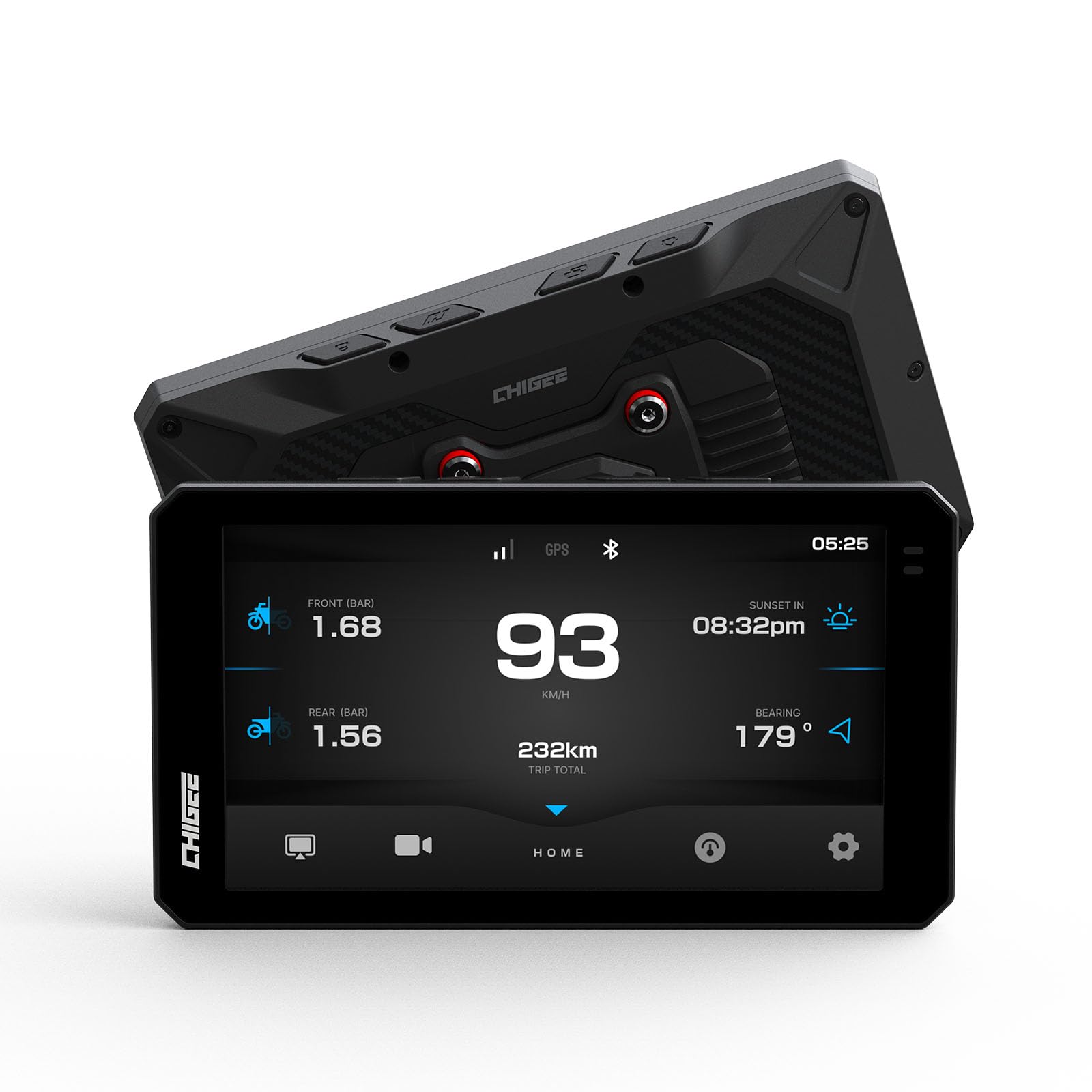
The smartphone-centric off-road companion that brings CarPlay and Android Auto to your handlebars with built-in 4G LTE for remote tracking.
This unit is in a different lane from the Garmin models above — it is less about preloaded trail maps and more about mirroring your phone’s apps on a 6-inch display with a 2000-nit brightness rating (almost certainly brighter than any phone screen in direct sun). It integrates built-in 4G LTE for real-time GPS tracking and remote monitoring, meaning you can wake the device from miles away to see live camera footage and your bike’s status (cameras sold separately).
The CHIGEE AIO-6 LTE also includes an Emergency SOS system developed with Bosch that detects crashes with millisecond accuracy and automatically sends GPS alerts to your emergency contact via 4G. Reviewers point out it is the best motorcycle CarPlay unit they have used, with a very responsive touchscreen and flawless Bluetooth, though one owner noted it is expensive but worth it. The unit has an IP69 waterproof rating — that is even higher than the Garmin zūmo XT2’s IPX7, meaning it can handle high-temperature, high-pressure water exposure.
The catch is that this unit relies heavily on cellular connectivity for its advanced features like geo-fence security and SOS. If you ride deep into canyons with no cell signal, those features go quiet. It also does not include a battery — it requires hardwiring to your bike or a separate power source, which limits quick swaps between bikes unless you buy the CG quick-mount system separately. The rating of 4.4 out of 5 from 29 reviews is excellent, but the small sample size means it is less battle-tested than the Garmin units.
Where this unit shines
- 2000-nit screen brightness beats the Garmin zūmo XT2 for raw sunlight visibility
- Apple CarPlay and Android Auto let you use your phone’s navigation apps directly
- Built-in 4G LTE enables remote tracking and crash-detection SOS via Bosch sensors
The important limits
- No internal battery — you must hardwire the unit to your bike’s power system
- Advanced 4G features need a cellular signal to function
Who this fits best: riders who want a modern smartphone-like interface on the bike with bright screen, CarPlay integration, and 4G-connected security features like geo-fence alerts and crash detection.
One real limit: if you ride in remote areas without cell coverage, the security and SOS features become unavailable, and you lose the main value of the 4G LTE connectivity.
3. Garmin Tread 2

The rugged specialist built for extreme cold, deep mud, and snowmobile trails where other GPS units quit.
The Garmin Tread 2 is the most purpose-built off-road navigator here — it is designed to withstand extreme temperatures and weather with an IP67 water rating (it can survive in up to one meter of water for 30 minutes, similar to the zūmo XT2’s IPX7 but with added dust-sealing). It also has a 7-hour internal battery, which is one hour longer than the zūmo XT2’s 6-hour battery, giving you extra cushion for a full day of riding without hardwiring.
This unit comes preloaded with snowmobile trail content for select areas in the US and Canadian provinces, including fuel stops, warming shelters, and restaurants accessible by snowmobile. For off-road riders, it includes U.S. Forest Service Motor Vehicle Use Maps (MVUM) and Adventure Roads and Trails map content — the same map type that one buyer specifically purchased the Tread 2 for. Shoppers say it is the best GPS they have ever owned, praising the bright sunlight-readable screen and the ability to download satellite imagery via Wi-Fi before a trip.
It also requires a subscription for the Outdoor Maps+ premium maps like slope angle and avalanche risk reports, which matters if you ride in avalanche country. The rating of 4.4 out of 5 from 51 reviews confirms solid reliability, though the high price places it firmly in the premium tier.
The standout strengths
- 7-hour battery life beats the Garmin zūmo XT2 by one hour for longer days on the trail
- Includes snowmobile trail data for U.S. and Canada — unique in this lineup
- Built-in sensors: altimeter, barometer, compass, and pitch/roll gauges for tough terrain
What holds it back
- More expensive than the zūmo XT2 with a similar feature set
- Premium map layers (avalanche risk, slope angle) need a paid subscription
Pick this for: serious off-road and snowmobile riders who want the longest battery life, preloaded MVUM and snowmobile maps, and extreme-weather durability in a single device.
skip it if: you mostly ride on pavement with occasional dirt roads — the zūmo XT2 covers that scenario for less money and with a slightly lighter package.
4. TomTom Rider 550

An aging but affordable entry-level GPS that gets the basics done for budget-focused riders who do not need trail-specific maps.
The TomTom Rider 550 is the most affordable unit in this roundup, but it is also the oldest design and the least suited for true off-road navigation. It comes with a standard LCD touchscreen and text-to-speech message reading, and it accepts microSD cards for map storage. The Wi-Fi connectivity protocol lets you update maps without plugging into a computer.
The harsh reality from buyers is that this device feels like using old-school GPS from 10-15 years ago, with one reviewer calling it highly outdated in 2025. Buyers report the rotating mount breaks easily — three separate mounts broke for one buyer, with springs falling out. Another key issue for off-road buyers: TomTom disabled GPX file downloads for non-UK users, making it nearly useless for trail riding. One owner said specifically, “Do. Not. Buy.” for off-road use. The battery also stops charging after roughly two years for some users, and the screen is hard to see in direct sunlight.
The rating of 4.2 out of 5 from 347 reviews is carried largely by on-road motorcycle riders who found it acceptable for street navigation. For off-road purposes, the lack of preloaded trail maps and GPX support is a dealbreaker compared to the Garmin zūmo XT2 or the CHIGEE AIO-6 LTE. If your budget is extremely tight and you only need basic on-road directions with occasional light gravel, it works — but it is not a true off-road GPS.
What still works
- Text-to-speech reads incoming messages aloud through a helmet headset
- MicroSD slot gives you the option to expand onboard map storage
The real problems
- GPX file support is blocked for non-UK buyers — essential for off-road track following
- Mount is fragile — owners mention springs falling out and the rotating mechanism breaking
- Battery no longer holds a charge after roughly two years for some owners
Only consider this if: you are on a very tight budget, ride exclusively on paved roads, and do not need trail GPS features — it can still handle basic street navigation.
Strongly avoid for off-road: the GPX file restriction and fragile mount system make this a poor choice for any dirt, trail, or adventure riding.
Understanding the Specs
IP Waterproof Rating (IPX7 / IP67 / IP69)
This rating tells you how much rain, mud, and water spray the GPS can survive without dying. IPX7 means the unit can be submerged in one meter of water for up to 30 minutes — good for a sudden downpour or a shallow creek crossing. IP67 adds dust-tight sealing on top of the same water protection. IP69 is even higher, designed to withstand high-temperature, high-pressure water jets, common in industrial or extreme-weather use. The off-road models here all meet IPX7 or higher, so none will quit on you in a rainstorm.
Sunlight-Readable Display & Nits
A “sunlight-readable” screen means the LCD uses a high-brightness backlight (measured in nits) so you can see the map in direct daylight without shading the unit. Standard phones put out 400 to 600 nits and wash out in the sun. Off-road GPS units aim for 1000 nits or higher — the CHIGEE AIO-6 LTE claims 2000 nits. A higher nit count means less squinting and safer riding because you can glance at the screen and read the trail junction without stopping.
FAQ
Can I use a regular car GPS for off-road motorcycle riding?
What is the difference between IPX7 and IP67 on a motorcycle GPS?
How long does the battery last on these GPS units for a full off-road ride?
Do these GPS units work without a cell phone signal?
Can I load my own GPX tracks for trail riding?
Is a glove-friendly touchscreen really necessary for off-road riding?
Will the GPS mount work on any motorcycle handlebar?
Can I use Apple CarPlay or Android Auto on an off-road GPS?
What is the “group ride” feature on the Garmin units?
How does the Emergency SOS work on the CHIGEE AIO-6 LTE?
Final Thoughts: The Verdict
For most riders, the best off-road motorcycle GPS is the Garmin zūmo XT2 because it balances a bright 6-inch sunlight-readable display, reliable Bluetooth and Wi-Fi, and Garmin’s extensive off-road map data with a battery life of 6 hours at a reasonable price point. If you want a modern smartphone-like interface with CarPlay and remote 4G tracking, grab the CHIGEE AIO-6 LTE. And for extreme off-road and snowmobile riding where you need a 7-hour battery life and preloaded snowmobile trails, pick the Garmin Tread 2.
How We Picked
We do not accept paid placement. Every pick is matched to a real buyer and a real use-case; we do not hands-on test units.
Sources & Methodology
Specifications: manufacturer listings and product documentation. Review insights: verified customer reviews, as of July 2026. Pricing: not shown on this page (it changes often); check the current price via the retailer link.
As an Amazon Associate, Trending Car earns from qualifying purchases. This does not affect which products we feature.