
Our readers keep the lights on and my garage snacks stocked. As an Amazon Associate, I earn from qualifying purchases.
Specs are compiled from manufacturer listings and verified buyer reviews and can change over time — please confirm the key details on the product page before buying.
A freezing garage makes every project a chore. You need a heater that kicks out real British Thermal Units (BTUs, the measure of heat energy) without blowing your budget or requiring a dedicated power plant. The right 240v electric garage heater turns a cold workshop into a comfortable workspace where you can actually get things done.
I’m Min Islam — the founder and writer behind Trending Car. This guide is built by comparing the manufacturers’ published specifications and the patterns across verified customer reviews, so you get each pick’s real strengths and trade-offs instead of marketing spin.
Our Picks at a Glance

How To Choose The Best 240V Electric Garage Heater
Choosing a 240V garage heater means matching its heat output to your garage size and ensuring your electrical panel can handle the amperage draw.
Match Wattage and BTUs to Your Garage Size
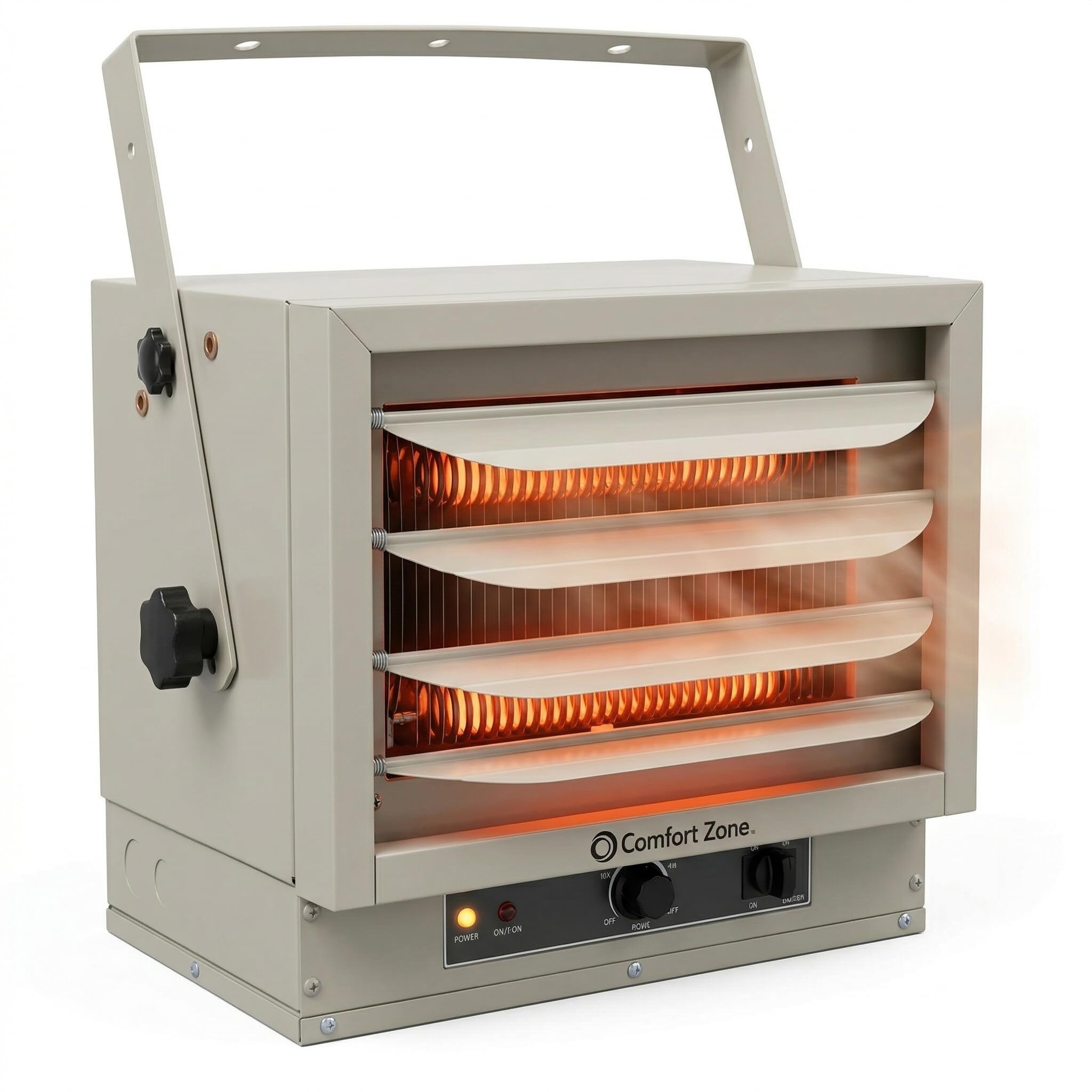
Wattage tells you how much power the heater consumes, while British Thermal Units (BTUs) tell you how much heat it actually pushes out. A common rule of thumb is 10 watts per square foot for an insulated garage. For a 500-square-foot space, aim for 5,000 watts (roughly 17,000 BTUs). If your garage is drafty or uninsulated, you will need more power. A unit like the Comfort Zone 5000W (with 17,065 BTUs) is built for up to 1,000 square feet, so it can handle a standard two-car garage with room to spare.
Check Your Electrical Panel Before You Buy
Every 240V heater lists its amperage draw — this tells you the size of the breaker and the thickness of the copper wire you need. A 20.83-amp unit requires a 30-amp double-pole breaker and 10-gauge wire. A 31.25-amp unit, like the DR. INFRARED HEATER DR-975, demands a 40-amp breaker and 8-gauge wire. Never guess: matching the heater to your existing wiring is the single most important safety step. If you are not sure, hire an electrician to confirm the circuit can support the load.
Choose the Right Heat Distribution Method
Forced-air heaters use a fan to blow air over a heating element, warming the room quickly and evenly. This makes them ideal for garages and workshops needing fast, whole-room heat. Infrared heaters warm objects and people directly rather than the air, which is quieter but less effective for heating a large open space from a distance. The Stiebel Eltron CK Trend uses a ceramic positive temperature coefficient (PTC) heating element in a fan-forced design, which self-regulates power to prevent overheating — a smart middle ground.
Quick Comparison
| Model | Best For | Wattage | BTU Output | Amperage | Amazon |
|---|---|---|---|---|---|
| Comfort Zone 5000W★ Best Overall | Best overall value | 5000 W | 17065 BTU | 20.83 Amps | Amazon |
| DR. INFRARED HEATER DR-975Top Performer | Large, open shops | 7500 W | — | 31.25 Amps | Amazon |
| Cadet Com-Pak Twin CSTC402TW | In-wall installation | 4000 W | 13648 BTU | 16.67 Amps | Amazon |
| KING PAW2422-W | Quiet, zone heating | 2250 W | — | 9.38 Amps | Amazon |
| Stiebel Eltron CK Trend | Small rooms & basements | 2000 W | 6824 BTU | 8.7 Amps | Amazon |
| DR. INFRARED HEATER DR218-3000W | Greenhouses & small workshops | 3000 W | — | 12.5 Amps | Amazon |
In‑Depth Reviews
1. Comfort Zone 5000W Ceiling Mounted Garage Heater
Our pick — over 4★ from 3,500+ verified ratings; the strongest balance of quality and price.
The overhead workhorse that clears your floor space while pushing out serious heat.
This unit delivers 5,000 watts and 17,065 BTUs through a fan-forced design, covering up to 1,000 square feet. It mounts to the ceiling, which frees up your garage floor entirely. The dual-knob thermostat gives you three heat settings — 3,000 / 4,000 / 5,000 watts — so you can dial in exactly the power you need for the day. It is hardwired and requires a 30-amp breaker with 10-gauge wire. Owners mention that one owner heated a 2,000-square-foot metal building to 20-30°F above the outside temperature using this model.
Compared to the Stiebel Eltron CK Trend, the Comfort Zone delivers 2.5 times the wattage and over twice the BTUs (17,065 vs 6,824), making it the clear choice for larger garages. Buyers mention a common quirk: the fan blade nut is often loose on arrival and needs to be tightened with blue Loctite (a thread-locking adhesive) because it is reverse-threaded. One reviewer also noted that the thermostat is “less accurate than a furnace but sufficient” for keeping a 12-by-25-foot garage above freezing in an Omaha winter.
Standout Strengths
- Ceiling-mount design saves valuable floor space in a crowded garage.
- Three selectable wattage settings let you match power to conditions.
- Heavy-gauge steel body holds up to the temperature swings of poorly insulated spaces.
Know Before You Buy
- Fan assembly can arrive loose — plan to tighten and balance it yourself.
- No fan-only mode for summer airflow.
- Thermostat is a basic dual-knob design, not a precise digital control.
Best for: the budget-conscious buyer who needs ceiling-mounted heat for a large garage and is comfortable with a quick DIY check on the fan assembly.
skip it if: you want a plug-and-play unit or need whisper-quiet operation — the forced-air fan is audible at 52 dB at one foot.
2. DR. INFRARED HEATER DR-975 7500-Watt
The heavy hitter that turns a freezing metal shop into a comfortable workspace in under an hour.
This unit puts out 7,500 watts of forced-air heat, enough to cover an 800-square-foot garage. It runs on a dedicated 40-amp breaker with 8-gauge copper wire — you will need an electrician for the hookup. The remote-controlled thermostat lets you dial in a temperature from 50 to 85 degrees Fahrenheit, and five adjustable louvers let you aim the hot air exactly where you need it most.
Buyers report that in a well-insulated 20-by-40-foot metal shop, the heater raised the temperature from 19°F outside to the 60s inside within about an hour. A common note is that the built-in thermostat can trip off too early; many owners pair it with an external Dr. Infrared thermostat for more accurate control. The fan is loud, but that is the trade-off for moving this much air through a large space.
Where It Excels
- Highest wattage in the lineup at 7500 W for the biggest garages.
- Remote control included so you can change settings without walking across a cold shop.
- UL/CUL listed for safety in the US and Canada.
The Trade-Offs
- Internal thermostat is not perfectly accurate; many owners add an external unit.
- Requires a heavy 40-amp circuit and 8 AWG wire — not a simple plug-in install.
- Fan noise is noticeable, especially at full power.
Reach for this if: you have a large, well-insulated shop over 600 square feet and are ready to dedicate a serious 40-amp circuit to permanent heat.
Watch out for: the need for an external thermostat to get consistent temperature control — the built-in one is a weak point.
3. Cadet Com-Pak Twin CSTC402TW
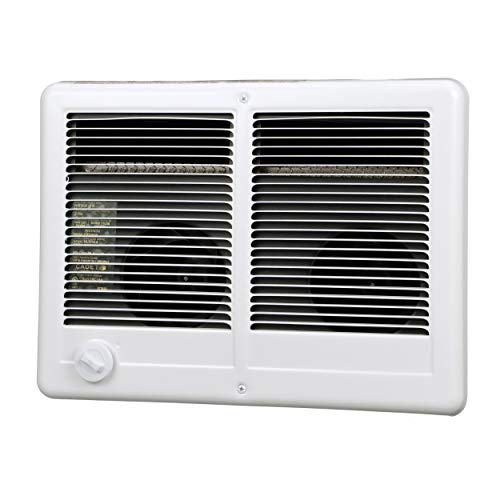
The flush wall heater that disappears into your studs while delivering 13,648 BTUs.
This Cadet unit slides between standard 16-inch wall studs and sits nearly flush, making it a clean, permanent heating solution. It pushes 4,000 watts (13,648 BTUs at 240 volts) via a double fan-forced design and covers up to 600 square feet. The built-in thermostat is a full-range knob, though several customers note it is not very precise and recommend pairing this with an external Honeywell thermostat for better accuracy. It runs on a 20-amp, 240-volt circuit with 12-gauge wire.
Reviewers report that one owner used it as the main heat source in a 564-square-foot insulated garage and said it maintained temperature quickly with a quiet fan. Another uses it in a 35-foot RV and says it heats the space quickly, though after a year the unit started cutting out after 5-7 minutes with a 5-minute reset cycle. The heater is made in the USA, and parts are easy to find — a plus for long-term ownership.
What Works Well
- In-wall design saves floor and wall space completely.
- Multi-watt option (4000/3000 W) for flexibility with 240/208 volt supplies.
- High-temperature safety shut-off for confidence.
Considerations
- Built-in thermostat is vague; a separate thermostat improves control.
- Only works in closed, well-insulated rooms — not ideal for drafty garages.
- After extended use, some units develop a cycling issue.
Ideal for: anyone who wants a completely flush, hardwired heater for a small to medium insulated garage and prefers an American-made product with available parts.
Not for: large, open, or uninsulated spaces where the heater would have to run constantly to keep up.
4. KING PAW2422-W Pic-A-Watt

The near-silent heater that sounds more like a forced-air vent than a noisy space heater.
This KING wall heater uses a squirrel-cage blower instead of a standard fan, which keeps the noise level exceptionally low. Buyers who replaced older Cadet units say the KING is “way less intrusive” and sounds like a regular HVAC vent with strong airflow. The patented Pic-A-Watt element lets you select multiple wattage options to fine-tune heating for a specific room, and the Smart Limit Protection prevents overheating. It covers up to 400 square feet and draws only 9.38 amps on a 240-volt circuit, making it one of the easiest to wire.
Installation is straightforward if you have access to the wall cavity, though reviewers point out the thermostat bracket diagram is confusing and the included grill screws are silver (not white) and strip easily. One reviewer who added it to a new construction basement says it is “great for taking the chill out of the room” and that the customer service is excellent if you ever need a replacement fan or heating unit.
Why It Stands Out
- Squirrel-cage blower is much quieter than traditional fan-forced heaters.
- Selectable wattage lets you match the heater to the exact room size.
- Low 9.38-amp draw on a 240V circuit, so you can use smaller gauge wire.
Small Annoyances
- Grill screws are a mismatched color and strip easily.
- Thermostat bracket install is poorly diagrammed in the manual.
- Only covers up to 400 square feet — not a whole-garage solution.
Perfect for: a finished workshop or home-office space above the garage where you need quiet, supplemental heat without the roar of a big fan.
But if: your garage is over 400 square feet or uninsulated, you will need a higher-wattage unit to keep up.
5. Stiebel Eltron CK Trend 2000W
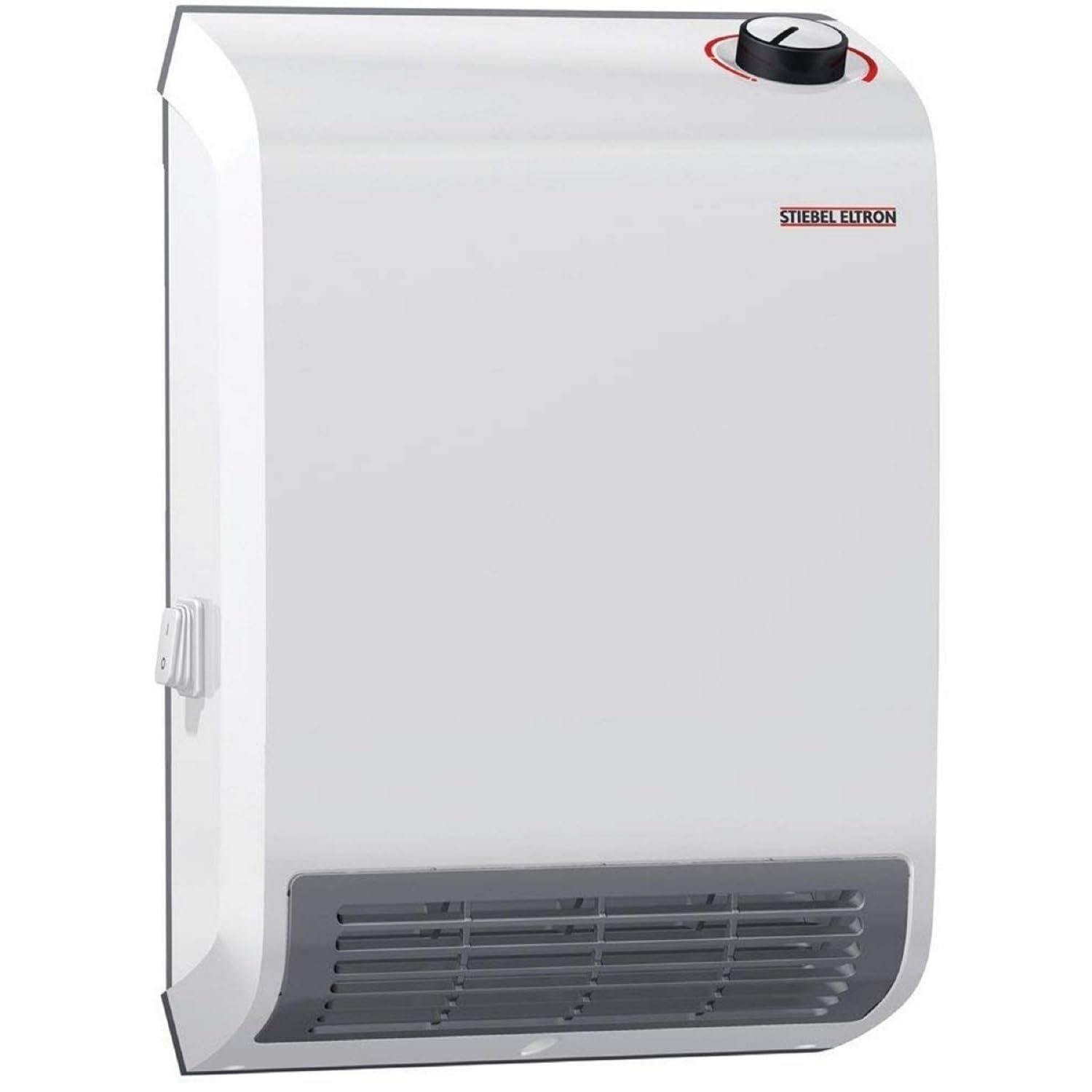
The German-engineered compact that quietly warms a basement without hogging your breaker panel.
This wall-mounted fan heater from Stiebel Eltron puts out 2,000 watts (6,824 BTUs at 240 volts) and draws only 8.7 amps, meaning you can run it on a standard 15-amp breaker with 14-gauge wire — the lightest electrical requirement in this lineup. It uses a ceramic positive temperature coefficient (PTC) heating element, which self-regulates power to avoid overheating. The glass-reinforced polycarbonate fan is rated at just 49 dB(A), so it is genuinely quiet in operation.
Shoppers say one owner heated a 25-by-40-foot finished basement from 58°F to 67°F in two hours, then maintained 65°F with a 15-minute on / 45-minute off cycle, estimating a monthly cost of around. Another reviewer used it in a high-ceiling bathroom and mounted it low to direct heat across the tile floor. The catch, noted by several US buyers, is that the unit has no exterior knockout for conduit — you must run the wire into the back of the unit, which complicates installation. A few owners reported failures they attributed to US power fluctuations blowing the internal fusible link.
What You Get
- Very low 8.7-amp draw means simple wiring on a 15-amp circuit.
- Ceramic PTC element is self-regulating and safe.
- Quiet operation at 49 dB(A) — fine for a living-adjacent space.
What to Know
- No conduit knockout; wire must enter through the back, making retrofits harder.
- 2,000 watts is not enough for a large, cold garage — at 2.5x less wattage than the Comfort Zone, it is better suited to basements and small rooms.
- Some units have failed due to US power fluctuations, according to a few reviewers.
Best suited for: a small workshop, finished basement, or 3-season porch where you want quiet heat without a major electrical upgrade.
Look elsewhere if: your space is over 400 square feet or you need to heat an uninsulated garage — the 2000W output will struggle.
6. DR. INFRARED HEATER DR218-3000W

The portable tower that keeps your plants alive through a New England winter while staying affordable.
This is a radiant infrared heater, meaning it warms objects and people directly rather than heating all the air in the room. It puts out 3,000 watts and covers up to 600 square feet, making it a solid choice for a small workshop or greenhouse. The IPX4 rating means it is protected against water splashing, so you can use it in a damp greenhouse without worry. It plugs into a 240-volt, 20-amp outlet — no hardwiring required, though you need that specific outlet.
Buyers report mixed long-term results. One reviewer in New England says their 50-by-13-foot garage stayed in the low-to-mid 60s on high fan with the thermostat set to 15-25%, and the electric bill stayed low. Another greenhouse owner with a 6-by-8-foot space says it maintained 42-48°F inside when it was 22°F outside. However, a different owner reported the unit caught fire twice — once after three months and again after a year — from wiring at the thermostat burning up. The company replaced the first unit, but the reliability concern is real.
The Upside
- IPX4 splash-proof rating makes it safe for greenhouses and damp spaces.
- Lightweight and portable — just plug into a 20-amp 240V outlet.
- Radiant heat is quiet and does not stir up dust like forced air.
The Downside
- Multiple reports of the unit burning up at the thermostat wiring connection.
- Radiant heat only reaches about 8 feet, so it is not great for tall ceilings.
- Some units do not shut off when the set temperature is reached.
Good for: a small, damp greenhouse or a compact workshop where you want quiet, maintenance-free radiant heat and can monitor it closely.
Not for: anyone who wants to low-maintenance — the fire risk reported by multiple owners means this unit needs active monitoring.
Understanding the Specs
Watts and BTUs — the Real Heat Numbers
Wattage is the electrical power the heater consumes, but British Thermal Units (BTUs) tell you how much heat it actually produces. One watt equals roughly 3.41 BTUs. A 5,000-watt heater (like the Comfort Zone) produces around 17,000 BTUs. For a typical two-car garage of about 500-600 square feet, you want at least 5,000 watts or 17,000 BTUs if it is insulated. Uninsulated garages may need up to double that power.
Amperage, Breakers, and Wire Gauge
Amperage (amps) is the current the heater draws. You must match this to your circuit breaker and wire thickness. A 20-amp heater needs a 30-amp double-pole breaker and 10-gauge copper wire. A 31-amp heater (like the DR-975) needs a 40-amp breaker and 8-gauge wire. If you use wire that is too thin for the amperage, it can overheat and cause a fire. Always consult a licensed electrician if you are not sure about your existing wiring.
FAQ
Can I run a 240V garage heater on a 120V outlet?
How many square feet can a 5000-watt garage heater heat?
Do I need a licensed electrician to install a hardwired garage heater?
What is the difference between forced-air and infrared radiant heat?
Can I use a space heater with a thermostat to maintain a constant garage temperature?
Does a 240V electric garage heater use a lot of electricity?
Can I mount a ceiling heater horizontally or vertically?
What does ETL listed mean for a garage heater?
Why does my garage heater keep tripping the breaker?
Can I use a 240V garage heater in a bathroom or basement?
Final Thoughts: The Verdict
If you want one dependable pick, the 240v electric garage heater winner is the Comfort Zone 5000W Ceiling Mounted Garage Heater because it delivers 17,065 BTUs for up to 1,000 square feet at a price that undercuts most rivals. If you want the raw power to heat a large, uninsulated shop fast, grab the DR. INFRARED HEATER DR-975 7500-Watt. And for a flush, quiet install in a small, finished basement or workshop, the KING PAW2422-W Pic-A-Watt is the quietest option at 49 dB(A) and the lightest on your electrical panel at 8.7 amps.
How We Picked
We do not accept paid placement. Every pick is matched to a real buyer and a real use-case; we do not hands-on test units.
Sources & Methodology
Specifications: manufacturer listings and product documentation. Review insights: verified customer reviews, as of July 2026. Pricing: not shown on this page (it changes often); check the current price via the retailer link.
As an Amazon Associate, Trending Car earns from qualifying purchases. This does not affect which products we feature.