
Our readers keep the lights on and my garage snacks stocked. As an Amazon Associate, I earn from qualifying purchases.
Specs are compiled from manufacturer listings and verified buyer reviews and can change over time — please confirm the key details on the product page before buying.
You pull your RV out of storage, the tires look fine, but after 50 miles the low-pressure light flashes. A gas station air pump might be miles away or broken, and the small 12V pump you have can’t keep up with the massive volume those heavy tires need. This guide covers portable air compressors that handle the pressure and volume of RV tires without leaving you stranded.
I’m Min Islam — the founder and writer behind Trending Car. This guide is built by comparing the manufacturers’ published specifications and the patterns across verified customer reviews, so you get each pick’s real strengths and trade-offs instead of marketing spin.
Whether you are heading cross-country or topping off before a weekend trip, the right compressor saves time and hassle. Find the best portable air compressor for rv tires that keeps you rolling without the delays.
Our Picks at a Glance


How To Choose The Best Portable Air Compressor for RV Tires
RV tires are not like car tires. They carry a lot more weight, run at higher pressures, and need a lot more air volume to go from flat to full. Buying the wrong pump means slow fills or failing to reach the required PSI.
Maximum PSI: The Real Number You Need
Most passenger car tires run between 30 and 35 PSI. An RV tire, especially on a large motorhome or fifth-wheel, can need 80 to 120 PSI, sometimes more. If your compressor tops out at, say, 100 PSI and your tires need 110, you are stuck. Always check the maximum pressure written on the sidewall of your RV tire and buy a compressor that exceeds that number — not just matches it. The units on this list reach between 120 and 160 PSI, so they cover the full RV range.
Air Flow: How Fast It Fills
PSI is about pressure, but CFM (cubic feet per minute) or L/min (liters per minute) is about speed. An RV tire holds a huge volume of air — much more than a car tire. A pump with low flow can take five minutes or more per tire. Look for a compressor that lists a decent flow rate (for this category, something around 1.47 CFM or 70 L/min) so you are not waiting around between tires.
Power Source: Cordless Freedom vs. Steady Corded Power
You have a real choice here. A cordless air compressor with a big battery (like 6,000 to 12,000 mAh) lets you inflate without finding your vehicle’s outlet — great for working around a large RV or at the back of the rig. The trade-off is limited runtime (20–30 minutes) and the need to recharge. A 12V corded unit plugs into your car or RV’s cigarette lighter and gives you unlimited run time, but the cord might not reach all four tires. Some high-end picks give you both options — battery and 12V — so you can choose by the situation.
Cooling and Duty Cycle: It Matters for Big Tires
Running an air compressor for several minutes non-stop on a big tire generates heat. A “duty cycle” tells you how long the pump can run before it needs a rest to cool down. A compressor rated for a 25-minute duty cycle at 30 PSI (like the VIAIR) can handle an RV tire without overheating. Cheaper units without a clear duty cycle spec may overheat and shut off halfway through your second tire. When you are on a trip with a low tire, a pump that quits is the last thing you need.
Quick Comparison
| Model | Best For | Max PSI | Power Source | Weight | Amazon |
|---|---|---|---|---|---|
| FORTEM FRTM-ACDC★ Best Overall | Budget-friendly all-rounder | 150 PSI | 110V AC / 12V DC | 2.8 lbs | Amazon |
| RoofPaxTop Performer | Triple-power flexibility | 160 PSI | 110V AC / 12V DC / 20V battery | 6.6 lbs (3 kg) | Amazon |
| GSPSCN 201X | Heavy-duty speed | 150 PSI | 12V DC (battery clamps) | 6.2 lbs | Amazon |
| VIAIR EVC88P | Off-road reliability | 120 PSI | 12V DC (battery clamps) | 4.75 lbs | Amazon |
| OlarHike TIX7V101 | Long cordless runtime | 150 PSI | 12V DC & 12,000 mAh battery | 3.2 lbs | Amazon |
| TORHAWK TH160 | Cordless & power bank combo | 160 PSI | 12V DC & 7,500 mAh battery | — | Amazon |
| Calmara Y34 | Compact glove-box fit | 150 PSI | 12V DC & 6,000 mAh battery | — | Amazon |
In‑Depth Reviews
1. FORTEM Tire Inflator Portable Air Compressor
Our pick — 4.5★ from 38,000+ verified ratings; the strongest balance of quality and price.
A tiny pump that works at home and on the road, backed by customer service that has impressed thousands.
The FORTEM is the definition of a gateway RV air compressor. It hits 150 PSI max pressure — enough for most RV tires — but it does it at a size (7.25 x 6 x 2.75 inches) and weight (2.8 pounds) that fits in a small cubby. The unique trick is the included 110V AC adapter: you can plug it into a wall outlet at home or the campsite to top off tires without running your vehicle. It also comes with a 14-foot DC power cord that stores inside the unit itself.
With over 38,000 ratings and a 4.5-star average, it is the most-reviewed pump on this list. Owners mention good results on sedans and crossovers, and the customer service story stands out. One reviewer wrote that even after 3 years (they started using it in 2023), when the calibration slipped, FORTEM sent a brand new unit with no hassle — just an Amazon message exchange. That level of warranty support (1 year officially, but the experience suggests they stand behind it) matters for a budget buy.
The trade-offs for RV use are real. The FORTEM is not fast for large tires — it has a single cylinder and no battery, so it runs only when plugged in. Several reviews mention the valve attachment is stiff, making it tricky to lock onto the tire stem, and the short 1.5-foot hose is limiting for big rigs. One shopper added the auto shut-off seemed preset to 32 PSI with no visible way to adjust it, though other reviews say you can set it. It will work on an RV tire, but you will wait and have to work around the hose length.
Why it is a deal
- Includes 110V AC adapter for home/campsite use
- Very compact and lightweight at 2.8 lbs
- Excellent customer support — they replaced a unit after 3 years
- Over 38,000 reviews prove long-term reliability
Where it shows its budget roots
- Short 1.5-ft hose makes RV tire setup awkward
- Stiff valve attachment loses some air on disconnect
- Single cylinder is slower than dual-pump units
A good starter for: smaller RVs or as a backup pump that stows in a tiny space and works at home without needing your car.
Reconsider if: you have a large Class A or heavy fifth-wheel with big tires — the short hose and slower fill make it a pain to use for big jobs.
2. RoofPax Tire Inflator Portable Air Compressor
Three power sources mean you never run out of options, even far from an outlet.
The RoofPax tackles the big question for RV owners: where do you plug in? It gives you three ways to power up — a standard 110V AC wall outlet at home or a campsite, your vehicle’s 12V DC port, or a 20V lithium-ion battery that goes wherever you walk. That battery is included, so you are not stuck hunting for an outlet when a tire goes low in a storage yard.
You get enough power for large RV tires thanks to its 160 PSI max pressure (the force pushing air into the tire), so even a heavy rig inflates without stalling. The dual motors also let you inflate or deflate — air down for soft sand or pack a vacuum bag tighter, all with the same tool. Buyers report the battery held a charge for nine months and still inflated three tires from 10 PSI under (pounds per square inch below target) on a single charge, giving you real confidence for seasonal RV use.
One honest catch: a few buyers found the included storage bag has a cheap zipper that broke early. The compressor itself is well-built, but the bag feels like an afterthought compared to the rest of the kit. The 5-year warranty, though, helps outweigh the bag concern.
Why it stands out
- Triple power (110V AC, 12V DC, 20V battery) covers every scenario
- 160 PSI max handles RV tires with ease
- Dual motors work for inflation and fast deflation
- 5-year warranty is the longest in this lineup
What to watch for
- Carrying bag zipper quality is poor
- Some units had early failures, though customer service quickly resolved them
- Heavier than some cordless-only competitors
Your best match if: you want a low-maintenance kit that works at the campsite (110V AC) and on the road (12V DC), and you value long-term warranty protection over a pretty carrying case.
Think twice if: light weight and smallest possible size are your top priorities — the RoofPax is built tough but not tiny.
3. GSPSCN Digital Portable Tire Inflator Heavy Duty

Dual metal cylinders and a massive air flow cut your inflation time down to seconds instead of minutes.
If you want speed for those big RV tires, the GSPSCN delivers where many portable units fall short. It pushes a flow of 70 L/min (about 2.12 CFM at 0 PSI) through dual metal cylinders — that is 6X faster than standard single-cylinder pumps. One reviewer noted inflating a tire in under 30 seconds. For an RV owner airing up four tires before departure, that time savings feels huge.
It runs on 12V power from your battery terminals, not your cigarette lighter. The kit includes battery clamps, a 3.5-meter (11.5-foot) power cord, and a separate 3.5-meter air hose, so you can reach every corner of a large RV or trailer without moving the rig. The alloy and ABS build gave one reviewer a “15/10 build quality” impression — heavy duty and quiet. The auto shut-off accurately stops at your set PSI, and the digital gauge matches expensive handheld gauges within 0.5 PSI according to multiple reviewers.
The trade-off is weight. At 6.2 pounds, this is one of the heavier picks on the list, and it requires a connection directly to your battery (no cigarette lighter adapter in the box). It is not a glove-box stasher, but for staying in your RV compartment or truck toolbox, it is a powerhouse.
Where it excels
- 70 L/min air flow fills RV tires in seconds
- Dual metal cylinders for durability and speed
- Long 11.5-ft power cord and air hose reach all tires
- Reviewers praise its build quality and accurate gauge
Where it falls short
- Heavier (6.2 lbs) than most other picks
- Must connect to battery clamps — no cigarette lighter option
- AC power adapter costs extra
Grab this if: speed is your #1 need and you prefer a metal-built, almost indestructible pump that stows in your RV compartment.
skip it if: you want a lightweight unit that plugs into a cigarette lighter — this one needs battery terminals and has some heft.
4. VIAIR Digital EVC88P

The 40-year reputation behind this pump means you get a proven workhorse that off-roaders trust.
VIAIR has been building portable compressors for decades, and the EVC88P is their digital upgrade to the classic 88P that off-roaders have relied on. It delivers a maximum working pressure of 120 PSI with a free flow capacity of 1.47 CFM — enough to fill a 225/60R18 tire from 20 to 30 PSI in 50 seconds or less. The real draw for RV and overland use is the duty cycle: 25 minutes at 30 PSI, meaning it can run continuously long enough to inflate multiple large tires without overheating.
Unlike most consumer pumps, the VIAIR connects via heavy-duty alligator clips directly to your vehicle battery, not the cigarette lighter (which can blow fuses on high-draw pumps). It comes with a 16-foot air hose and 10-foot power cord, so you have plenty of reach. The digital gauge lets you preset your target PSI, and the pump shuts off automatically when it hits it. Buyers frequently mention its solid build quality and note that Project Farm rated it highly for speed, sound, and low heat.
The catch here is the 120 PSI maximum. If your RV tires need more than 120 PSI (some large Class A motorhomes do), this pump will not work for you. It also requires direct battery connection — no cigarette lighter plug, so you need accessible battery terminals. One buyer mentioned blowing fuses with the unit, though that seems rare.
Strengths
- 30+ year brand heritage in portable compressors
- 25-minute duty cycle handles multiple large tires
- 16-ft air hose and 10-ft power cord for easy reach
- Project Farm rated it top for speed and low heat
Limitations
- Max 120 PSI may not be enough for the largest RV tires
- Only works with battery clamps — no 12V plug
- One user blew fuses, though most reports are positive
A smart pick for: overlanders and RV owners with tires needing up to 120 PSI who want a proven, rebuildable pump with good cooling for long inflation sessions.
Not ideal if: your tires need over 120 PSI or you want the simplicity of a cigarette lighter plug.
5. OlarHike Powerful 12000mAh Heavy Duty Tire Inflator
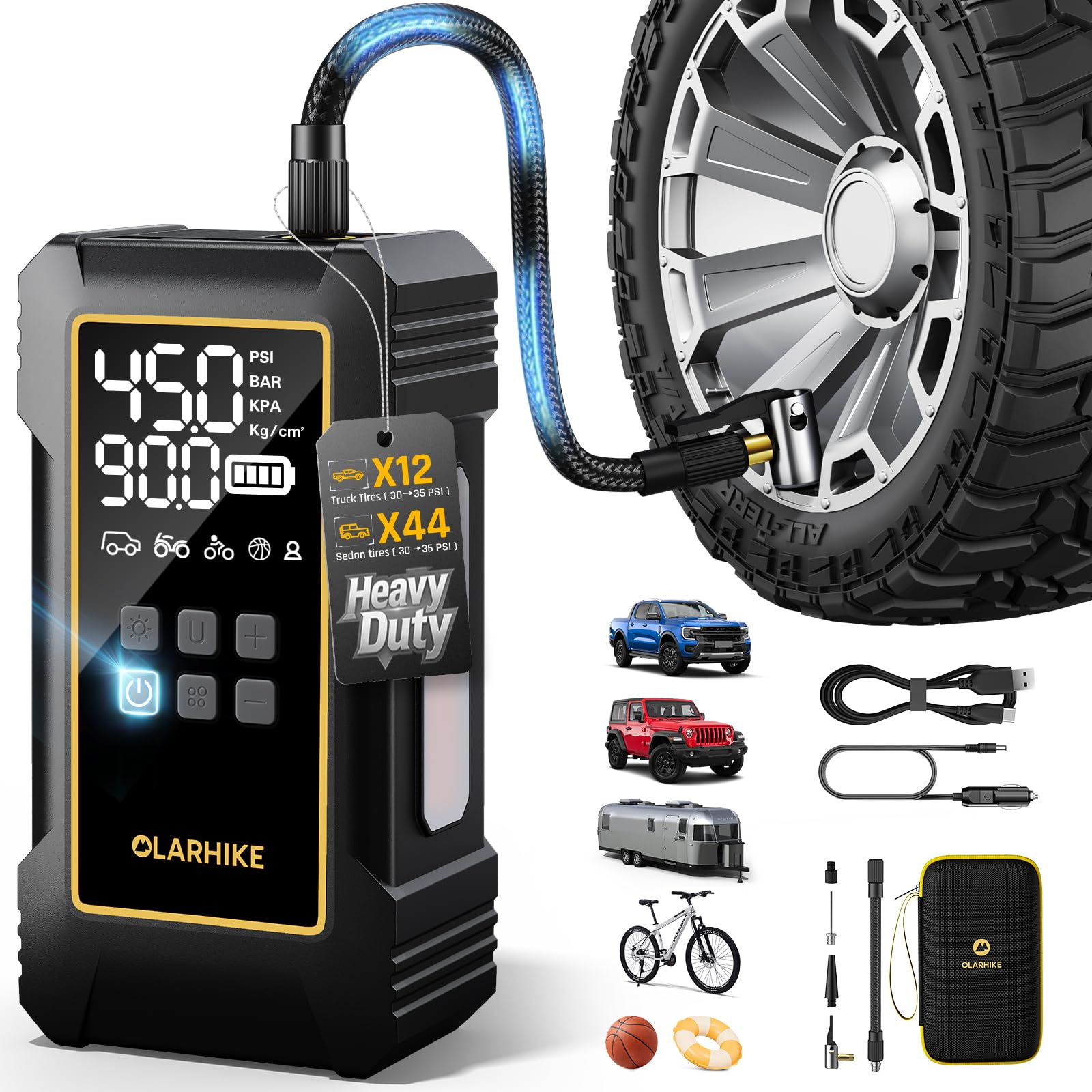
Massive 12,000 mAh battery capacity means you can top off four RV tires without hunting for a 12V outlet.
The OlarHike is built for people who hate being tethered to their vehicle. Its 12,000 mAh battery (the largest in this roundup) lets you inflate several tires cordlessly. One owner reported they topped off 5 PSI on two cars and the battery only dropped one bar — suggesting it has the reserve capacity for a full RV tire job. The unit also works in dual power mode, so you can plug into a 12V car adapter if the battery runs low.
At 150 PSI max pressure and a quoted flow of 50 L/min, it is not the fastest pump when connected cordless, but it gets the job done. The patented Twist-Lock hose connection is a nice touch — it clicks into place securely, so you don’t accidentally blow the hose off mid-inflation. The unit includes two braided nylon hoses (long and short), a full adapter set, and a rugged EVA case that buyers consistently say feels well-made. One customer observed it was “extremely fast with battery connection” when used on car tires.
The biggest downside reported across multiple reviews is the charge time. One user highlighted it took 4 hours to charge fully from empty. If you forget to charge before a trip, you will be waiting. Also, the pump vibrates heavily during use — some buyers recommend holding it firmly or wrapping it in a towel.
What we like
- 12,000 mAh battery is largest in class for cordless runtime
- Dual power (battery + 12V car adapter) offers flexibility
- Twist-Lock hose stays put during inflation
- Rugged EVA case keeps everything organized
What to note
- Long 4-hour charging time
- Vibrates heavily during use — needs a firm grip
- Unit had some quality control issues with early cigarette lighter connectors
Best for: RVers who prefer cordless freedom and need enough battery to tackle all four tires without plugging in.
Better to skip if: you have a quick trip and cannot wait hours for the battery to charge — corded-only units are more reliable that way.
6. TORHAWK TH160 Tire Inflator
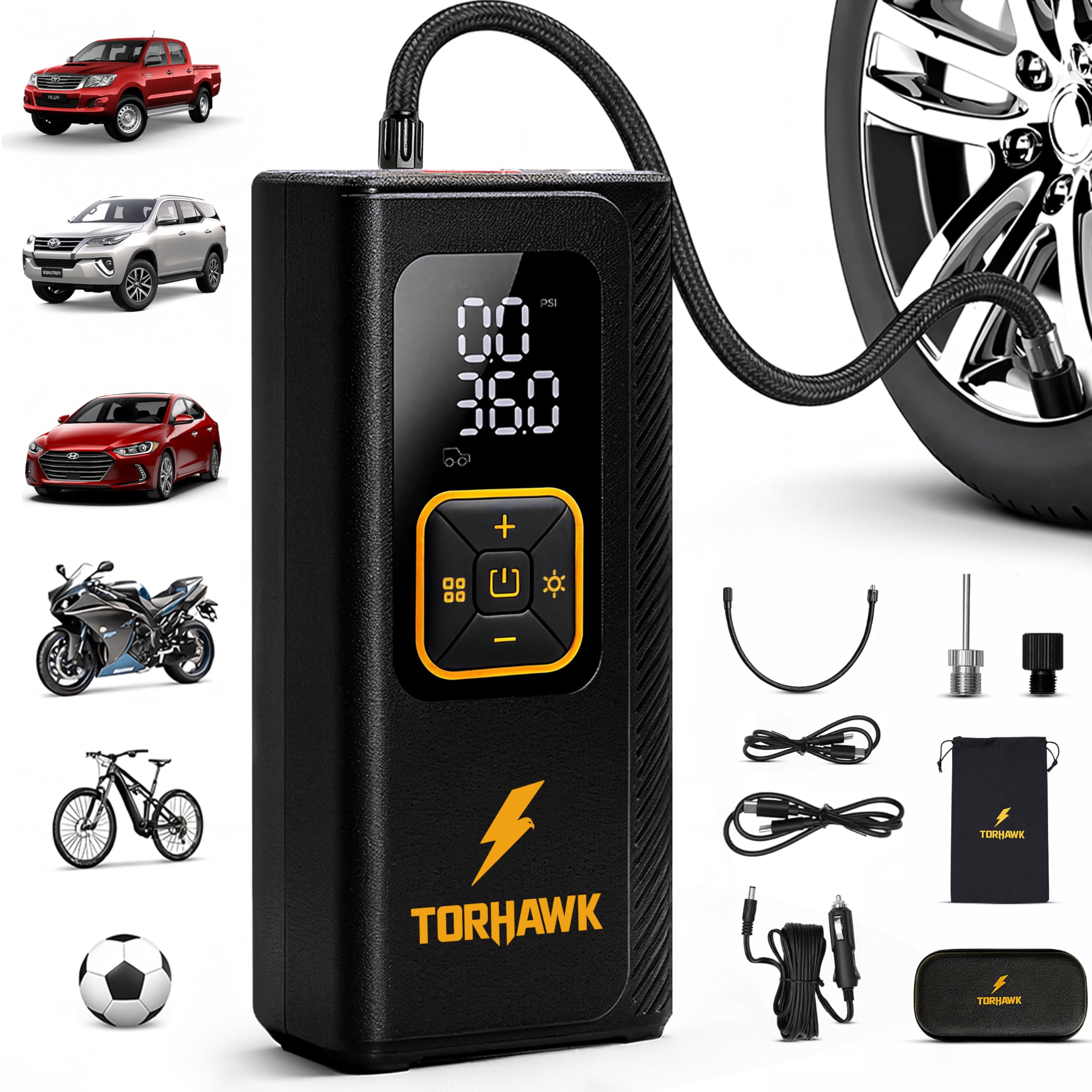
Dual-cylinder cordless power hits 160 PSI and doubles as a backup phone charger in a pinch.
The TORHAWK TH160 packs a dual-cylinder motor that claims 5X faster inflation than standard single-cylinder pumps, with a maximum pressure of 160 PSI — enough for almost any RV tire. It runs cordlessly on a 7,500 mAh battery for about 20 minutes, or you can plug into a 12V car outlet for continuous power when the battery runs low. That backup power option is a smart failsafe: if you drain the battery halfway through the third tire, you just switch to the 12V cord and finish the job.
One major feature that separates it from many competitors is the power bank function. It can charge your phone or devices via USB — a nice emergency tool if your phone dies while you are dealing with a flat in a remote area. The unit also includes 5 smart presets (Car, Motorcycle, Bike, Ball, Manual) so you don’t have to remember the correct PSI for each item. The digital gauge reads in PSI, KPA, BAR, and KG/CM², and the auto shut-off stops exactly at your target pressure.
However, not every experience is fast. One reviewer noted it started off slow, then got better after 3-4 minutes — not as quick as the marketing suggests in every case. A few buyers also said the twist-on valve stem was annoying to use, and some units shipped without instructions. The 85-decibel noise rating means it is not whisper-quiet, though that is typical for this class.
Standout features
- 160 PSI dual-cylinder for fast inflation
- Dual power (cordless + 12V backup)
- Power bank charges phones via USB
- 5 smart preset modes for different inflation needs
Known drawbacks
- Inflation speed inconsistent for some users
- Twist-on valve stem can be annoying to use
- No printed instructions included in some packs
Ideal for: those who want a fast cordless inflator with a phone-charging safety net and 160 PSI capability for large tires.
Less ideal if: you need dead-reliable speed every time — some units perform inconsistently on the first tire.
7. Calmara Y34 Tire Inflator
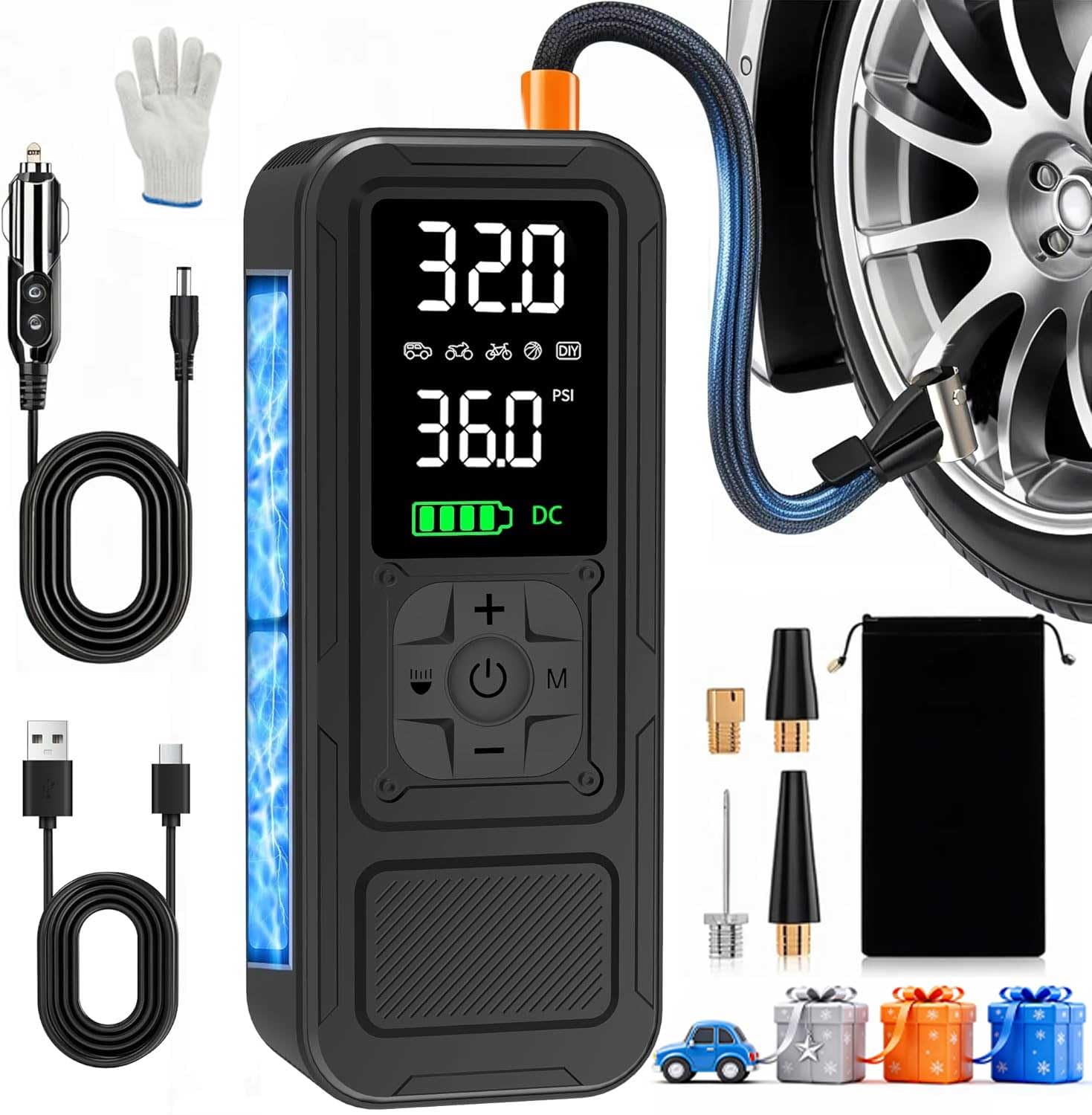
Slim enough for a glove box but strong enough to air up 33-inch truck tires to 44 PSI.
The Calmara Y34 is the most pocketable air compressor in this list at just 7.08 x 2.79 x 2.04 inches — about the size of a thick paperback. Despite that slim profile, it delivers 150 PSI max pressure with a 6,000 mAh battery that customers note provides about 20 minutes of cordless runtime. One verified review specifically mentions it “works on 33-inch truck tires at 44 PSI,” which is a strong signal for RV owners with smaller to mid-size rigs or who need a lightweight backup pump.
The Y34 claims 4X faster inflation compared to standard single-cylinder units, with accuracy within ±0.1 Bar (a metric unit of pressure, roughly 1.45 PSI). You get 4 preset modes (Car, Motorcycle, Bike, Ball) plus a custom 0-150 PSI mode. Buyers consistently say it is “easy to use” and call it a great glove-box addition for confidence.
There is a heat warning. Multiple reviews note the unit gets very hot during heavy use — one buyer mentioned the prominent heat warnings on the device. While the anti-scalding air tube helps, you should not leave it running unattended and keep it away from children. The battery also takes about 3 hours to recharge fully, so plan ahead.
Why it fits a glove box
- Ultra-compact dimensions (7″ long, 2.79″ wide)
- 150 PSI handles RV tires up to 44 PSI easily
- Dual power: 6,000 mAh battery + 12V for extended use
- Buyers confirm it airs up 33-inch truck tires
Drawbacks to know
- Gets very hot during extended inflation
- 3-hour battery recharge time
- Not as fast as larger dual-cylinder models
A perfect companion for: smaller RVs, tow vehicles, or anyone who wants a compact backup pump that tucks away unobtrusively but can still handle the job.
Look elsewhere if: you need to inflate multiple large RV tires in one session without waiting for the pump to cool down.
Understanding the Specs
Maximum PSI
PSI stands for pounds per square inch — it is the measure of air pressure a compressor can put out. For RV tires, this is the single most important number. Most passenger tires need 30-35 PSI, but many RV tires (especially on larger Class A motorhomes or fifth-wheels) require 80-120 PSI or more. Always check the sidewall of your specific tire. A compressor that maxes out below your tire’s requirement is useless even if it has every other feature. Look for a unit rated above your tire’s max pressure — 150 or 160 PSI models on this list cover the vast majority of RV needs.
Air Flow Rate (CFM / L/min)
CFM stands for cubic feet per minute, and L/min stands for liters per minute — both measure how much air the compressor can move. High pressure is only half the story; you also need volume. RV tires hold a lot of air (think: multiple cubic feet), so a pump with low CFM will take forever. Look for something around 1.47 CFM (the VIAIR spec) or 70 L/min (the GSPSCN spec). Higher numbers mean faster fill times, especially when going from a flat tire to road pressure.
Duty Cycle
The duty cycle tells you how long a compressor can run before it needs to cool down. It is usually stated in minutes at a given pressure (e.g., “25 minutes at 30 PSI”). Running a pump beyond its duty cycle can cause overheating and failure. For RV tires, you may need to run the pump for 3 to 5 minutes per tire non-stop. A compressor with a 25-minute duty cycle at 30 PSI can handle that easily. Some cheaper units have no published duty cycle and may stop working after a short run.
Power Source
You will see three power source types. 12V DC units plug into your vehicle’s cigarette lighter or battery terminals and run as long as the engine is on — unlimited runtime but tethered to the vehicle. Cordless battery units (like the OlarHike or Torhawk) use a rechargeable lithium-ion battery and let you move freely, but they have a limited runtime (typically 20 minutes). The most versatile option is a dual-power unit that works both ways: battery for cordless convenience and 12V for backup when the battery dies. A few premium picks also add a 110V AC wall plug for home use.
FAQ
What PSI does my RV tire actually need?
How long does it take to fill an RV tire with a portable compressor?
Can a 12V cigarette lighter pump handle RV tires?
Is a cordless air compressor powerful enough for RV tires?
What does auto shut-off mean on an air compressor?
How do I know if a compressor will overheat on my RV tires?
What is the difference between single-cylinder and dual-cylinder pumps?
Which portable compressor is best for airing down RV tires for off-road?
How often should I check the pressure in my RV tires?
Can I use a portable tire inflator for other things around my RV?
Final Thoughts: The Verdict
For most RV owners, the best portable air compressor for rv tires winner is the FORTEM because it covers the essentials—150 PSI, dual AC/DC power, and a proven track record over thousands of reviews—at a price that makes it an easy decision. If you want raw speed for big rigs, grab the GSPSCN with its metal dual-cylinder setup and 70 L/min flow (liters per minute, so it fills a tire faster than the FORTEM). And for maximum cordless freedom with enough battery for a full tire rotation, the OlarHike and its 12,000 mAh capacity (milliamp-hours, meaning it can inflate multiple tires without plugging in) is the one to pick.
How We Picked
We do not accept paid placement. Every pick is matched to a real buyer and a real use-case; we do not hands-on test units.
Sources & Methodology
Specifications: manufacturer listings and product documentation. Review insights: verified customer reviews, as of July 2026. Pricing: not shown on this page (it changes often); check the current price via the retailer link.
As an Amazon Associate, Trending Car earns from qualifying purchases. This does not affect which products we feature.