
Our readers keep the lights on and my garage snacks stocked. As an Amazon Associate, I earn from qualifying purchases.
Specs are compiled from manufacturer listings and verified buyer reviews and can change over time — please confirm the key details on the product page before buying.
Walking into a freezing garage on a winter morning is a hard way to start the day. You need heat that hits hard and fast without tripping breakers or running up electric bills, and a propane heater delivers exactly that — raw BTUs straight from a tank, no extension cords or outlets required. The trick is matching the right BTU output and heater style to your actual space, because a radiant unit that works for a 450-square-foot workshop will leave a two-car garage feeling like a refrigerator.
I’m Min Islam — the founder and writer behind Trending Car. This guide is built by comparing the manufacturers’ published specifications and the patterns across verified customer reviews, so you get each pick’s real strengths and trade-offs instead of marketing spin.
The six models below span forced-air blasters for big shops to quiet radiant cabinets that sip fuel, ranked by real-world performance and safety features you shouldn’t skip. This is the honest breakdown of the best propane garage heaters money can buy this season.
Our Picks at a Glance


How To Choose The Best Propane Garage Heater
Picking a propane heater is not complicated, but the wrong choice will leave you freezing or constantly refilling tanks. Focus on these three factors before you buy.
Match BTU Output to Your Square Footage
The British Thermal Unit (BTU — a measure of heat energy) is the single most important spec. A rough rule of thumb is 20 to 30 BTUs per square foot of garage space. A 450-square-foot workshop only needs about 18,000 BTUs, while a 1,500-square-foot shop demands a 60,000-BTU forced-air unit. Over-buy on BTUs and you will burn through propane faster; under-buy and your garage stays cold.
Forced Air vs Radiant — Which Style Fits?
Forced-air heaters use a fan to blow hot air across the room — they heat fast and are ideal for large, open, well-ventilated garages, but they are loud. Radiant heaters warm objects and people directly in front of them — they are whisper-quiet and do not need electricity, but the heat does not spread around corners or behind obstacles. Radiant units work best in smaller or partitioned spaces where you are staying put.
Safety Features Are Not Optional
Every heater on this list should include a tip-over shut-off (the heater turns off if it gets knocked over) and an oxygen depletion sensor, or ODS (which shuts down the gas if oxygen levels drop in a closed room). These are not nice-to-haves — they are critical in a garage where fumes can build up. Forced-air units often add a thermocouple and a high-temperature limit shut-off for extra protection.
Quick Comparison
| Model | Best For | Heat Output | Coverage | Heating Method | Amazon |
|---|---|---|---|---|---|
| Gasland MHA18BN★ Best Overall | Ultra-quiet radiant heat | 18,000 BTU | 450 sq ft | Radiant | Amazon |
| DEWALT 68,000 BTUAlso Great | Large shops + battery power | 68,000 BTU | 1,700 sq ft | Forced Air | Amazon |
| Remington 60,000 BTUTop Performer | Big garages on a budget | 60,000 BTU | 1,500 sq ft | Forced Air | Amazon |
| Flame King 60,000 BTU | Fast 15-minute heating | 60,000 BTU | 1,500 sq ft | Forced Air | Amazon |
| DEWALT 45,000 BTU Radiant | Job sites + no electricity | 45,000 BTU | 1,125 sq ft | Radiant | Amazon |
| Mr. Heater 18,000 BTU | Indoor-safe + vent-free | 18,000 BTU | 700 sq ft | Radiant | Amazon |
| Dura Heat LPC25 | Small 1-car garages | 15-25,000 BTU | 600 sq ft | Convection | Amazon |
| Avenger 18,000 BTU | Long runtime + casters | 18,000 BTU | 450 sq ft | Radiant | Amazon |
| CAMPLUX 18,000 BTU | Budget-friendly cabinet | 18,000 BTU | 450 sq ft | Radiant | Amazon |
In‑Depth Reviews
1. Gasland MHA18BN Propane Radiant Heater, 18,000 BTU
Our pick — over 4★ from 850+ verified ratings; the strongest balance of quality and price.
A whisper-quiet cabinet heater that runs on zero electricity and fits tight corners.
Gasland’s 18,000-BTU radiant heater covers up to 450 square feet, matching the Avenger and CAMPLUX, but in a cabinet design that hides the 20-pound propane tank inside for a cleaner look. It runs on three heating modes (high/medium/low) using a piezo ignition that needs no batteries or wall outlet — useful during power outages. The unit sits on built-in rolling wheels with an easy-carry handle for moving between rooms. Safety includes tip-over and low-oxygen (ODS) shut-off. Shoppers say it “heats open-concept kitchen/living room in manufactured home effectively” and that it is “efficient on propane (3 refills per winter),” which is notably thrifty for a northern climate.
The big difference from the Avenger below is that the Gasland runs quieter — one buyer calls the sound a “cozy, quiet hum.” On the downside, the front-facing radiant heat means the space behind the heater stays cold, and the exposed heating element is a burn risk for pets or kids who get too close. A faint propane smell can appear when the tank runs low.
Compact size
- Near-silent operation — barely audible over background noise
- Tank hides inside the cabinet for a tidy, furniture-like appearance
- Three propane refills per winter is impressive fuel economy per real owners
Limited output
- Front heat only — the backside of the room stays cold
- Propane smell may appear as the tank empties
Ideal for workshops: quiet, electric-free warming of a small workshop, office above the garage, or manufactured home where noise is unwelcome.
Not for outdoor use: spaces requiring heat distribution behind the heater — you need a forced-air unit for 360-degree coverage.
2. DEWALT 68000 BTU/H 1700 SQ FT Forced AIR Propane Heater
The big rig that runs on both AC power and a DEWALT battery for job-site flexibility.
The forced-air design blasts heat fast, and buyers report a 30-degree garage hits 70 degrees in about an hour. What makes this DEWALT special is its dual-power setup: you can plug it into a wall outlet or run it on a DEWALT 20-volt battery (an 8ah battery lasts most of the day, according to one owner). That means no extension cord needed in a detached shop without power.
Owners mention the heater runs quietly on low — low enough for a horse barn — but gets noisy when cranked to high. The included 10-foot hose and regulator make hookup straightforward, and the unit weighs 13.2 pounds, light for its output class. One caveat: this is an outdoor-use-only forced-air heater, so you need cross-ventilation in a garage; it is not rated for sealed indoor operation.
High BTU coverage
- Top-of-class 68,000 BTU heats a 1,700 sq ft shop faster than any other pick here
- Battery-power option frees you from needing an outlet — ideal for remote job sites
- Low-odor, low-fume operation compared to diesel alternatives
Noisy operation
- Noisy on the high setting — not a heater for quiet reading
- Requires outdoor ventilation — not for a sealed indoor workspace
Perfect for large spaces: Anyone running a large garage, horse barn, or construction trailer who wants battery-powered warmth without hunting for a wall outlet.
Skip if noise sensitive: your space is under 1,000 square feet — you will overpay for BTU capacity you do not need, and the noise on high may annoy you.
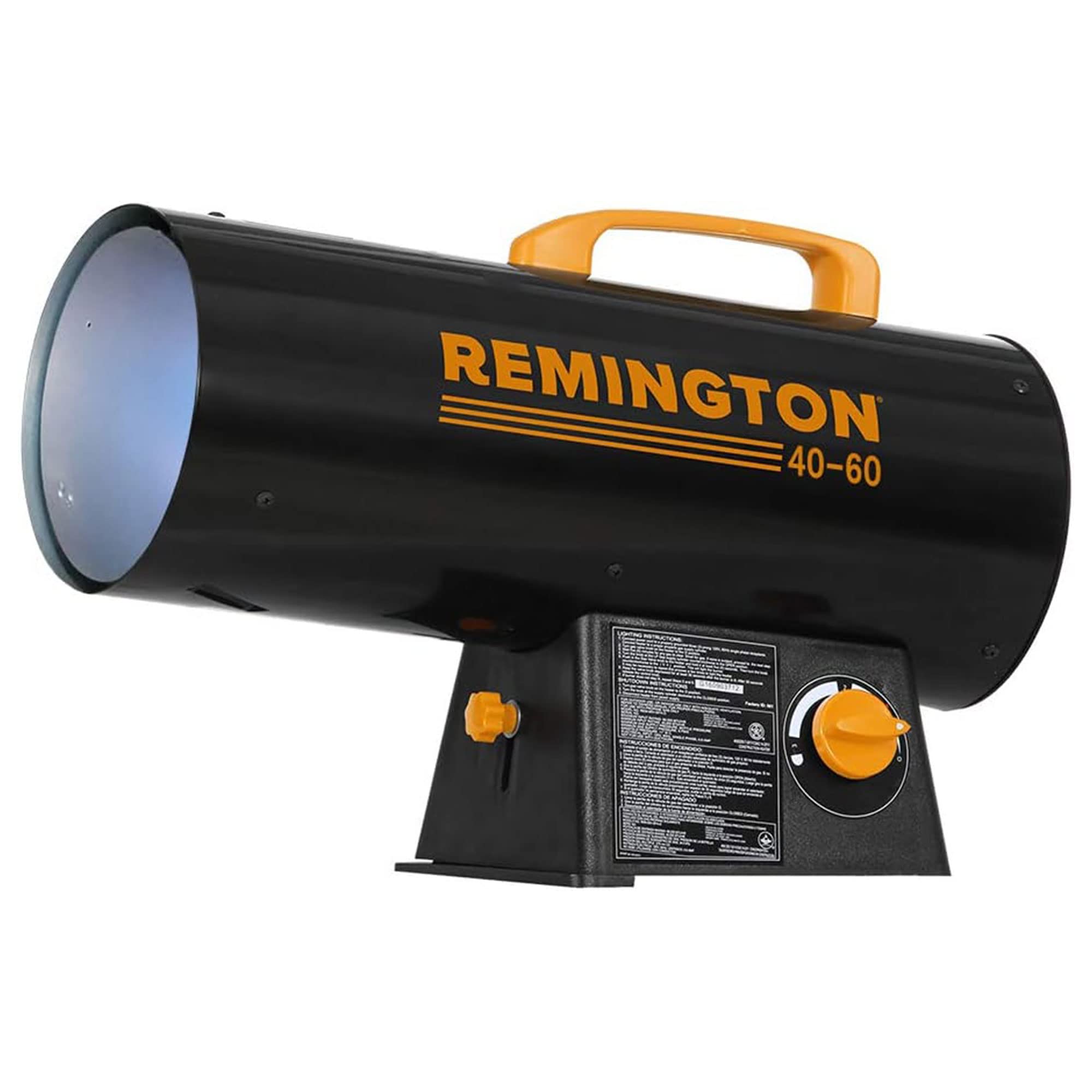
3. Remington LP Forced Air Heater, Portable 60,000 BTU
A 60,000-BTU forced-air cannon that weighs only 11 pounds for easy hauling.
Remington packs 60,000 BTUs of forced air into a unit that covers the same 1,500 square feet as the Flame King below but in a smaller package — 19 inches deep by just 7.5 inches wide. That slim profile slides into tight spaces between toolboxes. The heating coverage matches the Flame King at 1,500 square feet, making it a capable alternative if the Flame King is out of stock. Safety is thorough: a thermocouple (a sensor that detects if the pilot flame is lit), a high-temperature limit shut-off, and a flame-out fuel cut-off are all standard. The electronic ignition and included 10-foot hose and regulator get you running fast.
Buyers overwhelmingly praise the heat output but the #1 complaint is noise — one reviewer called it “Too Darn LOUD” and returned it for a quieter radiant model. The power cord is also very short (less than one foot), so an extension cord is mandatory. Unlike the DEWALT, this unit has no battery option; it needs 120-volt electricity to run the fan.
Portable design
- Heats a two-car insulated garage in about 10 minutes, based on buyer reports
- Light 11-pound body and compact 7.5-inch width for cramped storage
- Thermocouple + high-temp limit + flame-out shut-off triple safety stack
Lower build quality
- Very loud on high — not a fit for noise-sensitive spaces
- Short power cord forces you to supply an extension lead
Reach for this if mobile: you want maximum heat per dollar and can tolerate fan noise in an open garage or workshop.
Look elsewhere if durability: you need a quiet heater for a shared wall or a room where you will talk or watch TV.
4. Flame King 60,000 BTU Portable Propane Forced Air Heater

The 15-minute blizzard-blaster that turns a 24×24 garage into a warm room fast.
Flame King matches the Remington’s 60,000-BTU output and 1,500-square-foot coverage but in a more compact footprint — 17.5 inches deep by 9 inches wide by 14 inches tall, compared to the Avenger’s 22 inches tall. The forced-air method pushes heat aggressively across large spaces, and customers note it warms a 24×24-foot garage with 8-foot ceilings from 20-30°F in just 15 minutes. The included hose and regulator connect to a standard 20-pound propane tank, and the heater runs up to 8 hours on a single tank at full output. Safety features include a built-in fuel shut-off, a fire detection system, and a tilt shut-off, plus CSA certification.
The main trade-off is the piezo ignition — several reviewers point out the igniter can be “finicky” and struggles to catch the flame on the first try. A small number of units arrived damaged or failed within days, which the one-year warranty should cover. Like the Remington, this is an outdoor-use-only forced-air heater requiring ample garage ventilation.
Reliable ignition
- Legendary 15-minute warm-up on a typical two-car garage — confirmed by multiple owners
- Compact 9-inch width stows easily on a shelf or behind a workbench
- CSA-certified with tilt shut-off for added safety confidence
Basic features
- Piezo igniter can be unreliable, requiring multiple attempts to light
- Not for sealed indoor use — needs cross-ventilation per the manual
Ideal for simple needs: homeowners who want to step into a warm garage fast and do not mind a brief ignition ritual.
Not for you if advanced: you want a low-maintenance heater that never needs a second pull on the igniter — consider the DEWALT for more reliable starts.
5. DEWALT 45,000 BTU Portable Radiant Propane Heater
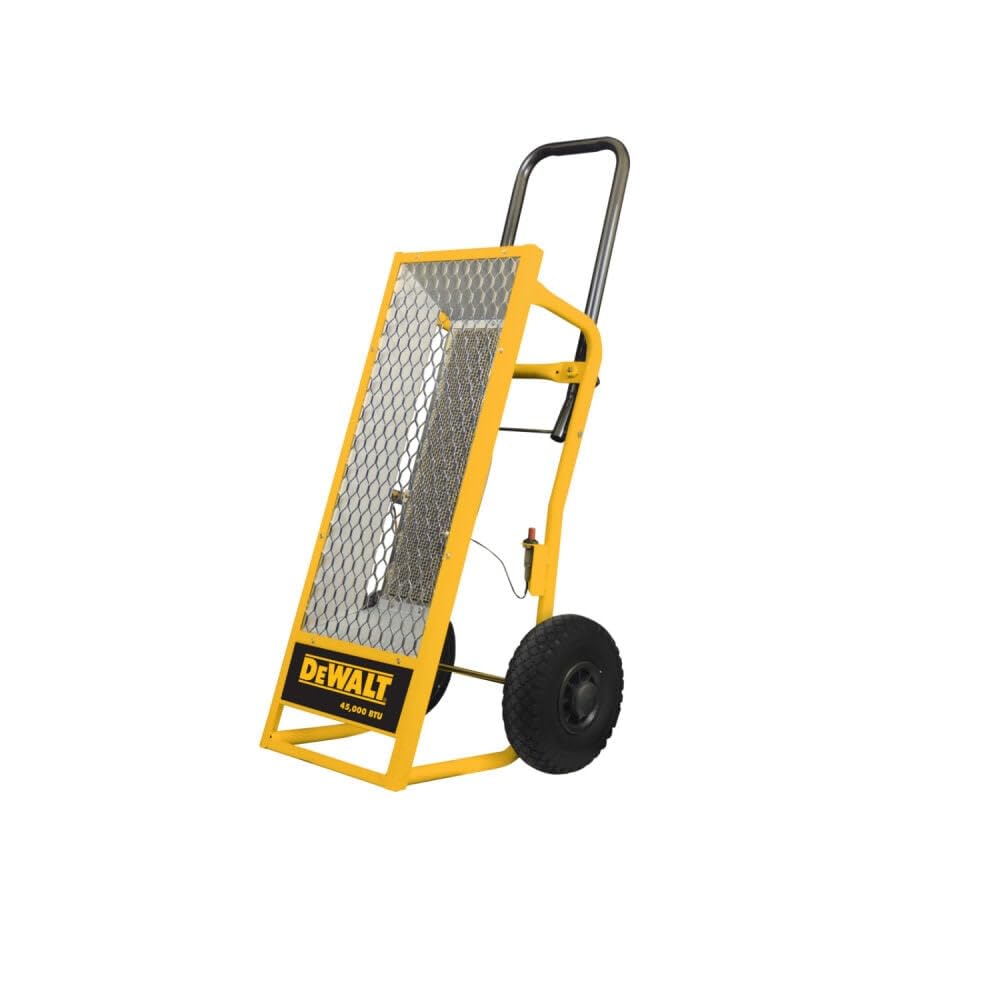
A radiant beast on a dolly that runs on zero electricity and rolls over rough ground.
This is the oddball of the group — a 45,000-BTU radiant heater mounted on a heavy-duty steel frame with foam-filled flat-free tires and a fold-down handle. Unlike the forced-air units above that need a fan and wall power, this DEWALT uses a steel mesh radiant burner and piezo ignition that require zero electricity. The radiant heat throws warmth in a straight line: one reviewer says it heats a garage fast, and another notes it has been going strong in their shop for four years. It is quieter than a forced-air torpedo heater, which is a big selling point for workshop use.
The catch is the on/off-only operation — there is no thermostat or variable heat dial, so you get full 45,000 BTUs or nothing. Buyers also point out a design flaw: the safety reset valve forces your face near the burner during ignition. The first burn-off of paint and oil produces smoke and odor, so initial ventilation is critical. CO levels measured around 3-4 ppm in a sealed garage, dropping to 0-1 ppm with a 2-inch door crack.
Radiant heat focus
- No electricity means you can use it during a power outage or on a remote job site
- Dolly frame with flat-free tires rolls through gravel and dirt — true job-site mobility
- Four-plus years of reliable service reported by multiple long-term owners
Limited area coverage
- No thermostat — runs at full 45,000 BTU until you manually shut it off
- First burn produces smoke from paint cure; ignition position is awkward
Best for targeted heat: contractors or shop owners who need a tough, electric-free radiant heater that moves easily across a construction site or barn floor.
skip it if large room: you want precise temperature control — the on/off-only design will cycle your garage between too hot and cold.
6. Mr. Heater 18,000 BTU Vent Free Radiant Propane Heater
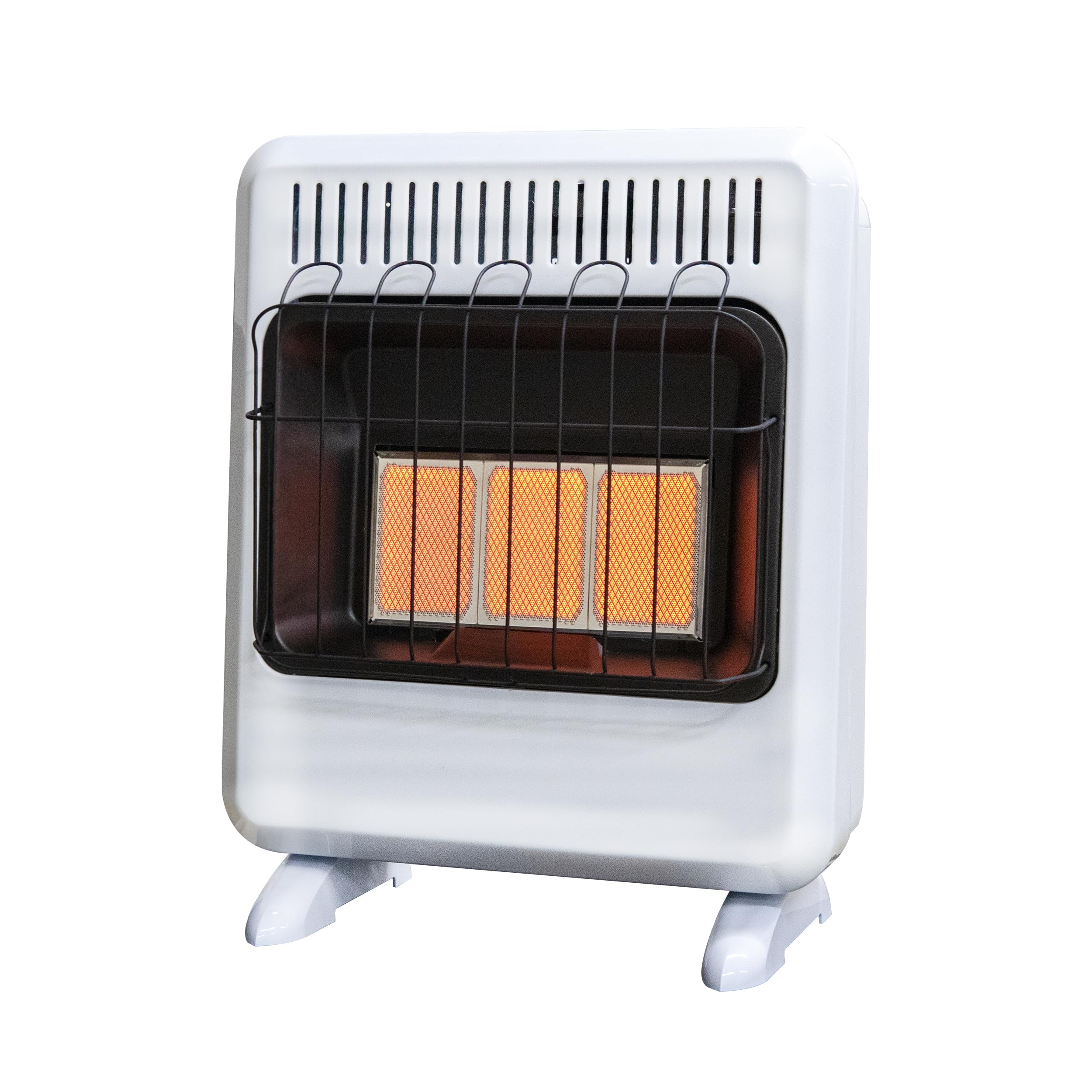
The only vent-free radiant heater here that is rated for indoor use without chimney venting.
Mr. Heater’s 18,000-BTU unit stands apart because it is certified for indoor use with no outdoor venting required — you can run it in a closed garage, basement, or even a home living space as long as the room has adequate fresh-air intake. It heats up to 700 square feet, which beats the Gasland and Avenger picks by roughly 250 to 300 square feet despite the same 18,000-BTU rating. The built-in thermostat cycles the heater on and off automatically, a feature most cabinet-style radiant heaters lack. The unit includes wall-mounting hardware and weighs 21.3 pounds, making it heavier than the portable options but stable on the floor or wall.
Buyers love the “near-silent” operation — no fan, no rumble — and one user says it kept a very large house above freezing during a multi-day power outage. The downside is that setting it up requires buying additional Mr. Heater-specific parts (regulator, hoses, connectors) not included in the box; the manual does not clearly list them, leading to extra research. A blower fan kit is sold separately if you want to push the heat sideways.
Vent free safe
- Vent-free indoor safety certification — unique among the 18,000-BTU picks here
- Thermostat-controlled, near-silent operation for living-space comfort
- Wall-mountable to save floor space
Small BTU output
- Missing parts info in the manual forces you to hunt down Mr. Heater-specific adapters
- Heavier than portable cabinet units at 21.3 pounds
Choose this if small space: you need a permanent, quiet, thermostat-controlled heater for a home workshop or garage where pulling in outdoor venting is impractical.
Pass if high heat needed: you want a roll-around portable heater — this is meant for stationary wall or floor mounting.
7. Dura Heat LPC25 15-25,000 BTU Propane Convection Heater

The 7.8-pound pedestal heater that fits a one-car garage but struggles to spread sideways.
Dura Heat’s LPC25 is an adjustable convection heater with a range of 15,000 to 25,000 BTU, covering up to 600 square feet — roughly the size of a one-car garage. At 7.8 pounds and just 13 inches tall, it is the smallest, lightest unit in this lineup. Unlike the radiant cabinet heaters that beam heat in one direction, this convection model uses a 360-degree heating radius to warm the air evenly around the unit. The built-in wind shield makes it stable in drafty spaces, and the auto shut-off cuts gas if it tips over. It runs up to 28 hours on a 20-pound propane tank at the low setting.
One buyer report captures the reality: the heater raised a 300-square-foot insulated garage from 9°F to 24°F in 4 hours on low — a clear 15-degree gain, but slow. The heat rises straight up with little side output, so you may need a fan or angled shield to push it sideways. Another reviewer notes that indoor use produces a noticeable propane burning smell, despite the “indoor/outdoor” label.
Convection efficiency
- Featherlight at 7.8 pounds — easiest to move around the garage
- 360-degree heat distribution warms the full room if air circulation is good
- 28-hour runtime on low means fewer tank swaps
Lower BTU range
- Heat rises straight up — weak lateral spread without a fan
- Slow temperature climb compared to forced-air models
Suitable for garages: a small, well-insulated one-car garage where you can pair the heater with a small fan to push heat sideways.
Not ideal if freezing: you want instant warmth or need to heat a drafty, open two-car space.
8. Avenger Portable Outdoor Propane Cabinet Heater – 18,000 BTU
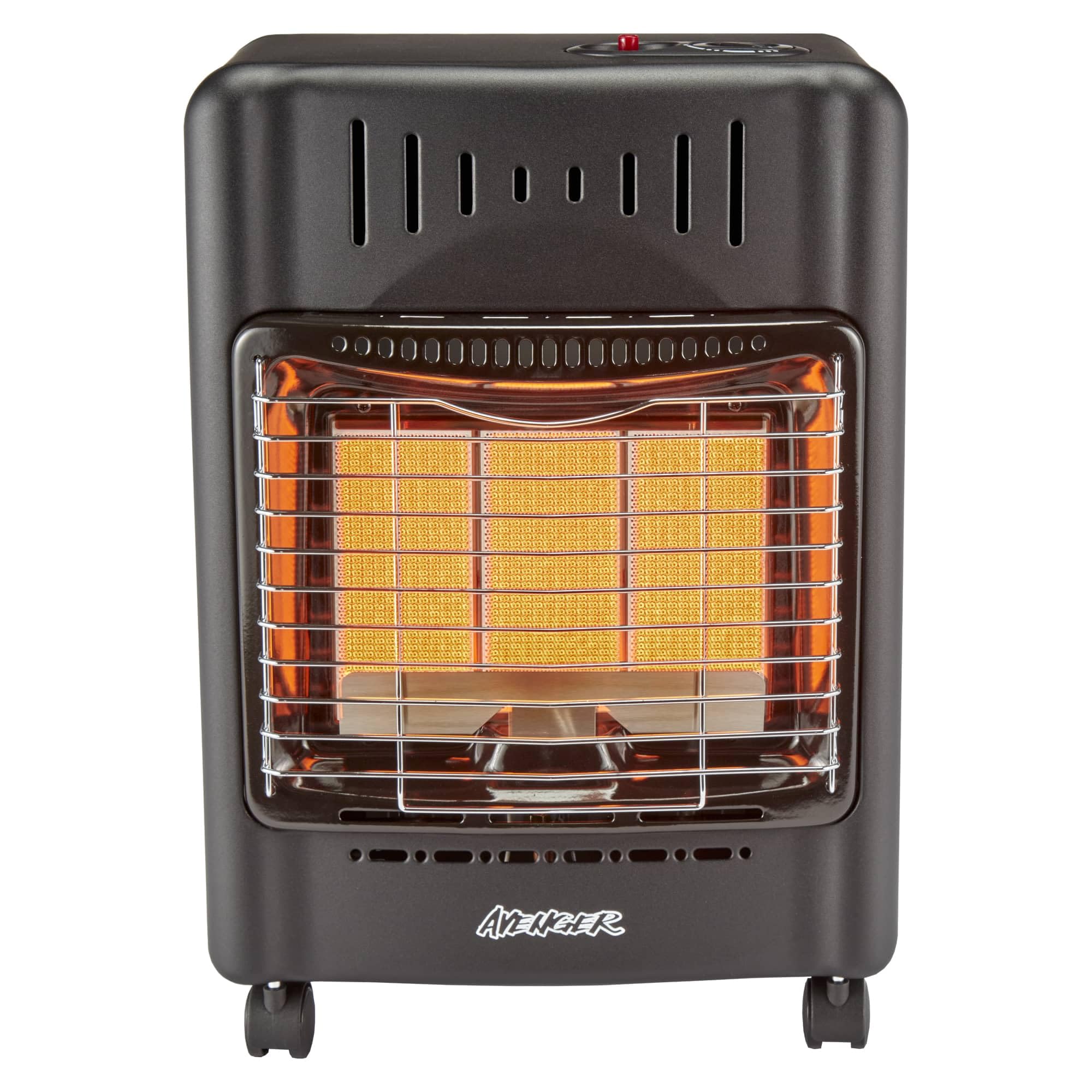
The 72-hour low-setting marathon runner that survives multi-day power outages.
The Avenger cabinet-style radiant heater is structurally similar to the Gasland and CAMPLUX with three ceramic heating plates (6,000, 12,000, and 18,000 BTU) covering 450 square feet. what separates it is fuel efficiency: one buyer confirms it “runs up to 72 hours on low with a standard 20 lb tank,” which is the longest runtime of any 18,000-BTU unit here. The durable steel cabinet has smooth-rolling casters, and the push-and-turn piezo ignition starts without electricity. Safety covers oxygen depletion sensing and tip-over shut-off. Buyers report it is “easy to lite, operate and maintain” and that it “did not set off the carbon monoxide alarm” during extended use.
The Avenger measures 10 inches deep by 15 inches wide by 22 inches tall — 75% more in height than the Flame King forced-air unit, a clear reminder that cabinet-style heaters take up more vertical space. Assembly is minimal at roughly 95% pre-assembled from the start. The only consistent complaint is that the first use requires holding the pilot purge button for 30 seconds to push air out of the gas line before ignition.
Outdoor safe
- Up to 72 hours of continuous heat on low — class-leading in this price tier
- Clean burn with no carbon monoxide alarm triggers in ventilated spaces
- Five-star average rating across 130 reviews indicates high owner satisfaction
Heavy unit
- Requires a 30-second pilot purge on first start to clear the gas line
- Tall cabinet (22 inches) takes up more floor space than a forced-air torpedo
Best for patios: emergency-preparedness buyers who need days of heat from a single 20-pound tank without electricity.
pass on it if portable: you need fast, blast-furnace heat — the 6,000-BTU low setting is meant for fuel conservation, not instant warmth.
9. CAMPLUX 18,000 BTU Outdoor Propane Heater

The entry-level cabinet heater that keeps a 120-square-foot shop toasty at -20°F.
CAMPLUX’s 18,000-BTU propane heater is almost identical to the Avenger and Gasland on paper: three heat settings (6,000/12,000/18,000 BTU), 450-square-foot coverage, ODS and tip-over safety, piezo ignition, and a cabinet that houses a 20-pound tank. It comes largely pre-assembled with five casters and a carry handle. A unique spec is the maximum temperature setting of 167°F — recorded in the technical data — which gives a sense of the output intensity. The unit runs up to 69 hours on the 6,000-BTU low setting, close to the Avenger’s 72-hour claim. One buyer in a very cold climate says it “keeps 120 sq ft warm at -20°F” but notes a 20-pound tank lasts only about 2.5 days on high, which is a fast consumption rate.
Like the Gasland, the CAMPLUX is rated for outdoor use only, so you need good ventilation. The biggest quality concern comes from a reported defective unit that the buyer could not return, calling it a fire hazard — a rare but serious edge-case given the 4.3-star average across 260 reviews.
Easy setup
- 69-hour max runtime on low stretches your propane tank during a cold snap
- Pre-assembled with roll-around casters — set up in under two minutes
- Proven in extreme cold (-20°F) for small insulated shops
Wind sensitive
- Propane tank drains in roughly 2.5 days on the high 18,000-BTU setting
- Quality control concerns with a small number of defective units reported
Go for it if calm: budget is your top concern and you want a quiet, electric-free cabinet heater for a small workshop up to 450 square feet.
Think twice if windy: you want proven long-term reliability — the Avenger and Gasland have stronger track records in reviews for the same price.
Understanding the Specs
BTU — How Hot, How Fast
The British Thermal Unit (BTU — the amount of heat needed to raise one pound of water by one degree Fahrenheit) tells you the raw heating power. Higher BTU heats faster and covers more square footage, but it also burns more propane. A 60,000-BTU forced-air heater can warm a 1,500-square-foot garage in minutes; an 18,000-BTU radiant heater may take an hour to bring a 450-square-foot workshop to the same temperature. Match BTUs to your space — not too low or you will freeze, not too high or you will waste fuel.
Forced Air vs Radiant
Forced-air heaters use an electric fan to blow hot air across the room — they heat fast and cover large areas but are noisy and need a wall outlet. Radiant heaters warm people and objects directly in front of them using infrared heat (heat you can feel instantly) — they are silent, use no electricity, and cost less to operate, but the heat does not wrap around corners. For most garage work, forced air wins for coverage; radiant wins for quiet and electric-free operation.
FAQ
Can I use a propane garage heater indoors without ventilation?
How many BTUs do I need to heat my garage?
How long will a 20-pound propane tank last in a garage heater?
Is it safe to leave a propane heater running overnight?
What is the difference between ODS and tip-over shut-off?
Do I need electricity to run a propane garage heater?
Can a propane heater set off my carbon monoxide detector?
Which is better for a garage — forced air or radiant?
Do I need to assemble a propane cabinet heater?
How loud is a forced-air propane heater?
Final Thoughts: The Verdict
Across the board, the propane garage heaters winner is the DEWALT 68,000 BTU Forced Air Heater because it combines the highest BTU output with the unique convenience of battery-powered operation for job sites without wall outlets. If you want a quiet, electric-free radiant heater that sips fuel during long power outages, grab the Avenger 18,000 BTU Cabinet Heater. And for the best balance of heat output and price in a standard garage, the standout is the Remington 60,000 BTU Forced Air Heater — just bring earplugs.
How We Picked
We do not accept paid placement. Every pick is matched to a real buyer and a real use-case; we do not hands-on test units.
Sources & Methodology
Specifications: manufacturer listings and product documentation. Review insights: verified customer reviews, as of July 2026. Pricing: not shown on this page (it changes often); check the current price via the retailer link.
As an Amazon Associate, Trending Car earns from qualifying purchases. This does not affect which products we feature.