
Our readers keep the lights on and my garage snacks stocked. As an Amazon Associate, I earn from qualifying purchases.
Specs are compiled from manufacturer listings and verified buyer reviews and can change over time — please confirm the key details on the product page before buying.
If your calls drop the moment you leave the interstate, or your music buffers every time you hit a stretch of remote highway, you know the frustration firsthand. A cell booster for your truck turns that weak flicker of signal into something you can actually use — clearer calls, faster data, and the confidence that comes from knowing you can reach help if you need it.
I’m Min Islam — the founder and writer behind Trending Car. This guide is built by comparing the manufacturers’ published specifications and the patterns across verified customer reviews, so you get each pick’s real strengths and trade-offs instead of marketing spin.
Whether you drive a semi across the country or take a work truck off-road, the right cell booster for truck can mean the difference between a productive run and a frustrating day of dropped connections.
Our Picks at a Glance

How To Choose The Best Cell Booster for Truck
Truck cell boosters range from simple plug-and-play kits to professional-grade systems with huge external antennas. Before you pick one, here are the specs and features that separate a good investment from a frustrating dud.
Antenna Size and Type Matter Most
The antenna is doing the heavy lifting. Short magnetic antennas are convenient, but a tall, rugged omnidirectional OTR (over-the-road) antenna captures weaker signals from farther towers. Look for an antenna that is at least 16 to 17 inches tall if you regularly drive through remote areas.
Gain (Measured in dB) Tells You the Boost Strength
Gain is the number that shows how much the booster amplifies the signal it receives. A 50 dB max gain is the standard for a truck booster that can turn a single faint bar into a few usable bars. Higher gain usually means a larger antenna, so balance it with your vehicle’s clearance.
Carrier and Band Compatibility
Not every booster works with every carrier’s specific frequency bands (the specific radio frequencies, like 700 MHz or 1900 MHz, that your carrier uses). Most good boosters cover the major bands for Verizon, AT&T, and T-Mobile — usually band 12/17 (700 MHz), band 13 (700 MHz), band 5 (850 MHz), band 4 (1700/2100 MHz), and band 25/2 (1900 MHz). Before you buy, check that the booster supports the bands your carrier uses in your area.
Single-User vs Multi-User
A single-user booster connects to one phone at a time. Multi-user boosters let everyone in the cab — driver, passenger, and anyone in the back seat — get a stronger signal on their own devices. If you regularly have multiple people in the truck, a multi-user model is worth the upgrade.
Ease of Installation
Some kits are designed for a quick DIY install under an hour, with a magnetic roof antenna and a simple indoor antenna. Others require drilling or permanent mounting hardware. If you are not comfortable with running cables or mounting an antenna on a tall mast, look for a kit that includes clear, truck-specific instructions and all the brackets you need.
Quick Comparison
| Model | Best For | Max Gain | Antenna Type | Multi-User | Amazon |
|---|---|---|---|---|---|
| weBoost Drive 4G-X OTR★ Best Overall | Serious truckers needing proven reliability | 50 dB | 17″ Omnidirectional | Yes | Amazon |
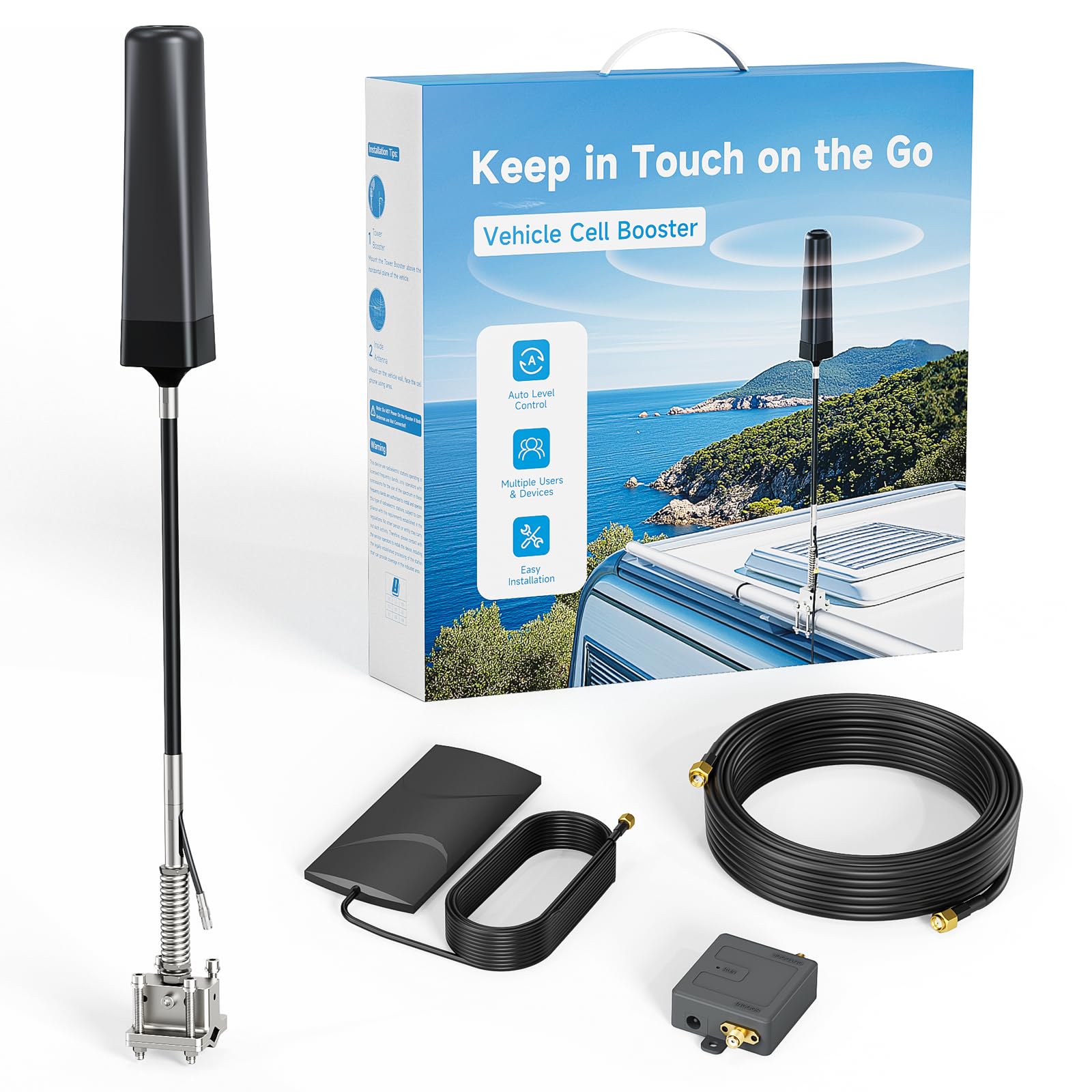
| ANNTLENT V50Zero-Loss Design | RVers & off-roaders wanting zero-loss design | — | Built-in (All-in-One) | Yes | Amazon |
| Atcall SF-TruckSmart Display | Drivers who want a real-time signal display | 50 dB | High-gain Omnidirectional | Yes | Amazon |
| weBoost Drive Reach OTR | Reaching the farthest towers | 50 dB | Drive RV Antenna | Yes | Amazon |
| SureCall Fusion2Go OTR | Fleet vehicles needing rugged durability | — | Omni High-Gain OTR | Yes | Amazon |
| HiBoost C30G-5S-BTW | Pickup & SUV drivers wanting a magnetic antenna | — | Magnetic Roof | Yes | Amazon |
| Upgarde GAGBK | Budget-minded owners needing solid value | 65 dB | Magnet (16ft cable) | Yes | Amazon |
| PRACOA RV Booster | Entry-level buyers on a tight budget | 65 dB | Magnet (16ft cable) | Yes | Amazon |
In‑Depth Reviews
1. weBoost Drive 4G-X OTR (470210)
Our pick — over 4★ from 900+ verified ratings; the strongest balance of quality and price.
The OTR antenna that has proven itself on countless long-haul runs across the country.
This is the booster you see bolted onto mirror mounts of semi-trucks everywhere, and for good reason. The 17-inch omnidirectional antenna (a weather-resistant antenna that picks up signals from all directions without needing to be pointed) is built to survive highway speeds and harsh weather. It delivers a 50 dB max gain, which is enough to turn a nearly dead zone into a usable connection — buyers report speed tests jumping from 0.99/0.00 Mbps up to 4.38/2.00 Mbps, meaning you go from a completely stalled connection to one that can handle VOIP calls and music streaming.
It works with all major U.S. carriers including Verizon, AT&T, T-Mobile, and Sprint, supporting bands 12/17, 13, 5, 4, and 25/2. The kit includes a 3-way CB antenna mount, mast extensions, and a side exit adapter, so fitting it to a truck mirror is straightforward. One truck driver reviewer noted that on the pipeline, it “boosted my phone reception and did the job on my truck,” giving him reliable signal where he previously had none. The catch is that the inside antenna placement is critical — you must avoid line-of-sight between the inside and outside antennas to prevent oscillation. The unit itself is 6.25″D x 1″W x 4.5″H and weighs 5 pounds, which is a noticeably smaller footprint than the wider RV-style boosters that measure 8.27″D x 5.7″W x 0.86″H.
Built for the Long Haul
- Proven 50 dB gain turns weak signals into usable data
- Rugged 17-inch OTR antenna handles tough road conditions
- Multi-user support benefits everyone in the cab
Installation Quirks
- Inside antenna placement is critical and requires experimentation
- Instructions focus on semi-trucks; pickup owners may need extra parts
Reach for this if: you drive a semi professionally and need a booster with a proven track record across thousands of miles.
Look elsewhere if: you want a zero-hassle install on a pickup truck — the antenna mounting is designed for mirror brackets on big rigs.
2. ANNTLENT V50 All-in-One Booster
An all-in-one design that amplifies the signal right at the antenna, before any cable delay.
Most boosters have a cable running from the antenna to the booster box, and that cable can weaken the signal slightly. The ANNTLENT V50 solves this by placing the amplifier directly inside the antenna unit — a design they call “All-in-One” — so you get zero signal loss. This matters most when you are driving through rapidly changing terrain where every fraction of a dB counts. The booster includes a smart app that helps you find the best location for the outdoor antenna by showing real-time signal strength and the direction of the nearest cell tower, which takes the guesswork out of installation.
It supports bands 2, 4, 5, 12, 13, 17, and 25, covering Verizon, AT&T, and T-Mobile. The kit comes with an inside antenna, cable, power supply, and waterproof tape. Owners mention that after installation, the booster consistently provides 4 bars in areas that previously had virtually no service. One reviewer noted that the build quality is above average — the sealed, compact design makes it feel more rugged than other kits in this range. The trade-off is that some users found the signal improvement marginal; one reported going from 2 bars to 3 bars, which may not be enough for everyone. The V50 is tune for RV, camper, and trailer use, but the compact form factor works well on trucks and off-road vehicles too.
Smart and Compact
- All-in-one design eliminates cable signal loss
- Smart app guides antenna placement with real-time data
- Sealed, compact build feels durable
Not a Miracle Worker
- Installation can be challenging and requires a tall vertical pole not included
- Some users report only a 1-bar improvement
Best for tech-savvy owners: who appreciate a smart app for installation and want a compact, all-in-one unit for an RV or off-road truck.
skip it if: you want a guaranteed multi-bar boost without any installation hassle — results vary more than with a traditional booster.
3. Atcall SF-Truck Booster
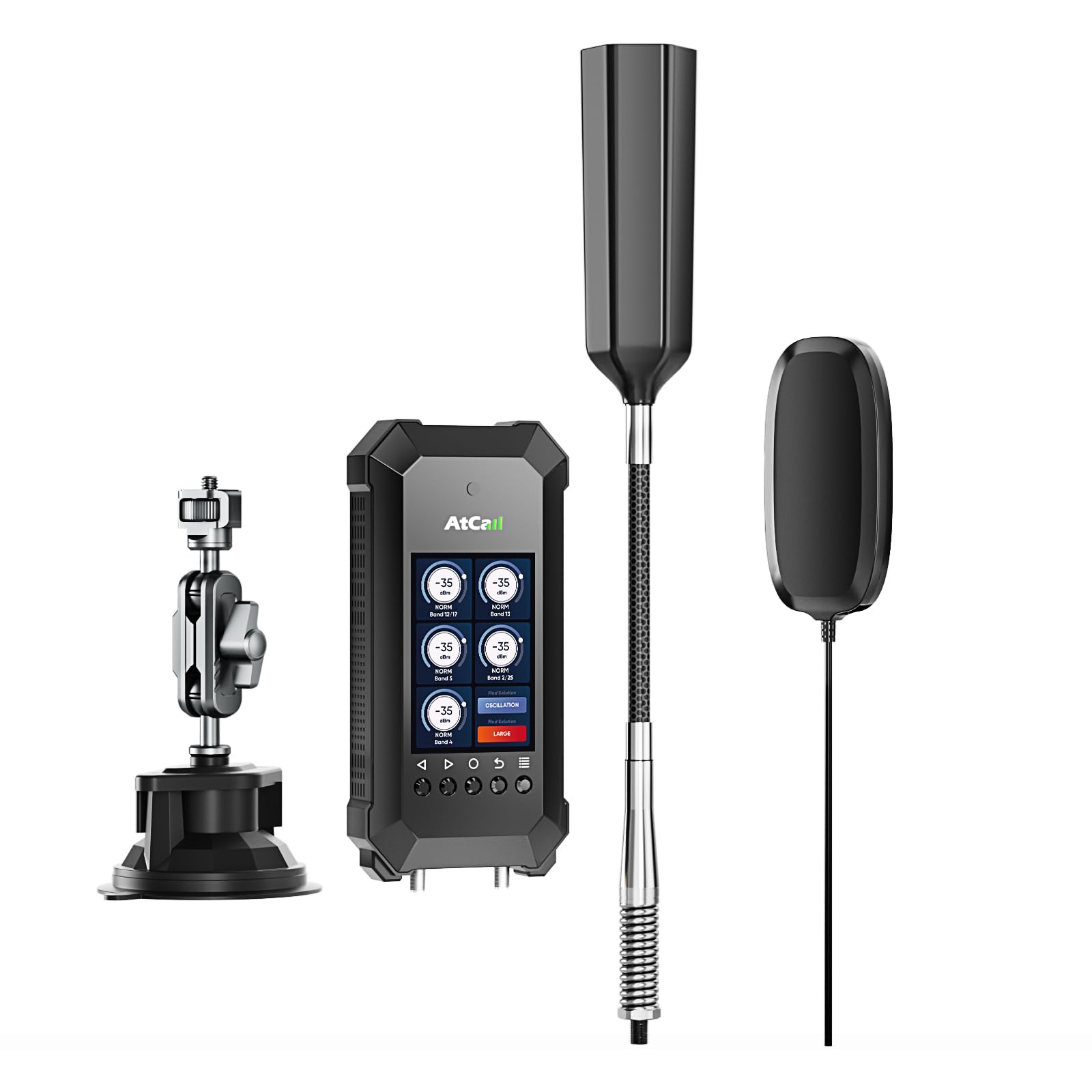
An LCD screen on the booster shows real-time signal changes, so you know exactly what is happening.
Unlike most boosters that just give you a blinking LED, the Atcall SF-Truck has an HD LCD display that shows the real-time signal strength and working status. This makes troubleshooting and installation much easier — you can instantly see if moving the antenna helps or if the booster is oscillating (creating feedback instead of boosting). The booster itself delivers 50 dB max gain and works on bands 12/17, 13, 5, 2/25, and 4, covering all major U.S. carriers. It is designed specifically for trucks, with two types of mounting brackets that let you mount the main unit directly on the center console. One truck driver using Verizon reported that the booster took his signal from 1 bar to 3 bars in a remote area, giving him back full phone functionality.
The rugged outside antenna is waterproof, shockproof, and rustproof. The booster supports multiple users, so everyone in the cab gets a stronger signal. An omnidirectional antenna receives signals from all carriers in all directions, meaning you do not have to point it at a specific tower. Buyers praise the excellent customer support and the quality of the parts, but note that the setup is more involved than a simple plug-and-play — you will likely spend close to an hour on your first install. The kit includes the booster, outside and inside antennas, mounting brackets, power adapter, cables, and mounting kits.
See Your Signal
- LCD display makes installation and troubleshooting clear
- Rugged, weather-resistant outside antenna
- Includes two console-mounting brackets for a clean install
Needs Some Effort
- Setup is not quick plug-and-play; first install takes time
- Boosts existing signal only — cannot create service where there is none
Ideal for drivers who tinker: the LCD screen gives you real-time feedback and control that other boosters do not offer.
Not for you if: you want a zero-effort, 15-minute install — this one requires patience and careful antenna placement.
4. weBoost Drive Reach OTR (477154)
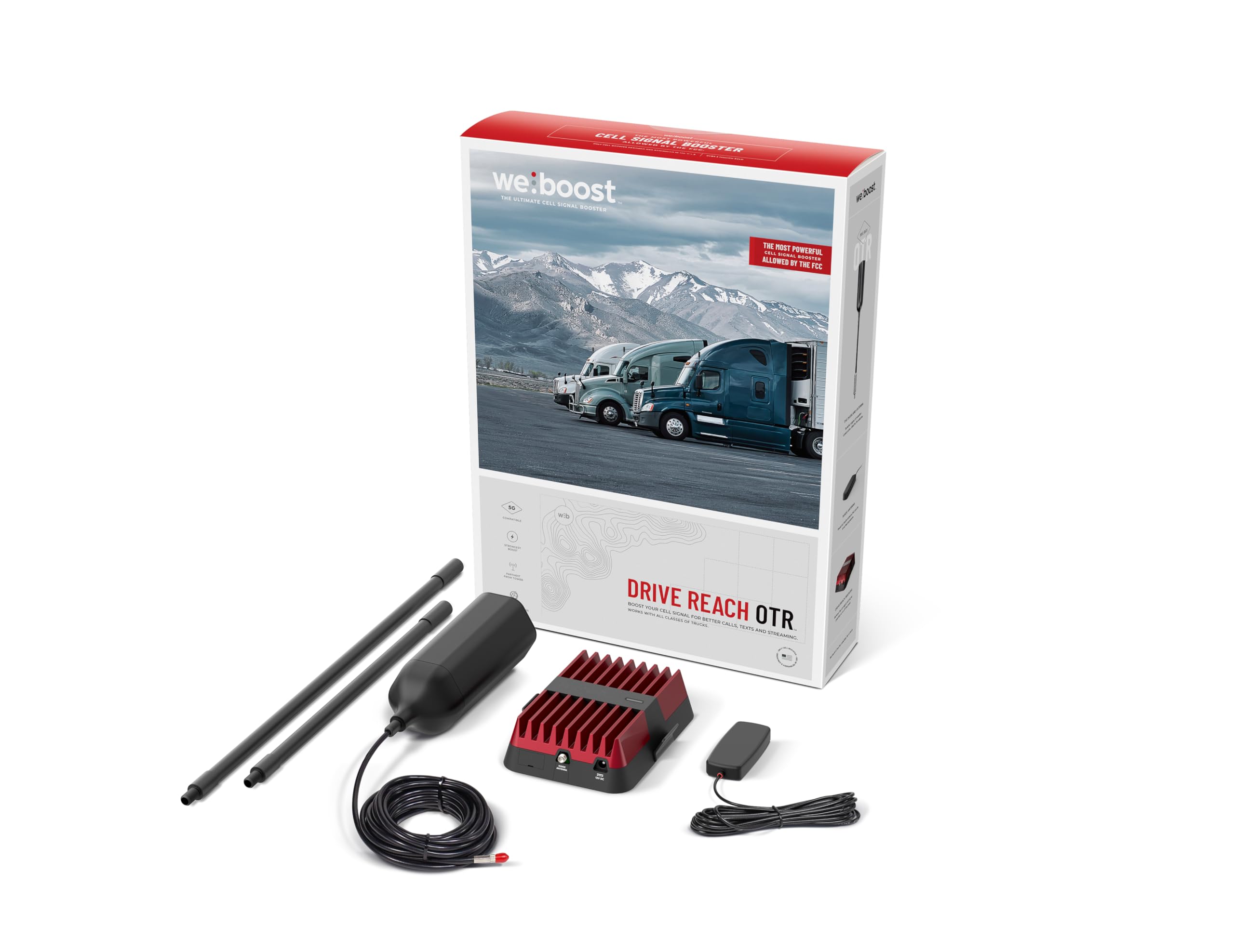
The top-tier weBoost that reaches the farthest cell towers and boosts for multiple devices at once.
If you often find yourself in areas where even the 4G-X drops out, the Drive Reach OTR is the upgrade. It delivers 50 dB max gain and is designed to reach towers that are farther away than the 4G-X can manage It supports the latest 5G technology and all U.S. carriers, including Verizon, AT&T, T-Mobile, and UScellular. The kit includes the Drive RV antenna, a mounting bracket, power supply, a slim low-profile antenna, coax cable, a side exit adapter, mast extensions (one 13-inch and one 18-inch), an antenna spring, and thread lock packets. A truck driver who ordered four of these for semi-trucks reports that they do exactly what they claim: “no more dropped calls while on the road in west TX and new mexico.”
The unit itself is compact at 3.75″D x 11.5″W x 21″H and weighs just 1.8 pounds, meaning the booster itself is light even though the antenna setup is substantial. One buyer mentioned that the instructions are written for semi-trucks only, so pickup owners may need to be creative and source extra parts. The signal improvement typically goes from 1 bar to 2-4 bars, but some users report that the connection can feel inconsistent rather than rock-solid. The power supply includes an on/off switch, which is a nice touch for saving power when parked. weBoost backs this model with a 2-year warranty and US-based customer support via app, chat, phone, or email.
Farthest Reach
- Improved range for remote areas
- Supports 5G and all major U.S. carriers
- Kit includes everything needed for a full install
Pickup Gotchas
- Instructions are semi-truck specific; pickup owners need extra hardware
- Signal boost can be inconsistent even when strong
Your best bet if: you drive in the most remote stretches of the country and need the longest possible reach from a single booster.
Consider the 4G-X if: you drive mainly on well-traveled routes and want a simpler, cheaper installation.
5. SureCall Fusion2Go OTR

A heavy-duty booster with patented 2XP technology that delivers double the uplink power for remote areas.
SureCall designed the Fusion2Go OTR for fleets and work vans that face the toughest conditions. The patented 2XP technology delivers enhanced uplink power, which means your phone can “talk back” to the tower more effectively — this is often the weak link when you are in a deep valley or behind a ridge. The antenna is omnidirectional and includes a built-in ground plane, so it works on any surface: metal, fiberglass, wood, or plastic. The antenna fits a standard 3/8 x 24 thread mount, and you can swap between a 16-inch and a 32-inch height using the optional mast extension. The kit includes a 10-foot integrated cable with a 5-foot extension option, a 2-clamp mounting bracket, and thread-lock glue to keep everything tight against vibrations.
It boosts all North American carriers on bands 600 MHz, 700 MHz, 850 MHz, 1700/2100 MHz, and 1900 MHz. One buyer using it on an adventure vehicle reported that the antenna survived branch hits at over 30 mph and boosted the signal from a dead zone to 2-4 bars of 4G using a solar generator. Another user measured an improvement from -119 dB (effectively a dead zone) to -95 dB (average) while in a canyon. The unit weighs 6 pounds and is built with weather-proof components rated for water and dust. However, some truck drivers report no measurable improvement after weeks of testing, so results are not universal. SureCall backs it with a 3-year warranty and lifetime US-based tech support.
Rugged Performance
- Patented 2XP uplink power helps in deep dead zones
- Antenna works on any surface material thanks to built-in ground plane
- Weather-proof components and 3-year warranty
Mixed Results
- Some users report zero improvement after proper installation
- Heavy unit at 6 pounds
Built for the work truck: if you drive a fleet vehicle or a work van that takes a beating, this booster is designed to survive it.
If you are on a budget: look elsewhere, as the mixed results make the high price a gamble.
6. HiBoost C30G-5S-BTW (Car & SUV)
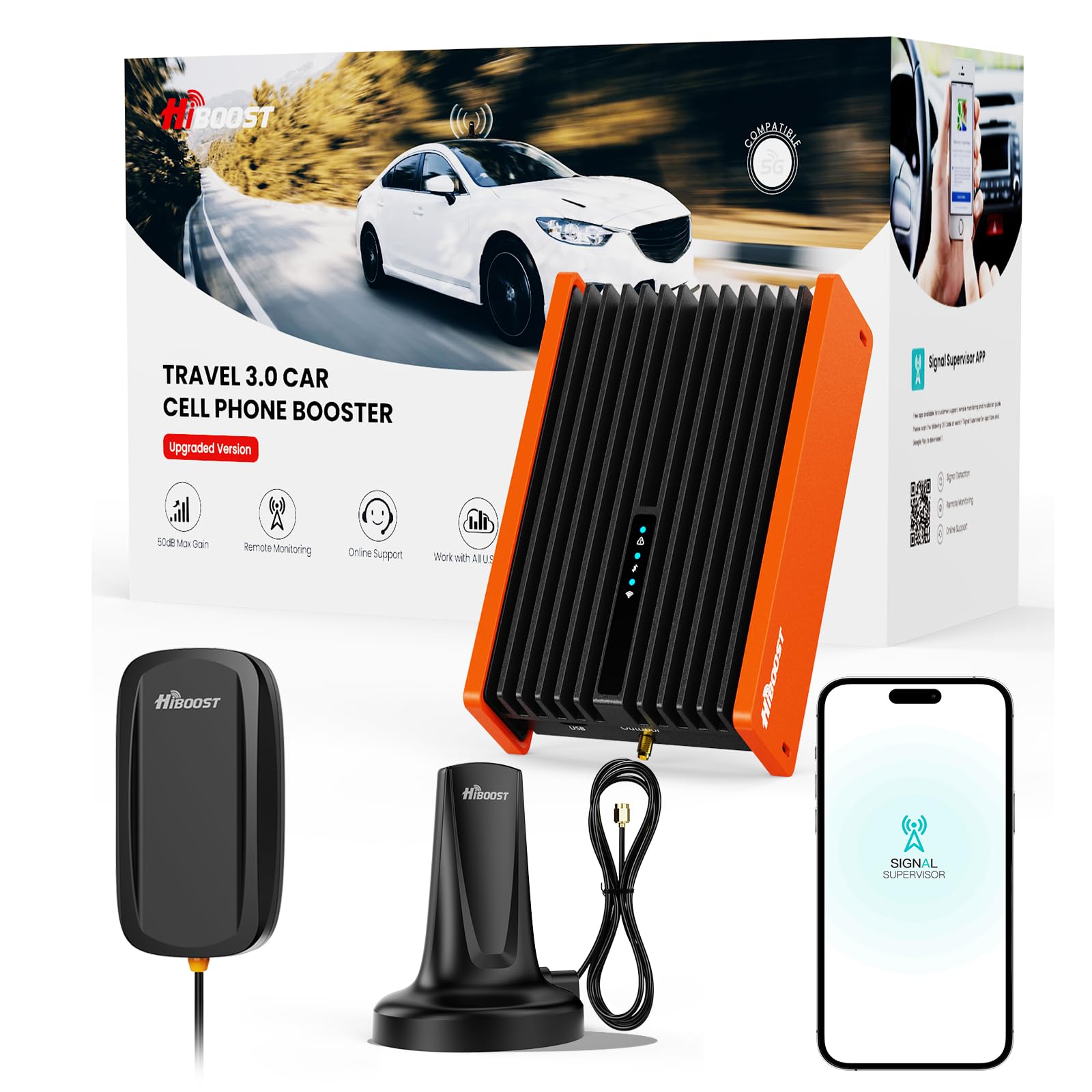
A magnetic roof antenna makes installation simple, and the rugged metal booster is built to last.
HiBoost designed this booster for cars, SUVs, and pickup trucks — not just semi-trucks — so the magnetic outdoor antenna simply sticks to the metal roof. This makes installation far easier than drilling or bolting. The booster itself has a rugged metal enclosure with a protective silicone cover that resists bumps and scratches. It supports 4G LTE and 5G signals on bands 12/17 (700 MHz), 13 (700 MHz), 5 (850 MHz), 4 (1700/2100 MHz), and 25/2 (1900 MHz), covering AT&T, Verizon, and T-Mobile. The kit includes a high-power booster, an inside antenna with a 9.84-foot cable, an outside magnetic antenna with a 13.12-foot cable, and installation accessories.
A buyer with a T-Mobile iPhone 15 Pro Max reported that the booster gave them full bars in an area that previously had no signal at all — a lifesaver in a weak coverage zone. Another driver of a 2024 Ford Super Duty crew cab saw their signal improve from 2 bars to 4 bars in a poor area. The HiBoost app provides signal detection and installation guidance, making it easier to find the optimal antenna position. One catch: the power cord is short, so you need to plan your device placement carefully. In smaller trucks, achieving enough separation between the outside and inside antennas to prevent a feedback loop can be tricky.
Easy Start
- Magnetic antenna makes installation quick and clean
- Rugged metal booster with silicone protection layer
- App helps with signal detection and placement
Small Truck Limits
- Short power cord limits placement options
- Small truck cabs make it hard to separate antennas to prevent feedback
Perfect for pickup and SUV owners: who want a strong booster without drilling permanent holes in their vehicle.
Not ideal for small cabs: where you cannot get enough physical separation between the indoor and outdoor antennas.
7. Upgarde GAGBK Cell Booster
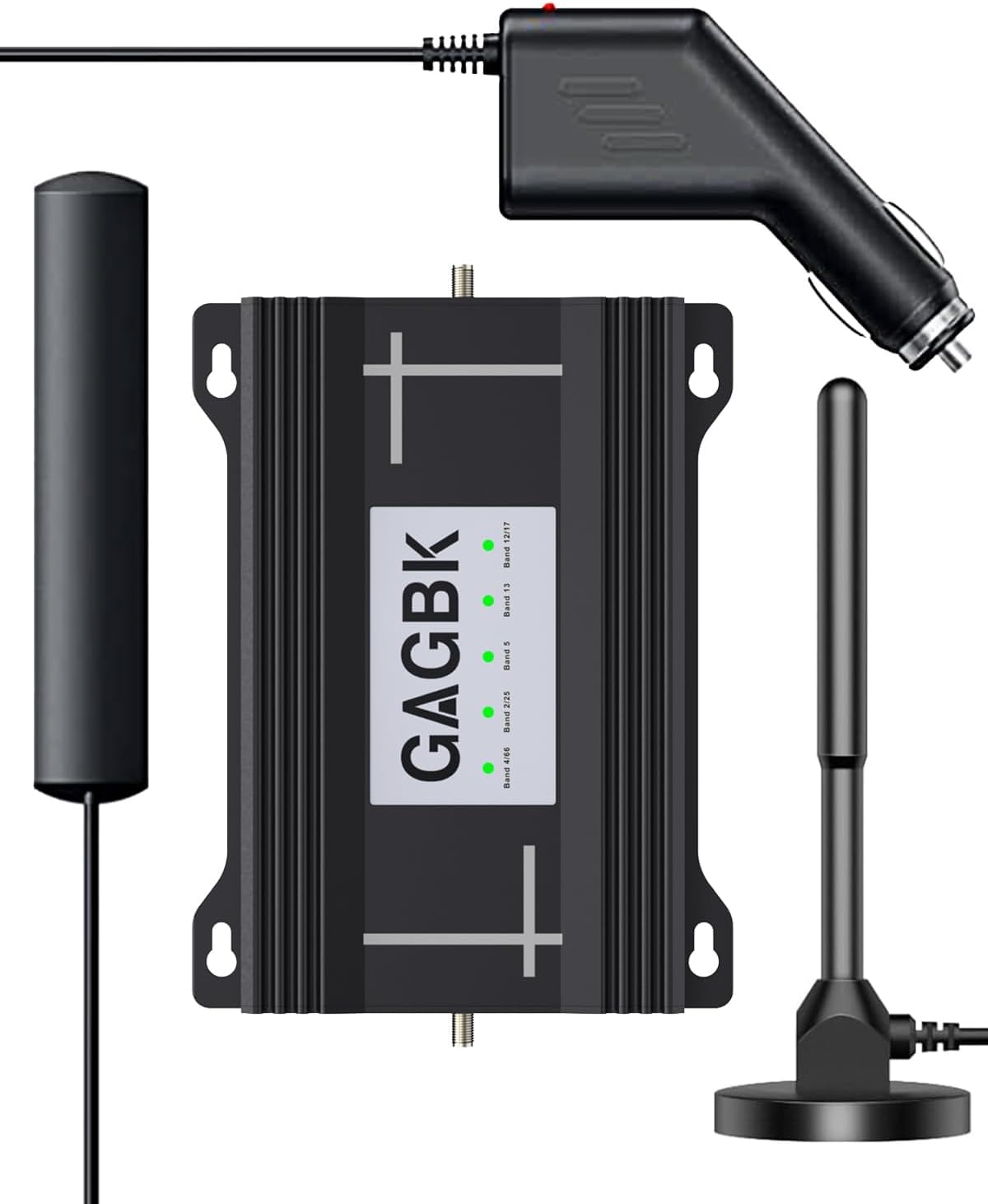
A 65 dB gain booster that claims a 5-8 mile communication range at a fraction of the premium cost.
The Upgarde GAGBK offers a high 65 dB gain (higher than the 50 dB of most premium boosters) and boasts a maximum communication distance of 5-8 miles. It supports 5G and 4G LTE on bands 2, 4, 5, 12, 13, 17, 25, and 66, covering all major U.S. carriers. The kit includes a 12V 3A power adapter, an indoor patch antenna with a 10-foot cable, and an outdoor magnetic antenna with a 16-foot cable. It is designed for RV, car, truck, van, SUV, and even boats. Automatic Gain Control, Inactivity Mode, and Oscillation Elimination features help the booster self-adjust as signal conditions change, so you do not have to fiddle with settings.
Customers note noticeable improvements: one owner reported that after installation, “phones work in the house no problem” where they previously had to go outside to make calls. Another user on the Boost network said the booster “works great” for the price. However, one buyer could not use the booster as expected and returned it for a refund. The 65 dB gain is higher on paper than competitors, but real-world performance depends heavily on your existing signal strength and antenna placement. The booster is FCC approved and comes with a 30-day money-back guarantee, a 90-day replacement policy for defective units, and a 3-year manufacturer warranty.
High Spec, Low Cost
- 65 dB gain is higher than many premium boosters
- Automatic features adjust to changing signal conditions
- Long 16-foot cable for flexible antenna placement
Mixed Results
- Some users find the improvement minimal or unusable
- Lower build quality feel compared to weBoost or SureCall
Smart pick for tight budgets: who want the highest dB gain number without paying premium prices.
pass on it if: you need guaranteed performance in consistently weak signal zones — results can be hit-or-miss.
8. PRACOA RV Cell Phone Signal Booster
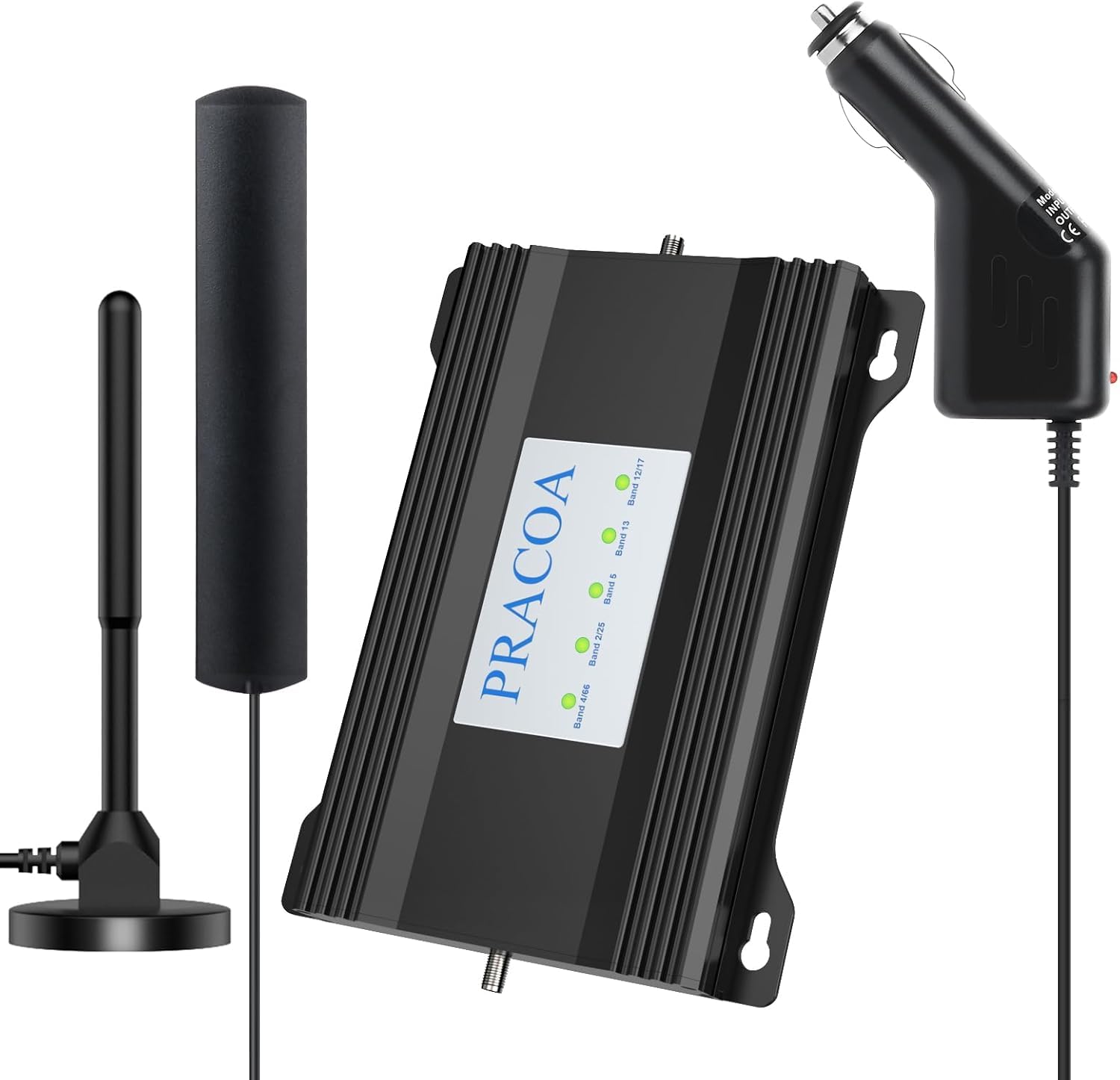
A 65 dB booster that offers the same core specs as the Upgarde at the most accessible price point.
The PRACOA booster matches the Upgarde on paper — 65 dB high gain, support for bands 2, 4, 5, 12, 13, 17, 25, and 66, a 5-8 mile maximum communication distance, and a 12V 3A power adapter. The kit includes an indoor patch antenna on a 10-foot cable and an outdoor magnetic antenna on a 16-foot cable. Automatic Gain Control, Inactivity Mode, and Oscillation Elimination are built in, so the system self-adjusts as you drive through different signal zones. It is designed for RV, car, truck, van, SUV, travel trailer, and boat use.
Another user living at the bottom of a canyon said the booster made a clear difference between when it was powered on versus off. However, one buyer in an area with tall pine trees found no improvement at all, suggesting that severe terrain obstructions can still overwhelm the booster. The unit itself measures 8.27″D x 5.7″W x 0.86″H — noticeably wider than the weBoost 4G-X’s slim 6.25″D x 1″W x 4.5″H profile. It is FCC approved, comes with a 30-day money-back, a 90-day replacement policy, and a 3-year manufacturer guarantee, plus technical support.
Budget Entry Point
- Lowest price point for a 65 dB gain booster
- Self-adjusting features help in changing conditions
- Solid warranty package for the price
Could Disappoint
- Bulkier footprint than premium boosters
- Ineffective in areas with heavy tree cover or severe terrain
Good starter booster: if you are new to cell boosters and want to test the waters without spending big.
Upgrade if: you regularly drive through the most remote parts of the country where terrain is extreme.
Understanding the Specs
Gain (dB) — How Much the Booster Amplifies
Gain is measured in decibels (dB), and it tells you how much stronger the signal becomes after passing through the booster. A 50 dB gain is the standard for a good truck booster — it can turn a barely-there signal into something usable. Some budget boosters advertise 65 dB, which sounds better on paper, but real-world performance also depends heavily on antenna quality and installation. A higher dB number does not always mean better results if the antenna is weak or the installation is poor.
Antenna — The Brain of the Operation
The antenna is more important than the booster box. A tall omnidirectional OTR antenna (17 inches or more) picks up signals from all directions and handles highway speeds. A small magnetic antenna is easier to install but will not reach as far. Some kits include a built-in ground plane, which lets the antenna work on fiberglass or plastic truck caps. Always check antenna height and weather resistance before buying — a cheap antenna will cap your booster’s potential.
Frequency Bands — Carriers Use Different Radio Channels
Your carrier sends signal on specific frequency bands (like 700 MHz or 1900 MHz). A booster must support the bands your carrier uses in your area. Most good truck boosters cover bands 12/17 (700 MHz), 13 (700 MHz), 5 (850 MHz), 4 (1700/2100 MHz), and 25/2 (1900 MHz) — which covers Verizon, AT&T, T-Mobile, and smaller carriers. If your carrier uses a band not listed, the booster will not help you. Check your phone’s band support before buying.
Multi-User vs Single-User
Multi-user boosters let everyone in the truck connect on their own phones simultaneously. Single-user boosters only work with one device at a time (usually the one closest to the indoor antenna). If you drive with a co-driver or passengers, a multi-user model is worth the extra cost. Most of the boosters in this guide support multiple users, making them ideal for team driving or family trips.
FAQ
Will a cell booster for truck work with any carrier?
Can a booster create signal where there is zero signal?
How hard is it to install a truck cell booster?
Does a cell booster drain my truck battery?
What is the difference between a single-user and multi-user booster?
Do I need a booster with 5G support?
Can I use a truck booster in a car or SUV?
How long do truck cell boosters usually last?
What does FCC approval mean for a cell booster?
Can I use the same booster for my RV and truck?
Final Thoughts: The Verdict
If you want one dependable pick, the cell booster for truck winner is the weBoost Drive 4G-X OTR because its 50 dB gain, proven track record, and rugged 17-inch OTR antenna make it the most reliable choice across the widest range of truck types and driving conditions. If you want the longest possible reach for remote off-road areas, grab the weBoost Drive Reach OTR. And for a budget-friendly entry point that still delivers 65 dB of gain, the standout is the PRACOA RV Cell Phone Signal Booster.
How We Picked
We do not accept paid placement. Every pick is matched to a real buyer and a real use-case; we do not hands-on test units.
Sources & Methodology
Specifications: manufacturer listings and product documentation. Review insights: verified customer reviews, as of July 2026. Pricing: not shown on this page (it changes often); check the current price via the retailer link.
As an Amazon Associate, Trending Car earns from qualifying purchases. This does not affect which products we feature.