
Our readers keep the lights on and my garage snacks stocked. As an Amazon Associate, I earn from qualifying purchases.
Specs are compiled from manufacturer listings and verified buyer reviews and can change over time — please confirm the key details on the product page before buying.
Plugging a Level 2 charger into a flimsy dryer outlet is how EV owners learn about melted plastic the hard way. The outlet itself — not the charger — is the part that either handles the long, high-current sessions quietly or fails and creates a fire risk. This guide compares the seven most popular NEMA 14-50 outlets that can actually take the heat of daily EV charging, separating the industrial-grade survivors from the ones that belong in a home inspector’s “do not use” list.
I’m Min Islam — the founder and writer behind Trending Car. This guide is built by comparing the manufacturers’ published specifications and the patterns across verified customer reviews, so you get each pick’s real strengths and trade-offs instead of marketing spin.
By the end you will know exactly why an industrial-grade connector with beefy terminals is the only smart buy for a nema 14-50 outlet for ev charging.
Our Picks at a Glance

How To Choose The Best NEMA 14-50 Outlet for EV Charging
An EV charger pulls a heavy current for hours every night — that’s a continuous load (a steady, full-power draw that runs longer than 3 hours), not the brief burst a clothes dryer needs. The outlet you choose must survive that steady heat without its internal contacts loosening or its plastic softening. Here are the three checks that matter most.
Look for Industrial-Grade Internals
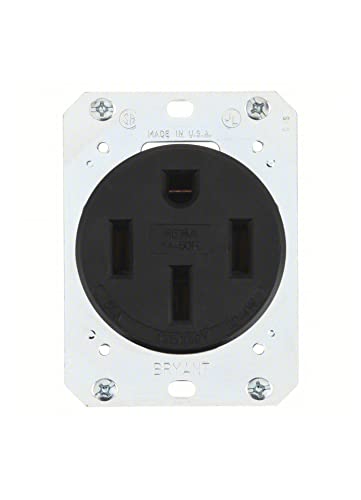
Residential-grade outlets (the kind found in a basic builder pack) use thin stamped-metal contact straps. Under continuous 40- or 50-amp current those straps expand, then contract when they cool — a cycle that can work the screws loose over months. Industrial-grade receptacles like the Hubbell 9450A and Bryant 9450FR use thicker copper-alloy clamps and back-wire pressure terminals rated to withstand this thermal cycling (the repeated expansion and contraction that loosens cheap connectors). If the product listing doesn’t mention industrial grade, thick clamps, or torque-rated terminals, assume it’s a standard dryer outlet that will struggle with daily EV duty.
Check the Terminal Type and Torque Rating
The best outlets for this job use screw-and-clamp terminals that fully capture the stripped wire, not the push-in holes found on cheap receptacles. A torque rating (tightness measured in inch-pounds, or in-lbs) tells you exactly how tight to make the connection. The Leviton 1450R, for example, specifies 75 in-lbs on its terminals. Torquing a connection to spec prevents a loose wire from generating heat. During installation, use a torque wrench (a screwdriver-like tool that clicks when you reach the set tightness) on the terminal screws — and re-torque them after the first month of charging because the wire “seats” under load and the screw can lose a fraction of its tightness.
Pick the Right Box for the Wire Gauge
A NEMA 14-50 outlet fed with #6 AWG copper needs more interior space than a standard 4-inch round box. Reviewers routinely recommend a 4-11/16-inch square box (often called a “deep” or “jumbo” box) so the thick wires can bend into position without crowding the receptacle. A cramped box makes it harder to seat the outlet flush and can push wire bends against the back of the terminals, creating strain that leads to a loose connection later. Plan the box size before you buy the outlet.
Quick Comparison
| Model | Best For | Material / Grade | Terminal Type | Dimensions (LxW) | Amazon |
|---|---|---|---|---|---|
| Hubbell HBL9450A★ Best Overall | Maximum heat and current endurance | Copper, Industrial | Back-wire clamp, torque-rated | 3.3″ x 3.3″ | Amazon |
| Bryant 9450FRCompact Fit | Industrial build with flush fit | Nylon, Industrial | Compression clamp, torque-rated | — | Amazon |
| Leviton 1450W | Weather-resistant indoor/outdoor EV outlet | Nylon/Steel, Heavy-Duty | Pressure-wire, 75 in-lbs | — | Amazon |
| Leviton 1450R | Budget-friendly EV-rated receptacle | Nylon/Steel, Heavy-Duty | Pressure-wire, 75 in-lbs | — | Amazon |
| WELLUCK Power Outlet Box | All-in-one weatherproof enclosure | Steel, Type 3R | Screw-on | — | Amazon |
| RVMATE Power Outlet Box | Pre-drilled metal RV outlet box | Powder-Coated Metal | M8 x 10mm screws | — | Amazon |
| STARELO NEMA 14-50R Box | Compact weatherproof unit for light use | ABS Plastic, IP66 | Screw-on | 3.93″ x 3.93″ | Amazon |
In‑Depth Reviews
1. Hubbell HBL9450A
Our pick — over 4.5★ from 650+ verified ratings; the strongest balance of quality and price.
This stays cool under the heat where other outlets would melt — the 9450A uses solid copper-alloy clamps, not stamped metal straps.
Your biggest risk with a cheap outlet is that the connection loosens over time and generates heat. The Hubbell HBL9450A eliminates that fear with thick copper-alloy clamp terminals that hold the wire securely through hundreds of heat cycles (repeated expansion and contraction as you charge and cool down). One electrician whose review is cited in the data chose this unit specifically because the wiring is “nice and thick and the outlet doesn’t get hot at all.” The 3.3 x 3.3-inch face is 19% more compact than the STARELO box-style unit, so you have more room to bend the stiff #6 AWG wire inside a standard 4-11/16-inch deep box.
To get that cool-running performance, you must torque (tighten with a special tool) the terminal screws to the factory spec and re-torque after a couple of months — the thermal expansion of the heavy wire can loosen a snug connection. Owners who follow that step report zero issues after years of nightly Level 2 charging. The brand ships it in a plain yellow unmarked box, so do not judge it by the outer cardboard. At roughly twice the physical heft of a standard Leviton 14-50R, the Hubbell needs a cutout that fits its larger body — you cannot swap it into a plate for a cheap dryer outlet without planning the box and cover plate first.
Why EV owners choose it
- Copper terminals stay cool under continuous 50A load — buyers confirm the outlet does not get hot
- Registered 4.8/5 from 676 ratings, with no pattern of failure reviews
- Tight 3.3 x 3.3-inch footprint leaves more room in the box for wire bends
What to plan for
- No weatherproof enclosure — it is a bare receptacle that needs a separate box and cover
- Plain packaging arrives in a yellow unbranded box, which can be surprising
- Slightly pricier upfront than most competitors in its category
Reach for this if: you want the most proven, heat-resistant outlet for daily Level 2 charging and are willing to buy the right deep box and cover plate separately.
Look elsewhere if: you need a complete weatherproof enclosure from the start — the Hubbell is a receptacle only.
2. Bryant 9450FR
Same industrial-grade internals as the Hubbell, but with a flush face that sits flat against the wall for a cleaner look.
Bryant and Hubbell share the same parent company, so the 9450FR uses identical copper-alloy compression connectors and thick-body construction as the 9450A. One owner who had replaced two builder-grade outlets that melted after about 9 months each reports the Bryant shows “no noticeable increase in temperature” even during extended charging sessions — a concrete head-to-head improvement over standard residential outlets. The flush mount appeals if you want a recessed, built-in appearance rather than a protruding box. Torque specs printed on the unit make it straightforward for an electrician to dial in the correct tightness.
Buyers report that the outlet is larger than many standard cover plates — you will need a jumbo wall plate (often not in stock at big-box stores) to cover it properly. On the charging speed side, a Tesla Model S owner reports getting 26-28 miles of range per hour at 30 amps, which means a full 84% overnight fill happens in 4-5 hours starting at 11 pm. The main caveat is packaging: reviewers mention the receptacle can arrive loose in the shipping bag, so inspect it before installation. Despite that, the 4.6/5 rating from 282 buyers suggests the product itself arrives undamaged in the vast majority of cases.
Beefy compression terminals: Unlike push-in style outlets, the Bryant uses screw-and-clamp connectors that grab the stripped wire fully, eliminating a common failure point where thin contacts loosen under heat cycles.
Grab it for: a flush-mounted industrial outlet that runs cool and shares its proven internal design with the premium Hubbell.
skip it if: you prefer a single brand-name all-in-one weatherproof box — the Bryant is a bare receptacle that needs a separate enclosure.
3. Leviton 1450W (Weather-Resistant)
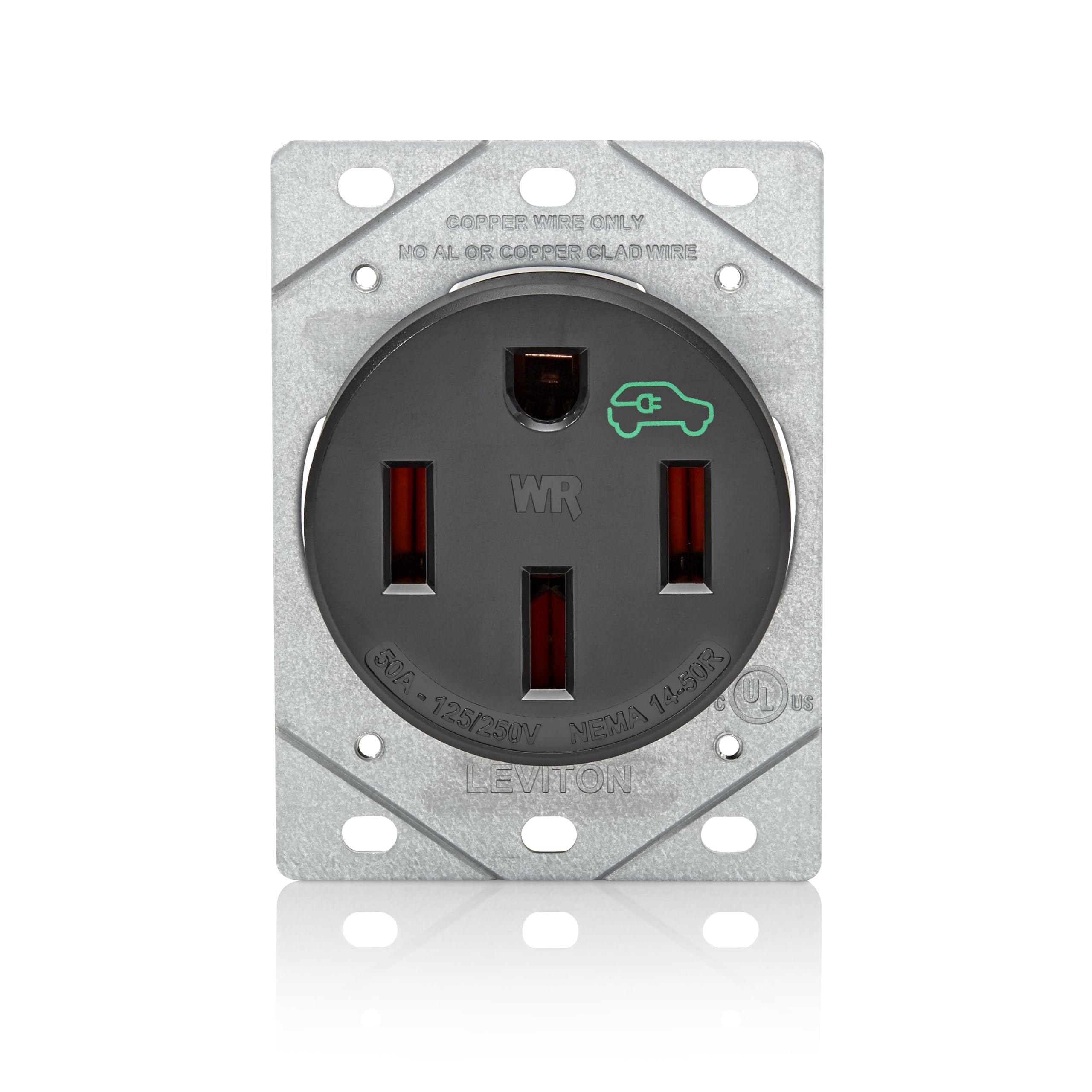
A major-brand EV receptacle with a weather-resistant rating so you can mount it on an outdoor wall without worrying about rain.
Leviton built the 1450W specifically for plug-in EV applications — it uses the same pressure-wire terminal system rated at 75 in-lbs as the standard 1450R, but adds a weather-resistant rating (suitable for damp or wet locations). That means you can install it outside under an eve or in a garage with high humidity. Buyers call the build quality “heavy duty” and note that the high-impact nylon body does not degrade or soften under the sustained 40- to 50-amp load that Level 2 charging demands. One reviewer summed it up bluntly: “Don’t use cheap outlet and burn down your home.” The larger face requires a deeper box and an oversized wall plate — a recurring need across all premium EV-grade receptacles. The 4.6/5 score from 80 ratings is early but strong, with no pattern of heat-related complaints.
If your charging station lives in a dry garage and you do not need the weather rating, the less expensive 1450R offers the same internal design without the outdoor protection — and that may be the smarter value play for you.
Stands out for
- Purpose-built for EV charging cycles and frequency of insertions
- Weather-resistant rating suits outdoor wall-mount installations
- Pressure-wire terminals spec’d at 75 in-lbs for a secure hold
Consider before buying
- Larger face than standard 14-50Rs — you need an oversized box and cover plate
- 80 ratings is a smaller sample than the 1450R’s 462, so long-term data is thinner
Choose it when: your EV charger is mounted on an exterior wall or in any location where the outlet could get splashed or rained on.
Pass if: you charge indoors — the standard 1450R gives you the same core design for less.
4. Leviton 1450R

The EV-rated receptacle that brings industrial-grade terminal torque (75 in-lbs) to a price that makes sense for a first-time EV owner.
Leviton’s 1450R swaps the brittle plastic of standard residential outlets for a high-impact nylon and steel body. The real upgrade is inside: full-width metal contact blades and beefy screw terminals that can handle hours-long charging heat. A buyer who upgraded from a standard Leviton to this EV-rated version says it “works flawlessly after dozen charges” on a 40A GFI breaker (a ground-fault circuit interrupter, which shuts off power if it detects a short). The hex-wire terminals need 75 in-lbs of torque, so you must use a torque wrench during installation — a minor step that prevents the most common failure mode. One reviewer did report the 1450R overheating after 7-8 months and switching to a Hubbell. That single negative review (1/5) sits among 462 total ratings and a 4.5/5 average, so it represents an outlier — but note that even an EV-rated outlet can fail if the circuit or wire gauge is wrong. The larger body means you will need to enlarge the box cutout and buy a jumbo wall plate — a one-time hassle.
Solid mid-range pick: The 1450R occupies the balance of being EV-certified with proper torque-rated terminals at a price that undercuts industrial brands — but unlike the Hubbell, it has at least one documented overheating report, so verify your box fit and wire size carefully.
Best for: a new EV owner who wants a dedicated Level 2 outlet with proper heavy-duty internals but does not need the absolute top-tier industrial build of Hubbell/Bryant.
Not ideal if: you are installing in an outdoor damp location — the non-weather-resistant 1450R is for dry indoor use only.
5. WELLUCK RV Power Outlet Box

Get a complete weatherproof enclosure with a lockable lid and UL certification — no separate box and receptacle shopping.
This WELLUCK unit bundles a NEMA 14-50R receptacle inside a 100% galvanized steel box with a spring-loaded cover, so you do not need to piece together a separate receptacle, box, and cover. The 4.7/5 rating across 542 reviews is the joint highest in this list (tied with RVMATE), and UL certification (a safety standard from Underwriters Laboratories) gives it a mark that budget plastic boxes lack. The updated design replaces traditional knockouts (pre-cut holes you punch out) with threaded inserts for 1/2-inch, 3/4-inch, and 1-inch conduit, which makes for a much cleaner installation. The trade-off: the internal receptacle is a standard builder-grade 14-50R, not an industrial part. One reviewer who examined it closely said it “seems quite acceptable” but acknowledged it is not a heavy-duty Hubbell-level part. If your EV charger pulls the full 50 amps for hours every night, the WELLUCK box’s internal receptacle may be the weak link in a few years — though the large sample of 542 reviews shows no pattern of failures. Another quirk: the wire entry is bottom-only, so if your conduit comes from above you have to loop the wire into a J-hook, which adds a step.
Why it sells well
- UL-certified all-in-one box — no separate receptacle sourcing needed
- Threaded conduit inserts replace messy knockouts for a cleaner install
- Lockable spring cover and 4.7/5 from over 500 buyers
Watch out for
- Standard-grade internal receptacle is not built for decades of daily 50A charging
- Wire must enter from the bottom — a workaround is needed if your conduit comes from above
- #6 AWG wire is a tight bend inside the enclosure
Pick this when: you want a single, ready-to-mount weatherproof box for an RV-style or occasional-use EV outlet — not for a daily 50-amp commuter car.
Avoid if: you need industrial-grade heat endurance for nightly max-current charging sessions.
6. RVMATE 50 Amp RV Power Outlet Box
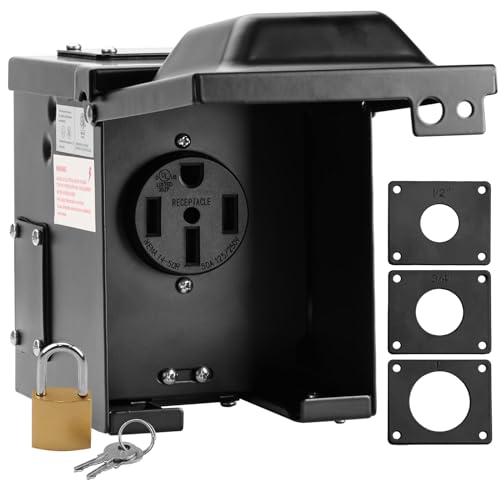
The cheapest ETL-listed (safety-tested by Intertek) metal box in this roundup — ready to mount with pre-drilled panels.
The RVMATE box gives you the same all-in-one ease as the WELLUCK but at a lower entry point. The heavy-duty metal body with powder coating resists rust, and the ETL listing (a nationally recognized safety mark) confirms it passed third-party testing. Three removable panels on the left, right, and bottom come with pre-drilled holes and three aperture gaskets (for 1/2-inch, 3/4-inch, and 1-inch conduit), so you pick your conduit size without drilling. The real downside: the lid does not lock when flipped open, so you have to hold it up with one hand while wiring the receptacle — an annoyance during installation. The cap also gets in the way when connecting wires. These are ergonomic quibbles, not safety problems, and the 4.7/5 rating from over 500 buyers shows most owners are happy with the finished result. The M8 x 10mm terminal screws feel sturdy, and the box includes a pre-attached 10-inch ground wire to simplify bonding. At 50 amps it works for both RV hookups and Level 2 EV chargers, though like the WELLUCK, the internal receptacle is standard-grade, not industrial. For daily heavy use, buy a separate heavy-duty receptacle instead.
Good if you are on a strict budget: The RVMATE is the most affordable ETL-listed all-in-one metal box in this list, but the internal receptacle is not designed for the continuous high-current cycles of nightly EV charging the way a Hubbell or Bryant would be.
Reach for it when: you need an inexpensive weatherproof box for a weekend RV plug or occasional EV charging — the metal body and ETL listing give it a safety baseline that cheap plastic boxes skip.
Pass on it if: your EV gets driven daily and needs a full 50-amp overnight charge every night; buy a separate heavy-duty receptacle instead.
7. STARELO NEMA 14-50R Outlet Box
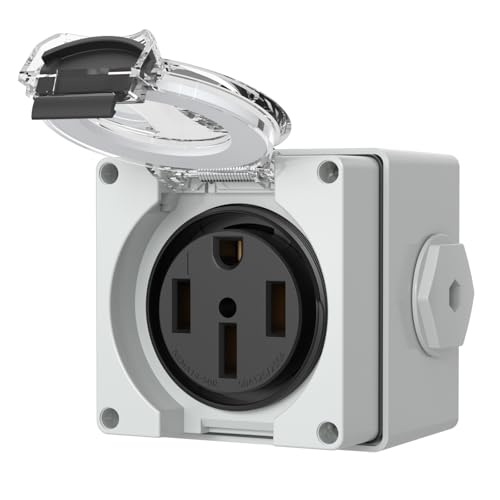
The smallest weatherproof NEMA 14-50 box here, but its ABS plastic body and tight fit limit you to 40-amp setups.
STARELO’s box measures 3.93 x 3.93 inches, making it the largest face plate in this list but the shallowest overall enclosure. The IP66 rating (fully dust-tight and protected against hose-directed water) means it suits outdoor use. One reviewer shares a real-life timing: “240V charges EV from 70% to 80% in ~1 hour,” which matches typical Level 2 rates. ETL listing adds a safety certification many budget outlets lack. The catch: the ABS plastic body does not dissipate heat as well as a metal enclosure. For an EV pulling 40 or 50 amps continuously, the interior of a sealed plastic box can get warm. Reviewers who ran #8 AWG copper (rated for 40 amps) note it was a tight fit and that #6 AWG simply will not fit inside. If your installation uses #6 wire for the full 50-amp capacity, this box is too small. The included receptacle is standard-grade, not industrial. For lighter daily use at 32 amps (7 kW, as one Tesla owner reported), the small footprint and weatherproof lid are real conveniences.
Compact appeal
- IP66 dust-tight and weatherproof rating exceeds typical NEMA 3R boxes
- ETL listed for safety at a budget-tier price
- Flat gray profile blends into a garage wall without sticking out
Know before you buy
- Too small for #6 AWG wire — limits you to 40-amp (8 AWG) setups
- ABS plastic traps more heat than a metal box under sustained 50A load
- Standard-grade receptacle not built for years of daily high-current cycling
Pick it for: a clean, weatherproof installation where your EV charger runs on a 40-amp breaker and the compact size matters more than max continuous power.
Do not buy if: you plan to charge at the full 50 amps — you need a metal box and an industrial-grade receptacle for safe long-term use.
Understanding the Specs
Industrial Grade vs. Residential Grade
This is the single most important distinction for an EV-charging outlet. Industrial-grade receptacles (Hubbell, Bryant, and the Leviton EV-series) use thicker copper-alloy contact straps and screw-and-clamp terminals that withstand hundreds of heat cycles without loosening. Residential “builder-grade” 14-50R outlets ( range) use thin stamped-metal contacts that can soften, lose tension, and arc under continuous 40-50A load. Multiple reviewers in the data explicitly warn: do not use a dryer outlet for EV charging. The difference is not visible from the face — you have to look at the terminal construction and read the product specifications.
Torque Rating and the 75 in-lbs Standard
Torque is how tight you turn the terminal screw — measured in inch-pounds (in-lbs). The Leviton 1450R and 1450W both specify 75 in-lbs on their pressure-wire terminals. That is a high value compared to standard outlets, and it requires a torque screwdriver or wrench set to that number. If you under-tighten, the loose wire connection will create resistance, heat up, and eventually burn. If you over-tighten with a standard screwdriver, you can strip the threads or crack the terminal block. After a month of charging, the wire “settles” into the terminal and the screw can lose a few in-lbs of torque — electricians and informed reviewers all advise re-torquing to spec after the first month and then annually.
FAQ
Will a standard dryer NEMA 14-50 outlet work for EV charging?
What wire gauge do I need for a 50-amp NEMA 14-50 outlet?
Can I install a NEMA 14-50 outlet outdoors?
What is the difference between the Leviton 1450R and 1450W?
How often should I re-torque the terminal screws on an EV outlet?
Is Hubbell really better than Leviton for EV charging?
Does a NEMA 14-50 outlet need a GFCI breaker for EV charging?
Can I use an RV power outlet box for my EV charger?
Why does my outlet feel warm during charging?
What size electrical box do I need for a NEMA 14-50 outlet?
Final Thoughts: The Verdict
Across the board, the nema 14-14 outlet for ev charging winner is the Leviton 1450R because it brings EV-rated heavy-duty internals and torque-rated terminals at a fair price — a safe, reliable pick for anyone charging a daily commuter on a 40-50 amp circuit. If you want maximum heat endurance and the most proven track record for continuous 50-amp loads, grab the Hubbell HBL9450A. And for a complete outdoor weatherproof solution without separate box and receptacle shopping, the {“@context”: “https://schema.org”, “@graph”: [{“@type”: “ItemList”, “name”: “7 Best NEMA 14-50 Outlet for EV Charging”, “url”: “https://trendingcar.com/best-nema-14-50-outlet-for-ev-charging/”, “numberOfItems”: 7, “itemListElement”: [{“@type”: “ListItem”, “position”: 1, “name”: “Hubbell HBL9450A”, “url”: “https://trendingcar.com/best-nema-14-50-outlet-for-ev-charging/#product-1”}, {“@type”: “ListItem”, “position”: 2, “name”: “Bryant 9450FR”, “url”: “https://trendingcar.com/best-nema-14-50-outlet-for-ev-charging/#product-2”}, {“@type”: “ListItem”, “position”: 3, “name”: “Leviton 1450W (Weather-Resistant)”, “url”: “https://trendingcar.com/best-nema-14-50-outlet-for-ev-charging/#product-3”}, {“@type”: “ListItem”, “position”: 4, “name”: “Leviton 1450R”, “url”: “https://trendingcar.com/best-nema-14-50-outlet-for-ev-charging/#product-4”}, {“@type”: “ListItem”, “position”: 5, “name”: “WELLUCK RV Power Outlet Box”, “url”: “https://trendingcar.com/best-nema-14-50-outlet-for-ev-charging/#product-5”}, {“@type”: “ListItem”, “position”: 6, “name”: “RVMATE 50 Amp RV Power Outlet Box”, “url”: “https://trendingcar.com/best-nema-14-50-outlet-for-ev-charging/#product-6”}, {“@type”: “ListItem”, “position”: 7, “name”: “STARELO NEMA 14-50R Outlet Box”, “url”: “https://trendingcar.com/best-nema-14-50-outlet-for-ev-charging/#product-7”}]}, {“@type”: “Product”, “position”: 1, “name”: “Hubbell HBL9450A”, “image”: “https://m.media-amazon.com/images/I/51p8xj39TEL.jpg”, “brand”: {“@type”: “Brand”, “name”: “Hubbell”}, “url”: “https://www.amazon.com/dp/B00EN9VO7W/?tag=tcarmin-20”, “offers”: {“@type”: “Offer”, “url”: “https://www.amazon.com/dp/B00EN9VO7W/?tag=tcarmin-20”}}, {“@type”: “Product”, “position”: 2, “name”: “Bryant 9450FR”, “image”: “https://m.media-amazon.com/images/I/313VfWQp1-L.jpg”, “brand”: {“@type”: “Brand”, “name”: “Bryant”}, “url”: “https://www.amazon.com/dp/B07R4LVX18/?tag=tcarmin-20”, “offers”: {“@type”: “Offer”, “url”: “https://www.amazon.com/dp/B07R4LVX18/?tag=tcarmin-20”}}, {“@type”: “Product”, “position”: 3, “name”: “Leviton 1450W (Weather-Resistant)”, “image”: “https://m.media-amazon.com/images/I/71CpsniHExL.jpg”, “brand”: {“@type”: “Brand”, “name”: “Leviton”}, “url”: “https://www.amazon.com/dp/B0CS89X186/?tag=tcarmin-20”, “offers”: {“@type”: “Offer”, “url”: “https://www.amazon.com/dp/B0CS89X186/?tag=tcarmin-20”}}, {“@type”: “Product”, “position”: 4, “name”: “Leviton 1450R”, “image”: “https://m.media-amazon.com/images/I/51mpxvgGZyL.jpg”, “brand”: {“@type”: “Brand”, “name”: “Leviton”}, “url”: “https://www.amazon.com/dp/B0CS8FFC1W/?tag=tcarmin-20”, “offers”: {“@type”: “Offer”, “url”: “https://www.amazon.com/dp/B0CS8FFC1W/?tag=tcarmin-20”}}, {“@type”: “Product”, “position”: 5, “name”: “WELLUCK RV Power Outlet Box”, “image”: “https://m.media-amazon.com/images/I/61qPuDB4WlL.jpg”, “brand”: {“@type”: “Brand”, “name”: “WELLUCK”}, “url”: “https://www.amazon.com/dp/B09W2J7NZJ/?tag=tcarmin-20”, “offers”: {“@type”: “Offer”, “url”: “https://www.amazon.com/dp/B09W2J7NZJ/?tag=tcarmin-20”}}, {“@type”: “Product”, “position”: 6, “name”: “RVMATE 50 Amp RV Power Outlet Box”, “image”: “https://m.media-amazon.com/images/I/41dQes8pCML.jpg”, “brand”: {“@type”: “Brand”, “name”: “RVMATE”}, “url”: “https://www.amazon.com/dp/B0CJTLZD9K/?tag=tcarmin-20”, “offers”: {“@type”: “Offer”, “url”: “https://www.amazon.com/dp/B0CJTLZD9K/?tag=tcarmin-20”}}, {“@type”: “Product”, “position”: 7, “name”: “STARELO NEMA 14-50R Outlet Box”, “image”: “https://m.media-amazon.com/images/I/41OyYQVy+DL.jpg”, “brand”: {“@type”: “Brand”, “name”: “STARELO”}, “url”: “https://www.amazon.com/dp/B0B6TGYD7F/?tag=tcarmin-20”, “offers”: {“@type”: “Offer”, “url”: “https://www.amazon.com/dp/B0B6TGYD7F/?tag=tcarmin-20”}}, {“@type”: “FAQPage”, “mainEntity”: [{“@type”: “Question”, “name”: “Will a standard dryer NEMA 14-50 outlet work for EV charging?”, “acceptedAnswer”: {“@type”: “Answer”, “text”: “It will physically fit the plug, but it is not safe for long-term use. A standard residential dryer outlet is not designed for continuous high-current loads — the thin metal contacts and plastic body can overheat, soften, and melt over months of nightly Level 2 charging. Buyers in the data describe replacing melted builder-grade outlets after 7-9 months. For EV charging, choose a receptacle specifically rated for EV duty or an industrial-grade model.”}}, {“@type”: “Question”, “name”: “What wire gauge do I need for a 50-amp NEMA 14-50 outlet?”, “acceptedAnswer”: {“@type”: “Answer”, “text”: “For the full 50-amp capacity you need #6 AWG copper wire. Many installations feed the outlet from a 40-amp breaker using #8 AWG copper, which limits charging to 32 amps. Whichever gauge you choose, the wire must be thick enough to fit into the terminal clamp — #6 AWG is noticeably stiffer and may not fit into compact outlet boxes. Always use copper wire, not aluminum, for these high-current connections.”}}, {“@type”: “Question”, “name”: “Can I install a NEMA 14-50 outlet outdoors?”, “acceptedAnswer”: {“@type”: “Answer”, “text”: “Yes, but the installation must meet code requirements for outdoor electrical enclosures. The receptacle must be housed in a weatherproof box (typically rated NEMA 3R or higher) with a spring-cover or gasketed lid. The Leviton 1450W is specifically rated as weather-resistant and suitable for damp locations. For direct rain exposure, use an all-in-one weatherproof box like the WELLUCK or RVMATE, or place the Hubbell inside a deep weatherproof enclosure.”}}, {“@type”: “Question”, “name”: “What is the difference between the Leviton 1450R and 1450W?”, “acceptedAnswer”: {“@type”: “Answer”, “text”: “Both share the same core design: a high-impact nylon body, pressure-wire terminals rated at 75 in-lbs, and 50-amp 125/250V capacity. The 1450W adds a weather-resistant rating, which means it can be installed in damp or outdoor locations where the 1450R is rated for dry indoor use only. If your receptacle lives in a dry garage, the 1450R is the same internal product at a lower price.”}}, {“@type”: “Question”, “name”: “How often should I re-torque the terminal screws on an EV outlet?”, “acceptedAnswer”: {“@type”: “Answer”, “text”: “After the initial installation, re-torque the terminal screws after the first month of use to account for the wire \”seating\” under the screw head. After that, an annual check is sufficient. Several verified buyers in the data and professional electricians in forums recommend this maintenance step as a cheap insurance against loose connections and heat buildup.”}}, {“@type”: “Question”, “name”: “Is Hubbell really better than Leviton for EV charging?”, “acceptedAnswer”: {“@type”: “Answer”, “text”: “The data and professional consensus give Hubbell (and its sibling brand Bryant) a reliability edge for continuous high-current use. The Hubbell 9450A uses solid copper-alloy clamps and has zero heat-failure complaints in its 676 ratings. The Leviton 1450R/1450W has a single verified overheating report out of 462 ratings — an outlier but real. For maximum heat endurance, the Hubbell is the proven choice. For most EV owners who charge at 32-40 amps, the Leviton 1450R is sufficient and costs about half as much.”}}, {“@type”: “Question”, “name”: “Does a NEMA 14-50 outlet need a GFCI breaker for EV charging?”, “acceptedAnswer”: {“@type”: “Answer”, “text”: “The NEC (National Electrical Code) currently requires a GFCI breaker for all 50-amp 125/250V outlets, including those used for EV charging, in garages and outdoors. Many EV chargers (EVSE units) have built-in GFCI protection, which can cause nuisance tripping when paired with an external GFCI breaker — a known compatibility issue. Check your local code requirements and your EVSE manual before deciding on the breaker type.”}}, {“@type”: “Question”, “name”: “Can I use an RV power outlet box for my EV charger?”, “acceptedAnswer”: {“@type”: “Answer”, “text”: “Yes, because an RV outlet uses the same NEMA 14-50R configuration and 50 amp rating as EV charging. The WELLUCK, RVMATE, and STARELO boxes are all sold for both RV and EV applications. The main difference is that most RV boxes come with a standard-grade internal receptacle, not an industrial-grade one — so if you charge every night, you may want to buy the box empty and install a Hubbell receptacle inside it.”}}, {“@type”: “Question”, “name”: “Why does my outlet feel warm during charging?”, “acceptedAnswer”: {“@type”: “Answer”, “text”: “A slight warmth is normal under continuous 40-50A load. If the outlet is hot to the touch (uncomfortable to hold a finger on), that indicates excessive resistance at the connection point — usually due to loose terminal screws, undersized wire, or a failing receptacle. Immediately shut off the breaker, re-torque the terminals to spec, and check the wire gauge. If the heat persists, replace the receptacle with an industrial-grade model before any damage occurs.”}}, {“@type”: “Question”, “name”: “What size electrical box do I need for a NEMA 14-50 outlet?”, “acceptedAnswer”: {“@type”: “Answer”, “text”: “The standard recommendation from both professional electricians and verified reviewers in the data is a 4-11/16 inch square box, sometimes called a \”deep\” or \”jumbo\” box. This size provides enough interior space for #6 AWG wire to bend without straining the terminals. A standard single-gang box is too small and can force the wires into sharp bends that create resistance or disconnect under tension. Plan your box before buying the receptacle, especially if you choose an industrial-grade model with a larger body.”}}]}]}