
Our readers keep the lights on and my garage snacks stocked. As an Amazon Associate, I earn from qualifying purchases.
Specs are compiled from manufacturer listings and verified buyer reviews and can change over time — please confirm the key details on the product page before buying.
You park your car in a crowded lot or on a busy street. Someone backs into your bumper or clips your tail while you are away. A dash cam with parking mode records the whole thing even with the engine off, so you have proof when you get back. That is the main reason to upgrade from a basic front-only camera — you need a system that watches both ends and runs all night on low power.
I’m Min Islam — the founder and writer behind Trending Car. This guide is built by comparing the manufacturers’ published specifications and the patterns across verified customer reviews, so you get each pick’s real strengths and trade-offs instead of marketing spin.
We break down five of the best current systems for dual-channel (front-and-rear) recording and overnight protection, helping you find the right front and rear dash cam with parking mode for your specific car and driving habits.
Our Picks at a Glance
How To Choose The Best Front and Rear Dash Cam with Parking Mode
Buying your first dual-cam (two-camera) setup that also records when parked depends on four key decisions — sensor quality, video resolution, how parking mode is triggered, and whether you prefer built-in storage or a memory card.
Sensor: STARVIS 2 is the night-game winner
The sensor is the chip that catches light. A Sony STARVIS 2 sensor (common in premium models like the IMX678 and IMX675) gives you clear color footage in near-darkness — think a dim parking garage or an alley at 2 AM. Without it, night recordings often look fuzzy or grainy, making it hard to read a license plate.
Resolution: Dual 4K vs. 4K+1080P
A true dual 4K dash cam records 3840×2160 on both the front and rear cameras. Many systems advertise “4K” but only the front shoots 4K while the rear runs 1080P (1920×1080). That is fine for general evidence, but if you need to read a plate coming up from behind at night, a higher rear resolution (2K or 4K) gives you more usable pixels to zoom in on.
Parking Mode Types: Time-lapse vs. Motion Detection vs. Collision Detection
Most parking modes let you pick from three styles: time-lapse (records one frame per second for a condensed view), motion detection (wakes up when something moves in front of the lens), and collision detection (uses a G-sensor — a small motion sensor inside the camera — to save footage only when a bump is felt). Systems that offer all three give you the most flexibility for your parking spot.
Storage: Built-in eMMC vs. Memory Card
Built-in eMMC storage (soldered flash memory, like the 128GB inside the REDTIGER F77) is attached directly to the camera’s circuit board. That means it survives a heavy impact that could dislodge a removable memory card. Memory cards are cheaper to expand, but you lose footage if the card pops out during a collision.
Quick Comparison
| Model | Best For | Resolution (Front + Rear) | Sensor | Parking Mode Type | Amazon |
|---|---|---|---|---|---|
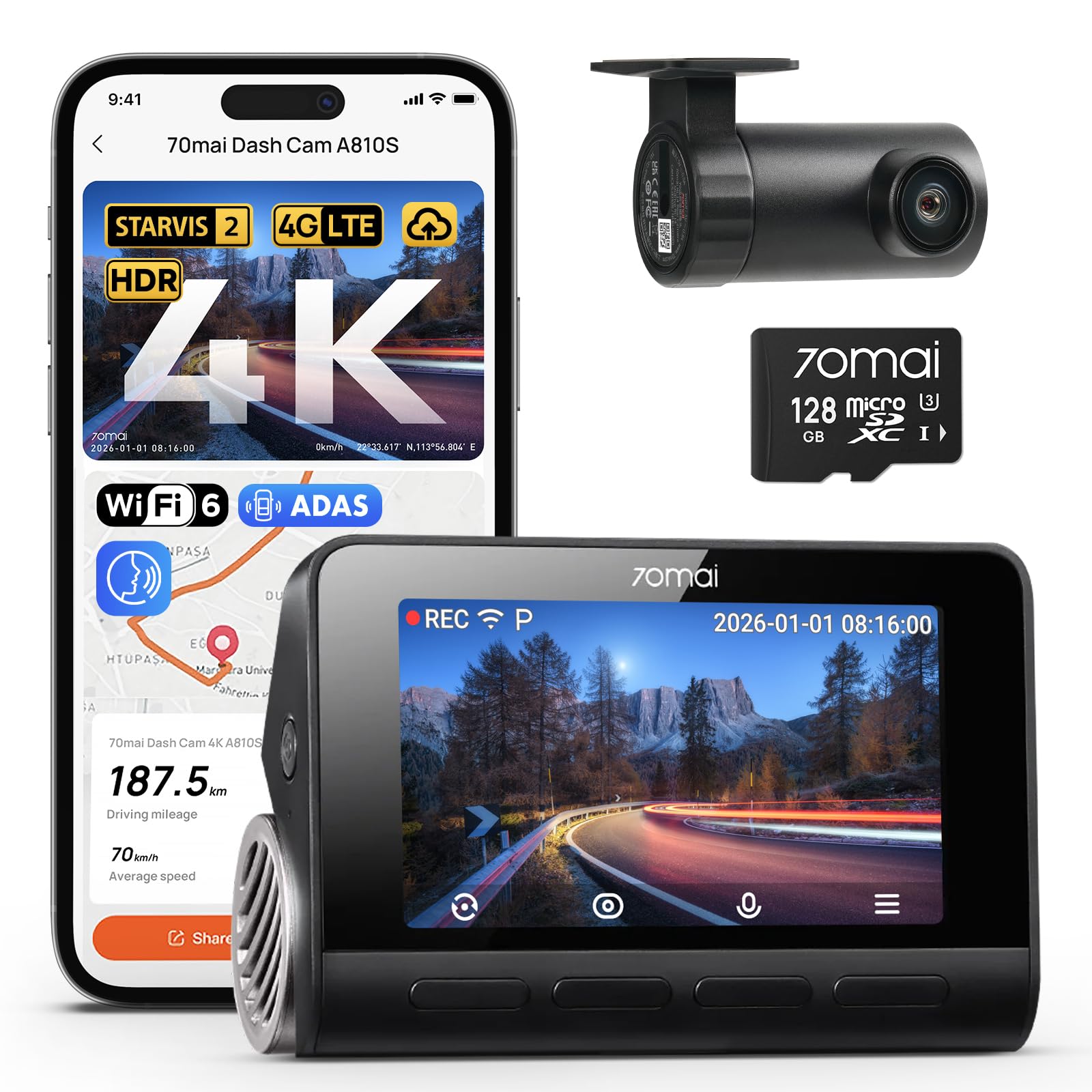
| 70mai 4K + 1080P★ Best Overall | Mid-range value with 4G remote access | 4K + 1080P | STARVIS 2 (IMX678 + IMX662) | AI Motion, Collision, Time-lapse | Amazon |
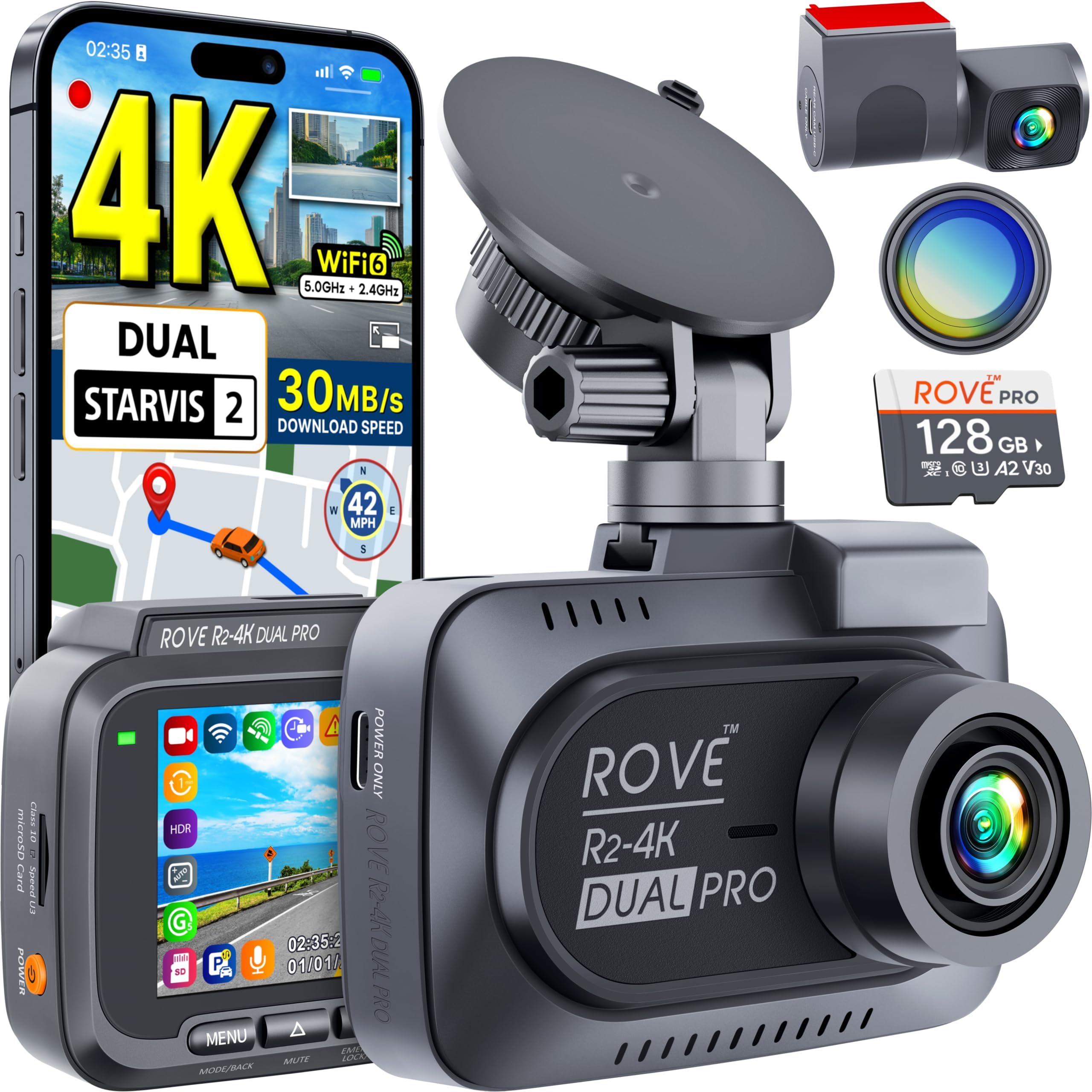
| ROVE R2-4K DUAL PROTop Performer | Premium dual STARVIS 2 with free 128GB card | 4K + 2K | STARVIS 2 (IMX678 + IMX675) | Time-lapse, Motion, Collision | Amazon |
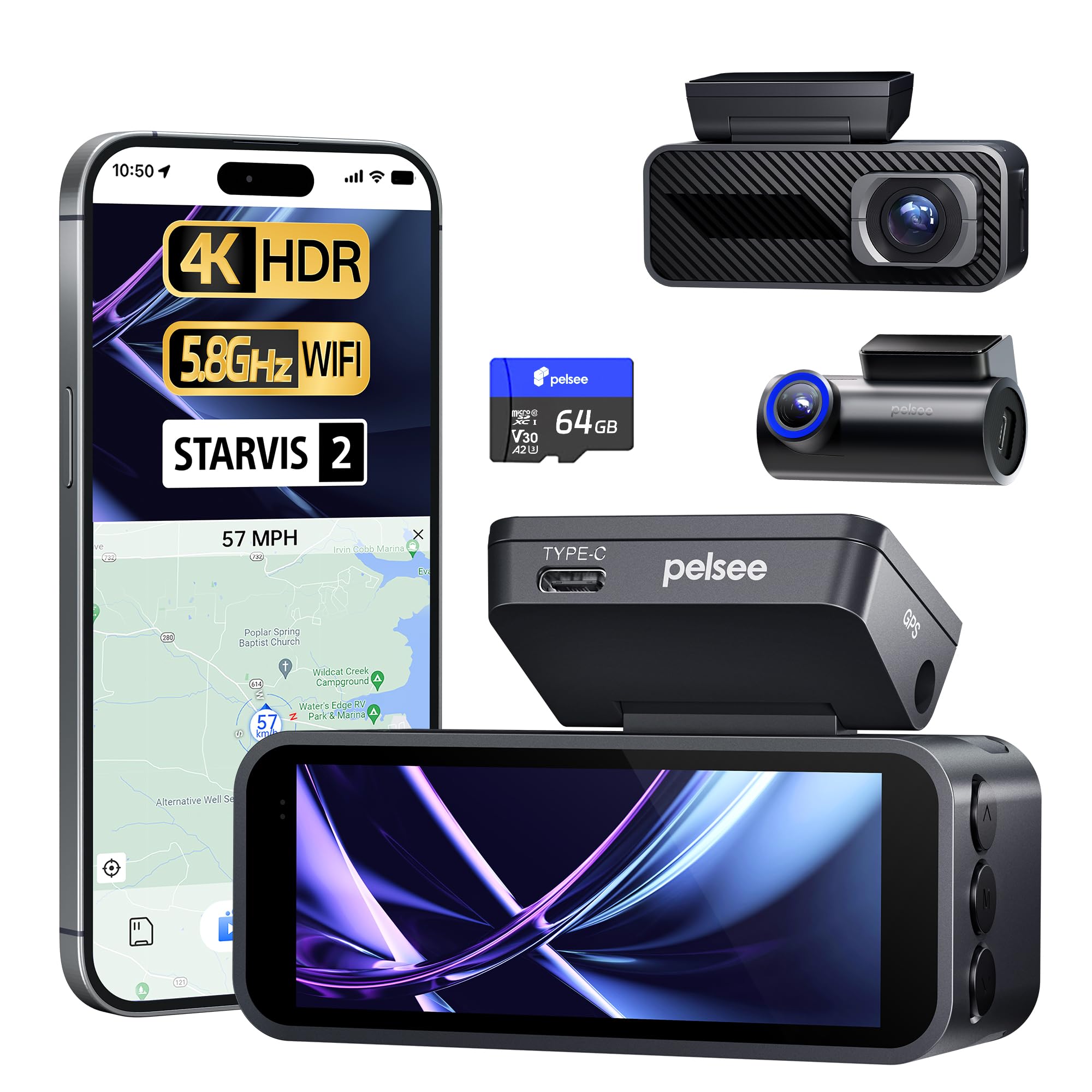
| Pelsee P1 Pro | Budget-friendly with included 64GB card | 4K + 1080P | STARVIS 2 | G-Sensor, Time-lapse | Amazon |
| FAIMEE F9 | Entry-level with dual-band Wi-Fi | 4K + 2K | — | Time-lapse, G-Sensor | Amazon |
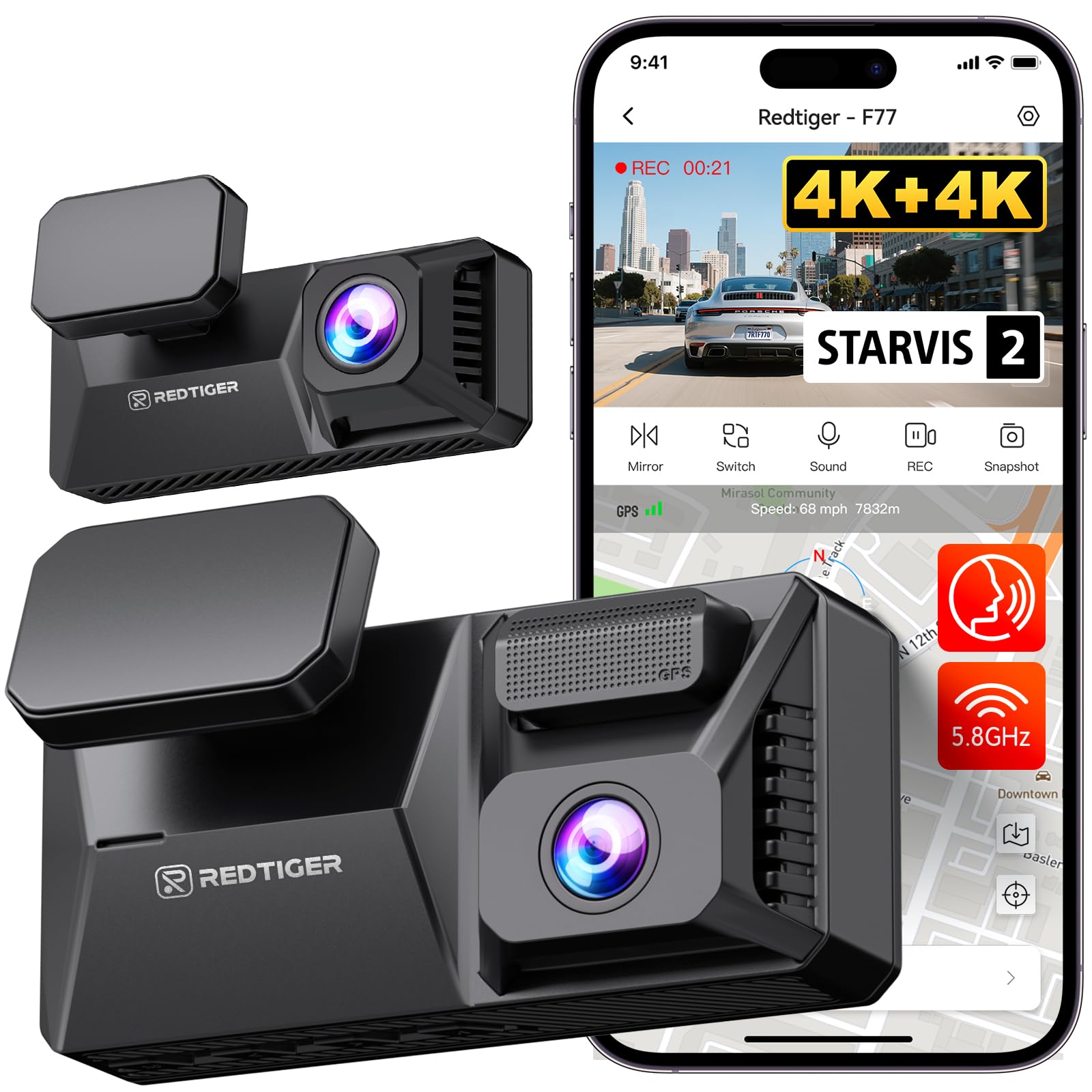
| REDTIGER F77 | True dual 4K with built-in 128GB | 4K + 4K | STARVIS 2 (IMX678 + IMX678) | G-Sensor, Time-lapse | Amazon |
In‑Depth Reviews
1. 70mai 4K + 1080P Dual STARVIS 2
Our pick — over 4★ from 1,500+ verified ratings; the strongest balance of quality and price.
A mid-range all-rounder that adds 4G remote live-view to STARVIS 2 sensors at a reasonable price.
The 70mai 4K + 1080P combines a Sony STARVIS 2 IMX678 front sensor with an IMX662 rear sensor — the same sensor class that the premium ROVE and REDTIGER use up front. The front 4K captures sharp daytime and night-time footage, while the 1080P (1920×1080) rear is adequate for documenting rear-end incidents, though it gives up some detail compared to the 2K or 4K rear cameras on the ROVE and REDTIGER above. The 150° front and 130° rear views cover the blind spots well, and the dual STARVIS 2 sensors with F1.7 aperture deliver very good color in low light. One owner reported after a two-week road trip it “worked without issue” and praised the clear front video.
Where this system sets itself apart is the optional 4G hardwire kit (UP05), which adds remote live-view, GPS tracking, and instant collision alerts to your phone from anywhere. That is a feature you typically only see on systems at twice the price. The 24-hour parking mode works with the hardwire kit and offers AI motion detection that the brand claims distinguishes people and vehicles from tree shadows or stray cats. Built-in GPS with five-position satellite support and Wi-Fi 6 for fast app downloads round out a genuinely strong value package.
STARVIS 2 sensor
- Optional 4G remote access — view live footage and get alerts from anywhere.
- STARVIS 2 front (IMX678) plus STARVIS 2 rear (IMX662) for strong low-light performance.
- Wi-Fi 6 and 5-mode positioning (GPS, BDS, GALILEO, GLONASS, QZSS).
- AI Motion Detection 2.0 reduces false parking-mode alerts, according to the maker.
app glitches
The rear camera records only 1080P (1920×1080) — at 130° it has a narrower field than the 146° front, and it is a step down from the 2K or 4K rear options on other picks.
night vision: Anyone who wants remote monitoring without spending a premium, and values the 4G connectivity and smart motion detection.
tech fuss: You need the rear camera to read plates in detail at night — the 1080P rear falls short of the 2K and 4K units above.
2. ROVE R2-4K DUAL PRO
The dual STARVIS 2 unit that packs Sony’s latest IMX678 and IMX675 sensors for top-tier low-light capture.
The ROVE R2-4K DUAL PRO records the front at true 3840x2160P 4K at 30fps and the rear at 2560x1440P 2K at 30fps — a meaningful step up from the 1080P (1920×1080) rear cameras many competitors use. Sony’s STARVIS 2 (back-illuminated sensor technology that captures color in near-darkness) IMX678 in the front and IMX675 in the rear, paired with wide apertures (F1.7 front, F1.55 rear), let you see license plates clearly in tunnels, rain, or after sunset without harsh headlight glare. Buyers report clear plates both day and night, and one reviewer noted the clarity is “better than BlackVue” at this price.
Parking mode offers three options — 1FPS time-lapse (records one frame per second into a long video), motion detection, and collision detection — and when triggered it saves a full 1-minute event video into a locked folder while giving a voice alert the next time you start the car. The hardwire kit (wiring that connects the camera to your fuse box) is sold separately, but the included 128GB ROVE PRO microSD card plus a CPL (circular polarizer) filter to cut windshield glare makes this one of the better out-of-box values. The ROVE app takes some learning, but dual-band Wi-Fi 6 (the latest fast Wi-Fi standard) with up to 30MB/s transfer speeds keeps downloads quick.
4K dual lens
- Sony STARVIS 2 IMX678 front + IMX675 rear — cleaner night video than many competitors, including the Pelsee P1 Pro which only has one STARVIS 2 sensor.
- Included 128GB microSD card and CPL filter in the box save you money upfront.
- Quad-Mode GPS (GPS, BEIDOU, GALILEO, GLONASS) embeds speed and route data onto videos.
- Wi-Fi 6 download speeds up to 30MB/s — quick enough to grab 4K clips in seconds.
pricey for value
- No built-in storage — relies entirely on the microSD card, which can pop out in a crash.
- The Wi-Fi app has a learning curve, according to several reviewers.
- Hardwire kit for parking mode is sold separately.
sharpest footage: You want the best night-time clarity available without jumping to true dual 4K pricing, and you appreciate getting a free 128GB card and CPL filter from the start.
budget stretch: You need built-in eMMC storage that won’t pop out in a crash, or you want dual 4K resolution at both ends — that is the REDTIGER F77’s territory.
3. REDTIGER F77
The rare dual 4K setup where both cameras use the same high-end STARVIS 2 IMX678 sensor.
The REDTIGER F77 is the only pick in this list that records both the front and rear at true 3840x2160P 4K at 30fps, using the same Sony STARVIS 2 IMX678 sensor at both ends. That makes a real difference when you are trying to read a license plate approaching from behind at night, because the rear camera gets the same light sensitivity as the front. The 4-inch IPS (in-plane switching) touch screen runs 12 voice commands (for example, “Lock the video”) so you do not have to poke at a tiny menu.
Instead of a removable memory card, the F77 uses built-in 128GB eMMC (embedded MultiMediaCard) storage — flash memory soldered directly onto the board. That means it won’t pop loose during a hard impact, and the write speeds are high enough to handle dual 4K recording without dropped frames. Owners mention crisp daytime footage and spot-on voice control, though one buyer mentioned that the adhesive mount can loosen over time and recommended cleaning the windshield thoroughly before installation. Parking mode needs the optional hardwire kit, but the G-sensor (motion sensor that detects bumps) and time-lapse modes cover both collision and continuous surveillance.
wide angle view
- True dual 4K (3840x2160P) on both cameras — sharper rear video than the 4K+1080P or 4K+2K rivals like the ROVE.
- Built-in 128GB eMMC storage — no memory card to lose in a collision.
- Both channels use the STARVIS 2 IMX678 sensor for consistent night performance.
- 4-inch touch screen with 12 voice commands for hands-free control.
night blur
- Some users report the adhesive mount fails over time, especially in hot climates.
- Higher price tag than mid-range options — you pay for that dual 4K quality.
- No CPL filter included to cut windshield reflections.
massive coverage: If reading plates from both directions matters most to you, true dual 4K with built-in storage that won’t pop out in a crash is tough to top.
low light: The mount can loosen — clean the glass thoroughly and consider an extra adhesive strip for long-term security.
4. Pelsee P1 Pro
A budget-friendly STARVIS 2 system that throws in a 64GB card and a 170-degree front lens.
The Pelsee P1 Pro records the front at 4K with HDR (high dynamic range, which balances bright and dark areas) and the rear at 1080P with WDR (wide dynamic range), using a Sony STARVIS 2 sensor for low-light color footage. Its front 170-degree field of view is noticeably wider than the 150-degree lens on the 70mai (170° vs. 150°) that helps catch activity at the edges of the frame in a parking lot. The 3.39-inch IPS (in-plane switching) screen is bigger than most at this level, and the included 64GB SD card means you can record right from the start without an extra purchase. Customers note an easy install — one customer observed a “40-minute install in a Palisade; long cable reaches rear.”
Parking mode uses a G-sensor (motion sensor that detects bumps) for collision detection and time-lapse for continuous surveillance, both requiring a hardwire kit sold separately. The ADAS (advanced driver-assistance system) provides forward collision, lane departure, and pedestrian warnings, though like most budget ADAS it works best in good weather and clear lane markings. Voice control with eight commands lets you lock video or snap photos hands-free, and the 5.8GHz Wi-Fi makes app viewing reasonably fast.
stealth design
- Front 170° field of view — wider coverage than most rivals in this price tier, including the 70mai.
- Comes with a 64GB SD card, saving you an immediate accessory purchase.
- STARVIS 2 sensor with full-color night vision for under a premium price.
- 3.39-inch IPS screen for easy live preview.
average clarity
- Rear camera is 1080P only — clearer rear footage comes from 2K or 4K alternatives like the FAIMEE F9.
- One user highlighted the included lighter adapter needed wiggling to power up reliably.
- ADAS alerts can be sensitive to dirty windshields or faded lane markings.
discreet look: The widest front angle at this price and the included memory card that makes setup truly plug-and-play.
crispness: Rear video clarity is a top priority — the 1080P rear is entry-level compared with the dual 2K or dual 4K systems.
5. FAIMEE F9 4K+2K
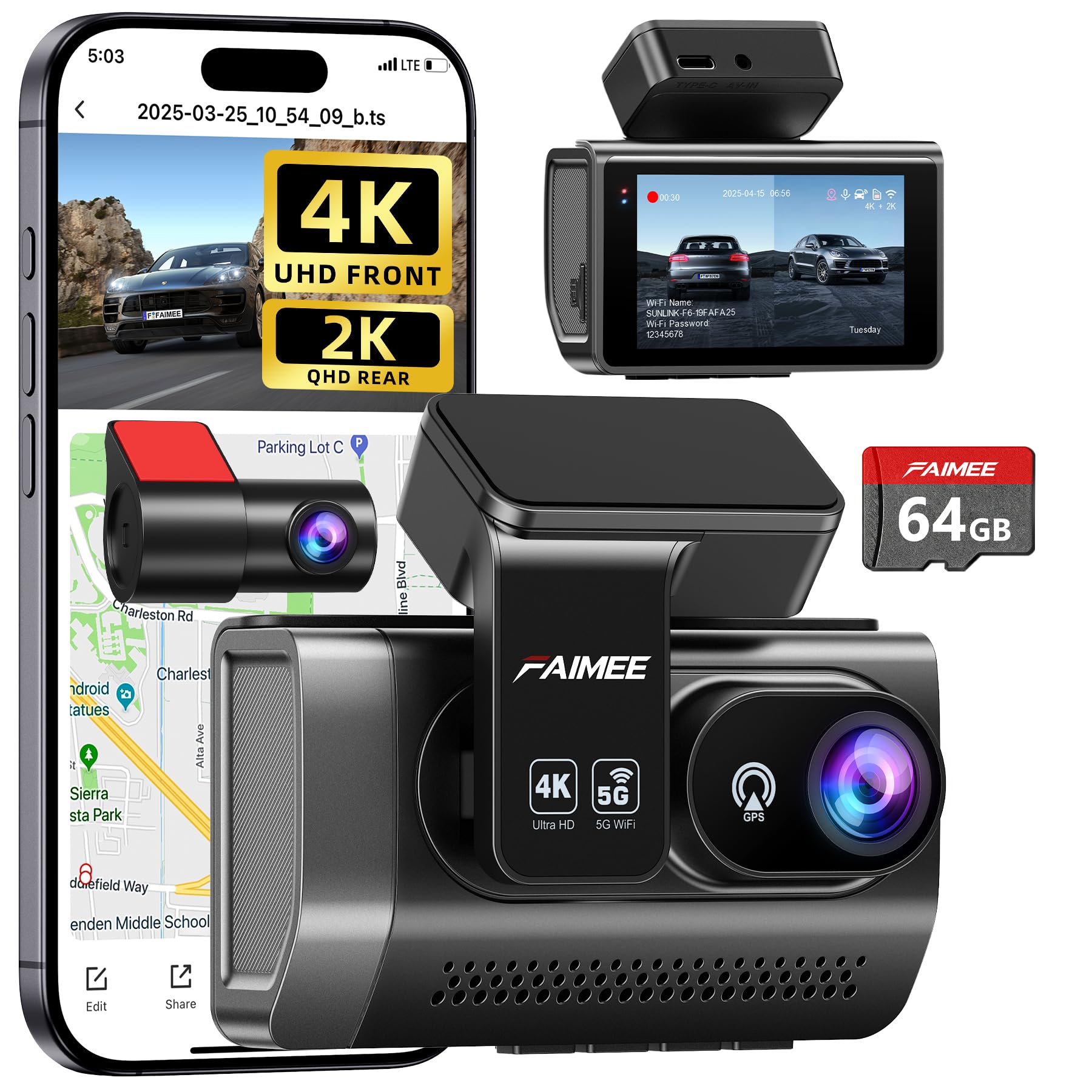
An entry-level dual-cam with a 4K front and a noticeably better 2K rear than most budget options.
The FAIMEE F9 records the front at 3840x2160P 4K and the rear at 2304x1296P 2K — a real upgrade over the typical 1080P (1920×1080) rear camera found on budget units like the Pelsee P1 Pro. The 170° front wide-angle lens covers six lanes of traffic, while enhanced WDR (wide dynamic range) and night vision help balance exposure in bright headlight glare or dark tunnels. A 64GB high-endurance memory card is included so you are ready to record immediately, and the card supports expansion up to 256GB. Reviewers point out the video quality is good for the price and that the app is “simple and straightforward” once you figure out you need to connect to the camera’s own Wi-Fi signal, not your home network.
24-hour parking mode comes in time-lapse or G-sensor (motion sensor for bumps) impact detection flavors, and the hardwire kit is required for continuous use when the engine is off. The built-in GPS tracks speed, route history, and location, embedding them onto the video files as evidence. Dual-band Wi-Fi (5.8GHz and 2.4GHz) gives you a stable connection for live view and video downloads from the FAIMEE app. The 18-month warranty is a nice safety net, though several reviewers noted the instruction booklet can be a little confusing on the first read.
budget 4K
- Rear camera shoots 2K (2304x1296P) — sharper than the 1080P rear on similarly priced competitors like the Pelsee P1 Pro.
- Front 170° wide-angle lens with F1.8 aperture captures broad, well-lit scenes.
- Includes a 64GB memory card and supports up to 256GB.
- Dual-band Wi-Fi (2.4/5.8GHz) for faster, more stable app connections.
build feels cheap
- No STARVIS 2 sensor — low-light footage is decent but not as clear as the Sony-sensor units above (ROVE, REDTIGER, 70mai, Pelsee).
- The body is a bit bulkier than other models, which some buyers noted during installation.
- App connection can be tricky on first setup — you must connect to the camera’s Wi-Fi, not your home router.
entry price: If you are on a tighter budget but still want a rear cam that shoots sharper than 1080P, the F9 delivers real 2K rear video for a very low entry cost.
durability: Night-vision quality is your non-negotiable — the STARVIS 2-equipped units above will give you noticeably better detail after dark.
Understanding the Specs
STARVIS 2 Sensor
STARVIS 2 is Sony’s latest back-illuminated CMOS (complementary metal-oxide-semiconductor) sensor technology for car cameras. It captures usable color footage in near-darkness — think municipal parking lots or rural roads — without needing bright white LEDs. A dash cam with a STARVIS 2 sensor (IMX678, IMX675, or IMX662) will give you noticeably clearer nighttime video than one without it.
Parking Mode Types
Parking mode keeps one or both cameras recording after the engine is off. The three main methods are: time-lapse (records one frame per second into a long video), motion detection (wakes the camera when something moves in the frame), and collision detection (records a locked clip when the G-sensor feels a bump). Most good dash cams let you pick the one that suits your parking spot.
G-Sensor
A G-sensor is a small motion sensor inside the dash cam that measures sudden acceleration or impact. When it detects a collision — even a door ding in a parking lot — it automatically marks the current video file as “locked” so it won’t be overwritten by loop recording. This is your primary evidence saver.
Hardwire Kit
A hardwire kit connects the dash cam directly to your car’s fuse box instead of the 12V cigarette lighter socket. It allows 24/7 parking mode by drawing a small amount of battery power, and most kits include a low-voltage cutoff that stops the camera from draining your battery below starting voltage.
FAQ
Can a dash cam drain my car battery in parking mode?
What is the difference between time-lapse, motion detection, and collision detection parking mode?
Do I really need a front and rear dash cam, or is just front enough?
Is a 4K front camera worth it if the rear is only 1080P?
Can I install a dual dash cam myself, or do I need a professional?
What size microSD card do I need for a 4K dash cam?
Is built-in eMMC storage better than a microSD card for dash cams?
Does Wi-Fi on a dash cam really matter?
What does the CPL filter do for a dash cam?
Final Thoughts: The Verdict
If you want one dependable pick, the front and rear dash cam with parking mode winner is the ROVE R2-4K DUAL PRO because it combines dual STARVIS 2 sensors for incredible night vision with a free 128GB card and CPL filter, delivering strong value for the premium sensor quality. If you want true dual 4K recording with built-in eMMC storage that won’t drop out in a crash, grab the REDTIGER F77. And for a balanced mid-range pick with optional 4G remote access, the 70mai 4K + 1080P gives you a solid feature set without the premium price.
How We Picked
We do not accept paid placement. Every pick is matched to a real buyer and a real use-case; we do not hands-on test units.
Sources & Methodology
Specifications: manufacturer listings and product documentation. Review insights: verified customer reviews, as of July 2026. Pricing: not shown on this page (it changes often); check the current price via the retailer link.
As an Amazon Associate, Trending Car earns from qualifying purchases. This does not affect which products we feature.