
Our readers keep the lights on and my garage snacks stocked. As an Amazon Associate, I earn from qualifying purchases.
Specs are compiled from manufacturer listings and verified buyer reviews and can change over time — please confirm the key details on the product page before buying.
Your van roof is curved — most are — so a stiff glass panel leaves a gap, catches wind, and wastes usable space. A flexible solar panel solves that: it bends to match the roof’s shape, sits nearly flush, and turns that awkward surface into charging power for your fridge, lights, and gadgets without drilling holes or adding heavy roof racks. The right panel delivers consistent power you can rely on for your van’s electrical system.
I’m Min Islam — the founder and writer behind Trending Car. This guide is built by comparing the manufacturers’ published specifications and the patterns across verified customer reviews, so you get each pick’s real strengths and trade-offs instead of marketing spin.
That research leads to one key takeaway for your setup: the best flexible van solar panels deliver real-world wattage you can actually see on your charge controller, with a bend radius that fits your roof’s curve and a weight you can lift with one hand.
Our Picks at a Glance


How To Choose The Best Flexible Van Solar Panels
The right flexible panel for your van is about more than the wattage number on the box. You have a curved roof, limited space, and a charging system that expects a steady voltage. Three things matter most: cell efficiency (how much power you get from each square foot of roof), busbar count (which affects how much shade kills your output), and the physical construction — ETFE vs. PET face sheet, bend radius, and waterproofing at the junction box.
Cell Efficiency and Busbar Technology
Efficiency is the percentage of sunlight the panel turns into electricity. A panel with 23% efficiency makes more power on the same roof area than a 21% panel — that matters when you only have a few square feet to work with. Busbars are the thin metal lines across each solar cell; more busbars (9BB, 11BB, or 16BB) mean the panel can still push current when part of the cell is shaded by a vent or antenna, because the electricity has more paths to travel around the shadow.
Physical Build: Face Sheet, Bend, and Weight
The top layer is either ETFE (a tough UV-resistant fluoropolymer) or plain PET (polyester). ETFE costs a bit more but stays clear longer and resists yellowing — key for a panel that sits in full sun for years. The bend radius matters if your van roof has a pronounced curve; a panel rated for 240° of flexibility hugs a dome better than a 100° one. Weight is a practical concern on a van roof: 4 pounds is easy to move, but 5.7 pounds is still manageable with one hand.
Voltage and Connector Compatibility
Most van electrical systems run on 12V lead-acid or LiFePO4 batteries (lithium iron phosphate, a common deep-cycle battery type). You want a panel with a maximum voltage (Voc — the voltage when no current is flowing) comfortably above your battery voltage so the charge controller can work properly — 18 to 24 Volts is typical for a 12V system. Make sure the panel has MC4 connectors (standard solar plug connectors) so you can hook it to your charge controller without splicing wires.
Quick Comparison
| Model | Best For | Cell Efficiency | Weight | Bend | Amazon |
|---|---|---|---|---|---|
| Renogy 100W Flexible (Original)★ Best Overall | Tried-and-true van build | 22% | 4 lbs | N/A (flexible) | Amazon |
| BougeRV Arch Pro 100WTop Performer | Maximum shade-proof output | 25% | 4.63 lbs | 270° | Amazon |
| Callsun 100W Ultra-Thin 11BB | Best balance of value and output | 23% | 5.66 lbs | 240° | Amazon |
| XINPUGUANG 100W 12BB | Ultra-light 4 lb install | 23-24% | 4 lbs | 260° | Amazon |
| Renogy 100W Half-Cut PERC | Premium 500 Wh/day output | 22% | 5.3 lbs | 240° | Amazon |
| Topunive 2-Pack 100W | Two panels for a full roof | 23% | 4.4 lbs (each) | 45cm radius (17.7 in) | Amazon |
| Topunive 100W 9BB | Entry-level curved roof | 23% | 4.4 lbs | 45cm radius (17.7 in) | Amazon |
In‑Depth Reviews
1. Renogy Flexible Solar Panel 100 Watt 12 Volt Monocrystalline Semi-Flexible
Our pick — over 4★ from 950+ verified ratings; the strongest balance of quality and price.
Van builders have trusted this panel for three years straight — a proven workhorse.
At 4 pounds and only 0.08 inches tall (about 95% thinner than a rigid panel), this Renogy is the reference standard that many others are measured against. It delivers 22% high efficiency versus the newer callsun’s 23%. The polymer and aluminum alloy frame together withstood wind up to 2400 Pa and snow loads up to 5400 Pa in testing. At 48 inches long, it is the longest single panel here, so it works well on the long flat section of a high-roof van.
Buyers report using two panels for three years on a van and hitting “peak output 175W” from the pair. Another reviewer simply says: “Used 2 Renogy 100W flexible panels for 3 years on van.” The Renogy ecosystem also means this panel plays well with Renogy charge controllers, cables, and bluetooth monitors from the start. The real trade-off: its efficiency (22%) versus the callsun’s 23%, and it has fewer busbars than the 11BB or 16BB competitors, so shading hits this one harder. But for a proven, well-reviewed build with over 950 ratings, this is the safe bet.
What makes it a classic
- 4 pounds and a 0.08-inch profile
- 954 ratings with a 4.4 average — huge buyer trust
- 5-year manufacturer warranty for confidence on a permanent install
The performance gap
- 22% efficiency trails the 23-25% newer panels — less power per square foot
- At 48 inches it is the longest panel here, which may hang over a short roof
Best for: van owners who want a panel with a huge community of builders behind it, proven long-term reliability, and a 5-year warranty.
Not the one if: you need the absolute highest efficiency per square inch of roof — the newer tech panels beat it on output density.
2. BougeRV Arch Pro 100 Watts Anti-Shading N-Type Fiberglass Flexible Solar Panel
This panel pushed 226 watts on a single 100W-rated panel in real sun.
This over-performance comes from the 16BB N-type cell design with a 25% conversion rate, the highest efficiency in this guide. For you on a van roof, it means you get usable power even when the boom of a sailboat or a roof vent throws partial shade — the bypass diode tech fights that hot-spot effect that normally causes delamination. The panel weighs 4.63 lbs and is only 2.5mm thick, so it sits flush against a curved fiberglass roof without looking lumpy.
Buyers report that one owner mounted theirs on a rooftop tent using 3M VHB tape and saw 190W to a Jackery on a sunny day, and another hit a literal 226W peak. The 270° flexibility is the widest in this guide; you can wrap it over the front curve of a camper or a van’s brow. Owners mention the fiberglass backing is stiff enough to hold its shape but still bends to odd contours — a rare combo. The catch at this premium tier is that sticky tape for mounting is sold separately, so budget for VHB or a glass glue kit.
Why it earns the top spot
- Real-world reports of 226W from a 100W-rated panel — far above typical output
- 25% efficiency with 16BB N-type cells deliver power even under partial shade
- Only 2.5 mm thick and 4.63 lbs, with a 270° bend radius for complex roof curves
The one trade-off
- Mounting tape is sold separately — no adhesive included from the start
- Premium price level; for a budget build one of the value picks below may suit better
Best for: van owners who want the highest possible output from a single flexible panel and are building a serious solar system with an MPPT controller.
Look elsewhere if: your budget is tight for a single 100W panel — the efficiency tech here commands a premium.
3. Callsun 100W Ultra-Thin Flexible Solar Panel 12V, 11BB 23% High-Efficiency ETFE Monocrystalline
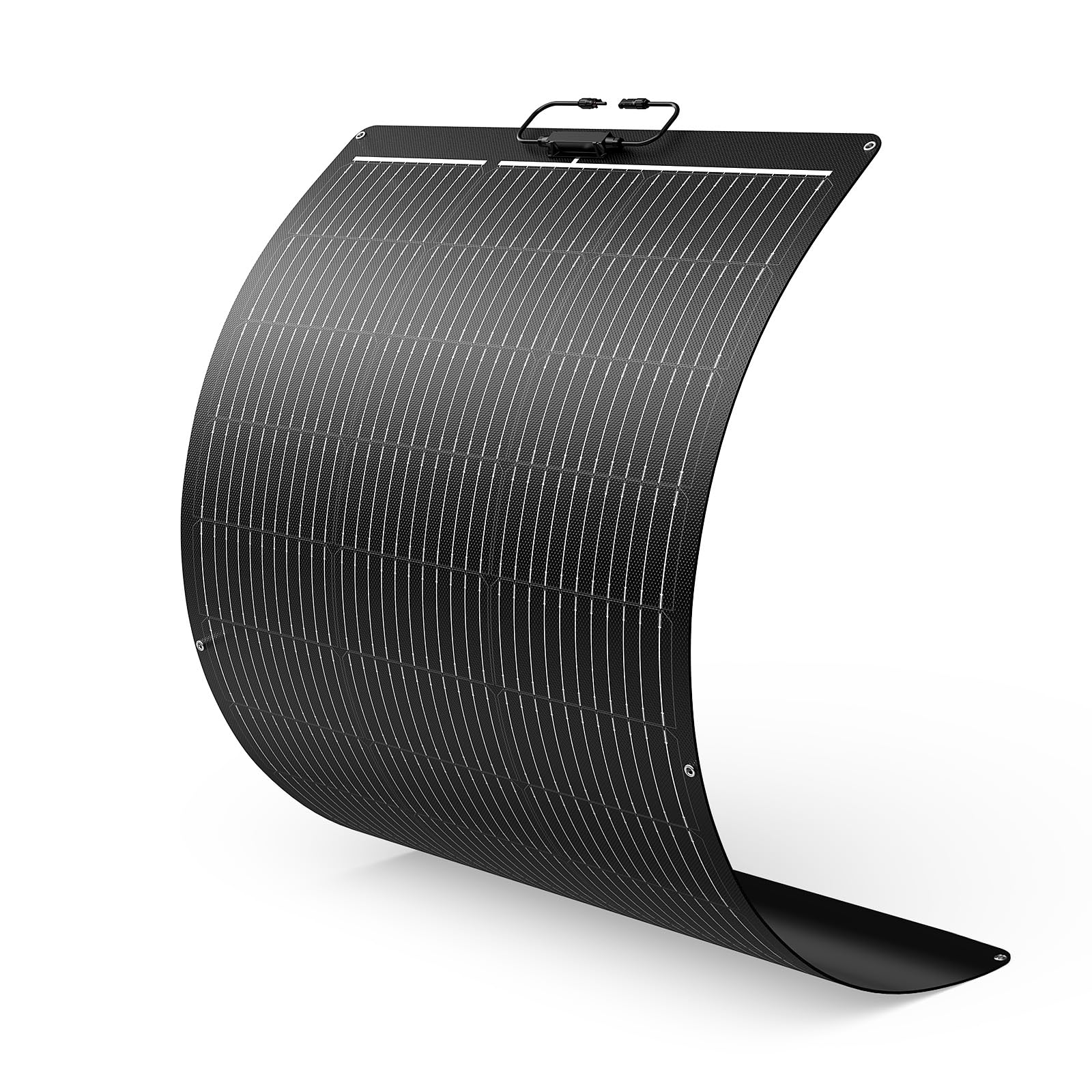
This budget-friendly panel matches its 100W rating in real sun, according to buyers.
With 23% high-efficiency cells and 11 busbars, this panel is a step ahead of the older 9BB designs — it keeps power flowing even when a little shade hits the leading edge. The ETFE coating resists salt-mist and UV-yellowing, which is a big deal if you are spending time near the coast or in the desert. It pulls 5.38 Amps at 18.61 Volts, meaning it charges a standard 12V LiFePO4 battery without needing a special charge controller.
Customers note seeing a combined 210W peak from two panels in series on a 99 Suburban, which is impressive for 100W-rated panels. At 5.66 lbs, it is the heaviest single panel here — but that weight reflects the thicker ETFE lamination. One reviewer noted a multimeter reading showed it “very efficient and was on-par with my more expensive panels output.” The 240° bend rating lets you curve it over most van roof contours, though it is slightly heavier than the 4 lb Renogy alternative.
The value edge
- 23% efficiency with 11BB cells; the original Renogy has 22% efficiency for a similar price tier
- ETFE coating fights UV yellowing better than PET-coated panels
- Buyers confirm 210W in series — real output matches the sticker
The trade-off to know
- At 5.66 lbs it is heavier than the 4 lb XINPUGUANG or 4.4 lb Topunive options
- Only a handful of reviews exist (37) so long-term data is thinner than on established brands
Reach for this if: you want the best power-to-price ratio and a panel with modern busbar tech that actually delivers real-world wattage close to the lab number.
skip it if: you need the absolute lightest panel for a weight-sensitive install — the 4 lb XINPUGUANG is a better choice.
4. XINPUGUANG Flexible Solar Panel 100W 12V Monocrystalline 12BB Cell Fiberglass Lightweight

Weighing only 4 pounds with a 260-degree bend, this is the featherweight champ for tricky roof curves.
At 0.098 inches thick, this panel is barely thicker than a credit card, and its 12BB monocrystalline cells hit a conversion efficiency of 23% to 24%. The high cell efficiency means the panel is physically smaller for the same 100W rating, leaving more room for a second panel or a MaxxAir fan. It also carries an IP67 waterproof rating (meaning it survives dust and immersion in a meter of water for 30 minutes) and is rated to handle snow loads up to 5400 Pa and wind loads up to 2400 Pa — so it stays stuck when the highway wind hits.
Reviewers point out one van owner mounted two on a cargo box and found they “literally charges up my apex 300 of almost 4000watts in one day.” Another reviewer noted getting 3 amps at 17.4 volts at noon in November in Washington, which is reasonable for a 100W panel in winter low sun. The 6.66 Amps capacity is the highest amperage on this list, which gives you flexibility to run multiple panels in parallel without worrying about current limits on your charge controller.
Why it stands out
- 4 lbs is tied for lightest in this guide — easy to lift, handle, and store flat
- 260° bend gives you more mounting flexibility than most panels
- 6.66 Amps output is the highest amperage here for parallel setups
The honest limit
- Some shoppers say the panel is delicate — instructions say not to squeegee or walk on it
- One unit arrived with scratches and missing protective film near the junction box
Best for: weight-conscious van builds where every pound on the roof counts, and for roofs with extreme curves that need a 260-degree bend.
Look elsewhere if: you need a panel that can take rough handling or surface pressure — this one is designed to be mounted and left alone.
5. Renogy 100W Solar Panel 12V Flexible 22% High-Efficiency 240° Ultra Lightweight Half-Cut PERC

Half-cut PERC cells ensure shade on one half doesn’t kill the other half’s output.
This Renogy uses half-cut PERC technology (Passivated Emitter and Rear Contact — a standard solar cell design that captures more light from the back), which takes each solar cell and slices it in half so that when shade covers the bottom of the panel, the top half still pushes current. Renogy claims an average of 500 Watt-hours per day from this 100W panel (depending on sun availability). With a 240° bend rating and IP67-rated junction box, it handles snow loads up to 5400 Pa and wind up to 2400 Pa just like the original Renogy.
Owners mention one owner gets about 87 watts on a sunny day mounted on a truck bed cap charging a Jackery. Another reviewer notes it is “shade-tolerant,” but a sailing owner found it “next to useless when partially shaded by the boom” — turns out it uses 9 busbars rather than the newer 16BB architecture. That is the honest trade-off: this panel is shade-resistant compared to a basic panel, but not as shade-tolerant as the BougeRV 16BB design. At 5.3 lbs and 0.8 inches thick, it is bulkier than the original Renogy.
The half-cut advantage
- Half-cut PERC cells keep half the panel working when the other half is shaded
- Rated for 500 Wh/day — solid daily energy for a fridge and lights
- 240° bend matches most van roof curves comfortably
Real-world catch
- 9 busbar architecture — shade on the full cell kills more power than a 16BB panel would
- At 5.3 lbs it is 1.3 lbs heavier than the original Renogy
Best for: van owners who want Renogy’s reliability with the added shade resilience of half-cut cells for roofs with partial shadow from vents.
Look elsewhere if: shade is a major issue at your campsite — the 16BB BougeRV is a better anti-shade weapon.
6. Topunive 2-Pack 100W 12V Flexible Solar Panel 9BB Monocrystalline Cell

Two panels in the box give you a full-roof solar array at a single-panel price from some competitors.
The 9BB monocrystalline cells deliver up to 23% conversion efficiency, and the ETFE front sheet resists weather better than the cheap PET used on lesser panels. Each panel weighs 4.4 lbs and measures 36.22 inches long — shorter than the Renogy’s 48 inches, which is actually an advantage if you have a shorter roof. The minimum bend radius of 45 cm (about 17.7 inches) means it will conform to most van curves, though it is not quite as bendy as the 240-270° rated panels.
Customers note one owner mounted the pair on a camper and saw 208W at 15 Amps from an MPPT controller, with a max of 210W. Another reviewer said the panels survived being ripped off the roof at 70 mph and run over by several vehicles — “still works fine.” That is a level of durability that is hard to ignore. However, a reviewer noted a batch change where newer panels have 9 columns of segments instead of 11 and started delaminating after four weeks, so be sure to buy from a recent batch with good return support.
Why buy the pair
- Two 100W panels for roughly the same price as one premium 100W — great value for a full 200W roof
- Buyers confirm 208-210W real-world output in good sun from an MPPT controller
- ETFE front sheet and IP67 junction box mean solid weather protection
Risk to be aware of
- One buyer mentioned delamination after 4 weeks on a newer production batch
- Small mounting grommets — only zip ties fit; you will likely need adhesive or custom brackets
Best for: van builders on a budget who want a complete 200W array in one shipment and are willing to handle some assembly creativity with mounting.
Look elsewhere if: you want a single panel with proven long-term production consistency — the Renogy original is a safer bet for a permanent single-panel setup.
7. Topunive 100W 12V Flexible Solar Panel 9BB Monocrystalline Cell Semi-Flexible
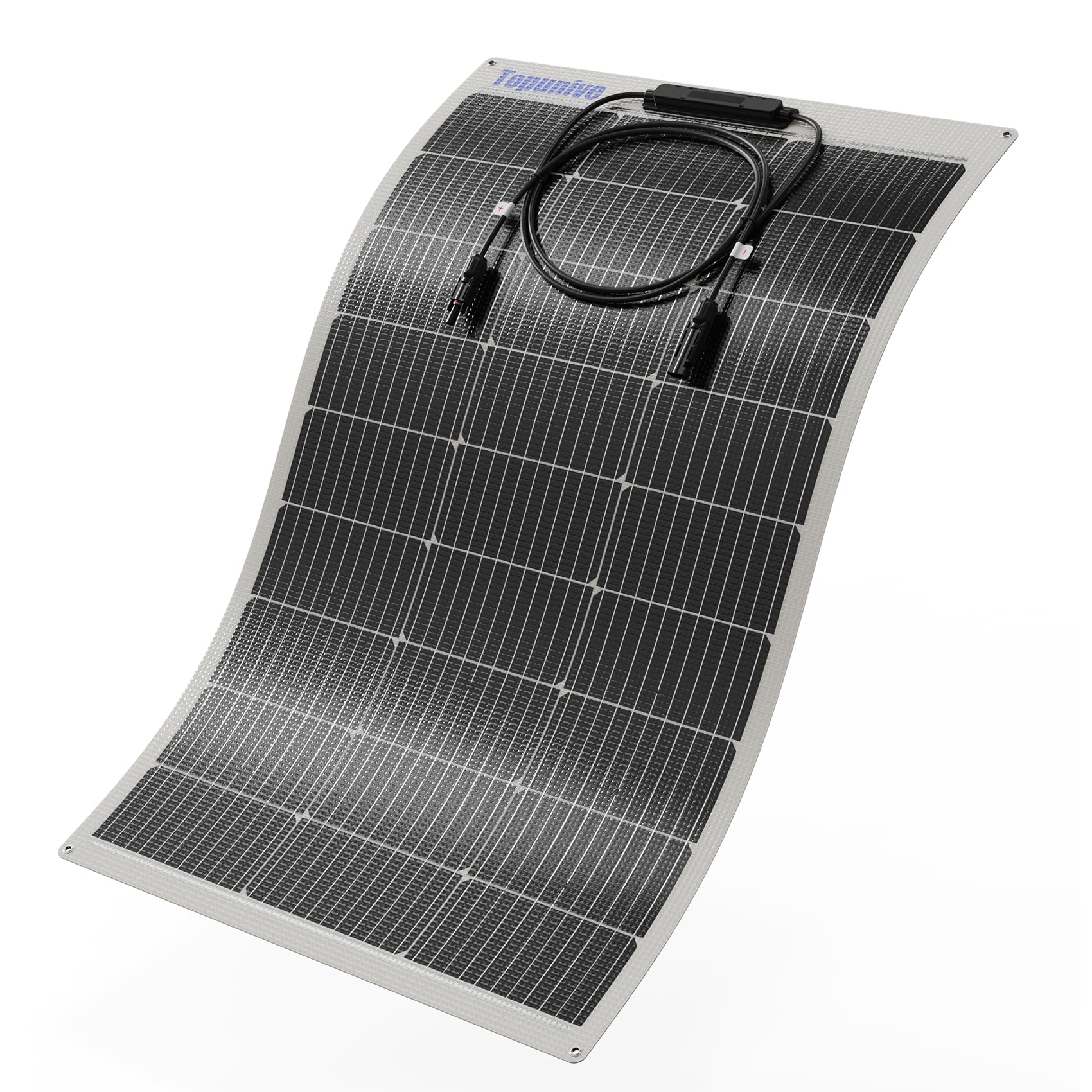
A no-frills 100W panel that fits tight budgets and tight roofs with equal ease.
The 9BB cell design delivers up to 23% efficiency, which is impressive at this entry-level price. The panel uses ETFE material for the front sheet — better light transmission and longer life than the PET you see on budget no-name brands. It weighs 4.4 lbs and is just 0.12 inches thick, and the 45cm bend radius (about 17.7 inches) means it wraps around a standard fiberglass camper curve without stress. The IP67-rated junction box and two bypass diodes help minimize power loss when a cloud or a tree branch casts a shadow.
Reviewers point out using four of these for a year in series+parallel and getting 300W typical (75-82W per panel) with a max of 330W. One owner reported the prismatic surface improves low-angle output compared to glass panels — a real advantage for morning and evening charging when the sun is slanted. At 5.24 Amps per panel, you can wire three in parallel and still stay under most charge controller input limits. The honest catch: some shoppers say max observed output around 89W per panel rather than the full 100W, so manage expectations on raw peak wattage.
Why it makes sense on a budget
- 23% efficiency at an entry-level price is tough to top for cost-per-watt
- ETFE face sheet outlasts PET in UV exposure
- Buyers confirm real-world 75-82W per panel after one year continuous use
The expectation check
- Typical real-world peak around 89W per panel, not the full 100W lab rating
- 9BB cells are less shade-tolerant than 11BB or 16BB options
Best for: a first-time van build on a strict budget where good efficiency and an ETFE face sheet matter more than a precise 100W peak.
pass on it if: you need exact 100W rated output for a critical power budget — the Callsun or XINPUGUANG panels are more consistent on real-world wattage.
Understanding the Specs
Busbars And Shade Tolerance
Busbars are the thin metal strips running across the width of each solar cell. A 9BB panel has nine of them; a 16BB has sixteen. More busbars give electricity more paths to flow around a shadowed spot — so if a leaf or a roof vent covers part of a cell, the panel still produces some power. On a van roof where an air conditioner, fan vent, or antenna creates constant shadows, a 16BB panel like the BougeRV Arch Pro will give you more usable energy through the day than a 9BB panel. The trade-off is that more busbars generally cost a little more.
ETFE vs. PET Face Sheets
The top clear layer of a flexible solar panel is either ETFE (ethylene tetrafluoroethylene) or PET (polyethylene terephthalate). ETFE is a fluoropolymer — the same tough material used on architectural roofs — and it resists UV yellowing, hazing, and cracking for years. PET is cheaper and works fine for the first season, but it tends to go cloudy or start peeling after 12-18 months of constant sun exposure. Every panel on this list that specifies its front material uses ETFE (the Callsun, the two Topunive, and the BougeRV), which is a strong sign the manufacturer expects it to last.
FAQ
Can I walk on a flexible solar panel mounted on my van roof?
How do I stick a flexible solar panel to a curved van roof?
Will a 100W flexible panel fully charge my van battery in one day?
What is the difference between a 9BB, 11BB, and 16BB solar cell?
Can I connect multiple flexible panels to one charge controller?
How do I clean a flexible solar panel without damaging it?
Will a flexible solar panel work if part of it is in the shade?
How long should a flexible solar panel last on a van roof?
Final Thoughts: The Verdict
For most van builders, the best flexible van solar panels winner is the Callsun 100W Ultra-Thin because it delivers 23% efficiency with 11 busbars at a price point that undercuts the Renogy and BougeRV options while still using ETFE lamination. If you want the absolute highest output from a single panel and will face partial shade every day, grab the BougeRV Arch Pro — its 25% efficiency and 16BB cells give you the best shade-proof performance on this list. And for a zero-fuss install with a 5-year warranty and a huge community of van builders who have already proven it works, the standout is the Renogy 100W Flexible.
How We Picked
We do not accept paid placement. Every pick is matched to a real buyer and a real use-case; we do not hands-on test units.
Sources & Methodology
Specifications: manufacturer listings and product documentation. Review insights: verified customer reviews, as of July 2026. Pricing: not shown on this page (it changes often); check the current price via the retailer link.
As an Amazon Associate, Trending Car earns from qualifying purchases. This does not affect which products we feature.