
Our readers keep the lights on and my garage snacks stocked. As an Amazon Associate, I earn from qualifying purchases.
Specs are compiled from manufacturer listings and verified buyer reviews and can change over time — please confirm the key details on the product page before buying.
Your truck’s glow-plug light pops on, and you lose power climbing hills. Fuel economy drops. Ignoring it means a costly dealership visit to replace the DPF (diesel particulate filter — the exhaust part that traps soot). The right cleaner burns soot faster, extends time between regeneration cycles, and keeps your engine running smoothly. This guide compares seven of the most effective additives and foams available on Amazon right now, using real owner results and the published specs, so you know which one fits your truck, tractor, or TDI before you spend a dime.
I’m Min Islam — the founder and writer behind Trending Car. This guide is built by comparing the manufacturers’ published specifications and the patterns across verified customer reviews, so you get each pick’s real strengths and trade-offs instead of marketing spin.
Finding the right best dpf cleaner means matching the chemistry to your specific buildup level and driving cycle — not just grabbing the cheapest bottle on the shelf.
Our Picks at a Glance


How To Choose The Best DPF Cleaner
A diesel particulate filter cleaner does one main job: it lowers the temperature at which trapped soot burns. That lets your truck’s regeneration cycle finish faster and use less fuel. But not every bottle does that well. Here are the three specs and decisions that separate a bottle that works from a bottle that just smells like diesel.
Fuel additive vs. direct foam spray
A fuel additive mixes with your diesel and works inside the combustion chamber, then passes through the exhaust to lower the soot burn temperature inside the DPF. It is the right choice for mild buildup — the kind where your regen interval (miles between self-cleaning burns) has slowly crept shorter over a few months. A direct foam spray, on the other hand, is applied through the oxygen sensor port directly into the filter. It physically dissolves heavy carbon crust in a parked car and is meant for filters that are already in limp mode or throwing a P242F code (a diagnostic trouble code meaning “Diesel Particulate Filter Restriction — Ash Accumulation”). If your DPF is severely clogged, a foam cleaner is usually the first step; a fuel additive is then used for maintenance.
Concentration and unit count
Buyers often overlook how much cleaner they are actually buying. A 64-ounce bottle like the Lucas Oil Deep Clean treats a 30-gallon fuel tank with the full bottle, while a 16.9-ounce concentrate requires one bottle per treatment. If you drive a heavy-duty diesel with a big tank, grab the larger volume so you are not buying a second bottle mid-week. The verified comparison shows a 2.1x gap in unit count between the largest and smallest offerings in this category — that matters when you are planning a long-haul maintenance schedule.
Regen-interval improvement data
The best evidence that a DPF cleaner works is a real number: the miles between active regenerations before treatment versus after. A regen interval that jumps from 384 miles to 462 miles — as one buyer measured with Wynn’s — tells you the product is doing its job. Look for reviews or specs that mention the reduction in soot mass after regen, or the increased miles before the next regen. Products that avoid publishing this number often rely on “feel” rather than measurable results.
Quick Comparison
| Model | Best For | Volume | Type | Key Result | Amazon |
|---|---|---|---|---|---|
| Lucas Oil 10873★ Best Overall | Heavy-duty prevention | 64 oz | Fuel additive | 32% reduction in particulate matter | Amazon |
| Rislone 4744Euro Diesel Pick | VW TDI / Euro diesel | 16.9 oz | Fuel additive | Clears P242F, P2463 codes | Amazon |
| MotorPower Foam Cleaner | Severely clogged DPF | 1 can (spray) | Direct foam spray | DPF load 114% to 0% (Sprinter) | Amazon |
| MotorPower Purge Additive (2-pack) | Post-foam maintenance | 30.8 oz (2 pk) | Fuel additive | Cleared low threshold code (Nissan) | Amazon |
| Wynn’s DPF Regenerator | Measured regen interval gain | 500 ml | Fuel additive | +78 mi regen interval | Amazon |
| Liqui Moly Pro-Line 5169 | Sprinter / professional use | 33.81 oz (1 L) | Spray/soak | 50k+ miles post-clean | Amazon |
| Power Service DPF Flush | Full system flush | 64 oz | Fuel additive | Regen frequency up to 50% less | Amazon |
In‑Depth Reviews
1. Lucas Oil 10873 Diesel Deep Clean – 64 Ounce
Our pick — over 4.5★ from 650+ verified ratings; the strongest balance of quality and price.
The 64-ounce jug that saved a Ram 2500 owner a DPF replacement.
This is the one to keep in your garage if you own a heavy-duty diesel with a big fuel tank — think Cummins, Duramax, Power Stroke. Lucas Oil claims a 32% reduction in particulate matter (the soot particles that clog the filter), and the 64.0 Fluid Ounce bottle holds more than twice the volume of the MotorPower Care 2-Pack at 30.8 Fluid Ounces. That means one bottle treats a full 30-gallon tank as a single dose. Buyers report that pouring a full 64oz into a 30-gallon tank, followed by a stationary regen (a forced self-clean) and a 30-mile drive, dropped a Ram 2500 6.7L Cummins DPF gauge from full to 0% in about two hours. Another owner on a 2016 Nissan XD 5.0L saw fuel economy jump from 17.8 to 20.2 miles per gallon on the same trip after using 16 ounces.
The real-world use case here is simple: you drive a lot, need consistent regen (self-cleaning burn) performance, and do not want to think about DPF problems every month. Unlike foam sprays that require you to pull a sensor and spray directly, this additive just pours into the tank. It also cleans fuel injectors at the same time — a dual function that saves you from buying a separate injector cleaner. The main trade-off is the price tag, but when measured against a dealer cleaning or a DPF replacement, it disappears.
The real-world edge
- 64-ounce bottle treats big tanks without needing a second purchase
- Owners mention measurable MPG gain — one owner saw 17.8 to 20.2 mpg on the same route
- Reduces particulate matter by up to 32% according to the manufacturer
- Works as a fuel injector cleaner simultaneously
The honest catch
- Not a “limp mode rescue” — if your DPF is severely crusted, you may need a foam clean first
- Some owners with extreme buildup still needed a second treatment
Reach for this if: you drive a heavy-duty diesel with a large tank and want a reliable, high-volume maintenance additive that also cleans injectors.
Look elsewhere if: your DPF is already in limp mode with rock-hard carbon — you need a direct spray foam first, then this as follow-up.
2. Rislone 4744 DPF CLEAN Diesel DPF, Exhaust & Emissions System Cleaner, 16.9 oz
The small-bottle specialist that cleared a CEL on a 2014 VW Jetta TDI at 140K miles.
European diesel owners — VW TDI, Audi, Mercedes — often struggle with DPF cleaners because most additives are formulated for American heavy-duty engines. Rislone specifically calls out compatibility with TDI (Turbocharged Direct Injection), common rail (a modern fuel injection system), and biodiesel blends up to B20 (20% biodiesel, 80% diesel). Buyers confirm it works. One owner reported the bottle cleared a check engine light on a 2014 VW Jetta TDI with 140,000 miles, though it took two bottles spaced 500 miles apart. That is a useful design detail: Rislone’s recommended use is every 5,000 miles as a tune-up, which matches the real-world experience of keeping the CEL off for about 2,000 miles per treatment.
The 16.9-ounce size is smaller than the Lucas Oil jug by a factor of roughly 3.8x, but for a passenger diesel with a small tank, that is exactly the right dose. The manufacturer also states the product lowers the ignition temperature inside the DPF to burn soot more efficiently — ideal for cars that mostly do city driving without frequent highway regen opportunities. The main limit is that 16.9 ounces is not enough for a 30-gallon heavy-duty tank in one go. If you drive a Ram or a Ford, you would need two bottles per treatment.
Why it fits Euro diesels
- Cleared P242F and other OBD (on-board diagnostic) codes on VW TDIs at 140K miles
- Safe for DOC catalysts (Diesel Oxidation Catalyst), SCR (Selective Catalytic Reduction), DEF (Diesel Exhaust Fluid) systems — not just DPF
- Customers note slower DPF accumulation and smoother 6.7L engine operation
Where it falls short
- 16.9 ounces per bottle — need two for a full heavy-duty truck treatment
- One reviewer noted the CEL stayed off for 2,000 miles but returned, requiring maintenance every 4,000-5,000 miles
the balance for: any TDI, Jetta, Passat, or smaller European diesel that is throwing a DPF code and needs a cleaner designed for its injection system.
Not ideal for: a 30-gallon truck tank in a single dose — buy the Lucas Oil or Power Service for those applications.
3. MotorPower Care DPF Foam Cleaner — Diesel Particulate Filter & Catalytic Converter Cleaner Spray
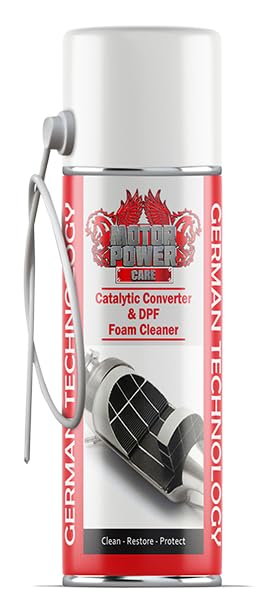
The German-engineered foam that dropped a Sprinter’s DPF load from 114% to 0% without removal.
When your diesel is in limp mode and fuel additives are just making it smell like a refinery, this direct-spray foam is your last stop before a DPF replacement. You spray the foam through the oxygen sensor port using the included long-reach nozzle — no disassembly required. You spray it in, let it soak 20-25 minutes, reinstall the sensor, and drive. One buyer on a 2019 Mercedes Sprinter removed the DPF sensor, sprayed the foam cleaner, then pumped in Liqui Moly cleaners; after a stationary heating cycle and a highway drive, the DPF load reading went from 114% to 0%. Another owner on a 2010 Jetta TDI in limp mode needed two cans and a Ross-Tech tool (a special diagnostic tool for VW/Audi) to reset the soot load, but after a forced regen the car ran fine.
The physical dimensions of this can are 8.5 x 3 x 3 inches — about 44% larger than the Wynn’s bottle’s footprint at 5.91 x 3.94 x 3.94 inches. That extra girth holds more foam, which matters when you are attacking a severely caked filter. The catch is that this is strictly a one-time deep clean tool, not a maintenance additive. After you clear the clog, you still need a fuel additive like the MotorPower Purge or Lucas Oil to keep it clean.
The deep-cleaning advantage
- No DPF removal needed — works through the O2 sensor port (oxygen sensor port)
- Buyers saw DPF load drop from 114% to 0% after one treatment on a Sprinter
- Saves – vs. professional DPF cleaning
The maintenance gap
- One can is often not enough for severely clogged filters — some owners needed two
- Must be paired with a fuel additive for ongoing maintenance
Grab this when: your DPF is in limp mode or throwing a P242F code and fuel additives have stopped working — this is the physical intervention before a replacement.
skip it if: you are just doing routine maintenance — a fuel additive is simpler and cheaper for prevention.
4. MotorPower Care DPF Filter Purge Additive 2-Pack, 16.9 fl oz Each

The two-pack that a 2016 Nissan Titan Xd owner used to clear a low DPF threshold code after trying 10+ other products.
This is the fuel-additive half of MotorPower Care’s one-two punch — after you foam-clean the DPF, you use this additive every 3,000 miles to maintain flow. Each bottle is 16.9 fluid ounces, and the two-pack gives you a total unit count of 30.8 Fluid Ounces, enough for two full treatments. The product is designed to work across all diesel engines, and the buyer reviews back that up: one owner on a 2022 Ram 2500 cleared the check engine light for regen frequency after running with a quarter tank of fuel. Another on a 2016 Nissan Titan Xd reported that after two cans over two tanks, the low particulate filter threshold code disappeared — and this was after the owner had tried more than 10 different DPF cleaners over two years without success.
The real story here is the reliability. The product does not claim the biggest MPG gains or the fastest regen drop; it claims consistency across engine types, and the reviews confirm that pattern. The catch is that 30.8 fluid ounces is still about half the volume of the Lucas Oil 64-ounce jug, so heavy-duty truck owners with 30-gallon tanks will need to buy two packs for a serious treatment cycle. The product’s strength is as a steady maintenance additive, not a one-shot miracle bottle.
What makes it reliable
- Cleared DPF codes on Ram 2500, Nissan Titan Xd, and farm tractors
- Two-pack gives a total of 30.8 fluid ounces for two treatments
- Reviewers point out it works where 10+ other cleaners failed
The volume compromise
- 30.8 fluid ounces total is less than half the volume of the Lucas Oil 64-ounce bottle
- Not a stand-alone deep cleaner — best used after foam spray
Best used as: a follow-up maintenance additive after a foam clean, or as a monthly preventative for fleet vehicles.
Not meant for: a single-shot rescue of a severely clogged DPF without a prior foam treatment.
5. Wynn’s Diesel Particulate Filter Regenerator 500ml
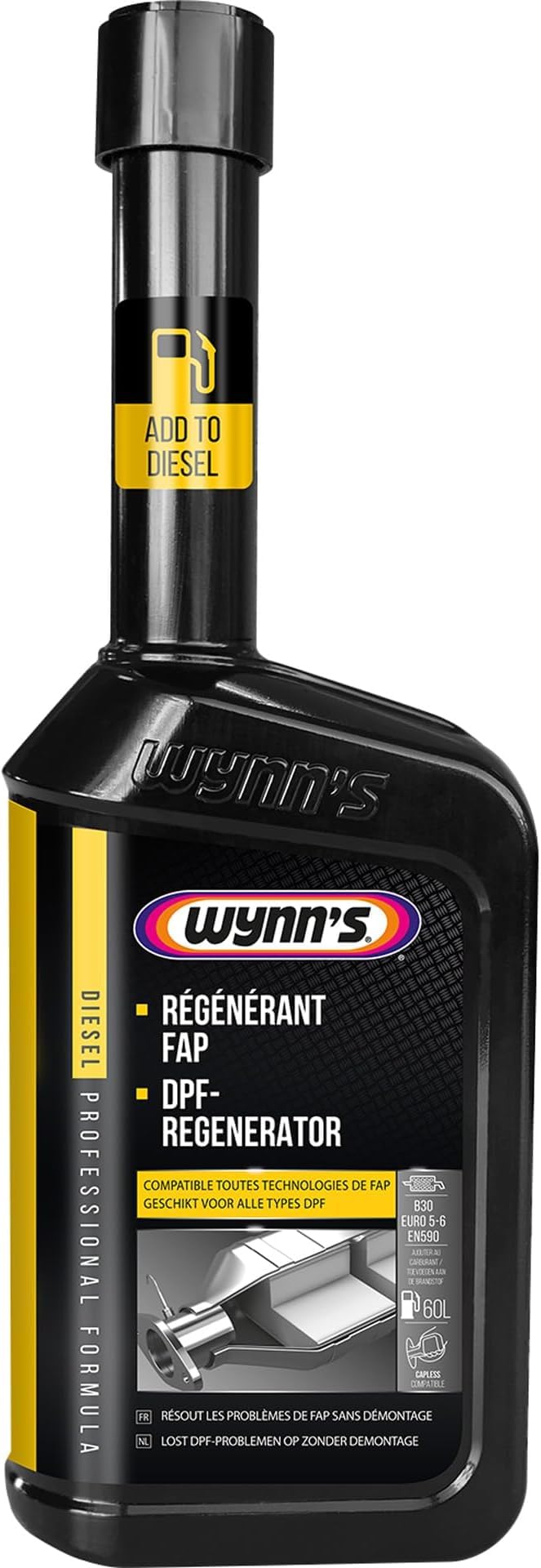
The professional-grade regenerator that delivered a measurable +78-mile gain in regen interval on a stock 200k-mile truck.
Wynn’s is an established chemistry brand in the professional service bay, and this 500ml bottle is the kind of product a diesel shop might pour in before a forced regen. The headline number comes from a buyer on a stock truck with over 200,000 miles: after using two bottles diluted in 26 gallons of fuel, the regen interval climbed from 384 miles (baseline) to 462 miles — a gain of 78 miles per cycle. That same review also noted the soot mass after regen dropped to 2 grams, and injector balance improved. For context, Wynn’s delivered a 71-mile advantage over the Archoil AR6200, which that same buyer had tested previously.
The product dimensions are 5.91 x 3.94 x 3.94 inches, making it significantly more compact than the MotorPower Foam can at 8.5 x 3 x 3 inches — a 44% size gap. But the smaller bottle means you get less product per purchase; 500ml is roughly 16.9 fluid ounces, so it competes directly with Rislone on volume. The professional labeling also means it is not marketed as aggressively for consumer DIY use, though the product is available on Amazon and thousands of owners have used it successfully. If you are the kind of buyer who tracks regen intervals and wants to see a hard number before you trust a product, Wynn’s is your pick.
The measurable advantage
- Verified regen interval gain from 384 to 462 miles (+78 miles) on a 200k+ mile truck
- Shoppers say soot mass after regen dropped to 2 grams
- Professional-grade chemistry trusted in diesel shops
The quantity trade-off
- 500 ml (16.9 fl oz) is on the smaller side — one bottle treats one tank only
- Not a deep-clean foam — only addresses soot burn temperature, not physical carbon crust
Ideal for: the diesel owner who tracks regen intervals and wants a chemist-tested product with a proven +78-mile gain per cycle.
Less ideal for: severely clogged filters that need a physical foam clean before additive chemistry can work.
6. Liqui Moly Pro-Line Diesel Particulate Filter Cleaner 1 L

The 1-liter favorite that kept a Mercedes Sprinter running 50,000+ miles after a single DIY clean.
Liqui Moly’s Pro-Line cleaner is the go-to for European van owners, especially Mercedes Sprinter and VW Crafter drivers, because it dissolves the specific type of contamination that builds up in closed diesel particle filters. The application method matters here — this is a spray-and-soak product that you apply through a garden sprayer with a modified copper tip, not a simple pour-in additive. One buyer on a 2014 Sprinter with 160,000 miles used the cleaner and drove 50,000 more miles with an average of about 21 miles per gallon before the P242F code came back. Another owner reported that after cleaning, soot and ash levels dropped close to zero.
Liqui Moly recommends using their Super Diesel Additive every other fill-up and Diesel Purge as regular maintenance. That approach — deep clean first, then maintain — mirrors what MotorPower Care advises. The catch is that this cleaner works best if you are willing to do the sprayer modification and follow the exact soak time. It is not a “pour and pray” product. But if you own a Sprinter and want to avoid the dealer cleaning, the reviews show this is the product most DIY owners reach for.
The Sprinter advantage
- Buyer drove 50,000+ miles post-clean with ~21 MPG average
- 1 Liter (33.81 fl oz) is a generous volume for European vans
- Drops soot/ash levels close to zero after treatment
The DIY requirement
- Requires a garden sprayer with a modified copper tube tip — not a simple pour-in
- One buyer mentioned the P242F code returned after about 10,000 miles
Reach for this if: you own a Sprinter, Crafter, or European diesel van and are willing to do a DIY sprayer-based DPF clean.
Look elsewhere if: you want a pour-and-drive additive — this is a manual application that takes about an hour.
7. Power Service Diesel Injector & DPF Flush – 64 Ounce

The 64-ounce flush with REGENEXTEND that claims to cut regen frequency by up to 50%.
Power Service is a familiar name in diesel additives for cold-weather fuel treatment, and this newer DPF flush product is their entry into the regen-reduction space. The bottle mirrors Lucas Oil’s format at 64 Fluid Ounces, making it a direct volume competitor. The manufacturer claims that its REGENEXTEND technology reduces regen frequency and duration by up to 50%, reduces emissions including NOx (nitrogen oxides) and black smoke by up to 50%, and improves fuel economy by up to 10%. The label also states it flushes the entire fuel system in a single tank, including removing injector deposits and balancing fuel injector flow rates.
Buyer response is strong early — the product only became available in March 2025, but it already holds a 4.6 rating from 161 reviews. One owner on a 2017 6.7L Power Stroke with 95,000 miles used it as preventative maintenance and observed minor tailpipe smoke during a high-RPM run, which they interpreted as the system cleaning itself. Another on a 2006 Duramax LBZ with 240,000 miles reported noticeable results: quieter idle, less smoke under acceleration, more power, and better MPG. The main uncertainty is long-term performance data since the product is new — there are no year-long regen interval logs yet. But the specs and the early reviews suggest it may be a serious challenger to Lucas Oil in the large-bottle segment.
The flush advantage
- 64-ounce bottle for a full-tank, single-dose treatment — matches Lucas Oil volume
- Buyers on 6.7L Power Stroke and 6.6L Duramax report quieter idle and less smoke
- REGENEXTEND technology claims up to 50% reduction in regen frequency
The open question
- Only released in March 2025 — no long-term regen interval data yet
- The brand’s claims of “up to 50% reduction” and “up to 10% MPG gain” need independent verification
Best suited for: diesel owners who want the latest chemistry for a full system flush and are willing to try a new formula with strong early reviews.
Not your first choice if: you need a proven, years-of-reviews product — Lucas Oil has the longer track record for the same 64-ounce format.
Understanding the Specs
Regen interval (miles between burns)
The single most useful number for judging a DPF cleaner’s effectiveness is the distance your truck travels between active regenerations. A regen is when the engine computer injects extra fuel to raise exhaust temperature and burn off trapped soot. If that interval gets shorter over time — from 500 miles down to 200 — your DPF is slowly clogging. A good cleaner should push the interval back up. The Wynn’s product, for example, moved it from 384 miles to 462 miles. That is a concrete, measurable improvement you can feel in fewer regen events per tank of fuel.
Volume (fluid ounces per treatment)
DPF cleaners are dosed by the bottle, not by the drop. A 64-ounce bottle like the Lucas Oil or Power Service is designed to treat a 30-gallon fuel tank in one complete pour. A smaller 16.9-ounce bottle, like Rislone, treats a passenger-car tank (around 15 gallons) in one dose. If you own a heavy-duty truck with a large tank and buy a small bottle, you will need two or three bottles per treatment. Check the unit count on the label — the 64.0-ounce Lucas Oil holds more than twice the volume of the 30.8-ounce MotorPower Care 2-pack. Matching bottle size to tank size saves you from running out mid-way through a treatment.
FAQ
How often should I use a DPF cleaner in my diesel truck?
Will a DPF cleaner work if my filter is completely clogged and in limp mode?
Can I use a DPF cleaner in a gasoline engine?
How long does it take for a DPF cleaner to show results?
Will a DPF cleaner fix the P242F code?
Is it safe to use a DPF cleaner in a truck with a DOC, SCR, or DEF system?
How does a DPF cleaner actually lower regen frequency?
What is the difference between a fuel additive DPF cleaner and a spray foam DPF cleaner?
Final Thoughts: The Verdict
Across the board, the best dpf cleaner{“@context”: “https://schema.org”, “@graph”: [{“@type”: “ItemList”, “name”: “7 Best DPF Cleaner”, “url”: “https://trendingcar.com/best-dpf-cleaner/”, “numberOfItems”: 7, “itemListElement”: [{“@type”: “ListItem”, “position”: 1, “name”: “Lucas Oil 10873 Diesel Deep Clean – 64 Ounce”, “url”: “https://trendingcar.com/best-dpf-cleaner/#product-1”}, {“@type”: “ListItem”, “position”: 2, “name”: “Rislone 4744 DPF CLEAN Diesel DPF, Exhaust & Emissions System Cleaner, 16.9 oz”, “url”: “https://trendingcar.com/best-dpf-cleaner/#product-2”}, {“@type”: “ListItem”, “position”: 3, “name”: “MotorPower Care DPF Foam Cleaner — Diesel Particulate Filter & Catalytic Converter Cleaner Spray”, “url”: “https://trendingcar.com/best-dpf-cleaner/#product-3”}, {“@type”: “ListItem”, “position”: 4, “name”: “MotorPower Care DPF Filter Purge Additive 2-Pack, 16.9 fl oz Each”, “url”: “https://trendingcar.com/best-dpf-cleaner/#product-4”}, {“@type”: “ListItem”, “position”: 5, “name”: “Wynn’s Diesel Particulate Filter Regenerator 500ml”, “url”: “https://trendingcar.com/best-dpf-cleaner/#product-5”}, {“@type”: “ListItem”, “position”: 6, “name”: “Liqui Moly Pro-Line Diesel Particulate Filter Cleaner 1 L”, “url”: “https://trendingcar.com/best-dpf-cleaner/#product-6”}, {“@type”: “ListItem”, “position”: 7, “name”: “Power Service Diesel Injector & DPF Flush – 64 Ounce”, “url”: “https://trendingcar.com/best-dpf-cleaner/#product-7”}]}, {“@type”: “Product”, “position”: 1, “name”: “Lucas Oil 10873 Diesel Deep Clean – 64 Ounce”, “image”: “https://m.media-amazon.com/images/I/710tuxjrkiL.jpg”, “brand”: {“@type”: “Brand”, “name”: “Lucas”}, “url”: “https://www.amazon.com/dp/B01CAD1UTE/?tag=tcarmin-20”, “offers”: {“@type”: “Offer”, “url”: “https://www.amazon.com/dp/B01CAD1UTE/?tag=tcarmin-20”}}, {“@type”: “Product”, “position”: 2, “name”: “Rislone 4744 DPF CLEAN Diesel DPF, Exhaust & Emissions System Cleaner, 16.9 oz”, “image”: “https://m.media-amazon.com/images/I/71sS5M6QrSL.jpg”, “brand”: {“@type”: “Brand”, “name”: “Rislone”}, “url”: “https://www.amazon.com/dp/B0BS49X7N5/?tag=tcarmin-20”, “offers”: {“@type”: “Offer”, “url”: “https://www.amazon.com/dp/B0BS49X7N5/?tag=tcarmin-20”}}, {“@type”: “Product”, “position”: 3, “name”: “MotorPower Care DPF Foam Cleaner — Diesel Particulate Filter & Catalytic Converter Cleaner Spray”, “image”: “https://m.media-amazon.com/images/I/41QoD6KsYRL.jpg”, “brand”: {“@type”: “Brand”, “name”: “MotorPower”}, “url”: “https://www.amazon.com/dp/B07FMB7K6W/?tag=tcarmin-20”, “offers”: {“@type”: “Offer”, “url”: “https://www.amazon.com/dp/B07FMB7K6W/?tag=tcarmin-20”}}, {“@type”: “Product”, “position”: 4, “name”: “MotorPower Care DPF Filter Purge Additive 2-Pack, 16.9 fl oz Each”, “image”: “https://m.media-amazon.com/images/I/61qeEo1j6wL.jpg”, “brand”: {“@type”: “Brand”, “name”: “MotorPower”}, “url”: “https://www.amazon.com/dp/B0BGV4STT8/?tag=tcarmin-20”, “offers”: {“@type”: “Offer”, “url”: “https://www.amazon.com/dp/B0BGV4STT8/?tag=tcarmin-20”}}, {“@type”: “Product”, “position”: 5, “name”: “Wynn’s Diesel Particulate Filter Regenerator 500ml”, “image”: “https://m.media-amazon.com/images/I/61e5-BVNfvL.jpg”, “brand”: {“@type”: “Brand”, “name”: “Wynn’s”}, “url”: “https://www.amazon.com/dp/B00900O426/?tag=tcarmin-20”, “offers”: {“@type”: “Offer”, “url”: “https://www.amazon.com/dp/B00900O426/?tag=tcarmin-20”}}, {“@type”: “Product”, “position”: 6, “name”: “Liqui Moly Pro-Line Diesel Particulate Filter Cleaner 1 L”, “image”: “https://m.media-amazon.com/images/I/71R9AEqTiGL.jpg”, “brand”: {“@type”: “Brand”, “name”: “Liqui”}, “url”: “https://www.amazon.com/dp/B008HIM118/?tag=tcarmin-20”, “offers”: {“@type”: “Offer”, “url”: “https://www.amazon.com/dp/B008HIM118/?tag=tcarmin-20”}}, {“@type”: “Product”, “position”: 7, “name”: “Power Service Diesel Injector & DPF Flush – 64 Ounce”, “image”: “https://m.media-amazon.com/images/I/71smeaVAMrL.jpg”, “brand”: {“@type”: “Brand”, “name”: “Power”}, “url”: “https://www.amazon.com/dp/B0F1Q6CNKY/?tag=tcarmin-20”, “offers”: {“@type”: “Offer”, “url”: “https://www.amazon.com/dp/B0F1Q6CNKY/?tag=tcarmin-20”}}, {“@type”: “FAQPage”, “mainEntity”: [{“@type”: “Question”, “name”: “How often should I use a DPF cleaner in my diesel truck?”, “acceptedAnswer”: {“@type”: “Answer”, “text”: “Most fuel additives recommend a treatment every 3,000 to 5,000 miles as maintenance. If you already have a check engine light, you may need a single concentrated dose. The Rislone product, for example, is designed for use every 5,000 miles as a tune-up. If you drive mostly city miles with few highway regen opportunities, monthly treatment may be reasonable.”}}, {“@type”: “Question”, “name”: “Will a DPF cleaner work if my filter is completely clogged and in limp mode?”, “acceptedAnswer”: {“@type”: “Answer”, “text”: “A fuel additive alone may not be enough for a severely clogged filter. In that case, a direct foam spray like MotorPower Care’s DPF Foam Cleaner — applied through the oxygen sensor port — is usually the first step. After the foam dissolves the heavy carbon crust, a fuel additive is used to keep the filter clean. Buyers on heavily clogged Sprinters and Jettas have reported success with this two-step process.”}}, {“@type”: “Question”, “name”: “Can I use a DPF cleaner in a gasoline engine?”, “acceptedAnswer”: {“@type”: “Answer”, “text”: “Most DPF cleaners — including the Lucas Oil, Rislone, and MotorPower Care products — are specifically formulated for diesel particulate filters. However, MotorPower Care’s foam cleaner states it works on diesel, gas, and hybrid vehicles because it is applied directly to the catalytic converter or DPF via the sensor port. Always check the label for your specific engine type.”}}, {“@type”: “Question”, “name”: “How long does it take for a DPF cleaner to show results?”, “acceptedAnswer”: {“@type”: “Answer”, “text”: “That depends on the product type. A fuel additive like Lucas Oil or Power Service can start working within 30 minutes of driving, as one buyer on a 2016 Nissan XD experienced — the DPF fault cleared during a 30-mile drive. A foam spray requires you to soak the filter for 20-25 minutes, then drive for about 30 minutes to burn off the dissolved soot. Some buyers report needing two treatments spaced 500 miles apart, as one Rislone user on a VW TDI noted.”}}, {“@type”: “Question”, “name”: “Will a DPF cleaner fix the P242F code?”, “acceptedAnswer”: {“@type”: “Answer”, “text”: “P242F is a code for \”Diesel Particulate Filter Restriction — Ash Accumulation.\” Fuel additives like Rislone and Lucas Oil specifically call out this code as one they can clear. Rislone’s product description explicitly lists P242F and other OBD codes. If the restriction is soot-based, a cleaner will help; if it is non-combustible ash that has filled the filter beyond capacity, the filter may need professional cleaning or replacement.”}}, {“@type”: “Question”, “name”: “Is it safe to use a DPF cleaner in a truck with a DOC, SCR, or DEF system?”, “acceptedAnswer”: {“@type”: “Answer”, “text”: “Yes — the Rislone product is specifically designed and tested to be safe for vehicles with DOC catalytic converters (Diesel Oxidation Catalyst), DPF filters, SCR systems (Selective Catalytic Reduction), and DEF systems (Diesel Exhaust Fluid). The Lucas Oil and Power Service products are also formulated for modern emissions systems. If your truck has a complex after-treatment system, choose a cleaner that explicitly states compatibility rather than a generic diesel additive.”}}, {“@type”: “Question”, “name”: “How does a DPF cleaner actually lower regen frequency?”, “acceptedAnswer”: {“@type”: “Answer”, “text”: “The cleaner contains chemicals that lower the temperature at which soot particles ignite and burn. When soot burns at a lower temperature, the engine does not need to raise exhaust temperature as aggressively or as long to complete a regen. Wynn’s product, for example, is described as reducing the combustion temperature of soot so it burns faster and at a lower temperature. This means each regen finishes sooner and you need fewer regens overall.”}}, {“@type”: “Question”, “name”: “What is the difference between a fuel additive DPF cleaner and a spray foam DPF cleaner?”, “acceptedAnswer”: {“@type”: “Answer”, “text”: “A fuel additive (like Lucas Oil, Rislone, or Power Service) is poured into the diesel tank and travels through the engine and exhaust to lower soot burn temperature. It works best for mild buildup and ongoing maintenance. A spray foam (like MotorPower Care’s foam cleaner) is sprayed directly into the DPF through the oxygen sensor port while the vehicle is parked. It physically dissolves heavy carbon crust and is used for severely clogged filters that are throwing codes or triggering limp mode. Many diesel owners use the foam first, then switch to a fuel additive for maintenance.”}}]}]}