
Our readers keep the lights on and my garage snacks stocked. As an Amazon Associate, I earn from qualifying purchases.
Specs are compiled from manufacturer listings and verified buyer reviews and can change over time — please confirm the key details on the product page before buying.
Choosing the right motor oil feels like decoding a secret language of letters and numbers. What you actually need is oil that stops that cold-start rattle, keeps sludge out of your engine, and matches whatever mileage your odometer is showing. This guide breaks down the real differences between synthetic, high-mileage, and standard blends so you know exactly which jug to grab.
I’m Min Islam — the founder and writer behind Trending Car. This guide is built by comparing the manufacturers’ published specifications and the patterns across verified customer reviews, so you get each pick’s real strengths and trade-offs instead of marketing spin.
Here is our breakdown of the best motor oil for different engines, driving styles, and budgets.
Our Picks at a Glance


How To Choose The Best Motor Oil
The single biggest mistake buyers make is grabbing the cheapest bottle or the most popular brand without checking their owner’s manual first. Your engine was designed around a specific viscosity and specification — the letters and numbers on the bottle, like 5W-30 or 0W-20, dictate how the oil flows at freezing startup and at full operating temperature. Start there, then layer on mileage and driving conditions.
Viscosity: The Number That Matters Most
The number before the W stands for winter — it is the oil’s thickness at cold temperatures. The lower that number, the easier your engine turns over on a freezing morning. A 0W oil flows better at -30 degrees F than a 10W. The number after the dash, like 30 or 20, is the thickness at 212 degrees F. A thicker hot-grade protects older, looser engines; a thinner one boosts fuel economy in modern tight-tolerance motors.
Full Synthetic vs. Conventional vs. High Mileage
Full synthetics, like Mobil 1 or Royal Purple, are engineered in a lab for extreme temperature stability and can often go 10,000 to 20,000 miles between changes — far longer than conventional oil. High-mileage oils add seal conditioners and extra anti-wear additives for engines past 75,000 miles. If your car burns oil or weeps from gaskets, a high-mileage blend is your first fix.
API and ILSAC Certifications
The latest API SP or ILSAC GF-6 rating on the bottle means the oil protects against low-speed pre-ignition (LSPI) — a phenomenon that can destroy a modern turbocharged engine. Older oils without these stamps might not have the right additive package for your car.
Quick Comparison
| Model | Best For | Viscosity | Volume | Weight | Amazon |
|---|---|---|---|---|---|
| Mobil 1 Advanced FS 5W-20★ Best Overall | Everyday synthetic protection | 5W-20 | 6 Quarts | 12 Pounds | Amazon |
| Mobil 1 Extended Performance 5W-30Top Performer | Extended 20,000-mile intervals | 5W-30 | 6 Quarts | 12 Pounds | Amazon |
| Pennzoil High Mileage 5W-30 | Leak reduction over 75k miles | 5W-30 | 192 fl. oz. | 11.9 Pounds | Amazon |
| K&N Premium Synthetic 5W-30 | All-weather full synthetic | 5W-30 | 5 Quarts | 9.23 Pounds | Amazon |
| Royal Purple HMX 10W-30 | High-mileage lifter noise fix | 10W-30 | 160 fl. oz. | 9.2 Pounds | Amazon |
| Royal Purple HP 10W-30 | Performance wear protection | 10W-30 | 5 Quarts | 8 Pounds | Amazon |
| Motul 8100 ECO-clean 0W-30 | Modern turbo engines with DPF | 0W-30 | 5 Liters | 9.7 Pounds | Amazon |
In‑Depth Reviews
1. Mobil 1 Advanced Full Synthetic Motor Oil 5W-20, 6-Pack
Our pick — over 4.5★ from 900+ verified ratings; the strongest balance of quality and price.
A rock-solid synthetic at a mid-range price that keeps most daily drivers running clean.
Mobil 1 Advanced Full Synthetic 5W-20 is the workhorse of this list. It protects critical engine parts for up to 10,000 miles, while the Extended Performance version above offers up to 20,000 miles. The 5W-20 viscosity is a thinner grade that helps improve fuel economy in many modern sedans and crossovers, especially those requiring low-viscosity oil for tighter engine tolerances.
One verified reviewer summed it up honestly: “But the oil gets dirty after about 4000 miles, not sure about that.” That reflects real-world driving — if you do a lot of stop-and-go or short trips, the interval may shrink. The oil handles heat up to 500 degrees F and cold down to -30 degrees F, so it works across most U.S. climates. At 12 Pounds for the 6-quart case, it costs notably less than the Extended Performance version.
Owners mention that the twist cap is extremely tight; a rubber band around the cap for grip is a common workaround. This oil meets ILSAC GF-6 standards, giving you the same LSPI and timing chain protection as pricier options. If Ford called for 5W-20 in your owner’s manual, this is a safe, affordable pick that won’t let you down.
Best for everyday drivers: Reliable full synthetic protection at a sensible price — no frills, no drama, just solid performance.
Not ideal for: High-mileage engines that need seal conditioners or a thicker 10W-30 viscosity.
2. Mobil 1 Extended Performance Full Synthetic Motor Oil 5W-30
The synthetic that stretches your oil change calendar to 20,000 miles without a second thought.
Mobil 1 Extended Performance earns its spot because it protects turbocharged engines from a damaging knock called low-speed pre-ignition (LSPI) — thanks to meeting ILSAC GF-6 standards (a set of engine oil requirements for modern cars). Its Triple Action+ Formula combines engine performance, cleanliness, and protection. One reviewer noted the oil “stays clean up to 7,000 miles; not burned or dark,” holding up longer than typical synthetics.
The 6-quart pack weighs 12 Pounds; the Royal Purple HP 10W-30 5-quart weighs 8 Pounds — but the extra weight comes with a much longer protection window. The Mobil 1 handles heat up to 500 degrees F and stays fluid down to -40 degrees F, while the standard Mobil 1 Advanced formula is rated down to -30 degrees F. If you drive in extreme cold, that extra low-temp range matters on winter starts.
Buyers report their engines feel smoother and quieter after switching, and one verified owner said they “have used Mobil 1 Synthetic oil for many years in all of my vehicles.” The trade-off is that you are paying for a premium product designed for high-performance or modern engines. If you drive a basic commuter car that burns through cheap oil, this level of protection may be overkill.
Why It Leads the Pack
- Up to 20,000 miles between oil changes — the longest interval on this list
- ILSA C GF-6 certified to prevent LSPI in turbo engines
- Excellent extreme-temperature range from -40°F to 500°F
The Only Catch
- Premium price for a 6-quart case — pays off over long drain intervals
Who it fits: Drivers who want maximum engine protection and hate frequent oil changes — one fill lasts 20,000 miles.
Look elsewhere if: Your engine burns oil quickly or you prefer shorter change cycles with cheaper conventional oil.
3. Royal Purple 11750 HMX SAE 10W-30 High-Mileage Synthetic Motor Oil

The high-mileage oil that one reviewer says eliminated lifter noise on a 160k-mile V8 cold start.
Royal Purple HMX is the first bottle to try if your engine has crossed 75,000 miles and you hear a ticking lifter on cold mornings. It is chemically enhanced to revitalize hardened seals — reducing the oil consumption that plagues older motors — and packs sturdy zinc/phosphorus anti-wear compounds that protect camshafts and lifters. The 10W-30 viscosity gives a thicker oil film than 5W-30 options, which helps cushion worn bearings.
One buyer mentioned: “Royal Purple HMX high mileage oil: Eliminated sticky lifter noise on cold start in 160k-mile Dodge Dakota 4.7L V8.” Another noted a smoother idle and less lifter tick in their 2500HD 6.0 gas engine. The HMX holds 160 Fluid Ounces — compared to the Pennzoil High Mileage at 192 Fluid Ounces, the Royal Purple is about 20 percent less oil per case, but many owners say it lasts longer between changes due to its oxidation resistance.
The 9.2-pound weight makes it lighter than the Mobil 1 cases, but the higher price per quart places it in the premium tier. It is designed for vehicle-specific fitment, so double-check that 10W-30 is compatible with your engine. For a 20-year-old car, it is often the oil that brings back smooth idling.
Why It Wins for High Mileage
- Chemically enhanced to revitalize hardened seals and reduce oil leaks
- High zinc/phosphorus content protects flat-tappet cam engines
- Customers note immediate noise reduction on cold starts
Where It Falls Short
- Higher cost per quart than Pennzoil High Mileage
- 10W-30 may be too thick for engines designed for 5W-20
Reach for this if: Your engine has over 75k miles, burns oil, or makes lifter noise — this is the targeted fix.
Look elsewhere if: Your car is under warranty and requires a specific low-viscosity grade like 0W-20.
4. Royal Purple 51130 API-Licensed SAE 10W-30 High Performance Synthetic Motor Oil

The full synthetic that one buyer calls “the bridge between Mobil 1 and Amsoil” for performance engines.
Where the HMX is built for high-mileage seal restoration, the Royal Purple HP 10W-30 is about pure wear protection and fuel efficiency. It uses a proprietary additive technology to reduce friction and metal-to-metal contact, and it provides superior corrosion protection — especially important if you live in a region with ethanol-blended fuels. The HP stands for High Performance, and it is API-licensed, meaning it meets the latest industry specifications.
It weighs 8 Pounds for 5 Quarts, while the Mobil 1 Extended Performance 6-quart case weighs 12 Pounds, but you get one less quart. Reviewers point out it works great in Jeep Wranglers with high mileage and even improves Cub Cadet mower performance, with one owner reporting “smoother operation, reduced noise, cooler running.” The 10W-30 viscosity is a good match for trucks and SUVs that run hot.
One reviewer described it as “the bridge between Mobil 1 and Amsoil” — meaning it offers near-Amsoil quality at a slightly lower price point. The catch is that 5 quarts may not be enough for larger engines. Check your car’s total capacity; many trucks need 6 or more quarts.
Best for: Performance-minded owners who want top-tier anti-wear protection for towing or spirited driving.
skip it if: You need a high-mileage seal conditioner — the HMX is the better choice for older engines.
5. Pennzoil High Mileage 5W-30 Motor Oil, 1 Quart (6 Pack)
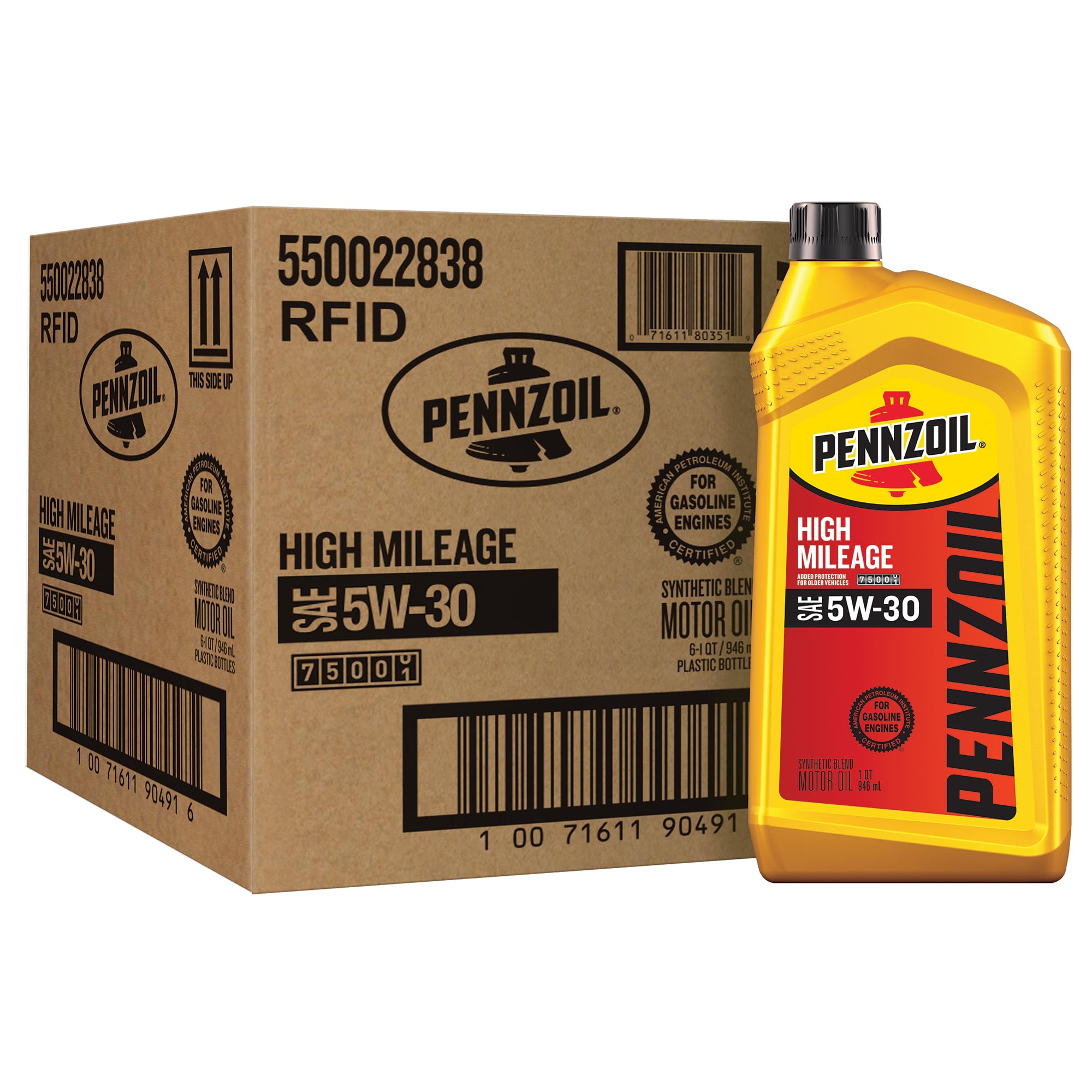
A high-mileage synthetic blend that targets leaks at a budget-friendly price for cars over 75k miles.
Pennzoil High Mileage 5W-30 is a synthetic blend — meaning it mixes conventional base oil with synthetic components — and it is specifically formulated to stop leaks and reduce oil consumption in worn engines. It offers 192 Fluid Ounces, while the Royal Purple HMX offers 160 Fluid Ounces, making it a better value if your engine burns through oil between changes. It is recommended for vehicles with more than 75,000 miles.
One reviewer simply said “good price for 6qts,” and another noted it works well on a 2006 Chevy HHR. The 5W-30 viscosity is the most common grade for American sedans and light trucks, so it is easy to find and use. The synthetic blend formula also meets low-speed pre-ignition protection requirements for modern turbocharged engines, which is unexpected at this price point.
The trade-off is that a synthetic blend does not offer the same extreme-temperature stability as a full synthetic. For a car that lives in a hot desert or cold northern winter, a 100% synthetic like Mobil 1 or Royal Purple will hold its viscosity longer. But for a daily driver with high mileage that just needs to stop dripping on the driveway, this is the most cost-effective solution.
The Smart Choice for Leaks
- Formulated to stop leaks and reduce oil consumption in engines over 75k miles
- Largest volume in the budget tier — 192 Fluid Ounces
- Good price for a six-pack of high-mileage oil
The Downside
- Synthetic blend, not full synthetic — shorter change intervals
- Not ideal for extreme hot or cold climates
Pick this for: An older car with a small leak that you want to slow down without spending premium money.
Pass on it if: You want the longest possible oil change interval — full synthetic lasts much longer.
6. K&N Motor Oil: 5W-30 Synthetic Engine Oil, Premium Protection, 5 Quarts

A full synthetic with K&N’s Synthamax Technology that wants to keep your engine like new.
K&N is famous for air filters, but their premium full synthetic oil with Synthamax Technology uses unique additives to protect critical engine components and minimize sludge. The 5W-30 viscosity is the universal middle-ground grade that fits sedans, SUVs, and light trucks. At 9.23 Pounds for 5 Quarts, it is a compact, easy-to-pour jug that feels lighter than the Mobil 1 cases.
Buyers appreciate the value: one said “great price for full synthetic,” and another confirmed that the bottle truly holds 5 quarts — “it absolutely 100% is 5 quarts says it on side of bottle!” The all-weather claim holds up in both hot and cold conditions, though K&N doesn’t publish specific temperature ratings like Mobil 1 does. That lack of granular data means you are trusting the brand’s reputation rather than hard numbers.
The main downside is the 3-month manufacturer warranty — the shortest on this list. While the oil itself performs well based on user reports, the warranty length suggests it may not have the same long-term durability testing as Mobil 1 or Royal Purple. For a middle-of-the-road synthetic that balances price and performance, it works fine for most daily drivers.
Who it works for: Brand loyalists who already trust K&N filters and want a matching synthetic oil at a fair price.
Who should skip it: Drivers looking for extreme long-life intervals — Mobil 1’s 20,000-mile guarantee is stronger.
7. Motul 8100 ECO-clean 0W-30 Motor Oil – 100% Synthetic, ACEA C2, 5 Liter

A true 100% synthetic with Mid SAPS technology for modern engines with DPFs and catalytic converters.
Motul 8100 ECO-clean is a 0W-30 — the thinnest cold-grade on this list — designed specifically for the latest generation of turbocharged, direct-injection engines, especially European models with diesel particulate filters (DPF) and catalytic converters. The Mid SAPS formulation reduces sulfated ash, phosphorus, and sulfur, preventing these emissions components from clogging over time. It is ACEA C2 certified and meets Ford WSS-M2C950-A.
One buyer switching from a different brand wrote, “After changing the motor oil to motul i definitely noticed a smoother ride.” Another called it “REAL 100% synthetic oil” as opposed to “full synthetic” petroleum-based oils.
The trade-off is price: this is the highest-cost option on the list, and the 0W-30 viscosity is not right for every car. It is a specialty lubricant for modern European and Asian engines that require a thin, low-SAPS oil. If your owner’s manual calls for 5W-20 or 10W-30, skip it. But for a BMW, Mercedes, or modern Hyundai/Kia turbo that needs C2-rated oil, this is the correct pick.
Why It Stands Out
- Mid SAPS formula protects DPFs and catalytic converters from clogging
- 0W-30 flows at extremely cold temperatures
- OEM approved — meets Ford WSS-M2C950-A and ACEA C2
The Premium Cost
- Highest price per liter on this list
- Only works for engines specifically requiring 0W-30 with C2 specifications
Best suited for: Owners of modern European or Asian turbo engines that need a thin, low-SAPS synthetic to keep emissions gear clean.
Not for: Older American V8s or any engine that wasn’t designed for 0W-30 — the viscosity is too thin.
Understanding the Specs
Viscosity Grades: 5W-30 vs. 10W-30 vs. 0W-30
The viscosity grade tells you how thick the oil is. The first number followed by W (Winter) is the flow rating at low temperatures — 0W flows easier in freezing weather than 10W. The second number is the thickness at 212°F (normal operating temp). A higher second number like 30 provides a thicker cushion for older, looser engines. Lower numbers like 20 improve fuel economy. Always match what your owner’s manual specifies; using the wrong viscosity can cause poor lubrication or oil pressure issues.
API and ILSAC Certifications
The API (American Petroleum Institute) stamp like API SP means the oil meets the latest protection standards against sludge, varnish, and engine wear. ILSAC GF-6 is the international standard that adds low-speed pre-ignition (LSPI) protection for modern turbo engines. If your car is from 2020 or newer, look for one of these stamps on the bottle. Oils without them may still work but lack the most recent additive improvements.
High-Mileage vs. Standard Synthetic
High-mileage oils contain seal conditioners that soften and swell dried-out gaskets, which reduces external leaks and oil burning. They also have extra detergents to clean sludge from older engines. Standard synthetics are better for newer engines that don’t have wear or leaks yet. If your car has over 75,000 miles, high-mileage oil is usually the better choice regardless of brand.
Synthetic Blend vs. Full Synthetic
A synthetic blend mixes conventional oil with a smaller percentage of synthetic base stock. It costs less but breaks down faster at high temperatures and has shorter change intervals — usually 5,000 miles or less. Full synthetic is 100% chemically engineered, offering longer intervals (10,000 to 20,000 miles), better extreme-temperature performance, and stronger protection against sludge. For most drivers, full synthetic is worth the extra cost over the long run.
FAQ
What happens if I use the wrong viscosity oil?
Can I mix different brands of motor oil?
How often should I change full synthetic oil?
Does high-mileage oil really stop leaks?
What does API SP or ILSAC GF-6 mean on the bottle?
Can I use 10W-30 instead of 5W-30?
Is Motul worth the higher price?
What is the difference between Royal Purple HMX and Royal Purple HP?
Final Thoughts: The Verdict
Across the board, the best motor oil winner is the Mobil 1 Extended Performance Full Synthetic 5W-30 because it offers the longest change interval at 20,000 miles and the broadest temperature range from -40°F to 500°F. If you drive a high-mileage car that ticks on cold starts, grab the Royal Purple HMX 10W-30. And for a modern European turbo engine with a DPF, the standout is the Motul 8100 ECO-clean 0W-30.
How We Picked
We do not accept paid placement. Every pick is matched to a real buyer and a real use-case; we do not hands-on test units.
Sources & Methodology
Specifications: manufacturer listings and product documentation. Review insights: verified customer reviews, as of July 2026. Pricing: not shown on this page (it changes often); check the current price via the retailer link.
As an Amazon Associate, Trending Car earns from qualifying purchases. This does not affect which products we feature.