
Our readers keep the lights on and my garage snacks stocked. As an Amazon Associate, I earn from qualifying purchases.
Specs are compiled from manufacturer listings and verified buyer reviews and can change over time — please confirm the key details on the product page before buying.
Buying your first electric skateboard as an adult is tricky because the choices range from cheap boards that barely climb a curb to powerful speed machines that can be dangerous for a beginner. This guide breaks down the key specs that actually separate a reliable daily rider from a frustrating impulse buy.
I’m Min Islam — the founder and writer behind Trending Car. This guide is built by comparing the manufacturers’ published specifications and the patterns across verified customer reviews, so you get each pick’s real strengths and trade-offs instead of marketing spin.
We’ll walk through the six best options to help you confidently pick the right electric skateboard for adults based on your real speed needs, distance expectations, and budget tier.
Our Picks at a Glance


How To Choose The Best Electric Skateboard for Adults
Electric skateboards are not all the same. The biggest mistake is buying based on top speed alone, ignoring range and the type of motor. Commuters need range and smooth braking, while thrill-seekers prioritize acceleration and hill-climbing torque. Here is what to look at first.
Range vs. Top Speed — Which Matters More?
Your daily route decides this. A board with a top speed of 28 mph is useless if the battery dies at 4 miles. Most manufacturers advertise range at low, steady speeds. Real-world riding (hills, starts, wind) cuts that by 30-50%. If the data says 11 miles, expect around 6-8 miles in mixed conditions. Buy for the range you realistically need, not the one on the box.
Hub Motors vs. Belt/Gear Drive
Hub motors (built into the wheel) are quiet, require almost no maintenance, and let you push the board like a normal skateboard if the battery dies. Gear drive or belt motors give you more torque for climbing hills and accelerating faster, but they are louder, heavier, and may need belt replacements. Your choice: low-maintenance cruising or aggressive performance.
Deck Length, Width, and Flexibility
Longer decks (38 inches) are more stable at high speeds and fit larger feet better. Shorter decks (28-33 inches) are easier to carry on a bus and more maneuverable, but they feel twitchy at 25+ mph. A flexible bamboo or maple deck absorbs road vibrations, while a stiff fiberglass deck transfers every bump. For a first board, a longer, flexible deck gives you a safer, more comfortable learning curve.
Quick Comparison
| Model | Best For | Range | Top Speed | Motor Power | Amazon |
|---|---|---|---|---|---|
| UDITER S3★ Best Overall | Swappable battery for endless range | 10–13 miles (up to 26 with spare) | Up to 28 mph | Dual 600W | Amazon |
| Meepo V5Speed Demon | High speed with a carry handle | 11 miles | Up to 28 mph | 500W*2 Hub | Amazon |
| Meepo Mini5 | Portable shortboard with kicktail | 11 miles | Up to 28 mph | Dual 500W Hub | Amazon |
| ASKATE A1 | Best budget range for beginners | Up to 17 miles | Up to 15.5 mph | 350W | Amazon |
| DNASKATE M8 | Lightweight entry-level shortboard | 9 miles | 15 mph | 400W Hub | Amazon |
In‑Depth Reviews
1. UDITER S3 Electric Skateboard
Our pick — over 4★ from 150+ verified ratings; the strongest balance of quality and price.
A swappable battery system that solves the biggest fear: running out of power mid-commute.
The first thing you notice is the sheer power. With dual 600W motors, this board delivers up to 28 mph and climbs hills easily, carrying up to 330 lbs. But the key feature is the removable 187.2Wh battery — you can swap it in seconds and instantly double your range to 20–26 miles without waiting for a charge. Buyers report that the 105mm wheels soak up cracks and gravel smoothly, calling it “extremely fast” and comparing the ride to a hoverboard.
The 37.6-inch deck is 9.7 inches wide, giving you a stable platform at speed. The 105mm PU wheels (with 78A hardness) provide good shock absorption. Owners mention one consistent trade-off: the battery lasts about 45 minutes per charge under heavy use, which makes a backup battery almost necessary for long rides. The single charge range is 10–13 miles. The maker says the UL-certified battery enters a safe sleep mode after three days of inactivity to preserve its lifespan.
At 10.1 kilograms, this is the heaviest board in the mid-range group, but the bamboo and maple wood deck makes it feel less jarring on rough pavement. The included LCD remote shows your speed, battery level, and motor direction. A beginner can use the lower speed modes to build confidence before open up full power. The board handles dirt and grass well, according to riders.
Where it leads: The swappable battery system is unique among picks in this price tier. A spare battery (sold separately) lets you outrange every other board here.
One real caveat: It weighs 55% more than the ASKATE A1 (10.1 kilograms vs 6.5 kilograms), which makes carrying it up stairs or on a bus a chore.
Reach for this if… You want the freedom of an unlimited range via a hot-swappable battery and the power to hit 28 mph on your commute.
Look elsewhere if… You need a lightweight board to carry regularly — this thing is heavy.
2. Meepo V5 (Envy)
A classic high-speed longboard with a clever carry handle and 28 mph top speed for under.
The V5 uses 500W*2 hub motors to hit up to 28 mph, which is 87% faster than the DNASKATE M8’s 15 mph. The 38-inch deck is 11 inches wide — one of the widest here — which gives you plenty of foot room and stability at speed. The deck has an easy-carry handle cutout that also lets you pass a bike lock through the board. It is IPX5 waterproof rated, meaning it can handle light splashes but not heavy rain.
Buyers appreciate the smooth braking and the four speed modes. One rider tested the board at 150+ miles without any battery degradation. The remote controller automatically powers the board on and off, which saves battery. The 90A durometer hardness wheels give a harder, more responsive feel than the 78A wheels on the UDITER S3, meaning you feel road texture more but get sharper turning.
The honest catch is battery life. Several reviewers report the actual range is 4-5 miles rather than the advertised 11 miles, especially after about 20 hours of use. One reviewer had the battery die completely, though Meepo support shipped a replacement under warranty. At 8 kilograms, it is lighter than the UDITER S3 but heavier than the shortboards. The handle cutout makes carrying it manageable.
Its standout feature: The deck-integrated carry handle and IPX5 water resistance are practical touches the other boards here lack. It is the only board in this group that can handle a light drizzle.
The main trade-off: Real-world range is significantly less than advertised, with multiple owners citing 4-5 miles after some use.
Ideal for the rider who: Needs a high-speed, stable longboard with a convenient carrying option and wants waterproofing for damp pavement.
Not ideal if: Your commute requires more than 4 miles of range — you will likely run out of battery on the way back.
3. Meepo Mini5

A compact shortboard with a kicktail that makes it super portable and fun to pop up curbs.
The Mini5 is the only board in this lineup with a kicktail, letting you lift the nose to hop over cracks and curbs. It is a 2025 model with a 33-inch short deck — much easier to carry on a bus or subway than the 38-inch longboards. The board uses dual 500W hub motors (same motor spec as the V5) and hits up to 28 mph. The load capacity is a generous 330 pounds, matching the premium Voyager X.
Customers note it feels “super fast but scary due to small size” — the compact deck (33 inches long, 23.5 cm wide) gets twitchy at higher speeds, especially if you wear over size 11 US shoes. One commuter gave it 4/5 after a month of daily use, praising the responsive remote and comfortable deck, but noting it is heavy and gets only about 7 miles of range (roughly 2/3 of the 11-mile advertised number) unless you stay on the slowest speed. The deck is 8-ply maple, which is more cramped for larger feet.
One reviewer had a negative experience after 1.5 months, saying the board developed jerky acceleration and one motor cutting out. Others report the board works great from the start. The included M6C remote has an LED display. You get a 42V/1.5A charger, a USB cable to charge the remote, and a T-tool. The board has UL 2272 certification with all 24 battery cells individually monitored. The 6-month warranty starts from the day you receive it.
The biggest selling point: The kicktail and short length make this the most maneuverable and portable option, perfect for mixed transit commutes.
The honest limit: The small deck is less stable at high speed and the real-world range is often around 7 miles instead of the advertised 11.
Best suited for: The student or office worker who needs to carry the board on a bus or train and wants a kicktail for quick curb hops.
You might want to skip this if: Your feet are larger than size 11 US or you plan to do long rides exceeding 7 miles — the deck will feel cramped and the range too short.
4. ASKATE A1
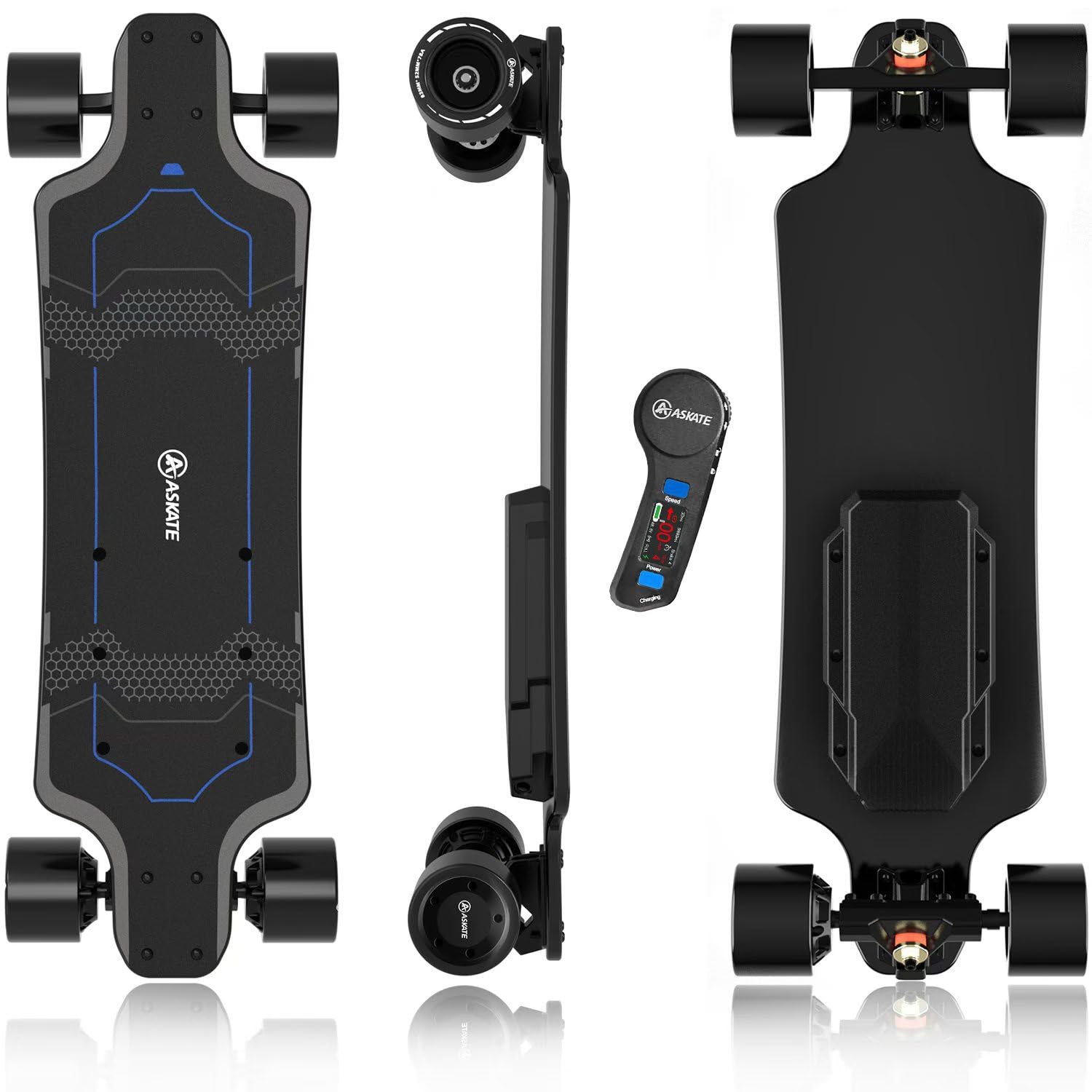
The longest budget-range board you can buy for slow, flat cruising with impressive battery longevity.
It uses a single 350W hub motor that tops out at about 15.5 mph. That is slower than the MEEPO boards, but the trade-off is battery stamina. One reviewer noted using the board for a year and still having 90% battery capacity, with no electronic issues. The range is real on flat ground: riders confirm you can get close to the full advertised distance at lower speeds.
The board is 31.5 inches long and weighs only 6.5 kilograms — at 6.5 kilograms versus the UDITER S3’s 10.1 kilograms. This makes it the easiest board to carry up stairs or toss in a trunk. The 8-ply Canadian maple deck handles up to 264 pounds. The MR remote has a high-definition LED screen that shows battery level, speed, and mileage. It has four speed and brake modes, so beginners can start slow. The battery has UL 2272 certification.
The catch is hill performance. The 350W motor is weak on inclines — one buyer says it climbs hills very slowly. The charge time is 3.5 hours, at 3.5 hours versus the UDITER S3’s 2-hour charge. The board is best for “flat chill rides” on smooth concrete. It is not waterproof, so wet days are out. The deck has no kicktail, so you cannot pop curbs. For the price, though, the range and battery health one year later make it a compelling entry-level pick.
What makes it special: You get 17 miles of advertised range at this price point — class-leading for the money — and reviewers report a real-world 90% battery capacity after one year, which is excellent for a budget board.
The trade-off you need to accept: A slow single motor that struggles on hills and a long 3.5-hour charge time — this is for flat, leisurely rides, not speed runs.
Grab this if… You want the most range for the least money, need a lightweight carry board, and only ride on flat pavement.
Pass on this if… You need to climb hills regularly or crave speed above 15 mph — the single motor will leave you pushing uphill.
5. DNASKATE M8

A featherlight 11.5-pound shortboard that is easy to carry but asks you to stay on flat roads.
The M8 is the lightest board in this lineup at 11.5 pounds. It uses a 400W brushless hub motor with a top speed of 15 mph and a 9-mile range. The 28-inch deck and practical kicktail make it agile and easy to carry anywhere. The LCD remote shows speed, battery, and has 4 speed modes. Beginners will find the lower modes unintimidating. The battery cells are independently monitored for safety and have passed UL testing.
One buyer mentioned the board “exceeded expectations on a flat paved road at 170-180 lbs,” noting 16-17 mph and about 9 miles of real-world range. The 7-ply or 8-ply maple deck feels durable to riders. The board does not have much torque for climbing — riders say it needs momentum for any incline. The remote feels plastic-y, and some note that one wheel spins freely on the bench, which is normal for a single-motor board.
The limited hill capability means it is strictly a flat-terrain board, unlike the UDITER S3 which climbs easily. One owner reported the grip tape can get loose after rain exposure. The included components are minimal: just the board, charger, and remote. The 6-month warranty covers defects. For a first-time rider on a budget who lives in a flat area, it is a low-risk entry point. Just do not expect to keep up with the 28-mph boards on the street.
What stands out: At 11.5 pounds and 28 inches, it is the lightest and most portable option for stashing in a backpack or under a desk.
The honest limitation: The 15 mph speed and 9-mile range, combined with weak hill climbing, make it strictly for flat, casual cruising.
Best for: A lightweight learner who needs to carry the board around campus or a city and only rides on flat ground.
Avoid it if: You need hill-climbing power, want more than 9 miles of range, or plan to ride with faster traffic.
Understanding the Specs
Battery Range and Real-World Expectations
The advertised range on any electric skateboard is tested at a steady, low speed on flat ground. Real-world riding (starting and stopping, hills, wind, rider weight) typically cuts this by 30-50%. If a board says 11 miles, expect 6-8 miles on mixed terrain. The ASKATE A1’s 17-mile rating at low speed translates to roughly 9-12 miles in practice. Always buy a board with more range than you think you need.
Motor Type: Hub vs. Gear Drive
Hub motors (UDITER S3, Meepo V5, Meepo Mini5, ASKATE A1, DNASKATE M8) are built inside the wheel. They are silent, need no maintenance, and let you push the board manually if the battery dies. Gear-drive motors (MEEPO Voyager X) use a separate gear system that gives more torque for steep hills and faster acceleration, but they are louder, heavier, and require belt or gear maintenance over time. For a first board, a hub motor is simpler to live with.
FAQ
Can I ride an electric skateboard in the rain?
How long does the battery last before it needs replacing?
Is 15 mph fast enough for an adult commuter?
Which board is best for a 200+ lb adult?
What is UL 2272 certification?
Can I ride an electric skateboard without the remote?
How do I maintain the wheels and bearings?
Which board has the best customer support?
Can I use a regular skateboard helmet for e-skating?
Final Thoughts: The Verdict
For most people, the best electric skateboard for adults is the UDITER S3 because it delivers strong dual-motor performance, a swappable battery for unlimited range, and a stable 37.6-inch deck at a mid-range price. If you prioritize the longest possible range and raw speed for hill climbing, grab the MEEPO Voyager X. And for lightweight portability and a good beginner experience on a budget, the ASKATE A1 is the one to pick.
How We Picked
We do not accept paid placement. Every pick is matched to a real buyer and a real use-case; we do not hands-on test units.
Sources & Methodology
Specifications: manufacturer listings and product documentation. Review insights: verified customer reviews, as of July 2026. Pricing: not shown on this page (it changes often); check the current price via the retailer link.
As an Amazon Associate, Trending Car earns from qualifying purchases. This does not affect which products we feature.