
Our readers keep the lights on and my garage snacks stocked. As an Amazon Associate, I earn from qualifying purchases.
Specs are compiled from manufacturer listings and verified buyer reviews and can change over time — please confirm the key details on the product page before buying.
Your 2005 Honda CR-V’s 2.4L engine lives on clean oil, and the one part that stands between that oil and abrasive grit is a single threaded canister no bigger than a soda can. Pick the wrong filter and you risk a slow starvation that turns a 300,000-mile motor into a swap candidate at 150,000. This guide breaks down exactly which filters seal tight, flow right, and survive the 5,000-mile cycles your CR-V expects — and which ones leave you chasing a drip.
I’m Min Islam — the founder and writer behind Trending Car. This guide is built by comparing the manufacturers’ published specifications and the patterns across verified customer reviews, so you get each pick’s real strengths and trade-offs instead of marketing spin.
A leak, a rattle at startup, or a filter that seizes to the block on removal day — those are the real headaches you are shopping to avoid. Here is everything you need to nail the right 2005 honda cr-v oil filter on the first try.
Our Picks at a Glance

How To Choose The Best 2005 Honda CR-V Oil Filter
Your CR-V needs a filter that spins onto a specific M14 thread, seals with the correct gasket width, and delivers at least the same dirt-holding capacity as the original Honda part. Here are the three decisions that separate a good oil change from a messy regret.
OEM vs Aftermarket
Genuine Honda filters (part number 15400-PLM-A02) are built to the exact pressure-relief calibration and bypass valve setting your 2.4L engine expects. Aftermarket filters often get that bypass curve wrong, which can send unfiltered oil through the engine during a cold start. Stick with OEM if you want no-surprise compatibility, but good aftermarket options like ECOGARD match the spec closely for less money.
Media Type and Mileage Interval
Standard cellulose media works fine for 5,000-mile changes with conventional oil. If you run synthetic oil and push to 7,500 or 10,000 miles, you want a synthetic-rated filter with higher-efficiency media — look for one that screens out up to 99% of particles and carries a 10,000-mile service rating. The ECOGARD S4610 is a strong example of that upgrade.
Thread Size, Gasket, and Fit
The 2005 Honda CR-V’s oil filter uses a 14mm (M14) thread. The gasket (the rubber O-ring that seals against the engine block) must be the correct width — a narrower gasket, as some buyers noted on the Kefly filter, can still seal but creates uncertainty. Always check that the gasket matches the OEM part’s footprint before you torque it down.
Quick Comparison
| Model | Best For | Media Type | Thread Size | Quantity | Amazon |
|---|---|---|---|---|---|
| Genuine Honda 15400-PLM-A02 (Single)★ Best Overall | No-compromise OEM fit | Cellulose | M14 | 1 | Amazon |
| ECOGARD S4610 | Synthetic oil / extended intervals | Synthetic-rated high-efficiency | M14 | 1 | Amazon |
| Kefly 15400-PLM-A02 (2-Pack) | Budget twin-pack for quick changes | Cellulose replacement | M14 | 2 | Amazon |
| Honda 15400-PLM-A02 6-Pack Kit | Bulk OEM supply with drain washers | Cellulose | M14 | 6 | Amazon |
In‑Depth Reviews
1. Genuine Honda 15400-PLM-A02 Oil (Honeywell) Filter, Blue
Our pick — over 4.5★ from 5,500+ verified ratings; the strongest balance of quality and price.
The factory filter your CR-V was designed around — zero guesswork, zero adaptation.
This is the exact same aluminum-bodied filter that Honda installs on the assembly line, carrying the 15400-PLM-A02 part number that fits your 2.4L engine. At 3.23 ounces and measuring 4 x 2 x 2 inches, it is noticeably lighter than the aftermarket Kefly filter (8.8 ounces) yet buyers report it “holds up over 6-month cycles” without leaks. The bypass valve and anti-drainback gasket are calibrated to your engine’s specific oil-pressure curve, so you get full lubrication at every cold start.
One owner who switched from dealership visits noted the convenience: “Original Honda oil filter at a great price” compared to what a service center charges. Another reviewer driving a 2011 Pilot confirmed the same fit and “shipped from Honda dealership ensures quality/authenticity.” Because it is an OEM part, the thread (M14) and gasket width are exact — you torque it hand-tight plus a quarter turn and you are done.
The single-item format means you pay per filter, not per bulk bundle. That is fine for a one-off change, but if you plan several oil changes ahead, the 6-pack below cuts the per-filter cost significantly.
Why reach for this one
- Genuine Honda part — no fitment questions for your 2005 CR-V
- Buyers confirm zero leaks and authentic build over repeated cycles
- Aluminum construction resists corrosion better than budget steel cans
The trade-off
- Single filter only — no included drain washer for the plug
- More expensive per filter than buying the 6-pack kit
Grab it for: the buyer who wants absolute certainty that every spec — thread, bypass setting, gasket width — matches what Honda built into the engine.
Look elsewhere if: you run synthetic oil on 10,000-mile intervals and want a filter media rated for that extra distance.
2. ECOGARD S4610 Spin-On Engine Oil Filter for Synthetic Oil

The synthetic-oil companion that stretches your change interval without second-guessing.
If you feed your CR-V full synthetic and run past 5,000 miles, this is the filter that keeps pace. ECOGARD engineered the S4610 with high-efficiency media that screens out up to 99% of particles — carbon, sand, dust, metal fragments — and they rate it for service intervals up to 10,000 miles under normal driving. The metal can measures 3.7 x 3.1 x 2.7 inches, compared to the OEM Honda’s 4 x 2 x 2 inches, which gives it a bit more media surface area.
One first-time DIYer shared: “I recently changed my oil myself for the first time, this filter came highly recommended.” The same reviewer added that “it went in with zero issues” and plans to run it 4,000 miles. The silicone anti-drainback valve (a premium touch over standard rubber) holds oil in the filter after shutdown so your valvetrain gets lubrication immediately at the next start — that matters for the 2.4L’s timing chain tensioner, which relies on immediate oil pressure.
It replaces a long list of cross-reference numbers including FRAM PH7317-S and Wix 51356XP, so if you were running a Wix before, you can swap to this without changing your habits. The 1-year warranty covers defects in materials or workmanship, though shipping cost applies.
What stands out
- Engineered for synthetic oil with 10,000-mile service capability
- Silicone anti-drainback valve for faster cold-start oil delivery
- Cross-references dozens of popular filter part numbers
Note before buying
- Not a genuine Honda part — bypass valve calibration may differ slightly from OEM
- Warranty requires shipping costs if a defect claim is needed
Choose this for: the extended interval driver running synthetic oil who wants verified 99% filtration efficiency and a better anti-drainback valve than standard filters offer.
skip it if: you change conventional oil every 3,000-5,000 miles and just want a cheap spin-on that works — the OEM single or 6-pack costs less per filter.
3. Kefly 15400-PLM-A02 Engine Oil Filters (2 Pcs)
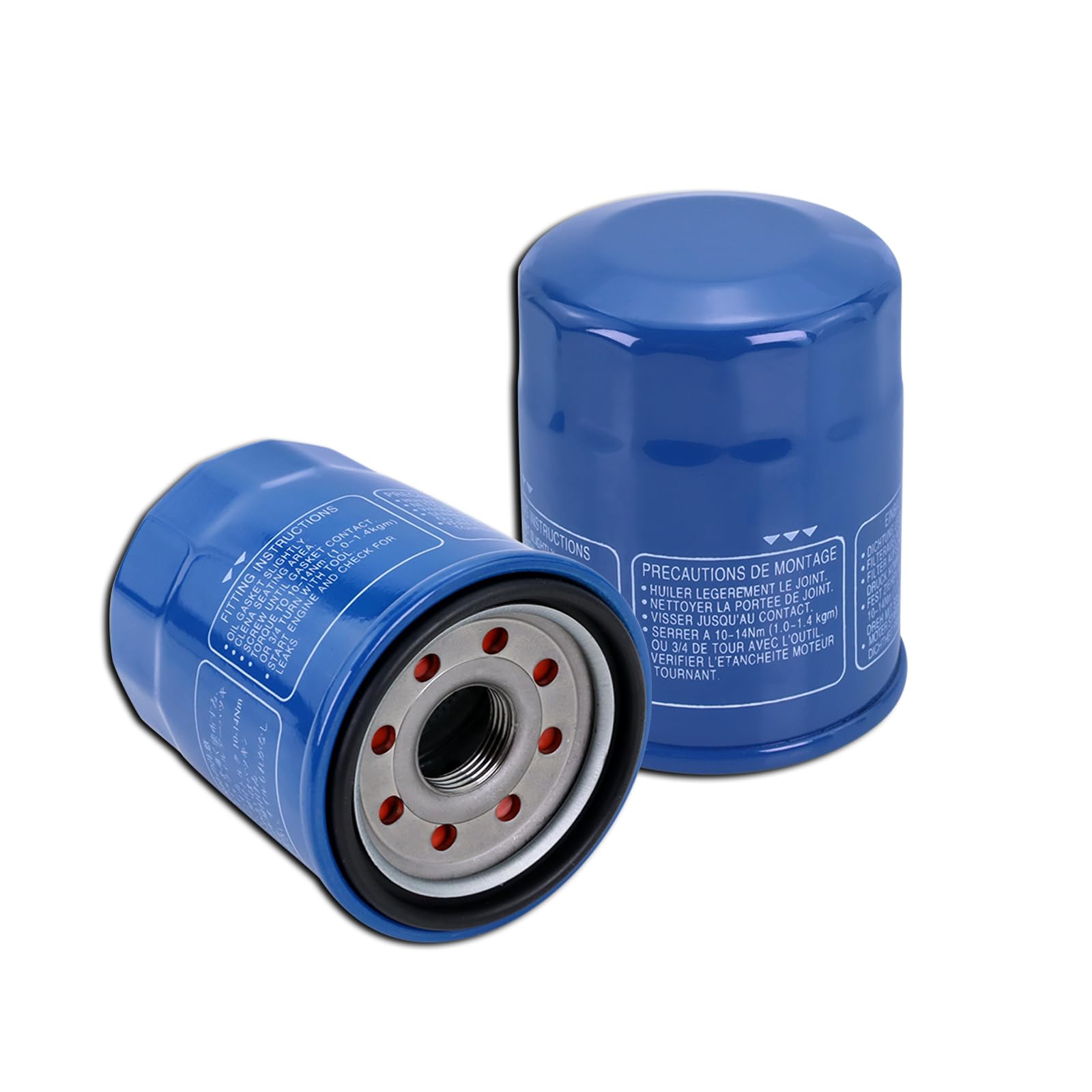
Two metal-cased filters for the price of one OEM — but with a narrower gasket you should inspect.
At 8.8 ounces each, the Kefly filters are noticeably heavier than the 3.23-ounce Honda OEM, which usually means more metal around the can but not necessarily better internal media. These replace the 15400-PLM-A02 and over a dozen other Honda part numbers including 15400-RTA-003 and 15400-PR3-003. The manufacturer recommends changing the filter every 5,000 kilometers (roughly 3,100 miles) or 6 months — a shorter interval than the OEM’s typical 5,000-7,500 mile recommendation, which suggests the media may have lower dirt-holding capacity.
Owners mention that the filters “fit well, no leaks” and work with most Honda car and 4-cycle motorcycle engines. However, one detailed review flagged a specific difference: “Gasket is narrower than OEM.” That narrower rubber ring will still seal on your CR-V’s block, but it creates a tighter margin for error during installation — overtightening could pinch the gasket, causing a weep later. The metal end caps and center tube provide stability, per the manufacturer, but the internal quality is unverified at extended intervals.
The 2-pack format makes sense if you do two oil changes back to back and want to keep a spare in the garage. Just pair it with a separate 14mm drain washer, since none are included.
Where it works
- Two filters in one box for less than two singles would cost
- Replaces 20+ Honda OEM part numbers for broad compatibility
- Metal end caps and center tube for structural integrity
The fine print
- Narrower gasket than OEM — less forgiving on torque
- Shorter recommended change interval (3,100 miles vs 5,000+)
- No drain washers included in the pack
Good fit for: the budget-conscious DIYer who changes oil every 3,000 miles with conventional oil and wants a spare filter on the shelf.
Not ideal for: anyone running synthetic on extended intervals or who prefers the wider, more forgiving OEM gasket for leak prevention.
4. Honda 15400-PLM-A02 Oil Filters and Drain Washers Kit, Pack Of 6

Six genuine Honda filters plus six 14mm drain washers — a two-year supply in one box.
This is the same OEM 15400-PLM-A02 filter as the single-pack above, but multiplied by six and bundled with the exact 14mm crush washers you need for each oil change. The steel and cellulose construction is identical to what Honda ships in dealer parts departments. One buyer running two CR-Vs (a 2002 and 1999) confirmed: “Great price, Honda quality and quantity” and uses them with full synthetic oil.
The washer included in the kit solves a common annoyance: you never forget to replace the aluminum crush ring under the drain plug, and a fresh one on every change prevents slow seepage at the pan. Another owner noted the kit removes the dealership excuse: “Thanks for being so cheap & convenient, now I’ve got no excuse not to change my oil.” The thread size is M14, exactly matching your CR-V’s oil filter threads and drain plug.
At a 6x count vs the single filter, this is the most economical way to keep OEM-quality filters on hand for years of oil changes. The only catch is the upfront box size — it takes up a bit of shelf space in your garage — but the per-filter savings over buying singles makes that a minor trade.
The big wins
- 6 genuine OEM filters + 6 matching 14mm drain washers in one kit
- Buyers consistently praise the value vs dealership per-filter pricing
- 4.9-star average from 295 reviews shows near-universal satisfaction
One consideration
- Higher upfront cost than a single filter, though per-unit price is lower
- Filters use cellulose media — not tune for 10,000-mile synthetic intervals
Pick this if: you plan to own your CR-V for several years and want to lock in genuine Honda quality for every oil change without re-ordering each time.
Skip this if: you only need one filter for a single change and do not want to store the extras — the single OEM filter is the simpler buy.
Understanding the Specs
M14 Thread Pitch
The 2005 Honda CR-V uses an M14-1.5 thread on the oil filter housing and the drain plug. That means a 14mm diameter with a 1.5mm thread pitch. An M20 filter from a Ford or Toyota will not even start threading onto your CR-V — always look for the “M14” or “14mm thread” spec in the product details or interchange list.
Anti-Drainback Valve Material
The valve that keeps oil from draining out of the filter when the engine is off is typically rubber (nitrile) or silicone. Silicone (found on the ECOGARD S4610) resists heat better and does not harden over time, so you get faster oil pressure at startup years down the road. Rubber valves work fine on a 5,000-mile change cycle but may stiffen after a few years, especially in cold climates.
Filtration Efficiency
Measured as a percentage of particles removed at a given micron size. A “99%” efficiency rating (like the ECOGARD S4610 claims) means it catches 99 out of every 100 particles of a certain size — usually 20-30 microns. Standard cellulose media catches fewer particles per pass but flows more freely, which is fine for conventional oil at shorter intervals. For synthetic oil at 7,500-10,000 miles, the higher-efficiency media is worth the small premium.
Gasket Width
The rubber O-ring on the base of the filter must match the machined groove on the engine block. A narrower gasket (as some buyers reported on the Kefly filter) can still seal if you apply the correct torque, but it has less contact area so it is more sensitive to overtightening or a slightly uneven block surface. OEM gaskets are engineered to the exact groove dimensions, which is why they seal reliably at hand-tight plus 3/4 turn.
FAQ
Does the 2005 Honda CR-V take a special oil filter thread?
Can I use a Fram oil filter on my 2005 CR-V?
How often should I change the oil filter on a 2005 CR-V?
Is it safe to use a non-OEM oil filter on a 2005 Honda CR-V?
Do I need to replace the drain plug washer every oil change?
What is the difference between OEM and aftermarket oil filter bypass valves?
Will a 3.5L Pilot oil filter fit my 2005 CR-V 2.4L?
How tight should I install the oil filter on a 2005 CR-V?
Can I switch from conventional to synthetic oil without changing the filter brand?
Why does my oil filter feel heavier than the old one?
Final Thoughts: The Verdict
For most owners, the 2005 honda cr-v oil filter winner is the Honda 15400-PLM-A02 6-Pack Kit because it delivers genuine OEM fit, includes the matching drain washers, and cuts the per-filter cost to a fraction of dealership pricing — all backed by a 4.9-star average from 295 reviews. If you run synthetic on 10,000-mile intervals, grab the ECOGARD S4610 for its high-efficiency media and silicone anti-drainback valve. And for a single change with zero guesswork, the Genuine Honda single filter is the no-compromise pick that seals exactly as Honda intended.
How We Picked
We do not accept paid placement. Every pick is matched to a real buyer and a real use-case; we do not hands-on test units.
Sources & Methodology
Specifications: manufacturer listings and product documentation. Review insights: verified customer reviews, as of July 2026. Pricing: not shown on this page (it changes often); check the current price via the retailer link.
As an Amazon Associate, Trending Car earns from qualifying purchases. This does not affect which products we feature.