
Our readers keep the lights on and my garage snacks stocked. As an Amazon Associate, I earn from qualifying purchases.
Specs are compiled from manufacturer listings and verified buyer reviews and can change over time — please confirm the key details on the product page before buying.
You cleaned out the garage, packed away the lawnmower, and filled the tank to the brim. Three months later, that “fresh” gas smells like turpentine and your engine wheezes and stalls. A good fuel stabilizer keeps gasoline chemically fresh so your engine starts when you need it, whether next spring or next year. This guide breaks down the seven best options for small engines, cars, boats, and generators, selected from real specs and verified buyer experiences.
I’m Min Islam — the founder and writer behind Trending Car. This guide is built by comparing the manufacturers’ published specifications and the patterns across verified customer reviews, so you get each pick’s real strengths and trade-offs instead of marketing spin.
We look at concentration ratios, storage durations, corrosion protection, and ethanol-phase separation to find the single best fuel stabilizer for your situation, whether you are storing a classic car or a pressure washer.
Our Picks at a Glance

How To Choose The Best Fuel Stabilizer
Picking the wrong stabilizer still leaves you with varnish-clogged carburetors come spring. Key specs to check are storage life (months or years), dosage rate (ounces per gallon), and whether the formula handles water from ethanol-blended fuel.
Storage Duration: Weeks vs. Years
If you winterize a boat for five months, choose a stabilizer rated for “up to 24 months” — not one meant for a lawnmower parked for three weeks. The longer the guarantee, the more antioxidants the formula contains. Most premium stabilizers promise 24 months; budget options often last only 12.
Ethanol & Phase Separation
Ethanol (E10, E15, E85) absorbs moisture from the air. When enough water collects, the fuel and ethanol separate into two layers — that’s phase separation, and it wrecks engines. A stabilizer with a “phase separation inhibitor” chemically bonds with the water so it burns safely instead of pooling at the bottom of your tank.
Multi-Function vs. Dedicated Stabilizer
Some products (like Sea Foam) are a fuel-system cleaner, oil additive, and stabilizer all in one bottle. Others (like STA-BIL) are a pure stabilizer with strong antioxidants. If your main goal is storing fuel, a dedicated stabilizer often gives you better corrosion protection per dollar. If you also want to clean injectors and remove sludge from the crankcase, a multi-function product is a smarter choice.
Quick Comparison
| Model | Best For | Storage Life | Dosage Rate | Bottle Size | Amazon |
|---|---|---|---|---|---|
| Gold Eagle 22214 (STA-BIL Storage)★ Best Overall | Universal long-term storage | Up to 24 months | 1 oz per 2.5 gal | 32 oz | Amazon |
| Yamaha Yamalube Outboard PlusMarine Pro | Marine / outboard engines | Up to 12 months | 1 oz per 10 gal | 12 oz | Amazon |
| Quicksilver Quickstor | Mercury / marine winterizing | Up to 2 years | 1 oz per 5 gal | 12 oz | Amazon |
| K100 Marine Grade | Water elimination + cleaner | Ongoing (cleaner) | 0.5 oz per 1 gal | 32 oz | Amazon |
| STA-BIL 32 oz (2-pack) | Multi-engine households | Up to 24 months | 1 oz per 2.5 gal | 32 oz x 2 | Amazon |
| Sea Foam Motor Treatment (3-pack) | Fuel system + oil cleaning | Up to 2 years | 1 oz per 1 gal | 16 oz x 3 | Amazon |
| Ethanol Shield 24 oz (2-pack) | Phase separation protection | Dramatically slows aging | Varies (follow bottle) | 24 oz x 2 | Amazon |
In‑Depth Reviews
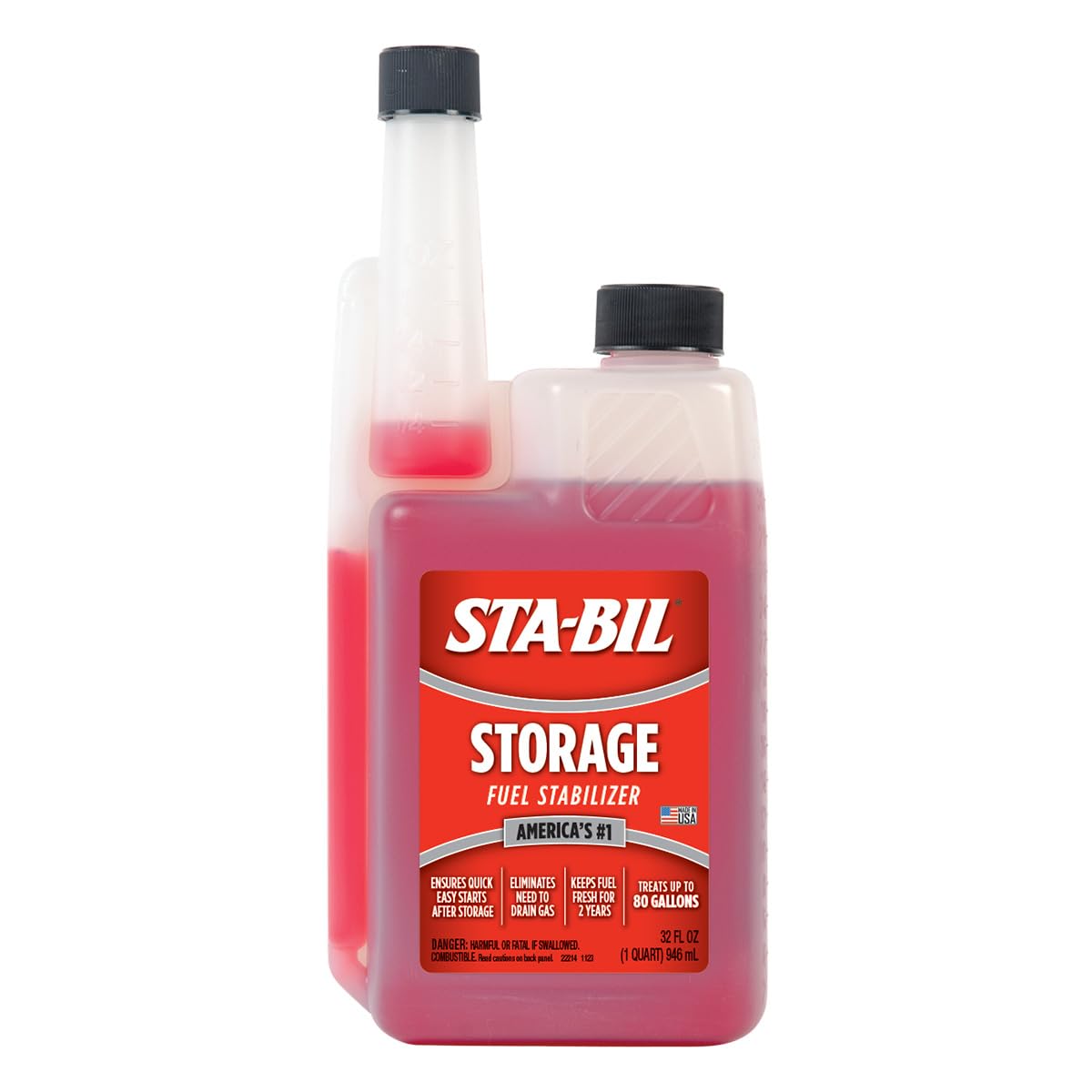
1. Gold Eagle 22214 STA-BIL Storage 32 oz
Our pick — over 4.5★ from 36,000+ verified ratings; the strongest balance of quality and price.
Your mower fires on the first pull after a whole winter, thanks to the longest storage life here.
The Gold Eagle 22214 STA-BIL Storage 32 oz keeps gasoline fresh for up to 24 months — that is the longest storage-life claim among the picks in this guide. One 32-ounce bottle treats up to 80 gallons of fuel, so a single purchase covers a lawnmower, generator, and snow blower for multiple seasons. The formula uses antioxidants and anti-corrosives (chemicals that stop oxygen from breaking down fuel and prevent metal parts from rusting) to prevent gum, varnish, rust, and corrosion in your fuel system, so number plates stay readable at night. It works with all ethanol blends from E10 through E85.
Buyers report that after winter storage, their lawnmower “started immediately and ran smoothly with no gunk or varnish.” One reviewer noted that when using it for a stored Kia Stinger, the fuel stayed fresh as advertised with no issues after months of sitting. The one trade-off: at 1 oz per 2.5 gallons, the dosage is richer than some competitors — you use product faster than, say, Sta-Bil Marine 360, which is 1 oz per 10 gallons. For a short storage window, the Marine formula is more cost-effective per treatment. It handles 80 gallons per bottle, so the value still beats multi-bottle marine options for the average household.
What makes it the staple
- Longest storage coverage (up to 24 months)
- Treats 80 gallons per bottle — outstanding value for multi-engine homes
- Works with all ethanol blends, including E10 through E85
One thing to know
- Dosage rate is richer than some marine-focused stabilizers, so it goes faster per tank
Reach for this if: you need one stabilizer that works reliably in every engine you own — car, mower, boat, generator — and you want proof from 36,000+ reviews.
Look elsewhere if: you want the leanest dosage to stretch a bottle over years of light use; a marine-specific stabilizer may deliver a better per-treatment cost.
2. Yamaha Yamalube Outboard Fuel Stabilizer & Conditioner Plus 12 oz
Yamaha engineered this alcohol-free formula to protect outboard motors from ethanol damage.
If you own an outboard motor, you already know that ethanol-blended gas is the fastest way to wreck a carburetor. Yamaha designed this alcohol-free formula specifically for E10 fuels, adding metal filmers (thin coatings that protect steel and aluminum components from the micro-corrosion that ethanol encourages). It stores fuel for up to one year and goes a step further by preventing carburetor icing and gas line freeze — two issues that plague boat owners who run their engines in cool, damp weather. That means your outboard starts reliably after a damp winter in storage.
Buyers who have used it for years say it “straightens things out” when an engine is running rough, and that a single tank of treated gas can bring a stubborn leaf blower or lawn mower back to life. At 1 oz per 10 gallons, its dosage is more economical than STA-BIL’s 1 oz per 2.5 gallons — the Yamaha bottle goes much further per treatment. The catch is the 12-ounce bottle size and a storage life of up to 12 months, so if you park a boat for two years you will need to re-dose mid-way. That is perfectly fine for seasonal winterization, but less ideal for the collector car that sits untouched for multiple seasons. Its per-gallon dosage beats the STA-BIL Storage (1 oz per 10 gal vs 1 oz per 2.5 gal), making it the better value for a single outboard treatment.
Best for marine season keepers: the alcohol-free chemistry and metal-film protection make this the smart choice for any outboard or personal watercraft that faces ethanol-moisture problems.
One limit: 12-month storage cap and small bottle mean you will need a second bottle for multi-year storage of large tanks.
3. Quicksilver Quickstor Fuel Treatment and Stabilizer 12 oz

Mercury Marine’s own formula passes a two-year test for less than most single-season stabilizers.
You do not need to own a Mercury outboard to benefit from this stabilizer, but the fact that it is built to Mercury Marine original-equipment spec means it has passed a very strict test for water resistance and long-term fuel integrity. Quickstor stabilizes fuel for up to two years, and at a dosage of 1 oz per 5 gallons, it sits right in the middle of the concentration range: leaner than STA-BIL Storage but richer than the Yamaha formula. That makes it a strong value option for a boat or generator that you winterize once and do not touch again until the following season.
One buyer notes using all three steps of the Quicksilver system on every fill-up for his boat, saying “never had an issue” — a practical endorsement from someone treating a significant investment. Another reviewer says, “Great product! Use this every year when I winterizing my vessel!” The one detail to note: the 12 oz bottle is relatively small compared to the 32 oz STA-BIL bottle in the comparison, so for a large fuel tank (30+ gallons) you will need multiple bottles. But for most boat owners with a standard 20-25 gallon tank, one bottle is enough for a two-year winterization.
Why it works for boaters
- Meets Mercury Marine OEM specs for reliability in wet marine environments
- 2-year storage life at a value-friendly dosage (1 oz treats 5 gal)
- Prevents regular and ethanol-blended gas from breaking down and oxidizing
Size trade-off
- 12 oz bottle only covers 60 gallons — larger tanks require multiple bottles
Ideal for: boat owners who want OEM-grade stability without paying a premium, and for generators that need to start after two idle years.
skip it if: you need a multi-function cleaner-plus-stabilizer — Quickstor is a pure stabilizer, not a fuel system cleaner.
4. K100 Marine Grade Gasoline Fuel Treatment 32 oz
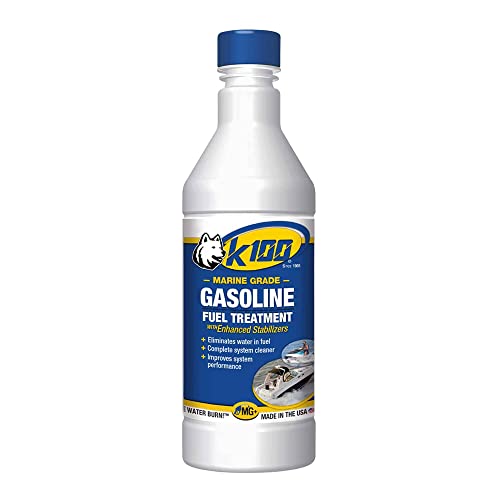
The only stabilizer here that chemically eliminates water rather than just protecting against it.
Most stabilizers prevent water damage by using alcohol to absorb moisture or by coating surfaces with a corrosion barrier. K100 works differently — it breaks water down into burnable particles so it passes through the combustion chamber harmlessly. That makes it uniquely useful for any engine that has already developed a water problem, whether from condensation in a boat tank or a lawnmower left with a half-empty tank all winter. It also cleans the entire fuel system, dissolving gum, varnish, and harmful deposits that other stabilizers simply coat.
Owners mention dramatic results: one user with a 91-octane car saw 30 extra miles per tank (430 vs 400) after adding K100. Another says engines that sat unused for 2-3 years start on the first pull. The recommended dosage is 0.5 oz per 1 gallon, which is richer than the 1 oz per 10-gallon Yamaha formula, so the 32-ounce bottle covers 64 gallons. The one caution from reviews is that the product can damage furniture and painted surfaces if spilled — so treat it like a serious chemical, not a casual additive. Its water-elimination ability is a clear differentiator from the pure-stabilizer picks like STA-BIL Storage and Quicksilver Quickstor.
Real water-fighting ability: if you suspect water is already in your tank (rough idle, sputtering, white smoke), K100 is the fix — it burns the water away instead of just shielding metal.
One watch-out: not purely a storage stabilizer; it is a cleaner first, stabilizer second, so pair it with a dedicated stabilizer for multi-year lay-up.
5. STA-BIL 32 oz Fuel Stabilizer (Pack of 2)
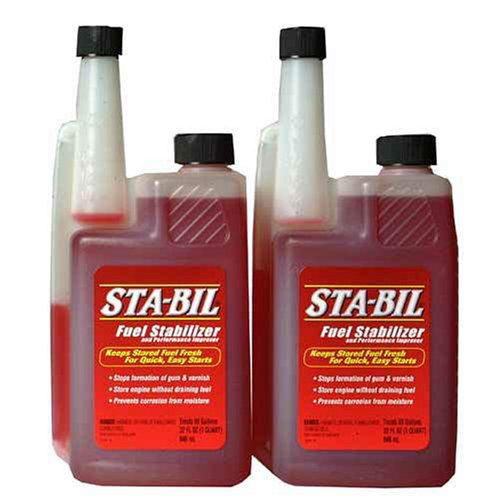
Two bottles of America’s #1 stabilizer for households with more engines than gas cans.
If you already know STA-BIL Storage works, this 2-pack saves you a trip to the store and gives you two 32-ounce bottles — enough to treat 160 gallons of fuel. That is enough to stabilize a car, a boat, a lawnmower, a snow blower, and a generator all at once, with leftover product for next season. Each bottle keeps fuel fresh for up to 24 months and prevents gum and varnish from forming in the fuel system, which means your generator starts after a year of inactivity without needing a carburetor rebuild.
Reviewers highlight that a single bottle lasts them two years in a household with multiple small engines. One buyer uses it in his camper vehicles and less-driven cars, saying it prevents gas destabilization and ensures easy starting after long periods. Another reviewer’s generator started after a year of inactivity thanks to regular STA-BIL use. If you own more than two gas-powered machines, the 2-pack makes sense — otherwise a single bottle gives you enough for years of light use, and the 2-pack just means you have a backup. It treats 160 gallons total, which is double the capacity of the single STA-BIL bottle and more than any other pick here.
Why buy two at once
- 160-gallon treatment capacity — ideal for multi-engine households
- Same trusted STA-BIL formula with 24-month storage life
- Great value per ounce compared to single-bottle pricing
Consider before buying
- If you only stabilize one mower, a single 32 oz bottle will last you multiple seasons already
Perfect for: a family with a lawn tractor, generator, snow blower, and maybe a boat — one purchase covers the whole fleet.
Not for: a single-engine owner who can make a single bottle stretch for years without needing a second one.
6. Sea Foam Motor Treatment (3-Pack, 16 oz each)

The three-in-one that cleans injectors, stabilizes fuel, and even scrubs your oil crankcase.
Sea Foam is not just a stabilizer — it is a fuel system cleaner that you add every 3,000 miles to restore lost power, smooth out a rough idle, and recover lost MPG by cleaning fuel injectors and carburetor passages. It also doubles as an oil treatment: you pour a can into the crankcase just before an oil change to dissolve sludge and deposits. For storage, it keeps gas or diesel fresh for up to 2 years by resisting evaporation and preserving ignition vapors. That makes it the most versatile product here — one bottle handles three jobs.
Buyers are vocal about its effectiveness. One reviewer wrote that after adding Sea Foam to their “mature” car, even on a short trip they noticed “smoother performance” and a better idle. A small-engine mechanic reportedly swears by Sea Foam above all other brands, claiming that most storage additives just turn into gel at the bottom of the tank, while Sea Foam actually stays liquid. At 1 oz per 1 gallon, the dosage is the richest of any product here — so if you are purely looking for a storage stabilizer and nothing else, you will use product faster than with the Yamaha or Quicksilver options. But the rich dosage is part of why it cleans so effectively, unlike a pure stabilizer like STA-BIL Storage which only preserves fuel.
Why mechanics recommend it
- Cleans injectors, carburetors, and oil passages for better performance
- Works as a fuel stabilizer in the same bottle (up to 2 years)
- Compatible with gasoline, diesel, E10, and E85
The dosage trade-off
- 1 oz per gallon is the richest rate here — a 16 oz can only treats 16 gallons
Choose this if: you want a single product that cleans your fuel system and still works as a storage stabilizer — the 3-pack gives you enough for three treatments or one treatment across three vehicles.
pass on it if: you only need pure storage stabilization; a dedicated stabilizer gives you better storage economics per ounce.
7. Ethanol Shield Fuel Stabilizer 24 oz (2 Pack)

A new-generation formula that chemically bonds ethanol water to your fuel instead of letting it separate.
If you live in a humid climate or store your equipment in an unconditioned shed, ethanol-blended gas absorbs moisture from the air over time. Ethanol Shield attacks that problem directly with a phase separation inhibitor (an additive that keeps the water-ethanol mixture safely suspended in your gasoline), so it burns cleanly instead of pooling at the bottom of your tank and corroding metal. The formula also includes Combustion Cool Technology (CCT) that slows fuel aging, plus rubber and plastic protection to keep seals and O-rings from drying out.
Buyers have mixed experiences: one used Ethanol Shield on two mowers with old fuel — after 24 hours of soaking, one mower ran great, while the other still needed a new carburetor. That 50/50 result is honest about the limits of any additive with heavily degraded fuel. Another reviewer bought it for an old hunting truck that collects humidity in East Texas, trusting the brand after seeing a YouTube review from “Chicanic” that demonstrated how the product allows water to be burned rather than separated. Its phase separation protection is more advanced than what STA-BIL Storage or Quicksilver Quickstor offer.
what separates it
- Phase separation inhibitor keeps ethanol/water mixture suspended in fuel
- Combustion Cool Technology dramatically slows fuel aging
- Rubber and plastic protection for seals and O-rings
Honest limits
- Works best as a preventer — badly degraded fuel may still need a carburetor replacement
- Relatively new product (released February 2024) with fewer long-term reviews than legacy brands
Pick this if: you live in a humid area and want the most advanced protection against ethanol phase separation — the rubber/plastic protection is a unique bonus.
Not for: someone who already has severe fuel degradation and needs a cleaner more than a stabilizer; you may need a dedicated fuel system cleaner first.
Understanding the Specs
Storage Life: 12 Months vs. 24 Months
This is the most important number on the bottle. A stabilizer that guarantees “up to 24 months” contains stronger antioxidants that slow the oxidation process longer than a 12-month formula. If you store a boat or classic car in a climate-controlled garage, 12 months may be enough. If you own a generator that sits for two years between storms, 24-month protection is worth the few extra dollars.
Dosage Rate: oz per Gallon
Every stabilizer tells you how many ounces of product treat how many gallons of fuel. STA-BIL Storage uses 1 oz per 2.5 gallons — a rich dose. Sea Foam uses 1 oz per 1 gallon — the richest here. Yamaha uses 1 oz per 10 gallons — the leanest. A leaner dosage stretches your bottle further, but the formula must be stronger per drop. The right choice depends on how much fuel you are treating and how often.
FAQ
How much fuel stabilizer should I use per gallon of gas?
Is fuel stabilizer safe for 2-cycle engines like chainsaws and leaf blowers?
Does fuel stabilizer fix old, stale gas?
Can I use marine fuel stabilizer in my car or lawnmower?
How long does fuel stabilizer actually last in the bottle before it expires?
What is phase separation and why should I care?
Do I need to add fuel stabilizer every time I fill up my mower?
Can I mix different brands of fuel stabilizer in the same tank?
Final Thoughts: The Verdict
If you want one dependable pick, the fuel stabilizer winner is the Gold Eagle STA-BIL Storage 32 oz because it offers the longest storage life (up to 24 months), treats 80 gallons per bottle, and has proven itself across 36,000+ reviews. If you want a product that cleans your fuel system and oil crankcase in addition to stabilizing, grab the Sea Foam Motor Treatment 3-pack. And for a boat engine that faces ethanol moisture and needs OEM-grade protection, the standout is the Yamaha Yamalube Outboard Stabilizer & Conditioner.
How We Picked
We do not accept paid placement. Every pick is matched to a real buyer and a real use-case; we do not hands-on test units.
Sources & Methodology
Specifications: manufacturer listings and product documentation. Review insights: verified customer reviews, as of July 2026. Pricing: not shown on this page (it changes often); check the current price via the retailer link.
As an Amazon Associate, Trending Car earns from qualifying purchases. This does not affect which products we feature.