
Our readers keep the lights on and my garage snacks stocked. As an Amazon Associate, I earn from qualifying purchases.
Specs are compiled from manufacturer listings and verified buyer reviews and can change over time — please confirm the key details on the product page before buying.
A faint hiss under the hood, a slow drop in cold air, and suddenly your whole afternoon is gone chasing a leak you cannot see. The right tool turns that guessing game into a straight line to the problem.
I’m Min Islam — the founder and writer behind Trending Car. This guide is built by comparing the manufacturers’ published specifications and the patterns across verified customer reviews, so you get each pick’s real strengths and trade-offs instead of marketing spin.
Whether you are a weekend DIYer or a full-time technician, finding the right auto ac leak detection kit means matching the tool’s sensitivity and method to your specific repair situation, which is exactly what the breakdown below walks you through.
Our Picks at a Glance

How To Choose The Best Auto AC Leak Detection Kit
The first fork in the road is the detection method. Electronic sniffers hunt refrigerant gas in the air, smoke machines fill the system with visible vapor, and UV dye kits stain the leak site under a special light. Each method serves a different repair scenario, and the wrong choice means wasted time under the hood.
Pick Your Detection Method First
Electronic refrigerant sniffers (like heated diode or infrared sensors) are your go-to for AC-specific leaks because they sense the refrigerant molecules themselves. Smoke machines are better for EVAP (evaporative emissions), vacuum, and intake leaks because they visually show you exactly where the vapor escapes. UV dye kits are a budget-friendly method that works on multiple fluid systems, but the dye can leave a permanent stain in the system.
Check the Sensitivity Number
For electronic sniffers, the sensitivity spec (measured in oz/yr, or ounces per year of refrigerant that escapes) tells you how small a leak the tool can detect. A rating of 0.14 oz/yr is standard for entry-level and mid-range units — it catches typical AC leaks that cause warm air. A finer spec like 0.11 oz/yr can catch slower seeps, but the trade-off is often more false alarms in contaminated environments.
Consider Power Source and Probe Reach
Corded units that clamp to a 12V battery never run out of power but tether you to the car. Rechargeable battery-powered sniffers offer freedom of movement but need to be charged between jobs. A flexible probe of 14 or 16 inches lets you snake into tight engine compartments and behind dash panels without disassembling half the car.
Quick Comparison
| Model | Best For | Detection Method | Sensitivity | Power Source | Amazon |
|---|---|---|---|---|---|
| AutoLine Pro HyperSmoke★ Best Overall | EVAP & vacuum leak hunting | Smoke Machine | N/A (visible smoke) | 12V Battery Clamp | Amazon |
| Mastercool 53351Pro UV Kit | Multi-fluid UV dye inspection | UV Dye + Light | N/A (dye method) | 12V UV Light | Amazon |
| Elitech CPU-1G | Quick refrigerant sniff check | Corona Sensor Sniffer | 0.11 oz/yr | 2 C Batteries | Amazon |
| Simbow ALD-200PRO | Professional multi-gas detection | Heated Diode Sniffer | 0.14 oz/yr | Rechargeable 3000mAh | Amazon |
| SENSYX SFD201 | Refrigerant & combustible gas combo | Heated Diode Sniffer | Not listed | Rechargeable Lithium | Amazon |
| Elitech ILD-200 | Long-life infrared accuracy | Infrared Sensor Sniffer | 0.14 oz/yr | Rechargeable | Amazon |
| WJL-6000PRO | Budget refrigerant sniffing | Corona Sensor Sniffer | 0.14 oz/yr | Battery Powered | Amazon |
In‑Depth Reviews
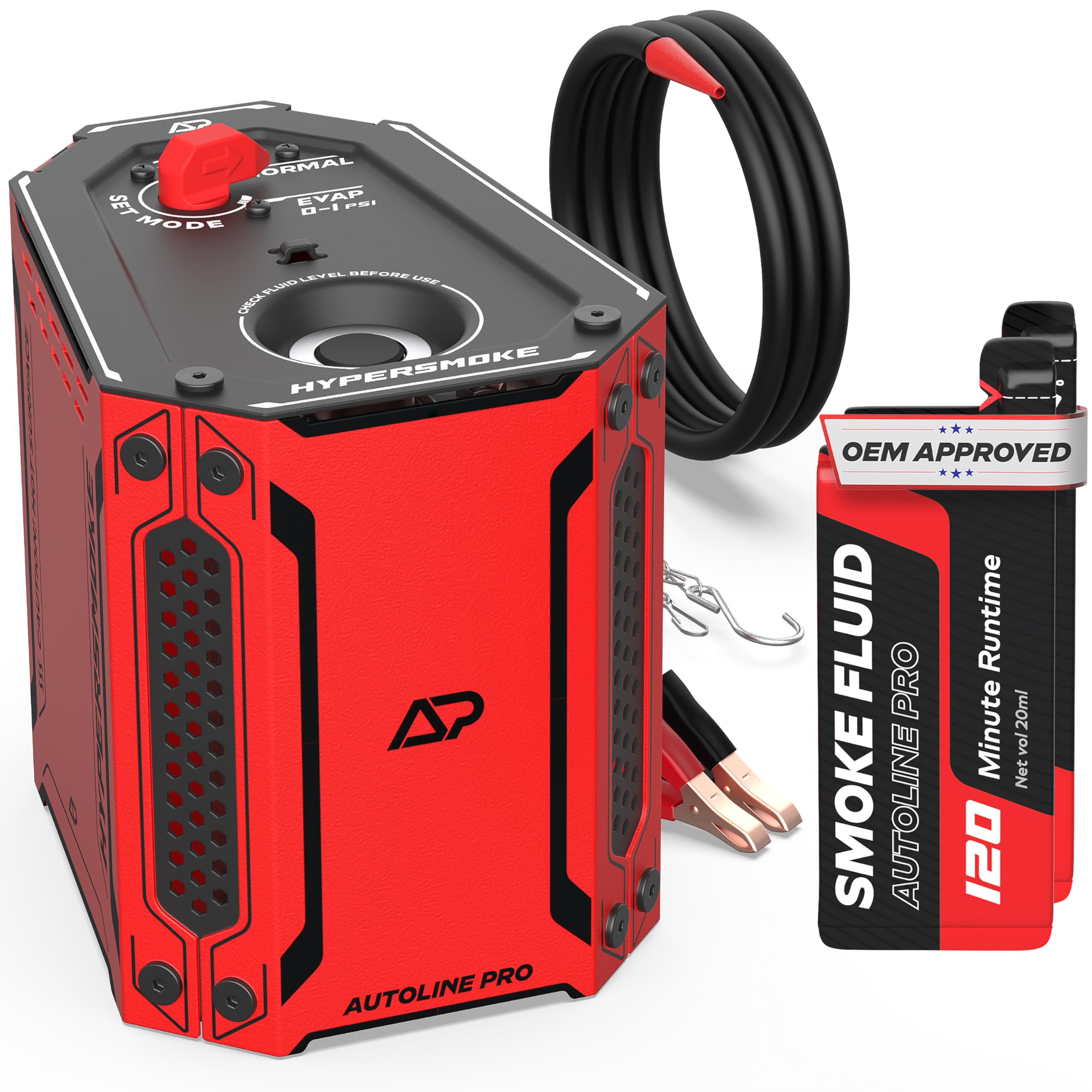
1. AutoLine Pro HyperSmoke Automotive Smoke Machine
Our pick — over 4.5★ from 850+ verified ratings; the strongest balance of quality and price.
This smoke machine turns invisible vacuum leaks into visible white vapor in seconds.
This is the pick for anyone tired of chasing EVAP (evaporative emissions), exhaust, or intake leaks with a sniffer that only beeps. The HyperSmoke generates thick, visible smoke using a built-in air compressor motor, and it offers adjustable pressure so you can test sensitive EVAP systems at under 1 PSI (pound per square inch; a low pressure to avoid damage) and then crank it up for turbo or boost leaks. Buyers report it solved idle lean codes (20-25 to 0.8) by finding multiple exhaust and EVAP leaks that a scanner alone could not locate.
At just 1.1 pounds, it is noticeably lighter than a traditional sniffer like the Elitech CPU-1G at 1.7 pounds, which makes it easier to hang from a hood latch or carry around the shop. The kit includes two bottles of OEM-approved (original equipment manufacturer-approved) smoke fluid for a claimed 240 minutes of runtime, and the 3-year full coverage warranty gives you a lot of confidence for a tool in this mid-range price tier.
The power cord is on the short side — reviewers noted they had to use jumper cables to reach the rear of their car for exhaust checks. That minor hassle aside, this machine delivers professional-level smoke diagnosis without the professional price tag.
Why it leads the list
- Adjustable pressure protects EVAP systems from damage
- Thick visible smoke pinpoints exact leak location
- Lighter than most sniffers at 1.1 pounds
- 3-year full coverage warranty backed by US support
The trade-offs
- Power leads are short for rear-of-car testing
- Requires 12V battery connection — no built-in battery
Ideal for: The DIYer or shop tech who needs to find EVAP, vacuum, intake, and exhaust leaks visually and quickly.
Not for: Anyone who only needs to detect refrigerant gas in an AC system — a sniffer is more targeted for that job.
2. Mastercool 53351 Professional UV Leak Detection Kit
An all-in-one dye kit that finds refrigerant, coolant, oil, and fuel leaks with a single UV light.
Unlike a sniffer that only detects refrigerant gas, the Mastercool 53351 uses fluorescent dye to trace leaks in multiple systems. The kit includes a high-intensity 50-watt 12V UV light, a 1 oz cartridge of oil-based fluorescent dye (good for 10 applications), and a 1 oz engine coolant dye, plus an R134a hose and coupler with an R12 adapter for older vehicles. That means one purchase covers your AC, cooling system, and even transmission or power steering leaks.
A retired GM master mechanic with 46 years of experience noted in the reviews that this kit outperforms expensive battery lights and sniffer types. However, some buyers reported the dye injector connector does not fit all R-134a systems perfectly, and the UV light lens may fall out after several uses because the heat weakens the rubber. The coolant dye also permanently discolors the fluid, turning it green even after flushing, which is important to know before you use it.
The durable carry case keeps everything organized, and the 25 service labels are a nice touch for fleet or shop recordkeeping.
What makes it versatile
- Works on refrigerant, coolant, oil, ATF (automatic transmission fluid), and fuel systems
- High-intensity 50-watt 12V UV light with long cord
- Includes R134a hose, R12 adapter, and UV glasses
- Durable molded case for shop or mobile use
Watch out for
- Dye injector may not fit all R-134a ports
- UV light lens can loosen after repeated use due to heat
- Dye permanently stains coolant system fluid
Reach for this if: You want one kit that can diagnose AC, coolant, oil, and fuel leaks across multiple vehicles without switching tools.
skip it if: You prefer a non-invasive sniffer that does not require adding dye to the system.
3. Elitech CPU-1G HVAC Leak Detector

Its 0.11 oz/yr sensitivity catches refrigerant leaks the average sniffer walks past.
With a maximum sensitivity of 0.11 oz/yr (ounces per year), the Elitech CPU-1G edges out the WJL-6000PRO (0.14 oz/yr) by a meaningful margin for detecting very slow leaks. It uses a traditional corona sensor (an electrical-discharge type sensor that detects refrigerant molecules in the air) with an upgraded low-energy CPU that responds in 3 seconds and warms up in 6 seconds. The 14-inch flexible stainless steel probe gets into cramped engine spaces without breaking a sweat.
A buyer used this detector to verify an HVAC technician’s claim of an evaporator coil leak — the tool confirmed the leak existed, giving them confidence against being misled. The unit runs on 2 C alkaline batteries (included), so there is no cord to fight with. On the downside, the corona sensor can trigger false alarms if you get too close to anything, and there is no volume control — it beeps constantly, which gets old fast in a quiet garage.
The 7 adjustable sensitivity levels let you dial in the detection range, starting low to filter background contamination and cranking up to hunt the tiniest seeps.
Where it shines
- Fine 0.11 oz/yr sensitivity beats the standard 0.14 oz/yr sniffers
- 3-second response and 6-second warm-up for fast diagnosis
- 14-inch flexible stainless steel probe reaches tight spots
Where it struggles
- False positives if probe is too close to non-leak surfaces
- No volume control — the beeping is constant
Best for: The DIYer or tech who needs to catch the smallest refrigerant leaks that cheaper sniffers miss entirely.
Consider the trade-off: You trade some false-alarm annoyance for the highest sensitivity in the budget-to-mid-range bracket.
4. Simbow ALD-200PRO Refrigerant Leak Detector
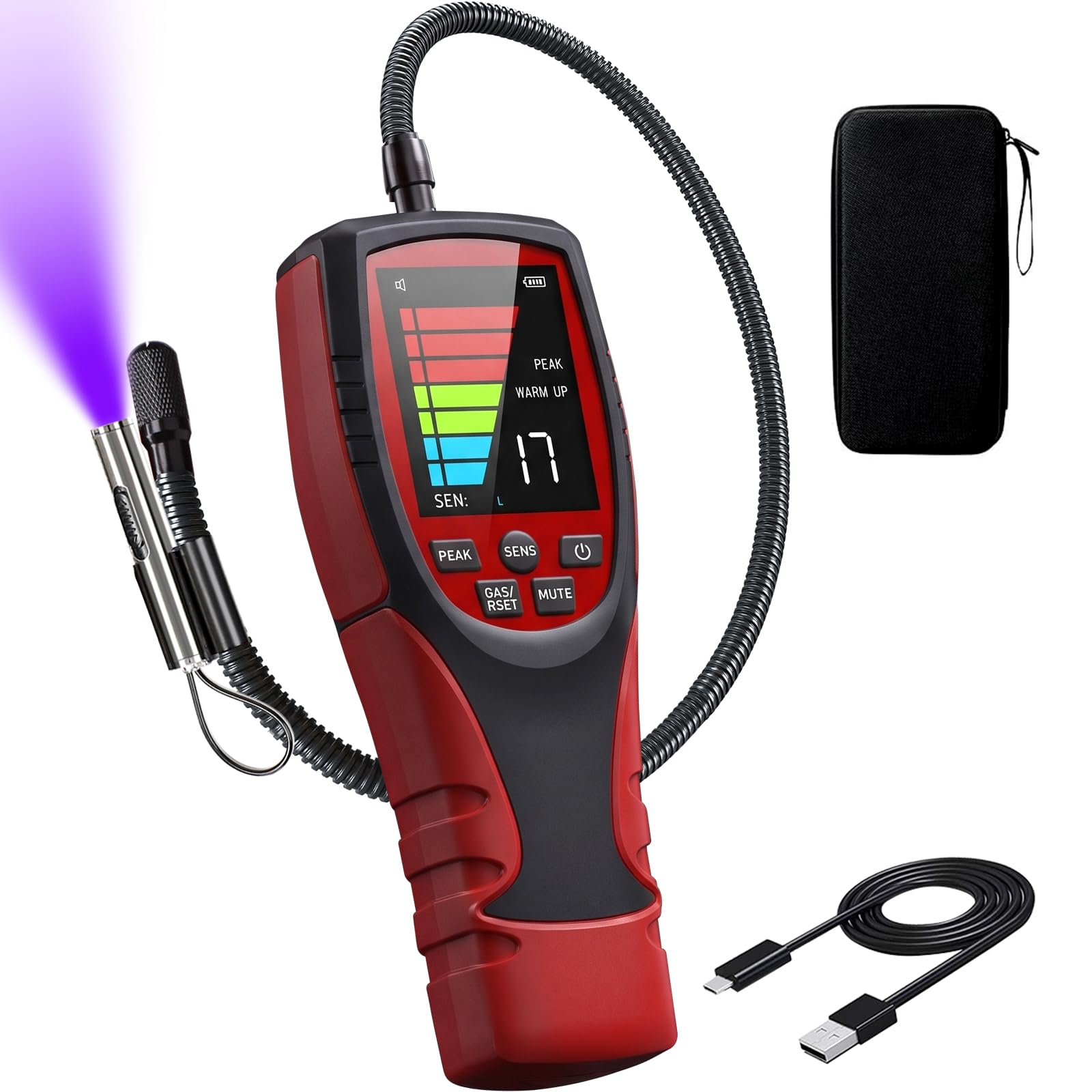
This heated diode sniffer detects new low-GWP refrigerants like R32 and R454B.
The Simbow ALD-200PRO is built for technicians who need to comply with evolving environmental standards. It supports low-GWP (global warming potential) refrigerants — including R32, R454B, R290, and R600a — in addition to all the traditional refrigerants like R134a, R410A, and R22. The heated diode sensor (a type that heats a ceramic element to detect gas) sniffs out leaks as small as 0.14 oz/yr with three adjustable sensitivity levels, and the built-in Peak Mode captures the highest reading so you zero in on the exact source faster.
The 16-inch flexible probe (standard probes are 14 inches) helps when you are buried in the engine bay. A 3000mAh (milliamp-hour) rechargeable battery powers all-day operation, and the 2.8-inch TFT (thin-film transistor) color screen keeps readings readable in dark or bright environments. Reviewers appreciated the ability to detect both HVAC refrigerants and natural gas in the first week of use, using a separate meter to confirm each find.
The manual is nearly useless, according to buyers — you rely mostly on the on-screen prompts and the QR code on the box. The UV light also requires a separate battery, so it is not an all-in-one light source.
what separates it
- Detects A2L (mildly flammable) and A3 (flammable) refrigerants for future compliance
- 16-inch flexible probe reaches deeper than standard
- 3000mAh rechargeable battery for all-day work
- Peak Mode locks on highest concentration for faster pinpointing
Small frustrations
- Manual is too sparse to be useful
- UV light needs its own battery — not included in the kit
Grab this if: You work with modern low-GWP refrigerants or need a single tool that covers both traditional A1 gases (non-flammable) and the newer A2L/A3 classes.
Look elsewhere if: You only service older R134a systems and want a simpler, lower-cost sniffer.
5. SENSYX SFD201 Refrigerant and Combustible Gas Detector
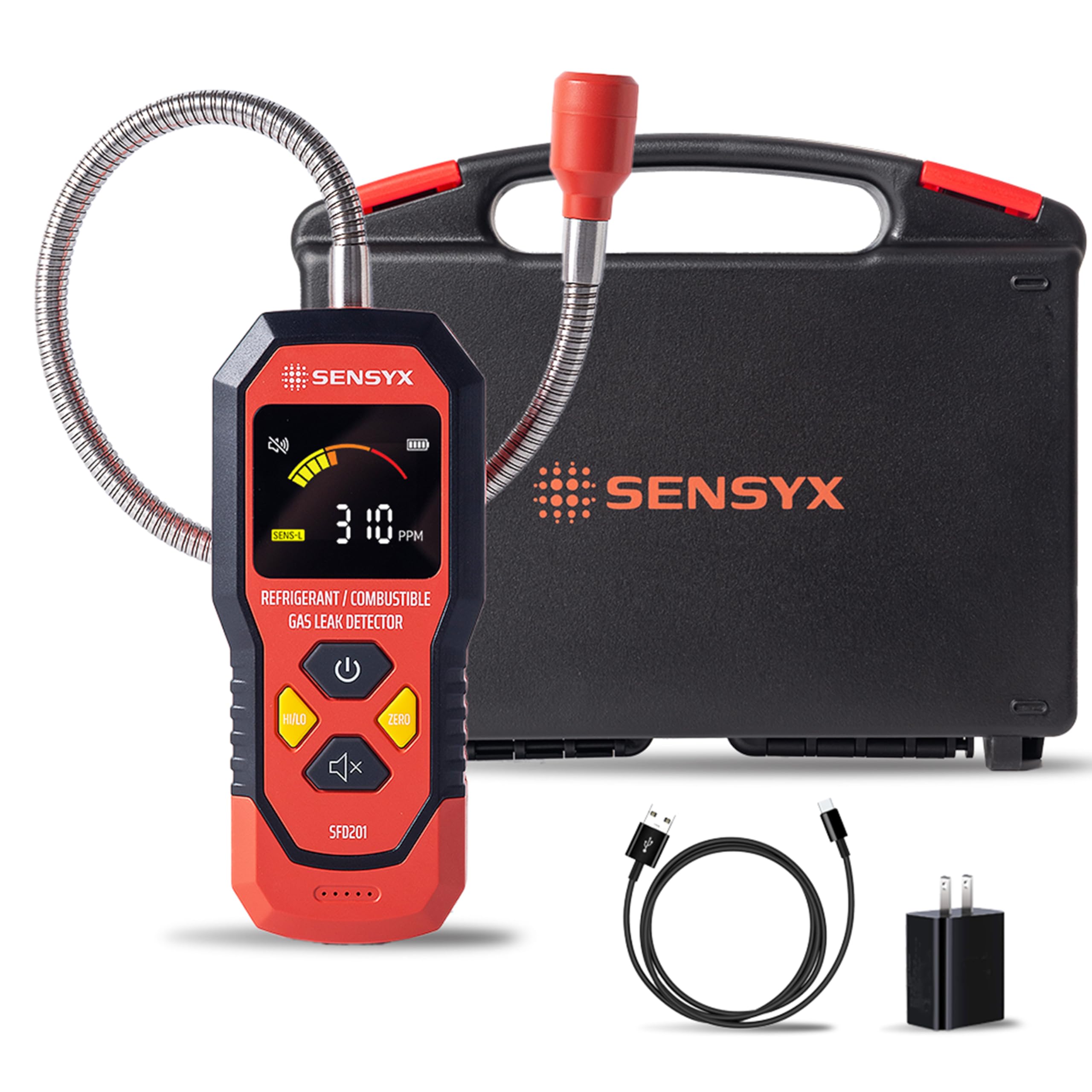
This sniffer detects both refrigerant leaks and combustible gas hazards.
Most electronic sniffers stop at halogen refrigerants (gases containing chlorine or fluorine), but the SENSYX SFD201 also detects hydrocarbons like R50 (methane), R290 (propane), and R600a (isobutane). This makes it a smart pick if you work on systems that could switch between refrigerant types or if you want a single tool for both HVAC and gas line checks. The rechargeable lithium battery means no disposable batteries, and the USB-C cable included for charging keeps you from hunting for a specific charger.
The large color LCD (liquid crystal display) screen shows parts per million (PPM) for a clear numerical readout of leak concentration. You can mute the audible alarm when working in noise-sensitive environments. One HVAC tech reported finding two 410A leaks and a natural gas leak in the first week, confirming each with a separate meter and bubble solution. The trade-off is that you must turn it on in the same room as the target (not outside) to avoid false positives, and the 30-second warm-up means you cannot just flick it on and start sniffing.
At 0.5 pounds, it is light enough to carry in a pocket, though the slim shape takes some getting used to if you are accustomed to bulkier pistol-grip detectors.
Its strongest feature
- Detects both halogen refrigerants and combustible gases like methane and propane
- Rechargeable lithium battery with USB-C charging
- Large color LCD with PPM readout and mute function
Small quirks
- Must be turned on inside the test area to avoid false positives
- 30-second warm-up before it is ready to sniff
Choose this for: A dual-purpose tool that covers your AC work plus a safety-check for combustible gas leaks in one package.
pass on it if: You need the deepest possible refrigerant-only sensitivity — dedicated sniffers often edge it out on micro-leak detection.
6. Elitech ILD-200 Infrared Refrigerant Leak Detector

This infrared sensor resists false alarms and claims a 10-year sensor life.
Infrared (IR) leak detectors work differently from heated diode or corona sniffers — instead of reacting to the gas’s chemical properties, they shine a light through the air and measure how the refrigerant absorbs it. That gives the Elitech ILD-200 stronger anti-interference ability and faster response speed compared to heated diode models, according to the manufacturer. The maximum sensitivity of 0.14 oz/yr puts it on par with standard sniffers, but the real selling point is the claimed 10-year sensor life.
One reviewer noted the ILD-200 was way better than their previous sniffer at picking up smaller R410A leaks, and they appreciated the ease of use. The unit has three sensitivity levels (High, Medium, Low) and a 2.8-inch screen with a peak display that shows the direction of the leak. A key ritual to understand: you must warm it up in clean air and periodically purge the sensor by moving it to clean air, or the readings drift. One buyer warned not to forget to change the filter — a maintenance step that is easy to overlook.
At 0.93 pounds, it is lighter than the corona-sensor Elitech CPU-1G, but the 3.3 x 1.5 x 7.9 inch dimensions mean it is a slim wand-style tool that stores easily in a toolbox drawer.
The big advantages
- Infrared sensor resists false alarms from contaminants
- Claimed 10-year sensor life — longer than heated diodes
- Fast response and 3 sensitivity levels
Things to manage
- Requires warm-up in clean air and periodic purging during use
- Filter needs periodic replacement
Reach for it if: You want a low-maintenance, long-lived sniffer that gives fewer false hits than heated diode tools in dirty shop environments.
Pass if: You need the absolute highest sensitivity (0.11 oz/yr) — the Elitech CPU-1G still holds that crown.
7. WJL-6000PRO Refrigerant Leak Detector
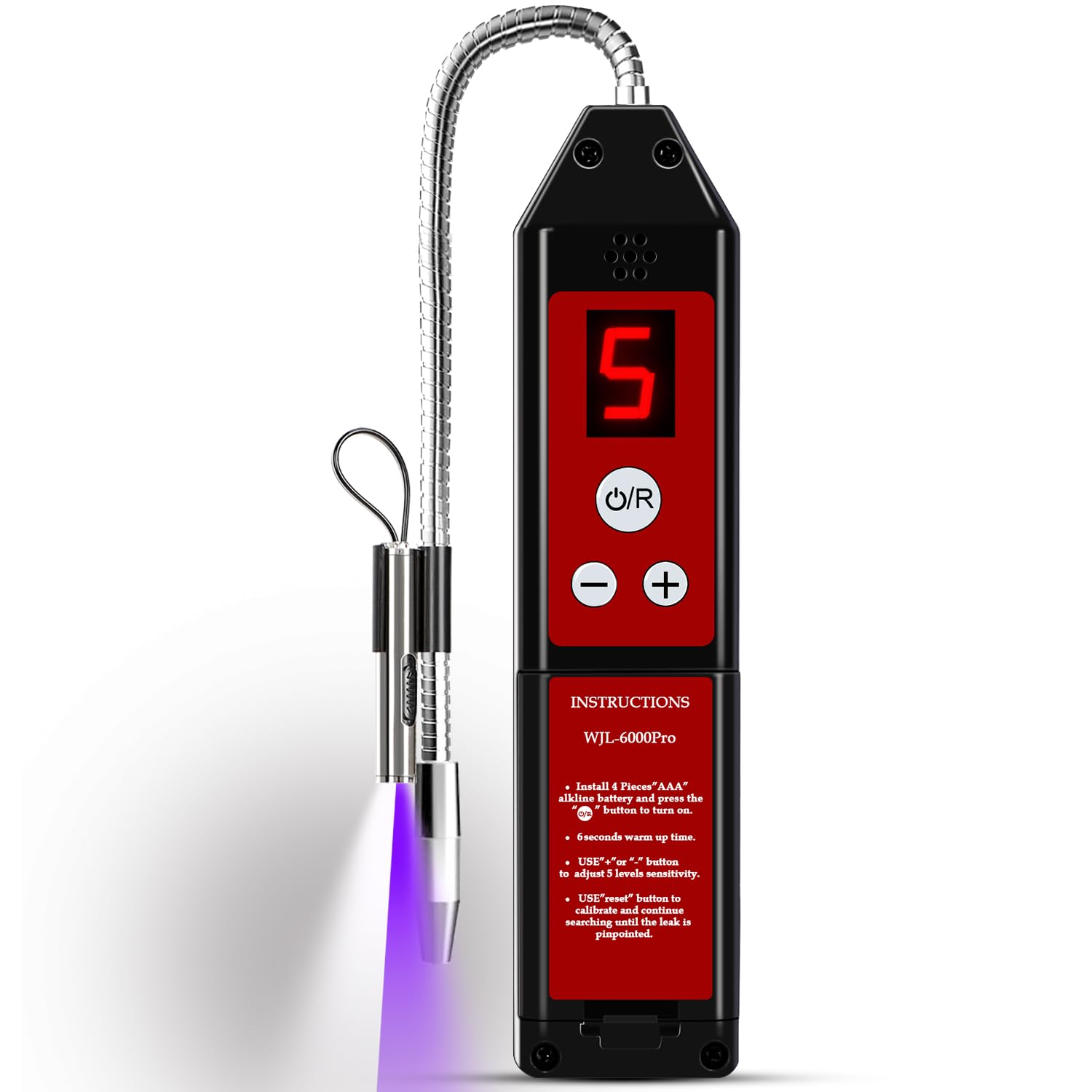
The entry-level sniffer that stops you from spending shop rates on a simple AC check.
At a sensitivity of 0.14 oz/yr, the WJL-6000PRO matches the standard spec of many pricier detectors at a fraction of the cost. It is designed specifically for DIYers and car enthusiasts who want to troubleshoot warm air issues without paying a shop hundreds of dollars. The 7.9-inch flexible sensing tip bends to reach hidden pipes and valves, and the built-in LCD (liquid crystal display) screen shows both the current sensitivity setting and the gas leakage level — a big improvement over older sniffers that only beeped.
The two-color LED (light-emitting diode) light and UV lamp help you see in dark garages and also work with fluorescent dye for double verification. One buyer mentioned that once they let the wind die down (to avoid false triggers from moving air), the tool found their car’s AC leak quickly. The main limitation is the lack of a rechargeable battery — it is battery powered with no USB-C charging, so you will need to keep spares handy. Also, the sensitivity is not adjustable in fine increments the way the Elitech CPU-1G’s 7 levels are.
For territory, this is a low-risk entry point. It covers all common refrigerants including R134a, R22, R410A, and even R1234yf, so you are not locked into one gas type.
Why it is a smart buy
- Standard 0.14 oz/yr sensitivity at a budget price
- LCD screen shows leak level and sensitivity setting
- Built-in UV and LED lights for dark work areas
- Detects all common refrigerants including R1234yf
Where it cuts corners
- Battery powered — no rechargeable battery or USB-C
- Sensitivity is not as finely adjustable as mid-range competitors
Pick this if: You are a weekend DIYer who wants a functional AC sniffer without spending more than a tank of gas.
Upgrade if: You work on cars daily and need the finer 0.11 oz/yr sensitivity or a longer probe for deep engine bay access.
Understanding the Specs
Sensitivity (oz/yr)
Sensitivity tells you the smallest leak the sniffer can reliably detect, measured in ounces per year. A rating of 0.14 oz/yr is the baseline for most consumer and prosumer detectors — it catches typical AC system leaks that cause warm air. A finer 0.11 oz/yr rating means the tool can sniff out slower, more subtle seeps that might escape a standard detector, but it also tends to trigger more false positives in environments with residual refrigerant in the air. You do not always want the highest sensitivity; if you work around contaminated shop air, a medium sensitivity may actually be more useful.
Detection Technology
Electronic sniffers use one of three sensor types. Corona sensors (like in the Elitech CPU-1G) are the most affordable but can false-alarm on non-leak surfaces. Heated diode sensors (like in the Simbow ALD-200PRO) offer better stability and support newer A2L refrigerants. Infrared sensors (like in the Elitech ILD-200) are the most immune to contaminants and claim longer sensor life, but they cost more and require periodic filter changes and warm-up in clean air. Smoke machines and UV dye kits use completely different detection principles and are better suited for non-refrigerant leak types.
FAQ
Can I use a refrigerant sniffer to find EVAP leaks?
What is the difference between 0.14 oz/yr and 0.11 oz/yr sensitivity?
Do I need a smoke machine or a sniffer for my car’s AC?
How long does a heated diode sensor last?
Can UV dye damage my AC system?
What does EVAP mode on a smoke machine do?
Can I use a refrigerant detector for natural gas or propane?
Why does my sniffer beep everywhere even when there is no leak?
How do I know if my smoke machine fluid is safe for my car’s oxygen sensors?
Does a longer probe always mean better access?
Final Thoughts: The Verdict
Across the board, the auto ac leak detection kit winner is the AutoLine Pro HyperSmoke because it turns invisible vacuum and EVAP leaks into visible white smoke, saving hours of guesswork. If you want the highest refrigerant sensitivity at 0.11 oz/yr for catching the slowest seeps, grab the Elitech CPU-1G. And for a budget-friendly sniffer that handles all common refrigerants and includes a UV light, the WJL-6000PRO is tough to top.
How We Picked
We do not accept paid placement. Every pick is matched to a real buyer and a real use-case; we do not hands-on test units.
Sources & Methodology
Specifications: manufacturer listings and product documentation. Review insights: verified customer reviews, as of July 2026. Pricing: not shown on this page (it changes often); check the current price via the retailer link.
As an Amazon Associate, Trending Car earns from qualifying purchases. This does not affect which products we feature.